COPD
REFERENCES:
Harrison’s Principles of Internal Medicine, 18th ed
American Thoracic Society, European Respiratory Society
Jocelyn T. Cordero, M.D.
Objectives
1. Definition
2. Epidemiology
3. Risk factors
4. Pathophysiology
5. Pathology: Large vs. small airways
6. Clinical Manifestations
7. Work ups
8. Diagnosis
9. Treatment
Definition
GOLD (Global Initiative for Chronic Obstructive
Lung Disease)
• Disease state characterized by airflow
obstruction
• Not fully reversible
• Progressive
• Abnormal inflammatory response
Epidemiology
• Male>female
• Lower socioeconomic status
• History of low birth weight
• Prevalence peak: 70-80 years old
Risk Factors
1. Cigarette smoking
2. Airway responsiveness
3. Respiratory infections
4. Occupational exposures
5. Ambient air pollution
6. Passive or second-hand smoking
7. Genetic
Risk Factors – Cigarette smoking
• Major risk factor
• Accelerated decline in FEV1
• Variable response
• Environmental
• Genetic factors
Risk Factors-Airway
responsiveness
• Dutch hypothesis: asthma, emphysema, chronic
bronchitis are variations of the same disease
• Modulated by environmental and genetic factors
• British hypothesis: asthma and COPD are
fundamentally different diseases
• Asthma: allergic phenomenon
• COPD: smoking-related inflammation and damage
• Airway hyperresponsiveness (AHR): risk factor
Risk Factors-Respiratory infections
• Trigger factor for acute exacerbation
Risk Factors-Occupational
exposures
• Dust: role?
Risk Factors -Ambient Air Pollution
• Unproven relationship?
Risk Factors – Passive smoking
• Reduced lung growth (children exposed to
maternal smoking)
• Reduced postnatal pulmonary function (in utero
exposure)
Risk Factors - Genetic
oSevere α1 antitrypsin deficiency
Natural History
Effects of smoking
1. Intensity of smoking exposure
2. Timing of smoking exposure during growth
3. Baseline lung function
Natural History
• Stop smoking before the development of marked
reductions in pulmonary function
Pathophysiology
• Most typical finding:
• Persistent reduction in forced expiratory flow
rates
• Other findings
• RV
• RV/TLC ratio
• Non uniform distribution of ventilation
• VQ mismatch
Pathophysiology – Airflow
obstruction
• FEV1/FVC
• Minimal reponse to bronchodilators (compared
to asthma)
• Max inspiratory flow inspite of markedly reduced
FEV1
• Early stages: abnormality in airflow is evident
only at or below FRC
Pathophysiology
• Hyperinflation
• Compensation for airway obstruction
• Late in the disease: air trapping
• RV and RV/TLC ratio
• TLC (progressive hyperinflation)
• Adverse effects
• due to flattening of the diaphragm
• Hinders rib cage movement and impairs
inspiration
Pathophysiology
• Gas exchange
• Near normal PaO2 until FEV1 ~ 50% of predicted
• For patients with marked reduction of FEV1<25%, with chronic
hypoxemia PaO2<55 mgHg
• Pulmonary hpn leading to cor pulmonale and rv failure
• Characteristic: non-uniform ventilation and VQ
mismatching
• VQ mismatch: accounts for reduction in PaO2
with minimal shunting
Pathology
• Cigarette smoke: large, small airways, alveolar
space
• Large airways: cough and sputum production
• Small airways: physiologic changes
Pathology
Large airways
• Enlarged mucous glands
• Goblet cell hyperplasia
• Squamous metaplasia
(bronchi): predisposition to
carcinogenesis, disrupts
mucociliary clearance
• Smooth muscle hypertrophy,
bronchial hyperreactivity:
airflow limitation
• Neutrophil influx: purulent
sputum production
Small airways
• MAJOR site of increased
resistance
• Airway narrowing results from
excess mucus, edema, cellular
infiltration
• Reduced surfactant:
increased surface tension
• Smooth muscle hypertrophy
• Wall fibrosis: airway
narrowing, hyperreactivity
• Airway distortion due to loss
of bronchiolar attachments
Pathophysiology
• Lung parenchyma
• Destruction of gas-exchanging airspaces
(respiratory bronchioles, alveolar ducts and
alveoli)
• Accumulation of macrophages
• Smokers’ lavage fluid: >95% macrophages, 1-
2% neutrophils
• T-lymphocytes (CD8)
Pathology -Emphysema
changes
Centriacinar (more frequent with
cigarette smoking):
• enlarged airspaces, most
prominent in upper lobes and
superior segments of the
lower lobes; smokers, coal
workers
Panacinar
• Abnormally large airspaces
evenly distributed within and
across acinar units in patients
with α1AT deficiency
• Predilection for lower lobes
Pathology
• Smoking-related emphysema: MIXED
Pathogenesis
• AIRFLOW LIMITATION: major physiologic change
• Fibrosis, collagen accumulation
Pathogenesis
• Four interrelated events
1. Chronic exposure to cigarette smoke may lead to
inflammatory cell recruitment within the terminal
airspaces of the lung
2. Release elastolytic proteinases (inflammatory cells)
3. Loss of matrix-cell attachment leads to apoptosis of
structural cells of the lung
4. Ineffective repair of elastin and perhaps other
extracellular matrix components result in airspace
enlargement that defines pulmonary emphysema
Pathogenesis - Inflammation
Cigarette
smoke
Alveolar macrophages
release of
cytokines/chemokines
• neutrophil recruitment
•Accumulation of macrophages
(BRONCHIOLES)
•Release of other inflammatory
substances
loss of cilia
Pathogenesis – Extracellular matrix
proteolysis
• Degradation of extracellular matrix protein sec.
to release of neutrophilic enzymes
• Release of proteinases by macrophages
Net effect: increase in collagen
deposition (airway submucosa)
Pathogenesis – Cell death
• Airspace enlargement
• Loss of alveolar units
Pathogenesis – Ineffective
repair
• Limited ability to repair damaged alveoli
Clinical Manifestations
• 3 most common symptoms in COPD
1. Cough
2. Exertional dyspnea
3. Sputum production
Clinical Manifestations
• Early stages: normal PE
• Late stages:
• Prolonged expiratory phase, expiratory wheezing
• Barrel chest, enlarged lung volumes with poor
diaphragmatic excursion
• use of accessory muscles of respiration, "tripod"
position
• Cyanosis
• Muscle wasting: independent poor prognostic factor
• Hoover’s sign
• Signs of right heart failure
• Elevated JVP
• RV heave or S3
• Hepatic congestion
• Ascites
• Peripheral edema
• Clubbing?
Laboratory Findings
• Spirometry: gold standard
• Airflow obstruction (hallmark)
• PFT: FEV1 and FEV1/FVC (<70%)
• Postbronchodilator: FEV1<80% predicted
• Worsening disease: lung volumes TLC,
FRC RV
• Emphysema: decreased diffusing capacity
Laboratory Findings
• ABG/oximetry: exertional hypoxemia
• Measures arterial PCO2 and pH
• Ventilatory failure PCO2 > 45 mmHg
• pH: acute vs. chronic
• Increased Hct chronic
• RVH hypoxemia
Laboratory Findings
• Radiographic
• Emphysema: bullae, paucity of parenchymal
markings, or hyperlucency
• Computed tomography (CT) scan is the current
definitive test for establishing the presence or
absence of emphysema in living subjects
• Serum α1 AT level
Table 254-1 Gold Criteria for
COPD Severity
Gold stage Severity Symptoms Spirometry
0 At risk Chronic cough, sputum
production
normal
I mild With or without chronic
cough or sputum
production
FEV1/FVC <0.7
and FEV1 80%
predicted
IIA moderate With or without chronic
cough or sputum
production
FEV1/FVC <0.7
and 50% FEV1
<80% predicted
Stage Severity Symptoms Spirometry
III severe With or without
chronic cough or
sputum
production
FEV1/FVC <0.7
and 30% FEV1
<50% predicted
IV Very severe With or without
chronic cough or
sputum
production
FEV1/FVC <0.7
and FEV1 <30%
predicted
or
FEV1 <50%
predicted with
respiratory failure
or signs of right
heart failure
DIAGNOSIS
Emphysema
• Anatomic/histologic
diagnosis
• Permanent/destructive
enlargement of air spaces
distal to the terminal
bronchioles
• No obvious fibrosis
• Loss of normal
architecture
Bronchitis
• Clinical diagnosis
• Presence of productive
cough in most days for at
least 3 months over 2
consecutive years
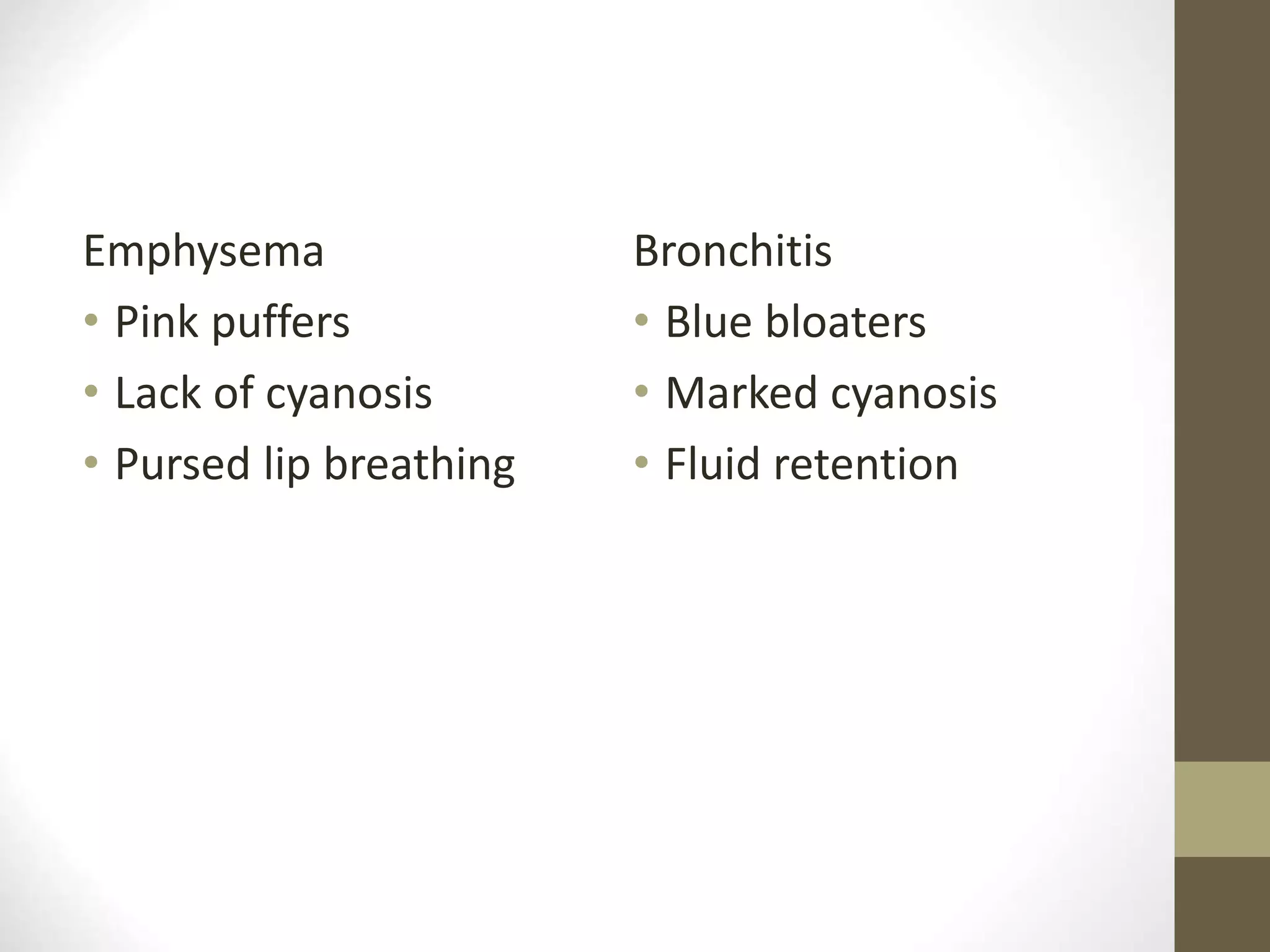
Emphysema
• Pink puffers
• Lack of cyanosis
• Pursed lip breathing
Bronchitis
• Blue bloaters
• Marked cyanosis
• Fluid retention
AmericanThoracicSociety/EuropeanRespiratorySociety
statement:standardsforthediagnosisandmanagementof
individualswithalpha-1antitrypsindeficiency.AmJRespirCritCare
Med.Oct12003;168(7):818-900
Emphysema
1. A long history of
progressive dyspnea
with late onset of
nonproductive
cough
2. Occasional
mucopurulent
relapses
3. Eventual cachexia
and respiratory
failure
Chronic bronchitis
1. Productive cough, with
progression over time
to intermittent
dyspnea
2. Frequent and recurrent
pulmonary infections
3. Progressive
cardiac/respiratory
failure over time, with
edema and weight gain
Treatment
GOLD components of disease management
1. Assess and monitor disease
2. Reduce risk factor
3. Manage stable COPD
4. Manage exacerbations
GOALS of Therapy
1. Prevent disease progression
2. Relieve symptoms
3. Improve exercise tolerance
4. Improve health status
5. Prevent and treat complications
• Stable COPD
• Stop smoking: decrease rate of decline in
pulmonary function
• Medications: Bupropion, nicotine replacement
therapy
Pharmacotherapy
• Bronchodilators: symptomatic relief
• Anticholinergics:
• Tiotropium, a long-acting anticholinergic, has
been shown to improve symptoms and reduce
exacerbations
• Minor side effects
Pharmacotherapy
• Beta agonists:
• tremor and tachycardia
• Long-acting inhaled agonists, such as
salmeterol, have benefits comparable to
ipratopium bromide
• more convenient use than short-acting
agents
Pharmacotherapy
• Inhaled glucocorticoids
• reduce exacerbation frequency by ~25%
• reduce mortality?
• For frequent exacerbations, defined as 2 or
more per year, and in patients who
demonstrate a significant amount of acute
reversibility in response to inhaled
bronchodilators
• Side effects: candidiasis, decreased bone
density
Pharmacotherapy
• Systemic steroids
• not recommended
• Theophylline
• produces modest improvements in expiratory
flow rates and vital capacity
• slight improvement in arterial oxygen and
carbon dioxide levels in patients with moderate
to severe COPD
• side effects: nausea, tachycardia and tremor
• Oxygen
• decrease mortality in patients with COPD
• resting hypoxemia (resting O2 saturation <88%
or <90% with signs of pulmonary hpn or right
heart failure
• Supplemental O2 is commonly prescribed for
patients with exertional hypoxemia or
nocturnal hypoxemia
Nonpharmacologic
• General Medical Care
• Annual influenza vaccine
• Polyvalent pneumococcal vaccine
• Pulmonary Rehabilitation
• Lung Volume Reduction Surgery (LVRS):
emphysema
• Exclusion: significant pleural disease, a pulmonary
artery systolic pressure >45 mmHg, extreme
deconditioning, congestive heart failure, or other
severe comorbid conditions
• Who may benefit? upper lobe–predominant
emphysema and a low postrehabilitation
exercise capacity
• Lung transplantation
• candidates should be <65 years; have severe
disability despite maximal medical therapy; and
be free of comorbid conditions such as liver,
renal, or cardiac disease
Acute exacerbations
• Exacerbation frequency correlates to the quality
of life
• Definition: episodes of increased dyspnea and
cough, change in the amount of sputum
• Precipitating causes
• Bacteria>viral
• No cause
• Chronic oral steroids: no benefit
• ICS: reduce frequency of exacerbation
• Patient assessment
• Need for hospitalization?
• Degree of activity-related dyspnea
• Fever, change in character of sputum, contacts
• Nausea, vomiting, chills, myalgias
• Frequency and severity of prior exacerbations
• PE: assess degree of distress
• CXR: Pneumonia and CHF (most frequent
findings)
• ABG
• Hypercarbia PCO2>45 mmHg
• PFT: not useful
• Need for hospitalization
• Hypercarbia with respiratory acidosis
• Significant hypoxemia
• Severe underlying disease
• Not so ideal living situation
• Bronchodilators
• Antibiotics
• Strep pnumoniae, H. influenxae, Moraxella
catarrhalis, Mycoplasma pneumoniae,
Chlamydia pneumoniae
• Glucocorticoids
• 2 weeks OCS
• 30-40 mg prednisolone for 10-14 days
• Oxygen
• Arterial saturation > 90%
• Mechanical ventilator
• NIPPV: reduces need for intubation
• CI: cadiovascular instability, impaired mental
status, copious secretions, burns, craniofacial
abnormalities, extreme obesity
• Invasive mechanical ventilation
• Severe respiratory distress, life threatening
hypoxemia, severe hypercapnia/acidocis,
markedly impaired mental status, respiratory
arrest, hemodynamic instability
• Mortality rate for patients requiring MV: 17 to
30%

copd 2012.ppt

  • 1.
    COPD REFERENCES: Harrison’s Principles ofInternal Medicine, 18th ed American Thoracic Society, European Respiratory Society Jocelyn T. Cordero, M.D.
  • 2.
    Objectives 1. Definition 2. Epidemiology 3.Risk factors 4. Pathophysiology 5. Pathology: Large vs. small airways 6. Clinical Manifestations 7. Work ups 8. Diagnosis 9. Treatment
  • 3.
    Definition GOLD (Global Initiativefor Chronic Obstructive Lung Disease) • Disease state characterized by airflow obstruction • Not fully reversible • Progressive • Abnormal inflammatory response
  • 4.
    Epidemiology • Male>female • Lowersocioeconomic status • History of low birth weight • Prevalence peak: 70-80 years old
  • 5.
    Risk Factors 1. Cigarettesmoking 2. Airway responsiveness 3. Respiratory infections 4. Occupational exposures 5. Ambient air pollution 6. Passive or second-hand smoking 7. Genetic
  • 6.
    Risk Factors –Cigarette smoking • Major risk factor • Accelerated decline in FEV1 • Variable response • Environmental • Genetic factors
  • 7.
    Risk Factors-Airway responsiveness • Dutchhypothesis: asthma, emphysema, chronic bronchitis are variations of the same disease • Modulated by environmental and genetic factors • British hypothesis: asthma and COPD are fundamentally different diseases • Asthma: allergic phenomenon • COPD: smoking-related inflammation and damage • Airway hyperresponsiveness (AHR): risk factor
  • 8.
    Risk Factors-Respiratory infections •Trigger factor for acute exacerbation
  • 9.
  • 10.
    Risk Factors -AmbientAir Pollution • Unproven relationship?
  • 11.
    Risk Factors –Passive smoking • Reduced lung growth (children exposed to maternal smoking) • Reduced postnatal pulmonary function (in utero exposure)
  • 12.
    Risk Factors -Genetic oSevere α1 antitrypsin deficiency
  • 13.
    Natural History Effects ofsmoking 1. Intensity of smoking exposure 2. Timing of smoking exposure during growth 3. Baseline lung function
  • 14.
    Natural History • Stopsmoking before the development of marked reductions in pulmonary function
  • 15.
    Pathophysiology • Most typicalfinding: • Persistent reduction in forced expiratory flow rates • Other findings • RV • RV/TLC ratio • Non uniform distribution of ventilation • VQ mismatch
  • 16.
    Pathophysiology – Airflow obstruction •FEV1/FVC • Minimal reponse to bronchodilators (compared to asthma) • Max inspiratory flow inspite of markedly reduced FEV1 • Early stages: abnormality in airflow is evident only at or below FRC
  • 17.
    Pathophysiology • Hyperinflation • Compensationfor airway obstruction • Late in the disease: air trapping • RV and RV/TLC ratio • TLC (progressive hyperinflation) • Adverse effects • due to flattening of the diaphragm • Hinders rib cage movement and impairs inspiration
  • 18.
    Pathophysiology • Gas exchange •Near normal PaO2 until FEV1 ~ 50% of predicted • For patients with marked reduction of FEV1<25%, with chronic hypoxemia PaO2<55 mgHg • Pulmonary hpn leading to cor pulmonale and rv failure • Characteristic: non-uniform ventilation and VQ mismatching • VQ mismatch: accounts for reduction in PaO2 with minimal shunting
  • 19.
    Pathology • Cigarette smoke:large, small airways, alveolar space • Large airways: cough and sputum production • Small airways: physiologic changes
  • 20.
    Pathology Large airways • Enlargedmucous glands • Goblet cell hyperplasia • Squamous metaplasia (bronchi): predisposition to carcinogenesis, disrupts mucociliary clearance • Smooth muscle hypertrophy, bronchial hyperreactivity: airflow limitation • Neutrophil influx: purulent sputum production Small airways • MAJOR site of increased resistance • Airway narrowing results from excess mucus, edema, cellular infiltration • Reduced surfactant: increased surface tension • Smooth muscle hypertrophy • Wall fibrosis: airway narrowing, hyperreactivity • Airway distortion due to loss of bronchiolar attachments
  • 21.
    Pathophysiology • Lung parenchyma •Destruction of gas-exchanging airspaces (respiratory bronchioles, alveolar ducts and alveoli) • Accumulation of macrophages • Smokers’ lavage fluid: >95% macrophages, 1- 2% neutrophils • T-lymphocytes (CD8)
  • 22.
    Pathology -Emphysema changes Centriacinar (morefrequent with cigarette smoking): • enlarged airspaces, most prominent in upper lobes and superior segments of the lower lobes; smokers, coal workers Panacinar • Abnormally large airspaces evenly distributed within and across acinar units in patients with α1AT deficiency • Predilection for lower lobes
  • 23.
  • 24.
    Pathogenesis • AIRFLOW LIMITATION:major physiologic change • Fibrosis, collagen accumulation
  • 25.
    Pathogenesis • Four interrelatedevents 1. Chronic exposure to cigarette smoke may lead to inflammatory cell recruitment within the terminal airspaces of the lung 2. Release elastolytic proteinases (inflammatory cells) 3. Loss of matrix-cell attachment leads to apoptosis of structural cells of the lung 4. Ineffective repair of elastin and perhaps other extracellular matrix components result in airspace enlargement that defines pulmonary emphysema
  • 26.
    Pathogenesis - Inflammation Cigarette smoke Alveolarmacrophages release of cytokines/chemokines • neutrophil recruitment •Accumulation of macrophages (BRONCHIOLES) •Release of other inflammatory substances loss of cilia
  • 27.
    Pathogenesis – Extracellularmatrix proteolysis • Degradation of extracellular matrix protein sec. to release of neutrophilic enzymes • Release of proteinases by macrophages Net effect: increase in collagen deposition (airway submucosa)
  • 28.
    Pathogenesis – Celldeath • Airspace enlargement • Loss of alveolar units
  • 29.
    Pathogenesis – Ineffective repair •Limited ability to repair damaged alveoli
  • 30.
    Clinical Manifestations • 3most common symptoms in COPD 1. Cough 2. Exertional dyspnea 3. Sputum production
  • 31.
    Clinical Manifestations • Earlystages: normal PE • Late stages: • Prolonged expiratory phase, expiratory wheezing • Barrel chest, enlarged lung volumes with poor diaphragmatic excursion • use of accessory muscles of respiration, "tripod" position • Cyanosis • Muscle wasting: independent poor prognostic factor
  • 32.
    • Hoover’s sign •Signs of right heart failure • Elevated JVP • RV heave or S3 • Hepatic congestion • Ascites • Peripheral edema • Clubbing?
  • 33.
    Laboratory Findings • Spirometry:gold standard • Airflow obstruction (hallmark) • PFT: FEV1 and FEV1/FVC (<70%) • Postbronchodilator: FEV1<80% predicted • Worsening disease: lung volumes TLC, FRC RV • Emphysema: decreased diffusing capacity
  • 34.
    Laboratory Findings • ABG/oximetry:exertional hypoxemia • Measures arterial PCO2 and pH • Ventilatory failure PCO2 > 45 mmHg • pH: acute vs. chronic • Increased Hct chronic • RVH hypoxemia
  • 35.
    Laboratory Findings • Radiographic •Emphysema: bullae, paucity of parenchymal markings, or hyperlucency • Computed tomography (CT) scan is the current definitive test for establishing the presence or absence of emphysema in living subjects • Serum α1 AT level
  • 36.
    Table 254-1 GoldCriteria for COPD Severity Gold stage Severity Symptoms Spirometry 0 At risk Chronic cough, sputum production normal I mild With or without chronic cough or sputum production FEV1/FVC <0.7 and FEV1 80% predicted IIA moderate With or without chronic cough or sputum production FEV1/FVC <0.7 and 50% FEV1 <80% predicted
  • 37.
    Stage Severity SymptomsSpirometry III severe With or without chronic cough or sputum production FEV1/FVC <0.7 and 30% FEV1 <50% predicted IV Very severe With or without chronic cough or sputum production FEV1/FVC <0.7 and FEV1 <30% predicted or FEV1 <50% predicted with respiratory failure or signs of right heart failure
  • 38.
    DIAGNOSIS Emphysema • Anatomic/histologic diagnosis • Permanent/destructive enlargementof air spaces distal to the terminal bronchioles • No obvious fibrosis • Loss of normal architecture Bronchitis • Clinical diagnosis • Presence of productive cough in most days for at least 3 months over 2 consecutive years
  • 39.
    Emphysema • Pink puffers •Lack of cyanosis • Pursed lip breathing Bronchitis • Blue bloaters • Marked cyanosis • Fluid retention
  • 40.
    AmericanThoracicSociety/EuropeanRespiratorySociety statement:standardsforthediagnosisandmanagementof individualswithalpha-1antitrypsindeficiency.AmJRespirCritCare Med.Oct12003;168(7):818-900 Emphysema 1. A longhistory of progressive dyspnea with late onset of nonproductive cough 2. Occasional mucopurulent relapses 3. Eventual cachexia and respiratory failure Chronic bronchitis 1. Productive cough, with progression over time to intermittent dyspnea 2. Frequent and recurrent pulmonary infections 3. Progressive cardiac/respiratory failure over time, with edema and weight gain
  • 41.
    Treatment GOLD components ofdisease management 1. Assess and monitor disease 2. Reduce risk factor 3. Manage stable COPD 4. Manage exacerbations
  • 42.
    GOALS of Therapy 1.Prevent disease progression 2. Relieve symptoms 3. Improve exercise tolerance 4. Improve health status 5. Prevent and treat complications
  • 43.
    • Stable COPD •Stop smoking: decrease rate of decline in pulmonary function • Medications: Bupropion, nicotine replacement therapy
  • 44.
    Pharmacotherapy • Bronchodilators: symptomaticrelief • Anticholinergics: • Tiotropium, a long-acting anticholinergic, has been shown to improve symptoms and reduce exacerbations • Minor side effects
  • 45.
    Pharmacotherapy • Beta agonists: •tremor and tachycardia • Long-acting inhaled agonists, such as salmeterol, have benefits comparable to ipratopium bromide • more convenient use than short-acting agents
  • 46.
    Pharmacotherapy • Inhaled glucocorticoids •reduce exacerbation frequency by ~25% • reduce mortality? • For frequent exacerbations, defined as 2 or more per year, and in patients who demonstrate a significant amount of acute reversibility in response to inhaled bronchodilators • Side effects: candidiasis, decreased bone density
  • 47.
    Pharmacotherapy • Systemic steroids •not recommended • Theophylline • produces modest improvements in expiratory flow rates and vital capacity • slight improvement in arterial oxygen and carbon dioxide levels in patients with moderate to severe COPD • side effects: nausea, tachycardia and tremor
  • 48.
    • Oxygen • decreasemortality in patients with COPD • resting hypoxemia (resting O2 saturation <88% or <90% with signs of pulmonary hpn or right heart failure • Supplemental O2 is commonly prescribed for patients with exertional hypoxemia or nocturnal hypoxemia
  • 49.
    Nonpharmacologic • General MedicalCare • Annual influenza vaccine • Polyvalent pneumococcal vaccine • Pulmonary Rehabilitation
  • 50.
    • Lung VolumeReduction Surgery (LVRS): emphysema • Exclusion: significant pleural disease, a pulmonary artery systolic pressure >45 mmHg, extreme deconditioning, congestive heart failure, or other severe comorbid conditions • Who may benefit? upper lobe–predominant emphysema and a low postrehabilitation exercise capacity
  • 51.
    • Lung transplantation •candidates should be <65 years; have severe disability despite maximal medical therapy; and be free of comorbid conditions such as liver, renal, or cardiac disease
  • 52.
    Acute exacerbations • Exacerbationfrequency correlates to the quality of life • Definition: episodes of increased dyspnea and cough, change in the amount of sputum • Precipitating causes • Bacteria>viral • No cause • Chronic oral steroids: no benefit • ICS: reduce frequency of exacerbation
  • 53.
    • Patient assessment •Need for hospitalization? • Degree of activity-related dyspnea • Fever, change in character of sputum, contacts • Nausea, vomiting, chills, myalgias • Frequency and severity of prior exacerbations • PE: assess degree of distress • CXR: Pneumonia and CHF (most frequent findings)
  • 54.
    • ABG • HypercarbiaPCO2>45 mmHg • PFT: not useful • Need for hospitalization • Hypercarbia with respiratory acidosis • Significant hypoxemia • Severe underlying disease • Not so ideal living situation
  • 55.
    • Bronchodilators • Antibiotics •Strep pnumoniae, H. influenxae, Moraxella catarrhalis, Mycoplasma pneumoniae, Chlamydia pneumoniae • Glucocorticoids • 2 weeks OCS • 30-40 mg prednisolone for 10-14 days
  • 56.
    • Oxygen • Arterialsaturation > 90%
  • 57.
    • Mechanical ventilator •NIPPV: reduces need for intubation • CI: cadiovascular instability, impaired mental status, copious secretions, burns, craniofacial abnormalities, extreme obesity • Invasive mechanical ventilation • Severe respiratory distress, life threatening hypoxemia, severe hypercapnia/acidocis, markedly impaired mental status, respiratory arrest, hemodynamic instability
  • 58.
    • Mortality ratefor patients requiring MV: 17 to 30%