Morten’s Flate Paulsen Cooperative freedom theory A simple approach
Morten Flate Paulsen,  Professor of Online Education, Director of Development The NKI Internet College, NKI Distance Education, Norway
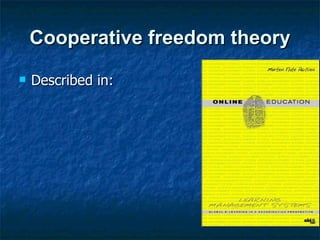
Cooperative freedom theory Described in:
The theory It claims that adult students often seek individual flexibility and freedom; Sometimes they prefer, group collaboration and social unity;
Can be classified as a theory of autonomy and independence;   It is influenced by Knowles's (1970) theory of andragogy; The theory of cooperative freedom perceives both adult and juvenile distance learners as motivated, self-directing students with a desire to control their learning outcomes.
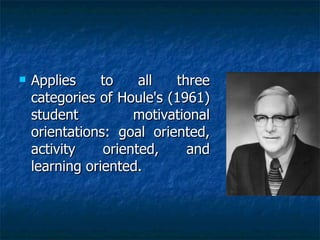
Applies to all three categories of Houle's (1961) student motivational orientations: goal oriented, activity oriented, and learning oriented.
It suggests that, independent of motivational orientation, distance students need cooperation as well as freedom
Cooperation . Houle (1984) states that education is a cooperative rather than an operative art. Even solitary students guiding their own programs without the help of an instructor seek help and encouragement from others.  In a social setting, those who take part in an educational activity should have some sense of collaboration in both planning and implementation.
Freedom It professes that students should have a high level of freedom to choose rather than be restrained by a rigid distance education program.  It states that freedom is crucial in distance education.  Today's students, need flexible education: education that allows them to combine job, family, and education in a manageable way.
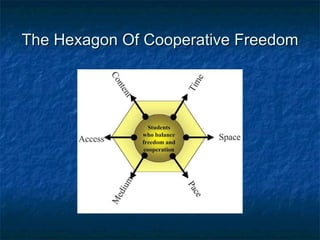
The Hexagon Of Cooperative Freedom
Freedom of  Time A student can choose the study hour - after work, weekend’s, using synchronous our asynchronous systems Freedom of Space The student can study where ever we wants.
Freedom  of Content Autonomy and independence. Freedom of  Medium Each distance learning generation uses last generation medium. By this way you have more learning styles and you can reach more students assumes dead line agreements flexibility.
Freedom of Pace It implies meeting deadlines for starting a course, for examinations, and for assignments.  Deadlines, however, can be flexible or rigid. Freedom of Access This point is related to the terms “open learning” and “open education.”
Conclusion Future adult students will seek individual flexibility and freedom. At the same time, many need or prefer group collaboration and social unity. These aims are difficult to combine, but online education, when integrated with other media, can be the means of joining individual freedom and collective unity into truly flexible, cooperative distance education.  in ( NKI Forlaget 2003,  Online Education and Learning Management Systems  by Morten Flate Paulsen)
References NKI Forlaget 2003,  Online Education and Learning Management Systems  by Morten Flate Paulsen Q & A with Ed Tech Leaders “interview with Morten Paulsen – Educational Technology/july-august 2007;

Cooperative Freedom Simple Approach

  • 1.
    Morten’s Flate PaulsenCooperative freedom theory A simple approach
  • 2.
    Morten Flate Paulsen, Professor of Online Education, Director of Development The NKI Internet College, NKI Distance Education, Norway
  • 3.
  • 4.
    The theory Itclaims that adult students often seek individual flexibility and freedom; Sometimes they prefer, group collaboration and social unity;
  • 5.
    Can be classifiedas a theory of autonomy and independence; It is influenced by Knowles's (1970) theory of andragogy; The theory of cooperative freedom perceives both adult and juvenile distance learners as motivated, self-directing students with a desire to control their learning outcomes.
  • 6.
    Applies to allthree categories of Houle's (1961) student motivational orientations: goal oriented, activity oriented, and learning oriented.
  • 7.
    It suggests that,independent of motivational orientation, distance students need cooperation as well as freedom
  • 8.
    Cooperation . Houle(1984) states that education is a cooperative rather than an operative art. Even solitary students guiding their own programs without the help of an instructor seek help and encouragement from others. In a social setting, those who take part in an educational activity should have some sense of collaboration in both planning and implementation.
  • 9.
    Freedom It professesthat students should have a high level of freedom to choose rather than be restrained by a rigid distance education program. It states that freedom is crucial in distance education. Today's students, need flexible education: education that allows them to combine job, family, and education in a manageable way.
  • 10.
    The Hexagon OfCooperative Freedom
  • 11.
    Freedom of Time A student can choose the study hour - after work, weekend’s, using synchronous our asynchronous systems Freedom of Space The student can study where ever we wants.
  • 12.
    Freedom ofContent Autonomy and independence. Freedom of Medium Each distance learning generation uses last generation medium. By this way you have more learning styles and you can reach more students assumes dead line agreements flexibility.
  • 13.
    Freedom of PaceIt implies meeting deadlines for starting a course, for examinations, and for assignments. Deadlines, however, can be flexible or rigid. Freedom of Access This point is related to the terms “open learning” and “open education.”
  • 14.
    Conclusion Future adultstudents will seek individual flexibility and freedom. At the same time, many need or prefer group collaboration and social unity. These aims are difficult to combine, but online education, when integrated with other media, can be the means of joining individual freedom and collective unity into truly flexible, cooperative distance education. in ( NKI Forlaget 2003, Online Education and Learning Management Systems by Morten Flate Paulsen)
  • 15.
    References NKI Forlaget2003, Online Education and Learning Management Systems by Morten Flate Paulsen Q & A with Ed Tech Leaders “interview with Morten Paulsen – Educational Technology/july-august 2007;