Polytechnic University of the
Philippines
M.H. Del Pilar Campus Sta. Mesa Manila

Graduate School

Report on DEM
History of Cooperative
Development of the
Philippines
By:
 Mr. Nereus V. Malinis
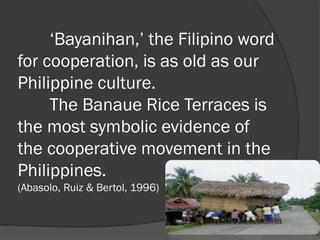
‘Bayanihan,’ the Filipino word
for cooperation, is as old as our
Philippine culture.
The Banaue Rice Terraces is
the most symbolic evidence of
the cooperative movement in the
Philippines.
(Abasolo, Ruiz & Bertol, 1996)
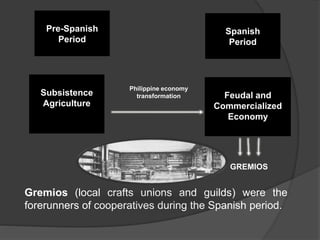
Pre-Spanish
Period

Subsistence
Agriculture

Spanish
Period

Philippine economy
transformation

Feudal and
Commercialized
Economy

GREMIOS

Gremios (local crafts unions and guilds) were the
forerunners of cooperatives during the Spanish period.
1ST STAGE OF COOPERATIVE
PHILIPPINES (1895-1941)

MOVEMENT

IN

THE

Highlights:
1.1 Pre-Formation Period – Spanish Period
-- Revolutionary illustrados like Jose Rizal, Emilio
Jacinto and Isabelo delos Reyes recognized
cooperatives as instruments for social justice and
economic development.
-- “The initial germ of cooperativism during the
Spanish colonial periods failed to take root due to
the intense revolutionary struggles of the Filipinos
against the Spaniards.”
(Muñoz & Battulayan, 1989)
Highlights:
1.2 Formation Period – The American Colonial Period
-- Raiffeisen-type of rural agricultural cooperatives
implanted
-- In 1906, the Corporation Law (PA No. 1459) passed –
legal framework for all private organizations
-- In 1907, the Sandiko Bill disapproved – first attempt for
state assistance to rural cooperatives via legislation
-- In 1915, the Rural Credit Cooperative Association Act
(PA No. 2508) passed – appropriation of P1 million state
assistance for farmers’ credit
-- In 1916, the first rural credit cooperative association
assisted by the government formed
-- By 1926, 541 credit cooperatives in 42 provinces
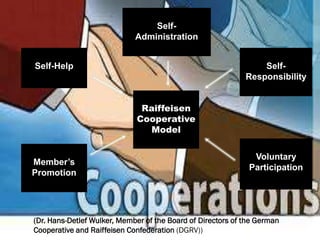
SelfAdministration
Self-Help

SelfResponsibility
Raiffeisen
Cooperative
Model

Member’s
Promotion

Voluntary
Participation

(Dr. Hans-Detlef Wulker, Member of the Board of Directors of the German
Cooperative and Raiffeisen Confederation (DGRV))
Highlights:
State-Initiated Cooperatives
-- In 1927, the Cooperative Marketing Law (PA No. 3425)
passed – formation of state-initiated farmers’ marketing
cooperatives
-- In 1940, Commonwealth Act No. 565 created the National
Trading Corporation (NTC). Replaced by the National
Cooperative Administration (NCA) in 1941
Assessment:
-- The state-initiated cooperatives introduced by American and
Filipino missionaries and teachers in 1927 “eventually failed
due to corrupt and incompetent management” (Villasin,
1990).
Highlights:
Privately-Initiated Cooperatives
-- In 1938, the Vigan Credit Union, Inc. founded – a churchbased credit union
-- In 1938, the Consumers Cooperative League of the
Philippines organized - the first cooperative federation
-- By 1939, there were 570 credit cooperatives, 150 farmers’
cooperatives and 48 consumers’ cooperatives.
-- By 1941, there were already 30 privately-initiated credit
unions.
Assessment:
-- Privately-initiated cooperatives of Raiffeisen types
served as the stable foundation of the Philippine
cooperative movement (Prof. Jorge V. Sibal, UP, Diliman,
Quezon City).
2ND STAGE OF COOPERATIVE MOVEMENT IN THE
PHILIPPINES (1941-1986)
Highlights:
2.1 Japanese Occupation
-- Cooperatives increased tremendously - severe food
shortages in Manila and other urban areas
-- Around 5,000 consumers’ and producers’ cooperatives
organized constituting 77% increase over 570 rural
cooperatives in 1939.
2.2 The Rehabilitation Period after WWII
-- Many laws were passed to assist the organization and
reorganization of cooperatives during the rehabilitation
period after WWII.
Highlights:
2.3 Resurgence Period of State-Initiated Cooperatives
-- To counter revolutionary activities - the state became
very active in organizing farmers' cooperatives.
-- In 1952, the Agricultural Credit Cooperative Financing
Administration (ACCFA) established
-- Farmers' Cooperative Marketing Associations
(FACOMAs) and Producers Marketing Associations
(PROCOMAs) provided collateral-free loans funded by
the United States Agency for International
Development (US AID).
Analysis:
-- The state-initiated FACOMAs failed as in the past,
again due to corruption and incompetent management.
Only 99 of the 255 FACOMAs survived and of the
millions lent, only 28% remained collectible.
NGO-Initiated Cooperatives:
-- In 1952, the Philippine Rural Reconstruction
Movement (PRRM) organized - a non-government
organization (NGO) and paved the way in the
organization of the Federation of Free Farmers (FFF) in
1953.
Highlights:
2.4 The Introduction and Encouragement of Non-agricultural
Cooperatives
-- In 1957, the Philippine Non-Agricultural Credit Act (RA No.
2023) implemented.
-- In 1957, the Roman Catholic Church called for the organization
of credit cooperatives in all parishes
-- In 1960, the Agricultural Credit Cooperative Institute (ACCI) in
the University of the Philippines Los Baños established
-- In 1969, the National Electrification Administration (NEA)
created - rural electrification through rural electric cooperatives
-- In 1969, the Philippine College of Commerce (now Polytechnic
University of the Philippines) - designated training center of nonagricultural cooperatives. In 1989, the Institute of Cooperatives
founded - offered Bachelor in Cooperatives.
Analysis:
-- The failure of the Philippine National Coop Bank once
again signaled the failures of state-initiated
cooperatives and the continuing decline of coop
membership since 1969.
-- But the assets and capitalization of some privatelyinitiated non-agricultural cooperatives (especially those
managed by the middle class and professionals) have
increased. This means that the cooperatives have
grown qualitatively and substantially.
Highlights:
2.5 The Martial Law Period
Before Martial Law:
-- no cooperation among cooperatives
-- government disorganized in supervising and
coordinating cooperatives
During Martial Law:
-- In 1972, the Bureau of Cooperative Development
(BCOD) created - to rationalize the cooperative
movement

-- the Cooperative Union of the Philippines (CUP) formed
- to centralize coordination of all education and training
programs of all cooperatives
Highlights:
2.5 The Martial Law Period
Analysis:
-- Cooperatives were politicized. Bureaucracy locked up
coop capital. Majority of the cooperatives were fake.
-- Milestone – In 1973, PD No. 175 passed to “strengthen the
coop movement” through tie-up with the Marcos Land
Reform Program (PD No. 27) - compulsory for a tenantfarmer to join a cooperative or Samahang Nayon (SN)
The haphazard formation of SNs resulted in weak Area
Marketing Coop (AMCs) and Coop Rural Banks (CRBs).
Intended government funds re-coursed to rural banks.
However, rural banks owned mostly by the elites - not
necessarily pro-cooperatives and pro-land reform. Created a
big crack both in coop development and land reform program.

-- Successful story - the rural electrification program paved the
development of electric cooperatives
-- The success of the electric cooperatives is due to the fact
that its rational for their organization was not as politicized as
the SNs.
(Muñoz & Battulayan, 1989
3RD STAGE OF COOPERATIVE MOVEMENT IN THE PHILIPPINES
(1941-1986)
Highlights:
Cooperative Movement as a Political Force
-- One cause of Marcos regime downfall - the failure of land
reform and cooperative programs in solving the widespread
poverty
-- The 1987 Constitution under the Aquino administration cooperative-friendly and the mistake of the past in organizing
state-initiated cooperatives for political and anti-insurgency
purposes avoided.
-- In 1990, the Constitution provision was
operationalized with the enactment of RA No.
6938, also known as the Cooperative Code of
the Philippines (which was later amended to RA
No. 9520 known as the “Philippine Cooperative
Code of 2008”), and RA No. 6939 (Cooperative
Development Act Authority Act).
-- The CDA took over the functions of the BCOD
and was tasked to coordinate the efforts of other
government branches, subdivisions,
instrumentalities and agencies in providing
technical guidance, financial assistance and
other services to cooperatives.
Highlights:

Cooperative Movement as a Political Force
-- The Local Government Code of 1991 (RA No. 7160) gave
the cooperatives, NGOs and POs the opportunity to
actively participate in local governance. The coop
movement, together with the NGOs (Non-Governmental
Organizations) and POs (People’s Organizations) emerged
as the country's third sector (civil society), the
government and the private enterprises being the first
two. The coop movement is the "largest socio-economic
institution” in the country.
-- In the first party list elections in the country, five coop
and coop-based parties won 6 out of 13 sectoral
representative seats for the marginalized and
underrepresented sectors of society.
In the final analysis, the Cooperative
Development Authority, in its banner article in
its webpage , states
“Considering the experiences of similar
societies in other countries, however, the
fundamental cause of failure in a cooperative
enterprise is the lack of proper understanding
of the principles and true aims of cooperative
associations, and the non-adherence to them in
actual operation of cooperative enterprises.”
THANK YOU.

Cooperative Development in the Philippines by Nereus V. Malinis

  • 1.
    Polytechnic University ofthe Philippines M.H. Del Pilar Campus Sta. Mesa Manila Graduate School Report on DEM History of Cooperative Development of the Philippines By:  Mr. Nereus V. Malinis
  • 3.
    ‘Bayanihan,’ the Filipinoword for cooperation, is as old as our Philippine culture. The Banaue Rice Terraces is the most symbolic evidence of the cooperative movement in the Philippines. (Abasolo, Ruiz & Bertol, 1996)
  • 4.
    Pre-Spanish Period Subsistence Agriculture Spanish Period Philippine economy transformation Feudal and Commercialized Economy GREMIOS Gremios(local crafts unions and guilds) were the forerunners of cooperatives during the Spanish period.
  • 5.
    1ST STAGE OFCOOPERATIVE PHILIPPINES (1895-1941) MOVEMENT IN THE Highlights: 1.1 Pre-Formation Period – Spanish Period -- Revolutionary illustrados like Jose Rizal, Emilio Jacinto and Isabelo delos Reyes recognized cooperatives as instruments for social justice and economic development. -- “The initial germ of cooperativism during the Spanish colonial periods failed to take root due to the intense revolutionary struggles of the Filipinos against the Spaniards.” (Muñoz & Battulayan, 1989)
  • 6.
    Highlights: 1.2 Formation Period– The American Colonial Period -- Raiffeisen-type of rural agricultural cooperatives implanted -- In 1906, the Corporation Law (PA No. 1459) passed – legal framework for all private organizations -- In 1907, the Sandiko Bill disapproved – first attempt for state assistance to rural cooperatives via legislation -- In 1915, the Rural Credit Cooperative Association Act (PA No. 2508) passed – appropriation of P1 million state assistance for farmers’ credit -- In 1916, the first rural credit cooperative association assisted by the government formed -- By 1926, 541 credit cooperatives in 42 provinces
  • 7.
  • 8.
    Highlights: State-Initiated Cooperatives -- In1927, the Cooperative Marketing Law (PA No. 3425) passed – formation of state-initiated farmers’ marketing cooperatives -- In 1940, Commonwealth Act No. 565 created the National Trading Corporation (NTC). Replaced by the National Cooperative Administration (NCA) in 1941 Assessment: -- The state-initiated cooperatives introduced by American and Filipino missionaries and teachers in 1927 “eventually failed due to corrupt and incompetent management” (Villasin, 1990).
  • 9.
    Highlights: Privately-Initiated Cooperatives -- In1938, the Vigan Credit Union, Inc. founded – a churchbased credit union -- In 1938, the Consumers Cooperative League of the Philippines organized - the first cooperative federation -- By 1939, there were 570 credit cooperatives, 150 farmers’ cooperatives and 48 consumers’ cooperatives. -- By 1941, there were already 30 privately-initiated credit unions. Assessment: -- Privately-initiated cooperatives of Raiffeisen types served as the stable foundation of the Philippine cooperative movement (Prof. Jorge V. Sibal, UP, Diliman, Quezon City).
  • 10.
    2ND STAGE OFCOOPERATIVE MOVEMENT IN THE PHILIPPINES (1941-1986) Highlights: 2.1 Japanese Occupation -- Cooperatives increased tremendously - severe food shortages in Manila and other urban areas -- Around 5,000 consumers’ and producers’ cooperatives organized constituting 77% increase over 570 rural cooperatives in 1939. 2.2 The Rehabilitation Period after WWII -- Many laws were passed to assist the organization and reorganization of cooperatives during the rehabilitation period after WWII.
  • 11.
    Highlights: 2.3 Resurgence Periodof State-Initiated Cooperatives -- To counter revolutionary activities - the state became very active in organizing farmers' cooperatives. -- In 1952, the Agricultural Credit Cooperative Financing Administration (ACCFA) established -- Farmers' Cooperative Marketing Associations (FACOMAs) and Producers Marketing Associations (PROCOMAs) provided collateral-free loans funded by the United States Agency for International Development (US AID).
  • 12.
    Analysis: -- The state-initiatedFACOMAs failed as in the past, again due to corruption and incompetent management. Only 99 of the 255 FACOMAs survived and of the millions lent, only 28% remained collectible. NGO-Initiated Cooperatives: -- In 1952, the Philippine Rural Reconstruction Movement (PRRM) organized - a non-government organization (NGO) and paved the way in the organization of the Federation of Free Farmers (FFF) in 1953.
  • 13.
    Highlights: 2.4 The Introductionand Encouragement of Non-agricultural Cooperatives -- In 1957, the Philippine Non-Agricultural Credit Act (RA No. 2023) implemented. -- In 1957, the Roman Catholic Church called for the organization of credit cooperatives in all parishes -- In 1960, the Agricultural Credit Cooperative Institute (ACCI) in the University of the Philippines Los Baños established -- In 1969, the National Electrification Administration (NEA) created - rural electrification through rural electric cooperatives -- In 1969, the Philippine College of Commerce (now Polytechnic University of the Philippines) - designated training center of nonagricultural cooperatives. In 1989, the Institute of Cooperatives founded - offered Bachelor in Cooperatives.
  • 14.
    Analysis: -- The failureof the Philippine National Coop Bank once again signaled the failures of state-initiated cooperatives and the continuing decline of coop membership since 1969. -- But the assets and capitalization of some privatelyinitiated non-agricultural cooperatives (especially those managed by the middle class and professionals) have increased. This means that the cooperatives have grown qualitatively and substantially.
  • 15.
    Highlights: 2.5 The MartialLaw Period Before Martial Law: -- no cooperation among cooperatives -- government disorganized in supervising and coordinating cooperatives During Martial Law: -- In 1972, the Bureau of Cooperative Development (BCOD) created - to rationalize the cooperative movement -- the Cooperative Union of the Philippines (CUP) formed - to centralize coordination of all education and training programs of all cooperatives
  • 16.
    Highlights: 2.5 The MartialLaw Period Analysis: -- Cooperatives were politicized. Bureaucracy locked up coop capital. Majority of the cooperatives were fake. -- Milestone – In 1973, PD No. 175 passed to “strengthen the coop movement” through tie-up with the Marcos Land Reform Program (PD No. 27) - compulsory for a tenantfarmer to join a cooperative or Samahang Nayon (SN)
  • 17.
    The haphazard formationof SNs resulted in weak Area Marketing Coop (AMCs) and Coop Rural Banks (CRBs). Intended government funds re-coursed to rural banks. However, rural banks owned mostly by the elites - not necessarily pro-cooperatives and pro-land reform. Created a big crack both in coop development and land reform program. -- Successful story - the rural electrification program paved the development of electric cooperatives -- The success of the electric cooperatives is due to the fact that its rational for their organization was not as politicized as the SNs. (Muñoz & Battulayan, 1989
  • 18.
    3RD STAGE OFCOOPERATIVE MOVEMENT IN THE PHILIPPINES (1941-1986) Highlights: Cooperative Movement as a Political Force -- One cause of Marcos regime downfall - the failure of land reform and cooperative programs in solving the widespread poverty -- The 1987 Constitution under the Aquino administration cooperative-friendly and the mistake of the past in organizing state-initiated cooperatives for political and anti-insurgency purposes avoided.
  • 19.
    -- In 1990,the Constitution provision was operationalized with the enactment of RA No. 6938, also known as the Cooperative Code of the Philippines (which was later amended to RA No. 9520 known as the “Philippine Cooperative Code of 2008”), and RA No. 6939 (Cooperative Development Act Authority Act). -- The CDA took over the functions of the BCOD and was tasked to coordinate the efforts of other government branches, subdivisions, instrumentalities and agencies in providing technical guidance, financial assistance and other services to cooperatives.
  • 20.
    Highlights: Cooperative Movement asa Political Force -- The Local Government Code of 1991 (RA No. 7160) gave the cooperatives, NGOs and POs the opportunity to actively participate in local governance. The coop movement, together with the NGOs (Non-Governmental Organizations) and POs (People’s Organizations) emerged as the country's third sector (civil society), the government and the private enterprises being the first two. The coop movement is the "largest socio-economic institution” in the country. -- In the first party list elections in the country, five coop and coop-based parties won 6 out of 13 sectoral representative seats for the marginalized and underrepresented sectors of society.
  • 21.
    In the finalanalysis, the Cooperative Development Authority, in its banner article in its webpage , states “Considering the experiences of similar societies in other countries, however, the fundamental cause of failure in a cooperative enterprise is the lack of proper understanding of the principles and true aims of cooperative associations, and the non-adherence to them in actual operation of cooperative enterprises.”
  • 22.