
Cooking Up Nutrition Education
https://learn.extension.org/events/2285
This material is based upon work supported by the National Institute of Food and Agriculture, U.S. Department of Agriculture, and the Office of Family
Readiness Policy, U.S. Department of Defense under Award Numbers 2012-48755-20306 and 2014-48770-22587. 1
Research and evidenced-based
professional development
through engaged online communities
www.extension.org/militaryfamilies
Sign up for webinar email notifications at www.extension.org/62831 2
wwww.facebook.com/MFLNNutritionWellness
@MFLNNW
www.youtube.com/user/MIlFamLN
MFLN Nutrition and Wellness Group
3
Military Families Learning Network LinkedIn Group
https://www.linkedin.com/groups/8409844
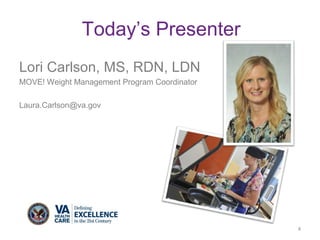
Today’s Presenter
Lori Carlson, MS, RDN, LDN
MOVE! Weight Management Program Coordinator
Laura.Carlson@va.gov
4
4
Learning Objectives
5
Photo Source: Condrasky & Hegler.
www.joe.org/joe/2010april/comm1.php
5
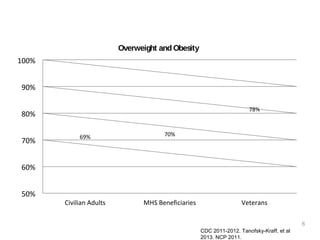
69% 70%
78%
50%
60%
70%
80%
90%
100%
Civilian Adults MHS Beneficiaries Veterans
Overweight and Obesity
6
CDC 2011-2012. Tanofsky-Kraff, et al
2013. NCP 2011.
6
Addressing Health Behaviors
7
TobaccoTobacco
DietDiet
InactivityInactivity
Bosley, Schechter, Skillings 2014 7
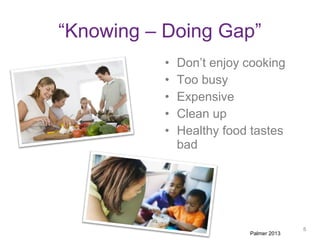
“Knowing – Doing Gap”
• Don’t enjoy cooking
• Too busy
• Expensive
• Clean up
• Healthy food tastes
bad
Palmer 2013
8
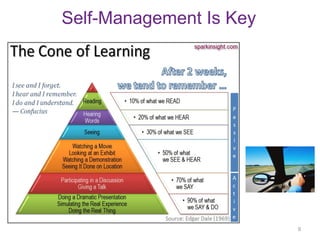
Self-Management Is Key
9
9
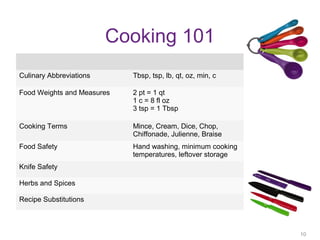
Cooking 101
Culinary Abbreviations Tbsp, tsp, lb, qt, oz, min, c
Food Weights and Measures 2 pt = 1 qt
1 c = 8 fl oz
3 tsp = 1 Tbsp
Cooking Terms Mince, Cream, Dice, Chop,
Chiffonade, Julienne, Braise
Food Safety Hand washing, minimum cooking
temperatures, leftover storage
Knife Safety
Herbs and Spices
Recipe Substitutions
10
10
What culinary education resources
do you use already?
Websites
Handouts
YouTube Videos
Apps
11
11
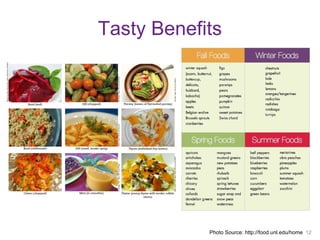
Tasty Benefits
12
Photo Source: http://food.unl.edu/home 12
13
Photo Source: http://food.unl.edu/home
14
Hands on Education
Adult Learning Theory & Experiential Learning Model
Photo Source: Bosley, Schechter, Skillings 2014
14
How many of you lead cooking
demonstrations as part of your
practice?
15
15
Potential Impact on Patient
Care
16
Bosley, Schechter, Skillings 2014
16
Where to start?
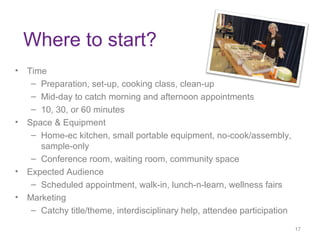
• Time
– Preparation, set-up, cooking class, clean-up
– Mid-day to catch morning and afternoon appointments
– 10, 30, or 60 minutes
• Space & Equipment
– Home-ec kitchen, small portable equipment, no-cook/assembly,
sample-only
– Conference room, waiting room, community space
• Expected Audience
– Scheduled appointment, walk-in, lunch-n-learn, wellness fairs
• Marketing
– Catchy title/theme, interdisciplinary help, attendee participation
17
17
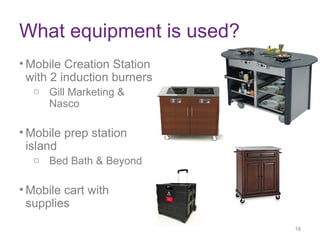
What equipment is used?
• Mobile Creation Station
with 2 induction burners
o Gill Marketing &
Nasco
• Mobile prep station
island
o Bed Bath & Beyond
• Mobile cart with
supplies
18
18
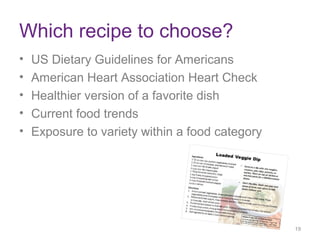
Which recipe to choose?
• US Dietary Guidelines for Americans
• American Heart Association Heart Check
• Healthier version of a favorite dish
• Current food trends
• Exposure to variety within a food category
19
19
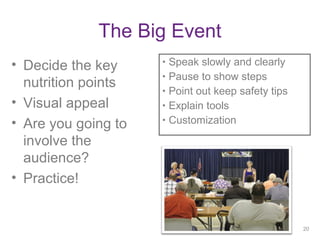
The Big Event
• Decide the key
nutrition points
• Visual appeal
• Are you going to
involve the
audience?
• Practice!
20
• Speak slowly and clearly
• Pause to show steps
• Point out keep safety tips
• Explain tools
• Customization
20
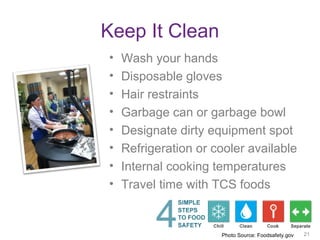
Keep It Clean
• Wash your hands
• Disposable gloves
• Hair restraints
• Garbage can or garbage bowl
• Designate dirty equipment spot
• Refrigeration or cooler available
• Internal cooking temperatures
• Travel time with TCS foods
21
Photo Source: Foodsafety.gov 21
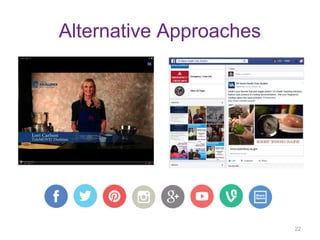
Alternative Approaches
22
22
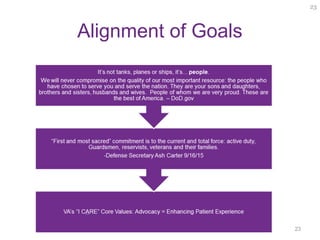
Alignment of Goals
23
23
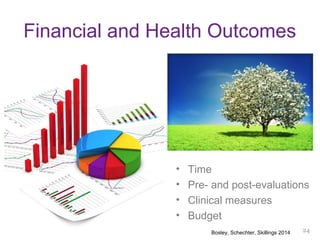
Financial and Health Outcomes
• Time
• Pre- and post-evaluations
• Clinical measures
• Budget
24Bosley, Schechter, Skillings 2014
Take-Aways
• Culinary education is supported by
evidence-based Experiential Learning
Model and Adult Education Theory.
• Culinary education improves staff
development through increased
integration and collaboration of
services.
• Gather and monitor outcomes for
program longevity.
25
25
Take-Aways
• Culinary Education Methods
1) Recipe card review
2) Watch a video
3) Demonstrate an app
4) Food samples
5) Cooking demonstration
6) Grocery store tour
26
26
Resources1. Bosley E, Schechtner G, Skillings A. Healthy Teaching Kitchen Nuts and Bolts of Clinical Outcomes. 2014
2. Carmody JF, Olendzki BC, Merriam PA, Liu Q, Oiao Y, Ma Y, A novel measure of dietary change in a prostate
cancer dietary program incorporating mindfulness training. Journal Academy of Nutrition and Dietetics. 2012. Doi:
10.1016/j.jand.2012.06.008
3. Centers for Disease Control and Prevention (CDC). National Center for Health Statistics (NCHS). National Health
and Nutrition Examination Survey Data. Hyattsville, MD: U.S. Department of Health and Human Services, Centers
for Disease Control and Prevention, 2015 http://www.cdc.gov/nchs/hus/healthrisk.htm
4. Condrasky MD, Hegler, M. How Culinary Nutrition Can Save the Health of a Nation. Journal of Extension,
2010;48(2).
5. DeAngelis M A, Blenkiron PO, Vieira S. Considering Culinary Nutrition as an Alternative Career Avenue for the
Registered Dietitian. Topics in Clinical Nutrition, 20001;17(1),12-19.
6. Foley W, Spurr S, Lenoy L, DeLong M, Fichera R. Cooking skills are important competencies for promoting healthy
eating in an urban indigenous health service. Nutrition and Dietetics Journal. 2011:12(1):291-295. Doi:
10.1111/j.1747-0080.2011.01551.x
7. Healthy Teaching Kitchen Tool Kit. Veterans Health Association Nutrition and Food Service. 2013;4.
8. Heart-Check Meal Certification Program Nutrition Requirements. American Heart Association.
http://www.heart.org/idc/groups/heart-public/@wcm/@fc/documents/downloadable/ucm_461670.pdf. Accessed
September 25, 2015.
9. Horodynski MA, Hoerr S, ColemanG. Nutrition Education Aimed at Toddlers. Family Community Health.
2004;27(2), 103-113.
10.Levy J, Auld G. Cooking classes outperform cooking demonstrations for college sophomores. Journal Nutrition
Education Behavior. 2004;36(4):197-203. Accessed September 25,2015.
11.Palmer S. Get Clients Cooking!. Today’s Dietitian. 2013:15(8):28. Accessed September 25, 2015
12.Roof R. Perfect Pairing — Chefs and Dietitians Unite for Healthy, Flavorful Cuisine. Today’s Dietitian. 2010;2(2):8
Accessed September 25, 2015.
13.Tanofsky-Kraff M, Sbrocco T, Theim KR, Cohen LA, et al. Obesity and the US Military Family. Obesity (Silver
Spring, Md.). 2013;21(11), 2205–2220. http://doi.org/10.1002/oby.20566.
27
27
QUESTIONS
28
Evaluation and CPEU Credit
• To receive CPEU credit please complete the
evaluation found at:
https://vte.co1.qualtrics.com/jfe/form/SV_5tp9BseuNGcUvVr
• Available until January 26, 2017. The
applicability of information presented today
may change with new research or policies after
this time.
29
MFLN Nutrition and Wellness
Upcoming Event
Trans-Fats
– Thursday, February 25 at 11:30 am Eastern
– https://learn.extension.org/events/2356
For more information on MFLN Nutrition and
Wellness go to:
https://blogs.extension.org/militaryfamilies/nutrition
-and-wellness/
30
Find all upcoming and recorded webinars covering:
31
Community Capacity Building
www.extension.org/62581
This material is based upon work supported by the National Institute of Food and Agriculture, U.S. Department of Agriculture, and the Office of Family
Readiness Policy, U.S. Department of Defense under Award Numbers 2012-48755-20306 and 2014-48770-22587.

Cooking Up Nutrition Education

  • 1.
    Cooking Up NutritionEducation https://learn.extension.org/events/2285 This material is based upon work supported by the National Institute of Food and Agriculture, U.S. Department of Agriculture, and the Office of Family Readiness Policy, U.S. Department of Defense under Award Numbers 2012-48755-20306 and 2014-48770-22587. 1
  • 2.
    Research and evidenced-based professionaldevelopment through engaged online communities www.extension.org/militaryfamilies Sign up for webinar email notifications at www.extension.org/62831 2
  • 3.
    wwww.facebook.com/MFLNNutritionWellness @MFLNNW www.youtube.com/user/MIlFamLN MFLN Nutrition andWellness Group 3 Military Families Learning Network LinkedIn Group https://www.linkedin.com/groups/8409844
  • 4.
    Today’s Presenter Lori Carlson,MS, RDN, LDN MOVE! Weight Management Program Coordinator Laura.Carlson@va.gov 4 4
  • 5.
    Learning Objectives 5 Photo Source:Condrasky & Hegler. www.joe.org/joe/2010april/comm1.php 5
  • 6.
    69% 70% 78% 50% 60% 70% 80% 90% 100% Civilian AdultsMHS Beneficiaries Veterans Overweight and Obesity 6 CDC 2011-2012. Tanofsky-Kraff, et al 2013. NCP 2011. 6
  • 7.
  • 8.
    “Knowing – DoingGap” • Don’t enjoy cooking • Too busy • Expensive • Clean up • Healthy food tastes bad Palmer 2013 8
  • 9.
  • 10.
    Cooking 101 Culinary AbbreviationsTbsp, tsp, lb, qt, oz, min, c Food Weights and Measures 2 pt = 1 qt 1 c = 8 fl oz 3 tsp = 1 Tbsp Cooking Terms Mince, Cream, Dice, Chop, Chiffonade, Julienne, Braise Food Safety Hand washing, minimum cooking temperatures, leftover storage Knife Safety Herbs and Spices Recipe Substitutions 10 10
  • 11.
    What culinary educationresources do you use already? Websites Handouts YouTube Videos Apps 11 11
  • 12.
    Tasty Benefits 12 Photo Source:http://food.unl.edu/home 12
  • 13.
  • 14.
    14 Hands on Education AdultLearning Theory & Experiential Learning Model Photo Source: Bosley, Schechter, Skillings 2014 14
  • 15.
    How many ofyou lead cooking demonstrations as part of your practice? 15 15
  • 16.
    Potential Impact onPatient Care 16 Bosley, Schechter, Skillings 2014 16
  • 17.
    Where to start? •Time – Preparation, set-up, cooking class, clean-up – Mid-day to catch morning and afternoon appointments – 10, 30, or 60 minutes • Space & Equipment – Home-ec kitchen, small portable equipment, no-cook/assembly, sample-only – Conference room, waiting room, community space • Expected Audience – Scheduled appointment, walk-in, lunch-n-learn, wellness fairs • Marketing – Catchy title/theme, interdisciplinary help, attendee participation 17 17
  • 18.
    What equipment isused? • Mobile Creation Station with 2 induction burners o Gill Marketing & Nasco • Mobile prep station island o Bed Bath & Beyond • Mobile cart with supplies 18 18
  • 19.
    Which recipe tochoose? • US Dietary Guidelines for Americans • American Heart Association Heart Check • Healthier version of a favorite dish • Current food trends • Exposure to variety within a food category 19 19
  • 20.
    The Big Event •Decide the key nutrition points • Visual appeal • Are you going to involve the audience? • Practice! 20 • Speak slowly and clearly • Pause to show steps • Point out keep safety tips • Explain tools • Customization 20
  • 21.
    Keep It Clean •Wash your hands • Disposable gloves • Hair restraints • Garbage can or garbage bowl • Designate dirty equipment spot • Refrigeration or cooler available • Internal cooking temperatures • Travel time with TCS foods 21 Photo Source: Foodsafety.gov 21
  • 22.
  • 23.
  • 24.
    Financial and HealthOutcomes • Time • Pre- and post-evaluations • Clinical measures • Budget 24Bosley, Schechter, Skillings 2014
  • 25.
    Take-Aways • Culinary educationis supported by evidence-based Experiential Learning Model and Adult Education Theory. • Culinary education improves staff development through increased integration and collaboration of services. • Gather and monitor outcomes for program longevity. 25 25
  • 26.
    Take-Aways • Culinary EducationMethods 1) Recipe card review 2) Watch a video 3) Demonstrate an app 4) Food samples 5) Cooking demonstration 6) Grocery store tour 26 26
  • 27.
    Resources1. Bosley E,Schechtner G, Skillings A. Healthy Teaching Kitchen Nuts and Bolts of Clinical Outcomes. 2014 2. Carmody JF, Olendzki BC, Merriam PA, Liu Q, Oiao Y, Ma Y, A novel measure of dietary change in a prostate cancer dietary program incorporating mindfulness training. Journal Academy of Nutrition and Dietetics. 2012. Doi: 10.1016/j.jand.2012.06.008 3. Centers for Disease Control and Prevention (CDC). National Center for Health Statistics (NCHS). National Health and Nutrition Examination Survey Data. Hyattsville, MD: U.S. Department of Health and Human Services, Centers for Disease Control and Prevention, 2015 http://www.cdc.gov/nchs/hus/healthrisk.htm 4. Condrasky MD, Hegler, M. How Culinary Nutrition Can Save the Health of a Nation. Journal of Extension, 2010;48(2). 5. DeAngelis M A, Blenkiron PO, Vieira S. Considering Culinary Nutrition as an Alternative Career Avenue for the Registered Dietitian. Topics in Clinical Nutrition, 20001;17(1),12-19. 6. Foley W, Spurr S, Lenoy L, DeLong M, Fichera R. Cooking skills are important competencies for promoting healthy eating in an urban indigenous health service. Nutrition and Dietetics Journal. 2011:12(1):291-295. Doi: 10.1111/j.1747-0080.2011.01551.x 7. Healthy Teaching Kitchen Tool Kit. Veterans Health Association Nutrition and Food Service. 2013;4. 8. Heart-Check Meal Certification Program Nutrition Requirements. American Heart Association. http://www.heart.org/idc/groups/heart-public/@wcm/@fc/documents/downloadable/ucm_461670.pdf. Accessed September 25, 2015. 9. Horodynski MA, Hoerr S, ColemanG. Nutrition Education Aimed at Toddlers. Family Community Health. 2004;27(2), 103-113. 10.Levy J, Auld G. Cooking classes outperform cooking demonstrations for college sophomores. Journal Nutrition Education Behavior. 2004;36(4):197-203. Accessed September 25,2015. 11.Palmer S. Get Clients Cooking!. Today’s Dietitian. 2013:15(8):28. Accessed September 25, 2015 12.Roof R. Perfect Pairing — Chefs and Dietitians Unite for Healthy, Flavorful Cuisine. Today’s Dietitian. 2010;2(2):8 Accessed September 25, 2015. 13.Tanofsky-Kraff M, Sbrocco T, Theim KR, Cohen LA, et al. Obesity and the US Military Family. Obesity (Silver Spring, Md.). 2013;21(11), 2205–2220. http://doi.org/10.1002/oby.20566. 27 27
  • 28.
  • 29.
    Evaluation and CPEUCredit • To receive CPEU credit please complete the evaluation found at: https://vte.co1.qualtrics.com/jfe/form/SV_5tp9BseuNGcUvVr • Available until January 26, 2017. The applicability of information presented today may change with new research or policies after this time. 29
  • 30.
    MFLN Nutrition andWellness Upcoming Event Trans-Fats – Thursday, February 25 at 11:30 am Eastern – https://learn.extension.org/events/2356 For more information on MFLN Nutrition and Wellness go to: https://blogs.extension.org/militaryfamilies/nutrition -and-wellness/ 30
  • 31.
    Find all upcomingand recorded webinars covering: 31 Community Capacity Building www.extension.org/62581 This material is based upon work supported by the National Institute of Food and Agriculture, U.S. Department of Agriculture, and the Office of Family Readiness Policy, U.S. Department of Defense under Award Numbers 2012-48755-20306 and 2014-48770-22587.

Editor's Notes

  • #5 Lori Carlson earned Bachelor’s and Master’s degrees in Dietetics from Eastern Illinois University. She initially worked as an inpatient dietitian prior to obtaining a position with VA Illiana Health Care System in Danville, IL. Currently Lori acts as the Weight Management Program Coordinator and is the site’s Healthy Teaching Kitchen Subject Matter Expert. She enjoys working on a variety of program enhancement projects while continuing to provide nutrition education and counseling to Veterans individually and in group classes. She uses her culinary degree from Richland Community College to lead interactive cooking demonstrations and grocery store tours. She is a leader in a national Marketing & Nutrition Informatics Committee to provide evidenced-based nutrition information to Veterans, families and the community while promoting the role of the Registered Dietitian Nutritionist as a member of the healthcare team.
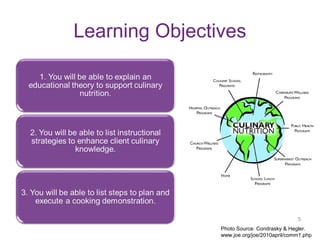
  • #6 There is more demand than ever for tasty, nutritious recipes. However, for some patients and clients, a lack of cooking skills can be a barrier to adopting more healthful eating patterns.  Dietitians are perfectly positioned to not only provide nutritious recipes to clients, but also assist them with the culinary skills necessary to fit nutrition recommendations into their daily lives. Culinary nutrition (as shown in the image) is utilized in a variety of settings- including the hospital, home, and public health programs. It is the practical application of nutrition principles combined with food science knowledge and is demonstrated using cooking skills. The result of merging nutrition and food science with the culinary arts is healthy eating behaviors, confidence in the kitchen and nutrition awareness. Current examples of culinary nutritionists are the pairing of chefs with nutrition educators, most often seen in community outreach programs, but more and more dietitians are incorporating culinary nutrition into clinical practice and using social media to share photos and videos of balanced meal preparation. At the end of this session: 1. You will be able to explain an educational theory to support culinary nutrition. 2. You will be able to list instructional strategies to enhance client culinary knowledge. 3. You will be able to list steps to plan and execute a cooking demonstration. Once these objectives are mastered, you can more effectively assist patients and clients in adopting healthful and delicious eating patterns.
  • #7 We know there’s an Obesity Epidemic but but it seems to be amplified within the populations of active servicemen and veterans. Therefore military is not immune to this trend, directly impacting the health and readiness of the active-duty service branches of the Armed Forces. 69% of American adults 20 years and older are considered overweight or obese (74% of men and 64% women). While 70% of the Department of Defense (DoD) Military Health System (MHS) beneficiaries are, and The National Center for Health Promotion Disease Prevention (NCP) estimates that 77% of Veterans in the United States are overweight or obese and could potentially benefit from nutrition services. (VHA Handbook 1120.01). The annual cost to the MHS for morbidities associated with overweight exceeds $1 billion annually (10). In 2008, over 4,500 servicemembers were discharged for failing to meet weight standards, incurring a cost of more than $183 million in annual recruiting and training expenses (17)1 The financial burden of obesity within the military does not end when personnel retire or separate from active-duty. Retirees continue to receive care within the MHS, while all other veterans eligible for care are treated at Veterans Affairs Medical Centers for obesity and associated comorbidities. VAMCs have incurred a significant obesity-related financial burden for the over 8.5 million enrollees in benefits (13), spending billions of dollars annually (14). The CDC reported in 2011 that Veterans were more likely than nonveterans to have 2 or more chronic diseases (CDC, 2011). Poor nutrition is a risk factor for four of the six leading causes of death in the United States: heart disease, stroke, diabetes, and cancer. Service men and women are likely at greater risk of overweight/obesity and developing chronic co-morbidities due to injury, psychological conditions, and learned behaviors from their military experience that we as dietitians need to consider when working with them. ***Supporting sound diet and nutrition practices within health care facilities is part of a systems approach, leveraging food expenditures to support active military, Veteran and community health (VHA Directive 2010-007).
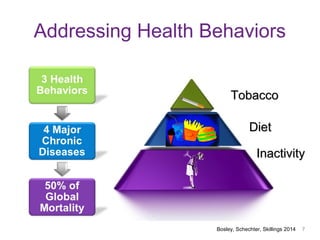
  • #8 Healthcare professionals are aware of the massive burden of chronic health conditions but often struggle to obtain quantitative data to support funding for expansion of prevention program and specifically nutrition services, which may be one factor limiting the incorporation of culinary nutrition into your practice. Cost savings from prevention efforts are challenging to obtain so using evidenced-based educational theories and strategies that we’ll talk about may be a foundation with which to start, followed by rigorous outcomes tracking to verify results. Prevention is key to changing the long term impact of care. Three Health Behaviors: Tobacco Use Diet Inactivity are directly related to the four major chronic diseases (Heart Disease, Diabetes, Stroke and Cancer). Together these account for 50% of global **mortality** People die because of these 3 changeable behaviors.
  • #9 The general public and those in the medical field know the importance of a healthy diet, but there’s a disconnect. We imagine family meals together but reality is eating on the go or away from an actual table. We all have experience that knowing is not doing. There’s an expanse that one must cross from taking knowledge and putting into consistent practice and forming a healthy lifestyle. So what’s in the way? Are your clients ready/motivated for change, understand dietary guidelines, do they have the skills to put them into practice? According to a 2010 Harris Interactive poll of more than 2500 adults, 28% said they don’t enjoy cooking or said they don’t cook at all; only 41% (less than ½) said they prepare meals at home five or more times per week. Older adults aged 65 and older said they cook more often than younger adults, indicating that the prospects for cooking may only get worse in the future. To make matters worse, many people who cook meals at home aren’t really cooking, per se; they’re merely heating up convenience foods and calling it cooking. Today people are busier than ever, juggling commutes and workdays with kids’ schedules, and also are plugged into social media. As a result, more people snack and skip planned balanced meals. Therefore culinary nutrition should highlight fast, one-pan meals that with family appeal. Consumer surveys repeatedly indicate that taste is the #1 when it comes to what consumers choose to eat. However, for too many years, nutrition messages have not favored delicious food. Nutrition by the numbers isn’t always the best approach. How can you make ‘nutrition recommendations’ into usable, approachable tips?
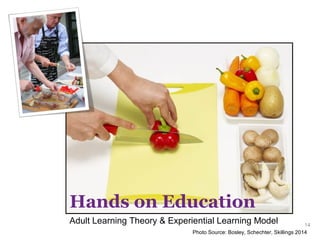
  • #10 Teaching self-management is key. Think back to when you were first learning a new, challenging, and unfamiliar skill. How did you learn best? When you were learning to drive a car did you learn by reading the car manual? Or did you learn when you sat in the driver’s seat and began to drive with simple instructions? You didn’t learn to drive a car by simply reading the manual. Learning to do three things, select, prepare, and enjoy cooking foods, follows the same principles of the Cone of Learning or Cone of Experience. (Bosley, Schechter, Skillings 2014) It is a model that incorporates several theories related to instructional design and the learning process. Research supports that learners retain more information by what they “do” as opposed to what is “heard”, “read” or “observed”. Today, this “learning by doing” has become known as “experiential learning” or “action learning” and directly supports the integration of culinary skills into nutrition education programs. Offering in person interactive classes that get clients engaged in hands on experiences of making healthy choices lets them be in the driver’s seat of their healthcare. There is a growing interest in cooking and nutrition due to the increasing number of celebrity chefs, cooking magazines, and Pinterest. So while there is mounting curiosity in these areas, it is not being met with evidenced-based nutrition knowledge that link cooking techniques to effectively alter eating behaviors….So just like on the previous slide, knowing and seeing is not doing. Providing knowledge alone has proven ineffective in altering eating behavior, but the offering of hands-on cooking and tasting demonstrations appears to be far more encouraging (Horodynski, Hoerr, & Coleman, 2004). Pairing discussion about food taste, appearance, and satiety along with nutrition goals can help increase mindfulness and make your education more approachable. Patients can visualize how new foods can be worked into their grocery list, pantry, and dinner table (DeAngelis, Blenkiron, & Vieira, 2001).
  • #11 So where to start….with the basics. In your session with a patient, start by ask more questions about their food purchases, storage, and preparation habits. Where do they get their groceries? Who shops? What cooking equipment do they have at home? The answers may be surprising but can enable you to better tailor your recommendations. Working with veterans, I’ve learned often times young men enlist and leave home where mom has made all the meals, to being in the service and getting all their meals from the mess hall, to being married with a wife in the kitchen and retiring without ever learning to prepare meals for themselves. I’ve worked with individuals who only feel comfortable using a microwave, but that was a piece of information that I had to dig for a little bit once rapport was established. Also many individuals receiving disability or social security income along with food assistance programs buy groceries only once a month or get the majority of items from food pantries so clearing up nutrition myths and appropriate meal planning strategies are key.
  • #12 Type answers into the chat box.
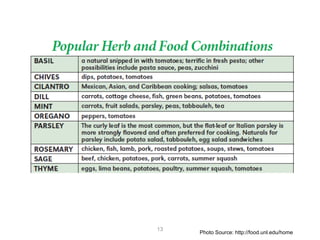
  • #13 You can incorporate cooking topics into your sessions in a variety of ways. Handing out recipe cards can reinforce your instruction with a real-life example. For instance, you’re talking with someone about how to reduce fat and add protein and follow this up by reviewing a recipe card for tuna salad made with Greek yogurt in place of mayonnaise. Now it can be intimidating to read a recipe card so I suggest avoiding just handing them out. Try to take time to read through the card with them. Review what any abbreviations and measurements mean. Describe cooking techniques like mincing, creaming, etc. Incorporate food safety guidelines and give suggestions for how they could customize the recipe using ingredients they currently have at home. Some people feel like recipes are rules that they can’t deviate from or don’t know about ingredient substitutions. I just spoke with one young guy who does not cook, preferring to buy wraps at a gas station. I asked him if he thought he could make his own wrap at home and he said he had no idea what goes into them. I was surprised and told him he can put whatever he wants so we talked about money saving and calorie saving ideas for him to make his own. If I had just told him to make his own wrap or given him a recipe card for low fat tuna salad, he would have been completely lost. Many of my clients don’t own measuring cups or spoons but they can be picked up at the dollar store. In the office setting, you can have handouts on low sodium seasonings and flavoring strategies, you can watch a YouTube Video on how to use a chef’s knife like chopping onions. Suggest and demonstrate use of cooking and recipe apps. Even if you can watch videos, have recipe cards, handouts, etc, they still may be reluctant to try a new food. Remember taste is king…Once they taste it, they’re more likely to try it.
  • #15 As we went through earlier, adults learn best when they 1) understand why something is important to know or do, 2) when they have the freedom to learn in their own way, and 3) when they physically have the opportunity to participate in hands on learning. These learning qualities make a strong case as to why group class formats are to be a combination of lectures with group discussions, cooking demonstrations, and hands on participation and if possible schedule a visit to the grocery store or market. Cooking demonstrations are part of the experiential learning model, which indicates that participation is the most helpful for adult learning.
  • #16 May be cold assembly, hot cooking preparation or offering samples at wellness fairs.
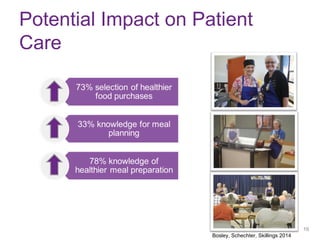
  • #17 Approximately 110 VA Medical Centers and clinically based outpatient clinics have implemented the Healthy Teaching Kitchen model and these interactive training demonstrations have helped the Veterans make better and healthier food choices. So far nationally, NFS has received feedback from 1000 HTK program participants. Previous research shows a 73 % increase in the selection of healthier foods to purchase, a 33 % increase in knowledge for meal planning, and a 78% increase in knowledge on how to cook healthier meals. Decrease BMI, and weight. Along with increase in confidence in incorporating fruits and vegetables into your diet as well as increased confidence in cooking healthy while at home. The initiative to incorporate culinary education needs to be deployed throughout health care to assist with improving nutritional outcomes along with combating chronic disease. Quarterly clinical outcome data is collected by VHA for national analysis, including both quantitative and qualitative data like: BMI, A1c, Nutrition Self-Efficacy, Number of Encounters, Veteran Satisfaction, Instructor Effectiveness, and Content Effectiveness using an approved evaluation tool. One Vet from one MOVE cooking group said, “The class really expanded my variety of tastes more than anything in the last 20 years.” Another gentleman from our October class said, “This class is a life changing event. Healthy teaching kitchen class will improve your quality of life.” That’s powerful feedback to pass along to leadership.
  • #18 Culinary education classes can increase self-efficacy related to cooking skills, fruit and vegetable intake, and nutrition knowledge of the participants. Group cooking classes allow a variety of participants to be actively involved in open discussion while learning to cook and discussing healthy food topics. Cooking classes that focus on healthy, quick, and affordable meals motivate participants to engage in a healthier lifestyle at home. A culinary program that incorporates hands-on nutrition and culinary skills, in a social setting, provides a greater chance of behavioral change when compared to other education tools. (Healthy Teaching Kitchen Tool Kit: 6/11/13) Time: Preparation, set-up, and the cooking class itself can all take more time than expected, especially if this is a first time experience. Get students/interns involved! Once you know your time constraints for the class, you can decide how many and what type of recipes to select. For example, if a recipe calls for a long cooking/baking time, you can prepare the food in advance and already portioned into samples. Then during the class, make a smaller portion to demonstrate the procedures, and then distribute the pre-portioned samples. Or often because our demonstrations run for 60-90 minutes, I start my longest cooking recipe (like a soup) first and then while it is simmering, I prepare 1-2 items with short prep time. I like the approach of incorporating several preparation techniques into one class. So one recipe that simmers on the stovetop, one maybe that uses a microwave or oven, and one just assembly item like a salad. This way they can experience several cooking techniques and it heightens the tasting experience. Space and Equipment: Get creative! If access to equipment such as stovetops or ovens is limited, participants will still learn from an effective cooking class. For instance a small, portable blender can be used to make smoothies. Trail mix does not need cooking and can be assembled live during a class along with salsas and dips. If a recipe cannot be prepared during the actual demonstration, pre-make the recipe for participants to sample. Class time can then be used to describe the steps of the recipe like how to properly measure, provide nutrition education like reading the labels saved from the food used to make samples, and tasting the pre-made finished product. Expected Audience: Plan an appropriate quantity of food samples for the anticipated number of participants. This can be handled by having the class as a scheduled group appointment. Walk-in classes can be used as well so you might reference historical data on the number of patients that have attended walk-in groups previously at your site. Consider demographic characteristics, which means taking into account culture, age, and other factors that may impact the audiences’ cooking knowledge and ability. Know your participant’s skill level and interests. During the class, can the participants help stir or measure to get them more involved? We did a class in which each veteran got to make their own salad vinaigrette to take home. We provided the basic ratio for a vinaigrette and they could add the spices they desired. I have found if you season with anything other than salt, pepper and garlic, they find it really interesting. I will ask individuals I see one-on-one in clinic what their interests are and use feedback from previous demo evaluations. They have given me great ideas like a microwave-only cooking class and make-ahead freezer and bulk meals. I always like introducing one new food or herb/spice.. Limit the audience number for more hands-on demonstrations. Think about partnering with other disciplines like PT/OT.
  • #19 Equipment from GSA Advantage/vendor file. (General Services Administration) Sink? Garbage Can? Oven? Cooktop? Electrical Outlets? Cooler/Refrigerator/Freezer? Counter Space? Counter Height? Will you have help?
  • #20 Recipes: Make sure to include validated nutrition information on the recipe card. Always site the source of your recipe. Enlist the help of your Medical Media department.
  • #21 Performing a cooking step while talking about another can be a little like patting your head and rubbing your stomach the first time so practice is very important. Make the recipe at home so you can go through all the steps yourself and always taste the recipe prior to deciding to make it for a class. Think ahead: What could go wrong? Even with electrical testing beforehand, I have dealt with tripped power switches. What ingredient, cooking and nutrition questions might the audience ask? Tell them how they might customize the flavors of recipe or sub ingredients. How can they use leftovers? Speak slowly and clearly Pause to show steps Take a moment to tip the bowl towards the audience and show the contents Point out safety tips Knife skills Refrigeration Final cooking temps If you are using a tool that all home cooks don’t have what can be used at home? Pastry bag = plastic zip top bag Point out areas where the recipe can be personalized Have FUN! Tell stories and add in fun facts or questions. Personal anecdotes makes you relatable. The more involved they are the more likely to listen and learn. Call on people. Hit home your key points in nice conclusion. Have to hear points at least 3 times to stick.
  • #22 Safety Guidelines Fire extinguishers Food temperatures – demonstrate using thermometer and internal cooking temps Hair restraints and gloves
  • #23 We discussed the efficacy hands on cooking classes have in increasing client awareness of foods they are consuming. But what about individuals who can’t come to the clinic regularly for follow up? There are many methods that cooking classes can be provided besides in person. Some options that facilities are currently using include telehealth and YouTube. Many social media savvy dietitians have blogs, SnapChat recipe prep and vine videos. With the fast moving climate of social media, your organization may not approve use of those techniques currently but they may be innovative ideas for the future as regulations evolve. YouTube videos also have the capability for patients to view them on-demand at any time they would like. Along with the convenience online videos have the capability to monitor usage or web hits to determine new accruals. https://www.youtube.com/watch?v=f-kqTYsgGgA&feature=youtu.be Telenutrition is an excellent way to provide cooking classes to the remote locations and still be able to have a two way conversation with the participants on the other side. By doing a demonstration at one host facility we can reach multiple facilities at one time through v-tel or CVT Clinical Video Telehealth. You can also continue the nutrition conversation outside of the classroom by posting links on your site’s social media pages to food safety and recipe resources. This allows patients to access information when they are ready for it. It makes sense for them to be more engaged and thinking about food when they’re in their own kitchen and looking at the content of their fridge and cabinets. Make sure you’re the source they seek out for reputable reliable information.
  • #24 Offering culinary nutrition as part of your regular care aligns with organization prevention goals. September 16, 2015 -Defense Secretary Ash Carter said at the Air Force Association’s Air and Space Conference and Technology Exposition 2015 at the Gaylord National Resort and Convention Center in National Harbor, Md., that the military must embrace the future to remain the best force. (www.af.mil) One of the VA’s core values is to be truly Veteran-centric by identifying, considering, and appropriately advancing the interests of Veterans. Integrity, Commitment, Advocacy, Respect, Excellence
  • #25 As part of the ongoing assessment of return on investment, you should collect and track HTK implementation data like: associated costs, the number of classes provided each fiscal year, staff hours required to provide the classes, and most recently clinical outcome measures including BMI and A1c. Quality Performance Improvement data of Weight, BMI and A1C Nutrition self-efficacy (pre and post evaluation) Assessment of course content and instructor Veteran satisfaction Although subjective, lets not overlook the benefit of self-reported program evaluation qualitative data that is very helpful for program improvement Participants need to be able to find the class beneficial – did the participant like the recipes prepared, was the classroom environment supportive of asking questions. This type of information is essential for the long term sustainability of a HTK program By tracking outcomes we are able to know that we are making improvements and also allow us to reflect on continually improve service and health outcomes.
  • #26 You can plan the perfect meal but it’s never going to come to fruition if the pt doesn’t know how to buy or prepare the food. Starting out- keep it simple. Microwave class. Fruit and vegetable salads. Yogurt parfaits.- best received. Top recipe is museli. Cone of Learning Experiential Learner Model Adult Learning Theory
  • #27 You can plan the perfect meal but it’s never going to come to fruition if the pt doesn’t know how to buy or prepare the food. Starting out- keep it simple. Microwave class. Fruit and vegetable salads. Yogurt parfaits.- best received. Top recipe is museli. Cone of Learning Experiential Learner Model Adult Learning Theory
  • #30 The MFLN Nutrition and Wellness Concentration Area team will offer 1.0 Continuing Professional Education Units (CPEUs) through the Commission on Dietetic Registration (CDR) for RD/RDN.