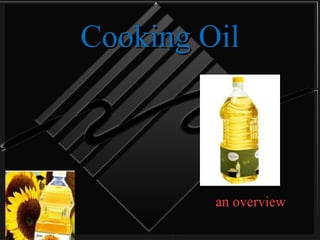
Cooking Oil an overview
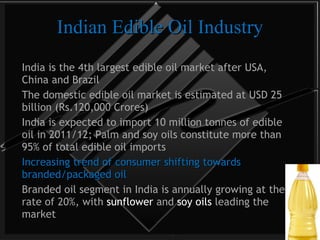
Indian Edible Oil Industry India is the 4th largest edible oil market after USA, China and Brazil The domestic edible oil market is estimated at USD 25 billion (Rs.120,000 Crores) India is expected to import 10 million tonnes of edible oil in 2011/12; Palm and soy oils constitute more than 95% of total edible oil imports Increasing trend of consumer shifting towards branded/packaged oil  Branded oil segment in India is annually growing at the rate of 20%, with  sunflower  and  soy oils  leading the market
Indian Edible Oil Industry Major Players The total edible oil consumption in India is around 18 million tons pa National Dairy Dev Board ITC Agro-Tech (Sec’bad) Marico Industries (Mumbai) Ahmed Mills (Mumbai) Adani Wilmar (Mundra) Hindustan Lever (Mumbai) Wipro (Bangalore) Rasoi (Kolkotta) Avi Industries (Mumbai) Kaleesuwari Refinery  (Chennai)
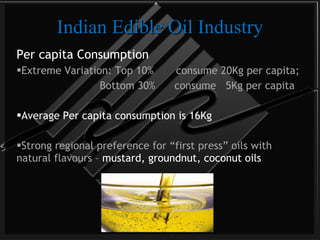
Indian Edible Oil Industry Per capita Consumption Extreme Variation: Top 10%  consume 20Kg per capita; Bottom 30%  consume  5Kg per capita Average Per capita consumption is 16Kg Strong regional preference for “first press” oils with natural flavours –  mustard, groundnut, coconut oils
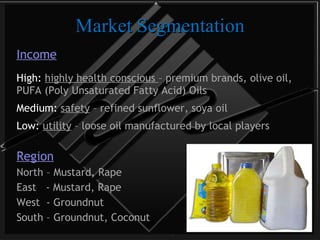
Market Segmentation Income High:  highly health conscious  – premium brands, olive oil, PUFA (Poly Unsaturated Fatty Acid) Oils Medium:  safety  – refined sunflower, soya oil Low:  utility  – loose oil manufactured by local players Region North – Mustard, Rape East  - Mustard, Rape West  - Groundnut South – Groundnut, Coconut
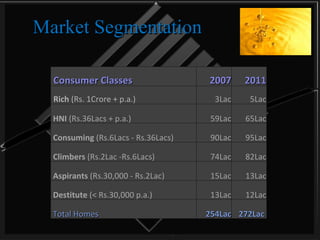
Market Segmentation Consumer Classes 2007 2011   Rich  (Rs. 1Crore + p.a.)   3Lac   5Lac HNI  (Rs.36Lacs + p.a.) 59Lac 65Lac Consuming  (Rs.6Lacs - Rs.36Lacs)  90Lac 95Lac Climbers  (Rs.2Lac -Rs.6Lacs) 74Lac 82Lac Aspirants  (Rs.30,000 - Rs.2Lac) 15Lac 13Lac Destitute  (< Rs.30,000 p.a.) 13Lac 12Lac Total Homes 254Lac 272Lac
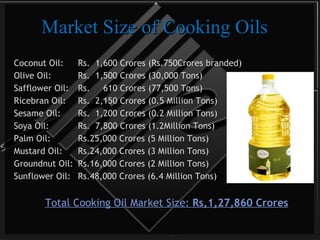
Market Size of Cooking Oils Coconut Oil: Rs.  1,600 Crores (Rs.750Crores branded) Olive Oil: Rs.  1,500 Crores (30,000 Tons) Safflower Oil: Rs.  610 Crores (77,500 Tons) Ricebran Oil: Rs.  2,150 Crores (0.5 Million Tons) Sesame Oil: Rs.  1,200 Crores (0.2 Million Tons) Soya Oil: Rs.  7,800 Crores (1.2Million Tons)  Palm Oil: Rs.25,000 Crores (5 Million Tons) Mustard Oil: Rs.24,000 Crores (3 Million Tons) Groundnut Oil: Rs.16,000 Crores (2 Million Tons)  Sunflower Oil: Rs.48,000 Crores (6.4 Million Tons)   Total Cooking Oil Market Size:  Rs,1,27,860 Crores
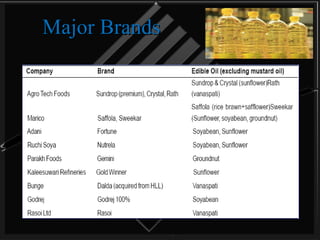
Major Brands
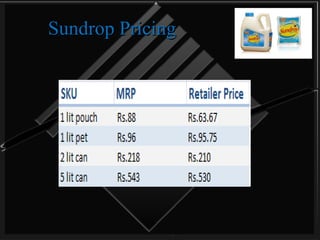
Sundrop Pricing
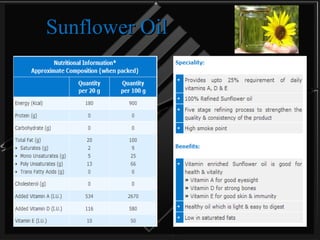
Sunflower Oil
Channel Arrangements There are 2 broad categories of Channels  Independent Channel Dependent Channel Independent Channel has “conventional” distribution arrangement, a channel member negotiates deals with others that do not result in binding relationships Dependent Channel, also called  “vertical marketing system” , a channel member feels tied to one or more members of the distribution channel
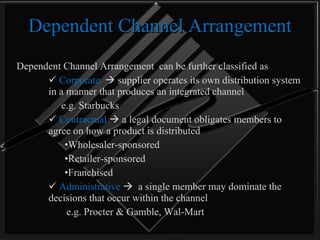
Dependent Channel Arrangement Dependent Channel Arrangement  can be further classified as Corporate     supplier operates its own distribution system in a manner that produces an integrated channel e.g. Starbucks Contractual     a legal document obligates members to agree on how a product is distributed Wholesaler-sponsored Retailer-sponsored Franchised Administrative      a single member may dominate the decisions that occur within the channel e.g. Procter & Gamble, Wal-Mart
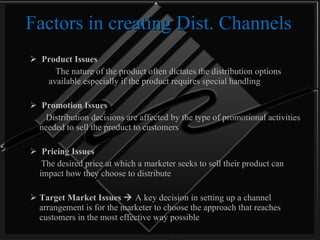
Factors in creating Dist. Channels Product Issues The nature of the product often dictates the distribution options available especially if the product requires special handling  Promotion Issues  Distribution decisions are affected by the type of promotional activities needed to sell the product to customers Pricing Issues The desired price at which a marketer seeks to sell their product can  impact how they choose to distribute Target Market Issues     A key decision in setting up a channel arrangement is for the marketer to choose the approach that reaches customers in the most effective way possible
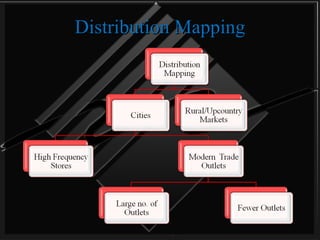
Distribution Mapping
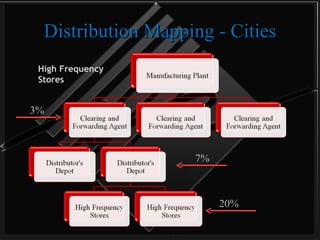
Distribution Mapping - Cities 3% 7% High Frequency Stores 20%
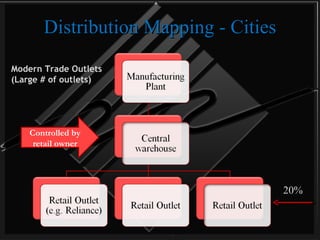
Distribution Mapping - Cities 20% Controlled by retail owner Modern Trade Outlets (Large # of outlets)
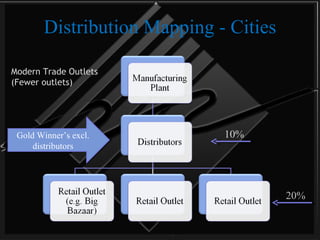
Distribution Mapping - Cities 10% Modern Trade Outlets (Fewer outlets) Gold Winner’s excl. distributors 20%
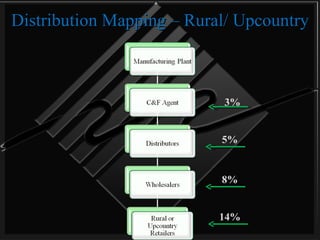
Distribution Mapping – Rural/ Upcountry 5% 3% 8% 14%
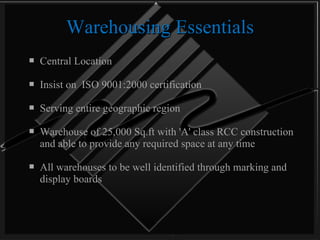
Warehousing Essentials Central Location  Insist on  ISO 9001:2000 certification Serving entire geographic region Warehouse of 25,000 Sq.ft with 'A' class RCC construction and able to provide any required space at any time All warehouses to be well identified through marking and display boards
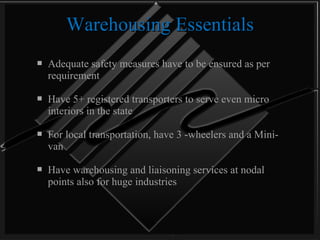
Warehousing Essentials Adequate safety measures have to be ensured as per requirement Have 5+ registered transporters to serve even micro interiors in the state For local transportation, have 3 -wheelers and a Mini-van Have warehousing and liaisoning services at nodal points also for huge industries
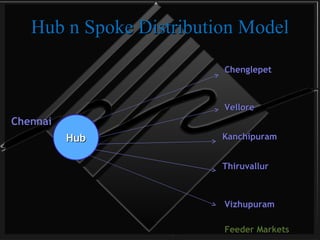
Hub n Spoke Distribution Model Chenglepet Vellore Chennai Kanchipuram Thiruvallur Vizhupuram Feeder Markets Hub
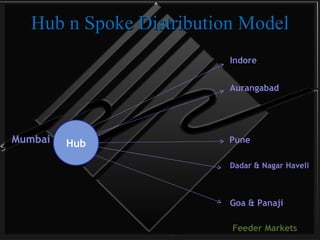
Hub n Spoke Distribution Model Indore Aurangabad Mumbai  Pune Dadar & Nagar Haveli Goa & Panaji  Feeder Markets Hub
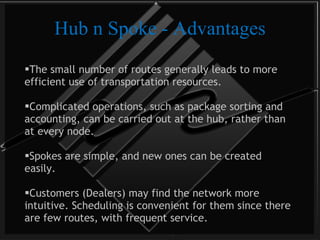
Hub n Spoke - Advantages The small number of routes generally leads to more efficient use of transportation resources. Complicated operations, such as package sorting and accounting, can be carried out at the hub, rather than at every node. Spokes are simple, and new ones can be created easily. Customers (Dealers) may find the network more intuitive. Scheduling is convenient for them since there are few routes, with frequent service.
Questions? Hari Prabhakar 98943 89188 9566 206 777

Cooking oil

  • 1.
  • 2.
    Indian Edible OilIndustry India is the 4th largest edible oil market after USA, China and Brazil The domestic edible oil market is estimated at USD 25 billion (Rs.120,000 Crores) India is expected to import 10 million tonnes of edible oil in 2011/12; Palm and soy oils constitute more than 95% of total edible oil imports Increasing trend of consumer shifting towards branded/packaged oil Branded oil segment in India is annually growing at the rate of 20%, with sunflower and soy oils leading the market
  • 3.
    Indian Edible OilIndustry Major Players The total edible oil consumption in India is around 18 million tons pa National Dairy Dev Board ITC Agro-Tech (Sec’bad) Marico Industries (Mumbai) Ahmed Mills (Mumbai) Adani Wilmar (Mundra) Hindustan Lever (Mumbai) Wipro (Bangalore) Rasoi (Kolkotta) Avi Industries (Mumbai) Kaleesuwari Refinery (Chennai)
  • 4.
    Indian Edible OilIndustry Per capita Consumption Extreme Variation: Top 10% consume 20Kg per capita; Bottom 30% consume 5Kg per capita Average Per capita consumption is 16Kg Strong regional preference for “first press” oils with natural flavours – mustard, groundnut, coconut oils
  • 5.
    Market Segmentation IncomeHigh: highly health conscious – premium brands, olive oil, PUFA (Poly Unsaturated Fatty Acid) Oils Medium: safety – refined sunflower, soya oil Low: utility – loose oil manufactured by local players Region North – Mustard, Rape East - Mustard, Rape West - Groundnut South – Groundnut, Coconut
  • 6.
    Market Segmentation ConsumerClasses 2007 2011   Rich (Rs. 1Crore + p.a.)   3Lac   5Lac HNI (Rs.36Lacs + p.a.) 59Lac 65Lac Consuming (Rs.6Lacs - Rs.36Lacs) 90Lac 95Lac Climbers (Rs.2Lac -Rs.6Lacs) 74Lac 82Lac Aspirants (Rs.30,000 - Rs.2Lac) 15Lac 13Lac Destitute (< Rs.30,000 p.a.) 13Lac 12Lac Total Homes 254Lac 272Lac
  • 7.
    Market Size ofCooking Oils Coconut Oil: Rs. 1,600 Crores (Rs.750Crores branded) Olive Oil: Rs. 1,500 Crores (30,000 Tons) Safflower Oil: Rs. 610 Crores (77,500 Tons) Ricebran Oil: Rs. 2,150 Crores (0.5 Million Tons) Sesame Oil: Rs. 1,200 Crores (0.2 Million Tons) Soya Oil: Rs. 7,800 Crores (1.2Million Tons) Palm Oil: Rs.25,000 Crores (5 Million Tons) Mustard Oil: Rs.24,000 Crores (3 Million Tons) Groundnut Oil: Rs.16,000 Crores (2 Million Tons) Sunflower Oil: Rs.48,000 Crores (6.4 Million Tons)   Total Cooking Oil Market Size: Rs,1,27,860 Crores
  • 8.
  • 9.
  • 10.
  • 11.
    Channel Arrangements Thereare 2 broad categories of Channels Independent Channel Dependent Channel Independent Channel has “conventional” distribution arrangement, a channel member negotiates deals with others that do not result in binding relationships Dependent Channel, also called “vertical marketing system” , a channel member feels tied to one or more members of the distribution channel
  • 12.
    Dependent Channel ArrangementDependent Channel Arrangement can be further classified as Corporate  supplier operates its own distribution system in a manner that produces an integrated channel e.g. Starbucks Contractual  a legal document obligates members to agree on how a product is distributed Wholesaler-sponsored Retailer-sponsored Franchised Administrative  a single member may dominate the decisions that occur within the channel e.g. Procter & Gamble, Wal-Mart
  • 13.
    Factors in creatingDist. Channels Product Issues The nature of the product often dictates the distribution options available especially if the product requires special handling Promotion Issues Distribution decisions are affected by the type of promotional activities needed to sell the product to customers Pricing Issues The desired price at which a marketer seeks to sell their product can impact how they choose to distribute Target Market Issues  A key decision in setting up a channel arrangement is for the marketer to choose the approach that reaches customers in the most effective way possible
  • 14.
  • 15.
    Distribution Mapping -Cities 3% 7% High Frequency Stores 20%
  • 16.
    Distribution Mapping -Cities 20% Controlled by retail owner Modern Trade Outlets (Large # of outlets)
  • 17.
    Distribution Mapping -Cities 10% Modern Trade Outlets (Fewer outlets) Gold Winner’s excl. distributors 20%
  • 18.
    Distribution Mapping –Rural/ Upcountry 5% 3% 8% 14%
  • 19.
    Warehousing Essentials CentralLocation Insist on ISO 9001:2000 certification Serving entire geographic region Warehouse of 25,000 Sq.ft with 'A' class RCC construction and able to provide any required space at any time All warehouses to be well identified through marking and display boards
  • 20.
    Warehousing Essentials Adequatesafety measures have to be ensured as per requirement Have 5+ registered transporters to serve even micro interiors in the state For local transportation, have 3 -wheelers and a Mini-van Have warehousing and liaisoning services at nodal points also for huge industries
  • 21.
    Hub n SpokeDistribution Model Chenglepet Vellore Chennai Kanchipuram Thiruvallur Vizhupuram Feeder Markets Hub
  • 22.
    Hub n SpokeDistribution Model Indore Aurangabad Mumbai Pune Dadar & Nagar Haveli Goa & Panaji Feeder Markets Hub
  • 23.
    Hub n Spoke- Advantages The small number of routes generally leads to more efficient use of transportation resources. Complicated operations, such as package sorting and accounting, can be carried out at the hub, rather than at every node. Spokes are simple, and new ones can be created easily. Customers (Dealers) may find the network more intuitive. Scheduling is convenient for them since there are few routes, with frequent service.
  • 24.
    Questions? Hari Prabhakar98943 89188 9566 206 777