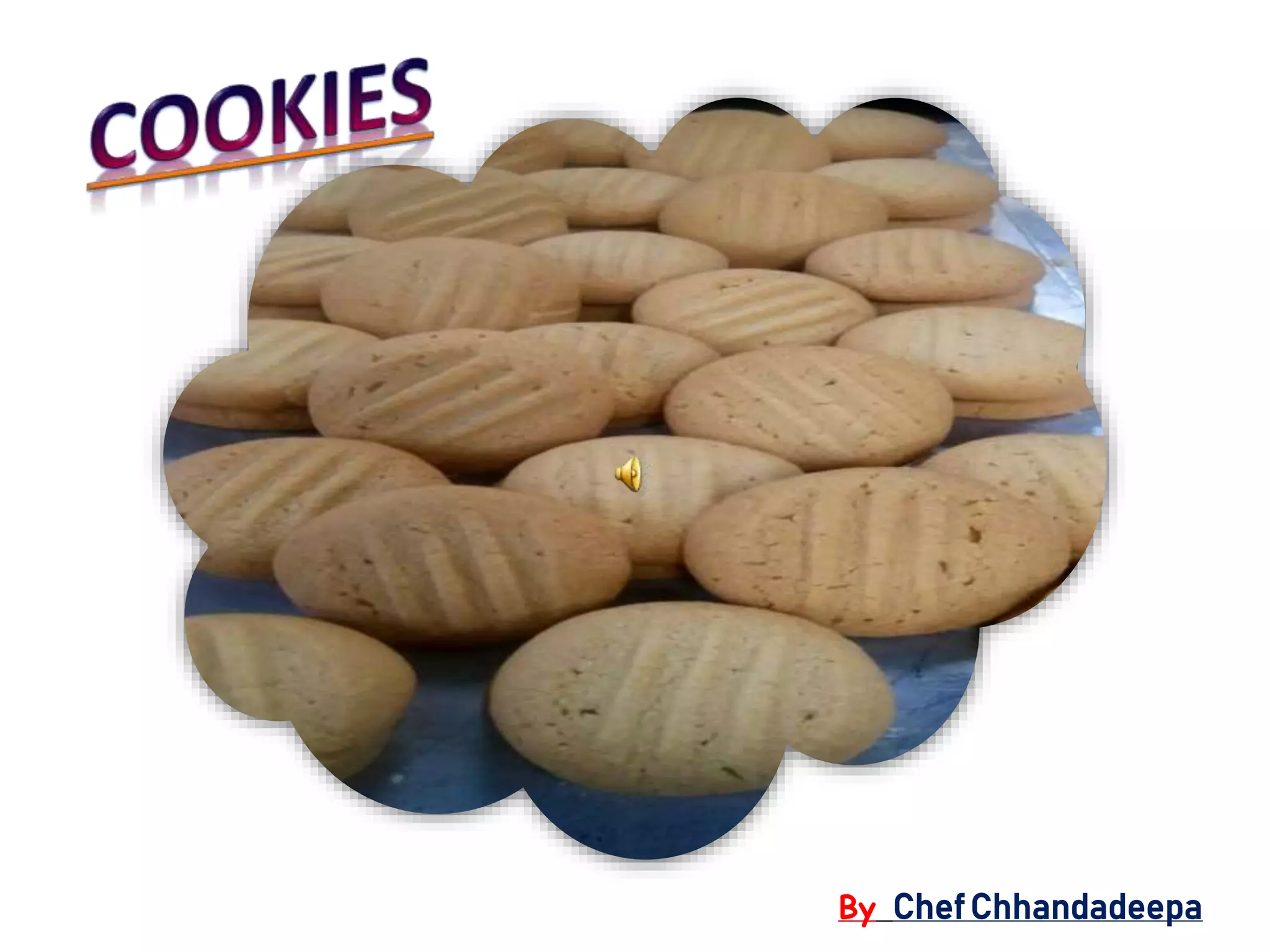
By ChefChhandadeepa
By definition, a cookie can be any of a
variety of hand-held, flour-based sweet
cakes, either crisp or soft. That
means cookie is a baked or cooked
food that is small, flat and sweet dry cake
— single-serving finger food.
Each country has its own word for cookie. In most English-
speaking countries except for the United States and Canada,
crisp cookies are called biscuits. Chewier biscuits are sometimes
called cookies even in the United Kingdom. Some cookies may
also be named by their shape, such as date squares or bars. In
Spain they’re Galletas. Germans call them Keks or Plzchen for
Christmas cookies, and in Italy there are several names to
identify various forms of cookies including Amaretti and Biscotti,
and so on. The name cookie is derived from the Dutch
word Koekje, meaning “small or little cake.” Biscuit comes from
the Latin word bis coctum, which means, “twice baked.”
Terminology
Cookies are broadly classified according to how they are formed.
 Bar cookies consist of batter or other ingredients that are
poured or pressed into a pan (sometimes in multiple layers)
and cut into cookie-sized pieces after baking.
 Drop cookies are made from a relatively soft dough that is
dropped by spoonfuls onto the baking sheet. During baking,
the mounds of dough spread and flatten. Chocolate chip
cookies (Toll House cookies), oatmeal raisin (or other
oatmeal-based) cookies, and rock cakes are popular
examples of drop cookies.
 Filled cookies are made from a rolled cookie dough filled
with a fruit or confectionery filling before baking.
Hamantashen is an example of a filled cookie.
Classification
 Molded cookies are also made from a stiffer dough that is molded
into balls or cookie shapes by hand before baking. Snicker doodles
and peanut butter cookies are examples of molded cookies.
 No-bake cookies are made by mixing a filler, such as cereal or nuts,
into a melted confectionery binder, shaping into cookies or bars,
and allowing to cool or harden. Oatmeal clusters and Rum balls are
no-bake cookies.
 Pressed cookies are made from a soft dough that is extruded from
a cookie press into various decorative shapes before baking.
Spritzgebäck is an example of a pressed cookie.
 Refrigerator cookies (also known as icebox cookies) are made from
a stiff dough that is refrigerated to make the raw dough even
stiffer before cutting and baking. The dough is typically shaped into
cylinders which are sliced into round cookies before baking.
 Rolled cookies are made from a stiffer dough that is rolled out and
cut into shapes with a cookie cutter. Gingerbread men are an
example.
 Sandwich cookies are rolled or pressed cookies that are
assembled as a sandwich with a sweet filling. Fillings
include marshmallow, jam, and icing. The Oreo cookie, made
of two chocolate cookies with a vanilla icing filling, is an
example.
 Vegan cookies can be made with flour, sugar, non-dairy milk
and non-dairy margarine. The icing can be made with
aquafaba to decorate the cookies.
 Gluten free cookies can be made with gluten free flour like
almond flour, sugar, milk , egg.
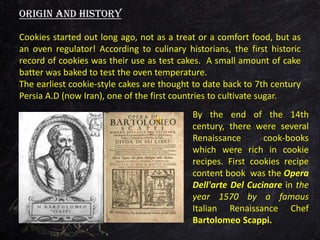
Cookies started out long ago, not as a treat or a comfort food, but as
an oven regulator! According to culinary historians, the first historic
record of cookies was their use as test cakes. A small amount of cake
batter was baked to test the oven temperature.
The earliest cookie-style cakes are thought to date back to 7th century
Persia A.D (now Iran), one of the first countries to cultivate sugar.
Origin and history
By the end of the 14th
century, there were several
Renaissance cook-books
which were rich in cookie
recipes. First cookies recipe
content book was the Opera
Dell'arte Del Cucinare in the
year 1570 by a famous
Italian Renaissance Chef
Bartolomeo Scappi.
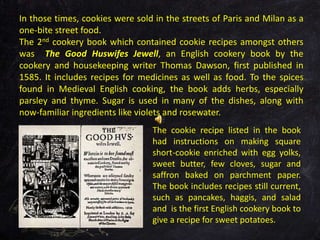
In those times, cookies were sold in the streets of Paris and Milan as a
one-bite street food.
The 2nd cookery book which contained cookie recipes amongst others
was The Good Huswifes Jewell, an English cookery book by the
cookery and housekeeping writer Thomas Dawson, first published in
1585. It includes recipes for medicines as well as food. To the spices
found in Medieval English cooking, the book adds herbs, especially
parsley and thyme. Sugar is used in many of the dishes, along with
now-familiar ingredients like violets and rosewater.
The cookie recipe listed in the book
had instructions on making square
short-cookie enriched with egg yolks,
sweet butter, few cloves, sugar and
saffron baked on parchment paper.
The book includes recipes still current,
such as pancakes, haggis, and salad
and is the first English cookery book to
give a recipe for sweet potatoes.
As technology improved during the Industrial Revolution in the 19th century,
so did the ability of bakers to make a wide range of sweet and savory cookies
for commercial consumption. Despite more varieties becoming available, the
essential ingredients of biscuits didn’t change. These ingredients are ‘soft’
wheat flour, which contains less protein than the flour used to bake bread,
sugar, and fats, such as butter and oil.
After that another variety of cookies were introduced and fondly called
Jumble Cookies. Jumbles (also called Jambles, Jumbals, Jumbolls, Jumbolds,
Jumballs) are cookie-like pastries, common in England and abroad since the
Middle Ages, which tend to have a relatively simple recipe of nuts, flour, eggs
and sugar, with vanilla, anise, or caraway seed used for flavoring. They were
formerly often made in the form of rings or rolls. Jumbles were widespread in
Europe by the 17th century, but possibly originated in Italy as the Cimabetta.
A very common cookie for travelers, they were probably brought to America
and that was when cookies were introduced in the USA for the first time. The
English Huswife by Gervase Markham was published in the year 1615, and
contained 2 Jumble Cookies recipes in the book.
The English, Scotch, and Dutch immigrants originally brought the first cookies
to the United States. Their simple butter cookies strongly resemble the English
tea-cakes and the Scotch shortbread.
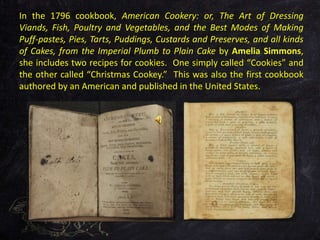
In the 1796 cookbook, American Cookery: or, The Art of Dressing
Viands, Fish, Poultry and Vegetables, and the Best Modes of Making
Puff-pastes, Pies, Tarts, Puddings, Custards and Preserves, and all kinds
of Cakes, from the Imperial Plumb to Plain Cake by Amelia Simmons,
she includes two recipes for cookies. One simply called “Cookies” and
the other called “Christmas Cookey.” This was also the first cookbook
authored by an American and published in the United States.
There are hundreds upon hundreds of cookie recipes in the
United States. The geographic development of the United States
was reflected in popular cookie recipes. The railroad’s expansion
in the early 1800s gave cooks access to coconuts from the
South.
Later in the century, oranges from the West were included in
many recipes. Around the turn of the century, the Kellogg
brothers in Michigan invented cornflakes and cookies were made
with cereal products.
The Evolution & Variety of Cookies
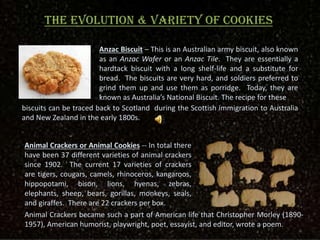
Anzac Biscuit – This is an Australian army biscuit, also known
as an Anzac Wafer or an Anzac Tile. They are essentially a
hardtack biscuit with a long shelf-life and a substitute for
bread. The biscuits are very hard, and soldiers preferred to
grind them up and use them as porridge. Today, they are
known as Australia’s National Biscuit. The recipe for these
biscuits can be traced back to Scotland during the Scottish immigration to Australia
and New Zealand in the early 1800s.
Animal Crackers or Animal Cookies -- In total there
have been 37 different varieties of animal crackers
since 1902. The current 17 varieties of crackers
are tigers, cougars, camels, rhinoceros, kangaroos,
hippopotami, bison, lions, hyenas, zebras,
elephants, sheep, bears, gorillas, monkeys, seals,
and giraffes. There are 22 crackers per box.
Animal Crackers became such a part of American life that Christopher Morley (1890-
1957), American humorist, playwright, poet, essayist, and editor, wrote a poem.
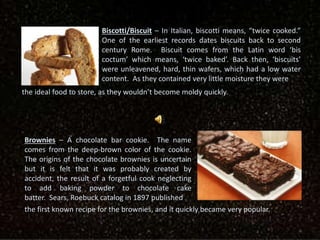
Biscotti/Biscuit – In Italian, biscotti means, “twice cooked.”
One of the earliest records dates biscuits back to second
century Rome. Biscuit comes from the Latin word ‘bis
coctum’ which means, ‘twice baked’. Back then, ‘biscuits’
were unleavened, hard, thin wafers, which had a low water
content. As they contained very little moisture they were
the ideal food to store, as they wouldn’t become moldy quickly.
Brownies – A chocolate bar cookie. The name
comes from the deep-brown color of the cookie.
The origins of the chocolate brownies is uncertain
but it is felt that it was probably created by
accident, the result of a forgetful cook neglecting
to add baking powder to chocolate cake
batter. Sears, Roebuck catalog in 1897 published
the first known recipe for the brownies, and it quickly became very popular.
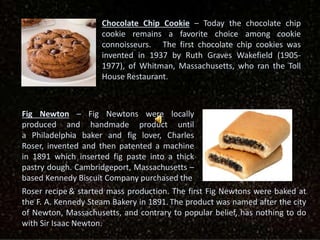
Chocolate Chip Cookie – Today the chocolate chip
cookie remains a favorite choice among cookie
connoisseurs. The first chocolate chip cookies was
invented in 1937 by Ruth Graves Wakefield (1905-
1977), of Whitman, Massachusetts, who ran the Toll
House Restaurant.
Fig Newton – Fig Newtons were locally
produced and handmade product until
a Philadelphia baker and fig lover, Charles
Roser, invented and then patented a machine
in 1891 which inserted fig paste into a thick
pastry dough. Cambridgeport, Massachusetts –
based Kennedy Biscuit Company purchased the
Roser recipe& started mass production. The first Fig Newtons were baked at
the F. A. Kennedy Steam Bakery in 1891.The product was named after the city
of Newton, Massachusetts, and contrary to popular belief, has nothing to do
with Sir Isaac Newton.
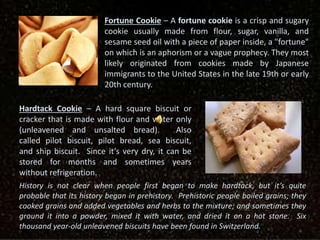
Fortune Cookie – A fortune cookie is a crisp and sugary
cookie usually made from flour, sugar, vanilla, and
sesame seed oil with a piece of paper inside, a "fortune"
on which is an aphorism or a vague prophecy. They most
likely originated from cookies made by Japanese
immigrants to the United States in the late 19th or early
20th century.
Hardtack Cookie – A hard square biscuit or
cracker that is made with flour and water only
(unleavened and unsalted bread). Also
called pilot biscuit, pilot bread, sea biscuit,
and ship biscuit. Since it’s very dry, it can be
stored for months and sometimes years
without refrigeration.
History is not clear when people first began to make hardtack, but it’s quite
probable that its history began in prehistory. Prehistoric people boiled grains; they
cooked grains and added vegetables and herbs to the mixture; and sometimes they
ground it into a powder, mixed it with water, and dried it on a hot stone. Six
thousand year-old unleavened biscuits have been found in Switzerland.
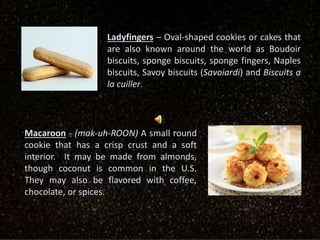
Ladyfingers – Oval-shaped cookies or cakes that
are also known around the world as Boudoir
biscuits, sponge biscuits, sponge fingers, Naples
biscuits, Savoy biscuits (Savoiardi) and Biscuits a
la cuiller.
Macaroon - (mak-uh-ROON) A small round
cookie that has a crisp crust and a soft
interior. It may be made from almonds,
though coconut is common in the U.S.
They may also be flavored with coffee,
chocolate, or spices.
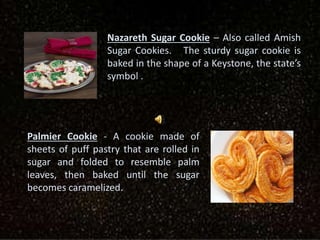
Nazareth Sugar Cookie – Also called Amish
Sugar Cookies. The sturdy sugar cookie is
baked in the shape of a Keystone, the state’s
symbol .
Palmier Cookie - A cookie made of
sheets of puff pastry that are rolled in
sugar and folded to resemble palm
leaves, then baked until the sugar
becomes caramelized.
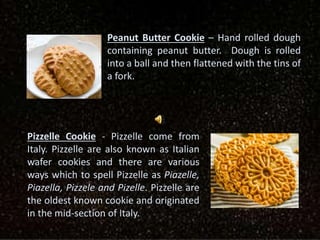
Peanut Butter Cookie – Hand rolled dough
containing peanut butter. Dough is rolled
into a ball and then flattened with the tins of
a fork.
Pizzelle Cookie - Pizzelle come from
Italy. Pizzelle are also known as Italian
wafer cookies and there are various
ways which to spell Pizzelle as Piazelle,
Piazella, Pizzele and Pizelle. Pizzelle are
the oldest known cookie and originated
in the mid-section of Italy.
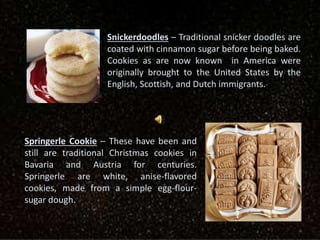
Snickerdoodles – Traditional snicker doodles are
coated with cinnamon sugar before being baked.
Cookies as are now known in America were
originally brought to the United States by the
English, Scottish, and Dutch immigrants.
Springerle Cookie – These have been and
still are traditional Christmas cookies in
Bavaria and Austria for centuries.
Springerle are white, anise-flavored
cookies, made from a simple egg-flour-
sugar dough.
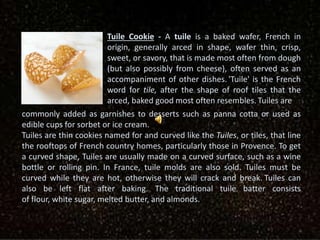
Tuile Cookie - A tuile is a baked wafer, French in
origin, generally arced in shape, wafer thin, crisp,
sweet, or savory, that is made most often from dough
(but also possibly from cheese), often served as an
accompaniment of other dishes. 'Tuile' is the French
word for tile, after the shape of roof tiles that the
arced, baked good most often resembles. Tuiles are
commonly added as garnishes to desserts such as panna cotta or used as
edible cups for sorbet or ice cream.
Tuiles are thin cookies named for and curved like the Tuiles, or tiles, that line
the rooftops of French country homes, particularly those in Provence. To get
a curved shape, Tuiles are usually made on a curved surface, such as a wine
bottle or rolling pin. In France, tuile molds are also sold. Tuiles must be
curved while they are hot, otherwise they will crack and break. Tuiles can
also be left flat after baking. The traditional tuile batter consists
of flour, white sugar, melted butter, and almonds.
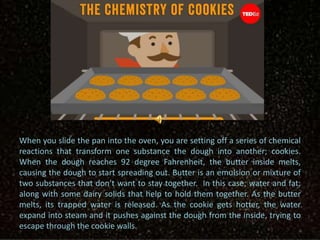
When you slide the pan into the oven, you are setting off a series of chemical
reactions that transform one substance the dough into another; cookies.
When the dough reaches 92 degree Fahrenheit, the butter inside melts,
causing the dough to start spreading out. Butter is an emulsion or mixture of
two substances that don’t want to stay together. In this case; water and fat;
along with some dairy solids that help to hold them together. As the butter
melts, its trapped water is released. As the cookie gets hotter, the water
expand into steam and it pushes against the dough from the inside, trying to
escape through the cookie walls.
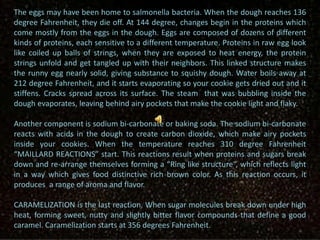
The eggs may have been home to salmonella bacteria. When the dough reaches 136
degree Fahrenheit, they die off. At 144 degree, changes begin in the proteins which
come mostly from the eggs in the dough. Eggs are composed of dozens of different
kinds of proteins, each sensitive to a different temperature. Proteins in raw egg look
like coiled up balls of strings, when they are exposed to heat energy, the protein
strings unfold and get tangled up with their neighbors. This linked structure makes
the runny egg nearly solid, giving substance to squishy dough. Water boils away at
212 degree Fahrenheit, and it starts evaporating so your cookie gets dried out and it
stiffens. Cracks spread across its surface. The steam that was bubbling inside the
dough evaporates, leaving behind airy pockets that make the cookie light and flaky.
Another component is sodium bi-carbonate or baking soda. The sodium bi-carbonate
reacts with acids in the dough to create carbon dioxide, which make airy pockets
inside your cookies. When the temperature reaches 310 degree Fahrenheit
“MAILLARD REACTIONS” start. This reactions result when proteins and sugars break
down and re-arrange themselves forming a “Ring like structure“, which reflects light
in a way which gives food distinctive rich brown color. As this reaction occurs, it
produces a range of aroma and flavor.
CARAMELIZATION is the last reaction. When sugar molecules break down under high
heat, forming sweet, nutty and slightly bitter flavor compounds that define a good
caramel. Caramelization starts at 356 degrees Fahrenheit.
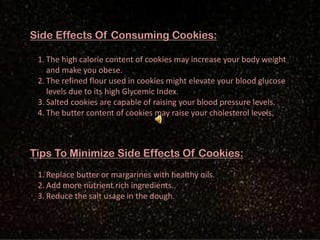
Side Effects Of Consuming Cookies:
1. The high calorie content of cookies may increase your body weight
and make you obese.
2. The refined flour used in cookies might elevate your blood glucose
levels due to its high Glycemic Index.
3. Salted cookies are capable of raising your blood pressure levels.
4. The butter content of cookies may raise your cholesterol levels.
Tips To Minimize Side Effects Of Cookies:
1. Replace butter or margarines with healthy oils.
2. Add more nutrient rich ingredients.
3. Reduce the salt usage in the dough.
Well, that nearly sums up almost
everything about Cookies. Who
knew that these small savories
which we all love, had such an
interesting and exhaustive history !
I would like to thank you all for
being patient throughout this
presentation.
Feel free to get back to me with
suggestions and feedback and
more brownie pointers on Cookies.
Thanks again and have a great
day!!

Cookies

  • 1.
  • 2.
    By definition, acookie can be any of a variety of hand-held, flour-based sweet cakes, either crisp or soft. That means cookie is a baked or cooked food that is small, flat and sweet dry cake — single-serving finger food.
  • 3.
    Each country hasits own word for cookie. In most English- speaking countries except for the United States and Canada, crisp cookies are called biscuits. Chewier biscuits are sometimes called cookies even in the United Kingdom. Some cookies may also be named by their shape, such as date squares or bars. In Spain they’re Galletas. Germans call them Keks or Plzchen for Christmas cookies, and in Italy there are several names to identify various forms of cookies including Amaretti and Biscotti, and so on. The name cookie is derived from the Dutch word Koekje, meaning “small or little cake.” Biscuit comes from the Latin word bis coctum, which means, “twice baked.” Terminology
  • 4.
    Cookies are broadlyclassified according to how they are formed.  Bar cookies consist of batter or other ingredients that are poured or pressed into a pan (sometimes in multiple layers) and cut into cookie-sized pieces after baking.  Drop cookies are made from a relatively soft dough that is dropped by spoonfuls onto the baking sheet. During baking, the mounds of dough spread and flatten. Chocolate chip cookies (Toll House cookies), oatmeal raisin (or other oatmeal-based) cookies, and rock cakes are popular examples of drop cookies.  Filled cookies are made from a rolled cookie dough filled with a fruit or confectionery filling before baking. Hamantashen is an example of a filled cookie. Classification
  • 5.
     Molded cookiesare also made from a stiffer dough that is molded into balls or cookie shapes by hand before baking. Snicker doodles and peanut butter cookies are examples of molded cookies.  No-bake cookies are made by mixing a filler, such as cereal or nuts, into a melted confectionery binder, shaping into cookies or bars, and allowing to cool or harden. Oatmeal clusters and Rum balls are no-bake cookies.  Pressed cookies are made from a soft dough that is extruded from a cookie press into various decorative shapes before baking. Spritzgebäck is an example of a pressed cookie.  Refrigerator cookies (also known as icebox cookies) are made from a stiff dough that is refrigerated to make the raw dough even stiffer before cutting and baking. The dough is typically shaped into cylinders which are sliced into round cookies before baking.  Rolled cookies are made from a stiffer dough that is rolled out and cut into shapes with a cookie cutter. Gingerbread men are an example.
  • 6.
     Sandwich cookiesare rolled or pressed cookies that are assembled as a sandwich with a sweet filling. Fillings include marshmallow, jam, and icing. The Oreo cookie, made of two chocolate cookies with a vanilla icing filling, is an example.  Vegan cookies can be made with flour, sugar, non-dairy milk and non-dairy margarine. The icing can be made with aquafaba to decorate the cookies.  Gluten free cookies can be made with gluten free flour like almond flour, sugar, milk , egg.
  • 7.
    Cookies started outlong ago, not as a treat or a comfort food, but as an oven regulator! According to culinary historians, the first historic record of cookies was their use as test cakes. A small amount of cake batter was baked to test the oven temperature. The earliest cookie-style cakes are thought to date back to 7th century Persia A.D (now Iran), one of the first countries to cultivate sugar. Origin and history By the end of the 14th century, there were several Renaissance cook-books which were rich in cookie recipes. First cookies recipe content book was the Opera Dell'arte Del Cucinare in the year 1570 by a famous Italian Renaissance Chef Bartolomeo Scappi.
  • 8.
    In those times,cookies were sold in the streets of Paris and Milan as a one-bite street food. The 2nd cookery book which contained cookie recipes amongst others was The Good Huswifes Jewell, an English cookery book by the cookery and housekeeping writer Thomas Dawson, first published in 1585. It includes recipes for medicines as well as food. To the spices found in Medieval English cooking, the book adds herbs, especially parsley and thyme. Sugar is used in many of the dishes, along with now-familiar ingredients like violets and rosewater. The cookie recipe listed in the book had instructions on making square short-cookie enriched with egg yolks, sweet butter, few cloves, sugar and saffron baked on parchment paper. The book includes recipes still current, such as pancakes, haggis, and salad and is the first English cookery book to give a recipe for sweet potatoes.
  • 9.
    As technology improvedduring the Industrial Revolution in the 19th century, so did the ability of bakers to make a wide range of sweet and savory cookies for commercial consumption. Despite more varieties becoming available, the essential ingredients of biscuits didn’t change. These ingredients are ‘soft’ wheat flour, which contains less protein than the flour used to bake bread, sugar, and fats, such as butter and oil. After that another variety of cookies were introduced and fondly called Jumble Cookies. Jumbles (also called Jambles, Jumbals, Jumbolls, Jumbolds, Jumballs) are cookie-like pastries, common in England and abroad since the Middle Ages, which tend to have a relatively simple recipe of nuts, flour, eggs and sugar, with vanilla, anise, or caraway seed used for flavoring. They were formerly often made in the form of rings or rolls. Jumbles were widespread in Europe by the 17th century, but possibly originated in Italy as the Cimabetta. A very common cookie for travelers, they were probably brought to America and that was when cookies were introduced in the USA for the first time. The English Huswife by Gervase Markham was published in the year 1615, and contained 2 Jumble Cookies recipes in the book. The English, Scotch, and Dutch immigrants originally brought the first cookies to the United States. Their simple butter cookies strongly resemble the English tea-cakes and the Scotch shortbread.
  • 10.
    In the 1796cookbook, American Cookery: or, The Art of Dressing Viands, Fish, Poultry and Vegetables, and the Best Modes of Making Puff-pastes, Pies, Tarts, Puddings, Custards and Preserves, and all kinds of Cakes, from the Imperial Plumb to Plain Cake by Amelia Simmons, she includes two recipes for cookies. One simply called “Cookies” and the other called “Christmas Cookey.” This was also the first cookbook authored by an American and published in the United States.
  • 11.
    There are hundredsupon hundreds of cookie recipes in the United States. The geographic development of the United States was reflected in popular cookie recipes. The railroad’s expansion in the early 1800s gave cooks access to coconuts from the South. Later in the century, oranges from the West were included in many recipes. Around the turn of the century, the Kellogg brothers in Michigan invented cornflakes and cookies were made with cereal products.
  • 12.
    The Evolution &Variety of Cookies Anzac Biscuit – This is an Australian army biscuit, also known as an Anzac Wafer or an Anzac Tile. They are essentially a hardtack biscuit with a long shelf-life and a substitute for bread. The biscuits are very hard, and soldiers preferred to grind them up and use them as porridge. Today, they are known as Australia’s National Biscuit. The recipe for these biscuits can be traced back to Scotland during the Scottish immigration to Australia and New Zealand in the early 1800s. Animal Crackers or Animal Cookies -- In total there have been 37 different varieties of animal crackers since 1902. The current 17 varieties of crackers are tigers, cougars, camels, rhinoceros, kangaroos, hippopotami, bison, lions, hyenas, zebras, elephants, sheep, bears, gorillas, monkeys, seals, and giraffes. There are 22 crackers per box. Animal Crackers became such a part of American life that Christopher Morley (1890- 1957), American humorist, playwright, poet, essayist, and editor, wrote a poem.
  • 13.
    Biscotti/Biscuit – InItalian, biscotti means, “twice cooked.” One of the earliest records dates biscuits back to second century Rome. Biscuit comes from the Latin word ‘bis coctum’ which means, ‘twice baked’. Back then, ‘biscuits’ were unleavened, hard, thin wafers, which had a low water content. As they contained very little moisture they were the ideal food to store, as they wouldn’t become moldy quickly. Brownies – A chocolate bar cookie. The name comes from the deep-brown color of the cookie. The origins of the chocolate brownies is uncertain but it is felt that it was probably created by accident, the result of a forgetful cook neglecting to add baking powder to chocolate cake batter. Sears, Roebuck catalog in 1897 published the first known recipe for the brownies, and it quickly became very popular.
  • 14.
    Chocolate Chip Cookie– Today the chocolate chip cookie remains a favorite choice among cookie connoisseurs. The first chocolate chip cookies was invented in 1937 by Ruth Graves Wakefield (1905- 1977), of Whitman, Massachusetts, who ran the Toll House Restaurant. Fig Newton – Fig Newtons were locally produced and handmade product until a Philadelphia baker and fig lover, Charles Roser, invented and then patented a machine in 1891 which inserted fig paste into a thick pastry dough. Cambridgeport, Massachusetts – based Kennedy Biscuit Company purchased the Roser recipe& started mass production. The first Fig Newtons were baked at the F. A. Kennedy Steam Bakery in 1891.The product was named after the city of Newton, Massachusetts, and contrary to popular belief, has nothing to do with Sir Isaac Newton.
  • 15.
    Fortune Cookie –A fortune cookie is a crisp and sugary cookie usually made from flour, sugar, vanilla, and sesame seed oil with a piece of paper inside, a "fortune" on which is an aphorism or a vague prophecy. They most likely originated from cookies made by Japanese immigrants to the United States in the late 19th or early 20th century. Hardtack Cookie – A hard square biscuit or cracker that is made with flour and water only (unleavened and unsalted bread). Also called pilot biscuit, pilot bread, sea biscuit, and ship biscuit. Since it’s very dry, it can be stored for months and sometimes years without refrigeration. History is not clear when people first began to make hardtack, but it’s quite probable that its history began in prehistory. Prehistoric people boiled grains; they cooked grains and added vegetables and herbs to the mixture; and sometimes they ground it into a powder, mixed it with water, and dried it on a hot stone. Six thousand year-old unleavened biscuits have been found in Switzerland.
  • 16.
    Ladyfingers – Oval-shapedcookies or cakes that are also known around the world as Boudoir biscuits, sponge biscuits, sponge fingers, Naples biscuits, Savoy biscuits (Savoiardi) and Biscuits a la cuiller. Macaroon - (mak-uh-ROON) A small round cookie that has a crisp crust and a soft interior. It may be made from almonds, though coconut is common in the U.S. They may also be flavored with coffee, chocolate, or spices.
  • 17.
    Nazareth Sugar Cookie– Also called Amish Sugar Cookies. The sturdy sugar cookie is baked in the shape of a Keystone, the state’s symbol . Palmier Cookie - A cookie made of sheets of puff pastry that are rolled in sugar and folded to resemble palm leaves, then baked until the sugar becomes caramelized.
  • 18.
    Peanut Butter Cookie– Hand rolled dough containing peanut butter. Dough is rolled into a ball and then flattened with the tins of a fork. Pizzelle Cookie - Pizzelle come from Italy. Pizzelle are also known as Italian wafer cookies and there are various ways which to spell Pizzelle as Piazelle, Piazella, Pizzele and Pizelle. Pizzelle are the oldest known cookie and originated in the mid-section of Italy.
  • 19.
    Snickerdoodles – Traditionalsnicker doodles are coated with cinnamon sugar before being baked. Cookies as are now known in America were originally brought to the United States by the English, Scottish, and Dutch immigrants. Springerle Cookie – These have been and still are traditional Christmas cookies in Bavaria and Austria for centuries. Springerle are white, anise-flavored cookies, made from a simple egg-flour- sugar dough.
  • 20.
    Tuile Cookie -A tuile is a baked wafer, French in origin, generally arced in shape, wafer thin, crisp, sweet, or savory, that is made most often from dough (but also possibly from cheese), often served as an accompaniment of other dishes. 'Tuile' is the French word for tile, after the shape of roof tiles that the arced, baked good most often resembles. Tuiles are commonly added as garnishes to desserts such as panna cotta or used as edible cups for sorbet or ice cream. Tuiles are thin cookies named for and curved like the Tuiles, or tiles, that line the rooftops of French country homes, particularly those in Provence. To get a curved shape, Tuiles are usually made on a curved surface, such as a wine bottle or rolling pin. In France, tuile molds are also sold. Tuiles must be curved while they are hot, otherwise they will crack and break. Tuiles can also be left flat after baking. The traditional tuile batter consists of flour, white sugar, melted butter, and almonds.
  • 23.
    When you slidethe pan into the oven, you are setting off a series of chemical reactions that transform one substance the dough into another; cookies. When the dough reaches 92 degree Fahrenheit, the butter inside melts, causing the dough to start spreading out. Butter is an emulsion or mixture of two substances that don’t want to stay together. In this case; water and fat; along with some dairy solids that help to hold them together. As the butter melts, its trapped water is released. As the cookie gets hotter, the water expand into steam and it pushes against the dough from the inside, trying to escape through the cookie walls.
  • 24.
    The eggs mayhave been home to salmonella bacteria. When the dough reaches 136 degree Fahrenheit, they die off. At 144 degree, changes begin in the proteins which come mostly from the eggs in the dough. Eggs are composed of dozens of different kinds of proteins, each sensitive to a different temperature. Proteins in raw egg look like coiled up balls of strings, when they are exposed to heat energy, the protein strings unfold and get tangled up with their neighbors. This linked structure makes the runny egg nearly solid, giving substance to squishy dough. Water boils away at 212 degree Fahrenheit, and it starts evaporating so your cookie gets dried out and it stiffens. Cracks spread across its surface. The steam that was bubbling inside the dough evaporates, leaving behind airy pockets that make the cookie light and flaky. Another component is sodium bi-carbonate or baking soda. The sodium bi-carbonate reacts with acids in the dough to create carbon dioxide, which make airy pockets inside your cookies. When the temperature reaches 310 degree Fahrenheit “MAILLARD REACTIONS” start. This reactions result when proteins and sugars break down and re-arrange themselves forming a “Ring like structure“, which reflects light in a way which gives food distinctive rich brown color. As this reaction occurs, it produces a range of aroma and flavor. CARAMELIZATION is the last reaction. When sugar molecules break down under high heat, forming sweet, nutty and slightly bitter flavor compounds that define a good caramel. Caramelization starts at 356 degrees Fahrenheit.
  • 25.
    Side Effects OfConsuming Cookies: 1. The high calorie content of cookies may increase your body weight and make you obese. 2. The refined flour used in cookies might elevate your blood glucose levels due to its high Glycemic Index. 3. Salted cookies are capable of raising your blood pressure levels. 4. The butter content of cookies may raise your cholesterol levels. Tips To Minimize Side Effects Of Cookies: 1. Replace butter or margarines with healthy oils. 2. Add more nutrient rich ingredients. 3. Reduce the salt usage in the dough.
  • 26.
    Well, that nearlysums up almost everything about Cookies. Who knew that these small savories which we all love, had such an interesting and exhaustive history ! I would like to thank you all for being patient throughout this presentation. Feel free to get back to me with suggestions and feedback and more brownie pointers on Cookies. Thanks again and have a great day!!