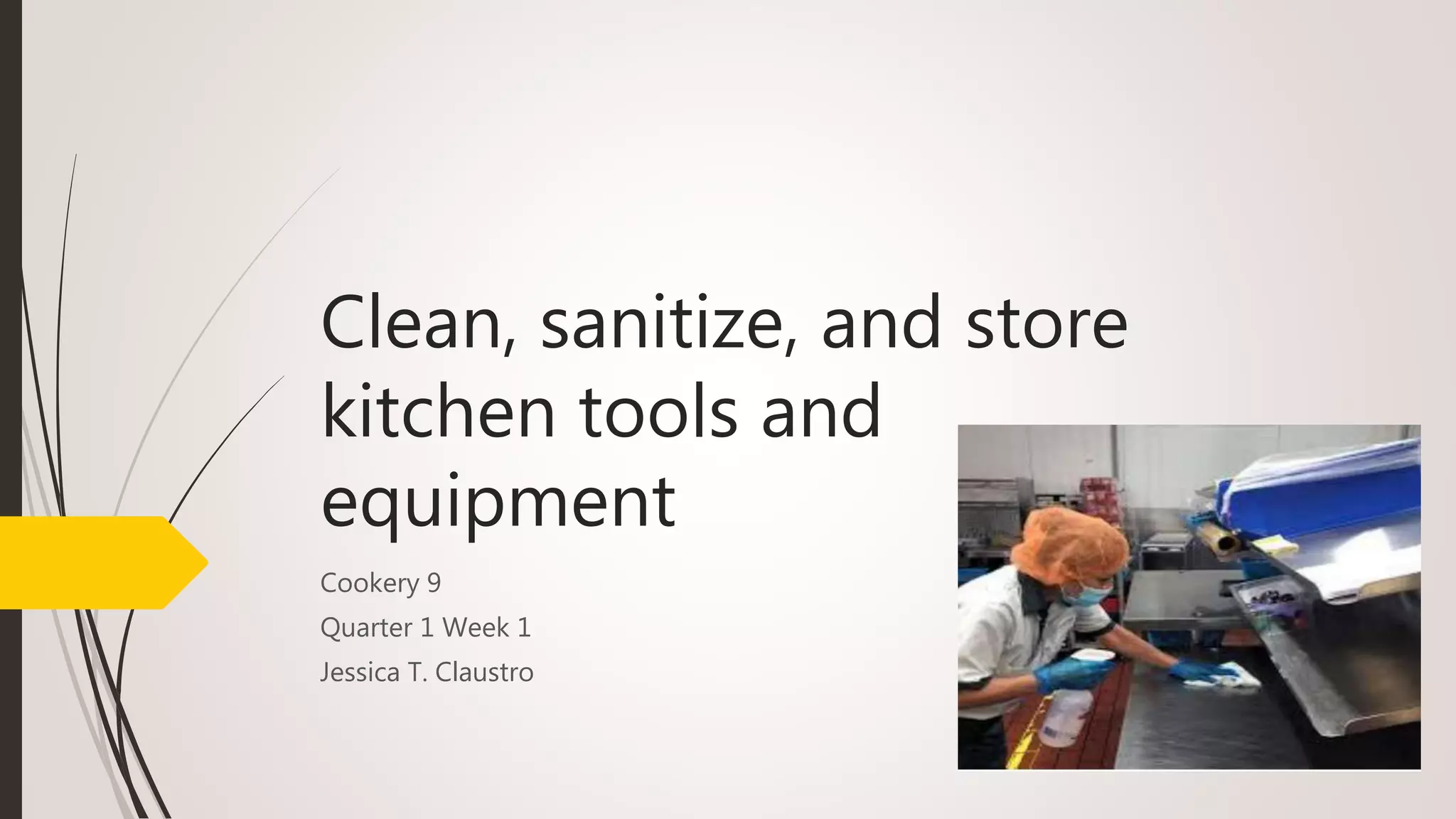
Clean, sanitize, and store
kitchen tools and
equipment
Cookery 9
Quarter 1 Week 1
Jessica T. Claustro
PRELIMINARY ACTIVITY
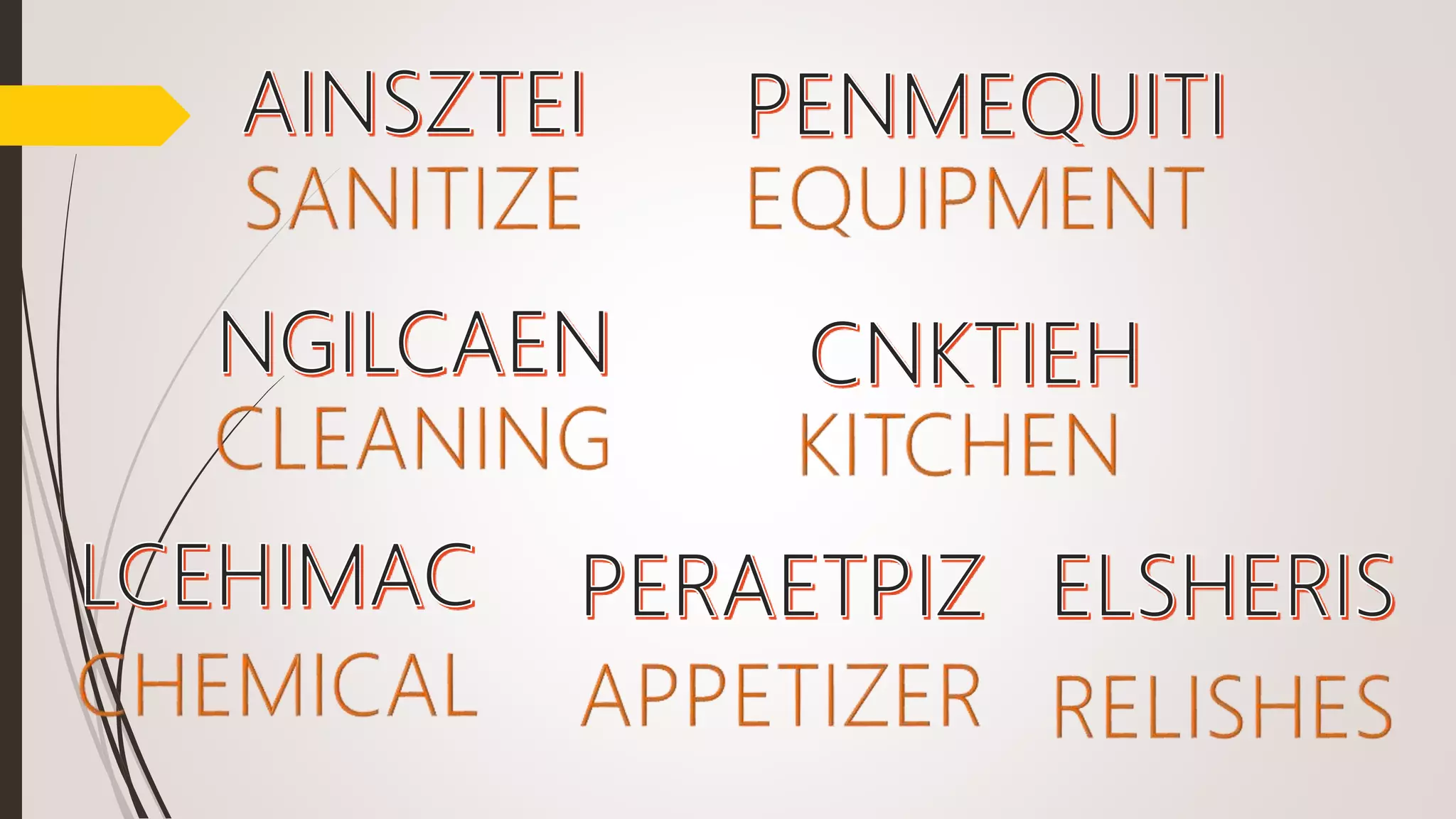
Given the scrambled letters below, unscramble them to get a word or a group of
words related to cleaning and maintaining kitchen premises.
Cleaning
 is the process that span the whole aspect of human life.
 Hygiene is a state were humans clean their body to prevent any
discomfort and diseases.
 Household and workplaces also requires cleaning and the process of
cleaning varies on their respective specific requirements.
 Cleaning refers to “ the action of making something clean, especially
inside of house ” (Oxford Languages, 2020). It is “ the activity of
removing dirt from things and places especially in the house “
(Cambridge English Dictionary, 2020). “It is the process of removing
unwanted substances, such as dirt, infectious agents, and other
impurities from an object or environment (Wikipedia, Internet).
Sanitizing
is defined as cleaning something to make it free from
bacteria or disease causing elements (yourdictionary.com).
Sanitation is the process of making something completely
clean and free from bacteria (Cambridge English Dictionary,
2020).
So, if cleaning is about removing dirt, sanitizing is about
removing microorganisms.
Sanitizing will also mean sterilizing.
Cleaning and sanitizing has to be done together in order to
make something clean and safe.
Before your start cleaning, you need to
know the following:
 1. Plan you Cleaning Activity;
 2. Make a Cleaning Schedule;
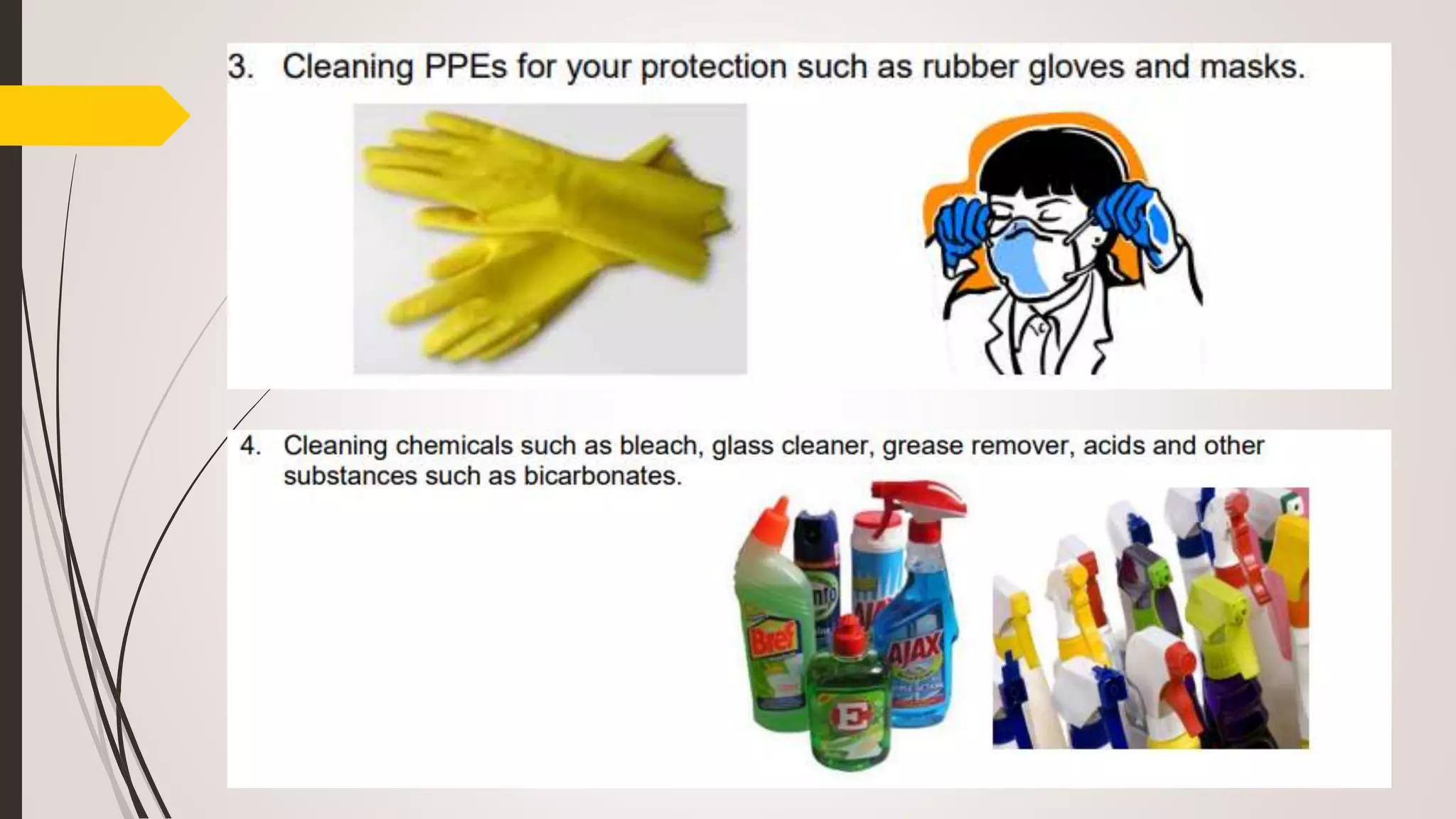
 3. Identify the PPEs to be used during the cleaning process;
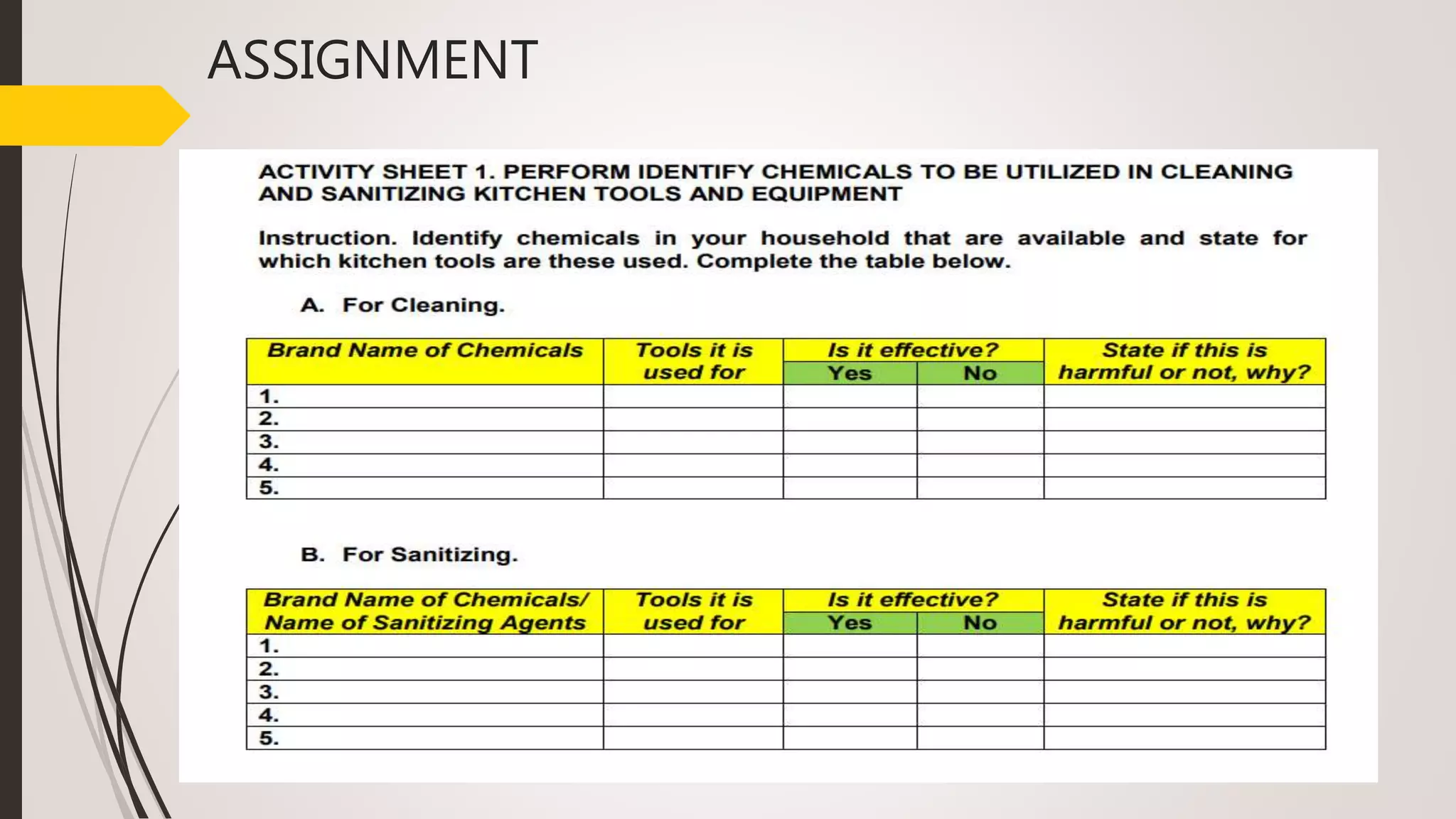
 4. Identify the chemicals to be utilized in cleaning and sanitizing kitchen
tools and equipment;
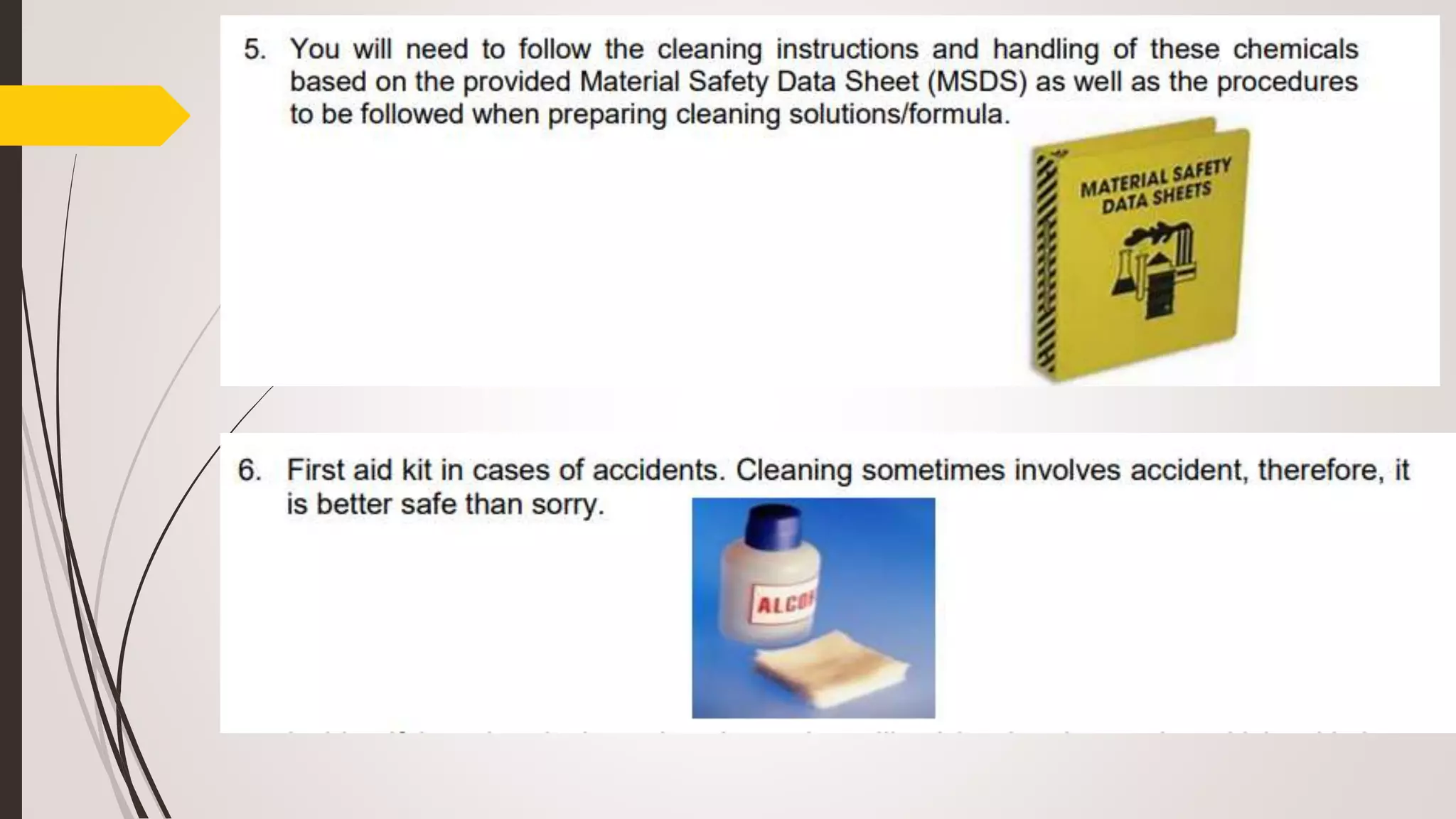
 5. Prepare cleaning agents in accordance with manufacturer’s instruction;
 6. Clean and and sanitize kitchen tools in accordance with prescribed
standards;
 7. Store cleaned kitchen tools and equipment safely in designated space.
CLEANING AND SANITIZING KITCHEN
TOOLS
1. Soap and Detergents
– commercially available cleaning agent that primarily contains
surfactants. These can come in powdered, liquid and bar forms.
2. Cleaning pads, sponges, brushes and scourers
– these will provide the cleaning action with the soap/detergents in
removing dirts, grease and other impurities.
Sanitizing Kitchen Tools and Equipment
 a. Put your utensils in a large pan, covering them fully in
water. Carefully bring the water to the boil, putting a lid on
the pan, for 5 minutes.
 b. Remove the lid and wait for the water to stop boiling
before removing the utensils with prongs.
 c. Another method for cleaning and sanitizing kitchen utensils
is to combine a tablespoon of bleach with a gallon of water,
leaving your tools to soak before rinsing them thoroughly
with hot water.
Sanitizing Kitchen Tools and Equipment
 a. Put your utensils in a large pan, covering them fully in
water. Carefully bring the water to the boil, putting a lid on
the pan, for 5 minutes.
 b. Remove the lid and wait for the water to stop boiling
before removing the utensils with prongs.
 c. Another method for cleaning and sanitizing kitchen utensils
is to combine a tablespoon of bleach with a gallon of water,
leaving your tools to soak before rinsing them thoroughly
with hot water.
When sanitizing kitchen tools, there are
acceptable and economical means:
 a. Sunlight
– the ultraviolet rays is the cheapest and the most effective sanitizing agent;
 b. Hot water
– effective but with economic issues (electricity and fuel cost);
 c. Electric sterilizer
– effective but expensive due to electric cost;
 d. Heating
– effective but expensive due to electric and fuel cost;
 e. Bleach
– effective for non-food contact surfaces but is not suitable for kitchen tools.
ASSIGNMENT

Cookery 9 q1 w1

  • 1.
    Clean, sanitize, andstore kitchen tools and equipment Cookery 9 Quarter 1 Week 1 Jessica T. Claustro
  • 4.
    PRELIMINARY ACTIVITY Given thescrambled letters below, unscramble them to get a word or a group of words related to cleaning and maintaining kitchen premises.
  • 6.
    Cleaning  is theprocess that span the whole aspect of human life.  Hygiene is a state were humans clean their body to prevent any discomfort and diseases.  Household and workplaces also requires cleaning and the process of cleaning varies on their respective specific requirements.  Cleaning refers to “ the action of making something clean, especially inside of house ” (Oxford Languages, 2020). It is “ the activity of removing dirt from things and places especially in the house “ (Cambridge English Dictionary, 2020). “It is the process of removing unwanted substances, such as dirt, infectious agents, and other impurities from an object or environment (Wikipedia, Internet).
  • 7.
    Sanitizing is defined ascleaning something to make it free from bacteria or disease causing elements (yourdictionary.com). Sanitation is the process of making something completely clean and free from bacteria (Cambridge English Dictionary, 2020). So, if cleaning is about removing dirt, sanitizing is about removing microorganisms. Sanitizing will also mean sterilizing. Cleaning and sanitizing has to be done together in order to make something clean and safe.
  • 8.
    Before your startcleaning, you need to know the following:  1. Plan you Cleaning Activity;  2. Make a Cleaning Schedule;  3. Identify the PPEs to be used during the cleaning process;  4. Identify the chemicals to be utilized in cleaning and sanitizing kitchen tools and equipment;  5. Prepare cleaning agents in accordance with manufacturer’s instruction;  6. Clean and and sanitize kitchen tools in accordance with prescribed standards;  7. Store cleaned kitchen tools and equipment safely in designated space.
  • 9.
    CLEANING AND SANITIZINGKITCHEN TOOLS 1. Soap and Detergents – commercially available cleaning agent that primarily contains surfactants. These can come in powdered, liquid and bar forms. 2. Cleaning pads, sponges, brushes and scourers – these will provide the cleaning action with the soap/detergents in removing dirts, grease and other impurities.
  • 12.
    Sanitizing Kitchen Toolsand Equipment  a. Put your utensils in a large pan, covering them fully in water. Carefully bring the water to the boil, putting a lid on the pan, for 5 minutes.  b. Remove the lid and wait for the water to stop boiling before removing the utensils with prongs.  c. Another method for cleaning and sanitizing kitchen utensils is to combine a tablespoon of bleach with a gallon of water, leaving your tools to soak before rinsing them thoroughly with hot water.
  • 13.
    Sanitizing Kitchen Toolsand Equipment  a. Put your utensils in a large pan, covering them fully in water. Carefully bring the water to the boil, putting a lid on the pan, for 5 minutes.  b. Remove the lid and wait for the water to stop boiling before removing the utensils with prongs.  c. Another method for cleaning and sanitizing kitchen utensils is to combine a tablespoon of bleach with a gallon of water, leaving your tools to soak before rinsing them thoroughly with hot water.
  • 14.
    When sanitizing kitchentools, there are acceptable and economical means:  a. Sunlight – the ultraviolet rays is the cheapest and the most effective sanitizing agent;  b. Hot water – effective but with economic issues (electricity and fuel cost);  c. Electric sterilizer – effective but expensive due to electric cost;  d. Heating – effective but expensive due to electric and fuel cost;  e. Bleach – effective for non-food contact surfaces but is not suitable for kitchen tools.
  • 15.