Convolution
CS474/674 – Prof. Bebis
Section 3.4, 4.2
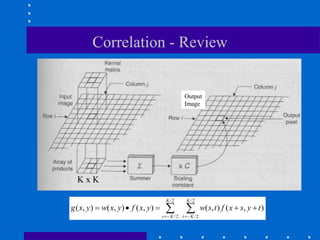
Correlation - Review
Output
Image
/2 /2
/2 /2
( , ) ( , ) ( , ) ( , ) ( , )
K K
s K t K
g x y w x y f x y w s t f x s y t
 
    
 
K x K
Convolution – Review
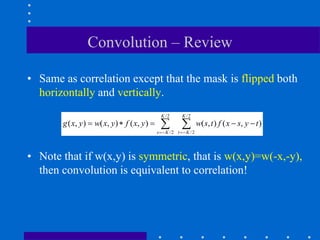
• Same as correlation except that the mask is flipped both
horizontally and vertically.
• Note that if w(x,y) is symmetric, that is w(x,y)=w(-x,-y),
then convolution is equivalent to correlation!
/2 /2
/2 /2
( , ) ( , ) ( , ) ( , ) ( , )
K K
s K t K
g x y w x y f x y w s t f x s y t
 
    
 
1D Continuous Convolution
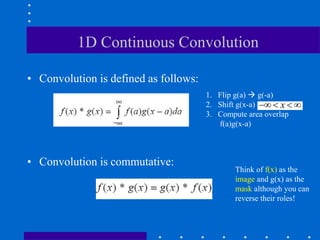
• Convolution is defined as follows:
• Convolution is commutative:
Think of f(x) as the
image and g(x) as the
mask although you can
reverse their roles!
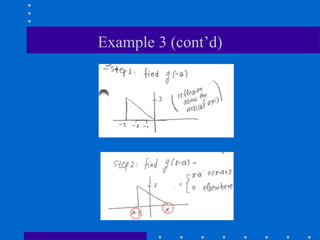
1. Flip g(a)  g(-a)
2. Shift g(x-a)
3. Compute area overlap
f(a)g(x-a)
x
  
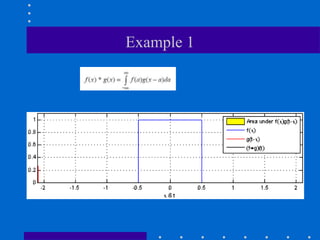
Example 1
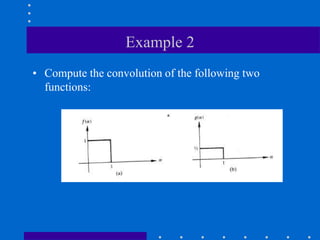
Example 2
• Compute the convolution of the following two
functions:
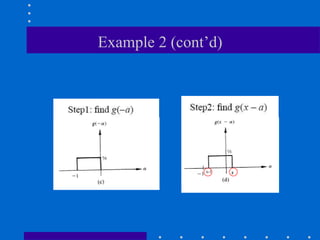
Example 2 (cont’d)
x-1
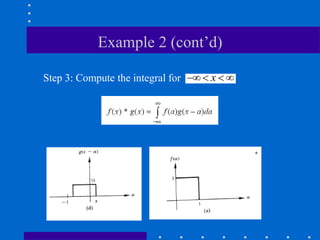
Example 2 (cont’d)
Step 3: Compute the integral for x
  
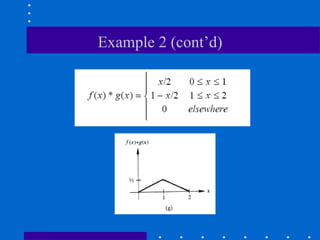
Example 2 (cont’d)
Important Observations
• The extent of f(x) * g(x) is equal to the extent of f(x)
plus the extent of g(x)
extent = 1 extent = 1
extent = 2
Important Observations (cont’d)
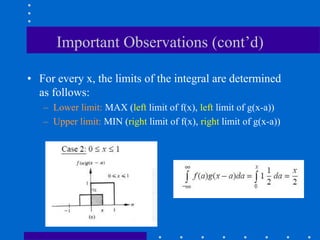
• For every x, the limits of the integral are determined
as follows:
– Lower limit: MAX (left limit of f(x), left limit of g(x-a))
– Upper limit: MIN (right limit of f(x), right limit of g(x-a))
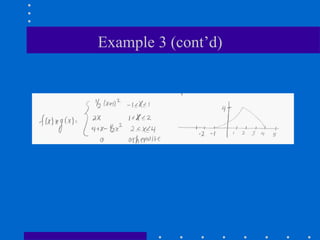
Example 3
α α
width = 2 width = 3
Example 3 (cont’d)
Example 3 (cont’d)
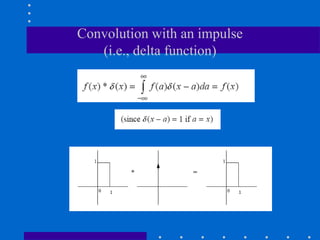
Convolution with an impulse
(i.e., delta function)
Convolution with an “train” of impulses
=
Convolution Theorem
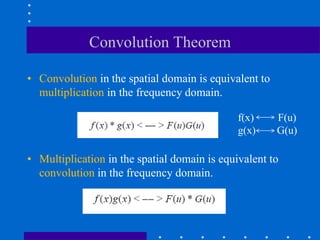
• Convolution in the spatial domain is equivalent to
multiplication in the frequency domain.
• Multiplication in the spatial domain is equivalent to
convolution in the frequency domain.
f(x) F(u)
g(x) G(u)
Efficient computation of (f * g)
• 1. Compute and
• 2. Multiply them:
• 3. Compute the inverse FT:
We will later analyze computational complexity!
(i.e., element-wise
complex multiplication)
Discrete Convolution
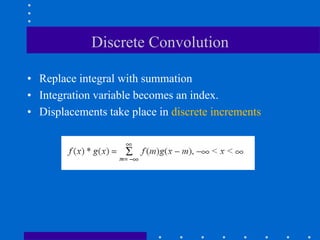
• Replace integral with summation
• Integration variable becomes an index.
• Displacements take place in discrete increments
Example
5 samples 3 samples
f(m) g(m)
-1 0 1
-2 -1 0 1 2
1 1
*
Example (cont’d)
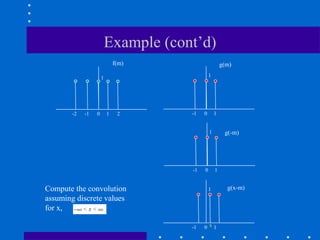
f(m) g(m)
-1 0 1
-2 -1 0 1 2
1 1
-1 0 1
1
-1 0 1
1
g(-m)
g(x-m)
x
Compute the convolution
assuming discrete values
for x,
Example (cont’d)
-4 -3 -2 -1 0 1 2
1
x
4 4
x or x
   
-3 -2 -1 0 1 2
1
x
3
x  
f *g = 0
f *g = 1
no overlap
Note that I show some
red samples “taller” for clarity!
Example (cont’d)
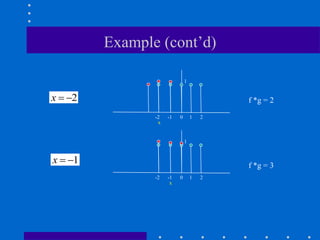
-2 -1 0 1 2
1
x
2
x  
1
x  
f *g = 2
f *g = 3
-2 -1 0 1 2
1
x
Example (cont’d)
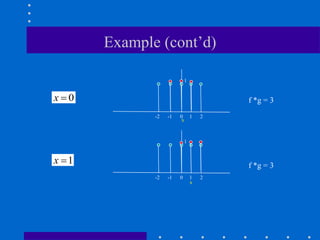
0
x 
1
x 
f *g = 3
f *g = 3
-2 -1 0 1 2
1
x
-2 -1 0 1 2
1
x
Example (cont’d)
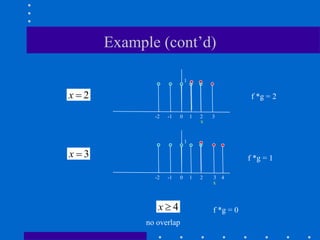
2
x 
3
x 
f *g = 2
f *g = 1
-2 -1 0 1 2 3 4
1
x
-2 -1 0 1 2 3
1
x
4
x  f *g = 0
no overlap
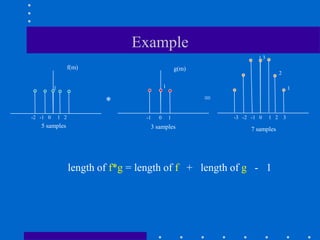
Example
5 samples 3 samples
f(m) g(m)
-1 0 1
1 1
* =
7 samples
-3 -2 -1 0 1 2 3
2
1
-2 -1 0 1 2
length of f*g = length of f + length of g - 1
3
Convolution Theorem in Discrete Case
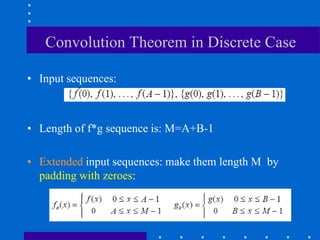
• Input sequences:
• Length of f*g sequence is: M=A+B-1
• Extended input sequences: make them length M by
padding with zeroes:
Convolution Theorem in Discrete Case
(cont’d)
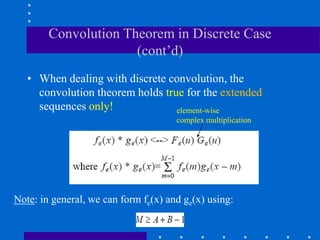
• When dealing with discrete convolution, the
convolution theorem holds true for the extended
sequences only!
Note: in general, we can form fe(x) and ge(x) using:
element-wise
complex multiplication
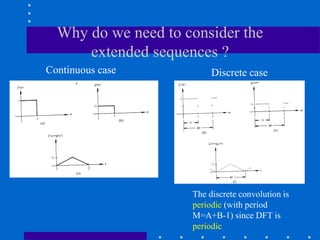
Why do we need to consider the
extended sequences ?
Continuous case Discrete case
The discrete convolution is
periodic (with period
M=A+B-1) since DFT is
periodic
Why do we need to consider the
extended sequences ? (cont’d)
If M<A+B-1, the periods move
closer to each other (overlap)
If M>A+B-1, the periods move
away from each other (no overlap)
Optimum:
M=A+B-1
2D Convolution
• Definition
• 2D convolution theorem element-wise
complex multiplication
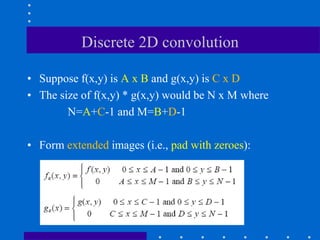
Discrete 2D convolution
• Suppose f(x,y) is A x B and g(x,y) is C x D
• The size of f(x,y) * g(x,y) would be N x M where
N=A+C-1 and M=B+D-1
• Form extended images (i.e., pad with zeroes):
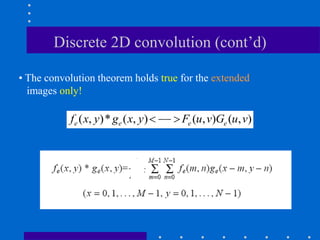
Discrete 2D convolution (cont’d)
• The convolution theorem holds true for the extended
images only!
( , )* ( , ) ( , ) ( , )
e e e e
f x y g x y F u v G u v
  
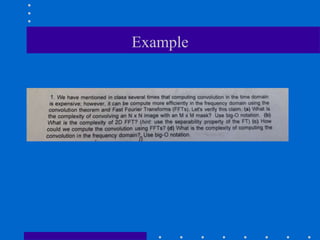
Example

Convolution.ppt

  • 1.
    Convolution CS474/674 – Prof.Bebis Section 3.4, 4.2
  • 2.
    Correlation - Review Output Image /2/2 /2 /2 ( , ) ( , ) ( , ) ( , ) ( , ) K K s K t K g x y w x y f x y w s t f x s y t          K x K
  • 3.
    Convolution – Review •Same as correlation except that the mask is flipped both horizontally and vertically. • Note that if w(x,y) is symmetric, that is w(x,y)=w(-x,-y), then convolution is equivalent to correlation! /2 /2 /2 /2 ( , ) ( , ) ( , ) ( , ) ( , ) K K s K t K g x y w x y f x y w s t f x s y t         
  • 4.
    1D Continuous Convolution •Convolution is defined as follows: • Convolution is commutative: Think of f(x) as the image and g(x) as the mask although you can reverse their roles! 1. Flip g(a)  g(-a) 2. Shift g(x-a) 3. Compute area overlap f(a)g(x-a) x   
  • 5.
  • 6.
    Example 2 • Computethe convolution of the following two functions:
  • 7.
  • 8.
    Example 2 (cont’d) Step3: Compute the integral for x   
  • 9.
  • 10.
    Important Observations • Theextent of f(x) * g(x) is equal to the extent of f(x) plus the extent of g(x) extent = 1 extent = 1 extent = 2
  • 11.
    Important Observations (cont’d) •For every x, the limits of the integral are determined as follows: – Lower limit: MAX (left limit of f(x), left limit of g(x-a)) – Upper limit: MIN (right limit of f(x), right limit of g(x-a))
  • 12.
    Example 3 α α width= 2 width = 3
  • 13.
  • 14.
  • 15.
    Convolution with animpulse (i.e., delta function)
  • 16.
    Convolution with an“train” of impulses =
  • 17.
    Convolution Theorem • Convolutionin the spatial domain is equivalent to multiplication in the frequency domain. • Multiplication in the spatial domain is equivalent to convolution in the frequency domain. f(x) F(u) g(x) G(u)
  • 18.
    Efficient computation of(f * g) • 1. Compute and • 2. Multiply them: • 3. Compute the inverse FT: We will later analyze computational complexity! (i.e., element-wise complex multiplication)
  • 19.
    Discrete Convolution • Replaceintegral with summation • Integration variable becomes an index. • Displacements take place in discrete increments
  • 20.
    Example 5 samples 3samples f(m) g(m) -1 0 1 -2 -1 0 1 2 1 1 *
  • 21.
    Example (cont’d) f(m) g(m) -10 1 -2 -1 0 1 2 1 1 -1 0 1 1 -1 0 1 1 g(-m) g(x-m) x Compute the convolution assuming discrete values for x,
  • 22.
    Example (cont’d) -4 -3-2 -1 0 1 2 1 x 4 4 x or x     -3 -2 -1 0 1 2 1 x 3 x   f *g = 0 f *g = 1 no overlap Note that I show some red samples “taller” for clarity!
  • 23.
    Example (cont’d) -2 -10 1 2 1 x 2 x   1 x   f *g = 2 f *g = 3 -2 -1 0 1 2 1 x
  • 24.
    Example (cont’d) 0 x  1 x f *g = 3 f *g = 3 -2 -1 0 1 2 1 x -2 -1 0 1 2 1 x
  • 25.
    Example (cont’d) 2 x  3 x f *g = 2 f *g = 1 -2 -1 0 1 2 3 4 1 x -2 -1 0 1 2 3 1 x 4 x  f *g = 0 no overlap
  • 26.
    Example 5 samples 3samples f(m) g(m) -1 0 1 1 1 * = 7 samples -3 -2 -1 0 1 2 3 2 1 -2 -1 0 1 2 length of f*g = length of f + length of g - 1 3
  • 27.
    Convolution Theorem inDiscrete Case • Input sequences: • Length of f*g sequence is: M=A+B-1 • Extended input sequences: make them length M by padding with zeroes:
  • 28.
    Convolution Theorem inDiscrete Case (cont’d) • When dealing with discrete convolution, the convolution theorem holds true for the extended sequences only! Note: in general, we can form fe(x) and ge(x) using: element-wise complex multiplication
  • 29.
    Why do weneed to consider the extended sequences ? Continuous case Discrete case The discrete convolution is periodic (with period M=A+B-1) since DFT is periodic
  • 30.
    Why do weneed to consider the extended sequences ? (cont’d) If M<A+B-1, the periods move closer to each other (overlap) If M>A+B-1, the periods move away from each other (no overlap) Optimum: M=A+B-1
  • 31.
    2D Convolution • Definition •2D convolution theorem element-wise complex multiplication
  • 32.
    Discrete 2D convolution •Suppose f(x,y) is A x B and g(x,y) is C x D • The size of f(x,y) * g(x,y) would be N x M where N=A+C-1 and M=B+D-1 • Form extended images (i.e., pad with zeroes):
  • 33.
    Discrete 2D convolution(cont’d) • The convolution theorem holds true for the extended images only! ( , )* ( , ) ( , ) ( , ) e e e e f x y g x y F u v G u v   
  • 34.