Signal Processing
Signal Processing
COS 323
COS 323
Digital “Signals”
Digital “Signals”
• 1D: functions of space or time (e.g., sound)
1D: functions of space or time (e.g., sound)
• 2D: often functions of 2 spatial dimensions
2D: often functions of 2 spatial dimensions
(e.g. images)
(e.g. images)
• 3D: functions of 3 spatial dimensions
3D: functions of 3 spatial dimensions
(CAT, MRI scans) or 2 space, 1 time (video)
Digital Signal Processing
1.
1. Understand analogues of
Understand analogues of filters
filters
2.
2. Understand nature of
Understand nature of sampling
sampling
Filtering
Filtering
• Consider a noisy 1D signal f(x)
Consider a noisy 1D signal f(x)
• Basic operation: smooth the signal
Basic operation: smooth the signal
– Output = new function h(x)
Output = new function h(x)
– Want properties: linearity, shift invariance
Want properties: linearity, shift invariance
• Linear Shift-Invariant Filters
Linear Shift-Invariant Filters
– If you double input, double output
If you double input, double output
– If you shift input, shift output
If you shift input, shift output
Convolution
Convolution
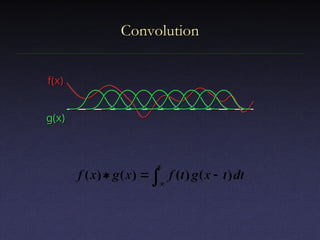
• Output signal at each point = weighted
Output signal at each point = weighted
average of local region of input signal
– Depends on input signal, pattern of weights
Depends on input signal, pattern of weights
– “
“Filter” g(x) = function of weights for linear
Filter” g(x) = function of weights for linear
combination
combination
– Basic operation = move filter to some position x,
Basic operation = move filter to some position x,
add up f times g
add up f times g
Convolution
Convolution






 dt
t
x
g
t
f
x
g
x
f )
(
)
(
)
(
)
(
f(x)
f(x)
g(x)
g(x)
Convolution
Convolution
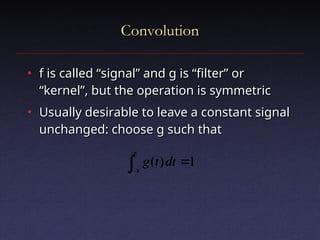
• f is called “signal” and g is “filter” or
f is called “signal” and g is “filter” or
“kernel”, but the operation is symmetric
• Usually desirable to leave a constant signal
Usually desirable to leave a constant signal
unchanged: choose g such that
1
)
( 




dt
t
g
Filter Choices
Filter Choices
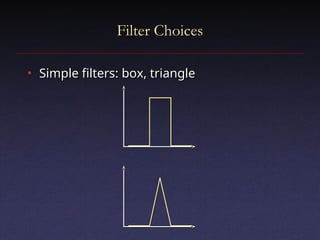
• Simple filters: box, triangle
Simple filters: box, triangle
Gaussian Filter
Gaussian Filter
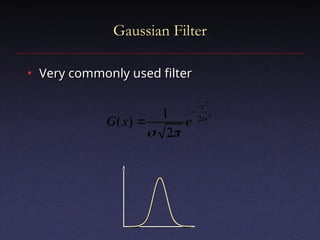
• Very commonly used filter
Very commonly used filter
2
2
2
2
1
)
( 


x
e
x
G


Gaussian Filters
Gaussian Filters
• Gaussians are used because:
Gaussians are used because:
– Smooth (infinitely differentiable)
Smooth (infinitely differentiable)
– Decay to zero rapidly
Decay to zero rapidly
– Simple analytic formula
Simple analytic formula
– Separable: multidimensional Gaussian =
Separable: multidimensional Gaussian =
product of Gaussians in each dimension
– Convolution of 2 Gaussians = Gaussian
Convolution of 2 Gaussians = Gaussian
– Limit of applying multiple filters is Gaussian
Limit of applying multiple filters is Gaussian
(Central limit theorem)
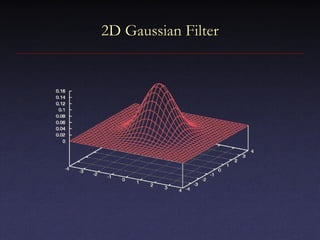
2D Gaussian Filter
2D Gaussian Filter
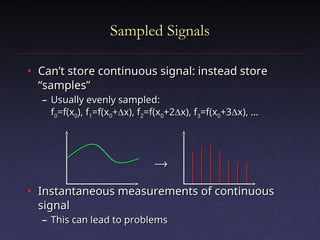
Sampled Signals
Sampled Signals
• Can’t store continuous signal: instead store
Can’t store continuous signal: instead store
“samples”
“samples”
– Usually evenly sampled:
Usually evenly sampled:
f
f0
0=f(x
=f(x0
0), f
), f1
1=f(x
=f(x0
0+
+
x), f
x), f2
2=f(x
=f(x0
0+2
+2
x), f
x), f3
3=f(x
=f(x0
0+3
+3
x), …
x), …
• Instantaneous measurements of continuous
Instantaneous measurements of continuous
signal
signal
– This can lead to problems
This can lead to problems


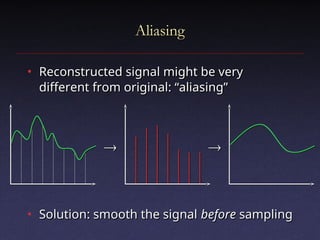
Aliasing
Aliasing
• Reconstructed signal might be very
Reconstructed signal might be very
different from original: “aliasing”
• Solution: smooth the signal
Solution: smooth the signal before
before sampling
sampling

 

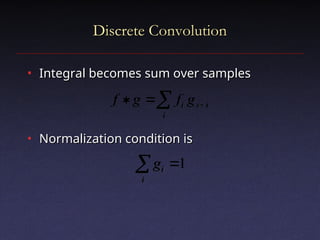
Discrete Convolution
• Integral becomes sum over samples
Integral becomes sum over samples
• Normalization condition is
Normalization condition is
 


i
i
x
i g
f
g
f
1


i
i
g
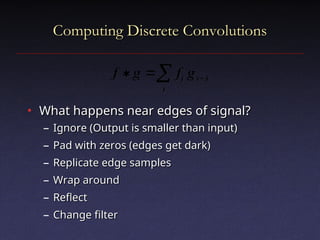
Computing Discrete Convolutions
• What happens near edges of signal?
What happens near edges of signal?
– Ignore (Output is smaller than input)
Ignore (Output is smaller than input)
– Pad with zeros (edges get dark)
Pad with zeros (edges get dark)
– Replicate edge samples
Replicate edge samples
– Wrap around
Wrap around
– Reflect
Reflect
– Change filter
Change filter
 


i
i
x
i g
f
g
f
Computing Discrete Convolutions
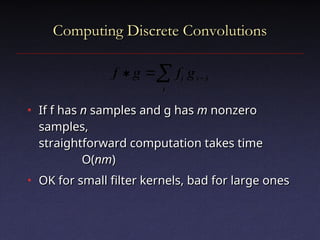
• If f has
If f has n
n samples and g has
samples and g has m
m nonzero
nonzero
samples,
samples,
straightforward computation takes time
O(
O(nm
nm)
)
• OK for small filter kernels, bad for large ones
OK for small filter kernels, bad for large ones
 


i
i
x
i g
f
g
f
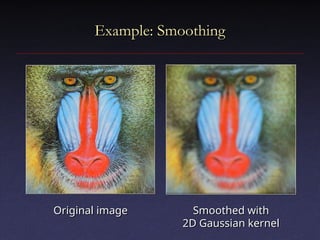
Example: Smoothing
Example: Smoothing
Original image
Original image Smoothed with
Smoothed with
2D Gaussian kernel
2D Gaussian kernel
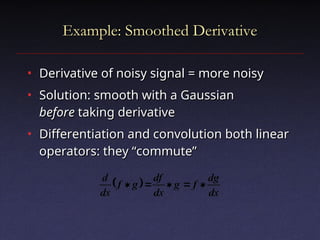
Example: Smoothed Derivative
• Derivative of noisy signal = more noisy
Derivative of noisy signal = more noisy
• Solution: smooth with a Gaussian
Solution: smooth with a Gaussian
before
before taking derivative
taking derivative
• Differentiation and convolution both linear
Differentiation and convolution both linear
operators: they “commute”
 
dx
dg
f
g
dx
df
g
f
dx
d





Example: Smoothed Derivative
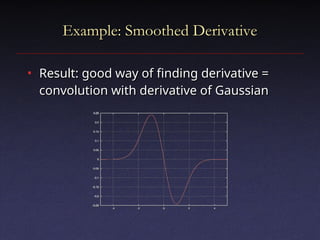
• Result: good way of finding derivative =
Result: good way of finding derivative =
convolution with derivative of Gaussian
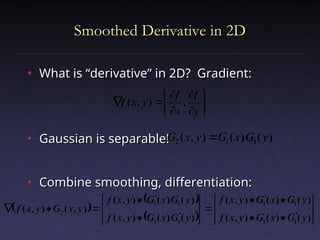
Smoothed Derivative in 2D
• What is “derivative” in 2D? Gradient:
What is “derivative” in 2D? Gradient:
• Gaussian is separable!
Gaussian is separable!
• Combine smoothing, differentiation:
Combine smoothing, differentiation:














y
f
x
f
y
x
f ,
)
,
(
 
 
  

























)
(
)
(
)
,
(
)
(
)
(
)
,
(
)
(
)
(
)
,
(
)
(
)
(
)
,
(
)
,
(
)
,
(
1
1
1
1
1
1
1
1
2
y
G
x
G
y
x
f
y
G
x
G
y
x
f
y
G
x
G
y
x
f
y
G
x
G
y
x
f
y
x
G
y
x
f
)
(
)
(
)
,
( 1
1
2 y
G
x
G
y
x
G 
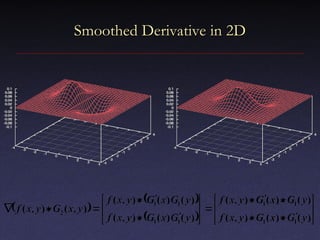
Smoothed Derivative in 2D
 
 
  

























)
(
)
(
)
,
(
)
(
)
(
)
,
(
)
(
)
(
)
,
(
)
(
)
(
)
,
(
)
,
(
)
,
(
1
1
1
1
1
1
1
1
2
y
G
x
G
y
x
f
y
G
x
G
y
x
f
y
G
x
G
y
x
f
y
G
x
G
y
x
f
y
x
G
y
x
f
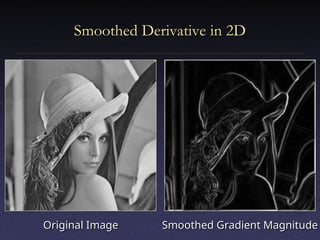
Smoothed Derivative in 2D
Original Image
Original Image Smoothed Gradient Magnitude
Smoothed Gradient Magnitude
Canny Edge Detector
Canny Edge Detector
• Smooth
Smooth
• Find derivative
Find derivative
• Find maxima
Find maxima
• Threshold
Threshold
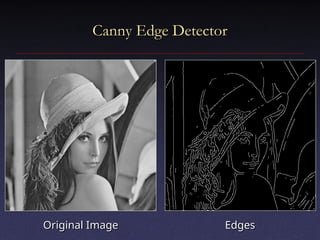
Canny Edge Detector
Canny Edge Detector
Original Image
Original Image Edges
Edges
Fourier Transform
Fourier Transform
• Transform applied to function to analyze its
Transform applied to function to analyze its
“frequency” content
“frequency” content
• Several versions
Several versions
– Fourier series:
Fourier series:
• input = continuous, bounded; output = discrete, unbounded
input = continuous, bounded; output = discrete, unbounded
– Fourier transform:
Fourier transform:
• input = continuous, unbounded; output = continuous, unbounded
input = continuous, unbounded; output = continuous, unbounded
– Discrete Fourier transform (DFT):
Discrete Fourier transform (DFT):
• input = discrete, bounded; output = discrete, bounded
input = discrete, bounded; output = discrete, bounded
Fourier Series
Fourier Series
• Periodic function f(x) defined over [–
Periodic function f(x) defined over [–
 ..
.. 
 ]
]
where
where






1
0
2
1
)
sin(
)
cos(
)
(
n
n
n nx
b
nx
a
a
x
f












dx
nx
x
f
b
dx
nx
x
f
a
n
n
)
sin(
)
(
)
cos(
)
(
1
1
Fourier Series
Fourier Series
• This works because sines, cosines are
This works because sines, cosines are
orthonormal over [–
orthonormal over [–
 ..
.. 
 ]:
]:
• Kronecker delta:
Kronecker delta:


 










otherwise
0
if
1
0
)
cos(
)
sin(
)
sin(
)
sin(
)
cos(
)
cos(
1
1
1
n
m
dx
nx
mx
dx
nx
mx
dx
nx
mx
mn
mn
mn












Fourier Transform
Fourier Transform
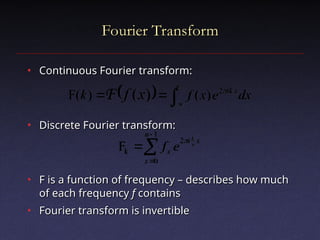
• Continuous Fourier transform:
Continuous Fourier transform:
• Discrete Fourier transform:
Discrete Fourier transform:
• F is a function of frequency – describes how much
F is a function of frequency – describes how much
of each frequency
of each frequency f
f contains
contains
• Fourier transform is invertible
Fourier transform is invertible
  dx
e
x
f
k x
ik
x
f 




 
2
)
(
)
(
F )
(
F




1
0
2
k
F
n
x
x
i
x
n
k
e
f

Fourier Transform and Convolution
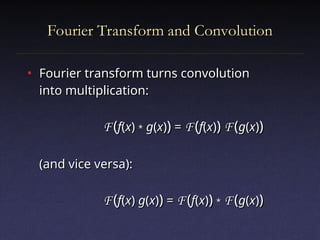
• Fourier transform turns convolution
Fourier transform turns convolution
into multiplication:
F
F (
(f
f(
(x
x)
) *
* g
g(
(x
x)
))
) =
= F
F (
(f
f(
(x
x)
))
) F
F (
(g
g(
(x
x)
))
)
(and vice versa):
(and vice versa):
F
F (
(f
f(
(x
x)
) g
g(
(x
x)
))
) =
= F
F (
(f
f(
(x
x)
))
) *
* F
F (
(g
g(
(x
x)
))
)
Fourier Transform and Convolution
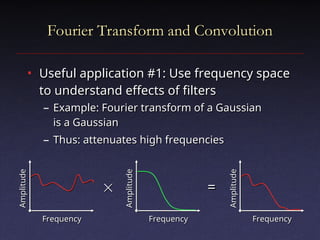
• Useful application #1: Use frequency space
Useful application #1: Use frequency space
to understand effects of filters
– Example: Fourier transform of a Gaussian
Example: Fourier transform of a Gaussian
is a Gaussian
is a Gaussian
– Thus: attenuates high frequencies
Thus: attenuates high frequencies

 =
=
Frequency
Frequency
Amplitude
Amplitude
Frequency
Frequency
Amplitude
Amplitude
Frequency
Frequency
Amplitude
Amplitude
Fourier Transform and Convolution
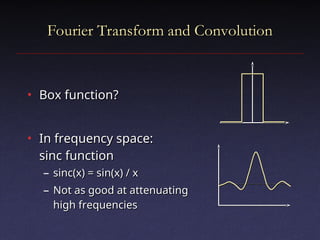
• Box function?
Box function?
• In frequency space:
In frequency space:
sinc function
sinc function
– sinc(x) = sin(x) / x
sinc(x) = sin(x) / x
– Not as good at attenuating
Not as good at attenuating
high frequencies
high frequencies
Fourier Transform and Convolution
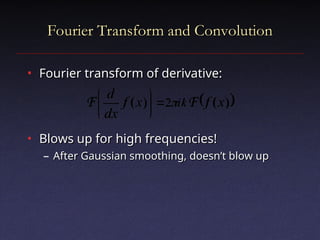
• Fourier transform of derivative:
Fourier transform of derivative:
• Blows up for high frequencies!
Blows up for high frequencies!
– After Gaussian smoothing, doesn’t blow up
After Gaussian smoothing, doesn’t blow up
 
)
(
)
( 2 x
f
x
f
dx
d
k
i F
F 









Fourier Transform and Convolution
• Useful application #2: Efficient
Useful application #2: Efficient
computation
computation
– Fast Fourier Transform (FFT) takes time
Fast Fourier Transform (FFT) takes time
O(
O(n
n log
log n
n)
)
– Thus, convolution can be performed in time
Thus, convolution can be performed in time
O(
O(n
n log
log n
n +
+ m
m log
log m
m)
)
– Greatest efficiency gains for large filters
Greatest efficiency gains for large filters

cos323_s06_lecture13_sigproc bio signal processing

  • 1.
  • 2.
    Digital “Signals” Digital “Signals” •1D: functions of space or time (e.g., sound) 1D: functions of space or time (e.g., sound) • 2D: often functions of 2 spatial dimensions 2D: often functions of 2 spatial dimensions (e.g. images) (e.g. images) • 3D: functions of 3 spatial dimensions 3D: functions of 3 spatial dimensions (CAT, MRI scans) or 2 space, 1 time (video) (CAT, MRI scans) or 2 space, 1 time (video)
  • 3.
    Digital Signal Processing DigitalSignal Processing 1. 1. Understand analogues of Understand analogues of filters filters 2. 2. Understand nature of Understand nature of sampling sampling
  • 4.
    Filtering Filtering • Consider anoisy 1D signal f(x) Consider a noisy 1D signal f(x) • Basic operation: smooth the signal Basic operation: smooth the signal – Output = new function h(x) Output = new function h(x) – Want properties: linearity, shift invariance Want properties: linearity, shift invariance • Linear Shift-Invariant Filters Linear Shift-Invariant Filters – If you double input, double output If you double input, double output – If you shift input, shift output If you shift input, shift output
  • 5.
    Convolution Convolution • Output signalat each point = weighted Output signal at each point = weighted average of local region of input signal average of local region of input signal – Depends on input signal, pattern of weights Depends on input signal, pattern of weights – “ “Filter” g(x) = function of weights for linear Filter” g(x) = function of weights for linear combination combination – Basic operation = move filter to some position x, Basic operation = move filter to some position x, add up f times g add up f times g
  • 6.
  • 7.
    Convolution Convolution • f iscalled “signal” and g is “filter” or f is called “signal” and g is “filter” or “kernel”, but the operation is symmetric “kernel”, but the operation is symmetric • Usually desirable to leave a constant signal Usually desirable to leave a constant signal unchanged: choose g such that unchanged: choose g such that 1 ) (      dt t g
  • 8.
    Filter Choices Filter Choices •Simple filters: box, triangle Simple filters: box, triangle
  • 9.
    Gaussian Filter Gaussian Filter •Very commonly used filter Very commonly used filter 2 2 2 2 1 ) (    x e x G  
  • 10.
    Gaussian Filters Gaussian Filters •Gaussians are used because: Gaussians are used because: – Smooth (infinitely differentiable) Smooth (infinitely differentiable) – Decay to zero rapidly Decay to zero rapidly – Simple analytic formula Simple analytic formula – Separable: multidimensional Gaussian = Separable: multidimensional Gaussian = product of Gaussians in each dimension product of Gaussians in each dimension – Convolution of 2 Gaussians = Gaussian Convolution of 2 Gaussians = Gaussian – Limit of applying multiple filters is Gaussian Limit of applying multiple filters is Gaussian (Central limit theorem) (Central limit theorem)
  • 11.
    2D Gaussian Filter 2DGaussian Filter
  • 12.
    Sampled Signals Sampled Signals •Can’t store continuous signal: instead store Can’t store continuous signal: instead store “samples” “samples” – Usually evenly sampled: Usually evenly sampled: f f0 0=f(x =f(x0 0), f ), f1 1=f(x =f(x0 0+ + x), f x), f2 2=f(x =f(x0 0+2 +2 x), f x), f3 3=f(x =f(x0 0+3 +3 x), … x), … • Instantaneous measurements of continuous Instantaneous measurements of continuous signal signal – This can lead to problems This can lead to problems  
  • 13.
    Aliasing Aliasing • Reconstructed signalmight be very Reconstructed signal might be very different from original: “aliasing” different from original: “aliasing” • Solution: smooth the signal Solution: smooth the signal before before sampling sampling    
  • 14.
    Discrete Convolution Discrete Convolution •Integral becomes sum over samples Integral becomes sum over samples • Normalization condition is Normalization condition is     i i x i g f g f 1   i i g
  • 15.
    Computing Discrete Convolutions ComputingDiscrete Convolutions • What happens near edges of signal? What happens near edges of signal? – Ignore (Output is smaller than input) Ignore (Output is smaller than input) – Pad with zeros (edges get dark) Pad with zeros (edges get dark) – Replicate edge samples Replicate edge samples – Wrap around Wrap around – Reflect Reflect – Change filter Change filter     i i x i g f g f
  • 16.
    Computing Discrete Convolutions ComputingDiscrete Convolutions • If f has If f has n n samples and g has samples and g has m m nonzero nonzero samples, samples, straightforward computation takes time straightforward computation takes time O( O(nm nm) ) • OK for small filter kernels, bad for large ones OK for small filter kernels, bad for large ones     i i x i g f g f
  • 17.
    Example: Smoothing Example: Smoothing Originalimage Original image Smoothed with Smoothed with 2D Gaussian kernel 2D Gaussian kernel
  • 18.
    Example: Smoothed Derivative Example:Smoothed Derivative • Derivative of noisy signal = more noisy Derivative of noisy signal = more noisy • Solution: smooth with a Gaussian Solution: smooth with a Gaussian before before taking derivative taking derivative • Differentiation and convolution both linear Differentiation and convolution both linear operators: they “commute” operators: they “commute”   dx dg f g dx df g f dx d     
  • 19.
    Example: Smoothed Derivative Example:Smoothed Derivative • Result: good way of finding derivative = Result: good way of finding derivative = convolution with derivative of Gaussian convolution with derivative of Gaussian
  • 20.
    Smoothed Derivative in2D Smoothed Derivative in 2D • What is “derivative” in 2D? Gradient: What is “derivative” in 2D? Gradient: • Gaussian is separable! Gaussian is separable! • Combine smoothing, differentiation: Combine smoothing, differentiation:               y f x f y x f , ) , (                                 ) ( ) ( ) , ( ) ( ) ( ) , ( ) ( ) ( ) , ( ) ( ) ( ) , ( ) , ( ) , ( 1 1 1 1 1 1 1 1 2 y G x G y x f y G x G y x f y G x G y x f y G x G y x f y x G y x f ) ( ) ( ) , ( 1 1 2 y G x G y x G 
  • 21.
    Smoothed Derivative in2D Smoothed Derivative in 2D                                 ) ( ) ( ) , ( ) ( ) ( ) , ( ) ( ) ( ) , ( ) ( ) ( ) , ( ) , ( ) , ( 1 1 1 1 1 1 1 1 2 y G x G y x f y G x G y x f y G x G y x f y G x G y x f y x G y x f
  • 22.
    Smoothed Derivative in2D Smoothed Derivative in 2D Original Image Original Image Smoothed Gradient Magnitude Smoothed Gradient Magnitude
  • 23.
    Canny Edge Detector CannyEdge Detector • Smooth Smooth • Find derivative Find derivative • Find maxima Find maxima • Threshold Threshold
  • 24.
    Canny Edge Detector CannyEdge Detector Original Image Original Image Edges Edges
  • 25.
    Fourier Transform Fourier Transform •Transform applied to function to analyze its Transform applied to function to analyze its “frequency” content “frequency” content • Several versions Several versions – Fourier series: Fourier series: • input = continuous, bounded; output = discrete, unbounded input = continuous, bounded; output = discrete, unbounded – Fourier transform: Fourier transform: • input = continuous, unbounded; output = continuous, unbounded input = continuous, unbounded; output = continuous, unbounded – Discrete Fourier transform (DFT): Discrete Fourier transform (DFT): • input = discrete, bounded; output = discrete, bounded input = discrete, bounded; output = discrete, bounded
  • 26.
    Fourier Series Fourier Series •Periodic function f(x) defined over [– Periodic function f(x) defined over [–  .. ..   ] ] where where       1 0 2 1 ) sin( ) cos( ) ( n n n nx b nx a a x f             dx nx x f b dx nx x f a n n ) sin( ) ( ) cos( ) ( 1 1
  • 27.
    Fourier Series Fourier Series •This works because sines, cosines are This works because sines, cosines are orthonormal over [– orthonormal over [–  .. ..   ]: ]: • Kronecker delta: Kronecker delta:               otherwise 0 if 1 0 ) cos( ) sin( ) sin( ) sin( ) cos( ) cos( 1 1 1 n m dx nx mx dx nx mx dx nx mx mn mn mn            
  • 28.
    Fourier Transform Fourier Transform •Continuous Fourier transform: Continuous Fourier transform: • Discrete Fourier transform: Discrete Fourier transform: • F is a function of frequency – describes how much F is a function of frequency – describes how much of each frequency of each frequency f f contains contains • Fourier transform is invertible Fourier transform is invertible   dx e x f k x ik x f        2 ) ( ) ( F ) ( F     1 0 2 k F n x x i x n k e f 
  • 29.
    Fourier Transform andConvolution Fourier Transform and Convolution • Fourier transform turns convolution Fourier transform turns convolution into multiplication: into multiplication: F F ( (f f( (x x) ) * * g g( (x x) )) ) = = F F ( (f f( (x x) )) ) F F ( (g g( (x x) )) ) (and vice versa): (and vice versa): F F ( (f f( (x x) ) g g( (x x) )) ) = = F F ( (f f( (x x) )) ) * * F F ( (g g( (x x) )) )
  • 30.
    Fourier Transform andConvolution Fourier Transform and Convolution • Useful application #1: Use frequency space Useful application #1: Use frequency space to understand effects of filters to understand effects of filters – Example: Fourier transform of a Gaussian Example: Fourier transform of a Gaussian is a Gaussian is a Gaussian – Thus: attenuates high frequencies Thus: attenuates high frequencies   = = Frequency Frequency Amplitude Amplitude Frequency Frequency Amplitude Amplitude Frequency Frequency Amplitude Amplitude
  • 31.
    Fourier Transform andConvolution Fourier Transform and Convolution • Box function? Box function? • In frequency space: In frequency space: sinc function sinc function – sinc(x) = sin(x) / x sinc(x) = sin(x) / x – Not as good at attenuating Not as good at attenuating high frequencies high frequencies
  • 32.
    Fourier Transform andConvolution Fourier Transform and Convolution • Fourier transform of derivative: Fourier transform of derivative: • Blows up for high frequencies! Blows up for high frequencies! – After Gaussian smoothing, doesn’t blow up After Gaussian smoothing, doesn’t blow up   ) ( ) ( 2 x f x f dx d k i F F          
  • 33.
    Fourier Transform andConvolution Fourier Transform and Convolution • Useful application #2: Efficient Useful application #2: Efficient computation computation – Fast Fourier Transform (FFT) takes time Fast Fourier Transform (FFT) takes time O( O(n n log log n n) ) – Thus, convolution can be performed in time Thus, convolution can be performed in time O( O(n n log log n n + + m m log log m m) ) – Greatest efficiency gains for large filters Greatest efficiency gains for large filters