Deep Learning
Convolutional and Pooling Layers
Dr. Ahsen Tahir
.The slides in part have been modified from Ian Good Fellow book slides and Alex’s Dive in to Deep Learning book slides
Convolutional Networks
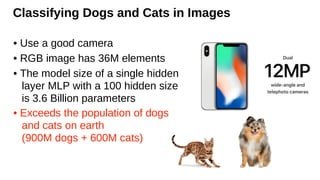
Classifying Dogs and Cats in Images
• Use a good camera
• RGB image has 36M elements
• The model size of a single hidden
layer MLP with a 100 hidden size
is 3.6 Billion parameters
• Exceeds the population of dogs
and cats on earth
(900M dogs + 600M cats)
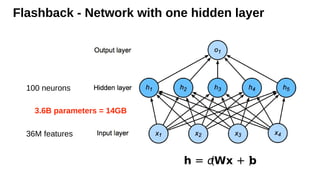
Flashback - Network with one hidden layer
36M features
100 neurons
h = σ
(Wx + b
)
3.6B parameters = 14GB
Convolution
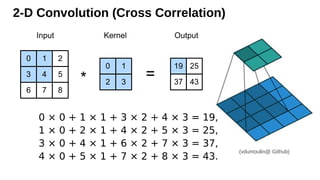
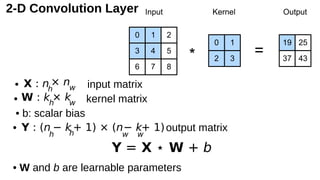
2-D Convolution (Cross Correlation)
(vdumoulin@ Github)
0 × 0 + 1 × 1 + 3 × 2 + 4 × 3 = 19,
1 × 0 + 2 × 1 + 4 × 2 + 5 × 3 = 25,
3 × 0 + 4 × 1 + 6 × 2 + 7 × 3 = 37,
4 × 0 + 5 × 1 + 7 × 2 + 8 × 3 = 43.
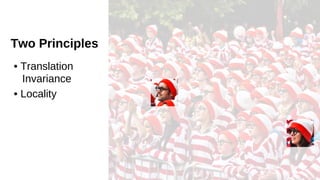
• Translation
Invariance
• Locality
Two Principles
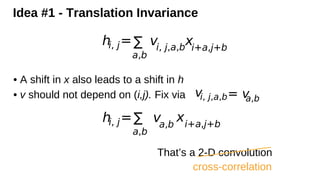
Idea #1 - Translation Invariance
• A shift in x also leads to a shift in h
• v should not depend on (i,j). Fix via vi, j,a,b= v
a,b
hi, j=∑
a,b
va,b
xi+a,j+b
hi, j=∑
a,b
vi, j,a,b
xi+a,j+b
That’s a 2-D convolution
cross-correlation
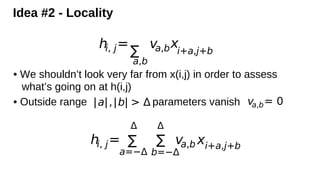
Idea #2 - Locality
• We shouldn’t look very far from x(i,j) in order to assess
what’s going on at h(i,j)
• Outside range parameters vanish
hi, j=
∑
a,b
va,bxi+a,j+b
|a|,|b| > Δ va,b= 0
hi, j=
Δ
∑
a=−Δ
Δ
∑
b=−Δ
va,b xi+a,j+b
2-D Convolution Layer
• input matrix
• kernel matrix
• b: scalar bias
• output matrix
• W and b are learnable parameters
Y = X ⋆ W + b
X : nh
× nw
W : kh
× kw
Y : (n
h
− kh
+ 1) × (n
w
− k
w
+ 1)
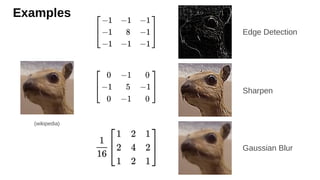
Examples
Edge Detection
Sharpen
Gaussian Blur
(wikipedia)
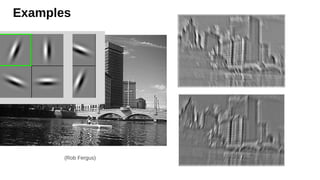
Examples
(Rob Fergus)
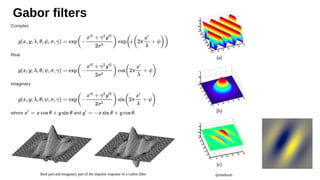
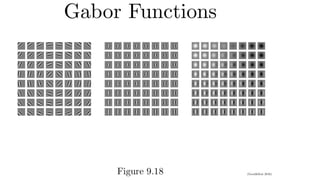
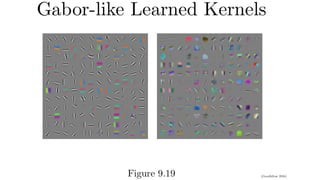
Gabor filters
@medium
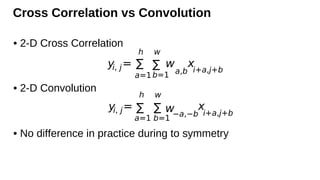
Cross Correlation vs Convolution
• 2-D Cross Correlation
• 2-D Convolution
• No difference in practice during to symmetry
yi, j=
h
∑
a=1
w
∑
b=1
w
a,b
xi+a,j+b
yi, j=
h
∑
a=1
w
∑
b=1
w−a,−b
x
i+a,j+b
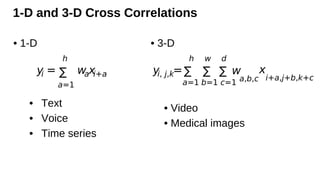
1-D and 3-D Cross Correlations
yi =
h
∑
a=1
waxi+a yi, j,k=
h
∑
a=1
w
∑
b=1
d
∑
c=1
w
a,b,c
x
i+a,j+b,k+c
• 1-D
• Text
• Voice
• Time series
• 3-D
• Video
• Medical images
courses.d2l.ai/berkeley-stat-157
Padding and Stride
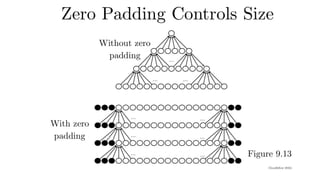
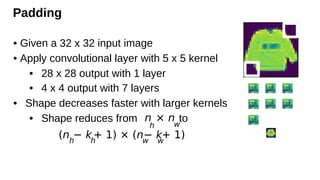
Padding
• Given a 32 x 32 input image
• Apply convolutional layer with 5 x 5 kernel
• 28 x 28 output with 1 layer
• 4 x 4 output with 7 layers
• Shape decreases faster with larger kernels
• Shape reduces from to
n
h
× n
w
(nh
− kh
+ 1) × (nw
− k
w
+ 1)
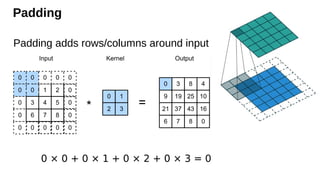
Padding
Padding adds rows/columns around input
0 × 0 + 0 × 1 + 0 × 2 + 0 × 3 = 0
Padding
• If Padding
• A common choice is
(n − k
+ 2p + 1)
p=1 (means zero layer around each side of image)
2p= k − 1
Stride
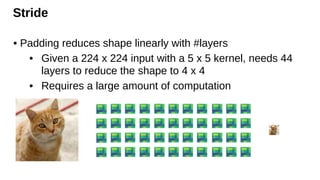
• Padding reduces shape linearly with #layers
• Given a 224 x 224 input with a 5 x 5 kernel, needs 44
layers to reduce the shape to 4 x 4
• Requires a large amount of computation
Stride
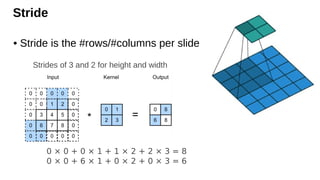
• Stride is the #rows/#columns per slide
Strides of 3 and 2 for height and width
0 × 0 + 0 × 1 + 1 × 2 + 2 × 3 = 8
0 × 0 + 6 × 1 + 0 × 2 + 0 × 3 = 6
Stride
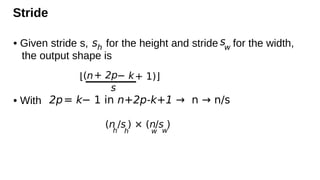
• Given stride s, for the height and stride for the width,
the output shape is
• With
sh
sw
2p= k− 1 in n+2p-k+1 → n → n/s
(n
h
/s
h
) × (n
w
/s
w
)
(n − k+ 1)
+ 2p
s
⌊ ⌋
courses.d2l.ai/berkeley-stat-157
Multiple Input and
Output Channels
Multiple Input Channels
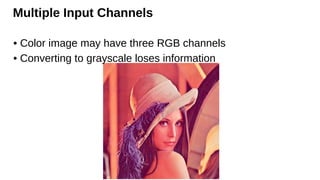
• Color image may have three RGB channels
• Converting to grayscale loses information
Multiple Input Channels
• Color image may have three RGB channels
• Converting to grayscale loses information
Multiple Input Channels
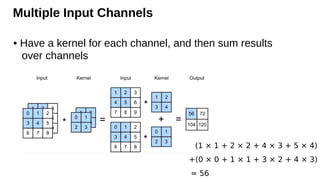
• Have a kernel for each channel, and then sum results
over channels
(1 × 1 + 2 × 2 + 4 × 3 + 5 × 4)
+(0 × 0 + 1 × 1 + 3 × 2 + 4 × 3)
= 56
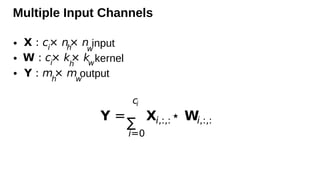
Multiple Input Channels
• input
• kernel
• output
X : ci
× nh
× nw
W : ci
× kh
× kw
Y : mh
× mw
Y =
ci
∑
i=0
Xi,:,:⋆ Wi,:,:
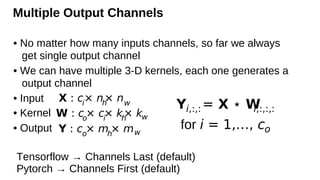
Multiple Output Channels
• No matter how many inputs channels, so far we always
get single output channel
• We can have multiple 3-D kernels, each one generates a
output channel
• Input
• Kernel
• Output
X : ci
× nh
× nw
W : co
× ci
× kh
× kw
Y : co
× mh
× mw
Yi,:,:= X ⋆ W
i,:,:,:
for i = 1,…, co
Tensorflow → Channels Last (default)
Pytorch → Channels First (default)
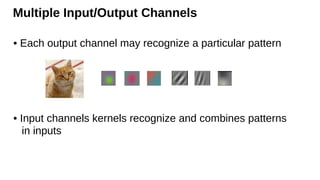
Multiple Input/Output Channels
• Each output channel may recognize a particular pattern
• Input channels kernels recognize and combines patterns
in inputs
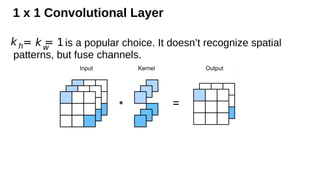
1 x 1 Convolutional Layer
is a popular choice. It doesn’t recognize spatial
patterns, but fuse channels.
kh= kw
= 1
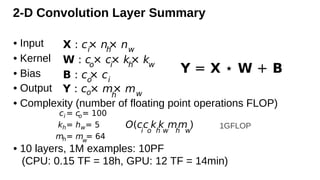
2-D Convolution Layer Summary
• Input
• Kernel
• Bias
• Output
• Complexity (number of floating point operations FLOP)
• 10 layers, 1M examples: 10PF
(CPU: 0.15 TF = 18h, GPU: 12 TF = 14min)
X : ci
× nh
× nw
W : co
× ci
× kh
× kw
Y : co× mh
× mw
Y = X ⋆ W + B
B : co
× ci
O(c
i
c
o
k
h
k
w
m
h
m
w
)
ci = co= 100
kh= hw= 5
mh= mw
= 64
1GFLOP
courses.d2l.ai/berkeley-stat-157
Pooling Layer
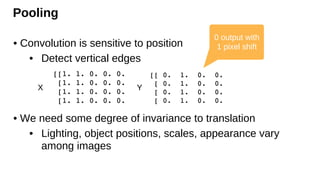
Pooling
• Convolution is sensitive to position
• Detect vertical edges
• We need some degree of invariance to translation
• Lighting, object positions, scales, appearance vary
among images
X Y
0 output with
1 pixel shift
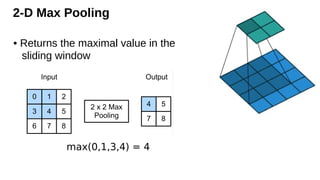
2-D Max Pooling
• Returns the maximal value in the
sliding window
max(0,1,3,4) = 4
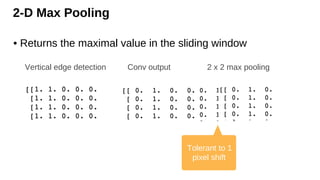
2-D Max Pooling
• Returns the maximal value in the sliding window
Conv output 2 x 2 max pooling
Vertical edge detection
Tolerant to 1
pixel shift
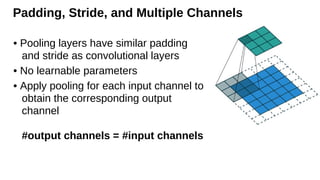
Padding, Stride, and Multiple Channels
• Pooling layers have similar padding
and stride as convolutional layers
• No learnable parameters
• Apply pooling for each input channel to
obtain the corresponding output
channel
#output channels = #input channels
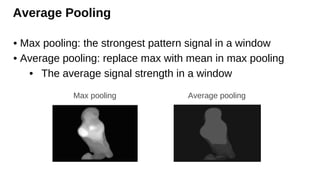
Average Pooling
• Max pooling: the strongest pattern signal in a window
• Average pooling: replace max with mean in max pooling
• The average signal strength in a window
Max pooling Average pooling
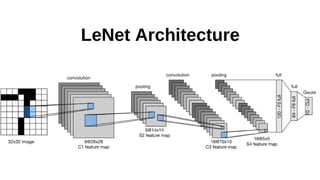
LeNet Architecture
courses.d2l.ai/berkeley-stat-157
Handwritten Digit
Recognition
courses.d2l.ai/berkeley-stat-157
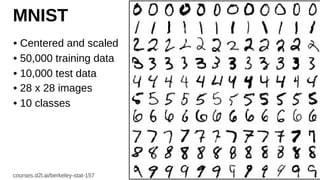
MNIST
• Centered and scaled
• 50,000 training data
• 10,000 test data
• 28 x 28 images
• 10 classes
courses.d2l.ai/berkeley-stat-157
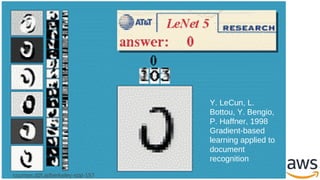
Y. LeCun, L.
Bottou, Y. Bengio,
P. Haffner, 1998
Gradient-based
learning applied to
document
recognition
courses.d2l.ai/berkeley-stat-157
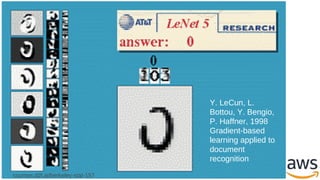
Y. LeCun, L.
Bottou, Y. Bengio,
P. Haffner, 1998
Gradient-based
learning applied to
document
recognition
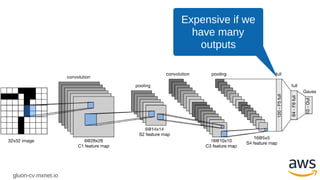
gluon-cv.mxnet.io
Expensive if we
have many
outputs
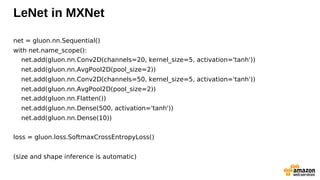
LeNet in MXNet
net = gluon.nn.Sequential()
with net.name_scope():
net.add(gluon.nn.Conv2D(channels=20, kernel_size=5, activation='tanh'))
net.add(gluon.nn.AvgPool2D(pool_size=2))
net.add(gluon.nn.Conv2D(channels=50, kernel_size=5, activation='tanh'))
net.add(gluon.nn.AvgPool2D(pool_size=2))
net.add(gluon.nn.Flatten())
net.add(gluon.nn.Dense(500, activation='tanh'))
net.add(gluon.nn.Dense(10))
loss = gluon.loss.SoftmaxCrossEntropyLoss()
(size and shape inference is automatic)
courses.d2l.ai/berkeley-stat-157
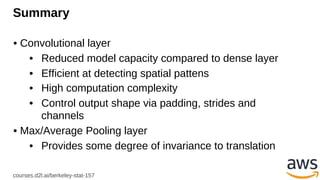
Summary
• Convolutional layer
• Reduced model capacity compared to dense layer
• Efficient at detecting spatial pattens
• High computation complexity
• Control output shape via padding, strides and
channels
• Max/Average Pooling layer
• Provides some degree of invariance to translation

convolutional neural networks for deep learning

  • 1.
    Deep Learning Convolutional andPooling Layers Dr. Ahsen Tahir .The slides in part have been modified from Ian Good Fellow book slides and Alex’s Dive in to Deep Learning book slides
  • 2.
  • 3.
    Classifying Dogs andCats in Images • Use a good camera • RGB image has 36M elements • The model size of a single hidden layer MLP with a 100 hidden size is 3.6 Billion parameters • Exceeds the population of dogs and cats on earth (900M dogs + 600M cats)
  • 4.
    Flashback - Networkwith one hidden layer 36M features 100 neurons h = σ (Wx + b ) 3.6B parameters = 14GB
  • 8.
  • 10.
    2-D Convolution (CrossCorrelation) (vdumoulin@ Github) 0 × 0 + 1 × 1 + 3 × 2 + 4 × 3 = 19, 1 × 0 + 2 × 1 + 4 × 2 + 5 × 3 = 25, 3 × 0 + 4 × 1 + 6 × 2 + 7 × 3 = 37, 4 × 0 + 5 × 1 + 7 × 2 + 8 × 3 = 43.
  • 15.
  • 16.
    Idea #1 -Translation Invariance • A shift in x also leads to a shift in h • v should not depend on (i,j). Fix via vi, j,a,b= v a,b hi, j=∑ a,b va,b xi+a,j+b hi, j=∑ a,b vi, j,a,b xi+a,j+b That’s a 2-D convolution cross-correlation
  • 17.
    Idea #2 -Locality • We shouldn’t look very far from x(i,j) in order to assess what’s going on at h(i,j) • Outside range parameters vanish hi, j= ∑ a,b va,bxi+a,j+b |a|,|b| > Δ va,b= 0 hi, j= Δ ∑ a=−Δ Δ ∑ b=−Δ va,b xi+a,j+b
  • 18.
    2-D Convolution Layer •input matrix • kernel matrix • b: scalar bias • output matrix • W and b are learnable parameters Y = X ⋆ W + b X : nh × nw W : kh × kw Y : (n h − kh + 1) × (n w − k w + 1)
  • 19.
  • 20.
  • 21.
  • 24.
    Cross Correlation vsConvolution • 2-D Cross Correlation • 2-D Convolution • No difference in practice during to symmetry yi, j= h ∑ a=1 w ∑ b=1 w a,b xi+a,j+b yi, j= h ∑ a=1 w ∑ b=1 w−a,−b x i+a,j+b
  • 25.
    1-D and 3-DCross Correlations yi = h ∑ a=1 waxi+a yi, j,k= h ∑ a=1 w ∑ b=1 d ∑ c=1 w a,b,c x i+a,j+b,k+c • 1-D • Text • Voice • Time series • 3-D • Video • Medical images
  • 26.
  • 28.
    Padding • Given a32 x 32 input image • Apply convolutional layer with 5 x 5 kernel • 28 x 28 output with 1 layer • 4 x 4 output with 7 layers • Shape decreases faster with larger kernels • Shape reduces from to n h × n w (nh − kh + 1) × (nw − k w + 1)
  • 29.
    Padding Padding adds rows/columnsaround input 0 × 0 + 0 × 1 + 0 × 2 + 0 × 3 = 0
  • 30.
    Padding • If Padding •A common choice is (n − k + 2p + 1) p=1 (means zero layer around each side of image) 2p= k − 1
  • 31.
    Stride • Padding reducesshape linearly with #layers • Given a 224 x 224 input with a 5 x 5 kernel, needs 44 layers to reduce the shape to 4 x 4 • Requires a large amount of computation
  • 32.
    Stride • Stride isthe #rows/#columns per slide Strides of 3 and 2 for height and width 0 × 0 + 0 × 1 + 1 × 2 + 2 × 3 = 8 0 × 0 + 6 × 1 + 0 × 2 + 0 × 3 = 6
  • 33.
    Stride • Given strides, for the height and stride for the width, the output shape is • With sh sw 2p= k− 1 in n+2p-k+1 → n → n/s (n h /s h ) × (n w /s w ) (n − k+ 1) + 2p s ⌊ ⌋
  • 34.
  • 35.
    Multiple Input Channels •Color image may have three RGB channels • Converting to grayscale loses information
  • 36.
    Multiple Input Channels •Color image may have three RGB channels • Converting to grayscale loses information
  • 37.
    Multiple Input Channels •Have a kernel for each channel, and then sum results over channels (1 × 1 + 2 × 2 + 4 × 3 + 5 × 4) +(0 × 0 + 1 × 1 + 3 × 2 + 4 × 3) = 56
  • 38.
    Multiple Input Channels •input • kernel • output X : ci × nh × nw W : ci × kh × kw Y : mh × mw Y = ci ∑ i=0 Xi,:,:⋆ Wi,:,:
  • 39.
    Multiple Output Channels •No matter how many inputs channels, so far we always get single output channel • We can have multiple 3-D kernels, each one generates a output channel • Input • Kernel • Output X : ci × nh × nw W : co × ci × kh × kw Y : co × mh × mw Yi,:,:= X ⋆ W i,:,:,: for i = 1,…, co Tensorflow → Channels Last (default) Pytorch → Channels First (default)
  • 40.
    Multiple Input/Output Channels •Each output channel may recognize a particular pattern • Input channels kernels recognize and combines patterns in inputs
  • 41.
    1 x 1Convolutional Layer is a popular choice. It doesn’t recognize spatial patterns, but fuse channels. kh= kw = 1
  • 42.
    2-D Convolution LayerSummary • Input • Kernel • Bias • Output • Complexity (number of floating point operations FLOP) • 10 layers, 1M examples: 10PF (CPU: 0.15 TF = 18h, GPU: 12 TF = 14min) X : ci × nh × nw W : co × ci × kh × kw Y : co× mh × mw Y = X ⋆ W + B B : co × ci O(c i c o k h k w m h m w ) ci = co= 100 kh= hw= 5 mh= mw = 64 1GFLOP
  • 43.
  • 44.
    Pooling • Convolution issensitive to position • Detect vertical edges • We need some degree of invariance to translation • Lighting, object positions, scales, appearance vary among images X Y 0 output with 1 pixel shift

  • 45.
    2-D Max Pooling •Returns the maximal value in the sliding window max(0,1,3,4) = 4
  • 46.
    2-D Max Pooling •Returns the maximal value in the sliding window Conv output 2 x 2 max pooling Vertical edge detection Tolerant to 1 pixel shift
  • 47.
    Padding, Stride, andMultiple Channels • Pooling layers have similar padding and stride as convolutional layers • No learnable parameters • Apply pooling for each input channel to obtain the corresponding output channel #output channels = #input channels
  • 48.
    Average Pooling • Maxpooling: the strongest pattern signal in a window • Average pooling: replace max with mean in max pooling • The average signal strength in a window Max pooling Average pooling
  • 49.
  • 50.
  • 51.
    courses.d2l.ai/berkeley-stat-157 MNIST • Centered andscaled • 50,000 training data • 10,000 test data • 28 x 28 images • 10 classes
  • 52.
    courses.d2l.ai/berkeley-stat-157 Y. LeCun, L. Bottou,Y. Bengio, P. Haffner, 1998 Gradient-based learning applied to document recognition
  • 53.
    courses.d2l.ai/berkeley-stat-157 Y. LeCun, L. Bottou,Y. Bengio, P. Haffner, 1998 Gradient-based learning applied to document recognition
  • 54.
  • 55.
    LeNet in MXNet net= gluon.nn.Sequential() with net.name_scope(): net.add(gluon.nn.Conv2D(channels=20, kernel_size=5, activation='tanh')) net.add(gluon.nn.AvgPool2D(pool_size=2)) net.add(gluon.nn.Conv2D(channels=50, kernel_size=5, activation='tanh')) net.add(gluon.nn.AvgPool2D(pool_size=2)) net.add(gluon.nn.Flatten()) net.add(gluon.nn.Dense(500, activation='tanh')) net.add(gluon.nn.Dense(10)) loss = gluon.loss.SoftmaxCrossEntropyLoss() (size and shape inference is automatic)
  • 56.
    courses.d2l.ai/berkeley-stat-157 Summary • Convolutional layer •Reduced model capacity compared to dense layer • Efficient at detecting spatial pattens • High computation complexity • Control output shape via padding, strides and channels • Max/Average Pooling layer • Provides some degree of invariance to translation