+

Conventions of Opening Title Sequences
By Daniel Bruce
+

Conventions of a Title Sequence
 A title

sequences is the methods by which cinematic
films or television programs present their title key
credit productions and cast members, or both,
utilizing conceptual visuals and sound. The opening
credits of motion pictures are shown at the beginning
and list the most important members of the
production they are now shown as the superimposed
on a blank screen or static pictures, or sometimes on
top of action in the show. There may or may not be
accompanying music.
+
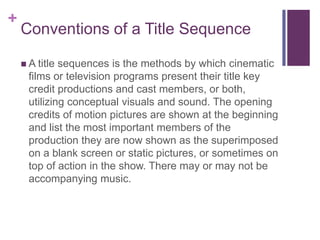
 The

title of the opening sequence is immediately put
into perspective. The colours used i.e. red and black
establishes the genre of the film which is horror. The
integration of the black and red only yet achieves to
associate itself with negative connotations of ‘death’
and ‘blood’. Considering the overall genre is
horror, it’s quite inevitable to use those specific
colours and shades.
+
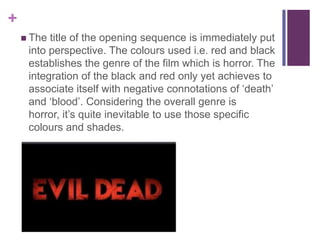
 The

background itself associates well with
the genre of the film. The idea of the title
sequence indicating that it’s a horror film, the
dark background only helps to reinforce the
message of ‘death’.
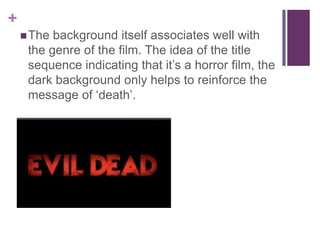
+  After the title has been demonstrated to the
audience, the second feature of a title
sequence which has been revealed is the
director. As the director has provided the
foundation for the creativity of the film to
grow, it’s vital that the title sequence has
given the name of the director.
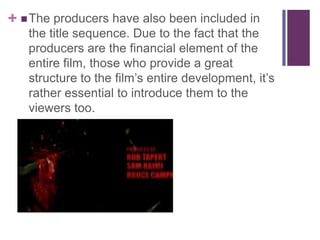
+  The producers have also been included in
the title sequence. Due to the fact that the
producers are the financial element of the
entire film, those who provide a great
structure to the film’s entire development, it’s
rather essential to introduce them to the
viewers too.
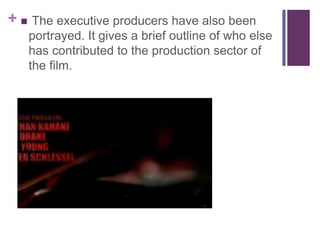
+  The executive producers have also been
portrayed. It gives a brief outline of who else
has contributed to the production sector of
the film.
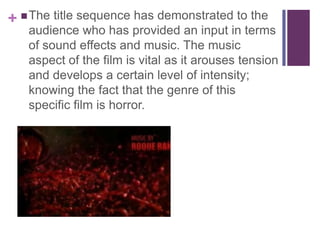
+  The title sequence has demonstrated to the

audience who has provided an input in terms
of sound effects and music. The music
aspect of the film is vital as it arouses tension
and develops a certain level of intensity;
knowing the fact that the genre of this
specific film is horror.
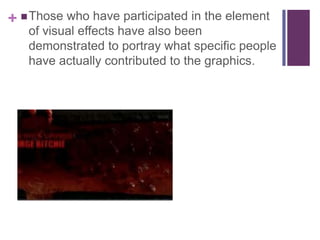
+  Those who have participated in the element

of visual effects have also been
demonstrated to portray what specific people
have actually contributed to the graphics.
+  After illustrating to the audience the key
figures that have contributed to the
development of the film, the actors have now
been put into perspective. Bearing in mind
that ‘starring’ has not been included as it’s
regarded rather old-fashion.

Conventions of Opening Title Sequences

  • 1.
    + Conventions of OpeningTitle Sequences By Daniel Bruce
  • 2.
    + Conventions of aTitle Sequence  A title sequences is the methods by which cinematic films or television programs present their title key credit productions and cast members, or both, utilizing conceptual visuals and sound. The opening credits of motion pictures are shown at the beginning and list the most important members of the production they are now shown as the superimposed on a blank screen or static pictures, or sometimes on top of action in the show. There may or may not be accompanying music.
  • 3.
    +  The title ofthe opening sequence is immediately put into perspective. The colours used i.e. red and black establishes the genre of the film which is horror. The integration of the black and red only yet achieves to associate itself with negative connotations of ‘death’ and ‘blood’. Considering the overall genre is horror, it’s quite inevitable to use those specific colours and shades.
  • 4.
    +  The background itselfassociates well with the genre of the film. The idea of the title sequence indicating that it’s a horror film, the dark background only helps to reinforce the message of ‘death’.
  • 5.
    +  Afterthe title has been demonstrated to the audience, the second feature of a title sequence which has been revealed is the director. As the director has provided the foundation for the creativity of the film to grow, it’s vital that the title sequence has given the name of the director.
  • 6.
    +  Theproducers have also been included in the title sequence. Due to the fact that the producers are the financial element of the entire film, those who provide a great structure to the film’s entire development, it’s rather essential to introduce them to the viewers too.
  • 7.
    +  Theexecutive producers have also been portrayed. It gives a brief outline of who else has contributed to the production sector of the film.
  • 8.
    +  Thetitle sequence has demonstrated to the audience who has provided an input in terms of sound effects and music. The music aspect of the film is vital as it arouses tension and develops a certain level of intensity; knowing the fact that the genre of this specific film is horror.
  • 9.
    +  Thosewho have participated in the element of visual effects have also been demonstrated to portray what specific people have actually contributed to the graphics.
  • 10.
    +  Afterillustrating to the audience the key figures that have contributed to the development of the film, the actors have now been put into perspective. Bearing in mind that ‘starring’ has not been included as it’s regarded rather old-fashion.