

Objectives:
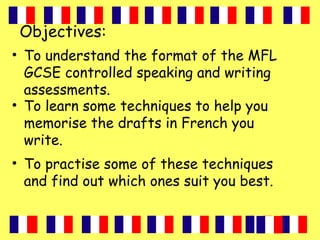
• To understand the format of the MFL
GCSE controlled speaking and writing
assessments.
• To learn some techniques to help you
memorise the drafts in French you
write.
• To practise some of these techniques
and find out which ones suit you best.
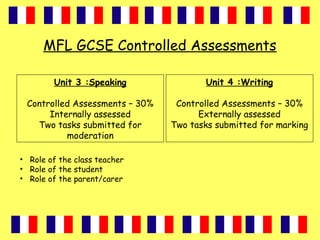
MFL GCSE Controlled Assessments
Unit 3 :Speaking
Controlled Assessments – 30%
Internally assessed
Two tasks submitted for
moderation
Unit 4 :Writing
Controlled Assessments – 30%
Externally assessed
Two tasks submitted for marking
• Role of the class teacher
• Role of the student
• Role of the parent/carer
Process
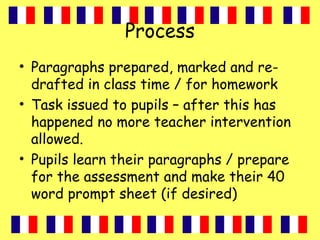
• Paragraphs prepared, marked and re-
drafted in class time / for homework
• Task issued to pupils – after this has
happened no more teacher intervention
allowed.
• Pupils learn their paragraphs / prepare
for the assessment and make their 40
word prompt sheet (if desired)
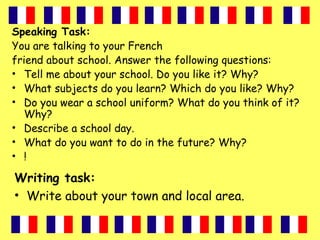
Speaking Task:
You are talking to your French
friend about school. Answer the following questions:
• Tell me about your school. Do you like it? Why?
• What subjects do you learn? Which do you like? Why?
• Do you wear a school uniform? What do you think of it?
Why?
• Describe a school day.
• What do you want to do in the future? Why?
• !
Writing task:
• Write about your town and local area.
40 word sheet
• Pupils are allowed a prompt sheet of 40
words in the assessment with them.
• No full sentences
• No conjugated verbs
Role of the parent/carer
• Letter home and e-alert
• Help pupil to split draft into learnable
paragraphs and make revision timetable.
30 minutes regularly is more effective
than 5 hours the night before the
assessment.
• Monitor that the revision is taking place.
• Test your son/daughter
Technique 1 (speaking)
• Look at first sentence in the paragraph you are
learning and read it out loud. Close your eyes
and say the first sentence without looking at it.
• Repeat the step above but this time with the
first two sentences.
• Next, try it with three and then four.
• Repeat until you have memorised it all.
• Try this with paragraph 1 on your sheet.
Technique 2 (Speaking)
The Roman Room Method
• Picture a room in your house and select several items in it (if it’s
your bedroom then perhaps your bed, lamp, window, wardrobe etc.).
• Place your sentences at these points in your room. You could use
post its/revision cards.
• You then walk round your room, stopping at each item to read the
sentences aloud. Eventually the items should act as prompts for the
sentences and you shouldn’t need to read from your notes.
• Your route around your room should help you recite a whole
paragraph from memory.
• Use a different room for each question.
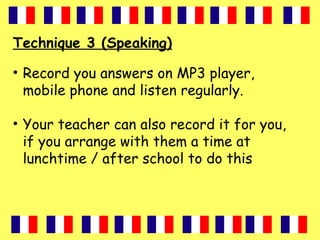
Technique 3 (Speaking)
• Record you answers on MP3 player,
mobile phone and listen regularly.
• Your teacher can also record it for you,
if you arrange with them a time at
lunchtime / after school to do this
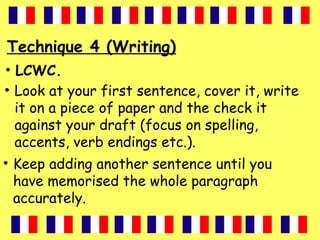
Technique 4 (Writing)
• LCWC.
• Look at your first sentence, cover it, write
it on a piece of paper and the check it
against your draft (focus on spelling,
accents, verb endings etc.).
• Keep adding another sentence until you
have memorised the whole paragraph
accurately.
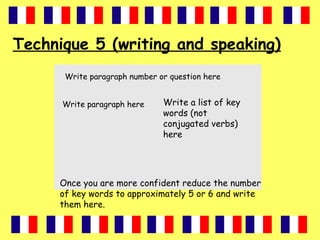
Technique 5 (writing and speaking)
Write paragraph number or question here
Write paragraph here Write a list of key
words (not
conjugated verbs)
here
Once you are more confident reduce the number
of key words to approximately 5 or 6 and write
them here.
Use technique 4 or 5 to memorise
paragraph 2 on your sheet.
Final advice.
• Start early!
• Revision timetable
• Little but often
• Parents/carers to check that revision takes place
• Practise writing for the written assessment (Don’t just say
aloud!)
• If using 40 words practise with them. Don’t decide to use
them at the last minute.
• Be positive together. Visualise the assessment going well.
Increased confidence will mean you are more relaxed in the
assessment.
Advice from current Year 11s
Learn small sections at a time
Make sure you vary your methods
Put it into a song
Highlight words you don’t know as well as the others
Learn it in English so you can translate it. If you only
know the French it’s just meaningless sounds
Get your teacher to record it so you know what it sounds
like
And finally…

Controlled Assessment Workshop

  • 2.
    Objectives: • To understandthe format of the MFL GCSE controlled speaking and writing assessments. • To learn some techniques to help you memorise the drafts in French you write. • To practise some of these techniques and find out which ones suit you best.
  • 3.
    MFL GCSE ControlledAssessments Unit 3 :Speaking Controlled Assessments – 30% Internally assessed Two tasks submitted for moderation Unit 4 :Writing Controlled Assessments – 30% Externally assessed Two tasks submitted for marking • Role of the class teacher • Role of the student • Role of the parent/carer
  • 4.
    Process • Paragraphs prepared,marked and re- drafted in class time / for homework • Task issued to pupils – after this has happened no more teacher intervention allowed. • Pupils learn their paragraphs / prepare for the assessment and make their 40 word prompt sheet (if desired)
  • 5.
    Speaking Task: You aretalking to your French friend about school. Answer the following questions: • Tell me about your school. Do you like it? Why? • What subjects do you learn? Which do you like? Why? • Do you wear a school uniform? What do you think of it? Why? • Describe a school day. • What do you want to do in the future? Why? • ! Writing task: • Write about your town and local area.
  • 6.
    40 word sheet •Pupils are allowed a prompt sheet of 40 words in the assessment with them. • No full sentences • No conjugated verbs
  • 7.
    Role of theparent/carer • Letter home and e-alert • Help pupil to split draft into learnable paragraphs and make revision timetable. 30 minutes regularly is more effective than 5 hours the night before the assessment. • Monitor that the revision is taking place. • Test your son/daughter
  • 8.
    Technique 1 (speaking) •Look at first sentence in the paragraph you are learning and read it out loud. Close your eyes and say the first sentence without looking at it. • Repeat the step above but this time with the first two sentences. • Next, try it with three and then four. • Repeat until you have memorised it all. • Try this with paragraph 1 on your sheet.
  • 9.
    Technique 2 (Speaking) TheRoman Room Method • Picture a room in your house and select several items in it (if it’s your bedroom then perhaps your bed, lamp, window, wardrobe etc.). • Place your sentences at these points in your room. You could use post its/revision cards. • You then walk round your room, stopping at each item to read the sentences aloud. Eventually the items should act as prompts for the sentences and you shouldn’t need to read from your notes. • Your route around your room should help you recite a whole paragraph from memory. • Use a different room for each question.
  • 10.
    Technique 3 (Speaking) •Record you answers on MP3 player, mobile phone and listen regularly. • Your teacher can also record it for you, if you arrange with them a time at lunchtime / after school to do this
  • 11.
    Technique 4 (Writing) •LCWC. • Look at your first sentence, cover it, write it on a piece of paper and the check it against your draft (focus on spelling, accents, verb endings etc.). • Keep adding another sentence until you have memorised the whole paragraph accurately.
  • 12.
    Technique 5 (writingand speaking) Write paragraph number or question here Write paragraph here Write a list of key words (not conjugated verbs) here Once you are more confident reduce the number of key words to approximately 5 or 6 and write them here.
  • 13.
    Use technique 4or 5 to memorise paragraph 2 on your sheet.
  • 14.
    Final advice. • Startearly! • Revision timetable • Little but often • Parents/carers to check that revision takes place • Practise writing for the written assessment (Don’t just say aloud!) • If using 40 words practise with them. Don’t decide to use them at the last minute. • Be positive together. Visualise the assessment going well. Increased confidence will mean you are more relaxed in the assessment.
  • 15.
    Advice from currentYear 11s Learn small sections at a time Make sure you vary your methods Put it into a song Highlight words you don’t know as well as the others Learn it in English so you can translate it. If you only know the French it’s just meaningless sounds Get your teacher to record it so you know what it sounds like
  • 16.

Editor's Notes

  • #3 Details of reasons – can also be helpful for other subjects besides Languages
  • #4 15% per piece of work. Each 1 is work approximately 1.5 grades
  • #5 Emphasise no corrections allowed. General feedback OK. Can do a “dry run” of them but teacher can’t correct just give general feedback.
  • #7 Explain conjugated verbs!
  • #9 Give 5-10 mins to work on this
  • #13 Give 5-10 mins on this.