M1 2011-2012
This is not a
presentation ;-)
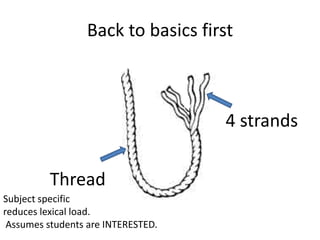
Back to basics first

4 strands
Thread
Subject specific
reduces lexical load.
Assumes students are INTERESTED.
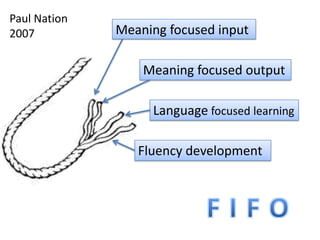
Paul Nation
2007

Meaning focused input
Meaning focused output
Language focused learning
Fluency development
Meaning focused input
• Learners are interested and want to
understand.
• Most of the listening or reading is already
familiar.
• Possible to gain some unknown language
items through context and background
knowledge
• Large quantities of input
Meaning focused output
• Speaking and especially writing makes the
student think about the language.
• Corrections are incidental
• When the activity is meaning focused, the
students wants to know how to say/write it.
• Fill the gaps in production with
communication strategies, dictionaries,
previous input.
Language focused learning
• Noticing
• Deliberate learning of language features
- pronunciation
- spelling
- vocabulary
- grammar
- discourse (styles)
Everything goes
•
•
•
•
•
•
•

Word lists, word cards
Pronunciation practise
Intensive reading
Translation
Memorising dialogues
Dictation self-dictation dictagloss
Getting feedback from writing
Language focused learning also
requires
• deliberate learning of strategies such as
– guessing from context
– dictionary use
– Google search
• spaced, repeated attention to the same features.
• Language features can also occur within the other
strands –> arise from the other strands
Fluency development
Speaking

Reading

4-3-2

New research on reading

Convince the students that they are
NOT wasting their time reading
something which is easy
Lessons which seem important to me
• Give the students the distribution of marks and
come back to it in later classes (once is NOT
enough)
• Early on, before explaining the exam ,do a
students-ask-the-questions session (handout)
• Write up lesson in courselog (this takes 2 sessions)
In the computer lab – work through the clarity
programmes (I use the listening first with whole
group to show them how feedback works)
More on “Clarity ” lesson
• Important in “whole class model ” example:
– The aim is NOT to get the right answer
– The aim is to learn – so do it as quickly as poss,
use: >mark > see answers > get feedback
– Then if working at home, do it again (and again) to
LEARN somthing
– this is not a test .. (difficult concept)
“Clarity ” lesson - after whole class
example
• Having seen what’s in SSS insisting on “always
read the intro first & do SSS vocab/reading/grammar for M1”

• Then the students chose their subject in Road
to IELTS and do the vocab and reading.
• Students pair up with someone who did a
different topic and talk about what they did.
• Write up lesson in courselog.
Advice on recording words
• Glossary section of courselog – (more than
single word translations) min 5 words/session
• Give out“Vocabulary Strategies” from word flo
• Demonstrate mind map (good for deciding
which vocab they’re “lacking”)
• Read / talk about collocation (OALD)
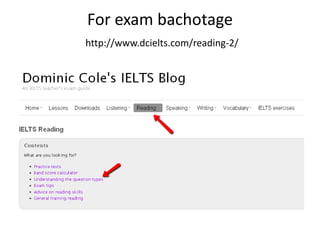
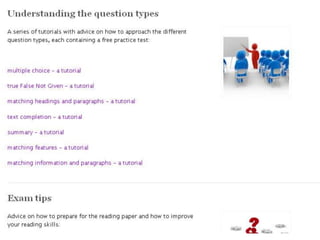
For exam bachotage
http://www.dcielts.com/reading-2/
Making a poster
• Absolutely all the required info is here
http://www.ncsu.edu/project/posters/NewSite/

• Or get them to discover that for themselves,
by googling “making a scientific poster”assign two sites per pair and then they explain
to the class.
Poster session
• Tell them they must give in the subject of their
poster in week 4 then use the pair
work/computer work time to talk to them
about their sources (because research article
not poss for M1Pro).
• All posters must be printed (21st century) – A3
is OK – less than 2 euros (price of A2???- use 2
A3)
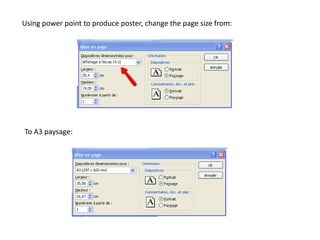
Using power point to produce poster, change the page size from:

To A3 paysage:
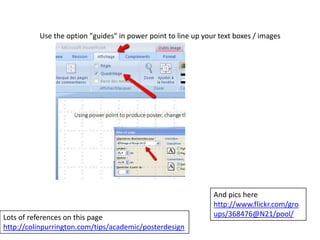
Use the option "guides" in power point to line up your text boxes / images

Lots of references on this page
http://colinpurrington.com/tips/academic/posterdesign

And pics here
http://www.flickr.com/gro
ups/368476@N21/pool/
Poster Session
• Posters up – in silence everyone goes round
the room taking notes on posters and deciding
questions to ask (5-10 mins)
• Students A stays with poster to answer
questions, Student B goes round asking
questions – then swap.
• Drinks and biscuits really make a poster
session work !
I ask my students to bring their courselog with them to the poster session,
and then send me the account of the
poster session by email
Reading exam date :
Friday 16th March 17h30
Courselogs
• Are for assessment at this point, and are not
given back
• Need a clear front page (name, speciality,
year, teacher’s name) and a staple in the
corner.
• After marking, courselogs should be given to
the English coordinator. (i.e. comments on the
front are for the coordinator)

M1 2012

  • 1.
    M1 2011-2012 This isnot a presentation ;-)
  • 2.
    Back to basicsfirst 4 strands Thread Subject specific reduces lexical load. Assumes students are INTERESTED.
  • 3.
    Paul Nation 2007 Meaning focusedinput Meaning focused output Language focused learning Fluency development
  • 4.
    Meaning focused input •Learners are interested and want to understand. • Most of the listening or reading is already familiar. • Possible to gain some unknown language items through context and background knowledge • Large quantities of input
  • 5.
    Meaning focused output •Speaking and especially writing makes the student think about the language. • Corrections are incidental • When the activity is meaning focused, the students wants to know how to say/write it. • Fill the gaps in production with communication strategies, dictionaries, previous input.
  • 6.
    Language focused learning •Noticing • Deliberate learning of language features - pronunciation - spelling - vocabulary - grammar - discourse (styles)
  • 7.
    Everything goes • • • • • • • Word lists,word cards Pronunciation practise Intensive reading Translation Memorising dialogues Dictation self-dictation dictagloss Getting feedback from writing
  • 8.
    Language focused learningalso requires • deliberate learning of strategies such as – guessing from context – dictionary use – Google search • spaced, repeated attention to the same features. • Language features can also occur within the other strands –> arise from the other strands
  • 9.
  • 10.
    Speaking Reading 4-3-2 New research onreading Convince the students that they are NOT wasting their time reading something which is easy
  • 11.
    Lessons which seemimportant to me • Give the students the distribution of marks and come back to it in later classes (once is NOT enough) • Early on, before explaining the exam ,do a students-ask-the-questions session (handout) • Write up lesson in courselog (this takes 2 sessions) In the computer lab – work through the clarity programmes (I use the listening first with whole group to show them how feedback works)
  • 12.
    More on “Clarity” lesson • Important in “whole class model ” example: – The aim is NOT to get the right answer – The aim is to learn – so do it as quickly as poss, use: >mark > see answers > get feedback – Then if working at home, do it again (and again) to LEARN somthing – this is not a test .. (difficult concept)
  • 13.
    “Clarity ” lesson- after whole class example • Having seen what’s in SSS insisting on “always read the intro first & do SSS vocab/reading/grammar for M1” • Then the students chose their subject in Road to IELTS and do the vocab and reading. • Students pair up with someone who did a different topic and talk about what they did. • Write up lesson in courselog.
  • 14.
    Advice on recordingwords • Glossary section of courselog – (more than single word translations) min 5 words/session • Give out“Vocabulary Strategies” from word flo • Demonstrate mind map (good for deciding which vocab they’re “lacking”) • Read / talk about collocation (OALD)
  • 15.
  • 17.
    Making a poster •Absolutely all the required info is here http://www.ncsu.edu/project/posters/NewSite/ • Or get them to discover that for themselves, by googling “making a scientific poster”assign two sites per pair and then they explain to the class.
  • 18.
    Poster session • Tellthem they must give in the subject of their poster in week 4 then use the pair work/computer work time to talk to them about their sources (because research article not poss for M1Pro). • All posters must be printed (21st century) – A3 is OK – less than 2 euros (price of A2???- use 2 A3)
  • 19.
    Using power pointto produce poster, change the page size from: To A3 paysage:
  • 20.
    Use the option"guides" in power point to line up your text boxes / images Lots of references on this page http://colinpurrington.com/tips/academic/posterdesign And pics here http://www.flickr.com/gro ups/368476@N21/pool/
  • 22.
    Poster Session • Postersup – in silence everyone goes round the room taking notes on posters and deciding questions to ask (5-10 mins) • Students A stays with poster to answer questions, Student B goes round asking questions – then swap. • Drinks and biscuits really make a poster session work !
  • 23.
    I ask mystudents to bring their courselog with them to the poster session, and then send me the account of the poster session by email Reading exam date : Friday 16th March 17h30
  • 24.
    Courselogs • Are forassessment at this point, and are not given back • Need a clear front page (name, speciality, year, teacher’s name) and a staple in the corner. • After marking, courselogs should be given to the English coordinator. (i.e. comments on the front are for the coordinator)