Control Systems -2
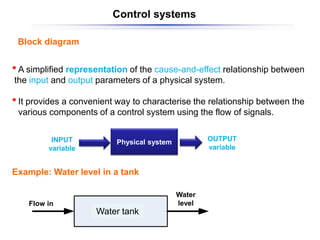
•A simplified representation of the cause-and-effect relationship between
the input and output parameters of a physical system.
•It provides a convenient way to characterise the relationship between the
various components of a control system using the flow of signals.
Block diagram
Control systems
Physical system
INPUT
variable
OUTPUT
variable
Example: Water level in a tank
Réservoir
Débit Niveau
Flow in
Water
level
Water tank
Control systems
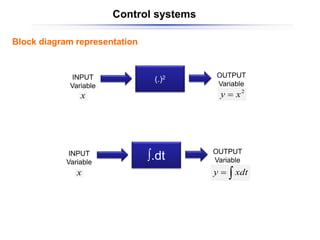
(.)2
INPUT
Variable
OUTPUT
Variable
∫.dt
INPUT
Variable
OUTPUT
Variable
2
x
y =
x
x 
= xdt
y
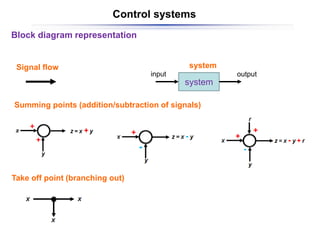
Block diagram representation
Summing points (addition/subtraction of signals)
Control systems
Block diagram representation
Take off point (branching out)
Signal flow system
system
input output
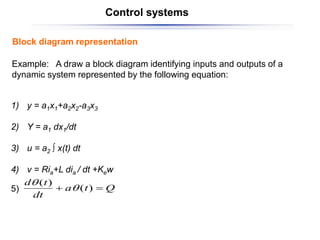
1) y = a1x1+a2x2-a3x3
2) Y = a1 dx1/dt
3) u = a2 ∫ x(t) dt
4) v = Ria+L dia / dt +Kew
a2
x2
y
+
+
-
a1
a3
x3
x1
a2
X(t) u
a1
x1 y
d./dt
Control systems
Example: A draw a block diagram identifying inputs and outputs of a
dynamic system represented by the following equation:
• dt
Q
t
a
dt
t
d
=
+ )
(
)
(


5)
Block diagram representation
2
Control systems
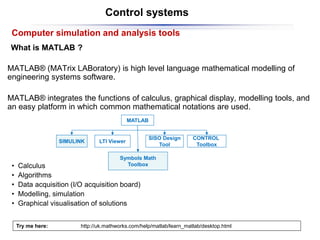
What is MATLAB ?
MATLAB® (MATrix LABoratory) is high level language mathematical modelling of
engineering systems software.
MATLAB® integrates the functions of calculus, graphical display, modelling tools, and
an easy platform in which common mathematical notations are used.
Computer simulation and analysis tools
MATLAB
SIMULINK LTI Viewer
CONTROL
Toolbox
SISO Design
Tool
Symbols Math
Toolbox
• Calculus
• Algorithms
• Data acquisition (I/O acquisition board)
• Modelling, simulation
• Graphical visualisation of solutions
Try me here: http://uk.mathworks.com/help/matlab/learn_matlab/desktop.html
Control systems
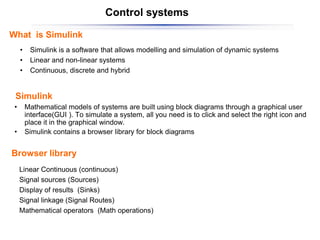
What is Simulink
• Simulink is a software that allows modelling and simulation of dynamic systems
• Linear and non-linear systems
• Continuous, discrete and hybrid
• Mathematical models of systems are built using block diagrams through a graphical user
interface(GUI ). To simulate a system, all you need is to click and select the right icon and
place it in the graphical window.
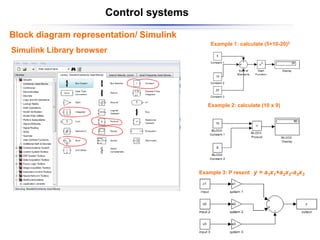
• Simulink contains a browser library for block diagrams
Linear Continuous (continuous)
Signal sources (Sources)
Display of results (Sinks)
Signal linkage (Signal Routes)
Mathematical operators (Math operations)
Simulink
Browser library
y = a1x1+a2x2-a3x3
Control systems
Block diagram representation/ Simulink
Simulink Library browser
Example 1: calculate (5+10-20)2
Example 2: calculate (10 x 9)
Example 3: P resent
Example 1. Generate a plot of 𝑦 𝑥 = 𝑒−0.7𝑥
sin(𝜔𝑥)
where ω = 15 rad/s, and 0<x<15. Use the colon notation to generate the x vector in increments
of 0.1.
Solution.
>> x = [0 : 0.1 : 15];
>> w = 15;
>> y = exp(– 0.7*x).*sin(w*x);
>> plot(x, y)
>> title(‘y(x) = e^-^0^.^7^x sinomega x’)
>> xlabel(‘x’)
>> ylabel(‘y)’
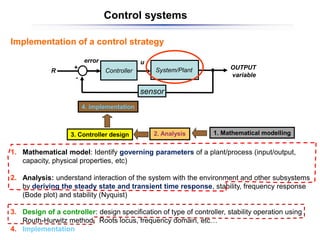
1. Mathematical model: Identify governing parameters of a plant/process (input/output,
capacity, physical properties, etc)
2. Analysis: understand interaction of the system with the environment and other subsystems
by deriving the steady state and transient time response, stability, frequency response
(Bode plot) and stability (Nyquist)
3. Design of a controller: design specification of type of controller, stability operation using
Routh-Hurwitz method, Roots locus, frequency domain, etc…
4. Implementation
Control systems
System/Plant
R
OUTPUT
variable
-
+
error
Controller
u
sensor
Implementation of a control strategy
1. Mathematical modelling
2. Analysis
3. Controller design
4. implementation
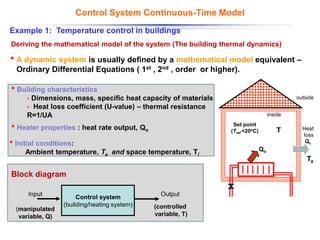
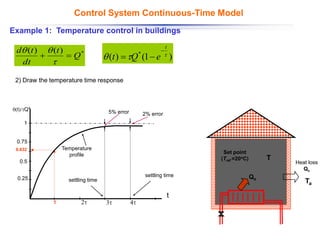
Example 1: Temperature control in buildings
T Heat
loss
Qc
Set point
(Tref =20oC)
Ta
Qo
Control System Continuous-Time Model
• Heater properties : heat rate output, Qo
• Building characteristics
▪ Dimensions, mass, specific heat capacity of materials
▪ Heat loss coefficient (U-value) – thermal resistance
R=1/UA
• Initial conditions:
Ambient temperature, Ta and space temperature, Ti
Block diagram
Input
(manipulated
variable, Q)
Output
(controlled
variable, T)
Control system
(building/heating system)
Deriving the mathematical model of the system (The building thermal dynamics)
• A dynamic system is usually defined by a mathematical model equivalent –
Ordinary Differential Equations ( 1st , 2nd , order or higher).
inside
outside
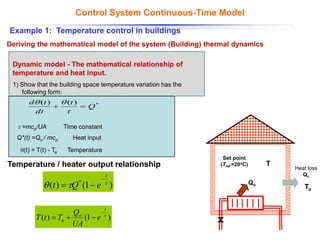
Example 1: Temperature control in buildings
T
Heat loss
Qc
Set point
(Tref =20oC)
Ta
Qo
Control System Continuous-Time Model
Dynamic model - The mathematical relationship of
temperature and heat input.
Deriving the mathematical model of the system (Building) thermal dynamics
1) Show that the building space temperature variation has the
following form:
 =mcp/UA Time constant
*
)
(
)
(
Q
t
dt
t
d
=
+



Q*(t) =Qo / mcp Heat input
(t) = T(t) - Ta Temperature
Temperature / heater output relationship
)
1
(
)
( 
t
o
a e
UA
Q
T
t
T
−
−
+
=
)
1
(
)
( * 


t
e
Q
t
−
−
=
(t)Q*
t
0.5
0.25
1
0.75
 
 
0.632
*
)
(
)
(
Q
t
dt
t
d
=
+



settling time
T
Heat loss
Qc
Set point
(Tref =20oC)
Ta
Qo
Control System Continuous-Time Model
)
1
(
)
( * 


t
e
Q
t
−
−
=
2% error
5% error
settling time
Temperature
profile
Example 1: Temperature control in buildings
2) Draw the temperature time response
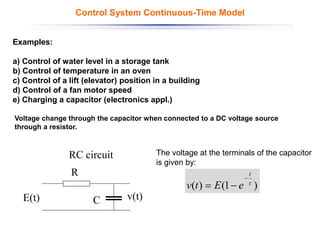
Voltage change through the capacitor when connected to a DC voltage source
through a resistor.
C
R
E(t) v(t)
RC circuit The voltage at the terminals of the capacitor
is given by:
)
1
(
)
( 
t
e
E
t
v
−
−
=
Control System Continuous-Time Model
Examples:
a) Control of water level in a storage tank
b) Control of temperature in an oven
c) Control of a lift (elevator) position in a building
d) Control of a fan motor speed
e) Charging a capacitor (electronics appl.)
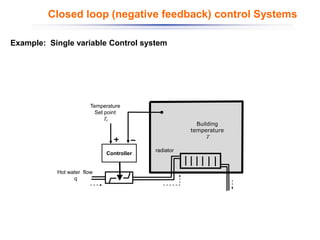
Closed loop (negative feedback) control Systems
Building
temperature

Temperature
Set point
r
radiator
Hot water flow
q
Controller
Example: Single variable Control system
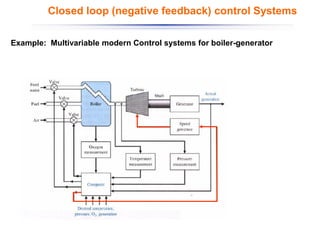
Example: Multivariable modern Control systems for boiler-generator
Closed loop (negative feedback) control Systems
Introduction to Laplace transforms
• A dynamic system is usually defined by a mathematical model equivalent
– Ordinary Differential Equations ( 1st , 2nd , order or higher).
LAPLACE TRANSFORM
Mathematical modelling of a dynamic system
Control System Continuous-Time Model
• The mathematical model of a dynamic system is often complex to
solve directly
• Use a TRANSFORM method – make the problem easier to solve
• Operator, s, is usually used to refer to Laplace transformation
• The Laplace transform is a mathematical tool for solving systems of linear
differential equations with constant coefficients.
• The Laplace transform allows original functions of time (i.e., a function
describing the relationship of a physical system’s input and output
variables) to be represented (mirrored) in a new domain called the s-
domain (or frequency domain).
• The transformation provides a different but simpler method for
analysing the behaviour of a dynamic system.
Laplace transform
(Pierre Simon De Laplace 1749-1827)
Definition
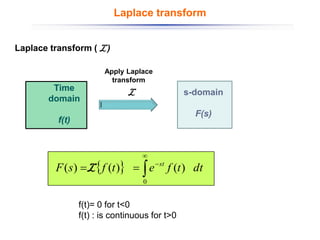
Laplace transform ( L)
Time
domain
f(t)
s-domain
F(s)
L
f(t)= 0 for t<0
f(t) : is continuous for t>0
Laplace transform
  

−
=
=
0
)
(
)
(
)
( dt
t
f
e
t
f
s
F st
L
Apply Laplace
transform
Laplace transform
)
(
)
( t
f
t
y =
)}
(
{
)
( t
f
s
Y =
)
(
)
( s
F
s
Y =
)
(
)
( t
f
t
y =
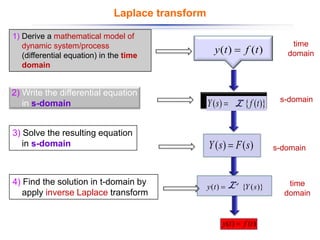
1) Derive a mathematical model of
dynamic system/process
(differential equation) in the time
domain
2) Write the differential equation
in s-domain
3) Solve the resulting equation
in s-domain
4) Find the solution in t-domain by
apply inverse Laplace transform
time
domain
L
)}
(
{
)
( s
Y
t
y = L-1
time
domain
s-domain
s-domain
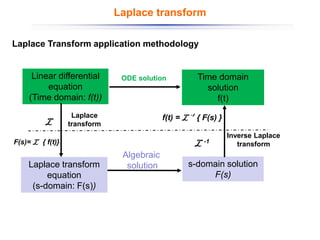
Linear differential
equation
(Time domain: f(t))
Time domain
solution
f(t)
L
L -1
f(t) = L -1
{ F(s) }
Laplace transform
Laplace Transform application methodology
ODE solution
s-domain solution
F(s)
Laplace transform
equation
(s-domain: F(s))
Laplace
transform
Algebraic
solution
Inverse Laplace
transform
F(s)= L { f(t)}
t ≥ to
t < 0
0
)
(
=
= a
t
f
s
a
s
ae
dt
e
a
dt
e
t
f
t
f
L
st
st
st
=






−
=
=
=

−

−

−


0
0
0
)
(
)
(
)]
(
[
1) Step signal (Heaviside)
a
f(t)
t
f(t)
t
a
0
t
0
0
)]
(
[ 0
st
t
st
e
s
a
s
e
a
t
t
f
L −

−
=






−
=
−


−
=
=
0
st
dt
e
)
t
(
f
)
s
(
F
)]
t
(
f
[
L
L
2) Delayed step signal (Heaviside)
Laplace transform
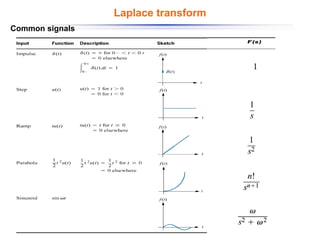
Example of common signals
a
t
f =
)
(
L
L
2
0
st
0
st
0
st
s
a
dt
e
s
a
s
ate
dt
ate
)]
t
(
r
[
L =
−
−





−
=
= 


−

−

−
0
t
,
at
)
t
(
r 
=
f(t)
t
Laplace transform
Examples
3) Ramp signal
L


−
=
=
0
st
dt
e
)
t
(
f
)
s
(
F
)]
t
(
f
[
L
L
Laplace transform
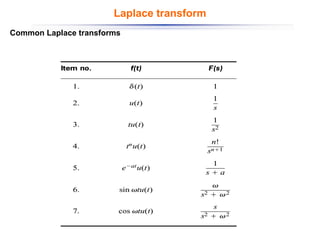
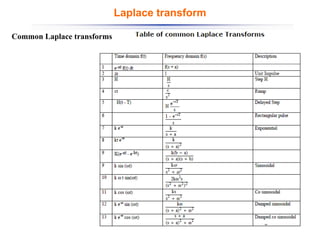
Common Laplace transforms
Laplace transform
Common signals
Common Laplace transforms
Laplace transform
Linearity properties of Laplace transform
)]
t
(
f
[
L
)
s
(
F 1
1 =
)]
t
(
f
[
L
)
s
(
F 2
2 =
ts
tan
Cons
c
,
c 2
1 =
)
(
.
)
(
.
)]
(
[
.
)]
(
[
.
)]
(
.
)
(
.
[
2
2
1
1
2
2
1
1
2
2
1
1
s
F
c
s
F
c
t
f
L
c
t
f
L
c
t
f
c
t
f
c
L
+
=
+
=
+
Laplace transform
L L L
)
0
(
)
0
(
)
(
.
)]
(
[
]
[
)]
(
"
[ '
2
..
2
2
+
+
−
−
=
=
= f
sf
s
F
s
t
f
dt
f
d
t
f
Derivatives
)
0
(
f
)
s
(
F
.
s
)]
t
(
f
[
L
]
dt
df
[
L
)]
t
(
'
f
[
L +
•
−
=
=
=
)
1
(
)
1
(
2
1
)
0
(
.....
)
0
(
)
0
(
)
(
]
)
(
[
−
−
−
−
−
−
=
n
n
n
n
n
n
f
f
s
f
s
s
F
s
dt
t
df
)
1
i
(
n
1
i
i
n
n
)
n
(
)
0
(
f
.
s
)
s
(
F
s
]
)
t
(
f
[
L
−
=
−

−
=
Laplace transform
L L L
L L
L
L
L
 =
t
0
s
)
s
(
F
]
du
)
u
(
f
[
L
Integral
Laplace transform
L
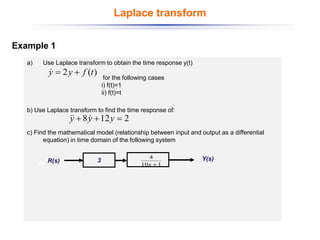
Example 1
a) Use Laplace transform to obtain the time response y(t)
for the following cases
i) f(t)=1
ii) f(t)=t
b) Use Laplace transform to find the time response of:
c) Find the mathematical model (relationship between input and output as a differential
equation) in time domain of the following system
)
(
2 t
f
y
y +
=

2
12
8 =
+
+ y
y
y 


Y(s)
3
1
10
4
+
s
R(s)
R(s)
Laplace transform

control systems block representation and first order systems

  • 1.
  • 2.
    •A simplified representationof the cause-and-effect relationship between the input and output parameters of a physical system. •It provides a convenient way to characterise the relationship between the various components of a control system using the flow of signals. Block diagram Control systems Physical system INPUT variable OUTPUT variable Example: Water level in a tank Réservoir Débit Niveau Flow in Water level Water tank
  • 3.
  • 4.
    Summing points (addition/subtractionof signals) Control systems Block diagram representation Take off point (branching out) Signal flow system system input output
  • 5.
    1) y =a1x1+a2x2-a3x3 2) Y = a1 dx1/dt 3) u = a2 ∫ x(t) dt 4) v = Ria+L dia / dt +Kew a2 x2 y + + - a1 a3 x3 x1 a2 X(t) u a1 x1 y d./dt Control systems Example: A draw a block diagram identifying inputs and outputs of a dynamic system represented by the following equation: • dt Q t a dt t d = + ) ( ) (   5) Block diagram representation 2
  • 6.
    Control systems What isMATLAB ? MATLAB® (MATrix LABoratory) is high level language mathematical modelling of engineering systems software. MATLAB® integrates the functions of calculus, graphical display, modelling tools, and an easy platform in which common mathematical notations are used. Computer simulation and analysis tools MATLAB SIMULINK LTI Viewer CONTROL Toolbox SISO Design Tool Symbols Math Toolbox • Calculus • Algorithms • Data acquisition (I/O acquisition board) • Modelling, simulation • Graphical visualisation of solutions Try me here: http://uk.mathworks.com/help/matlab/learn_matlab/desktop.html
  • 7.
    Control systems What isSimulink • Simulink is a software that allows modelling and simulation of dynamic systems • Linear and non-linear systems • Continuous, discrete and hybrid • Mathematical models of systems are built using block diagrams through a graphical user interface(GUI ). To simulate a system, all you need is to click and select the right icon and place it in the graphical window. • Simulink contains a browser library for block diagrams Linear Continuous (continuous) Signal sources (Sources) Display of results (Sinks) Signal linkage (Signal Routes) Mathematical operators (Math operations) Simulink Browser library
  • 8.
    y = a1x1+a2x2-a3x3 Controlsystems Block diagram representation/ Simulink Simulink Library browser Example 1: calculate (5+10-20)2 Example 2: calculate (10 x 9) Example 3: P resent
  • 9.
    Example 1. Generatea plot of 𝑦 𝑥 = 𝑒−0.7𝑥 sin(𝜔𝑥) where ω = 15 rad/s, and 0<x<15. Use the colon notation to generate the x vector in increments of 0.1. Solution. >> x = [0 : 0.1 : 15]; >> w = 15; >> y = exp(– 0.7*x).*sin(w*x); >> plot(x, y) >> title(‘y(x) = e^-^0^.^7^x sinomega x’) >> xlabel(‘x’) >> ylabel(‘y)’
  • 10.
    1. Mathematical model:Identify governing parameters of a plant/process (input/output, capacity, physical properties, etc) 2. Analysis: understand interaction of the system with the environment and other subsystems by deriving the steady state and transient time response, stability, frequency response (Bode plot) and stability (Nyquist) 3. Design of a controller: design specification of type of controller, stability operation using Routh-Hurwitz method, Roots locus, frequency domain, etc… 4. Implementation Control systems System/Plant R OUTPUT variable - + error Controller u sensor Implementation of a control strategy 1. Mathematical modelling 2. Analysis 3. Controller design 4. implementation
  • 11.
    Example 1: Temperaturecontrol in buildings T Heat loss Qc Set point (Tref =20oC) Ta Qo Control System Continuous-Time Model • Heater properties : heat rate output, Qo • Building characteristics ▪ Dimensions, mass, specific heat capacity of materials ▪ Heat loss coefficient (U-value) – thermal resistance R=1/UA • Initial conditions: Ambient temperature, Ta and space temperature, Ti Block diagram Input (manipulated variable, Q) Output (controlled variable, T) Control system (building/heating system) Deriving the mathematical model of the system (The building thermal dynamics) • A dynamic system is usually defined by a mathematical model equivalent – Ordinary Differential Equations ( 1st , 2nd , order or higher). inside outside
  • 12.
    Example 1: Temperaturecontrol in buildings T Heat loss Qc Set point (Tref =20oC) Ta Qo Control System Continuous-Time Model Dynamic model - The mathematical relationship of temperature and heat input. Deriving the mathematical model of the system (Building) thermal dynamics 1) Show that the building space temperature variation has the following form:  =mcp/UA Time constant * ) ( ) ( Q t dt t d = +    Q*(t) =Qo / mcp Heat input (t) = T(t) - Ta Temperature Temperature / heater output relationship ) 1 ( ) (  t o a e UA Q T t T − − + = ) 1 ( ) ( *    t e Q t − − =
  • 13.
    (t)Q* t 0.5 0.25 1 0.75     0.632 * ) ( ) ( Q t dt t d = +    settlingtime T Heat loss Qc Set point (Tref =20oC) Ta Qo Control System Continuous-Time Model ) 1 ( ) ( *    t e Q t − − = 2% error 5% error settling time Temperature profile Example 1: Temperature control in buildings 2) Draw the temperature time response
  • 14.
    Voltage change throughthe capacitor when connected to a DC voltage source through a resistor. C R E(t) v(t) RC circuit The voltage at the terminals of the capacitor is given by: ) 1 ( ) (  t e E t v − − = Control System Continuous-Time Model Examples: a) Control of water level in a storage tank b) Control of temperature in an oven c) Control of a lift (elevator) position in a building d) Control of a fan motor speed e) Charging a capacitor (electronics appl.)
  • 15.
    Closed loop (negativefeedback) control Systems Building temperature  Temperature Set point r radiator Hot water flow q Controller Example: Single variable Control system
  • 16.
    Example: Multivariable modernControl systems for boiler-generator Closed loop (negative feedback) control Systems
  • 17.
  • 18.
    • A dynamicsystem is usually defined by a mathematical model equivalent – Ordinary Differential Equations ( 1st , 2nd , order or higher). LAPLACE TRANSFORM Mathematical modelling of a dynamic system Control System Continuous-Time Model • The mathematical model of a dynamic system is often complex to solve directly • Use a TRANSFORM method – make the problem easier to solve
  • 19.
    • Operator, s,is usually used to refer to Laplace transformation • The Laplace transform is a mathematical tool for solving systems of linear differential equations with constant coefficients. • The Laplace transform allows original functions of time (i.e., a function describing the relationship of a physical system’s input and output variables) to be represented (mirrored) in a new domain called the s- domain (or frequency domain). • The transformation provides a different but simpler method for analysing the behaviour of a dynamic system. Laplace transform (Pierre Simon De Laplace 1749-1827) Definition
  • 20.
    Laplace transform (L) Time domain f(t) s-domain F(s) L f(t)= 0 for t<0 f(t) : is continuous for t>0 Laplace transform     − = = 0 ) ( ) ( ) ( dt t f e t f s F st L Apply Laplace transform
  • 21.
    Laplace transform ) ( ) ( t f t y= )} ( { ) ( t f s Y = ) ( ) ( s F s Y = ) ( ) ( t f t y = 1) Derive a mathematical model of dynamic system/process (differential equation) in the time domain 2) Write the differential equation in s-domain 3) Solve the resulting equation in s-domain 4) Find the solution in t-domain by apply inverse Laplace transform time domain L )} ( { ) ( s Y t y = L-1 time domain s-domain s-domain
  • 22.
    Linear differential equation (Time domain:f(t)) Time domain solution f(t) L L -1 f(t) = L -1 { F(s) } Laplace transform Laplace Transform application methodology ODE solution s-domain solution F(s) Laplace transform equation (s-domain: F(s)) Laplace transform Algebraic solution Inverse Laplace transform F(s)= L { f(t)}
  • 23.
    t ≥ to t< 0 0 ) ( = = a t f s a s ae dt e a dt e t f t f L st st st =       − = = =  −  −  −   0 0 0 ) ( ) ( )] ( [ 1) Step signal (Heaviside) a f(t) t f(t) t a 0 t 0 0 )] ( [ 0 st t st e s a s e a t t f L −  − =       − = −   − = = 0 st dt e ) t ( f ) s ( F )] t ( f [ L L 2) Delayed step signal (Heaviside) Laplace transform Example of common signals a t f = ) ( L L
  • 24.
    2 0 st 0 st 0 st s a dt e s a s ate dt ate )] t ( r [ L = − −      − = =    −  −  − 0 t , at ) t ( r = f(t) t Laplace transform Examples 3) Ramp signal L   − = = 0 st dt e ) t ( f ) s ( F )] t ( f [ L L
  • 25.
  • 26.
  • 27.
  • 28.
    Linearity properties ofLaplace transform )] t ( f [ L ) s ( F 1 1 = )] t ( f [ L ) s ( F 2 2 = ts tan Cons c , c 2 1 = ) ( . ) ( . )] ( [ . )] ( [ . )] ( . ) ( . [ 2 2 1 1 2 2 1 1 2 2 1 1 s F c s F c t f L c t f L c t f c t f c L + = + = + Laplace transform L L L
  • 29.
    ) 0 ( ) 0 ( ) ( . )] ( [ ] [ )] ( " [ ' 2 .. 2 2 + + − − = = = f sf s F s t f dt f d t f Derivatives ) 0 ( f ) s ( F . s )] t ( f [ L ] dt df [ L )] t ( ' f [ L+ • − = = = ) 1 ( ) 1 ( 2 1 ) 0 ( ..... ) 0 ( ) 0 ( ) ( ] ) ( [ − − − − − − = n n n n n n f f s f s s F s dt t df ) 1 i ( n 1 i i n n ) n ( ) 0 ( f . s ) s ( F s ] ) t ( f [ L − = −  − = Laplace transform L L L L L L L L
  • 30.
  • 31.
    Example 1 a) UseLaplace transform to obtain the time response y(t) for the following cases i) f(t)=1 ii) f(t)=t b) Use Laplace transform to find the time response of: c) Find the mathematical model (relationship between input and output as a differential equation) in time domain of the following system ) ( 2 t f y y + =  2 12 8 = + + y y y    Y(s) 3 1 10 4 + s R(s) R(s) Laplace transform