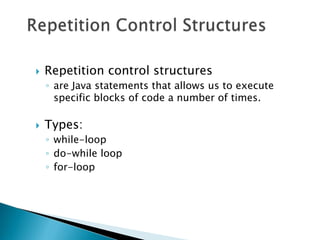
   Repetition control structures
    ◦ are Java statements that allows us to execute
      specific blocks of code a number of times.

   Types:
    ◦ while-loop
    ◦ do-while loop
    ◦ for-loop
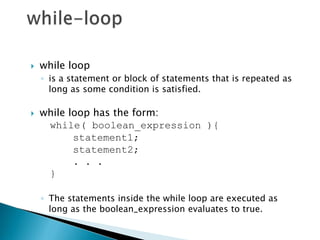
   while loop
    ◦ is a statement or block of statements that is repeated as
      long as some condition is satisfied.

   while loop has the form:
     while( boolean_expression ){
           statement1;
           statement2;
           . . .
     }

    ◦ The statements inside the while loop are executed as
      long as the boolean_expression evaluates to true.
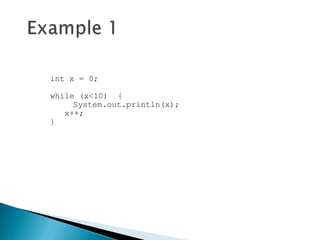
int x = 0;

while (x<10) {
     System.out.println(x);
   x++;
}
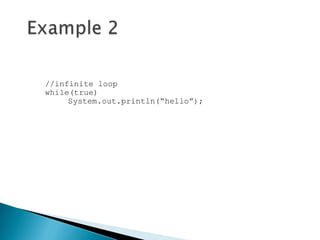
//infinite loop
while(true)
     System.out.println(“hello”);
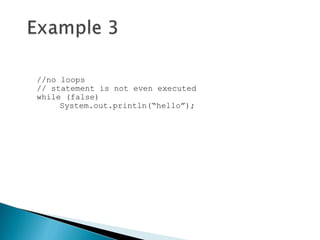
//no loops
// statement is not even executed
while (false)
     System.out.println(“hello”);
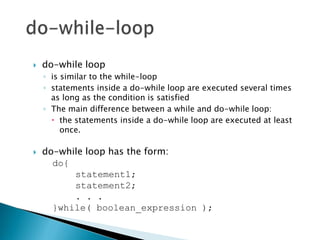
   do-while loop
    ◦ is similar to the while-loop
    ◦ statements inside a do-while loop are executed several times
      as long as the condition is satisfied
    ◦ The main difference between a while and do-while loop:
       the statements inside a do-while loop are executed at least
         once.

   do-while loop has the form:
      do{
          statement1;
          statement2;
          . . .
      }while( boolean_expression );
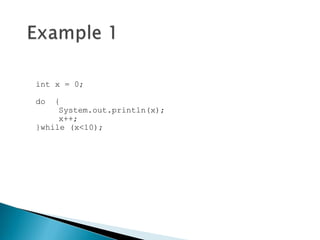
int x = 0;

do  {
     System.out.println(x);
     x++;
}while (x<10);
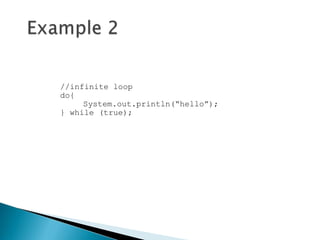
//infinite loop
do{
     System.out.println(“hello”);
} while (true);
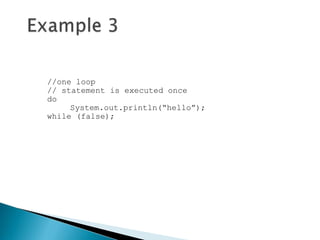
//one loop
// statement is executed once
do
     System.out.println(“hello”);
while (false);
   for loop
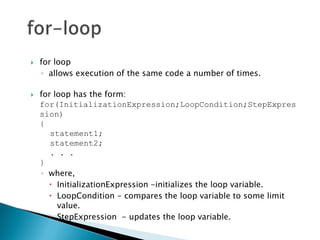
    ◦ allows execution of the same code a number of times.

   for loop has the form:
    for(InitializationExpression;LoopCondition;StepExpres
    sion)
    {
       statement1;
       statement2;
       . . .
    }
    ◦ where,
       InitializationExpression -initializes the loop variable.
       LoopCondition - compares the loop variable to some limit
         value.
       StepExpression - updates the loop variable.
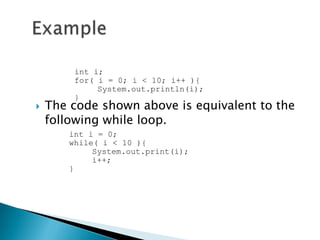
int i;
        for( i = 0; i < 10; i++ ){
             System.out.println(i);
        }
   The code shown above is equivalent to the
    following while loop.
       int i = 0;
       while( i < 10 ){
            System.out.print(i);
            i++;
       }

Control structures

  • 1.
    Repetition control structures ◦ are Java statements that allows us to execute specific blocks of code a number of times.  Types: ◦ while-loop ◦ do-while loop ◦ for-loop
  • 2.
    while loop ◦ is a statement or block of statements that is repeated as long as some condition is satisfied.  while loop has the form: while( boolean_expression ){ statement1; statement2; . . . } ◦ The statements inside the while loop are executed as long as the boolean_expression evaluates to true.
  • 3.
    int x =0; while (x<10) { System.out.println(x); x++; }
  • 4.
    //infinite loop while(true) System.out.println(“hello”);
  • 5.
    //no loops // statementis not even executed while (false) System.out.println(“hello”);
  • 6.
    do-while loop ◦ is similar to the while-loop ◦ statements inside a do-while loop are executed several times as long as the condition is satisfied ◦ The main difference between a while and do-while loop:  the statements inside a do-while loop are executed at least once.  do-while loop has the form: do{ statement1; statement2; . . . }while( boolean_expression );
  • 7.
    int x =0; do { System.out.println(x); x++; }while (x<10);
  • 8.
    //infinite loop do{ System.out.println(“hello”); } while (true);
  • 9.
    //one loop // statementis executed once do System.out.println(“hello”); while (false);
  • 10.
    for loop ◦ allows execution of the same code a number of times.  for loop has the form: for(InitializationExpression;LoopCondition;StepExpres sion) { statement1; statement2; . . . } ◦ where,  InitializationExpression -initializes the loop variable.  LoopCondition - compares the loop variable to some limit value.  StepExpression - updates the loop variable.
  • 11.
    int i; for( i = 0; i < 10; i++ ){ System.out.println(i); }  The code shown above is equivalent to the following while loop. int i = 0; while( i < 10 ){ System.out.print(i); i++; }