CONTRACT MANUFACTURING

Presented By- Anubhav, Shani
M.pharm 1st year
IPR, GLA university
INTRODUCTION
• A Contract Manufacturing Organization (CMO), sometimes called a Contract
Development and Manufacturing Organization (CDMO), is an organization that
serves the pharmaceutical industry and provides clients with comprehensive
services from drug development through manufacture.
• Services offered by CMOs include, but are not limited to: pre-formulation,
formulation development, stability studies, method development, pre-clinical and
Phase I clinical trial materials, late-stage clinical trial materials, formal stability,
scale-up, registration batches and commercial production.
• contract manufacturers offer numerous other advantages over in-house
manufacturing, including lower costs, flexibility, access to external expertise and
reduced capital.
NEED OF CONTRACT MANUFACTURING

• There are many benefits as well as risks to contract manufacturing.
• With escalating R&D costs and the long path to new medicine, these companies are
forced to view outsourcing or contract services as an important part of their
manufacturing strategy.
• In recent years, the concept of a comprehensive single-source provider from drug
development through commercial manufacture has emerged. This concept has been
implemented by providers known today as contract development and
manufacturing organizations (CMOs)
• The best-positioned service providers focus on a specific technology or dosage
form and promote end-to-end continuity and efficiency for their outsourcing
clients.
EFFECT OF CONTRACT MANUFACTURING
• Success in contract manufacturing is lead by factors such as product quality, cost
competitiveness, delivery schedule and CM/Customer relationship.
• The increasing complexity of pharmaceutical products has phased out manual
operating methods and forced manufacturers to utilize hi-tech automatic
manufacturing techniques. This works out to be more cost-effective for them since
their internal resources can be focused on more important aspects of business such
as product development and marketing.
• This trend has led to a boom in a phenomenon called contract manufacturing (CM).
• In other words, the manufacturing process yield depends on the knowledge of the
production process expertise, and how well they are able to motivate and educate
production operators.
• That’s why some time Contract manufacturing is also known as Win-Win
Strategy.
Winning Factors in Contract Manufacturing
• Contract manufacturing has undergone a tremendous change with the transition
from through-hole to surface-mount technology.
• Consumer awareness and global competition has made it mandatory for
manufacturers to produce high-quality products at minimum cost within the
delivery schedule.
• Factors important for achieving success in CM are product quality, cost
competitiveness, delivery schedule and CM/Customer relationship.
Product Quality
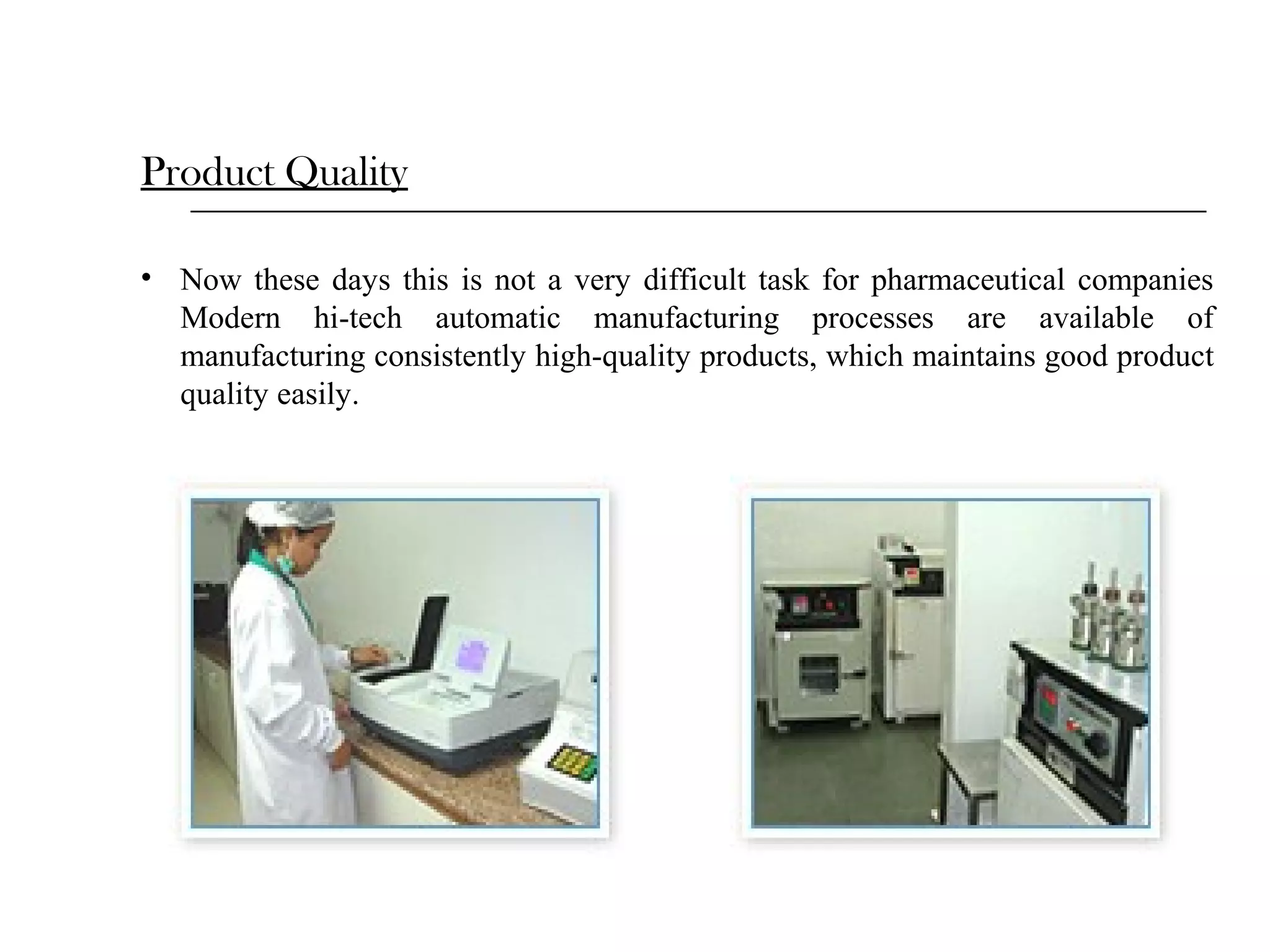
• Now these days this is not a very difficult task for pharmaceutical companies
Modern hi-tech automatic manufacturing processes are available of
manufacturing consistently high-quality products, which maintains good product
quality easily.
Delivery Schedule
• As All Contract manufacturer demand that their products be delivered within
contractual time frames.
• The success of a CM largely depends on whether it is capable of meeting this
requirement of Customers.
• Maintaining a Consistent and strict delivery schedule involves close planning of
the entire production. Such a planning involves; Control of incoming materials.
Maintaining an operating schedule of the production line.
• This can be taken care of by determining the number of lines and shifts needed,
the manpower required and the process yield.
CM/Customers Relationship

• We know that the success of contract manufacturing depends on the mutual
understanding between the contract manufacturer and the customers. The former
must know how to service the latter, and must make clear his requirements (to the
customer) in advance.
• The relationship depends on mutual trust, and hence the communication between
the two parties must remain open. This will help both the sides to understand the
requirements of maintaining the partnership.
Conclusion
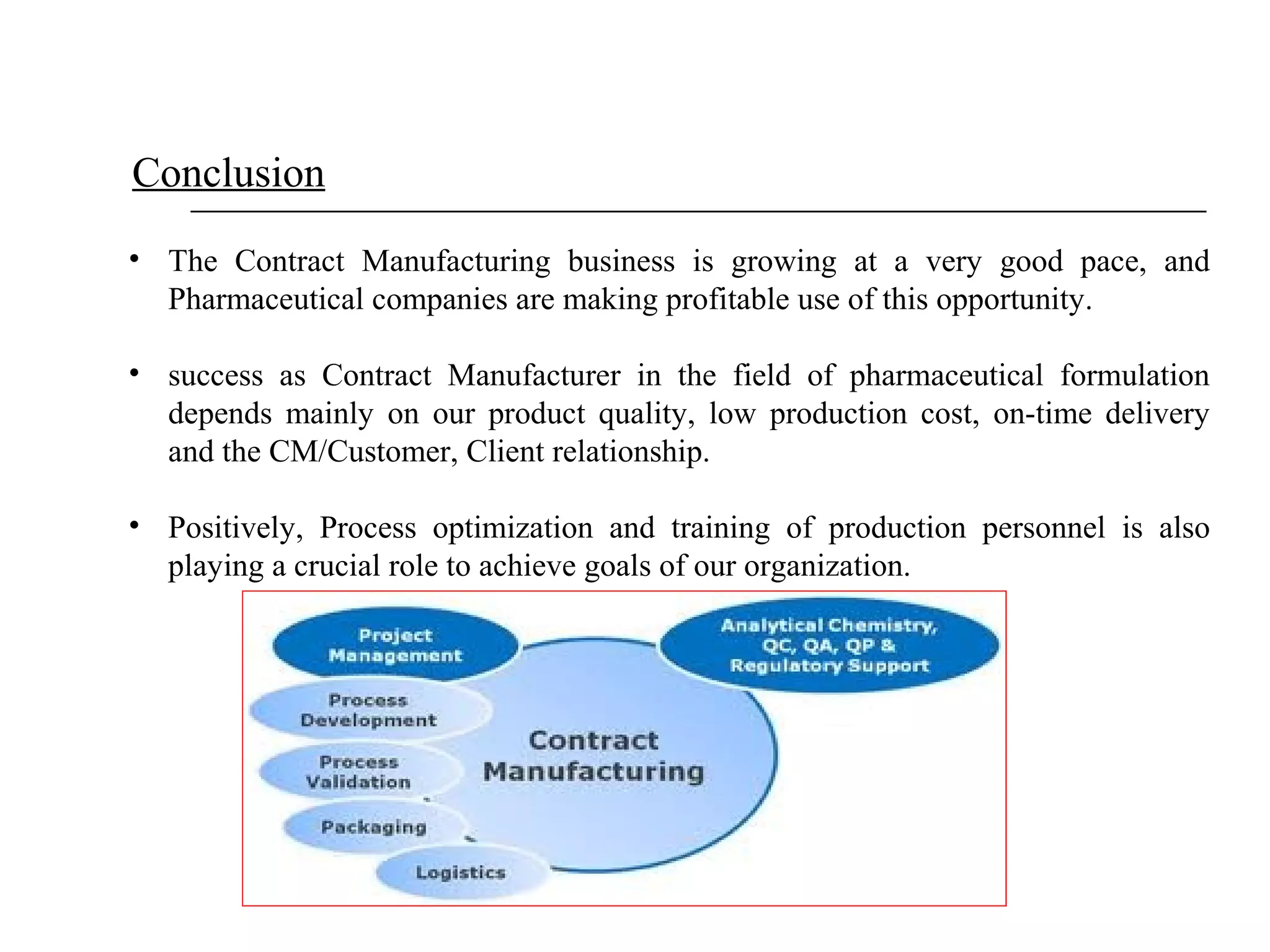
• The Contract Manufacturing business is growing at a very good pace, and
Pharmaceutical companies are making profitable use of this opportunity.
• success as Contract Manufacturer in the field of pharmaceutical formulation
depends mainly on our product quality, low production cost, on-time delivery
and the CM/Customer, Client relationship.
• Positively, Process optimization and training of production personnel is also
playing a crucial role to achieve goals of our organization.
EXAMPLE- BIOCON PVT. LTD.
• Biocon leverages its India cost-base together with its extensive expertise and
technology platforms to offer competitive, high quality, custom manufacturing
services to a global clientele.
• Biocon’s full set of customer manufacturing capabilities, include mammalian cell
culture fermentation, microbial cell culture fermentation, synthetic chemistry.
• The facility has been inspected by various international regulators including the
USFDA, EU Inspectors, and Anvisa (Regulatory authority of Brazil).
ADVANTAGES OF CONTRACT MANUFACTURING
• Outsourcing to a CMO allows the pharmaceutical client to expand its technical
resources without increased overhead. The client can then manage its internal
resources and costs by focusing on core competencies and high-value projects
while reducing or not adding infrastructure or technical staff.
• Working with a CMO also limits a client’s upfront capital investment for drug
development, thus minimizing a project’s cost.
• By concentrating resources with a single-source provider, the outsourcing client
can minimize technical transfer of projects or products, thereby reducing
unforeseen costs and potentially speeding new products to market.
DISADVANTAGES OF CONTRACT MANUFACTURING
The pharmaceutical client using the services of a CMO does not have direct control
of the project in regard to scheduling, cost, quality or accountability.

Note- For small companies, contract manufacturing may not be a good business
strategy. For large companies that are trying to extend into new markets, contract
manufacturing may be a good choice.
Industries that use the practice
•










Many industries use this process, especially the –
aerospace,
defense,
computer,
semiconductor,
energy,
medical,
food manufacturing,
personal care, and
automotive fields.

• Some types of contract manufacturing include CNC machining, complex
assembly, aluminum die casting, grinding, broaching, gears, and forging.
• The pharmaceutical industry use this process with CMs called Contract
manufacturing organizations.
REFERENCE
• http://www.healthbiotech.in/contract-manufacturing.html
• Images from Google Images.
Contract manufacturing, By Anubhav Singh, M.pharm

Contract manufacturing, By Anubhav Singh, M.pharm

  • 1.
    CONTRACT MANUFACTURING Presented By-Anubhav, Shani M.pharm 1st year IPR, GLA university
  • 2.
    INTRODUCTION • A ContractManufacturing Organization (CMO), sometimes called a Contract Development and Manufacturing Organization (CDMO), is an organization that serves the pharmaceutical industry and provides clients with comprehensive services from drug development through manufacture. • Services offered by CMOs include, but are not limited to: pre-formulation, formulation development, stability studies, method development, pre-clinical and Phase I clinical trial materials, late-stage clinical trial materials, formal stability, scale-up, registration batches and commercial production. • contract manufacturers offer numerous other advantages over in-house manufacturing, including lower costs, flexibility, access to external expertise and reduced capital.
  • 3.
    NEED OF CONTRACTMANUFACTURING • There are many benefits as well as risks to contract manufacturing. • With escalating R&D costs and the long path to new medicine, these companies are forced to view outsourcing or contract services as an important part of their manufacturing strategy. • In recent years, the concept of a comprehensive single-source provider from drug development through commercial manufacture has emerged. This concept has been implemented by providers known today as contract development and manufacturing organizations (CMOs) • The best-positioned service providers focus on a specific technology or dosage form and promote end-to-end continuity and efficiency for their outsourcing clients.
  • 5.
    EFFECT OF CONTRACTMANUFACTURING • Success in contract manufacturing is lead by factors such as product quality, cost competitiveness, delivery schedule and CM/Customer relationship. • The increasing complexity of pharmaceutical products has phased out manual operating methods and forced manufacturers to utilize hi-tech automatic manufacturing techniques. This works out to be more cost-effective for them since their internal resources can be focused on more important aspects of business such as product development and marketing. • This trend has led to a boom in a phenomenon called contract manufacturing (CM). • In other words, the manufacturing process yield depends on the knowledge of the production process expertise, and how well they are able to motivate and educate production operators. • That’s why some time Contract manufacturing is also known as Win-Win Strategy.
  • 6.
    Winning Factors inContract Manufacturing • Contract manufacturing has undergone a tremendous change with the transition from through-hole to surface-mount technology. • Consumer awareness and global competition has made it mandatory for manufacturers to produce high-quality products at minimum cost within the delivery schedule. • Factors important for achieving success in CM are product quality, cost competitiveness, delivery schedule and CM/Customer relationship.
  • 7.
    Product Quality • Nowthese days this is not a very difficult task for pharmaceutical companies Modern hi-tech automatic manufacturing processes are available of manufacturing consistently high-quality products, which maintains good product quality easily.
  • 8.
    Delivery Schedule • AsAll Contract manufacturer demand that their products be delivered within contractual time frames. • The success of a CM largely depends on whether it is capable of meeting this requirement of Customers. • Maintaining a Consistent and strict delivery schedule involves close planning of the entire production. Such a planning involves; Control of incoming materials. Maintaining an operating schedule of the production line. • This can be taken care of by determining the number of lines and shifts needed, the manpower required and the process yield.
  • 9.
    CM/Customers Relationship • Weknow that the success of contract manufacturing depends on the mutual understanding between the contract manufacturer and the customers. The former must know how to service the latter, and must make clear his requirements (to the customer) in advance. • The relationship depends on mutual trust, and hence the communication between the two parties must remain open. This will help both the sides to understand the requirements of maintaining the partnership.
  • 10.
    Conclusion • The ContractManufacturing business is growing at a very good pace, and Pharmaceutical companies are making profitable use of this opportunity. • success as Contract Manufacturer in the field of pharmaceutical formulation depends mainly on our product quality, low production cost, on-time delivery and the CM/Customer, Client relationship. • Positively, Process optimization and training of production personnel is also playing a crucial role to achieve goals of our organization.
  • 11.
    EXAMPLE- BIOCON PVT.LTD. • Biocon leverages its India cost-base together with its extensive expertise and technology platforms to offer competitive, high quality, custom manufacturing services to a global clientele. • Biocon’s full set of customer manufacturing capabilities, include mammalian cell culture fermentation, microbial cell culture fermentation, synthetic chemistry. • The facility has been inspected by various international regulators including the USFDA, EU Inspectors, and Anvisa (Regulatory authority of Brazil).
  • 12.
    ADVANTAGES OF CONTRACTMANUFACTURING • Outsourcing to a CMO allows the pharmaceutical client to expand its technical resources without increased overhead. The client can then manage its internal resources and costs by focusing on core competencies and high-value projects while reducing or not adding infrastructure or technical staff. • Working with a CMO also limits a client’s upfront capital investment for drug development, thus minimizing a project’s cost. • By concentrating resources with a single-source provider, the outsourcing client can minimize technical transfer of projects or products, thereby reducing unforeseen costs and potentially speeding new products to market.
  • 13.
    DISADVANTAGES OF CONTRACTMANUFACTURING The pharmaceutical client using the services of a CMO does not have direct control of the project in regard to scheduling, cost, quality or accountability. Note- For small companies, contract manufacturing may not be a good business strategy. For large companies that are trying to extend into new markets, contract manufacturing may be a good choice.
  • 14.
    Industries that usethe practice •          Many industries use this process, especially the – aerospace, defense, computer, semiconductor, energy, medical, food manufacturing, personal care, and automotive fields. • Some types of contract manufacturing include CNC machining, complex assembly, aluminum die casting, grinding, broaching, gears, and forging. • The pharmaceutical industry use this process with CMs called Contract manufacturing organizations.
  • 15.