Elizabeth Pollina Cormier, Ph.D.
Review Chemist
Division of Manufacturing Technologies
FDA/CVM/ONADE
Chemistry, Manufacturing, and
Controls (CMC) and Good
Manufacturing Practices (GMPs):
The Big Picture of a
Long-term Commitment
 To assure that the drug sold to the public will have
quality attributes similar to those of the drug
demonstrated to be safe and effective
 To assure that the quality of the drug meets
appropriate standards and is consistent
 To assure that the drug you
are using is the drug
described onthe label
Why is there CMC?
• How and where is the drug made?
• How are raw materials tested and monitored?
• What control procedures are in place to assure
product consistency and quality?
• Are quality attributes adequately identified and
characterized for the product?
• Are the test methods used to monitor product
quality appropriate?
• How long does the product maintain its quality
after it is made (shelf life/expiry)?
CMC critical elements
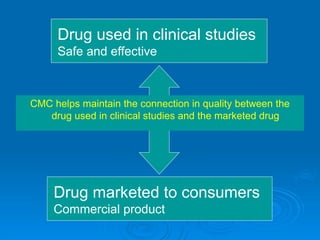
CMC helps maintain the connection in quality between the
drug used in clinical studies and the marketed drug
Drug marketed to consumers
Commercial product
Drug used in clinical studies
Safe and effective
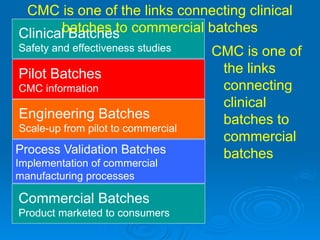
Commercial Batches
Product marketed to consumers
Process Validation Batches
Implementation of commercial
manufacturing processes
Engineering Batches
Scale-up from pilot to commercial
Pilot Batches
CMC information
Clinical Batches
Safety and effectiveness studies CMC is one of
the links
connecting
clinical
batches to
commercial
batches
CMC is one of the links connecting clinical
batches to commercial batches
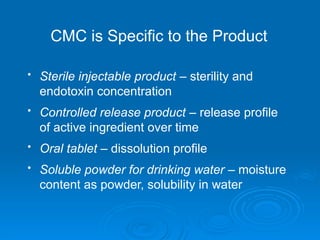
• Sterile injectable product – sterility and
endotoxin concentration
• Controlled release product – release profile
of active ingredient over time
• Oral tablet – dissolution profile
• Soluble powder for drinking water – moisture
content as powder, solubility in water
CMC is Specific to the Product
• Testing alone of the finished drug product is
insufficient for control of product quality
• The manufacturer should know which steps and
variables in the manufacturing process need to
be controlled and why
• Process understanding is the foundation of a
controlled manufacturing process
Process Understanding is Vital to
Quality and Consistency
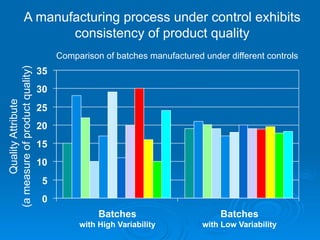
Quality
Attribute
(a
measure
of
product
quality)
0
5
10
15
20
25
30
35
Batches
with High Variability
Batches
with Low Variability
A manufacturing process under control exhibits
consistency of product quality
Comparison of batches manufactured under different controls
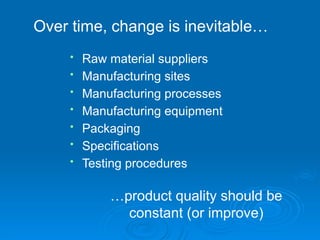
…product quality should be
constant (or improve)
• Raw material suppliers
• Manufacturing sites
• Manufacturing processes
• Manufacturing equipment
• Packaging
• Specifications
• Testing procedures
Over time, change is inevitable…
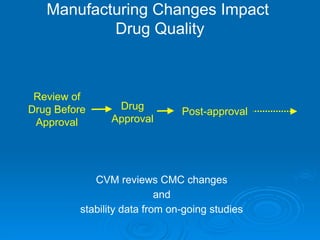
CVM reviews CMC changes
and
stability data from on-going studies
Post-approval
Drug
Approval
Review of
Drug Before
Approval
Manufacturing Changes Impact
Drug Quality
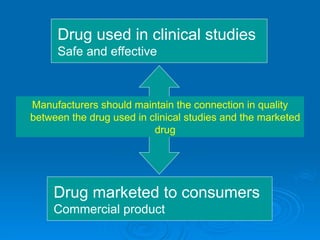
Drug marketed to consumers
Commercial product
Manufacturers should maintain the connection in quality
between the drug used in clinical studies and the marketed
drug
Drug used in clinical studies
Safe and effective
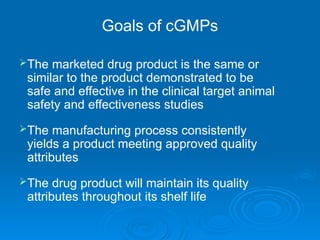
The marketed drug product is the same or
similar to the product demonstrated to be
safe and effective in the clinical target animal
safety and effectiveness studies
The manufacturing process consistently
yields a product meeting approved quality
attributes
The drug product will maintain its quality
attributes throughout its shelf life
Goals of cGMPs
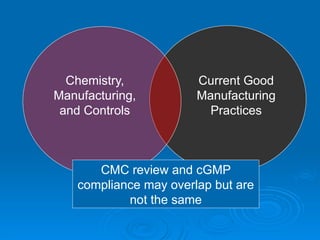
Current Good
Manufacturing
Practices
Chemistry,
Manufacturing,
and Controls
CMC review and cGMP
compliance may overlap but are
not the same
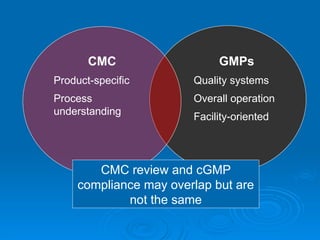
CMC review and cGMP
compliance may overlap but are
not the same
GMPs
Quality systems
Overall operation
Facility-oriented
CMC
Product-specific
Process
understanding
GMPs cover all aspects of production - from the starting
materials, premises, and equipment to the qualifications,
training and personal hygiene of staff and management.
Detailed, written procedures are essential for the quality of
the finished product.
Specific recordkeeping systems must be established to
demonstrate that procedures are consistently and correctly
followed at each step in the manufacturing process - every
time a product is made.
Facility GMP Considerations
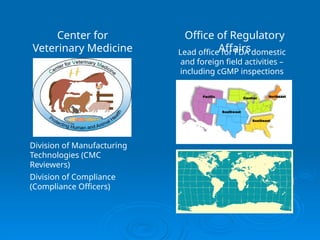
Lead office for FDA domestic
and foreign field activities –
including cGMP inspections
Office of Regulatory
Affairs
Division of Manufacturing
Technologies (CMC
Reviewers)
Division of Compliance
(Compliance Officers)
Center for
Veterinary Medicine
Role of CMC review
and
generic drugs
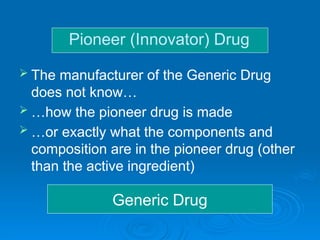
Generic Drug
 The manufacturer of the Generic Drug
does not know…
 …how the pioneer drug is made
 …or exactly what the components and
composition are in the pioneer drug (other
than the active ingredient)
Pioneer (Innovator) Drug
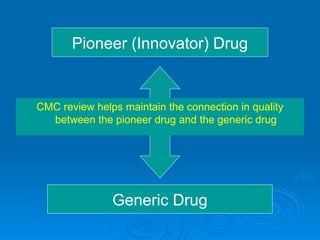
CMC review helps maintain the connection in quality
between the pioneer drug and the generic drug
Generic Drug
Pioneer (Innovator) Drug
 Through CMC and GMPs, drug product
manufacturers ensure that
 Quality is designed into the manufacturing
process (and does not rely on testing
alone)
 Quality is maintained as
long as the product is
marketed
Bottom Line

CMCsandGMPssssdsssseeeeeeeeeeeeeees.pptx

  • 1.
    Elizabeth Pollina Cormier,Ph.D. Review Chemist Division of Manufacturing Technologies FDA/CVM/ONADE Chemistry, Manufacturing, and Controls (CMC) and Good Manufacturing Practices (GMPs): The Big Picture of a Long-term Commitment
  • 2.
     To assurethat the drug sold to the public will have quality attributes similar to those of the drug demonstrated to be safe and effective  To assure that the quality of the drug meets appropriate standards and is consistent  To assure that the drug you are using is the drug described onthe label Why is there CMC?
  • 3.
    • How andwhere is the drug made? • How are raw materials tested and monitored? • What control procedures are in place to assure product consistency and quality? • Are quality attributes adequately identified and characterized for the product? • Are the test methods used to monitor product quality appropriate? • How long does the product maintain its quality after it is made (shelf life/expiry)? CMC critical elements
  • 4.
    CMC helps maintainthe connection in quality between the drug used in clinical studies and the marketed drug Drug marketed to consumers Commercial product Drug used in clinical studies Safe and effective
  • 5.
    Commercial Batches Product marketedto consumers Process Validation Batches Implementation of commercial manufacturing processes Engineering Batches Scale-up from pilot to commercial Pilot Batches CMC information Clinical Batches Safety and effectiveness studies CMC is one of the links connecting clinical batches to commercial batches CMC is one of the links connecting clinical batches to commercial batches
  • 6.
    • Sterile injectableproduct – sterility and endotoxin concentration • Controlled release product – release profile of active ingredient over time • Oral tablet – dissolution profile • Soluble powder for drinking water – moisture content as powder, solubility in water CMC is Specific to the Product
  • 7.
    • Testing aloneof the finished drug product is insufficient for control of product quality • The manufacturer should know which steps and variables in the manufacturing process need to be controlled and why • Process understanding is the foundation of a controlled manufacturing process Process Understanding is Vital to Quality and Consistency
  • 8.
    Quality Attribute (a measure of product quality) 0 5 10 15 20 25 30 35 Batches with High Variability Batches withLow Variability A manufacturing process under control exhibits consistency of product quality Comparison of batches manufactured under different controls
  • 9.
    …product quality shouldbe constant (or improve) • Raw material suppliers • Manufacturing sites • Manufacturing processes • Manufacturing equipment • Packaging • Specifications • Testing procedures Over time, change is inevitable…
  • 10.
    CVM reviews CMCchanges and stability data from on-going studies Post-approval Drug Approval Review of Drug Before Approval Manufacturing Changes Impact Drug Quality
  • 11.
    Drug marketed toconsumers Commercial product Manufacturers should maintain the connection in quality between the drug used in clinical studies and the marketed drug Drug used in clinical studies Safe and effective
  • 12.
    The marketed drugproduct is the same or similar to the product demonstrated to be safe and effective in the clinical target animal safety and effectiveness studies The manufacturing process consistently yields a product meeting approved quality attributes The drug product will maintain its quality attributes throughout its shelf life Goals of cGMPs
  • 13.
    Current Good Manufacturing Practices Chemistry, Manufacturing, and Controls CMCreview and cGMP compliance may overlap but are not the same
  • 14.
    CMC review andcGMP compliance may overlap but are not the same GMPs Quality systems Overall operation Facility-oriented CMC Product-specific Process understanding
  • 15.
    GMPs cover allaspects of production - from the starting materials, premises, and equipment to the qualifications, training and personal hygiene of staff and management. Detailed, written procedures are essential for the quality of the finished product. Specific recordkeeping systems must be established to demonstrate that procedures are consistently and correctly followed at each step in the manufacturing process - every time a product is made. Facility GMP Considerations
  • 16.
    Lead office forFDA domestic and foreign field activities – including cGMP inspections Office of Regulatory Affairs Division of Manufacturing Technologies (CMC Reviewers) Division of Compliance (Compliance Officers) Center for Veterinary Medicine
  • 17.
    Role of CMCreview and generic drugs
  • 18.
    Generic Drug  Themanufacturer of the Generic Drug does not know…  …how the pioneer drug is made  …or exactly what the components and composition are in the pioneer drug (other than the active ingredient) Pioneer (Innovator) Drug
  • 19.
    CMC review helpsmaintain the connection in quality between the pioneer drug and the generic drug Generic Drug Pioneer (Innovator) Drug
  • 20.
     Through CMCand GMPs, drug product manufacturers ensure that  Quality is designed into the manufacturing process (and does not rely on testing alone)  Quality is maintained as long as the product is marketed Bottom Line

Editor's Notes

  • #1 CMC is one of the major sections that is reviewed BEFORE a drug can be approved. But the CMC technical section is a “long-term commitment” and doesn’t stop AFTER the drug is approved – it is not “once and done” for either the drug sponsor or CVM. The reason why the CMC section lives as long as the product lives will become clear. By “product” I’m not talking about just a vial of pills sitting on the shelf, I’m talking about the “product” in terms of the entire decades-long life cycle of a drug, from “gestation” before drug approval to “death” when the drug is no longer made and sold.
  • #2 CMC technical section (critical elements) = one of the major technical sections that sponsors have to provide to CVM for review; We build QUALITY into the product by assuring that the drug is safe and effective, meets appropriate standards – consistently, and labelled appropriately
  • #3 There are raw materials that go into making a drug (solvents, chemical starting materials, inactive ingredients, etc.) – how is the quality of those raw materials monitored and controlled before use? Are the steps needed to be controlled (e.g., reaction temperature) identified and controlled? If it’s a sterile product, are the sterilization steps validated? Do the stability data support the shelf life proposed for the label? CMC TS provides answers to the those questions “The ability to consistently produce the same product to meet the same specifications time after time!”
  • #4 Another way to think about the CMC technical section… It provides a link to the between the drug used in the clinical studies to the marketed drug on the shelf
  • #5 How is this connection between clinical and commercial batches first made? Clinical batches are made to produce drug used in clinical studies. Pilot batches are made to demonstrate a quality, stable drug can be made consistently – the data collected from the pilot batches are submitted to the FDA in the CMC technical section for review. After the drug is approved, the manufacturer may need to increase the size of the batch from the pilot batch to the commercial batch size. To do the scale up, the manufacturer may need to make engineering batches and process validation batches. (I’ve separated out these batches here for illustration, but clinical batches can be the same as pilot batches, and process validation batches can be the same as commercial batches, and so on). The drug should be made with the same formulation and similar manufacturing processes at each of these stages. ----------- Batches at each stage should be made using the same or similar processes and raw materials
  • #6 The CMC technical section is not a “check list” or simply a list of tests performed on the product. The kind of questions raised will depend on the nature of the product. Quality attributes may be specific to the product or type of product For example for a a sterile product, the answers to these questions are different from product to product – and CVM evaluates whether the data provided by the sponsor supports the adequacy of the answers. ***Because each product is unique, sponsors are encouraged to contact CVM during product development to begin a dialogue. We expect sponsors to have questions, we will have questions (because we need to understand your product in order to properly review it), sponsors may learn what concerns CVM may have.***
  • #7 Relying solely on testing of the product at the end will not be enough to assure product quality over the long run. The manufacturer that understands the sources of variability in its process can preempt problems, and if problems occur, is more likely to quickly find the root cause and fix it.
  • #8 The same (or similar) processes and raw materials should be used to manufacture the drug used in clinical studies and the marketed drug Common product quality attributes may include: Potency of active pharmaceutical ingredient (API) in the drug product Impurities related to the API Residual solvents from the manufacturing process Concentration of critical formulation component (e.g., preservative) Container-closure integrity
  • #9 Manufacturing changes are inevitable over time
  • #10 Manufacturers should consider how all manufacturing changes made during the life of the drug impact its quality After the drug is approved, the manufacturer report any changes it makes in the process to the FDA for review. ***Because some of these changes need approval by CVM before they can be implemented, sponsors are encouraged to contact CVM as soon as possible to take into account the review timeline before changes can be made.
  • #12 In addition to submitting a CMC technical section for review by CVM, manufacturers must comply with FDA regulations known as Current Good Manufacturing Practices. Current Good Manufacturing Practices are commonly referred to as “cGMPs” or “GMPs”. The goals of CMC and GMPs are the same: a product consistently meeting pre-determined quality standards, but they involve different yet overlapping approaches and regulations.
  • #13 Although the goals of CMC and GMPs are the same: they involve different yet overlapping approaches and regulations. ------------- CMC information is totally specific to a product – and CVM’s review of the CMC is a scientific evaluation of whether the data provided by the manufacturer demonstrates it has appropriate manufacturing procedures and controls to produce a safe and effective drug that is accurately described by the product label. On the other hand, GMPs typically tend to encompass the manufacturer’s overall operations – for example, their record keeping, equipment cleaning and maintenance, raw materials control, validation of manufacturing processes, sampling and testing, quality control, etc. If something does go wrong with a batch of product, a GMP-compliant facility should be able to track down the cause of the problem and trace other batches that may have also been affected. When the FDA inspects a facility for GMP compliance, they may focus on a specific product, or they may look at the operations in general. FDA field investigators often ask for CMC information, and CMC reviewers will ask field investigators to look more closely at certain aspects of a specific product. Again, the two are inter-related and over-lapping, but not the same.
  • #14 Reviewing the CMC information and doing a GMP inspection are two different ways we ensure that a product has appropriate quality and controls. CMC information is totally specific to a product – and CVM’s review of the CMC is a scientific evaluation of whether the data provided by the manufacturer demonstrates it has appropriate manufacturing procedures and controls to produce a safe and effective drug that is accurately described by the product label. On the other hand, GMPs typically tend to encompass the manufacturer’s overall operations – for example, their record keeping, equipment cleaning and maintenance, raw materials control, validation of manufacturing processes, sampling and testing, quality control, etc. If something does go wrong with a batch of product, a GMP-compliant facility should be able to track down the cause of the problem and trace other batches that may have also been affected. When the FDA inspects a facility for GMP compliance, they may focus on a specific product, or they may look at the operations in general. FDA field investigators often ask for CMC information, and CMC reviewers will ask field investigators to look more closely at certain aspects of a specific product. Again, the two are inter-related and over-lapping, but not the same.
  • #15 READ slide -GMPs cover all aspects of production - There should be written procedures such that any properly trained personnel can follow the procedures and make a product that meets its predetermined quality standards. The quality of the raw materials (including packaging) should be monitored. Equipment and facilities should be clean and properly maintained. -Detailed, written procedures are essential for the quality of the finished product. A robust quality system includes written SOPs detailing with specificity how every step of the manufacturing process is carried out and documented -Specific recordkeeping systems must be established to demonstrate that procedures are consistently and correctly followed at each step in the manufacturing process - every time a product is made. Records should be kept such that a manufacturer can trace back a specific batch of pills, the date it was made, the lot numbers of the ingredients that went into it, etc. ---------- During an inspection, an FDA investigator will audit records, watch manufacturing operations, ask questions, check the quality control and assurance units – they are the eyes and ears for FDA.
  • #16 For the United States, GMP inspections are typically performed by an FDA office outside CVM – The Office of Regulatory Affairs. With regard to GMP compliance, CVM - in particular the Division of Manufacturing Technologies and the Division of Compliance - interacts with the Office of Regulatory Affairs at various stages. The Division of Manufacturing Technologies reviews the Chemistry, Manufacturing, and Controls Technical Section. GMP compliance is evaluated at the manufacturing site by Office of Regulatory Affairs. If there are GMP deficiencies, the District Offices and CVM Division of Compliance determine what regulatory actions should be taken. Inspections of manufacturing facilities are performed by investigators in the FDA Office of Regulatory Affairs, which is another part of FDA separate from CVM. The Office of Regulatory Affairs conducts inspections in the US and overseas. In CVM, there are two divisions that interact with investigators and the Office of Regulatory Affairs – the Division of Manufacturing Technologies (in ONADE) and the Division of Compliance (in OS&C). The District Offices (within the Office of Regulatory Affairs) and CVM Division of Compliance determine will regulatory actions regarding inspections --------------- You could also keep slide 18 and move it after the slide with the regs to explain how responsibilities for review and GMP evaluation are divided in the US.
  • #17 Until now, I’ve been talking in the context of pioneer drugs. When you think about it, the review of a new generic drug is an interesting situation – something I’ll touch on only briefly here.
  • #18 After the patent expires on a drug, the FDA allows other companies to make and sell generic drugs, which are copies of the pioneer drug. But the maker of the generic drug does not know how the pioneer drug is made or its exact composition.
  • #19 Review of the CMC information for generic drugs is important to assure the generic drug has quality similar to the pioneer drug. CVM asks the same kinds of CMC questions I talked about earlier – how are the raw materials controlled and monitored? How is the drug made? What quality standards are used and how is the manufacturing process monitored and controlled to assure the product meets these standards. FDA determines whether the manufacturing processes of the generic drug will result in a product of comparable quality.