Continuous Testing
How to define, assess and create a roadmap for Continuous
Testing for Quality Engineering, DevOps, DevSecOps and SRE.
Continuous Testing Copyright © 2023 by Marc Hornbeek All rights reserved.
Marc Hornbeek
DevOps_the_Gray
DevOps Institute Ambassador
CEO Engineering DevOps Consulting
www.engineeringdevops.com
mhornbeek@engineeringdevops.com
- Essential for Continuous Quality Engineering
Continuous Testing
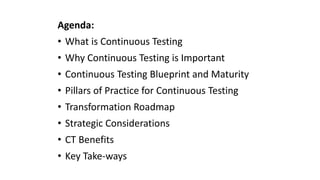
Agenda:
• What is Continuous Testing
• Why Continuous Testing is Important
• Continuous Testing Blueprint and Maturity
• Pillars of Practice for Continuous Testing
• Transformation Roadmap
• Strategic Considerations
• CT Benefits
• Key Take-ways
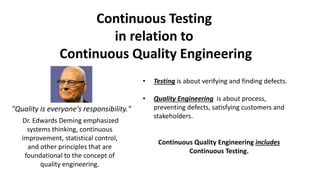
• Testing is about verifying and finding defects.
• Quality Engineering is about process,
preventing defects, satisfying customers and
stakeholders.
Continuous Quality Engineering includes
Continuous Testing.
Continuous Testing
in relation to
Continuous Quality Engineering
Dr. Edwards Deming emphasized
systems thinking, continuous
improvement, statistical control,
and other principles that are
foundational to the concept of
quality engineering.
"Quality is everyone's responsibility."
Test
Management
Test
Tools
Test
Automation
Leadership
and Culture
Continuous Testing Blueprint
Test Strategies and
Plans
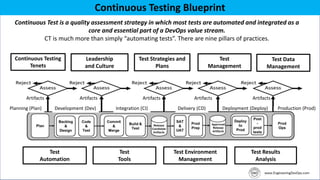
Continuous Test is a quality assessment strategy in which most tests are automated and integrated as a
core and essential part of a DevOps value stream.
CT is much more than simply “automating tests”. There are nine pillars of practices.
Test Results
Analysis
Test Environment
Management
Continuous Testing
Tenets
Continuous Testing Blueprint
Artifacts
Development (Dev)
Artifacts Artifacts Artifacts Artifacts
Integration (CI) Delivery (CD) Deployment (Deploy) Production (Prod)
Planning (Plan)
Test Data
Management
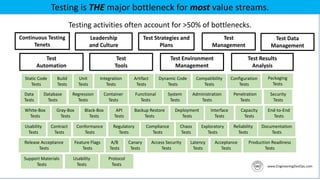
Testing is THE major bottleneck for most value streams.
Testing activities often account for >50% of bottlenecks.
Test
Management
Leadership
and Culture
Test Strategies and
Plans
Continuous Testing
Tenets
Test Data
Management
Test
Tools
Test
Automation
Test Results
Analysis
Test Environment
Management
Contract
Tests
Conformance
Tests
Regulatory
Tests
Compliance
Tests
Chaos
Tests
Exploratory
Tests
End-to-End
Tests
Usability
Tests
Static Code
Tests
Dynamic Code
Tests
Interface
Tests
Compatibility
Tests
Configuration
Tests
Data
Tests
Integration
Tests
Regression
Tests
Acceptance
Tests
Deployment
Tests
Penetration
Tests
Functional
Tests
System
Tests
Administration
Tests
Backup Restore
Tests
White-Box
Tests
Gray-Box
Tests
Black-Box
Tests
API
Tests
Container
Tests
Packaging
Tests
Capacity
Tests
Latency
Tests
Access Security
Tests
Canary
Tests
Build
Tests
Artifact
Tests
Release Acceptance
Tests
A/B
Tests
Feature Flags
Tests
Unit
Tests
Protocol
Tests
Usability
Tests
Reliability
Tests
Security
Tests
Support Materials
Tests
Documentation
Tests
Production Readiness
Tests
Database
Tests
Scope of Continuous Testing
SRE
Agile, DevOps, DevSecOps
Requirement
Production
Plan Develop CI/CD
In-Prod Ops
& SecOps
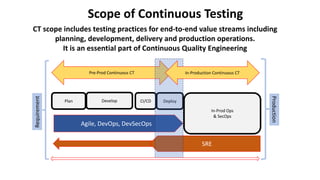
CT scope includes testing practices for end-to-end value streams including
planning, development, delivery and production operations.
It is an essential part of Continuous Quality Engineering
Pre-Prod Continuous CT
Deploy
In-Production Continuous CT
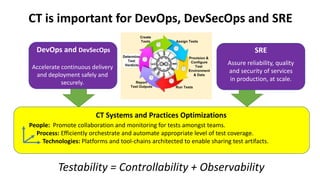
CT is important for DevOps, DevSecOps and SRE
CT Systems and Practices Optimizations
People: Promote collaboration and monitoring for tests amongst teams.
Process: Efficiently orchestrate and automate appropriate level of test coverage.
Technologies: Platforms and tool-chains architected to enable sharing test artifacts.
DevOps and DevSecOps SRE
Accelerate continuous delivery
and deployment safely and
securely.
Assure reliability, quality
and security of services
in production, at scale.
Testability = Controllability + Observability
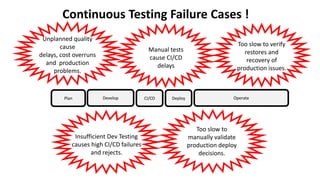
Continuous Testing Failure Cases !
Plan
Manual tests
cause CI/CD
delays
Develop CI/CD Operate
Insufficient Dev Testing
causes high CI/CD failures
and rejects.
Deploy
Too slow to
manually validate
production deploy
decisions.
Unplanned quality
cause
delays, cost overruns
and production
problems.
Too slow to verify
restores and
recovery of
production issues.
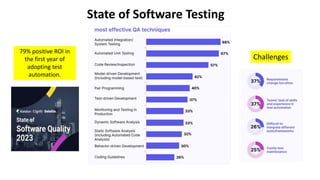
State of Software Testing
Quality requirements
left out of plan cause
delays, cost overruns
and production
problems.
79% positive ROI in
the first year of
adopting test
automation.
Challenges
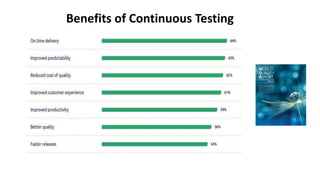
Benefits of Continuous Testing
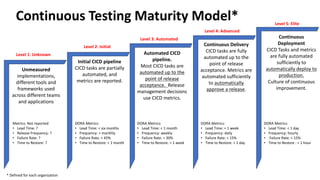
Level 1: Unknown
Level 2: Initial
Continuous Testing Maturity Model*
Unmeasured
implementations,
different tools and
frameworks used
across different teams
and applications
Level 3: Automated
Level 4: Advanced
Level 5: Elite
Initial CICD pipeline
CICD tasks are partially
automated, and
metrics are reported.
Automated CICD
pipeline.
Most CICD tasks are
automated up to the
point of release
acceptance. Release
management decisions
use CICD metrics.
Continuous Delivery
CICD tasks are fully
automated up to the
point of release
acceptance. Metrics are
automated sufficiently
to automatically
approve a release.
Continuous
Deployment
CICD Tasks and metrics
are fully automated
sufficiently to
automatically deploy to
production.
Culture of continuous
improvement.
Metrics: Not reported
• Lead Time: ?
• Release Frequency: ?
• Failure Rate: ?
• Time to Restore: ?
DORA Metrics:
• Lead Time: < six months
• Frequency: > monthly
• Failure Rate: < 45%
• Time to Restore: < 1 month
DORA Metrics:
• Lead Time: < 1 month
• Frequency: weekly
• Failure Rate: < 30%
• Time to Restore: < 1 week
DORA Metrics:
• Lead Time: < 1 week
• Frequency: daily
• Failure Rate: < 15%
• Time to Restore: < 1 day
DORA Metrics:
• Lead Time: < 1 day
• Frequency: hourly
• Failure Rate: < 15%
• Time to Restore : < 1 hour
* Defined for each organization
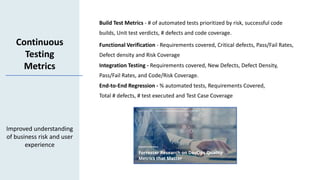
Build Test Metrics - # of automated tests prioritized by risk, successful code
builds, Unit test verdicts, # defects and code coverage.
Continuous
Testing
Metrics
Improved understanding
of business risk and user
experience
Functional Verification - Requirements covered, Critical defects, Pass/Fail Rates,
Defect density and Risk Coverage
Integration Testing - Requirements covered, New Defects, Defect Density,
Pass/Fail Rates, and Code/Risk Coverage.
End-to-End Regression - % automated tests, Requirements Covered,
Total # defects, # test executed and Test Case Coverage
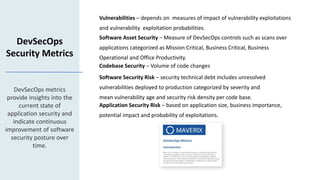
Vulnerabilities – depends on measures of impact of vulnerability exploitations
and vulnerability exploitation probabilities.
DevSecOps
Security Metrics
DevSecOps metrics
provide insights into the
current state of
application security and
indicate continuous
improvement of software
security posture over
time.
Software Asset Security – Measure of DevSecOps controls such as scans over
applications categorized as Mission Critical, Business Critical, Business
Operational and Office Productivity.
Codebase Security – Volume of code changes
Software Security Risk – security technical debt includes unresolved
vulnerabilities deployed to production categorized by severity and
mean vulnerability age and security risk density per code base.
Application Security Risk – based on application size, business importance,
potential impact and probability of exploitations.
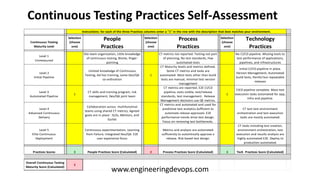
Continuous Testing Practices Self-Assessment
Continuous Testing
Maturity Level
Selection
(choose
one)
People
Practices
Selection
(choose
one)
Process
Practices
Selection
(choose
one)
Technology
Practices
Level 1
Unmeasured
Silo team organization, Little knowledge
of continuous testing, Blame, finger-
pointing
CT metrics not reported. Testing not part
of planning, No test standards, Few
automated tests
No CI/CD pipeline. Missing tools to
test performance of applications,
pipelines, and infrastructures
Level 2
Initial Pipeline
Limited knowledge of Continuous
Testing, Ad hoc training, some Dev/QA
co-ordination
1
CT Maturity levels and metrics defined.
Some CT metrics and tasks are
automated. Most tests other than build
tests are manual, minimal test version
management
Initial CI/CD pipeline in place.
Version Management, Automated
build tests, Painful but repeatable
releases
Level 3
Automated Pipeline
1
CT skills and training program, risk
management, Dev/QA joint team
CT metrics are reported. E2E CI/CD
pipeline, tests visible, test/release
standards, test management. Release
Management decisions use QE metrics.
1
CICD pipeline complete. Most test
execution tasks automated for app,
infra and pipeline.
Level 4
Advanced Continuous
Delivery
Collaboration across multifunctinal
teams using shared CT metrics, Agreed
goals are in place : SLOs, Mentors, and
Guilds
CT metrics and automated and used for
predictive test analytics.Sufficient to
automate release approvals. E2E
performance trends drive test design.
Focus on removing test bottlenecks.
CT test test environment
orchestration and test execution
tasks are mostly automated.
Level 5
Elite Continuous
Deployment
Continuous experimentation, Learning
from Failure, Integrated Dev/QA. E2E
user experience focus
Metrics and analysis are automated
sufficiently to automtically approve a
release. Risk based test design.
CT tasks including test creation,
environment orchestration, test
execution and results analysis are
highly automated E2E. Deploy to
production automated.
Practices Scores 3 People Practices Score (Calculated) 2 Process Practices Score (Calculated) 3 Tech Practices Score (Calculated)
2
Instructions: for each of the three Practices columns enter a "1" in the row with the description that best matches your environment.
Overall Continuous Testing
Maturity Score (Calculated)
www.engineeringdevops.com
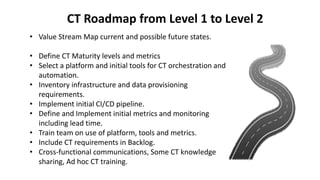
CT Roadmap from Level 1 to Level 2
• Value Stream Map current and possible future states.
• Define CT Maturity levels and metrics
• Select a platform and initial tools for CT orchestration and
automation.
• Inventory infrastructure and data provisioning
requirements.
• Implement initial CI/CD pipeline.
• Define and Implement initial metrics and monitoring
including lead time.
• Train team on use of platform, tools and metrics.
• Include CT requirements in Backlog.
• Cross-functional communications, Some CT knowledge
sharing, Ad hoc CT training.
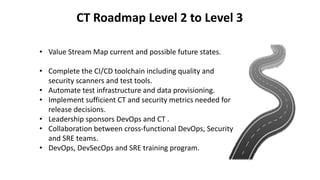
CT Roadmap Level 2 to Level 3
• Value Stream Map current and possible future states.
• Complete the CI/CD toolchain including quality and
security scanners and test tools.
• Automate test infrastructure and data provisioning.
• Implement sufficient CT and security metrics needed for
release decisions.
• Leadership sponsors DevOps and CT .
• Collaboration between cross-functional DevOps, Security
and SRE teams.
• DevOps, DevSecOps and SRE training program.
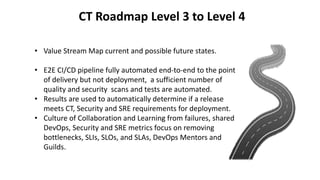
CT Roadmap Level 3 to Level 4
• Value Stream Map current and possible future states.
• E2E CI/CD pipeline fully automated end-to-end to the point
of delivery but not deployment, a sufficient number of
quality and security scans and tests are automated.
• Results are used to automatically determine if a release
meets CT, Security and SRE requirements for deployment.
• Culture of Collaboration and Learning from failures, shared
DevOps, Security and SRE metrics focus on removing
bottlenecks, SLIs, SLOs, and SLAs, DevOps Mentors and
Guilds.
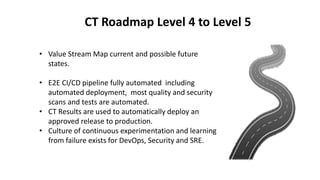
CT Roadmap Level 4 to Level 5
• Value Stream Map current and possible future
states.
• E2E CI/CD pipeline fully automated including
automated deployment, most quality and security
scans and tests are automated.
• CT Results are used to automatically deploy an
approved release to production.
• Culture of continuous experimentation and learning
from failure exists for DevOps, Security and SRE.
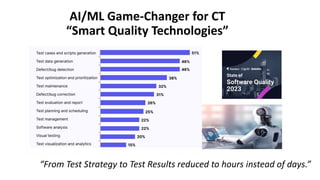
AI/ML Game-Changer for CT
“Smart Quality Technologies”
“From Test Strategy to Test Results reduced to hours instead of days.”
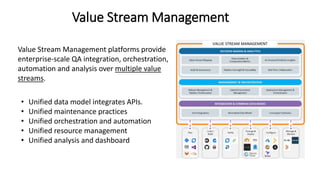
Value Stream Management
Value Stream Management platforms provide
enterprise-scale QA integration, orchestration,
automation and analysis over multiple value
streams.
• Unified data model integrates APIs.
• Unified maintenance practices
• Unified orchestration and automation
• Unified resource management
• Unified analysis and dashboard
Continuous Testing projects
realize
‘instant” ROI.
$
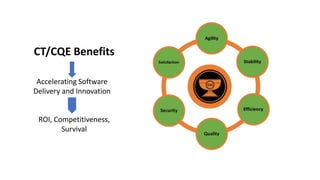
CT/CQE Benefits
Accelerating Software
Delivery and Innovation
ROI, Competitiveness,
Survival
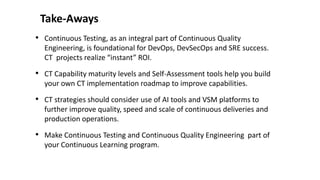
Take-Aways
• Continuous Testing, as an integral part of Continuous Quality
Engineering, is foundational for DevOps, DevSecOps and SRE success.
CT projects realize “instant” ROI.
• CT Capability maturity levels and Self-Assessment tools help you build
your own CT implementation roadmap to improve capabilities.
• CT strategies should consider use of AI tools and VSM platforms to
further improve quality, speed and scale of continuous deliveries and
production operations.
• Make Continuous Testing and Continuous Quality Engineering part of
your Continuous Learning program.
Marc Hornbeek
DevOps_the_Gray esq.
DevOps Institute Ambassador
CEO Engineering DevOps Consulting
www.engineeringdevops.com
mhornbeek@engineeringdevops.com
- Essential for Continuous Quality Engineering
Continuous Testing

Continuous Testing Landscape.pptx

  • 1.
    Continuous Testing How todefine, assess and create a roadmap for Continuous Testing for Quality Engineering, DevOps, DevSecOps and SRE. Continuous Testing Copyright © 2023 by Marc Hornbeek All rights reserved.
  • 2.
    Marc Hornbeek DevOps_the_Gray DevOps InstituteAmbassador CEO Engineering DevOps Consulting www.engineeringdevops.com mhornbeek@engineeringdevops.com - Essential for Continuous Quality Engineering Continuous Testing
  • 3.
    Agenda: • What isContinuous Testing • Why Continuous Testing is Important • Continuous Testing Blueprint and Maturity • Pillars of Practice for Continuous Testing • Transformation Roadmap • Strategic Considerations • CT Benefits • Key Take-ways
  • 4.
    • Testing isabout verifying and finding defects. • Quality Engineering is about process, preventing defects, satisfying customers and stakeholders. Continuous Quality Engineering includes Continuous Testing. Continuous Testing in relation to Continuous Quality Engineering Dr. Edwards Deming emphasized systems thinking, continuous improvement, statistical control, and other principles that are foundational to the concept of quality engineering. "Quality is everyone's responsibility."
  • 5.
    Test Management Test Tools Test Automation Leadership and Culture Continuous TestingBlueprint Test Strategies and Plans Continuous Test is a quality assessment strategy in which most tests are automated and integrated as a core and essential part of a DevOps value stream. CT is much more than simply “automating tests”. There are nine pillars of practices. Test Results Analysis Test Environment Management Continuous Testing Tenets Continuous Testing Blueprint Artifacts Development (Dev) Artifacts Artifacts Artifacts Artifacts Integration (CI) Delivery (CD) Deployment (Deploy) Production (Prod) Planning (Plan) Test Data Management
  • 6.
    Testing is THEmajor bottleneck for most value streams. Testing activities often account for >50% of bottlenecks. Test Management Leadership and Culture Test Strategies and Plans Continuous Testing Tenets Test Data Management Test Tools Test Automation Test Results Analysis Test Environment Management Contract Tests Conformance Tests Regulatory Tests Compliance Tests Chaos Tests Exploratory Tests End-to-End Tests Usability Tests Static Code Tests Dynamic Code Tests Interface Tests Compatibility Tests Configuration Tests Data Tests Integration Tests Regression Tests Acceptance Tests Deployment Tests Penetration Tests Functional Tests System Tests Administration Tests Backup Restore Tests White-Box Tests Gray-Box Tests Black-Box Tests API Tests Container Tests Packaging Tests Capacity Tests Latency Tests Access Security Tests Canary Tests Build Tests Artifact Tests Release Acceptance Tests A/B Tests Feature Flags Tests Unit Tests Protocol Tests Usability Tests Reliability Tests Security Tests Support Materials Tests Documentation Tests Production Readiness Tests Database Tests
  • 7.
    Scope of ContinuousTesting SRE Agile, DevOps, DevSecOps Requirement Production Plan Develop CI/CD In-Prod Ops & SecOps CT scope includes testing practices for end-to-end value streams including planning, development, delivery and production operations. It is an essential part of Continuous Quality Engineering Pre-Prod Continuous CT Deploy In-Production Continuous CT
  • 8.
    CT is importantfor DevOps, DevSecOps and SRE CT Systems and Practices Optimizations People: Promote collaboration and monitoring for tests amongst teams. Process: Efficiently orchestrate and automate appropriate level of test coverage. Technologies: Platforms and tool-chains architected to enable sharing test artifacts. DevOps and DevSecOps SRE Accelerate continuous delivery and deployment safely and securely. Assure reliability, quality and security of services in production, at scale. Testability = Controllability + Observability
  • 9.
    Continuous Testing FailureCases ! Plan Manual tests cause CI/CD delays Develop CI/CD Operate Insufficient Dev Testing causes high CI/CD failures and rejects. Deploy Too slow to manually validate production deploy decisions. Unplanned quality cause delays, cost overruns and production problems. Too slow to verify restores and recovery of production issues.
  • 10.
    State of SoftwareTesting Quality requirements left out of plan cause delays, cost overruns and production problems. 79% positive ROI in the first year of adopting test automation. Challenges
  • 11.
  • 12.
    Level 1: Unknown Level2: Initial Continuous Testing Maturity Model* Unmeasured implementations, different tools and frameworks used across different teams and applications Level 3: Automated Level 4: Advanced Level 5: Elite Initial CICD pipeline CICD tasks are partially automated, and metrics are reported. Automated CICD pipeline. Most CICD tasks are automated up to the point of release acceptance. Release management decisions use CICD metrics. Continuous Delivery CICD tasks are fully automated up to the point of release acceptance. Metrics are automated sufficiently to automatically approve a release. Continuous Deployment CICD Tasks and metrics are fully automated sufficiently to automatically deploy to production. Culture of continuous improvement. Metrics: Not reported • Lead Time: ? • Release Frequency: ? • Failure Rate: ? • Time to Restore: ? DORA Metrics: • Lead Time: < six months • Frequency: > monthly • Failure Rate: < 45% • Time to Restore: < 1 month DORA Metrics: • Lead Time: < 1 month • Frequency: weekly • Failure Rate: < 30% • Time to Restore: < 1 week DORA Metrics: • Lead Time: < 1 week • Frequency: daily • Failure Rate: < 15% • Time to Restore: < 1 day DORA Metrics: • Lead Time: < 1 day • Frequency: hourly • Failure Rate: < 15% • Time to Restore : < 1 hour * Defined for each organization
  • 13.
    Build Test Metrics- # of automated tests prioritized by risk, successful code builds, Unit test verdicts, # defects and code coverage. Continuous Testing Metrics Improved understanding of business risk and user experience Functional Verification - Requirements covered, Critical defects, Pass/Fail Rates, Defect density and Risk Coverage Integration Testing - Requirements covered, New Defects, Defect Density, Pass/Fail Rates, and Code/Risk Coverage. End-to-End Regression - % automated tests, Requirements Covered, Total # defects, # test executed and Test Case Coverage
  • 14.
    Vulnerabilities – dependson measures of impact of vulnerability exploitations and vulnerability exploitation probabilities. DevSecOps Security Metrics DevSecOps metrics provide insights into the current state of application security and indicate continuous improvement of software security posture over time. Software Asset Security – Measure of DevSecOps controls such as scans over applications categorized as Mission Critical, Business Critical, Business Operational and Office Productivity. Codebase Security – Volume of code changes Software Security Risk – security technical debt includes unresolved vulnerabilities deployed to production categorized by severity and mean vulnerability age and security risk density per code base. Application Security Risk – based on application size, business importance, potential impact and probability of exploitations.
  • 15.
    Continuous Testing PracticesSelf-Assessment Continuous Testing Maturity Level Selection (choose one) People Practices Selection (choose one) Process Practices Selection (choose one) Technology Practices Level 1 Unmeasured Silo team organization, Little knowledge of continuous testing, Blame, finger- pointing CT metrics not reported. Testing not part of planning, No test standards, Few automated tests No CI/CD pipeline. Missing tools to test performance of applications, pipelines, and infrastructures Level 2 Initial Pipeline Limited knowledge of Continuous Testing, Ad hoc training, some Dev/QA co-ordination 1 CT Maturity levels and metrics defined. Some CT metrics and tasks are automated. Most tests other than build tests are manual, minimal test version management Initial CI/CD pipeline in place. Version Management, Automated build tests, Painful but repeatable releases Level 3 Automated Pipeline 1 CT skills and training program, risk management, Dev/QA joint team CT metrics are reported. E2E CI/CD pipeline, tests visible, test/release standards, test management. Release Management decisions use QE metrics. 1 CICD pipeline complete. Most test execution tasks automated for app, infra and pipeline. Level 4 Advanced Continuous Delivery Collaboration across multifunctinal teams using shared CT metrics, Agreed goals are in place : SLOs, Mentors, and Guilds CT metrics and automated and used for predictive test analytics.Sufficient to automate release approvals. E2E performance trends drive test design. Focus on removing test bottlenecks. CT test test environment orchestration and test execution tasks are mostly automated. Level 5 Elite Continuous Deployment Continuous experimentation, Learning from Failure, Integrated Dev/QA. E2E user experience focus Metrics and analysis are automated sufficiently to automtically approve a release. Risk based test design. CT tasks including test creation, environment orchestration, test execution and results analysis are highly automated E2E. Deploy to production automated. Practices Scores 3 People Practices Score (Calculated) 2 Process Practices Score (Calculated) 3 Tech Practices Score (Calculated) 2 Instructions: for each of the three Practices columns enter a "1" in the row with the description that best matches your environment. Overall Continuous Testing Maturity Score (Calculated) www.engineeringdevops.com
  • 16.
    CT Roadmap fromLevel 1 to Level 2 • Value Stream Map current and possible future states. • Define CT Maturity levels and metrics • Select a platform and initial tools for CT orchestration and automation. • Inventory infrastructure and data provisioning requirements. • Implement initial CI/CD pipeline. • Define and Implement initial metrics and monitoring including lead time. • Train team on use of platform, tools and metrics. • Include CT requirements in Backlog. • Cross-functional communications, Some CT knowledge sharing, Ad hoc CT training.
  • 17.
    CT Roadmap Level2 to Level 3 • Value Stream Map current and possible future states. • Complete the CI/CD toolchain including quality and security scanners and test tools. • Automate test infrastructure and data provisioning. • Implement sufficient CT and security metrics needed for release decisions. • Leadership sponsors DevOps and CT . • Collaboration between cross-functional DevOps, Security and SRE teams. • DevOps, DevSecOps and SRE training program.
  • 18.
    CT Roadmap Level3 to Level 4 • Value Stream Map current and possible future states. • E2E CI/CD pipeline fully automated end-to-end to the point of delivery but not deployment, a sufficient number of quality and security scans and tests are automated. • Results are used to automatically determine if a release meets CT, Security and SRE requirements for deployment. • Culture of Collaboration and Learning from failures, shared DevOps, Security and SRE metrics focus on removing bottlenecks, SLIs, SLOs, and SLAs, DevOps Mentors and Guilds.
  • 19.
    CT Roadmap Level4 to Level 5 • Value Stream Map current and possible future states. • E2E CI/CD pipeline fully automated including automated deployment, most quality and security scans and tests are automated. • CT Results are used to automatically deploy an approved release to production. • Culture of continuous experimentation and learning from failure exists for DevOps, Security and SRE.
  • 20.
    AI/ML Game-Changer forCT “Smart Quality Technologies” “From Test Strategy to Test Results reduced to hours instead of days.”
  • 21.
    Value Stream Management ValueStream Management platforms provide enterprise-scale QA integration, orchestration, automation and analysis over multiple value streams. • Unified data model integrates APIs. • Unified maintenance practices • Unified orchestration and automation • Unified resource management • Unified analysis and dashboard
  • 22.
  • 23.
    CT/CQE Benefits Accelerating Software Deliveryand Innovation ROI, Competitiveness, Survival
  • 24.
    Take-Aways • Continuous Testing,as an integral part of Continuous Quality Engineering, is foundational for DevOps, DevSecOps and SRE success. CT projects realize “instant” ROI. • CT Capability maturity levels and Self-Assessment tools help you build your own CT implementation roadmap to improve capabilities. • CT strategies should consider use of AI tools and VSM platforms to further improve quality, speed and scale of continuous deliveries and production operations. • Make Continuous Testing and Continuous Quality Engineering part of your Continuous Learning program.
  • 25.
    Marc Hornbeek DevOps_the_Gray esq. DevOpsInstitute Ambassador CEO Engineering DevOps Consulting www.engineeringdevops.com mhornbeek@engineeringdevops.com - Essential for Continuous Quality Engineering Continuous Testing