FOREGROUND/BACKGROUND SYSTEMS
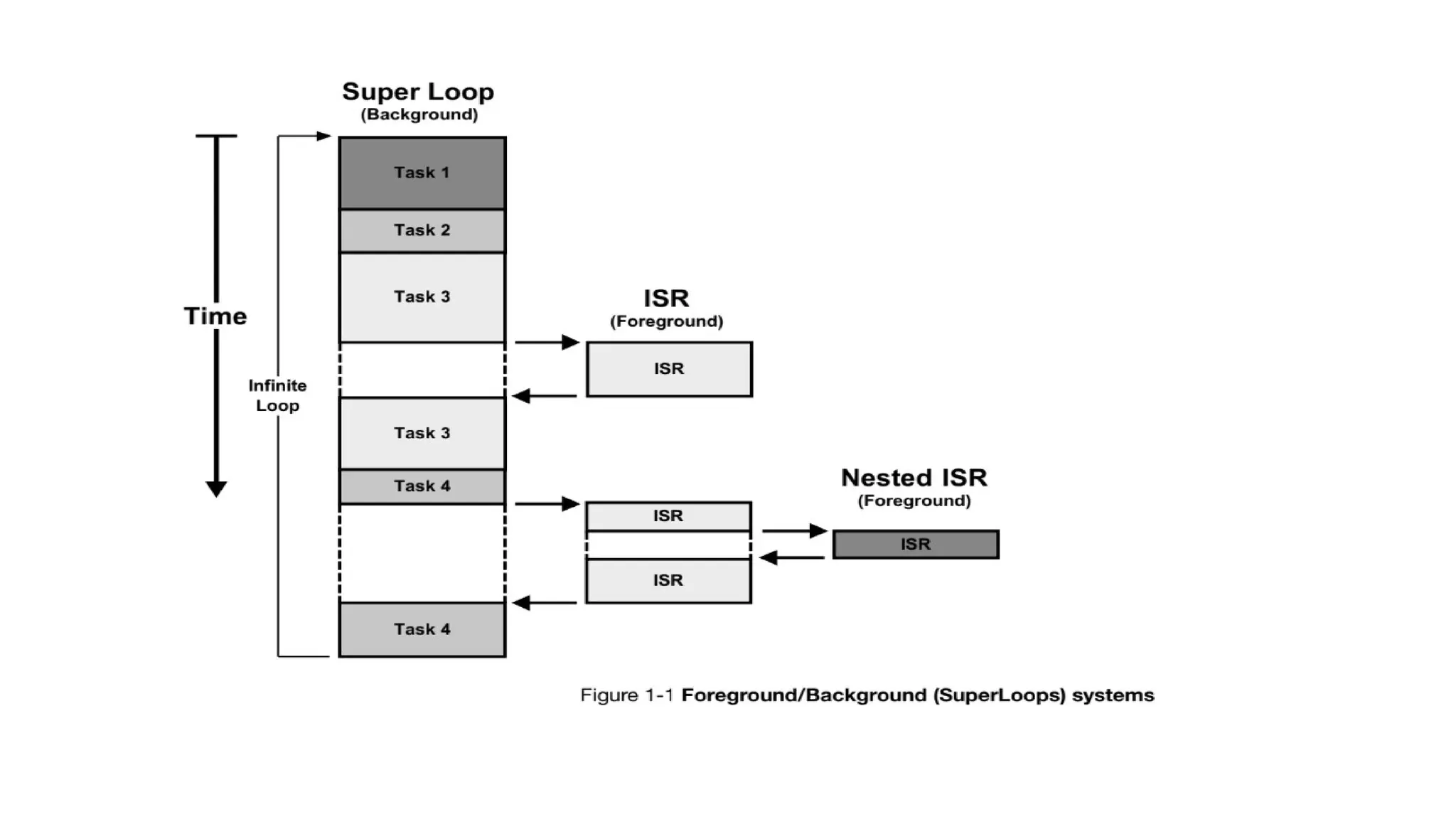
• Smallsystems of low complexity are typically designed as
foreground/background systems or super-loops.
• An application consists of an infinite loop that calls modules
(i.e.,tasks) to perform the desired operations (background).
• Interrupt Service Routines (ISRs) handle asynchronous events
(foreground).
• Foreground is also called interrupt level;
• background is called task level.
3.
• Critical operationsthat should be performed at the task level must
unfortunately be handled by the ISRs to ensure that they are dealt with in a
timely fashion.
• This causes ISRs to take longer than they should. Also, information for a
background module that an ISR makes available is not processed until the
background routine gets its turn to execute, which is called the task-level
response.
• The worst-case task-level response time depends on how long a background
loop takes to execute and, since the execution time of typical code is not
constant, the time for successive passes through a portion of the loop is
nondeterministic.
• Furthermore, if a code change is made, the timing of the loop is affected.
• Most high-volume and low-cost microcontroller-based applications (e.g.,
microwave ovens, telephones, toys, etc.) are designed as
foreground/background systems.
5.
REAL-TIME KERNELS
• Areal-time kernel is software that manages the time and resources
of a microprocessor, microcontroller or Digital Signal Processor
(DSP).
• The design process of a real-time application involves splitting the
work into tasks, each responsible for a portion of the job.
• A task (also called a thread) is a simple program that thinks it has the
Central Processing Unit (CPU) completely to itself.
• On a single CPU, only one task executes at any given time.
• A task is also typically implemented as an infinite loop.
6.
Context Switching
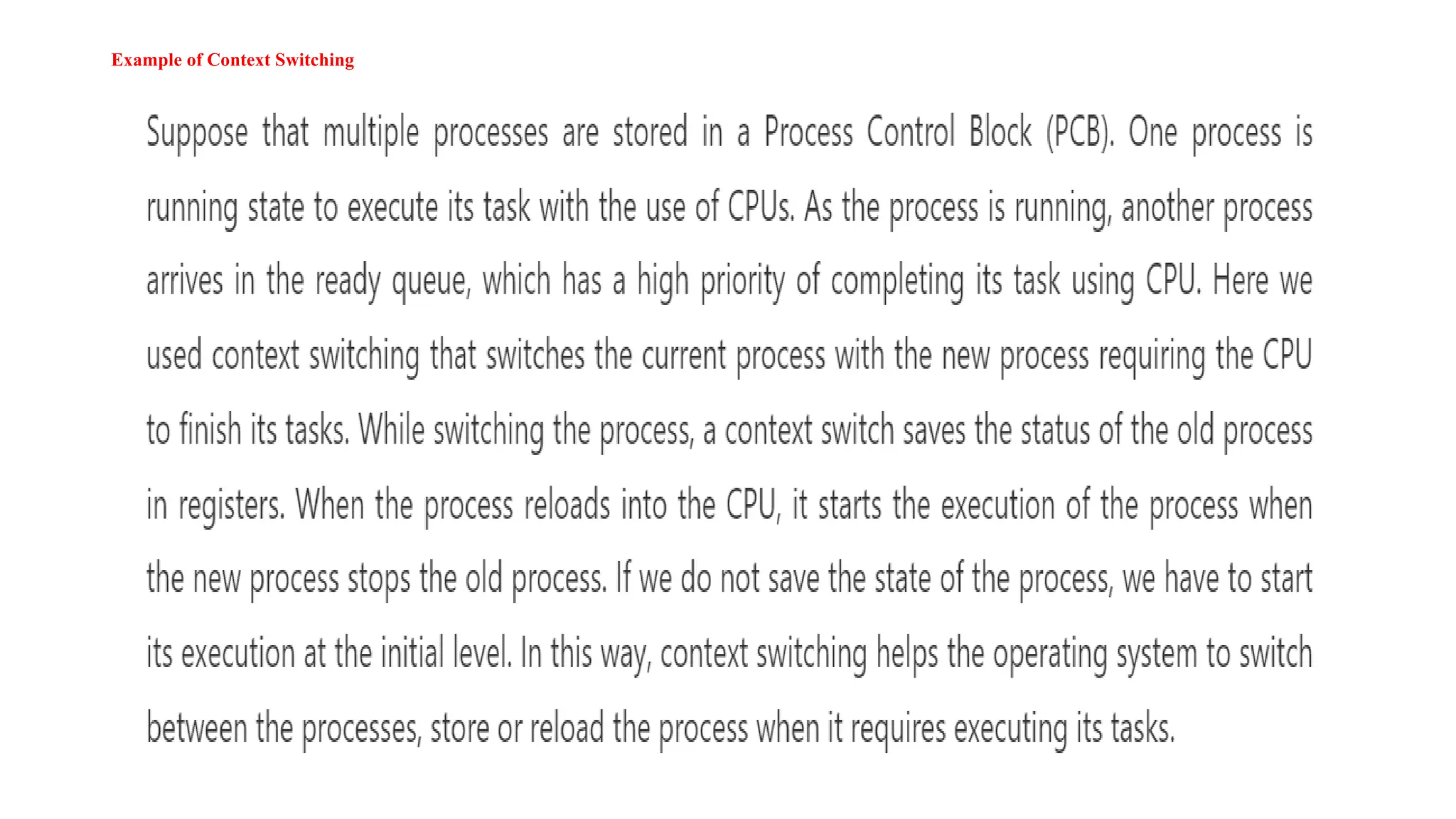
• TheContext switching is a technique or method used by the operating
system to switch a process from one state to another to execute its
function using CPUs in the system.
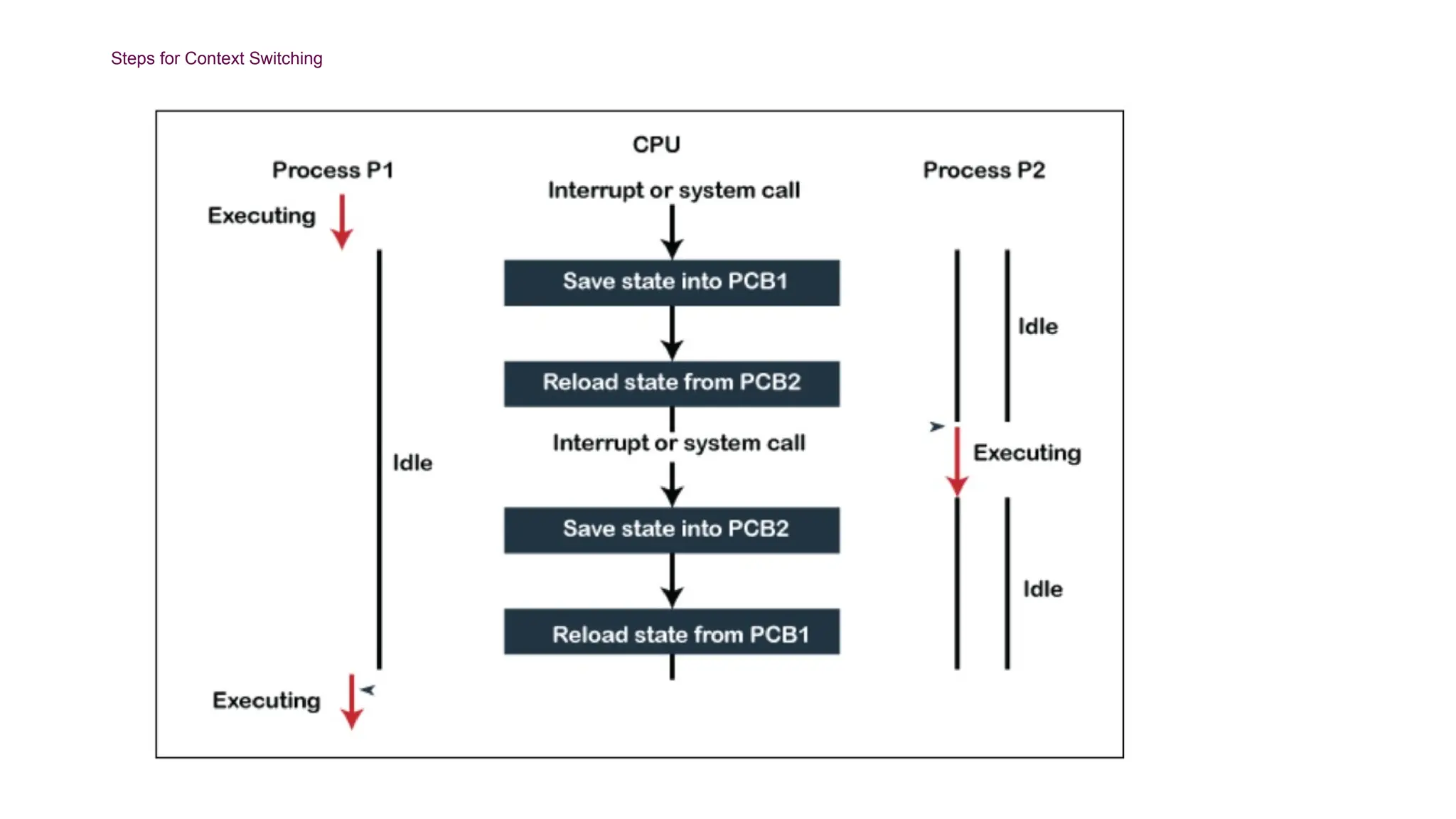
• When switching perform in the system, it stores the old running
process's status in the form of registers and assigns the CPU to a new
process to execute its tasks.
• While a new process is running in the system, the previous process
must wait in a ready queue.
• The execution of the old process starts at that point where another
process stopped it.
• It defines the characteristics of a multitasking operating system in
which multiple processes shared the same CPU to perform multiple
tasks without the need for additional processors in the system.
7.
The need forContext switching
• A context switching helps to share a single CPU across all processes to
complete its execution and store the system's tasks status.
• When the process reloads in the system, the execution of the process starts at
the same point where there is conflicting.
Following are the reasons that describe the need for context switching in the
Operating system.
1.The switching of one process to another process is not directly in the
system. A context switching helps the operating system that switches
between the multiple processes to use the CPU's resource to accomplish its
tasks and store its context. We can resume the service of the process at the
same point later. If we do not store the currently running process's data or
context, the stored data may be lost while switching between processes.
2.A context switching allows a single CPU to handle multiple process
requests simultaneously without the need for any additional processors.
8.
3.If a highpriority process falls into the ready queue, the currently
running process will be shut down or stopped by a high priority
process to complete its tasks in the system.
4.If any running process requires I/O resources in the system, the
current process will be switched by another process to use the CPUs.
And when the I/O requirement is met, the old process goes into a
ready state to wait for its execution in the CPU. Context switching
stores the state of the process to resume its tasks in an operating
system. Otherwise, the process needs to restart its execution from the
initials level.
5.If any interrupts occur while running a process in the operating
system, the process status is saved as registers using context
switching. After resolving the interrupts, the process switches from a
wait state to a ready state to resume its execution at the same point
later, where the operating system interrupted occurs.
Context switching triggers
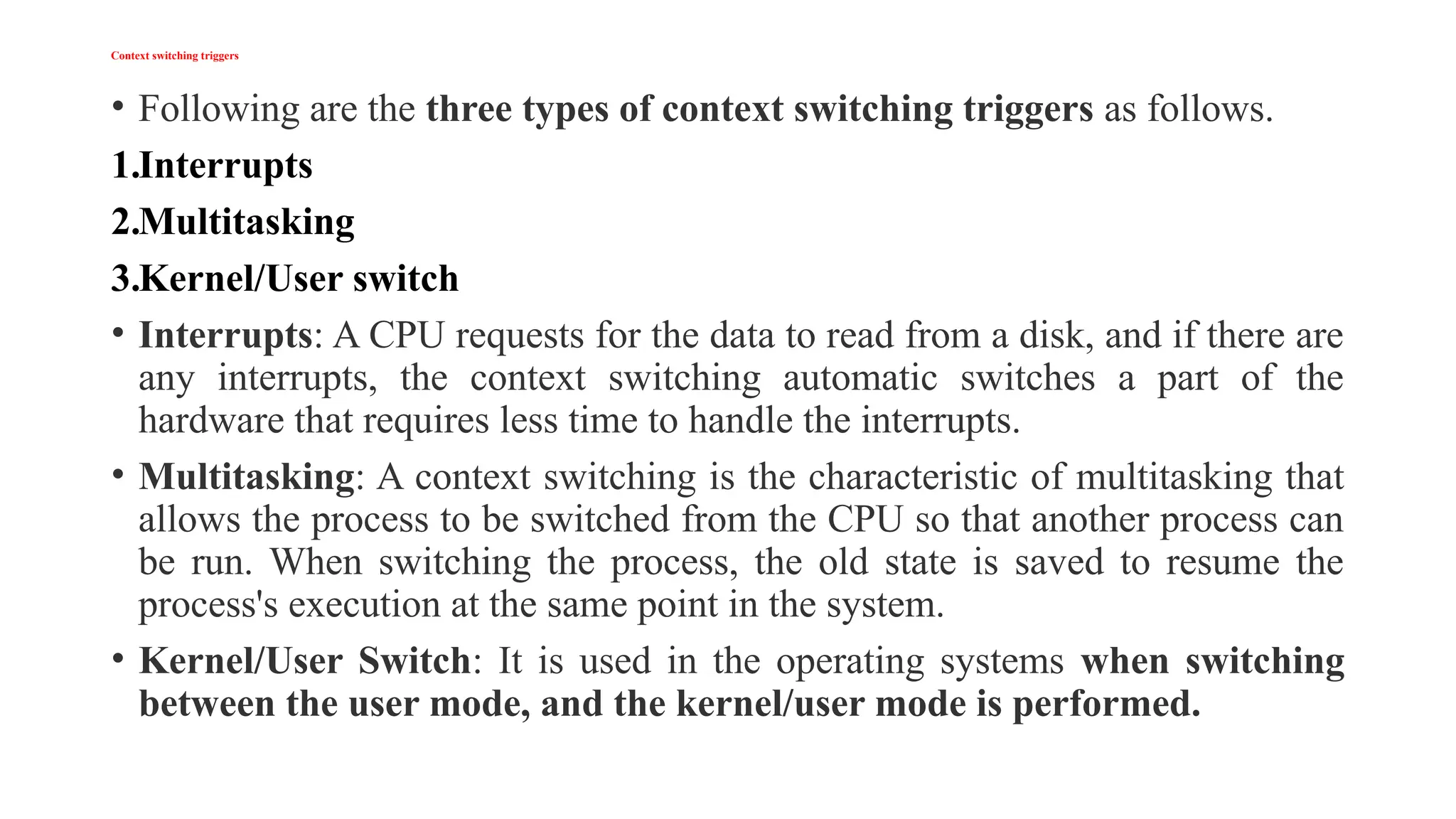
•Following are the three types of context switching triggers as follows.
1.Interrupts
2.Multitasking
3.Kernel/User switch
• Interrupts: A CPU requests for the data to read from a disk, and if there are
any interrupts, the context switching automatic switches a part of the
hardware that requires less time to handle the interrupts.
• Multitasking: A context switching is the characteristic of multitasking that
allows the process to be switched from the CPU so that another process can
be run. When switching the process, the old state is saved to resume the
process's execution at the same point in the system.
• Kernel/User Switch: It is used in the operating systems when switching
between the user mode, and the kernel/user mode is performed.
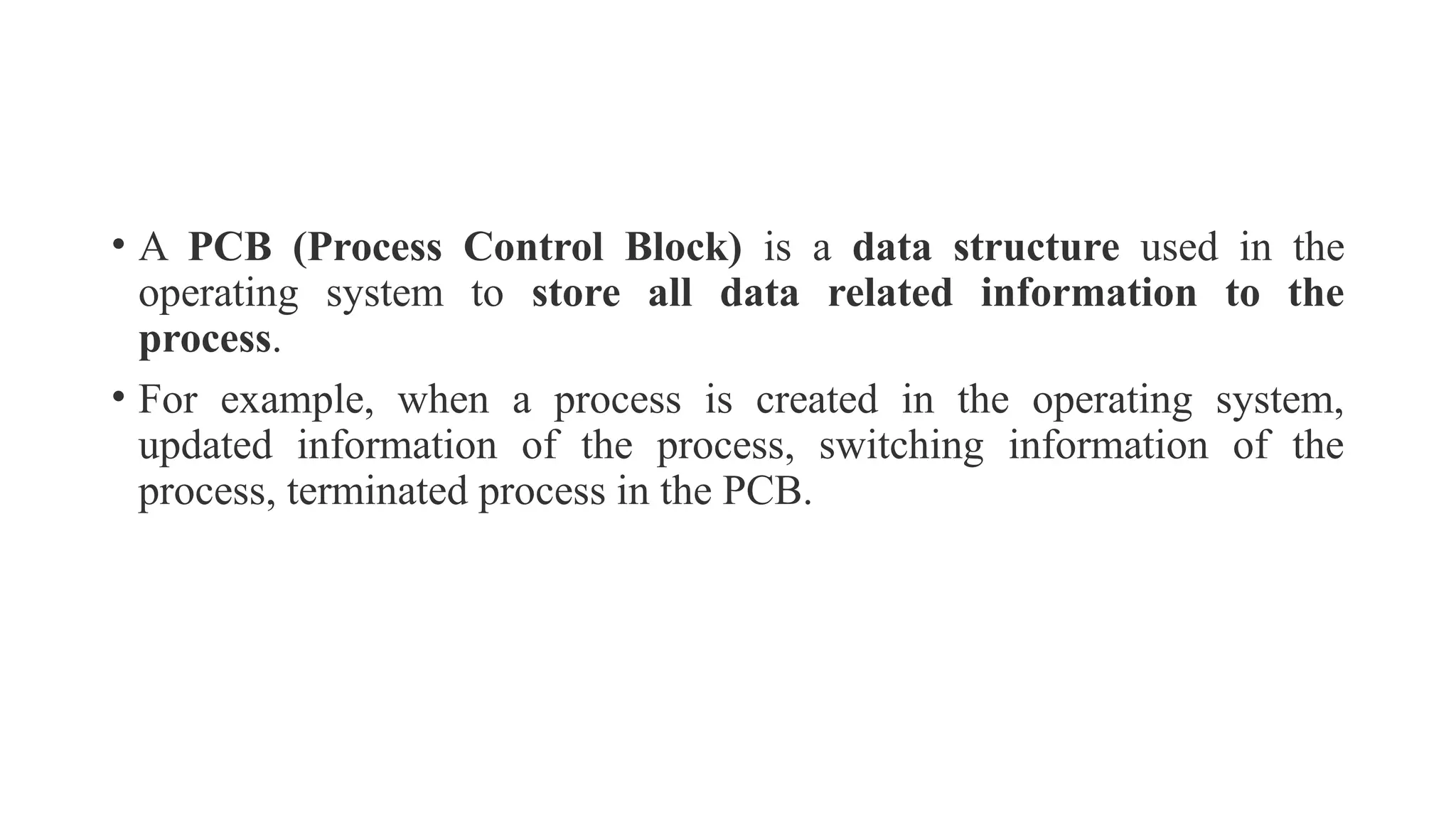
• A PCB(Process Control Block) is a data structure used in the
operating system to store all data related information to the
process.
• For example, when a process is created in the operating system,
updated information of the process, switching information of the
process, terminated process in the PCB.
13.
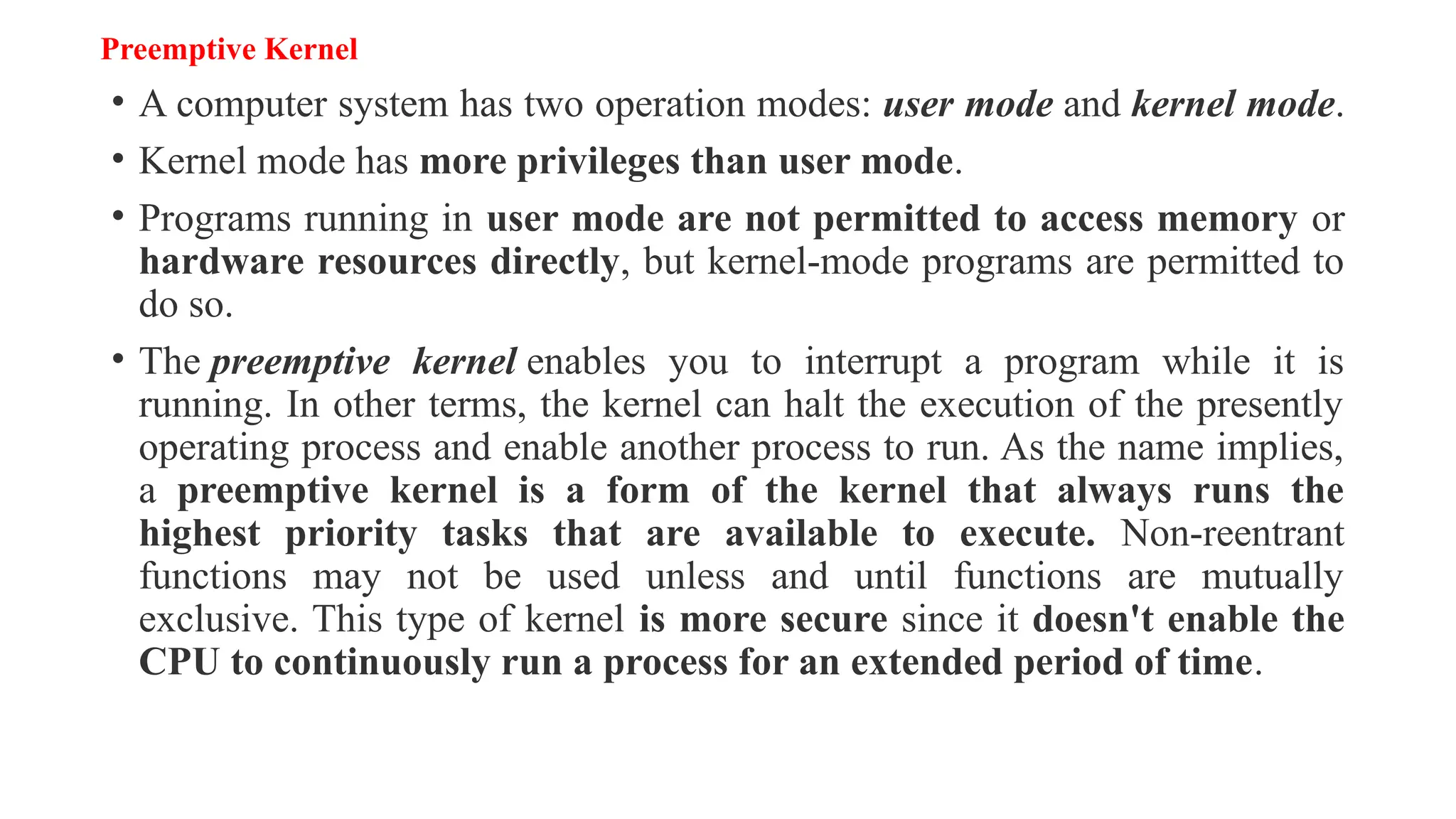
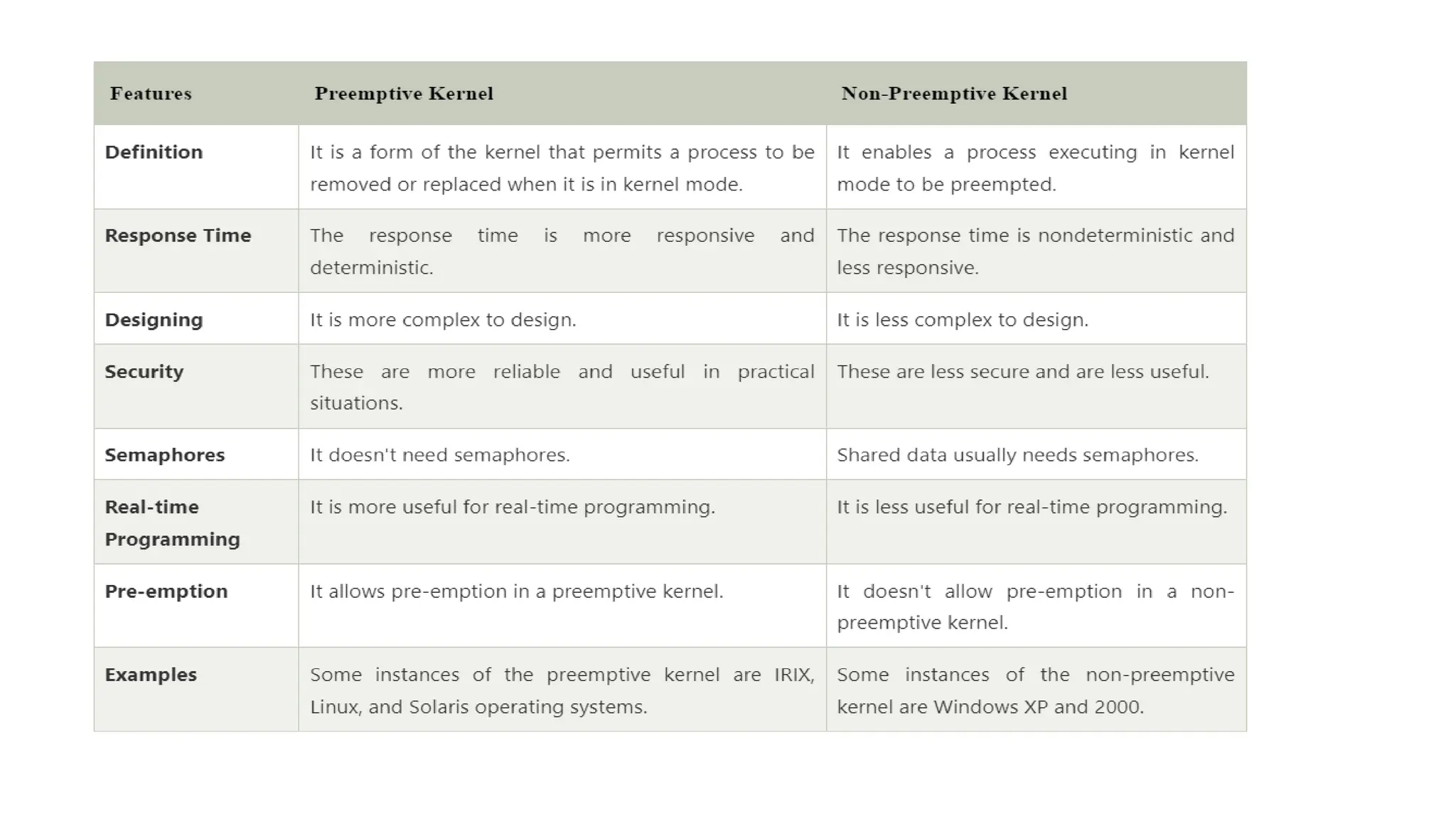
Preemptive Kernel
• Acomputer system has two operation modes: user mode and kernel mode.
• Kernel mode has more privileges than user mode.
• Programs running in user mode are not permitted to access memory or
hardware resources directly, but kernel-mode programs are permitted to
do so.
• The preemptive kernel enables you to interrupt a program while it is
running. In other terms, the kernel can halt the execution of the presently
operating process and enable another process to run. As the name implies,
a preemptive kernel is a form of the kernel that always runs the
highest priority tasks that are available to execute. Non-reentrant
functions may not be used unless and until functions are mutually
exclusive. This type of kernel is more secure since it doesn't enable the
CPU to continuously run a process for an extended period of time.
14.
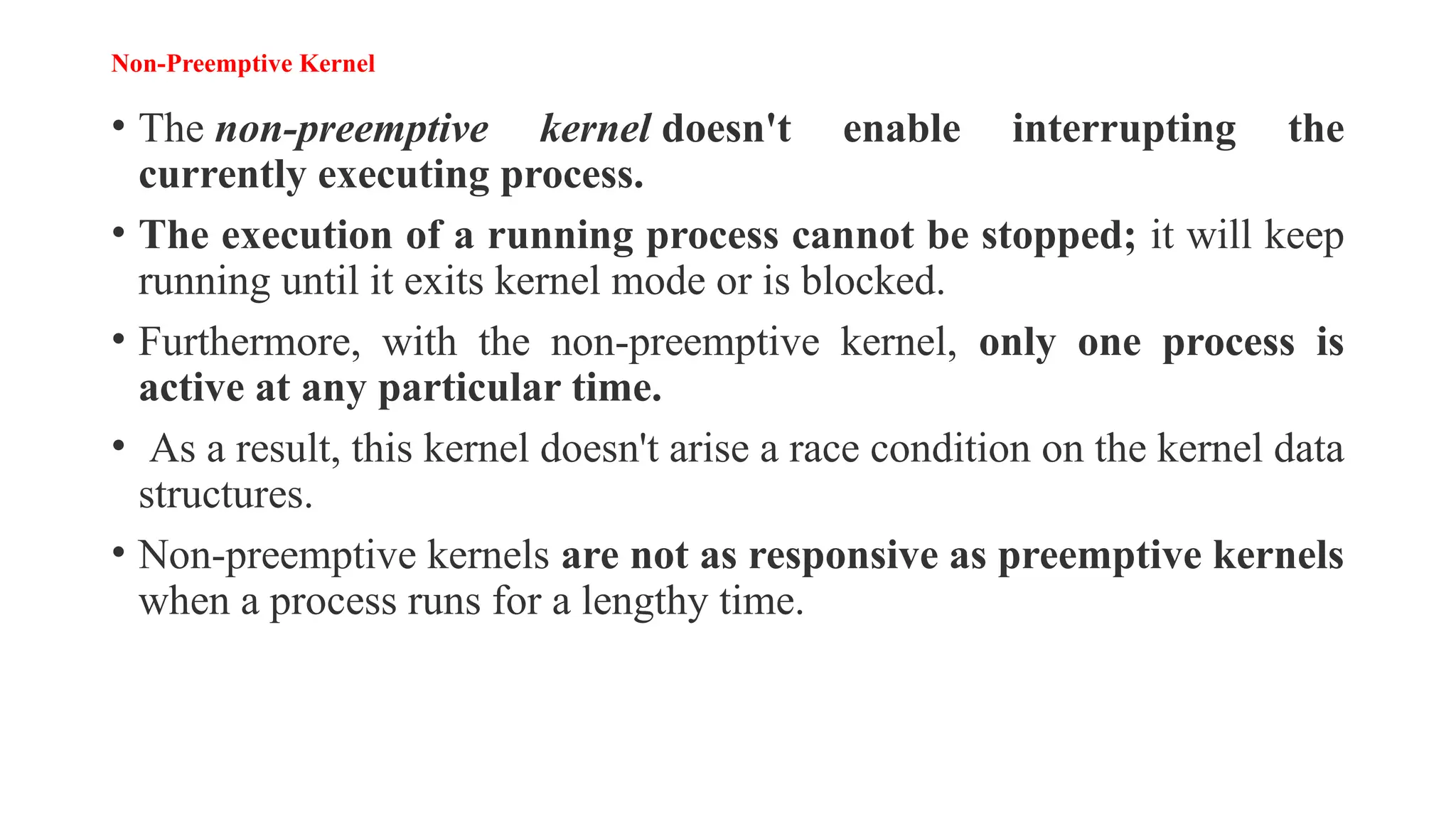
Non-Preemptive Kernel
• Thenon-preemptive kernel doesn't enable interrupting the
currently executing process.
• The execution of a running process cannot be stopped; it will keep
running until it exits kernel mode or is blocked.
• Furthermore, with the non-preemptive kernel, only one process is
active at any particular time.
• As a result, this kernel doesn't arise a race condition on the kernel data
structures.
• Non-preemptive kernels are not as responsive as preemptive kernels
when a process runs for a lengthy time.