Contents
Cover
Title Page
Copyright
Preface
Introduction
The Challenges
The New Organization
The Leadership Model™
Putting The Leadership Model into Practice
Step 1: Think Like a Leader
Chapter 1: Begin with Vision
Why a Vision Is Important
Visions Begin at the Enterprise Level
Develop Your Vision
Communicate Your Vision
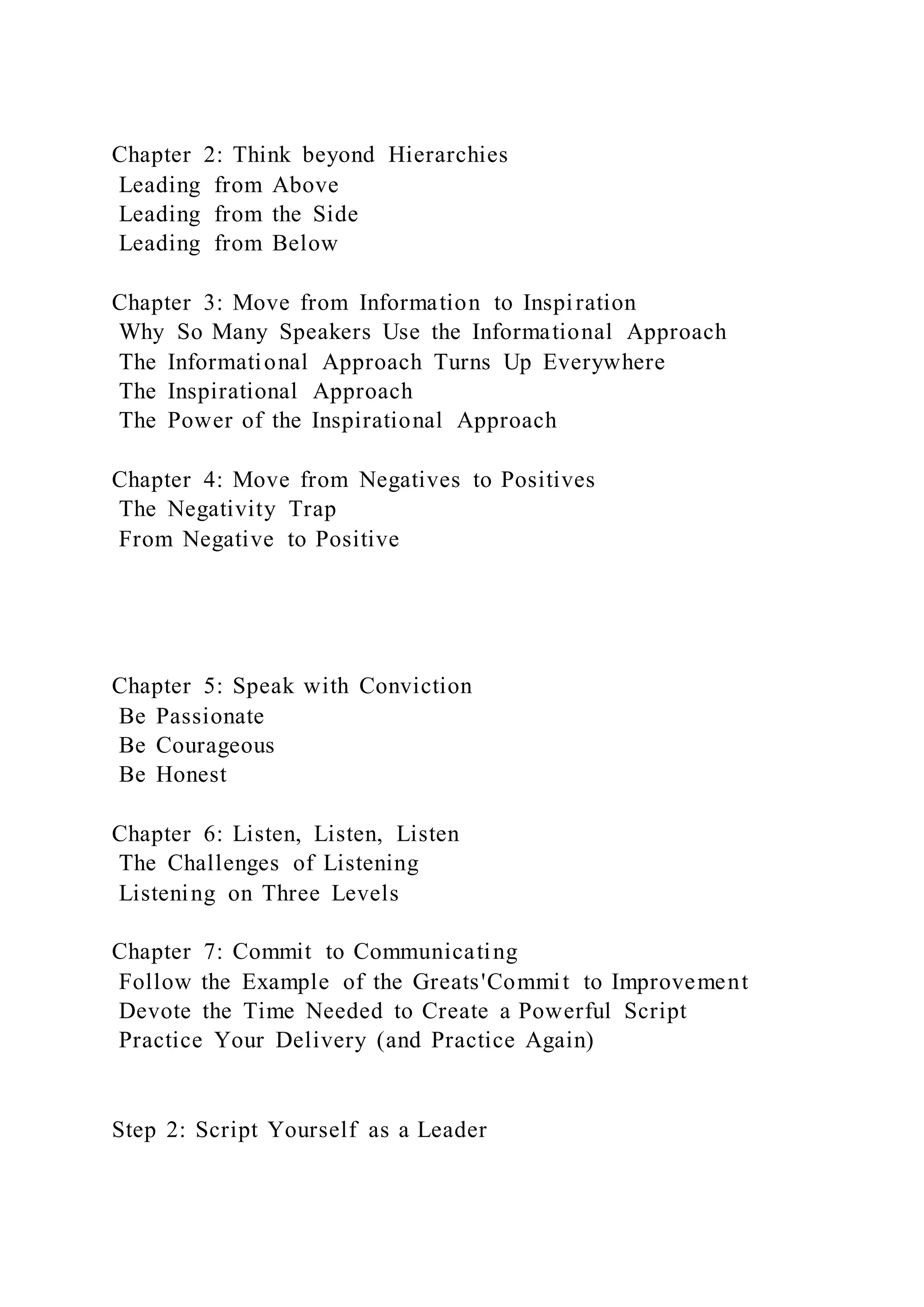
Chapter 2: Think beyond Hierarchies
Leading from Above
Leading from the Side
Leading from Below
Chapter 3: Move from Information to Inspiration
Why So Many Speakers Use the Informational Approach
The Informational Approach Turns Up Everywhere
The Inspirational Approach
The Power of the Inspirational Approach
Chapter 4: Move from Negatives to Positives
The Negativity Trap
From Negative to Positive
Chapter 5: Speak with Conviction
Be Passionate
Be Courageous
Be Honest
Chapter 6: Listen, Listen, Listen
The Challenges of Listening
Listening on Three Levels
Chapter 7: Commit to Communicating
Follow the Example of the Greats'Commit to Improvement
Devote the Time Needed to Create a Powerful Script
Practice Your Delivery (and Practice Again)
Step 2: Script Yourself as a Leader
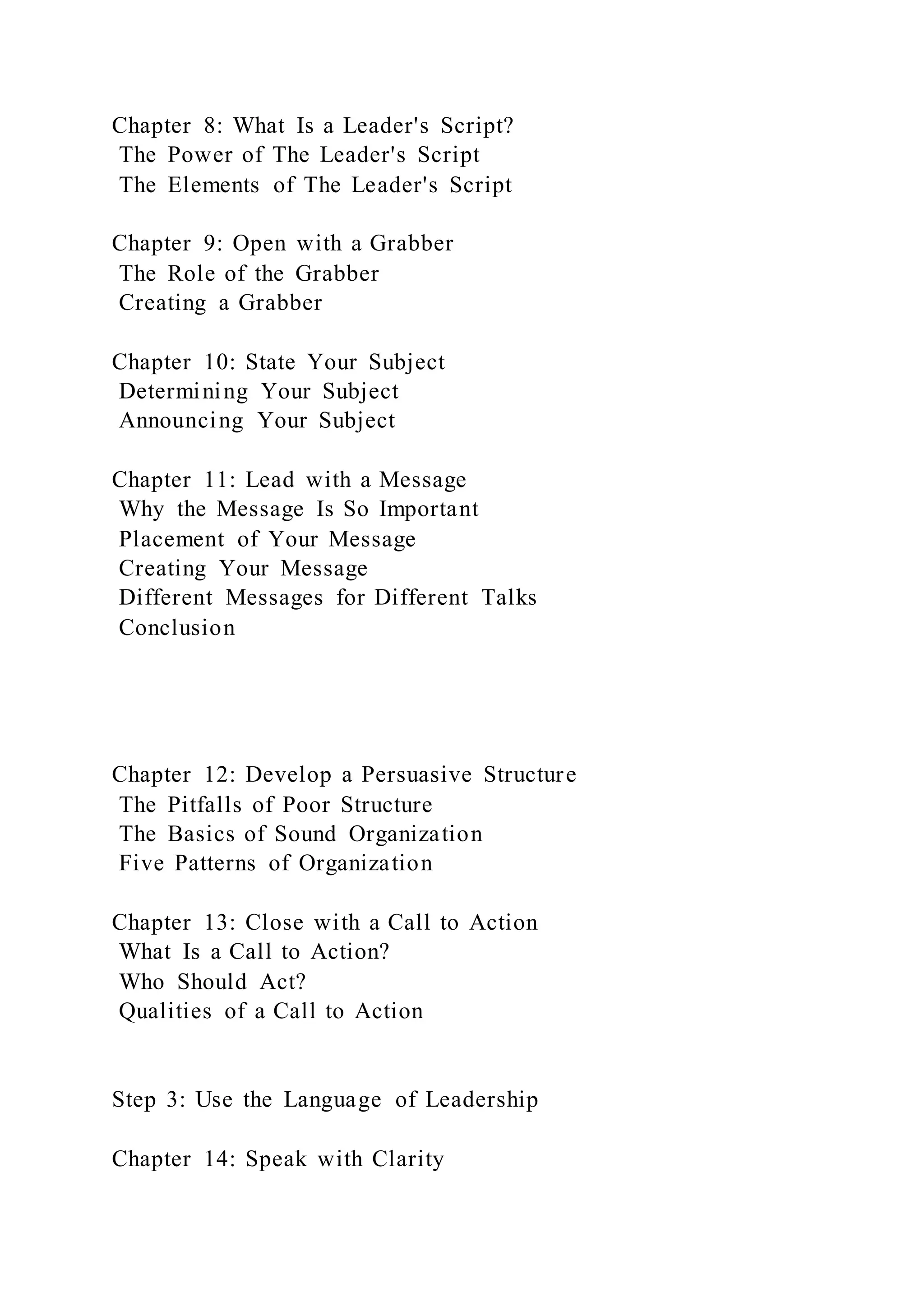
Chapter 8: What Is a Leader's Script?
The Power of The Leader's Script
The Elements of The Leader's Script
Chapter 9: Open with a Grabber
The Role of the Grabber
Creating a Grabber
Chapter 10: State Your Subject
Determining Your Subject
Announcing Your Subject
Chapter 11: Lead with a Message
Why the Message Is So Important
Placement of Your Message
Creating Your Message
Different Messages for Different Talks
Conclusion
Chapter 12: Develop a Persuasive Structure
The Pitfalls of Poor Structure
The Basics of Sound Organization
Five Patterns of Organization
Chapter 13: Close with a Call to Action
What Is a Call to Action?
Who Should Act?
Qualities of a Call to Action
Step 3: Use the Language of Leadership
Chapter 14: Speak with Clarity
A Lack of Clarity
Always Be Clear
Chapter 15: Take the “Jar” out of Jargon
Chapter 16: Be Conversational
Why People Lose Their Conversational Voice
Using Conversational Language
Chapter 17: Be Personal
Put Yourself into Your Remarks Using “I”
Use “You” to Engage Your Audience
Use “We” to Create a Connection with Your Audience
Chapter 18: Be Eloquent
Metaphor
Antithesis
Alliteration
Repetition
Rhetorical Questions
Chapter 19: Don't Be . . . Um . . . Tentative
Chapter 20: Take the “Numb” out of Numbers
1. Round ’Em Off
2. Use Fewer Numbers
3. Use Analogies
4. Create a Context
5. Give Statistics a Human Face
6. Define Your Terms
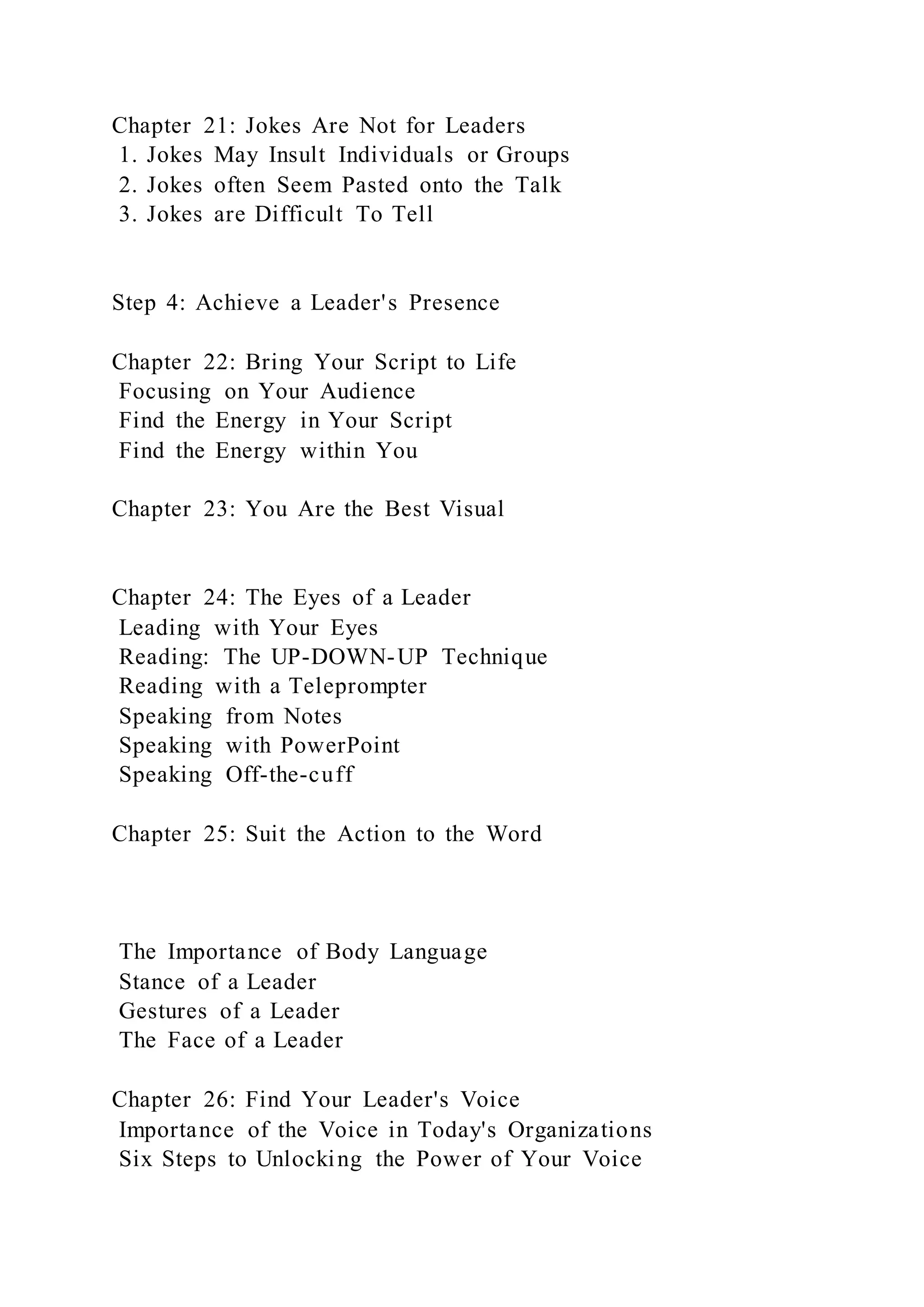
Chapter 21: Jokes Are Not for Leaders
1. Jokes May Insult Individuals or Groups
2. Jokes often Seem Pasted onto the Talk
3. Jokes are Difficult To Tell
Step 4: Achieve a Leader's Presence
Chapter 22: Bring Your Script to Life
Focusing on Your Audience
Find the Energy in Your Script
Find the Energy within You
Chapter 23: You Are the Best Visual
Chapter 24: The Eyes of a Leader
Leading with Your Eyes
Reading: The UP-DOWN-UP Technique
Reading with a Teleprompter
Speaking from Notes
Speaking with PowerPoint
Speaking Off-the-cuff
Chapter 25: Suit the Action to the Word
The Importance of Body Language
Stance of a Leader
Gestures of a Leader
The Face of a Leader
Chapter 26: Find Your Leader's Voice
Importance of the Voice in Today's Organizations
Six Steps to Unlocking the Power of Your Voice
Conclusion: Always Leading, Always Infl uencing
Large and Small Stages
The Mike Is Always On
Every Situation Is a Leadership Moment
Endnotes
Introduction
Chapter 1
Chapter 2
Chapter 3
Chapter 4
Chapter 5
Chapter 6
Chapter 7
Chapter 8
Chapter 9
Chapter 10
Chapter 11
Chapter 12
Chapter 13
Chapter 14
Chapter 15
Chapter 16
Chapter 17
Chapter 18
Chapter 19
Chapter 20
Chapter 21
Chapter 22
Chapter 23
Chapter 24
Chapter 25
Chapter 26
Conclusion
Index
Copyright © 2012 Judith Humphrey. All rights reserved.
Speaking as a Leader® is a registered trademark of The
Humphrey Group Inc., used by
John Wiley & Sons Canada, Ltd. under license for this
publication.
Taking the Stage® is also a registered trademark of The
Humphrey Group Inc.
The Leader's Script™, The Leadership Model™, and Leadership
Conversations™ are
trademarks of The Humphrey Group Inc.
No part of this work covered by the copyright herein may be
reproduced or used in any
form or by any means—graphic, electronic or mechanical —
without the prior written
permission of the publisher. Any request for photocopying,
recording, taping or information
storage and retrieval systems of any part of this book shall be
directed in writing to The
Canadian Copyright Licensing Agency (Access Copyright). For
an Access Copyright license,
visit www.accesscopyright.ca or call toll free 1-800-893-5777.
Care has been taken to trace ownership of copyright material
contained in this book. The
publisher will gladly receive any information that will enable
them to rectify any reference or
credit line in subsequent editions.
While the publisher and author have used their best efforts in
preparing this book, they
make no representations or warranties with respect to the
accuracy or completeness of the
contents of this book and specifically disclaim any implied
warranties of merchantability or
fitness for a particular purpose. No warranty may be created or
extended by sales
representatives or written sales materials. The advice and
strategies contained herein may not
be suitable for your situation. You should consult with a
professional where appropriate.
Neither the publisher nor author shall be liable for any loss of
profit or any other commercial
damages, including but not limited to special, incidental,
consequential, or other damages.
Library and Archives Canada Cataloguing in Publication
Humphrey, Judith, 1943–
Speaking as a leader : how to lead every time you speak—from
boardrooms to meeting
rooms, from town halls to phone calls / Judith Humphrey.
Includes index.
Issued also in electronic formats.

ISBN 978-1-118-14101-4
1. Communication in management. 2. Business communication.
3. Leadership. I. Title.
HD30.3.H86 2011 658.4'5 C2011-906155-4
E-ISBNs: 978-1-118-14755-9, 978-1-118-14756-6, 978-1-118-
14757-3
http://www.accesscopyright.ca
Production Credits
Cover Concept: Ben Egnal
Cover Design: Adrian So
Composition: Thomson Digital
Editorial Credits
Executive Editor: Karen Milner
Production Editor: Pauline Ricablanca
John Wiley & Sons Canada, Ltd.
6045 Freemont Blvd.
Mississauga, Ontario
L5R 4J3
Preface
This book has grown out of The Humphrey Group's privileged
work with leaders in business,
government, and not-for-profit organizations over the past 23
years. It's a book that will show
you how to lead every time you speak, whether you are
addressing a town hall, making a
presentation, fielding challenging questions, or talking one-on-
one with a colleague.
My interest in helping executives and managers communicate
more effectively dates back to
the 1980s and my years as a corporate speechwriter. I realized
that most business executives
would benefit from coaching, and saw an entrepreneurial
opportunity.
My plans came together when I had lunch with an actor,
Marshall Bell, who was then
visiting Toronto. Marshall is a veteran actor. You've seen him if
you're a movie buff. He's had
roles in Diggstown, Twins, Total Recall, and many other films
and television productions. On
a napkin we planned a new firm, one that combined his talents
as an actor and coach with
mine as a writer. Our first clients were top executives in the oil
and banking industries, and
together we taught them how to inspire their audiences. The
Humphrey Group continues to
draw upon the talents of a remarkable group of stage and screen
actors.
Today The Humphrey Group, with offices in Toronto and
Vancouver, coaches leaders
around the globe. On any given day, our instructors might be
teaching mine managers in Reno,
executives in a retail firm in Mexico City, or leaders in Abu
Dhabi. Our communication
program for women—Taking the Stage®—has reached more
than 100,000 female leaders
around the world, including women in Tokyo, Hong Kong,
London, and major centers across
North America.
Readers of this book will gain the insights we in The Humphrey
Group have acquired over
nearly a quarter century. You will discover why our courses
have met such a need and why
companies and their leaders are inspired by what they learn
from us. It's a work that goes far
beyond the “tips” and “secrets” of speaking offered in many
other books. Rather, on every
page it emphasizes the need to speak as a leader. And it
provides one model for all situations.
That's why you'll find in every chapter examples from formal
speech making, meeting
presentations, and informal conversations.
The examples in this book are also drawn from various sources.
Many chapter openings are
from Lewis Carroll, author of Alice's Adventures in Wonderland
and Through the Looking-
Glass. While these are thought to be children's books, they have
great wisdom beyond their
supposed audience.
You will encounter famous speakers like Benazir Bhutto,
Margaret Thatcher, Martin Luther
King, Jr., Bill Clinton, Steve Jobs, GE's Jeffrey Immelt, and
English physicist Stephen
Hawking. You'll also find depictions of individuals The
Humphrey Group has coached. We
have always learned from our clients as they have learned from
us. For the most part, I've
changed the names of the individuals and their companies to
safeguard their privacy. Linda
Stromme, Principal at End Result Consulting, provided the
“Story of Commitment.”
I am indebted to the members of The Humphrey Group, a
talented team of professionals
with business and acting backgrounds. They have inspired me
with their intelligence, superb
coaching, and devotion to clients. All of them have contributed
directly or indirectly to our
methodology and the creation of this book. Nicky Guadagni
provided much of the material for
the chapter “Find Your Leader's Voice,” and Linda Griffiths
contributed to the chapters “Bring
Your Script to Life” and “Suit the Action to the Word.” Adam
Bradley assisted with chapters
throughout. Bart Egnal, Rob Borg-Olivier, Brenda Allen,
Maggie Huculak, and Cynthia Ward
read and commented thoughtfully on much of the text. Jodi Ann
Smith encouraged me to send
the manuscript out to the publisher.
I want to thank Karen Milner, executive editor at John Wiley &
Sons, who greeted my book
proposal with those most coveted words: “This is a book we've
been waiting for!” Karen has
been a true partner—supportive, enthusiastic, and most
insightful in her editorial suggestions.
The production editor, Pauline Ricablanca, was also most
accommodating. The entire Wiley
team lived up to the firm's reputation as one of the best
publishing organizations. I look
forward to the prospect of doing more books with John Wiley.
My sons—Bart and Ben—have been strong supporters of this
book and of my career. I am
remarkably proud of both of them. Bart is now senior vice
president of our company,
overseeing our Vancouver office. Ben, who is in advertising,
helped design the cover of this
book, with some final touches by Wiley.
Marc Egnal, my husband, has been my soul mate in the creation
of this work. As a historian
who has written four major books, he willingly read draft after
draft of this text—with such a
finely chiseled editorial touch that I would typically ask him
after reading each chapter, “Is
there anything left of it?” Happily what remains is distilled and
much improved.
Harvard Business School Publishing gave permission to use
two chapters that were
previously published in the Harvard Management
Communication Letter. They are “Taking
the Jar Out of Jargon,” in the August 2001 issue, and “You are
the Best Visual,” in the
October 2001 issue.
To all my readers: Enjoy! And please share with me your
thoughts and successes. You can
reach me at www.thehumphreygroup.com.
http://www.thehumphreygroup.com
Introduction
Speaking as an Act of Leadership
This book has been written for one reason: to show readers how
to lead every time they
speak.
In our work with executives, managers, specialists, and
professionals over the past 23
years, The Humphrey Group has seen that the most effective
leaders use every speaking
opportunity to influence and inspire. They make every formal
speech, presentation, phone
call, or elevator conversation a leadership opportunity. They
realize that their power lies less
in any title they hold than in their ability to move others. They
realize that the true task of a
leader is to create believers.
This day-in, day-out commitment to energizing others can be
challenging. It means that
every conversation, regardless of the task at hand, regardless of
the challenges to be
surmounted, regardless of the venue or audience, must be
thought of as an occasion not merely
to inform, but to inspire. It means that a leader must always be
ready to convey the right
message to a variety of audiences—employees, senior
management, customers, partners, and
other stakeholders. For a leader, the mike is always on.
This book puts communication squarely at the center of
leadership, and shows you how to
lead when you speak. It provides a template for speaking as a
leader every time you interact
with others.
The Challenges
The link between leading and communicating is unmistakable.
When people fail to
communicate, they fail to lead. It's that simple. You can have
brilliant ideas, but if you can't
get them across in a way that engages, excites, and motivates
others to believe and act, those
ideas will remain unrealized. And as a leader you will have
missed an opportunity to create
followers.
In my years of coaching managers and executives, I've seen
many people come to us because
they cannot reach others. Here are some examples.
A senior manager says she's not “heard” when she makes a
presentation. Executives
interrupt her, and only when others repeat her remarks are they
affirmed.
An engineer with great technical skills has fallen off the fast
track because he
communicates so poorly.
An executive faces a rebellion in the ranks because his
employees resent his harsh style
and insulting messages.
A brilliant technology specialist who has discovered a new
way of building fiber
networks is unable to present his ideas to senior executives.
A CFO cannot ask her managers to speak at senior-level
meetings because they don't
know how to get their point across clearly and simply.
An account manager appears dismissive and arrogant when
talking to his client. The
client has given him 30 days to “shape up” or be removed from
the account.
All these individuals are potential leaders. Whether they are
technology specialists, account
managers, or financial executives, they must be able to persuade
others to believe in their
ideas and act upon them. Failure to engage and influence others
means a failure to lead.
My experience as a communication coach has taught me that
such examples are not the
exceptions; they are the norm. The vast majority of people do
not speak as leaders. They may
have valuable insights and proposals, but if they can't bring
them forward and move others to
believe in these ideas, they are not speaking as leaders.
The New Organization
More than ever, organizations are driven by ideas, not by
hierarchies. In fact, companies
today must be idea driven to succeed in the increasingly
competitive business environment.
You cannot expect consumers to purchase your products or
praise your services simply
because they did so last year. The competitive advantage of
organizations lies in the know-
how of their brightest people. Jack Welch, the former CEO of
General Electric (GE), put it
this way: “Business is all about getting the best ideas from
everyone. New ideas are the
lifeblood of the organization.”1 One big idea can shape success
for a division, or for a whole
company. Just think of an advertising executive, or a software
engineer, or a brilliant
researcher. Not only must these creative minds think clearly,
and articulate that thinking so
others buy into it, but managers and business heads must
translate these path-breaking ideas
into business plans, and sell these to their superiors, to their
customers, and to their
employees. Everyone, at every level, must bring forward ideas.
Noel Tichy, in his book The
Leadership Engine, states: “Winning leaders understand that
ideas are an essential tool for
shaping and motivating an organization. They consider the
generation of ideas one of their
most important functions.”2
Hierarchies are flattening, so leadership opportunities are
plentiful in everyday interactions
at every level. Senior leaders have a broad range of possibilities
for communicating their
ideas. These go well beyond the usual staged events, and
require a mind-set that constantly
searches for opportunities to sell one's message. The head of a
major retail chain, Marc
Chouinard, understood the power of seizing such everyday
opportunities. He took time to
meet with store employees in 20 locations when the company
was going through a major
restructuring. He knew that his power base resided with those
individuals. He spoke clearly,
from the heart, and without the claptrap of visual aids. He then
turned the discussion over to
his audience, and engaged in an open dialogue with them. He
won them over, and they
implemented the restructuring plan successfully. As he put it,
“Thanks to those conversations,
they own the plan!”
You don't have to be a C-level officer to speak as a leader in
every interaction. A vice
president told me of a young woman from his bank's branch who
was asked to sit in on a
meeting with very senior financial people. Millions of dollars
needed to be transferred by
this corporate accounting group, and this top team, including
the bank's chief accountant,
didn't know how to do this. Only the young woman from the
branch knew how. She spoke
clearly about what needed to be done and provided the
leadership needed to orchestrate this
transfer. The vice president said: “I remember thinking this is
amazing. The most junior
person is overseeing the move of millions of dollars. It showed
me that anybody at any level
can be a good leader.”
If you internalize the idea that speaking as a leader is an
everpresent responsibility you
have to your stakeholders, you will infuse all your speaking
with the quality of leadership.
Whether you are answering a question, commenting on a
project, presenting a strategic plan,
selling to a customer, or simply taking a group of people
through a solution to a problem, your
intention must be to inspire and move others to believe and act
on that belief.
The ability to take the stage and lead gives you the power to
inspire, influence, and move
others. It gives your audience the incentive to listen, respond,
and follow. If you accept this
role, you will flourish as a leader. But remember: your ability to
play this part well depends
on your powers of persuasion. Those are the skills that you will
discover in this book. As a
leader, know that you have a right to speak strongly and with
confidence. And know that
others want to be convinced, want to be moved, and want to be
inspired. While respecting
your superiors, get used to this new leadership order in which
you are the equal of anyone in
your organization.
The Leadership Model™
But how do you speak as a leader in all situations? This book
presents a systematic approach
called The Leadership Model™. It is scalable: it works equally
for an address to a town hall
event and for a brief elevator conversation. It unlocks your
leadership potential every time
you communicate. The Leadership Model consists of four steps:
(1) think like a leader, (2)
create a leader's script, (3) use the language of leadership, and
(4) achieve a leader's
presence.
These four steps also structure the four parts of this book. Here
are the steps.
1. Think like a leader. This first step is mental preparation. You
must begin with a
vision of leadership, one that sees every speaking situation as
an opportunity to
motivate others. That vision of leadership requires deep
conviction, courage, and a
willingness to think beyond hierarchies. The best leaders know
their audience, are
concerned with inspiring rather than simply informing, and
above all are committed
to communicating every time they speak. They also know the
importance of
listening well and learning from others.
2. Create a leader's script. The script structures your ideas and
influences the
audience's thinking. It opens with a grabber that captures the
audience's attention.
Next comes a clear statement of your subject. But the most
important element of The
Leader's Script is its message. It's the powerful idea that you
want your audience to
hear, believe in, and act upon. A leader then supports the
message with a
persuasive structure, and closes the script with a call to action.
3. Use the language of leadership. The best leaders are
conscious of the language
they use, and deliberately choose words that have the power to
influence and
inspire. You will learn how to bring your messages to life with
language that's
clear, conversational, personal, eloquent, and strong. If your
words embody these
qualities, your ideas will be understood and felt by the
audience.
4. Achieve a leader's presence. A leader, like a good actor,
brings a script to life
through energy, eye contact, gestures, and voice. The most
compelling speakers
realize they are their own best visual. Developing a leader's
presence is important
whether you are speaking to hundreds or to one person.
The four steps of The Leadership Model provide a powerful
template. They will help turn
your listeners into followers.
Putting The Leadership Model into Practice
Clients sometimes ask, “How can I possibly internalize The
Leadership Model sufficiently to
make it work when I'm speaking on the fly?” I tell them, the
more you use it, the more
instinctive it becomes. It will create small, daily acts of
speaking as a leader. This
Leadership Model fosters a way of thinking and communicating
that enables those who use it
to be inspirational in every conversation.
As mentioned above, The Leadership Model is scalable. It is
applicable to both a brief
phone call with a client and a 30-minute keynote address to 500
executives. Different
situations, to be sure, call for different scripts. But the process
and overall model are always
the same.
No book by itself can completely transform an individual, but
this one is designed to be a
change agent. Speaking as a Leader will take you to a new level
of leadership—to where you
speak not only about what you know, but more importantly
about what you believe and want
others to believe. We have all heard speakers who leave us with
a lasting, positive
impression—they are not necessarily charismatic in the
traditional sense of the word. They
may not have the “flash” that some others have. But they speak
sincerely, deeply, and with
passion about what they believe. They speak in a way that
engages others, and moves them.
They are the leaders of the twenty-first century.
Speaking as a Leader will enable you to achieve this power by
bringing forward your
ideas and expressing them with clarity, confidence, and true
charisma. You will learn how to
communicate every day with well-focused, clearly developed
messages. You will learn how
to mobilize others through the power of your ideas. You will
learn how to lead every time you
speak.
Step 1
Think Like a Leader
Chapter 1
Begin with Vision
In Alice's Adventures in Wonderland, Alice says to the Cheshire
Cat:
“Would you tell me, please, which way I ought to go from
here?”
“That depends a good deal on where you want to get to,” said
the Cat.
“I don't much care where—” said Alice.
“Then it doesn't matter which way you go,” said the Cat.1
Alice discovered that having a larger goal'a broad vision'is all -
important. Any leader who
says “I don't much care” when asked where he or she wants to
go is never going to get
anywhere. Leaders need a mission that guides them and their
followers. And it should shape
everything a leader communicates. To speak like a leader you
must have a clear sense of your
larger goal. Begin with vision.
Why a Vision Is Important
A vision tells everyone in your organization, your department,
or your area what's important.
It shapes, or should shape, all your communications, from major
speeches to the way you
conduct meetings. It aligns your remarks with the overall goals
of your organization. Without
a vision, even e-mails can become unproductive. Recently The
Humphrey Group worked with
a tech company where a group of five engineers sent a total of
17 e-mails back and forth
about the specifications of a screen display for a smartphone. A
supplier had sent them the
wrong product. Should they use it or demand a replacement?
There was endless debate about
the right course of action. What those five engineers had
forgotten, or never grasped fully,
was the company's broad vision, which states: “We have an
unalterable commitment to the
highest quality products.” Had they kept this vision in mind,
decision making (and their e-
mails) would have been far more straightforward. They could
have decided'after rigorous
testing'that the substitute screens met the company standards, or
they could have rejected those
screens as substandard. The vision would have led them to the
right action.
Visions shape everything leaders say and do, whether they are
running a meeting or
responding to a question. And there are times when it's useful to
restate that vision. One
individual I coached remarked that he had begun to do so. In his
words: “I find it really
valuable to say, at some point in the meeting, ‘Let me take a
minute to share my vision with
you.—” Doing so will rally your audience around your high-
level leadership thinking.
Visions Begin at the Enterprise Level
Every organization'as well as groups within an
organization'should have a clear vision. These
visionary statements should begin at the enterprise level. The
vision of other groups must be
nested inside that larger vision.
Sergey Brin, co-founder of Google, explained his company's
overarching goal this way:
“We take all the world's information and make it accessible and
useful to everyone. That's our
mission, and that's a pretty important mission.”2 Mark
Zuckerberg, founder of Facebook, has a
simple, clear, and powerful statement. He's even written his
company's vision on the inside of
his hoodie: “Making the world more open and connected.”3
It's not just the largest firms that have vision statements. The
Humphrey Group, too, has a
clear goal: “The Humphrey Group fosters inspirational
leadership.” That mission helps us
stand out in the marketplace'and it shapes this book.
So your mandate is to be a visionary.
Develop Your Vision
Before you speak, know the guiding vision for your company,
division, or team. This will
keep everyone on the same page. If your team or division does
not have a vision, it's useful to
formulate one. (These same principles apply if you are creating
a vision for the entire
enterprise.) Think about where you want your company,
department, or team to be in five
months, five years'maybe even five decades! To ensure your
vision is inspiring, develop it
with the following principles in mind.
1. Your Vision Must Be Focused
Consider the following vision statement, delivered to a board
of directors:
It is time to rethink our business strategy and make some
dramatic changes.We must bring
more focus and discipline to our business. We have a strong
entrepreneurial culture,
which must operate with a better mix of discipline and
aggression. We must rededicate
ourselves to profitable growth, and to the overall success of this
firm.
This may be an impassioned statement, but it contains at least
three messages. Which one is
most important? Which one is going to take priority? Multiple
messages confuse, rather than
inspire. If, instead, the statement had focused on one of these
ideas, the speaker would have
been clearer. A one-sentence vision statement is always best.
Keep it focused.
2. Your Vision Must Be Positive
Lift up your listeners. Move them from “negatives” to
“positives.” One of the great corporate
visions is that of Kinross Gold Corporation. It reads: “Our core
purpose is to lead the world
in generating value through responsible mining.”4 This high-
ground vision infuses everything
with the dignity of creating value by acting
responsibly'including having respect for local
cultures, for employees, for the land being mined, …
Contents
Listening and Leadership
The Active Listening Skill Set
Pay Attention
Hold Judgment
Reflect
Clarify
Summarize
Share
Barriers to Active Listening
The Image of Leadership
Silence as Agreement
External Pressures
Lack of Know-how
Individual Makeup
Time and Place
Emotion
Cultural Differences
How to Improve Your Listening Skills
Leading with Active Listening
2
Suggested Readings
Background
Key Point Summary
Lead Contributor
3
Ideas Into Action Guidebooks
Aimed at managers and executives who are concerned with their
own and others’ development, each guidebook in this series
gives
specific advice on how to complete a developmental task or
solve a
leadership problem.
LEAD CONTRIBUTOR Michael H. Hoppe
CONTRIBUTORS
Wilfred Drath
Chris Ernst
Cynthia D. McCauley
Lisa Moye
DIRECTOR OF PUBLICATIONS Martin Wilcox
EDITOR Peter Scisco
ASSOCIATE EDITOR Karen Mayworth
WRITER Rebecca Garau
DESIGN AND LAYOUT Joanne Ferguson
CONTRIBUTING ARTISTS
Laura J. Gibson
Chris Wilson, 29 & Company
Copyright ©2006 Center for Creative Leadership.
All Rights Reserved. No part of this publication may be
reproduced,
stored in a retrieval system, or transmitted, in any form or by
any means,
electronic, mechanical, photocopying, recording, or otherwise,
without
the prior written permission of the publisher.
CCL No. 430
ISBN-13: 978-1-882197-94-1
ISBN-10: 1-882197-94-1
Center for Creative Leadership
Post Office Box 26300
Greensboro, North Carolina 27438-6300
336-288-7210
www.ccl.org/publications
pfeiffer.com/go/cclguidebooks
4
http://www.ccl.org/publications
http://pfeiffer.com/go/cclguidebooks
5
6
7
The Ideas Into Action Guidebook Series
This series of guidebooks draws on the practical knowledge
that the
Center for Creative Leadership (CCL®) has generated, since its
inception in 1970, through its research and educational activity
conducted in partnership with hundreds of thousands of
managers and
executives. Much of this knowledge is shared—in a way that is
distinct
from the typical university department, professional association,
or
consultancy. CCL is not simply a collection of individual
experts,
although the individual credentials of its staff are impressive;
rather it is
a community, with its members holding certain principles in
common
and working together to understand and generate practical
responses to
today’s leadership and organizational challenges.
The purpose of the series is to provide managers with specific
advice
on how to complete a developmental task or solve a leadership
challenge. In doing that, the series carries out CCL’s mission to
advance
the understanding, practice, and development of leadership for
the
benefit of society worldwide. We think you will find the Ideas
Into
Action Guidebooks an important addition to your leadership
toolkit.
8
Executive Brief
Active listening is a person’s willingness and ability to hear
and understand. At its
core, active listening is a state of mind that involves paying full
and careful attention
to the other person, avoiding premature judgment, reflecting
understanding, clarifying
information, summarizing, and sharing. By learning and
committing to the skills and
behaviors of active listening, leaders can become more effective
listeners and, over
time, improve their ability to lead.
9
Listening and Leadership
Jim is a smart, successful leader and a likeable coworker. Six
months
ago, he took on a job with greater responsibility in a new
division. To
his surprise, he’s having difficulty leading his new group. He is
unable
to pinpoint the reason for the friction between himself and
several of his
direct reports, and he’s frustrated that his new group hasn’t
jelled. He
calls one of his direct reports in to address the issue. Here’s
how it
goes:
Jim: Mary, we need to talk. There’s obviously some friction
between
us, and it’s having a bad effect on the whole group. What’s the
problem?
Mary (caught off guard and not knowing where to start): Well,
I
would say that one problem is that we don’t have enough
flexibility—
(Jim’s cell phone rings; he answers it and swivels his chair,
looking
out the window while he talks.)
Jim (ending the call and turning back to Mary): Okay, you were
saying…?
Mary: …that we don’t have enough flexibility—
Jim: Not enough flexibility? No, that’s not it. We have that
floating
holiday, and you can take your lunch hour anytime between
12:00 and
1:30. How much more flexibility do you want?
Mary: It’s just that it would help a lot if I could take a shorter
lunch
and leave a few minutes earlier in the afternoon. If I don’t get
to my
son’s daycare by 6:00, they charge me a dollar a minute—
Jim: Now, Mary, you know you can’t expect special favors just
because you have a child. That wouldn’t be fair to everyone
else.
Mary (voice trembling, but trying to maintain composure): I
see…
Jim (standing abruptly and motioning Mary toward the door):
Yes!
Well! Thank you! I’m glad we had this talk! And remember that
my door
is always open. Thanks!
Fortunately, most real leaders do better than Jim. But like him,
many
take for granted their ability to listen to others. They are often
surprised
10
to find out that their peers, direct reports, or bosses think they
don’t
listen well and are impatient, judgmental, arrogant, or unaware.
Assessments of thousands of leaders in CCL’s database
indicate that
many leaders have development needs that directly relate to
their
listening skills:
dealing with people’s feelings
accepting criticism well
trying to understand what other people think before making
judgments about them
encouraging direct reports to share
using feedback to make necessary changes in their behavior
being open to the input of others
putting themselves in another person’s shoes and imagining
that
person’s point of view
Impact of Poor Listening
The impact of not listening well is far-reaching. Colleagues,
direct reports, and
others often describe poor listeners in these ways:
11
The ability to listen effectively is an essential component of
leadership, and most leaders know they need to be good
listeners to be
effective. Although they may have the best intentions, they
don’t know
specifically what to do or to avoid doing to become better
listeners. By
learning the skills and behaviors of active listening, you can
become a
more effective listener and leader. You can use active listening
with
direct reports, peers, customers, bosses, stakeholders, and
others to
hear accurately
understand
draw out ideas and information
empathize
gather information
show respect
build self-esteem
find answers
show appreciation
12
buy time
connect
question assumptions and ideas
weigh options
change perspectives
soothe or heal
set the stage for something else
build relationships
To begin, assess your listening skills with the worksheet on the
following pages.
Assess Your Listening Skills
Do you have a listening problem? To assess how well you
listen to others, rate
yourself on the following behaviors. Use a fivepoint scale:
When I listen to others:
1. ___ I sit behind my desk, accept phone calls, shuffle papers,
or otherwise
communicate by my activities or gestures that I am not fully
attentive.
2. ___ I have a hard time concentrating on what is being said.
3. ___ I am annoyed when someone slows me down.
4. ___ I think about what I want to say next rather than about
what the other
person is saying.
5. ___ I don’t like it when someone questions my ideas or
actions.
6. ___ I interrupt or show signs of impatience as I wait for the
other person to finish
talking.
7. ___ I give advice too soon; I suggest courses of action or
solutions to problems
before the other person has fully explained his or her
perspective.
8. ___ I tell people not to feel the way they do.
9. ___ I sense that people seem upset after talking to me.
10. ___ I tend to talk significantly more than the other person
talks.
11. ___ I make it a point to fill any silences.
13
12. ___ I am uncomfortable or at a loss when the other person
expresses emotions.
13. ___ I have a hard time understanding what people are
trying to say.
14. ___ I avoid asking any questions that would encourage the
other person to talk
more.
15. ___ I ask questions for which I already have the answers.
16. ___ I expect yes or no answers.
17. ___ I frequently lose track of where the conversation is
going.
18. ___ I have a hard time remembering what has been said
when a conversation is
over.
19. ___ I frequently discover that things the other person and I
have agreed upon
during a conversation don’t get done.
20. ___ I avoid having things repeated, by the other person or
myself.
21. ___ I keep my thoughts to myself.
22. ___ I keep my feelings to myself.
23. ___ I avoid sharing personal experiences.
24. ___ I try hard not to let the other person know how his or
her behavior during
the conversation affects me.
We’ll revisit this assessment further along in this guidebook.
14
The Active Listening Skill Set
Active listening is a person’s willingness and ability to hear and
understand. Many of us intuitively know what active listening
looks,
sounds, and feels like. However, we may not know what to do to
be
successful at it. By learning the skills and behaviors of active
listening,
leaders can become more effective listeners and, over time,
improve
their ability to lead.
It is useful to think of active listening as an exchange between
people.
On one level, the quality of a conversation can be improved
when one
person is engaged in active listening. Leaders who practice
active
listening are able to draw out more information and more
meaningful
information during a conversation. At its most engaging and
effective,
active listening is the norm for conversation and everyone
involved is a
full participant. It involves bringing about and finding common
ground,
connecting to each other, and opening up to new possibilities.
Active listening involves six skills: paying attention, holding
judgment, reflecting, clarifying, summarizing, and sharing.
Each skill
contributes to the active listening mind-set, and each skill
includes
various techniques or behaviors. These skills are not mutually
exclusive.
For example, paying attention isn’t something you stop doing
when you
start holding judgment. Nor are the skills consistently weighted
in
importance. In one conversation, clarifying may take much
effort and
time; in another conversation, gaining clarity and understanding
may be
quick and easy.
Pay Attention
A primary goal of active listening is to set a comfortable tone
and allow
time and opportunity for the other person to think and speak. By
paying
attention to your behavior and that of the other person, you
create the
setting for productive dialogue. Pay attention to the following:
15
Your frame of mind. Cultivate an active listening mind-set. Get
in the
frame of mind of a listener and learner. Be present, focused on
the
moment. Remember that your intention is to connect to and
understand—
not interrogate—the other person. Operate from a place of
respect,
letting yourself empathize with the other person. Be
comfortable being
silent. Remember that you’ll need to accurately summarize the
other
person’s ideas, concerns, and feelings at the end of the
discussion, so
prepare to do so.
Your body language. Maintain comfortable eye contact. Show
interest. Lean forward. Maintain open body position and
posture. Give
nonverbal affirmations. Nod to show that you understand.
Smile, when
appropriate to content. Indicate understanding and keep the
other person
talking.
The other person. Observing and hearing effectively require
careful
attention. Pay close attention to the other person’s nonverbal
and verbal
behavior in order to pick up on the important information that it
offers,
and then to make sense of it. There are often cues that convey
the type of
emotion that underlies the perspective the other person is
expressing,
16
and also the level of that emotion. Look for and pay attention to
the tone
of voice, intensity, loudness, facial expressions, and physical
posture.
Watch for shifts in body, language, and voice. By focusing on
the other
person and being present in the moment, you convey that your
primary
purpose is to understand his or her point of view.
Hold Judgment
Active listening requires an open mind. As a listener and a
leader, you
need to be open to new ideas, new perspectives, and new
possibilities.
Even when good listeners have strong views, they suspend
judgment,
hold their criticism, and avoid arguing or selling their point of
view
right away. Tell yourself, “I’m here to understand how the other
person
sees the world. It is not time to judge or give my view.”
Holding judgment is particularly important when tensions run
high. Let
the other side vent or blow off steam if needed. Don’t jump
immediately
to problem solving or offering advice. Again, be comfortable
not talking.
Your main job is to listen and pay attention. This does not mean
that you
agree; it shows that you are trying to understand.
Practice empathy. Empathy is the ability to put yourself in
someone
else’s shoes, to temporarily live in that person’s world without
making
any judgments about the situation. Demonstrating empathy is
the
behavior that expresses your willingness to understand the other
person’s situation. For example, “I’d be excited too if I had
such
attractive options before me” or “It must be really hard to make
this
choice.” It conveys respect for the other person and his or her
views and
experiences.
Indicate your open mind. Show your genuine intention to be
open
minded by saying something like “I’m coming from another
perspective
and I want to understand your view” or “My goal here is to
understand,
not to judge or make a decision.”
Acknowledge difference. Each person brings a unique
perspective to
a situation. Experience, culture, personal background, and
current
circumstances all contribute to the way people react at work.
Communicate that you’d like to understand things through the
other
17
person’s unique lens.
Be patient. Slow your pace to allow the other person to talk and
elaborate. Don’t speed the conversation along. Allow pauses; be
comfortable with silence.
Reflect
Like a mirror, reflect information and emotions without
agreeing or
disagreeing. Use paraphrasing—a brief, periodic recap of the
other
person’s key points—to confirm your understanding. Reflecting
the other
person’s information, perspective, and feelings is a way to
indicate that
you hear and understand. Don’t assume that you understand
correctly or
that the other person knows you’ve heard. The ability to reflect
his or
her content as well as feelings creates strong rapport and
deepens the
exploration.
Paraphrase information. Demonstrate that you are tracking with
the
information presented by periodically restating the other’s basi c
ideas,
emphasizing the facts. Responses such as “What I’m hearing
is…” and
“Let me make sure I understand what you’re saying…” allow
you to
identify any disconnects and signal to the other person that you
are
getting it.
Paraphrase emotion. Identifying the feeling message that
accompanies the content is equally important, but often more
challenging. Yet reflecting the other person’s emotions is an
effective
way to get to the core of the issue. The feeling message may be
contained in the words used, the tone of voice, the body
language, or a
combination of all these things. Using this technique shows the
other
person that you are paying close attention and that you are
putting energy
into understanding what he or she is communicating to you. It
may also
help others by providing clarity about feelings they are
experiencing but
not consciously aware of. Here are some examples of
paraphrasing
emotion:
You seem to have doubts about…
18
It seems to me that you are feeling very happy about…
Sounds as if you’re feeling pretty frustrated and stuck.
Clarify
Double-check on any issue that is ambiguous or unclear. Open-
ended,
clarifying, and probing questions are important tools.
Open-ended questions. These questions draw people out and
encourage them to expand their ideas. They allow you to
uncover hidden
issues. They also encourage people to reflect, rather than
justifying or
defending a position, or trying to guess the “right answer.”
Open-ended
questions can’t be answered with a simple yes or no. For
example:
What are your thoughts on…?
What led you to draw this conclusion?
What would happen next?
Clarifying questions. These questions help ensure
understanding and
clear up confusion. They define problems, uncover gaps in
information,
and encourage accuracy and precision. Any who, what, where,
when,
how, or why question can be a clarifying question, but those are
not the
only possibilities. For example:
Let me see if I’m clear. Are you talking about…?
I must have missed something. Could you repeat that?
I am not sure that I got what you were saying. Can you explain
it
again another way?
Probing questions. These questions introduce new ideas or
suggestions. Often they highlight details and contain an element
of
challenge. By asking probing questions, you invite reflection
and a
thoughtful response instead of telling others what to do. This
fosters
ownership of decisions and outcomes, and serves to develop
problem-
19
solving capacity in others. For example:
More specifically, what are some of the things you’ve tried?
How direct have you been with Marcus about the consequences
for
the sales force if the situation doesn’t change?
What is it in your own leadership approach that might be
contributing to Tonya’s failure to meet her deadlines?
Summarize
This is a brief restatement of core themes raised by the other
person as
the conversation proceeds. Summarizing helps people see their
key
themes, and it confirms and solidifies your grasp of their points
of view.
Again, the summary does not necessarily imply agreement or
disagreement by you, but merely allows you to close the loop. It
may
lead to additional questions as a transition to problem solving.
It also
helps both parties to be clear on mutual responsibilities and
follow-up.
Briefly summarize what you have understood as you listened:
“It
sounds as if your main concern is…” or “These seem to be the
key
points you have expressed….” In addition to—or instead of—
doing the
summarizing yourself, you may ask the other person to
summarize:
“What have you heard so far?” or “To make sure we’re on the
same
page, would you please summarize for both of us the key plans
we’ve
agreed upon today?”
Share
Being an active listener doesn’t mean being a sponge, passively
soaking
up the information coming your way. You are an active party to
the
conversation with your own thoughts and feelings. Yet active
listening is
first about understanding the other person, then about being
understood.
That’s hard for anyone to learn and apply. It may be especially
hard for
people in leadership roles, who may have been led to believe
that they
20
need to be understood first so that others can follow them.
As you gain a clearer understanding of the other person’s
perspective,
it’s time to introduce your ideas, feelings, and suggestions, and
address
any concerns. It’s time to share your view and to collaborate on
solutions and next steps. For example:
Your telling me…triggered the thought that…
I felt so happy when it became clear to me from what you said
that I
wasn’t the only one feeling that way.
May I share something similar?
21
Barriers to Active Listening
Most people would see some of the skills and behaviors
associated with
active listening as basic courtesy (not interrupting, for
example). But
other active listening skills (such as asking clarifying questions)
are less
familiar and therefore may require teaching and practice.
Leaders who
seek to improve their ability to actively listen may face a
number of
barriers.
The Image of Leadership
The role of listening can seem to contradict common cultural
notions of
what a leader is. In a society that values leaders who are action
oriented, charismatic, visionary, and directive, the expectation
is that
leaders should have the answers, call the shots, and do all the
talking.
Our emphasis on the performance of leaders cuts into their
ability to be
quiet and listen. Interestingly, leaders believe they listen just as
much as
they talk. But studies show they do 80 percent of the talking in
their
interactions with others.
Silence as Agreement
Listening quietly can also be confused with agreement or
acceptance of
the other’s ideas and perspective. When leaders disagree or
have
additional ideas and information, they may be quick to debate or
respond. Active listening allows different viewpoints to be aired
and
assessed. It does not require you to discount or hold back your
own
opinion or objections; however, it does require allowing
sufficient time
to learn, uncover assumptions, and seek clarity—all with an
open mind.
External Pressures
22
A volatile, uncertain, complex, or ambiguous environment
makes it
tempting not to listen. The daily demands placed on leaders
make it
difficult to slow down, focus, inquire, and listen. At the same
time, one
of the critical skills for dealing with uncertain conditions is to
actively
solicit information and make sense of it. Communicating
effectively—
especially the ability to listen well—is a survival skill.
Lack of Know-how
Listening is a neglected communication skill. Much of the
emphasis on
communication by leaders is about how to effectively “get your
message
out.” Less effort is made to ensure that leaders accurately
receive the
messages of others.
Individual Makeup
An individual’s experience (whether accustomed to working
collaboratively or independently, for example) and personality
(such as
action driven, impatient, talk oriented, or reserved) may also
create
barriers to effective active listening.
Time and Place
Listening is particularly challenging when you aren’t in the
same room
with those with whom you are working. Telephone calls and
video
conferences are impersonal, nonverbal cues are missing,
technology may
be distracting, and the lure of multitasking is strong. Active
listening may
be all the more important given the reality of working routinely
across
time zones and with coworkers anywhere in the world.
Emotion
When people express strong feelings, it may be tempting to
react quickly
23
or passionately. It’s better to use active listening to ease
tensions,
address conflict, and find common ground for solving problems.
Low-
grade emotions, too, can make it difficult to listen well. When a
leader is
negotiating with someone he or she doesn’t respect, it may be a
particular challenge to listen without judging, to be patient, and
so on.
Emotions are always going to play a role at work; a good leader
is able
to manage his or her feelings and help others to manage theirs.
Cultural Differences
The way we work, communicate, and lead is deeply connected
to our
cultural backgrounds. Routine or natural behaviors can be
misinterpreted
and can create unexpected problems when you are working with
people
whose cultural backgrounds are different from yours. Similarly,
ideas
and techniques that leaders learn—including techniques of
active
listening—have some level of cultural bias. While active
listening may
allow you to better communicate in culturally diverse settings,
it is
important to be mindful of your own assumpti ons and
interpretations.
24
How to Improve Your Listening Skills
This section offers specific tips and activities to help you
practice and
hone your active listening skills. Look back at the assessment
that you
completed on pages 10–11. If you gave yourself a 4 or 5 on any
item,
find that item below. We’ve listed tips for addressing each one;
use the
margin to add ideas of your own. Then use our suggestions and
your
ideas to set goals and practice plans.
1. I sit behind my desk, accept phone calls, shuffle papers….
Select a place and time that make distractions and disruptions
less
likely.
Ask others not to disturb you.
If you are in the middle of something important, ask the other
person for a few minutes to complete your task. Then pay full
attention to him or her.
2. I have a hard time concentrating on what is being said.
Turn toward the other person, make eye contact, and remove
things
in front of you that may distract you.
With permission from the other person, take notes to help you
remember important points.
If a session gets long, suggest a breather.
3. I am annoyed when someone slows me down.
Consider the potential costs of not slowing down and listening
to
the other person.
Offer the other person a specified amount of time during which
you
will be fully attentive. If the conversation is not finished by
then,
suggest another time to continue.
Be proactive. Make room on your calendar every day to walk
25
around and visit with people. Let them know you want to hear
their
concerns, suggestions, and needs.
4. I think about what I want to say next….
Set a goal of being able to repeat the last sentence the other
person
has said.
Allow yourself time to formulate your response after the other
person finishes speaking.
Remind yourself that your primary goal as a listener is to
understand, not to fix.
5. I don’t like it when someone questions my ideas or actions.
Ask yourself why you think that your ideas and actions can’t be
improved upon.
Ask someone you trust to give you feedback when you come
across
as a know-it-all.
Pay attention to your body language, tone of voice, facial
expressions, and gestures when you’re questioned.
6. I interrupt or show signs of impatience….
Focus on what is being said, not what you want to say.
Give the other person permission to call you on interrupting
him or
her.
Allow yourself time to formulate your response after the other
person finishes speaking.
7. I give advice too soon….
Consider that the other person may primarily need to be heard
and
understood.
Ask open-ended questions that encourage the other person to
offer
ideas.
26
Don’t be afraid of silence. It gives the other person a chance to
continue, and it gives you a chance to collect your thoughts.
8. I tell people not to feel the way they do.
Feelings are real for the people experiencing them. Don’t
expect
people not to have them.
Acknowledge the other person’s feelings and include them in
your
interpretation of what’s going on.
Ask the other person to describe how his or her feelings affect
work and relationships.
9. I sense that people seem upset after talking to me.
Summarize the key points you heard the other person make.
Ask
whether that was what he or she was trying to communicate.
Ask someone you trust to observe you during conversations
with
others and give you feedback.
List two or three things that you may have done to contribute to
the
other person’s reaction. At an opportune time, check them out
with
him or her.
10. I tend to talk significantly more than the other person talks.
Apply the 80:20 rule. Do 80 percent of the listening and 20
percent
of the talking.
Periodically paraphrase what you have heard the other person
say:
“Let me see whether I heard you correctly…”
Don’t be afraid of silence. It gives the other person a chance to
continue, and it gives you a chance to collect your thoughts.
11. I make it a point to fill any silences.
Ask yourself why you’re uncomfortable with silence.
Extroverted
preferences? Desire to appear decisive?
27
Don’t be afraid of silence. It gives the other person a chance to
continue, and it gives you a chance to collect your thoughts.
Admit your discomfort with silence to the other person: “I feel
the
urge to respond immediately, but I want to hear as much as
possible
from you.”
12. I am uncomfortable…when the other person expresses
emotions.
Remember that emotions can provide important data. They can
tell
you what’s behind the spoken words.
Pay attention to the tone of voice, body language, and the use
of
specific words.
Name the emotions as you notice them: “You seem worried
about…. Tell me more about it.”
13. I have a hard time understanding what people are trying to
say.
Use open-ended, clarifying, and probing questions.
Ask people to give you the essence of what they’re trying to
say.
Repeat what you hear, and invite corrections and additions.
If others are present, ask someone else to state what he …
Contents
Networking for Leaders
Mapping Your Network
Six Requirements of Leadership Networking
Barriers to Building a Leadership Network
Operational Differences
Level Differences
Demographic Differences
Personal Preferences
Other Barriers
Assessing Your Network
Strategies for Developing Your Leadership Network
Learn from Others
Invite Others
Invite Yourself
Ask for Feedback
Work with Others
Be Direct
Be an Information Hub
Make Allies
Setting Goals and Taking Action
Suggested Readings
Background
Key Point Summary
Lead Contributors
Ideas Into Action Guidebooks
Aimed at managers and executives who are concerned with their
own and others’ development, each guidebook in
this series gives specific advice on how to complete a
developmental task or solve a leadership problem.
LEAD CONTRIBUTORS Curt Grayson
David Baldwin
CONTRIBUTORS Kate Beatty
Gene Klann
Cynthia D. McCauley
Eric Roth
Cresencio Torres
DIRECTOR OF PUBLICATIONS Martin Wilcox
EDITOR Peter Scisco
ASSOCIATE EDITOR Karen Mayworth
WRITER Rebecca Garau
DESIGN AND LAYOUT Joanne Ferguson
CONTRIBUTING ARTISTS
Laura J. Gibson
Chris Wilson, 29 & Company
Copyright ©2007 Center for Creative Leadership.
All Rights Reserved. No part of this publication may be
reproduced, stored in a retrieval system, or transmitted, in
any form or by any means, electronic, mechanical,
photocopying, recording, or otherwise, without the prior written
permission of the publisher. Printed in the United States of
America America.
CCL No. 433
ISBN No. 978-1-882197-97-2
Center for Creative Leadership
Post Office Box 26300
Greensboro, North Carolina 27438–6300
336-288-7210
www.ccl.org/publications
pfeiffer.com/go/cclguidebooks
http://www.ccl.org/publications
http://pfeiffer.com/go/cclguidebooks
The Ideas Into Action Guidebook Series
This series of guidebooks draws on the practical knowledge
that the Center for Creative Leadership (CCL®) has
generated, since its inception in 1970, through its research and
educational activity conducted in partnership with
hundreds of thousands of managers and executives. Much of this
knowledge is shared—in a way that is distinct from the
typical university department, professional association, or
consultancy. CCL is not simply a collection of individual
experts, although the individual credentials of its staff are
impressive; rather it is a community, with its members
holding certain principles in common and working together to
understand and generate practical responses to today’s
leadership and organizational challenges.
The purpose of the series is to provide managers with specific
advice on how to complete a developmental task or
solve a leadership challenge. In doing that, the series carries out
CCL’s mission to advance the understanding, practice,
and development of leadership for the benefit of society
worldwide. We think you will find the Ideas Into Action
Guidebooks an important addition to your leadership toolkit.
Executive Brief
Networking is essential to effective leadership in today’s
organizations. Leaders who are skilled networkers have access
to people, information, and
resources to help solve problems and create opportunities.
Leaders who neglect their networks are missing out on a critical
component of their role
as leaders. This book will help leaders take a new view of
networking and provide insight into how to enhance their
networks and become effective
at leadership networking.
Networking for Leaders
Welcome to the network! Were you aware that you’re already a
member? A network is a set of connected relationships
with people inside and outside your organization upon whom
you depend to accomplish your work. Within your
existing network, you share information, collaborate, and solve
problems. Sometimes you pitch in or cover for each
other, make referrals, endorse and support. Other times you
push back or offer criticism. Within your network, there are
differences of opinion, even cliques and conflict. From your
current position, you influence and respond to the network.
Conventional wisdom often places networking in the context of
looking for a new job, chatting at parties and events,
or working in sales. The ability to network is useful in those
situations, but it is in the day-to-day work of leading
where networking becomes an essential and indispensable skill.
Leadership networking is not about collecting business
cards or schmoozing. Leadership networking is about building
relationships and making alliances in service of others
—customers, clients, constituents, peers, bosses, and
employees—and in service of the organization’s work and
goals.
A robust leadership network helps provide access to people,
information, and resources. Leaders can use those
connections to solve problems and create opportunities.
Intentionally developing, maintaining, and using contacts and
alliances are at the heart of leadership networking.
Managers who develop their skill at these tasks build
relationships throughout the organization and expand their pool
of
resources to include people and organizations on the outside:
customers, clients, vendors, media, industry experts, and
so on. Over time, these leaders create broad-based and strong
networks that provide greater access to the information
and resources they need to reach their goals. Through their
networks, they
increase effectiveness by deepening and broadening the
communication channels between individuals and groups
remove political roadblocks by bridging distances that separate
positions, work groups, teams, and business units
open up new opportunities and uncover ideas by
“crosspollinating” with other groups and individuals who may
connect in ways not readily apparent
strengthen their power base by delivering support and
resources to groups and individuals in need, by accepting
resources as required, and by broadcasting the availability of
talent and resources found in their group
gain exposure across their organizations by highlighting
individual efforts and the work of their groups in
achieving organizational goals
Still, many managers in leadership roles are ambivalent about
or even averse to the idea of networking. They have
seen colleagues aggressively network for personal gain. They
may view networking as an uncomfortable or tedious
process. Some managers consider themselves too busy to gi ve
attention to networking, and even if they see its value,
they think the organization should value their individual
contributions even more. But becoming a more effective leader
requires not only developing their skills and capabilities as
individuals, but also developing relationships with others.
If managers who struggle with either the concept or the practice
of networking can set aside their preconceived notions,
they can develop skills that take networking to a different level.
Beyond Conventional Wisdom
Aspects of conventional networking are useful, but for
longterm or complex situations a leadership view of
networking is essential.
Conve ntional ne tworking can be s e e n as ...
transaction based
one way
investing in self first
providing contacts
a source of information
expanding address book
building number of contacts
short term
limited
individual
Le ade rs hip ne tworking s hould be ...
relationship based
two way
investing in others first
providing resources to get work done
a forum for sharing and problem solving
building alliances
leading to greater access and influence
long term
in depth
organizational
Reflections on Networking
What benefits have you experienced with networking? How
has networking helped you professionally? Are there situations
where networking helped you accomplish your work?
_____________________________________________________
__________________________________
_____________________________________________________
__________________________________
_____________________________________________________
__________________________________
Mapping Your Network
In traditional organizations, managers accomplish their work
through others in a direct reporting structure.
Although this structure still exists in some organizations, in
many others the traditional hierarchy has changed
significantly. In many cases, this is because new technologies
make it easier to share information and connect with
others. Regardless of how an organization might draw its formal
structure, the arrangement of the work itself looks
more like a web and less like a pyramid.
In this fluid, multidimensional environment, leaders are more
dependent upon other people to get access, information,
and resources to accomplish tasks and goals. They get things
done through a large and often diverse network of people
over whom they have little (if any) direct control. Much of their
work is accomplished by using relationship-rich skills
like influence, communication, and political savvy. Leadership
networking provides a conduit and a context for using
those kinds of skills to get results.
Six Requirements of Leadership Networking
Improving your leadership network takes time, and it begins
with assessing your current network, its strengths, and its
weaknesses. It also takes your personal commitment to act in
ways that strengthen the relationships in your network and
cultivate the relationships you need in your network. Later in
this guidebook, we offer specific strategies for
developing your leadership network. But first, let’s take a look
at six critical requirements of leadership networking.
Leadership Networking Demands Authenticity
You will be most effective in building your leadership network
if you maintain a genuine objective of building
relationships, providing support, and accomplishing the work
for the benefit of the organization. Your authenticity will
generate trust in others; people are drawn to leaders who are
sincere and genuine. Networking is not a ploy for getting
your way. People will see through attempts at networking that
are self-serving or manipulative. If you earn a reputation
as someone who takes but doesn’t give, who uses information
inappropriately, or who breaks confidences, your
networks will shut down. Regaining the trust and respect needed
to rebuild will not be easy—if possible at all.
What Does Your Network Look Like?
Using the organizational diagram at the bottom of page 10 as a
model, map your own current leadership network. This type of
diagram is a visual
picture of the people you interact with to accomplish your work.
Having a picture of your network in mind is the first step
toward developing or
improving your leadership networking skills.
In the space provided on the next page, add ovals wi th the
names of those with whom you have important work
relationships (your boss, direct
reports, peers, boss’s boss, customers, vendors, and so on).
Draw double lines to people with whom you interact frequently,
draw single lines to
people with whom you interact less frequently, and draw dotted
lines to people with whom you rarely interact.
Modify this activity so that it’s an accurate reflection of your
network. For example, if you work in sales or purchasing, your
relationships with
clients or vendors may be your most important relationships—
even more important that your relationship with your boss.
After you complete your diagram, answer the following
questions:
Is your network larger or smaller than you would have
expected?
_____________________________________________________
__________________________________
How much do you depend upon your direct reports?
_____________________________________________________
__________________________________
How much do you depend upon people who are outside your
scope of authority?
_____________________________________________________
__________________________________
_____________________________________________________
__________________________________
Given that you’ve identified all of these as important work
relationships, what determines how much you interact with
different people?
_____________________________________________________
__________________________________
_____________________________________________________
__________________________________
Network Diagram
Leadership Networking Trades in Resources
Having resources such as information, services, access, and
power that can be contributed to organizational projects
builds a leadership network through give-and-take. Reciprocity
is important in creating, keeping, and using your
leadership network. Leaders who are skilled at this kind of
bartering know their assets and share them appropriately.
For example, a manager may assign an individual with excellent
presentation skills to a team that seeks visibility with
top executives, routinely give a peer a preview of monthly sales
reports, or offer personal time to advocate for
another’s cause. Consider how each of you contributes to the
overall organization’s goals, and how working together
might make both of you more effective toward that end.
Leadership Networking Calls for Thoughtful and Deliberate
Use of Power
Within an organization, a good definition of power is the ability
to get things done. Some power comes from your
position, such as the ability to reward and punish. But that kind
of power is impossible to use effectively in most
network relationships. In the context of leadership networking,
there are three sources of power. Regardless of the
source of your power, it’s important to use it wisely, in a way
that maintains your authenticity and the trust others have
in you.
Reputation. Who you are, how you lead, and what you have
accomplished determine your reputation in an
organization. People are naturally drawn to leaders who are
competent and successful, and they’re naturally hesitant to
network with those who have a bad attitude, who don’t have a
strong work ethic, and who are marginal performers. If
you are known as someone who gets results and who can be held
accountable, you gain power from your positive
reputation.
Alliances. The quality of your network affects others. If you
have connections to other key influencers and decision
makers, your perceived power increases.
Position. The nature of your work generates power. If you are
involved in the organization’s greatest priorities or
problems, your visibility and role add to your power.
Leadership Networking Requires Skillful Communication
Much of the effectiveness of a leadership network depends on
whether you can communicate in a way that builds
awareness of your needs and your assets. If you cannot make
others aware of what you can bring to bear on a problem
or project and what you need in order to accomplish goals of
your own, your networking strategies will be largely
ineffectual. Creating that awareness means disseminating
information accurately, timely, and clearly. It requires that you
have the listening skills necessary to elicit and absorb
information from others. And it demands that you know when to
speak and when to listen. Consider a manager with excellent
speaking skills, who can clearly communicate a point of
view or share information. If that same manager can’t hear and
understand the perspectives and needs of others, the
relationships in his or her leadership network are weakened
because the communication channel works in only one
direction.
Leadership Networking Calls for Savvy Negotiating Skill
Effective negotiators know when to push hard and when to back
off, when to share information and when to hold
back, when to swap resources, and when to trade short-term
outcomes for a long-term goal. This skill is linked closely
to being aware of resources and needs—those that you have and
those that others have. A manager who is known to
always play hardball or a manager who is viewed as a pushover
has very little room to negotiate within a network.
Leadership Networking Means Managing Conflict
The definition of network implies that conflicts within networks
usually cannot be resolved in a win-lose way. Very
seldom do you have enough power over peers, lateral
subordinates, superiors, and external contacts to force them to
act in ways that are not in their self-interest. You need skills for
resolving conflict with win-win or win-learn solutions.
When conflict occurs within your network, work to appreciate
the opposing point of view. Look for points of mutual
agreement. Express your position in a way that is helpful to
resolving the conflict by drawing on your influence skills.
Barriers to Building a Leadership Network
The nature of networking—working with and through others
over whom you have no direct control—means that
building and using networks can be difficult, even problematic.
Identifying the people and groups with whom you
should connect is often the easiest part. However, in the process
of building and maintaining relationships, leaders are
likely to face a number of barriers. Any one barrier can pose a
challenge to effective networking; often a number of
factors conspire to prevent good networks from developing.
Operational Differences
Valuable networking relationships may be thwarted because of
the operations of the organization. Working in different
functions, departments, or divisions can make networking seem
too unnatural or out of the way. Different bosses, goals,
and objectives may set up competitive—even adversarial—
relationships, rather than collaborative ones.
Level Differences
The structure of the organization can make building and
maintaining important network relationships harder. When lead
ers try to network with someone higher or lower on the
organizational chart, issues of power, access, and agendas can
get in the way. For example, it is often your boss’s boss who is
critical in defining your agenda and providing the
resources you need, yet he or she is not always accessible. The
stronger the hierarchy of an organization and the more
people believe in following the chain of command, the more
difficult this level difference becomes.
Demographic Differences
People more readily and easily make connections with people
they view as similar to themselves. As a result,
networking with others who differ from you by race, gender,
age, country of origin, and socioeconomic status may
require greater effort. A leader who is in a demographic
minority in the organization may have to overcome a sense of
isolation in order to network. Conversely, a leader who is in the
demographic mainstream must not mistake familiar
networks for effective networks.
Desirable Diversity
It’s important for your network to bridge diverse groups of
people. If everyone in your network already interacts with each
other, the network
won’t be as useful as it otherwise could be. Building a network
of people who do not regularly interact gives you the
opportunity to tap into more
diverse subgroups.
Personal Preferences
Personality and patterns of behavior can make the process of
effective networking more or less challenging. Leaders
who are outgoing or collaborative usually network more readily
than leaders who tend to be reserved or independent.
Networking will be more of a stretch for someone who is more
introverted than for someone who is extroverted and
thrives on interaction with colleagues. This is not to say you
must try to change your personality or how you are
hardwired if you fall into the more introverted camp in order to
be an effective leadership networker. It simply means
you will have to go against the grain somewhat to find,
maintain, and effectively utilize your network.
Other Barriers
Effective networking can also be blocked by other factors.
Unclear big picture. One possible barrier to effective net
working is a lack of understanding of your own role in
helping your organization succeed, as well as a lack of
understanding of others’ roles in achieving that same end.
Without an understanding of the big picture that your
organization is working toward, it is hard to connect to each
other.
Time. Already pressed for time, leaders may see the investment
in networking as too consumi ng.
Location. Working with colleagues in other locations—often in
different countries or time zones—can become a
barrier to building effective two-way relationships. Even
seemingly innocuous circumstances, such as working on a
different floor or in a different building, can contribute to
making interactions, and therefore relationships, more
difficult.
Thinking Globally
Building a network across national boundaries can be difficult,
but very worthwhile. Perhaps you can’t just walk down the hall
to talk to your
intended network partner, but networking is still possible
through technology and travel. You’re likely to face significant
differences—in culture,
language, religion, values, education, political systems,
socioeconomic factors, and family and socialization practices.
The greater those differences,
the harder it may be to build the trust on which a good network
is based. Leaders who seek to understand different cultures and
the most effective
ways to network will succeed. And given that diversity in a
network is a good thing, having the opportunity to build a
global network is a great
advantage. It gives your network the potential to be much richer
and more diverse.
Previous relationship history. A positive experience or
relationship is a boost to building effective networks. On the
other hand, a negative experience or perception can be
incredibly difficult to overcome.
Change. Organizational restructuring, new management, and
changing roles can throw a wrench into well-functioning
networks and relationships. Organizational changes may change
the organization’s goals—and individuals’ roles in
meeting those goals.
Assessing Your Network
This section serves as a workbook to help you understand your
leadership network, identify your most important
relationships, and diagnose weaknesses and gaps. It includes
four brief activities, along with questions for reflection,
to help you clarify your situation prior to setting networking
goals.
1. Think about your current priorities or leadership challenges.
Perhaps you are a leader of a team responsible for
a new product launch that is behind schedule. Perhaps you’re
working to implement a new training program. Or
maybe you’re struggling to manage a difficult employee.
Whatever your key challenge is, take a moment and write
it down:
_____________________________________________________
__________________________________
_____________________________________________________
__________________________________
_____________________________________________________
__________________________________
2. Next, create a network diagram directly related to your
leadership challenge. Who could help you meet this
challenge? Indicate how often you interact with double lines
(frequently), single lines (less frequently), and dotted
lines (rarely). If you don’t know of a spe cific person, write a
position, department, or function. (One of your
networking tasks would then be to find out names you need to
add to your network.)
Network Diagram
3. Look at the people you included on your diagram. How
important is each person in terms of your ability to face
or resolve your leadership challenge? Label each name in the
diagram with a 1 (very important), 2 (moderately
important), or 3 (not very important).
4. Write the name of each person you ranked as very important
at the top of a column. Then rate the effectiveness
of your relationship with each person by responding to the
statements at the left. Use the following scale:
If you rated your very important relationships at 4 or 5, this
indicates solid networking relationships. You can
depend on these people and they can depend on you—an ideal
situation. If you rated your key relationships as less
effective (meaning that you gave them ratings of mostly 1 and
2), then you are in a situation of depending on
people without being able to count on their support. If your
responses for a person are scattered across 1 through
5, your relationship with that person is inconsistent, but you
have a foundation on which you can develop an
effective relationship.
5. After completing the four activities above, reflect on the
following questions.
Are your relationships helping or hurting you when it comes to
meeting your leadership challenge?
What experiences or behaviors have contributed to your
stronger relationships?
What experiences or behaviors have contributed to your
weaker relationships?
What makes you a valuable component of other people’s
networks?
What do you share or contribute most often?
What do you seek or require most often?
How can you utilize your strong network relationships in
service of your leadership challenge?
What are some ways you could begin to strengthen the weaker
relationships in service of your leadership
challenge?
What do your less effective relationships have in common?
What patterns do you see in how you interact in these
relationships?
Looking at your networking difficulties, what have you
learned?
Identifying and Analyzing Barriers
Review your analysis of how effective your network
relationships are. For those relationships that you rated as less
effective, what are the possible
causes? Are operational differences, level differences,
demographic differences, personal preferences, or some other
kind of barriers standing in
the way?
Use this worksheet to analyze and record what is keeping
specific relationships from being as effective as they could be.
Use the following code:
OD—operational differences, LD—level differences, DD—
demographic differences, PP—personal preferences, O—other
Pe rs on Barrie r Your Analys is of the Barrie r
Will Smithson OD His office is in another building, and his
department has different pressures.
Martha Pritchett LD She is a lateral superior. I need her buy-in
more than she needs my services.
Strategies for Developing Your Leadership Network
A strong and vibrant leadership network requires time and
effort. But the work and understanding involved don’t have
to overwhelm you. Once you understand how your present
network is structured, who is involved, and where you can
push your network to the next level, you can take action using
these eight strategies.
Learn from Others
Individuals who learn by accessing others seek advice,
examples, support, or instruction from people who have met a
challenge similar to the one they face, or they learn how to do
something by watching someone else do it. Who
networks well in your organization or in your community? What
exactly do they do, and what do they say? Try similar
tactics or approaches. Ask them to talk to you about their view
of networking and how they build and use relationships.
Keep a networking notebook for a week. Observe people
around you in meetings, working together, and in casual
interactions. Who
seems connected? Who seems isolated? What specifically are
they doing? What clues does this activity give you as to how
you should act and how
you should treat others?
Invite Others
Bring others into your world. Invite them to lunch. Find time
for a fifteen- or thirty-minute conversation to find out what
is happening in their world and to tell them what you and your
group are doing. Invite others to your meetings and ask
them to contribute their expertise and their perspective, or to
explore possible connections between their work and
yours.
Arrange one invitation each week. One week you may ask a
teammate to talk for fifteen minutes after a meeting and ask for
an opinion
on another project. The next week, you could invite a peer to
lunch. Keep up the once-a-week practice, and soon it will be
routine.
Invite Yourself
Ask to sit in on another group’s meeting or planning session.
Join a committee or group outside your own area.
Set a goal to join a new committee or task force in the next
month. If you don’t know what options you have, spend a week
gathering
ideas. Talk to your boss, ask a peer, or check in with human
resources.
Ask for Feedback
Seek honest answers from peers, direct reports, and superiors
to gain a clear picture of how you and your group
function and what impact you have on others. Feedback engages
others in a constructive way by adding depth to
existing relationships.
Seek feedback on a regular basis, after you have set goals for
developing your leadership network. Ask for specific comments
about
how others see you in regard to your relationships with others,
how you share information, how you use your influence, and
other networking skills.
Work with Others
Volunteer for assignments or projects that give you an
opportunity to work across functions. One of the best ways to
build connections with others is to work together on something.
A fringe benefit is the visibility you will gain with
people outside your department.
Volunteer for the next assignment that involves people outside
your work group. Whatever it is—a presentation to senior
management,
giving a plant tour, working on a crossfunctional team—raise
your hand and take that step forward.
Be Direct
Let people know what you are doing, why it matters, and how it
relates to their work or goals. By …
LDRS 410
The PERSUASION PRESENTATION
Think about it?
What’s short
but sweet and
is attractive?
Introduce yourself
Summarise what you do
Explain what you want
Time to Deliver
Take your time
Make it conversational
Speak language that is easy to understand and follow
Be confident
Developing a Persuasive Structure
Humphrey’s “Speaking as a Leader”
Chapter 12, Pg 102
Developing a Persuasive Structure
Check your Speech Pattern
Present your Argument, not the topic, in a Pattern
Organise your argument in an easy-to-understand
pattern/structure
Scale the structure : how much time? Just the facts?
Work out the structure – on paper or mentally : Visualise…
What have you decided?
Let’s hear you:
Persuasion assignment – what is your topic?
Field Report interviewees – who are you interviewing?
5 Patterns of Organisation
Reasoning
Ways
Situation and Response
Present Results and Future Prospects
Chronological
Words to Persuade
Give synonyms or substitutes
to these words:
Help
Started
Changed
Cut
Nice
Happy
Good
Bad
SYNONYM it but is it applicable?
HelpAssist
StartedIgnited
ChangedTransformed
CutLower
NicePleasant
HappyJoyful
GoodWonderful
Bad Poor
Figures of Speech
METAPHOR – to compare between two things that are not alike
but do have something in common.
Her tears were a river flowing down her cheeks
ANTITHESIS – The definition of antitheses is a contrary or
opposite opinion, concept or characteristic.
The Yin may be the antithesis of yang
More common figures of speech
ANALOGY – compares two things that are mostly different
from each other but have some traits in common.
Showing a connection between two different things, writers help
to explain something important about one thing by using a
second thing you already know about.
Example:Bird is to nest
Hair is to comb
Life is like a race
A movie is a rollercoaster ride of emotions
A few more
Hyperbole: An extravagant statement; the use of exaggerated
terms for the purpose of emphasis or heightened effect.
Example: I have a ton of things to do when I get home.
Irony: The use of words to convey the opposite of their literal
meaning. Also, a statement or situation where the meaning is
contradicted by the appearance or presentation of the idea.
Example: "Oh, I love spending big bucks," said my dad
Be familiar with them
Onomatopoeia: The use of words that imitate the sounds
associated with the objects or actions they refer to.
>>The clap of thunder went bang and scared my poor dog.
Simile: A stated comparison (usually formed with "like" or
"as") between two fundamentally dissimilar things that have
certain qualities in common.
>>Roberto was white as a sheet after watching the horror
movie.
Feb 26th Persuasive PresentersTan, JingWang, JingjingWang,
KaichengWang, MengfeiWang, SiyuXu, LimengXu,
WanzhengYang, NuoyuanYe, DanniZhang, TinggeZhang,
ZheHaoZhou, JiashengZhou, ZheshiZhu, Zhouyiqing
March 5th Persuasive PresentersCao, JiayangChu, Hiu PangGao,
ChuanlinGao, YiGuo, XiangyuHan, XuezhengJia, ZhengLi,
ChenyangLi, HongdiLian, YiLu, MingqiLuo, ShengyangLuo,
ZhaohongShen, HaohanSong, ZuolinTai, Fanmingli
LDRS 410
Week 2, Topic 2
Analysing Audiences (Moodle)
Ask Yourself?
Why? What? How? Who? When?
Entertain
Inform
Engage
Instruct
Persuade
Organisational Devices (Pg 43)
“Analysing Audiences” PDF in Topic 2
Deduction
Induction
Chronological
Cause & Effect
Comparison and Contrast
Problem and
Solution
Spatial
Persuade Positively
Can we do it?
6 Principles of Persuasion
A persuasive message can succeed through the
principles of:
reciprocity,
scarcity,
authority,
commitment and consistency,
consensus, and
liking.
Field Report &
Persuasion Assignments
Field Report
Persuasion Assignment
Persuasion Presentation Assignment
To motivate, inspire, persuade
To convince the class to do something or
To share your opinion about a topic.
Assignment:
Make a presentation to the class about a topic that is important
to you.
Script
Preparation: Research a topic that is important to you to support
your message.
You must submit your speech for grading: Use the leader’s
script as an outline for your presentation (on page 76 in
“Speaking as a Leader”).
Write out your entire speech. The body must be written in
paragraph form and in APA form i.e. with cover page.
I recommend that you memorize part of your speech. By
memorizing your speech, you can concentrate on how you
present – see rubric.
Choose words for your script that help to inspire your audience.
Use cue cards to refer to for your presentation.
Your script will be graded based on your use of research to
support your key points.
Submit a paper copy of your speech before you present.
Presentation
Review the rubric so you are aware of the areas on which you
will be evaluated.
Do not use Powerpoint or any other slides. You are to
sell/persuade the class by using language and the leader’s script
(not with visual aids).
Before your presentation practice saying your speech out loud
(ideally in front of someone). It is important to practice your
diction/pronunciation.
Find out how to pronounce words you do not know how to
pronounce.
Do not read your script while you present – use to cue cards to
guide you through your talk.
Elements of a Script
Name the 5
Script Elements
The Grabber,
State Your Subject,
Lead with a Message,
Develop a Persuasive Structure and
(close with a) Call to Action
The Humphrey Group Leadership Communication Model
Pg 28
The “Reasons” Model >> why You must BELIEVE
The “Ways” Model >> step by step process of how we will
achieve it and why you should believe
The “Situation and Response” Model >> problem/solution,
cause and effect
The “Present Results, Future Prospects” Model >> anticipation
and you will believe
The “Chronological” Model >> from start to end and you will
believe
Language of Leadership
Conversational
Personal
Concise
Precise, no jargon
FIGURES of SPEECH – see egs on pg 38
Speak with confidence
The Leader’s Presence
Presence
Pace
Eye contact
Expression
6 Steps to Speak
as an Authentic leader
Be Committed
Know your audience
Have a clear message
Use real, appropriate language
Be a visual – show yourself
Be authentic – be true to yourself and to your audience
RHETORIC
WHAT is this?
5 Canons of Rhetoric
inventio (invention): The process of developing and refining
your arguments.
dispositio (arrangement): The process of arranging and
organizing your arguments for maximum impact.
elocutio (style): The process of determining how you present
your arguments using figures of speech and other rhetorical
techniques.
memoria (memory): The process of learning and memorizing
your speech so you can deliver it without the use of notes.
Memory-work not only consisted of memorizing the words of a
specific speech, but also storing up famous quotes, literary
references, and other facts that could be used in impromptu
speeches.
actio (delivery): The process of practicing how you deliver your
speech using gestures, pronunciation, and tone of voice.
Great oratory
has three components:
style,
substance, and
impact.
famous speeches
lift hearts in dark times,
gave hope in despair,
refined the characters of men,
inspired brave feats,
gave courage to the weary,
honored the dead, and
changed the course of history.
John F Kennedy
John F. Kennedy, “Inauguration Address”
January 20, 1961; Washington, D.C.
Young, handsome, with a glamorous family in tow, John F.
Kennedy embodied the fresh optimism that had marked the post-
war decade.
On January 20, 1961, Kennedy took the oath of office as the
35th President of the United States. The youngest president in
United States history, he was the first man born in the 20th
century to hold that office.
Listening to his inaugural address, the nation felt that a new era
and a “new frontier” were being ushered in.
Excerpt:
Can we forge against these enemies a grand and global alliance,
North and South, East and West, that can assure a more fruitful
life for all mankind? Will you join in that historic effort?
Where are the key words or phrases of speech-making here?
In the long history of the world, only a few generations have
been granted the role of defending freedom in its hour of
maximum danger. I do not shrink from this responsibility — I
welcome it. I do not believe that any of us would exchange
places with any other people or any other generation. The
energy, the faith, the devotion which we bring to this endeavor
will light our country and all who serve it — and the glow from
that fire can truly light the world.
And so, my fellow Americans: ask not what your country can do
for you — ask what you can do for your country.
My fellow citizens of the world: ask not what America will do
for you, but what together we can do for the freedom of man
Developing a Persuasive Structure
Check your Speech Pattern
Present your Argument, not the topic
Organise your argument in an easy-to-understand
pattern/structure
Scale the structure
Work out the structure – on paper or mentally
5 Patterns of Organisation
Reasoning
Ways
Situation and Response
Present Results and Future Prospects
Chronological
What will you
present and persuade us on?
Let’s talk about it

Contents cover title page copyright

  • 1.
    Contents Cover Title Page Copyright Preface Introduction The Challenges TheNew Organization The Leadership Model™ Putting The Leadership Model into Practice Step 1: Think Like a Leader Chapter 1: Begin with Vision Why a Vision Is Important Visions Begin at the Enterprise Level Develop Your Vision Communicate Your Vision
  • 2.
    Chapter 2: Thinkbeyond Hierarchies Leading from Above Leading from the Side Leading from Below Chapter 3: Move from Information to Inspiration Why So Many Speakers Use the Informational Approach The Informational Approach Turns Up Everywhere The Inspirational Approach The Power of the Inspirational Approach Chapter 4: Move from Negatives to Positives The Negativity Trap From Negative to Positive Chapter 5: Speak with Conviction Be Passionate Be Courageous Be Honest Chapter 6: Listen, Listen, Listen The Challenges of Listening Listening on Three Levels Chapter 7: Commit to Communicating Follow the Example of the Greats'Commit to Improvement Devote the Time Needed to Create a Powerful Script Practice Your Delivery (and Practice Again) Step 2: Script Yourself as a Leader
  • 3.
    Chapter 8: WhatIs a Leader's Script? The Power of The Leader's Script The Elements of The Leader's Script Chapter 9: Open with a Grabber The Role of the Grabber Creating a Grabber Chapter 10: State Your Subject Determining Your Subject Announcing Your Subject Chapter 11: Lead with a Message Why the Message Is So Important Placement of Your Message Creating Your Message Different Messages for Different Talks Conclusion Chapter 12: Develop a Persuasive Structure The Pitfalls of Poor Structure The Basics of Sound Organization Five Patterns of Organization Chapter 13: Close with a Call to Action What Is a Call to Action? Who Should Act? Qualities of a Call to Action Step 3: Use the Language of Leadership Chapter 14: Speak with Clarity
  • 4.
    A Lack ofClarity Always Be Clear Chapter 15: Take the “Jar” out of Jargon Chapter 16: Be Conversational Why People Lose Their Conversational Voice Using Conversational Language Chapter 17: Be Personal Put Yourself into Your Remarks Using “I” Use “You” to Engage Your Audience Use “We” to Create a Connection with Your Audience Chapter 18: Be Eloquent Metaphor Antithesis Alliteration Repetition Rhetorical Questions Chapter 19: Don't Be . . . Um . . . Tentative Chapter 20: Take the “Numb” out of Numbers 1. Round ’Em Off 2. Use Fewer Numbers 3. Use Analogies 4. Create a Context 5. Give Statistics a Human Face 6. Define Your Terms
  • 5.
    Chapter 21: JokesAre Not for Leaders 1. Jokes May Insult Individuals or Groups 2. Jokes often Seem Pasted onto the Talk 3. Jokes are Difficult To Tell Step 4: Achieve a Leader's Presence Chapter 22: Bring Your Script to Life Focusing on Your Audience Find the Energy in Your Script Find the Energy within You Chapter 23: You Are the Best Visual Chapter 24: The Eyes of a Leader Leading with Your Eyes Reading: The UP-DOWN-UP Technique Reading with a Teleprompter Speaking from Notes Speaking with PowerPoint Speaking Off-the-cuff Chapter 25: Suit the Action to the Word The Importance of Body Language Stance of a Leader Gestures of a Leader The Face of a Leader Chapter 26: Find Your Leader's Voice Importance of the Voice in Today's Organizations Six Steps to Unlocking the Power of Your Voice
  • 6.
    Conclusion: Always Leading,Always Infl uencing Large and Small Stages The Mike Is Always On Every Situation Is a Leadership Moment Endnotes Introduction Chapter 1 Chapter 2 Chapter 3 Chapter 4 Chapter 5 Chapter 6 Chapter 7 Chapter 8 Chapter 9 Chapter 10 Chapter 11 Chapter 12 Chapter 13 Chapter 14 Chapter 15 Chapter 16 Chapter 17 Chapter 18 Chapter 19 Chapter 20 Chapter 21 Chapter 22 Chapter 23 Chapter 24 Chapter 25
  • 7.
    Chapter 26 Conclusion Index Copyright ©2012 Judith Humphrey. All rights reserved. Speaking as a Leader® is a registered trademark of The Humphrey Group Inc., used by John Wiley & Sons Canada, Ltd. under license for this publication. Taking the Stage® is also a registered trademark of The Humphrey Group Inc. The Leader's Script™, The Leadership Model™, and Leadership Conversations™ are trademarks of The Humphrey Group Inc. No part of this work covered by the copyright herein may be reproduced or used in any form or by any means—graphic, electronic or mechanical — without the prior written permission of the publisher. Any request for photocopying, recording, taping or information storage and retrieval systems of any part of this book shall be
  • 8.
    directed in writingto The Canadian Copyright Licensing Agency (Access Copyright). For an Access Copyright license, visit www.accesscopyright.ca or call toll free 1-800-893-5777. Care has been taken to trace ownership of copyright material contained in this book. The publisher will gladly receive any information that will enable them to rectify any reference or credit line in subsequent editions. While the publisher and author have used their best efforts in preparing this book, they make no representations or warranties with respect to the accuracy or completeness of the contents of this book and specifically disclaim any implied warranties of merchantability or fitness for a particular purpose. No warranty may be created or extended by sales representatives or written sales materials. The advice and strategies contained herein may not be suitable for your situation. You should consult with a professional where appropriate. Neither the publisher nor author shall be liable for any loss of profit or any other commercial damages, including but not limited to special, incidental, consequential, or other damages.
  • 9.
    Library and ArchivesCanada Cataloguing in Publication Humphrey, Judith, 1943– Speaking as a leader : how to lead every time you speak—from boardrooms to meeting rooms, from town halls to phone calls / Judith Humphrey. Includes index. Issued also in electronic formats. ISBN 978-1-118-14101-4 1. Communication in management. 2. Business communication. 3. Leadership. I. Title. HD30.3.H86 2011 658.4'5 C2011-906155-4 E-ISBNs: 978-1-118-14755-9, 978-1-118-14756-6, 978-1-118- 14757-3 http://www.accesscopyright.ca
  • 10.
    Production Credits Cover Concept:Ben Egnal Cover Design: Adrian So Composition: Thomson Digital Editorial Credits Executive Editor: Karen Milner Production Editor: Pauline Ricablanca John Wiley & Sons Canada, Ltd. 6045 Freemont Blvd. Mississauga, Ontario L5R 4J3 Preface This book has grown out of The Humphrey Group's privileged work with leaders in business, government, and not-for-profit organizations over the past 23
  • 11.
    years. It's abook that will show you how to lead every time you speak, whether you are addressing a town hall, making a presentation, fielding challenging questions, or talking one-on- one with a colleague. My interest in helping executives and managers communicate more effectively dates back to the 1980s and my years as a corporate speechwriter. I realized that most business executives would benefit from coaching, and saw an entrepreneurial opportunity. My plans came together when I had lunch with an actor, Marshall Bell, who was then visiting Toronto. Marshall is a veteran actor. You've seen him if you're a movie buff. He's had roles in Diggstown, Twins, Total Recall, and many other films and television productions. On a napkin we planned a new firm, one that combined his talents as an actor and coach with mine as a writer. Our first clients were top executives in the oil and banking industries, and together we taught them how to inspire their audiences. The Humphrey Group continues to draw upon the talents of a remarkable group of stage and screen actors. Today The Humphrey Group, with offices in Toronto and Vancouver, coaches leaders around the globe. On any given day, our instructors might be teaching mine managers in Reno, executives in a retail firm in Mexico City, or leaders in Abu Dhabi. Our communication program for women—Taking the Stage®—has reached more than 100,000 female leaders around the world, including women in Tokyo, Hong Kong, London, and major centers across North America.
  • 12.
    Readers of thisbook will gain the insights we in The Humphrey Group have acquired over nearly a quarter century. You will discover why our courses have met such a need and why companies and their leaders are inspired by what they learn from us. It's a work that goes far beyond the “tips” and “secrets” of speaking offered in many other books. Rather, on every page it emphasizes the need to speak as a leader. And it provides one model for all situations. That's why you'll find in every chapter examples from formal speech making, meeting presentations, and informal conversations. The examples in this book are also drawn from various sources. Many chapter openings are from Lewis Carroll, author of Alice's Adventures in Wonderland and Through the Looking- Glass. While these are thought to be children's books, they have great wisdom beyond their supposed audience. You will encounter famous speakers like Benazir Bhutto, Margaret Thatcher, Martin Luther King, Jr., Bill Clinton, Steve Jobs, GE's Jeffrey Immelt, and English physicist Stephen Hawking. You'll also find depictions of individuals The Humphrey Group has coached. We have always learned from our clients as they have learned from us. For the most part, I've changed the names of the individuals and their companies to safeguard their privacy. Linda Stromme, Principal at End Result Consulting, provided the “Story of Commitment.” I am indebted to the members of The Humphrey Group, a
  • 13.
    talented team ofprofessionals with business and acting backgrounds. They have inspired me with their intelligence, superb coaching, and devotion to clients. All of them have contributed directly or indirectly to our methodology and the creation of this book. Nicky Guadagni provided much of the material for the chapter “Find Your Leader's Voice,” and Linda Griffiths contributed to the chapters “Bring Your Script to Life” and “Suit the Action to the Word.” Adam Bradley assisted with chapters throughout. Bart Egnal, Rob Borg-Olivier, Brenda Allen, Maggie Huculak, and Cynthia Ward read and commented thoughtfully on much of the text. Jodi Ann Smith encouraged me to send the manuscript out to the publisher. I want to thank Karen Milner, executive editor at John Wiley & Sons, who greeted my book proposal with those most coveted words: “This is a book we've been waiting for!” Karen has been a true partner—supportive, enthusiastic, and most insightful in her editorial suggestions. The production editor, Pauline Ricablanca, was also most accommodating. The entire Wiley team lived up to the firm's reputation as one of the best publishing organizations. I look forward to the prospect of doing more books with John Wiley. My sons—Bart and Ben—have been strong supporters of this book and of my career. I am remarkably proud of both of them. Bart is now senior vice president of our company, overseeing our Vancouver office. Ben, who is in advertising, helped design the cover of this book, with some final touches by Wiley. Marc Egnal, my husband, has been my soul mate in the creation of this work. As a historian
  • 14.
    who has writtenfour major books, he willingly read draft after draft of this text—with such a finely chiseled editorial touch that I would typically ask him after reading each chapter, “Is there anything left of it?” Happily what remains is distilled and much improved. Harvard Business School Publishing gave permission to use two chapters that were previously published in the Harvard Management Communication Letter. They are “Taking the Jar Out of Jargon,” in the August 2001 issue, and “You are the Best Visual,” in the October 2001 issue. To all my readers: Enjoy! And please share with me your thoughts and successes. You can reach me at www.thehumphreygroup.com. http://www.thehumphreygroup.com Introduction Speaking as an Act of Leadership This book has been written for one reason: to show readers how to lead every time they speak. In our work with executives, managers, specialists, and professionals over the past 23 years, The Humphrey Group has seen that the most effective leaders use every speaking opportunity to influence and inspire. They make every formal speech, presentation, phone call, or elevator conversation a leadership opportunity. They
  • 15.
    realize that theirpower lies less in any title they hold than in their ability to move others. They realize that the true task of a leader is to create believers. This day-in, day-out commitment to energizing others can be challenging. It means that every conversation, regardless of the task at hand, regardless of the challenges to be surmounted, regardless of the venue or audience, must be thought of as an occasion not merely to inform, but to inspire. It means that a leader must always be ready to convey the right message to a variety of audiences—employees, senior management, customers, partners, and other stakeholders. For a leader, the mike is always on. This book puts communication squarely at the center of leadership, and shows you how to lead when you speak. It provides a template for speaking as a leader every time you interact with others. The Challenges The link between leading and communicating is unmistakable. When people fail to communicate, they fail to lead. It's that simple. You can have brilliant ideas, but if you can't get them across in a way that engages, excites, and motivates others to believe and act, those ideas will remain unrealized. And as a leader you will have missed an opportunity to create followers. In my years of coaching managers and executives, I've seen many people come to us because they cannot reach others. Here are some examples.
  • 16.
    A senior managersays she's not “heard” when she makes a presentation. Executives interrupt her, and only when others repeat her remarks are they affirmed. An engineer with great technical skills has fallen off the fast track because he communicates so poorly. An executive faces a rebellion in the ranks because his employees resent his harsh style and insulting messages. A brilliant technology specialist who has discovered a new way of building fiber networks is unable to present his ideas to senior executives. A CFO cannot ask her managers to speak at senior-level meetings because they don't know how to get their point across clearly and simply. An account manager appears dismissive and arrogant when talking to his client. The client has given him 30 days to “shape up” or be removed from the account. All these individuals are potential leaders. Whether they are technology specialists, account managers, or financial executives, they must be able to persuade others to believe in their ideas and act upon them. Failure to engage and influence others means a failure to lead. My experience as a communication coach has taught me that such examples are not the exceptions; they are the norm. The vast majority of people do
  • 17.
    not speak asleaders. They may have valuable insights and proposals, but if they can't bring them forward and move others to believe in these ideas, they are not speaking as leaders. The New Organization More than ever, organizations are driven by ideas, not by hierarchies. In fact, companies today must be idea driven to succeed in the increasingly competitive business environment. You cannot expect consumers to purchase your products or praise your services simply because they did so last year. The competitive advantage of organizations lies in the know- how of their brightest people. Jack Welch, the former CEO of General Electric (GE), put it this way: “Business is all about getting the best ideas from everyone. New ideas are the lifeblood of the organization.”1 One big idea can shape success for a division, or for a whole company. Just think of an advertising executive, or a software engineer, or a brilliant researcher. Not only must these creative minds think clearly, and articulate that thinking so others buy into it, but managers and business heads must translate these path-breaking ideas into business plans, and sell these to their superiors, to their customers, and to their employees. Everyone, at every level, must bring forward ideas. Noel Tichy, in his book The Leadership Engine, states: “Winning leaders understand that ideas are an essential tool for shaping and motivating an organization. They consider the generation of ideas one of their most important functions.”2
  • 18.
    Hierarchies are flattening,so leadership opportunities are plentiful in everyday interactions at every level. Senior leaders have a broad range of possibilities for communicating their ideas. These go well beyond the usual staged events, and require a mind-set that constantly searches for opportunities to sell one's message. The head of a major retail chain, Marc Chouinard, understood the power of seizing such everyday opportunities. He took time to meet with store employees in 20 locations when the company was going through a major restructuring. He knew that his power base resided with those individuals. He spoke clearly, from the heart, and without the claptrap of visual aids. He then turned the discussion over to his audience, and engaged in an open dialogue with them. He won them over, and they implemented the restructuring plan successfully. As he put it, “Thanks to those conversations, they own the plan!” You don't have to be a C-level officer to speak as a leader in every interaction. A vice president told me of a young woman from his bank's branch who was asked to sit in on a meeting with very senior financial people. Millions of dollars needed to be transferred by this corporate accounting group, and this top team, including the bank's chief accountant, didn't know how to do this. Only the young woman from the branch knew how. She spoke clearly about what needed to be done and provided the leadership needed to orchestrate this
  • 19.
    transfer. The vicepresident said: “I remember thinking this is amazing. The most junior person is overseeing the move of millions of dollars. It showed me that anybody at any level can be a good leader.” If you internalize the idea that speaking as a leader is an everpresent responsibility you have to your stakeholders, you will infuse all your speaking with the quality of leadership. Whether you are answering a question, commenting on a project, presenting a strategic plan, selling to a customer, or simply taking a group of people through a solution to a problem, your intention must be to inspire and move others to believe and act on that belief. The ability to take the stage and lead gives you the power to inspire, influence, and move others. It gives your audience the incentive to listen, respond, and follow. If you accept this role, you will flourish as a leader. But remember: your ability to play this part well depends on your powers of persuasion. Those are the skills that you will discover in this book. As a leader, know that you have a right to speak strongly and with confidence. And know that others want to be convinced, want to be moved, and want to be inspired. While respecting your superiors, get used to this new leadership order in which you are the equal of anyone in your organization. The Leadership Model™ But how do you speak as a leader in all situations? This book presents a systematic approach called The Leadership Model™. It is scalable: it works equally
  • 20.
    for an addressto a town hall event and for a brief elevator conversation. It unlocks your leadership potential every time you communicate. The Leadership Model consists of four steps: (1) think like a leader, (2) create a leader's script, (3) use the language of leadership, and (4) achieve a leader's presence. These four steps also structure the four parts of this book. Here are the steps. 1. Think like a leader. This first step is mental preparation. You must begin with a vision of leadership, one that sees every speaking situation as an opportunity to motivate others. That vision of leadership requires deep conviction, courage, and a willingness to think beyond hierarchies. The best leaders know their audience, are concerned with inspiring rather than simply informing, and above all are committed to communicating every time they speak. They also know the importance of listening well and learning from others. 2. Create a leader's script. The script structures your ideas and influences the audience's thinking. It opens with a grabber that captures the audience's attention. Next comes a clear statement of your subject. But the most important element of The Leader's Script is its message. It's the powerful idea that you want your audience to hear, believe in, and act upon. A leader then supports the
  • 21.
    message with a persuasivestructure, and closes the script with a call to action. 3. Use the language of leadership. The best leaders are conscious of the language they use, and deliberately choose words that have the power to influence and inspire. You will learn how to bring your messages to life with language that's clear, conversational, personal, eloquent, and strong. If your words embody these qualities, your ideas will be understood and felt by the audience. 4. Achieve a leader's presence. A leader, like a good actor, brings a script to life through energy, eye contact, gestures, and voice. The most compelling speakers realize they are their own best visual. Developing a leader's presence is important whether you are speaking to hundreds or to one person. The four steps of The Leadership Model provide a powerful template. They will help turn your listeners into followers. Putting The Leadership Model into Practice Clients sometimes ask, “How can I possibly internalize The Leadership Model sufficiently to make it work when I'm speaking on the fly?” I tell them, the more you use it, the more instinctive it becomes. It will create small, daily acts of speaking as a leader. This Leadership Model fosters a way of thinking and communicating that enables those who use it to be inspirational in every conversation.
  • 22.
    As mentioned above,The Leadership Model is scalable. It is applicable to both a brief phone call with a client and a 30-minute keynote address to 500 executives. Different situations, to be sure, call for different scripts. But the process and overall model are always the same. No book by itself can completely transform an individual, but this one is designed to be a change agent. Speaking as a Leader will take you to a new level of leadership—to where you speak not only about what you know, but more importantly about what you believe and want others to believe. We have all heard speakers who leave us with a lasting, positive impression—they are not necessarily charismatic in the traditional sense of the word. They may not have the “flash” that some others have. But they speak sincerely, deeply, and with passion about what they believe. They speak in a way that engages others, and moves them. They are the leaders of the twenty-first century. Speaking as a Leader will enable you to achieve this power by bringing forward your ideas and expressing them with clarity, confidence, and true charisma. You will learn how to communicate every day with well-focused, clearly developed messages. You will learn how to mobilize others through the power of your ideas. You will learn how to lead every time you speak. Step 1 Think Like a Leader
  • 23.
    Chapter 1 Begin withVision In Alice's Adventures in Wonderland, Alice says to the Cheshire Cat: “Would you tell me, please, which way I ought to go from here?” “That depends a good deal on where you want to get to,” said the Cat. “I don't much care where—” said Alice. “Then it doesn't matter which way you go,” said the Cat.1 Alice discovered that having a larger goal'a broad vision'is all - important. Any leader who says “I don't much care” when asked where he or she wants to go is never going to get anywhere. Leaders need a mission that guides them and their followers. And it should shape everything a leader communicates. To speak like a leader you must have a clear sense of your larger goal. Begin with vision. Why a Vision Is Important A vision tells everyone in your organization, your department, or your area what's important. It shapes, or should shape, all your communications, from major speeches to the way you conduct meetings. It aligns your remarks with the overall goals of your organization. Without
  • 24.
    a vision, evene-mails can become unproductive. Recently The Humphrey Group worked with a tech company where a group of five engineers sent a total of 17 e-mails back and forth about the specifications of a screen display for a smartphone. A supplier had sent them the wrong product. Should they use it or demand a replacement? There was endless debate about the right course of action. What those five engineers had forgotten, or never grasped fully, was the company's broad vision, which states: “We have an unalterable commitment to the highest quality products.” Had they kept this vision in mind, decision making (and their e- mails) would have been far more straightforward. They could have decided'after rigorous testing'that the substitute screens met the company standards, or they could have rejected those screens as substandard. The vision would have led them to the right action. Visions shape everything leaders say and do, whether they are running a meeting or responding to a question. And there are times when it's useful to restate that vision. One individual I coached remarked that he had begun to do so. In his words: “I find it really valuable to say, at some point in the meeting, ‘Let me take a minute to share my vision with you.—” Doing so will rally your audience around your high- level leadership thinking. Visions Begin at the Enterprise Level Every organization'as well as groups within an
  • 25.
    organization'should have aclear vision. These visionary statements should begin at the enterprise level. The vision of other groups must be nested inside that larger vision. Sergey Brin, co-founder of Google, explained his company's overarching goal this way: “We take all the world's information and make it accessible and useful to everyone. That's our mission, and that's a pretty important mission.”2 Mark Zuckerberg, founder of Facebook, has a simple, clear, and powerful statement. He's even written his company's vision on the inside of his hoodie: “Making the world more open and connected.”3 It's not just the largest firms that have vision statements. The Humphrey Group, too, has a clear goal: “The Humphrey Group fosters inspirational leadership.” That mission helps us stand out in the marketplace'and it shapes this book. So your mandate is to be a visionary. Develop Your Vision Before you speak, know the guiding vision for your company, division, or team. This will keep everyone on the same page. If your team or division does not have a vision, it's useful to formulate one. (These same principles apply if you are creating a vision for the entire enterprise.) Think about where you want your company, department, or team to be in five months, five years'maybe even five decades! To ensure your vision is inspiring, develop it with the following principles in mind. 1. Your Vision Must Be Focused
  • 26.
    Consider the followingvision statement, delivered to a board of directors: It is time to rethink our business strategy and make some dramatic changes.We must bring more focus and discipline to our business. We have a strong entrepreneurial culture, which must operate with a better mix of discipline and aggression. We must rededicate ourselves to profitable growth, and to the overall success of this firm. This may be an impassioned statement, but it contains at least three messages. Which one is most important? Which one is going to take priority? Multiple messages confuse, rather than inspire. If, instead, the statement had focused on one of these ideas, the speaker would have been clearer. A one-sentence vision statement is always best. Keep it focused. 2. Your Vision Must Be Positive Lift up your listeners. Move them from “negatives” to “positives.” One of the great corporate visions is that of Kinross Gold Corporation. It reads: “Our core purpose is to lead the world in generating value through responsible mining.”4 This high- ground vision infuses everything with the dignity of creating value by acting responsibly'including having respect for local cultures, for employees, for the land being mined, …
  • 27.
    Contents Listening and Leadership TheActive Listening Skill Set Pay Attention Hold Judgment Reflect Clarify Summarize Share Barriers to Active Listening The Image of Leadership Silence as Agreement External Pressures Lack of Know-how Individual Makeup Time and Place Emotion Cultural Differences How to Improve Your Listening Skills Leading with Active Listening 2
  • 28.
    Suggested Readings Background Key PointSummary Lead Contributor 3 Ideas Into Action Guidebooks Aimed at managers and executives who are concerned with their own and others’ development, each guidebook in this series gives specific advice on how to complete a developmental task or solve a leadership problem. LEAD CONTRIBUTOR Michael H. Hoppe CONTRIBUTORS Wilfred Drath
  • 29.
    Chris Ernst Cynthia D.McCauley Lisa Moye DIRECTOR OF PUBLICATIONS Martin Wilcox EDITOR Peter Scisco ASSOCIATE EDITOR Karen Mayworth WRITER Rebecca Garau DESIGN AND LAYOUT Joanne Ferguson CONTRIBUTING ARTISTS Laura J. Gibson Chris Wilson, 29 & Company Copyright ©2006 Center for Creative Leadership. All Rights Reserved. No part of this publication may be reproduced, stored in a retrieval system, or transmitted, in any form or by any means, electronic, mechanical, photocopying, recording, or otherwise, without the prior written permission of the publisher. CCL No. 430 ISBN-13: 978-1-882197-94-1 ISBN-10: 1-882197-94-1 Center for Creative Leadership
  • 30.
    Post Office Box26300 Greensboro, North Carolina 27438-6300 336-288-7210 www.ccl.org/publications pfeiffer.com/go/cclguidebooks 4 http://www.ccl.org/publications http://pfeiffer.com/go/cclguidebooks 5 6 7 The Ideas Into Action Guidebook Series This series of guidebooks draws on the practical knowledge that the Center for Creative Leadership (CCL®) has generated, since its inception in 1970, through its research and educational activity conducted in partnership with hundreds of thousands of managers and
  • 31.
    executives. Much ofthis knowledge is shared—in a way that is distinct from the typical university department, professional association, or consultancy. CCL is not simply a collection of individual experts, although the individual credentials of its staff are impressive; rather it is a community, with its members holding certain principles in common and working together to understand and generate practical responses to today’s leadership and organizational challenges. The purpose of the series is to provide managers with specific advice on how to complete a developmental task or solve a leadership challenge. In doing that, the series carries out CCL’s mission to advance the understanding, practice, and development of leadership for the benefit of society worldwide. We think you will find the Ideas Into Action Guidebooks an important addition to your leadership toolkit. 8 Executive Brief Active listening is a person’s willingness and ability to hear and understand. At its core, active listening is a state of mind that involves paying full and careful attention
  • 32.
    to the otherperson, avoiding premature judgment, reflecting understanding, clarifying information, summarizing, and sharing. By learning and committing to the skills and behaviors of active listening, leaders can become more effective listeners and, over time, improve their ability to lead. 9 Listening and Leadership Jim is a smart, successful leader and a likeable coworker. Six months ago, he took on a job with greater responsibility in a new division. To his surprise, he’s having difficulty leading his new group. He is unable to pinpoint the reason for the friction between himself and several of his direct reports, and he’s frustrated that his new group hasn’t jelled. He calls one of his direct reports in to address the issue. Here’s how it goes: Jim: Mary, we need to talk. There’s obviously some friction between us, and it’s having a bad effect on the whole group. What’s the problem? Mary (caught off guard and not knowing where to start): Well, I would say that one problem is that we don’t have enough
  • 33.
    flexibility— (Jim’s cell phonerings; he answers it and swivels his chair, looking out the window while he talks.) Jim (ending the call and turning back to Mary): Okay, you were saying…? Mary: …that we don’t have enough flexibility— Jim: Not enough flexibility? No, that’s not it. We have that floating holiday, and you can take your lunch hour anytime between 12:00 and 1:30. How much more flexibility do you want? Mary: It’s just that it would help a lot if I could take a shorter lunch and leave a few minutes earlier in the afternoon. If I don’t get to my son’s daycare by 6:00, they charge me a dollar a minute— Jim: Now, Mary, you know you can’t expect special favors just because you have a child. That wouldn’t be fair to everyone else. Mary (voice trembling, but trying to maintain composure): I see… Jim (standing abruptly and motioning Mary toward the door): Yes! Well! Thank you! I’m glad we had this talk! And remember that my door is always open. Thanks! Fortunately, most real leaders do better than Jim. But like him, many take for granted their ability to listen to others. They are often surprised 10
  • 34.
    to find outthat their peers, direct reports, or bosses think they don’t listen well and are impatient, judgmental, arrogant, or unaware. Assessments of thousands of leaders in CCL’s database indicate that many leaders have development needs that directly relate to their listening skills: dealing with people’s feelings accepting criticism well trying to understand what other people think before making judgments about them encouraging direct reports to share using feedback to make necessary changes in their behavior being open to the input of others putting themselves in another person’s shoes and imagining that person’s point of view Impact of Poor Listening The impact of not listening well is far-reaching. Colleagues, direct reports, and others often describe poor listeners in these ways: 11
  • 35.
    The ability tolisten effectively is an essential component of leadership, and most leaders know they need to be good listeners to be effective. Although they may have the best intentions, they don’t know specifically what to do or to avoid doing to become better listeners. By learning the skills and behaviors of active listening, you can become a more effective listener and leader. You can use active listening with direct reports, peers, customers, bosses, stakeholders, and others to hear accurately understand draw out ideas and information empathize gather information show respect build self-esteem find answers show appreciation 12 buy time connect question assumptions and ideas weigh options
  • 36.
    change perspectives soothe orheal set the stage for something else build relationships To begin, assess your listening skills with the worksheet on the following pages. Assess Your Listening Skills Do you have a listening problem? To assess how well you listen to others, rate yourself on the following behaviors. Use a fivepoint scale: When I listen to others: 1. ___ I sit behind my desk, accept phone calls, shuffle papers, or otherwise communicate by my activities or gestures that I am not fully attentive. 2. ___ I have a hard time concentrating on what is being said. 3. ___ I am annoyed when someone slows me down. 4. ___ I think about what I want to say next rather than about what the other person is saying. 5. ___ I don’t like it when someone questions my ideas or actions. 6. ___ I interrupt or show signs of impatience as I wait for the other person to finish talking. 7. ___ I give advice too soon; I suggest courses of action or
  • 37.
    solutions to problems beforethe other person has fully explained his or her perspective. 8. ___ I tell people not to feel the way they do. 9. ___ I sense that people seem upset after talking to me. 10. ___ I tend to talk significantly more than the other person talks. 11. ___ I make it a point to fill any silences. 13 12. ___ I am uncomfortable or at a loss when the other person expresses emotions. 13. ___ I have a hard time understanding what people are trying to say. 14. ___ I avoid asking any questions that would encourage the other person to talk more. 15. ___ I ask questions for which I already have the answers. 16. ___ I expect yes or no answers. 17. ___ I frequently lose track of where the conversation is going. 18. ___ I have a hard time remembering what has been said when a conversation is over. 19. ___ I frequently discover that things the other person and I have agreed upon during a conversation don’t get done. 20. ___ I avoid having things repeated, by the other person or
  • 38.
    myself. 21. ___ Ikeep my thoughts to myself. 22. ___ I keep my feelings to myself. 23. ___ I avoid sharing personal experiences. 24. ___ I try hard not to let the other person know how his or her behavior during the conversation affects me. We’ll revisit this assessment further along in this guidebook. 14 The Active Listening Skill Set Active listening is a person’s willingness and ability to hear and understand. Many of us intuitively know what active listening looks, sounds, and feels like. However, we may not know what to do to be successful at it. By learning the skills and behaviors of active listening, leaders can become more effective listeners and, over time, improve their ability to lead. It is useful to think of active listening as an exchange between people. On one level, the quality of a conversation can be improved when one person is engaged in active listening. Leaders who practice active listening are able to draw out more information and more meaningful
  • 39.
    information during aconversation. At its most engaging and effective, active listening is the norm for conversation and everyone involved is a full participant. It involves bringing about and finding common ground, connecting to each other, and opening up to new possibilities. Active listening involves six skills: paying attention, holding judgment, reflecting, clarifying, summarizing, and sharing. Each skill contributes to the active listening mind-set, and each skill includes various techniques or behaviors. These skills are not mutually exclusive. For example, paying attention isn’t something you stop doing when you start holding judgment. Nor are the skills consistently weighted in importance. In one conversation, clarifying may take much effort and time; in another conversation, gaining clarity and understanding may be quick and easy. Pay Attention A primary goal of active listening is to set a comfortable tone and allow time and opportunity for the other person to think and speak. By paying attention to your behavior and that of the other person, you create the setting for productive dialogue. Pay attention to the following: 15
  • 40.
    Your frame ofmind. Cultivate an active listening mind-set. Get in the frame of mind of a listener and learner. Be present, focused on the moment. Remember that your intention is to connect to and understand— not interrogate—the other person. Operate from a place of respect, letting yourself empathize with the other person. Be comfortable being silent. Remember that you’ll need to accurately summarize the other person’s ideas, concerns, and feelings at the end of the discussion, so prepare to do so. Your body language. Maintain comfortable eye contact. Show interest. Lean forward. Maintain open body position and posture. Give nonverbal affirmations. Nod to show that you understand. Smile, when appropriate to content. Indicate understanding and keep the other person talking. The other person. Observing and hearing effectively require careful attention. Pay close attention to the other person’s nonverbal and verbal behavior in order to pick up on the important information that it offers, and then to make sense of it. There are often cues that convey the type of emotion that underlies the perspective the other person is expressing,
  • 41.
    16 and also thelevel of that emotion. Look for and pay attention to the tone of voice, intensity, loudness, facial expressions, and physical posture. Watch for shifts in body, language, and voice. By focusing on the other person and being present in the moment, you convey that your primary purpose is to understand his or her point of view. Hold Judgment Active listening requires an open mind. As a listener and a leader, you need to be open to new ideas, new perspectives, and new possibilities. Even when good listeners have strong views, they suspend judgment, hold their criticism, and avoid arguing or selling their point of view right away. Tell yourself, “I’m here to understand how the other person sees the world. It is not time to judge or give my view.” Holding judgment is particularly important when tensions run high. Let the other side vent or blow off steam if needed. Don’t jump immediately to problem solving or offering advice. Again, be comfortable not talking. Your main job is to listen and pay attention. This does not mean that you
  • 42.
    agree; it showsthat you are trying to understand. Practice empathy. Empathy is the ability to put yourself in someone else’s shoes, to temporarily live in that person’s world without making any judgments about the situation. Demonstrating empathy is the behavior that expresses your willingness to understand the other person’s situation. For example, “I’d be excited too if I had such attractive options before me” or “It must be really hard to make this choice.” It conveys respect for the other person and his or her views and experiences. Indicate your open mind. Show your genuine intention to be open minded by saying something like “I’m coming from another perspective and I want to understand your view” or “My goal here is to understand, not to judge or make a decision.” Acknowledge difference. Each person brings a unique perspective to a situation. Experience, culture, personal background, and current circumstances all contribute to the way people react at work. Communicate that you’d like to understand things through the other 17 person’s unique lens. Be patient. Slow your pace to allow the other person to talk and
  • 43.
    elaborate. Don’t speedthe conversation along. Allow pauses; be comfortable with silence. Reflect Like a mirror, reflect information and emotions without agreeing or disagreeing. Use paraphrasing—a brief, periodic recap of the other person’s key points—to confirm your understanding. Reflecting the other person’s information, perspective, and feelings is a way to indicate that you hear and understand. Don’t assume that you understand correctly or that the other person knows you’ve heard. The ability to reflect his or her content as well as feelings creates strong rapport and deepens the exploration. Paraphrase information. Demonstrate that you are tracking with the information presented by periodically restating the other’s basi c ideas, emphasizing the facts. Responses such as “What I’m hearing is…” and “Let me make sure I understand what you’re saying…” allow you to identify any disconnects and signal to the other person that you are getting it. Paraphrase emotion. Identifying the feeling message that accompanies the content is equally important, but often more challenging. Yet reflecting the other person’s emotions is an effective way to get to the core of the issue. The feeling message may be
  • 44.
    contained in thewords used, the tone of voice, the body language, or a combination of all these things. Using this technique shows the other person that you are paying close attention and that you are putting energy into understanding what he or she is communicating to you. It may also help others by providing clarity about feelings they are experiencing but not consciously aware of. Here are some examples of paraphrasing emotion: You seem to have doubts about… 18 It seems to me that you are feeling very happy about… Sounds as if you’re feeling pretty frustrated and stuck. Clarify Double-check on any issue that is ambiguous or unclear. Open- ended, clarifying, and probing questions are important tools. Open-ended questions. These questions draw people out and encourage them to expand their ideas. They allow you to uncover hidden issues. They also encourage people to reflect, rather than justifying or
  • 45.
    defending a position,or trying to guess the “right answer.” Open-ended questions can’t be answered with a simple yes or no. For example: What are your thoughts on…? What led you to draw this conclusion? What would happen next? Clarifying questions. These questions help ensure understanding and clear up confusion. They define problems, uncover gaps in information, and encourage accuracy and precision. Any who, what, where, when, how, or why question can be a clarifying question, but those are not the only possibilities. For example: Let me see if I’m clear. Are you talking about…? I must have missed something. Could you repeat that? I am not sure that I got what you were saying. Can you explain it again another way? Probing questions. These questions introduce new ideas or suggestions. Often they highlight details and contain an element of challenge. By asking probing questions, you invite reflection and a thoughtful response instead of telling others what to do. This fosters
  • 46.
    ownership of decisionsand outcomes, and serves to develop problem- 19 solving capacity in others. For example: More specifically, what are some of the things you’ve tried? How direct have you been with Marcus about the consequences for the sales force if the situation doesn’t change? What is it in your own leadership approach that might be contributing to Tonya’s failure to meet her deadlines? Summarize This is a brief restatement of core themes raised by the other person as the conversation proceeds. Summarizing helps people see their key themes, and it confirms and solidifies your grasp of their points of view. Again, the summary does not necessarily imply agreement or disagreement by you, but merely allows you to close the loop. It may lead to additional questions as a transition to problem solving. It also helps both parties to be clear on mutual responsibilities and follow-up. Briefly summarize what you have understood as you listened: “It sounds as if your main concern is…” or “These seem to be the
  • 47.
    key points you haveexpressed….” In addition to—or instead of— doing the summarizing yourself, you may ask the other person to summarize: “What have you heard so far?” or “To make sure we’re on the same page, would you please summarize for both of us the key plans we’ve agreed upon today?” Share Being an active listener doesn’t mean being a sponge, passively soaking up the information coming your way. You are an active party to the conversation with your own thoughts and feelings. Yet active listening is first about understanding the other person, then about being understood. That’s hard for anyone to learn and apply. It may be especially hard for people in leadership roles, who may have been led to believe that they 20 need to be understood first so that others can follow them. As you gain a clearer understanding of the other person’s perspective, it’s time to introduce your ideas, feelings, and suggestions, and address any concerns. It’s time to share your view and to collaborate on
  • 48.
    solutions and nextsteps. For example: Your telling me…triggered the thought that… I felt so happy when it became clear to me from what you said that I wasn’t the only one feeling that way. May I share something similar? 21 Barriers to Active Listening Most people would see some of the skills and behaviors associated with active listening as basic courtesy (not interrupting, for example). But other active listening skills (such as asking clarifying questions) are less familiar and therefore may require teaching and practice. Leaders who seek to improve their ability to actively listen may face a number of barriers. The Image of Leadership The role of listening can seem to contradict common cultural notions of what a leader is. In a society that values leaders who are action oriented, charismatic, visionary, and directive, the expectation
  • 49.
    is that leaders shouldhave the answers, call the shots, and do all the talking. Our emphasis on the performance of leaders cuts into their ability to be quiet and listen. Interestingly, leaders believe they listen just as much as they talk. But studies show they do 80 percent of the talking in their interactions with others. Silence as Agreement Listening quietly can also be confused with agreement or acceptance of the other’s ideas and perspective. When leaders disagree or have additional ideas and information, they may be quick to debate or respond. Active listening allows different viewpoints to be aired and assessed. It does not require you to discount or hold back your own opinion or objections; however, it does require allowing sufficient time to learn, uncover assumptions, and seek clarity—all with an open mind. External Pressures 22 A volatile, uncertain, complex, or ambiguous environment makes it
  • 50.
    tempting not tolisten. The daily demands placed on leaders make it difficult to slow down, focus, inquire, and listen. At the same time, one of the critical skills for dealing with uncertain conditions is to actively solicit information and make sense of it. Communicating effectively— especially the ability to listen well—is a survival skill. Lack of Know-how Listening is a neglected communication skill. Much of the emphasis on communication by leaders is about how to effectively “get your message out.” Less effort is made to ensure that leaders accurately receive the messages of others. Individual Makeup An individual’s experience (whether accustomed to working collaboratively or independently, for example) and personality (such as action driven, impatient, talk oriented, or reserved) may also create barriers to effective active listening. Time and Place Listening is particularly challenging when you aren’t in the same room with those with whom you are working. Telephone calls and video conferences are impersonal, nonverbal cues are missing,
  • 51.
    technology may be distracting,and the lure of multitasking is strong. Active listening may be all the more important given the reality of working routinely across time zones and with coworkers anywhere in the world. Emotion When people express strong feelings, it may be tempting to react quickly 23 or passionately. It’s better to use active listening to ease tensions, address conflict, and find common ground for solving problems. Low- grade emotions, too, can make it difficult to listen well. When a leader is negotiating with someone he or she doesn’t respect, it may be a particular challenge to listen without judging, to be patient, and so on. Emotions are always going to play a role at work; a good leader is able to manage his or her feelings and help others to manage theirs. Cultural Differences The way we work, communicate, and lead is deeply connected to our cultural backgrounds. Routine or natural behaviors can be misinterpreted and can create unexpected problems when you are working with
  • 52.
    people whose cultural backgroundsare different from yours. Similarly, ideas and techniques that leaders learn—including techniques of active listening—have some level of cultural bias. While active listening may allow you to better communicate in culturally diverse settings, it is important to be mindful of your own assumpti ons and interpretations. 24 How to Improve Your Listening Skills This section offers specific tips and activities to help you practice and hone your active listening skills. Look back at the assessment that you completed on pages 10–11. If you gave yourself a 4 or 5 on any item, find that item below. We’ve listed tips for addressing each one; use the margin to add ideas of your own. Then use our suggestions and your ideas to set goals and practice plans. 1. I sit behind my desk, accept phone calls, shuffle papers…. Select a place and time that make distractions and disruptions less
  • 53.
    likely. Ask others notto disturb you. If you are in the middle of something important, ask the other person for a few minutes to complete your task. Then pay full attention to him or her. 2. I have a hard time concentrating on what is being said. Turn toward the other person, make eye contact, and remove things in front of you that may distract you. With permission from the other person, take notes to help you remember important points. If a session gets long, suggest a breather. 3. I am annoyed when someone slows me down. Consider the potential costs of not slowing down and listening to the other person. Offer the other person a specified amount of time during which you will be fully attentive. If the conversation is not finished by then, suggest another time to continue. Be proactive. Make room on your calendar every day to walk 25 around and visit with people. Let them know you want to hear their concerns, suggestions, and needs.
  • 54.
    4. I thinkabout what I want to say next…. Set a goal of being able to repeat the last sentence the other person has said. Allow yourself time to formulate your response after the other person finishes speaking. Remind yourself that your primary goal as a listener is to understand, not to fix. 5. I don’t like it when someone questions my ideas or actions. Ask yourself why you think that your ideas and actions can’t be improved upon. Ask someone you trust to give you feedback when you come across as a know-it-all. Pay attention to your body language, tone of voice, facial expressions, and gestures when you’re questioned. 6. I interrupt or show signs of impatience…. Focus on what is being said, not what you want to say. Give the other person permission to call you on interrupting him or her. Allow yourself time to formulate your response after the other person finishes speaking. 7. I give advice too soon….
  • 55.
    Consider that theother person may primarily need to be heard and understood. Ask open-ended questions that encourage the other person to offer ideas. 26 Don’t be afraid of silence. It gives the other person a chance to continue, and it gives you a chance to collect your thoughts. 8. I tell people not to feel the way they do. Feelings are real for the people experiencing them. Don’t expect people not to have them. Acknowledge the other person’s feelings and include them in your interpretation of what’s going on. Ask the other person to describe how his or her feelings affect work and relationships. 9. I sense that people seem upset after talking to me. Summarize the key points you heard the other person make. Ask whether that was what he or she was trying to communicate. Ask someone you trust to observe you during conversations with others and give you feedback. List two or three things that you may have done to contribute to
  • 56.
    the other person’s reaction.At an opportune time, check them out with him or her. 10. I tend to talk significantly more than the other person talks. Apply the 80:20 rule. Do 80 percent of the listening and 20 percent of the talking. Periodically paraphrase what you have heard the other person say: “Let me see whether I heard you correctly…” Don’t be afraid of silence. It gives the other person a chance to continue, and it gives you a chance to collect your thoughts. 11. I make it a point to fill any silences. Ask yourself why you’re uncomfortable with silence. Extroverted preferences? Desire to appear decisive? 27 Don’t be afraid of silence. It gives the other person a chance to continue, and it gives you a chance to collect your thoughts. Admit your discomfort with silence to the other person: “I feel the urge to respond immediately, but I want to hear as much as possible from you.”
  • 57.
    12. I amuncomfortable…when the other person expresses emotions. Remember that emotions can provide important data. They can tell you what’s behind the spoken words. Pay attention to the tone of voice, body language, and the use of specific words. Name the emotions as you notice them: “You seem worried about…. Tell me more about it.” 13. I have a hard time understanding what people are trying to say. Use open-ended, clarifying, and probing questions. Ask people to give you the essence of what they’re trying to say. Repeat what you hear, and invite corrections and additions. If others are present, ask someone else to state what he … Contents Networking for Leaders Mapping Your Network Six Requirements of Leadership Networking
  • 58.
    Barriers to Buildinga Leadership Network Operational Differences Level Differences Demographic Differences Personal Preferences Other Barriers Assessing Your Network Strategies for Developing Your Leadership Network Learn from Others Invite Others Invite Yourself Ask for Feedback Work with Others Be Direct Be an Information Hub Make Allies Setting Goals and Taking Action Suggested Readings Background Key Point Summary Lead Contributors
  • 59.
    Ideas Into ActionGuidebooks Aimed at managers and executives who are concerned with their own and others’ development, each guidebook in this series gives specific advice on how to complete a developmental task or solve a leadership problem. LEAD CONTRIBUTORS Curt Grayson David Baldwin CONTRIBUTORS Kate Beatty Gene Klann Cynthia D. McCauley Eric Roth Cresencio Torres DIRECTOR OF PUBLICATIONS Martin Wilcox EDITOR Peter Scisco ASSOCIATE EDITOR Karen Mayworth WRITER Rebecca Garau DESIGN AND LAYOUT Joanne Ferguson CONTRIBUTING ARTISTS Laura J. Gibson Chris Wilson, 29 & Company Copyright ©2007 Center for Creative Leadership.
  • 60.
    All Rights Reserved.No part of this publication may be reproduced, stored in a retrieval system, or transmitted, in any form or by any means, electronic, mechanical, photocopying, recording, or otherwise, without the prior written permission of the publisher. Printed in the United States of America America. CCL No. 433 ISBN No. 978-1-882197-97-2 Center for Creative Leadership Post Office Box 26300 Greensboro, North Carolina 27438–6300 336-288-7210 www.ccl.org/publications pfeiffer.com/go/cclguidebooks http://www.ccl.org/publications http://pfeiffer.com/go/cclguidebooks
  • 61.
    The Ideas IntoAction Guidebook Series This series of guidebooks draws on the practical knowledge that the Center for Creative Leadership (CCL®) has generated, since its inception in 1970, through its research and educational activity conducted in partnership with hundreds of thousands of managers and executives. Much of this knowledge is shared—in a way that is distinct from the typical university department, professional association, or consultancy. CCL is not simply a collection of individual experts, although the individual credentials of its staff are impressive; rather it is a community, with its members holding certain principles in common and working together to understand and generate practical responses to today’s leadership and organizational challenges. The purpose of the series is to provide managers with specific advice on how to complete a developmental task or solve a leadership challenge. In doing that, the series carries out CCL’s mission to advance the understanding, practice, and development of leadership for the benefit of society worldwide. We think you will find the Ideas Into Action Guidebooks an important addition to your leadership toolkit. Executive Brief Networking is essential to effective leadership in today’s organizations. Leaders who are skilled networkers have access to people, information, and
  • 62.
    resources to helpsolve problems and create opportunities. Leaders who neglect their networks are missing out on a critical component of their role as leaders. This book will help leaders take a new view of networking and provide insight into how to enhance their networks and become effective at leadership networking. Networking for Leaders Welcome to the network! Were you aware that you’re already a member? A network is a set of connected relationships with people inside and outside your organization upon whom you depend to accomplish your work. Within your existing network, you share information, collaborate, and solve problems. Sometimes you pitch in or cover for each other, make referrals, endorse and support. Other times you push back or offer criticism. Within your network, there are differences of opinion, even cliques and conflict. From your current position, you influence and respond to the network. Conventional wisdom often places networking in the context of looking for a new job, chatting at parties and events, or working in sales. The ability to network is useful in those situations, but it is in the day-to-day work of leading where networking becomes an essential and indispensable skill. Leadership networking is not about collecting business cards or schmoozing. Leadership networking is about building relationships and making alliances in service of others —customers, clients, constituents, peers, bosses, and employees—and in service of the organization’s work and goals.
  • 63.
    A robust leadershipnetwork helps provide access to people, information, and resources. Leaders can use those connections to solve problems and create opportunities. Intentionally developing, maintaining, and using contacts and alliances are at the heart of leadership networking. Managers who develop their skill at these tasks build relationships throughout the organization and expand their pool of resources to include people and organizations on the outside: customers, clients, vendors, media, industry experts, and so on. Over time, these leaders create broad-based and strong networks that provide greater access to the information and resources they need to reach their goals. Through their networks, they increase effectiveness by deepening and broadening the communication channels between individuals and groups remove political roadblocks by bridging distances that separate positions, work groups, teams, and business units open up new opportunities and uncover ideas by “crosspollinating” with other groups and individuals who may connect in ways not readily apparent strengthen their power base by delivering support and resources to groups and individuals in need, by accepting resources as required, and by broadcasting the availability of talent and resources found in their group gain exposure across their organizations by highlighting individual efforts and the work of their groups in achieving organizational goals Still, many managers in leadership roles are ambivalent about or even averse to the idea of networking. They have seen colleagues aggressively network for personal gain. They may view networking as an uncomfortable or tedious
  • 64.
    process. Some managersconsider themselves too busy to gi ve attention to networking, and even if they see its value, they think the organization should value their individual contributions even more. But becoming a more effective leader requires not only developing their skills and capabilities as individuals, but also developing relationships with others. If managers who struggle with either the concept or the practice of networking can set aside their preconceived notions, they can develop skills that take networking to a different level. Beyond Conventional Wisdom Aspects of conventional networking are useful, but for longterm or complex situations a leadership view of networking is essential. Conve ntional ne tworking can be s e e n as ... transaction based one way investing in self first providing contacts a source of information expanding address book building number of contacts short term limited individual Le ade rs hip ne tworking s hould be ... relationship based two way investing in others first providing resources to get work done a forum for sharing and problem solving building alliances leading to greater access and influence long term
  • 65.
    in depth organizational Reflections onNetworking What benefits have you experienced with networking? How has networking helped you professionally? Are there situations where networking helped you accomplish your work? _____________________________________________________ __________________________________ _____________________________________________________ __________________________________ _____________________________________________________ __________________________________ Mapping Your Network In traditional organizations, managers accomplish their work through others in a direct reporting structure. Although this structure still exists in some organizations, in many others the traditional hierarchy has changed significantly. In many cases, this is because new technologies
  • 66.
    make it easierto share information and connect with others. Regardless of how an organization might draw its formal structure, the arrangement of the work itself looks more like a web and less like a pyramid. In this fluid, multidimensional environment, leaders are more dependent upon other people to get access, information, and resources to accomplish tasks and goals. They get things done through a large and often diverse network of people over whom they have little (if any) direct control. Much of their work is accomplished by using relationship-rich skills like influence, communication, and political savvy. Leadership networking provides a conduit and a context for using those kinds of skills to get results. Six Requirements of Leadership Networking Improving your leadership network takes time, and it begins with assessing your current network, its strengths, and its weaknesses. It also takes your personal commitment to act in ways that strengthen the relationships in your network and cultivate the relationships you need in your network. Later in this guidebook, we offer specific strategies for developing your leadership network. But first, let’s take a look at six critical requirements of leadership networking. Leadership Networking Demands Authenticity You will be most effective in building your leadership network
  • 67.
    if you maintaina genuine objective of building relationships, providing support, and accomplishing the work for the benefit of the organization. Your authenticity will generate trust in others; people are drawn to leaders who are sincere and genuine. Networking is not a ploy for getting your way. People will see through attempts at networking that are self-serving or manipulative. If you earn a reputation as someone who takes but doesn’t give, who uses information inappropriately, or who breaks confidences, your networks will shut down. Regaining the trust and respect needed to rebuild will not be easy—if possible at all. What Does Your Network Look Like? Using the organizational diagram at the bottom of page 10 as a model, map your own current leadership network. This type of diagram is a visual picture of the people you interact with to accomplish your work. Having a picture of your network in mind is the first step toward developing or improving your leadership networking skills. In the space provided on the next page, add ovals wi th the names of those with whom you have important work relationships (your boss, direct reports, peers, boss’s boss, customers, vendors, and so on). Draw double lines to people with whom you interact frequently, draw single lines to people with whom you interact less frequently, and draw dotted lines to people with whom you rarely interact. Modify this activity so that it’s an accurate reflection of your network. For example, if you work in sales or purchasing, your relationships with
  • 68.
    clients or vendorsmay be your most important relationships— even more important that your relationship with your boss. After you complete your diagram, answer the following questions: Is your network larger or smaller than you would have expected? _____________________________________________________ __________________________________ How much do you depend upon your direct reports? _____________________________________________________ __________________________________ How much do you depend upon people who are outside your scope of authority? _____________________________________________________ __________________________________ _____________________________________________________ __________________________________ Given that you’ve identified all of these as important work relationships, what determines how much you interact with different people? _____________________________________________________ __________________________________ _____________________________________________________ __________________________________ Network Diagram
  • 69.
    Leadership Networking Tradesin Resources Having resources such as information, services, access, and power that can be contributed to organizational projects builds a leadership network through give-and-take. Reciprocity is important in creating, keeping, and using your leadership network. Leaders who are skilled at this kind of bartering know their assets and share them appropriately. For example, a manager may assign an individual with excellent presentation skills to a team that seeks visibility with top executives, routinely give a peer a preview of monthly sales reports, or offer personal time to advocate for another’s cause. Consider how each of you contributes to the overall organization’s goals, and how working together might make both of you more effective toward that end. Leadership Networking Calls for Thoughtful and Deliberate Use of Power Within an organization, a good definition of power is the ability to get things done. Some power comes from your position, such as the ability to reward and punish. But that kind of power is impossible to use effectively in most network relationships. In the context of leadership networking, there are three sources of power. Regardless of the source of your power, it’s important to use it wisely, in a way that maintains your authenticity and the trust others have in you. Reputation. Who you are, how you lead, and what you have accomplished determine your reputation in an organization. People are naturally drawn to leaders who are competent and successful, and they’re naturally hesitant to
  • 70.
    network with thosewho have a bad attitude, who don’t have a strong work ethic, and who are marginal performers. If you are known as someone who gets results and who can be held accountable, you gain power from your positive reputation. Alliances. The quality of your network affects others. If you have connections to other key influencers and decision makers, your perceived power increases. Position. The nature of your work generates power. If you are involved in the organization’s greatest priorities or problems, your visibility and role add to your power. Leadership Networking Requires Skillful Communication Much of the effectiveness of a leadership network depends on whether you can communicate in a way that builds awareness of your needs and your assets. If you cannot make others aware of what you can bring to bear on a problem or project and what you need in order to accomplish goals of your own, your networking strategies will be largely ineffectual. Creating that awareness means disseminating information accurately, timely, and clearly. It requires that you have the listening skills necessary to elicit and absorb information from others. And it demands that you know when to speak and when to listen. Consider a manager with excellent speaking skills, who can clearly communicate a point of view or share information. If that same manager can’t hear and understand the perspectives and needs of others, the relationships in his or her leadership network are weakened because the communication channel works in only one direction. Leadership Networking Calls for Savvy Negotiating Skill Effective negotiators know when to push hard and when to back
  • 71.
    off, when toshare information and when to hold back, when to swap resources, and when to trade short-term outcomes for a long-term goal. This skill is linked closely to being aware of resources and needs—those that you have and those that others have. A manager who is known to always play hardball or a manager who is viewed as a pushover has very little room to negotiate within a network. Leadership Networking Means Managing Conflict The definition of network implies that conflicts within networks usually cannot be resolved in a win-lose way. Very seldom do you have enough power over peers, lateral subordinates, superiors, and external contacts to force them to act in ways that are not in their self-interest. You need skills for resolving conflict with win-win or win-learn solutions. When conflict occurs within your network, work to appreciate the opposing point of view. Look for points of mutual agreement. Express your position in a way that is helpful to resolving the conflict by drawing on your influence skills. Barriers to Building a Leadership Network The nature of networking—working with and through others over whom you have no direct control—means that building and using networks can be difficult, even problematic. Identifying the people and groups with whom you should connect is often the easiest part. However, in the process of building and maintaining relationships, leaders are likely to face a number of barriers. Any one barrier can pose a
  • 72.
    challenge to effectivenetworking; often a number of factors conspire to prevent good networks from developing. Operational Differences Valuable networking relationships may be thwarted because of the operations of the organization. Working in different functions, departments, or divisions can make networking seem too unnatural or out of the way. Different bosses, goals, and objectives may set up competitive—even adversarial— relationships, rather than collaborative ones. Level Differences The structure of the organization can make building and maintaining important network relationships harder. When lead ers try to network with someone higher or lower on the organizational chart, issues of power, access, and agendas can get in the way. For example, it is often your boss’s boss who is critical in defining your agenda and providing the resources you need, yet he or she is not always accessible. The stronger the hierarchy of an organization and the more people believe in following the chain of command, the more difficult this level difference becomes. Demographic Differences People more readily and easily make connections with people they view as similar to themselves. As a result, networking with others who differ from you by race, gender, age, country of origin, and socioeconomic status may require greater effort. A leader who is in a demographic minority in the organization may have to overcome a sense of isolation in order to network. Conversely, a leader who is in the demographic mainstream must not mistake familiar
  • 73.
    networks for effectivenetworks. Desirable Diversity It’s important for your network to bridge diverse groups of people. If everyone in your network already interacts with each other, the network won’t be as useful as it otherwise could be. Building a network of people who do not regularly interact gives you the opportunity to tap into more diverse subgroups. Personal Preferences Personality and patterns of behavior can make the process of effective networking more or less challenging. Leaders who are outgoing or collaborative usually network more readily than leaders who tend to be reserved or independent. Networking will be more of a stretch for someone who is more introverted than for someone who is extroverted and thrives on interaction with colleagues. This is not to say you must try to change your personality or how you are hardwired if you fall into the more introverted camp in order to be an effective leadership networker. It simply means you will have to go against the grain somewhat to find, maintain, and effectively utilize your network. Other Barriers Effective networking can also be blocked by other factors. Unclear big picture. One possible barrier to effective net working is a lack of understanding of your own role in
  • 74.
    helping your organizationsucceed, as well as a lack of understanding of others’ roles in achieving that same end. Without an understanding of the big picture that your organization is working toward, it is hard to connect to each other. Time. Already pressed for time, leaders may see the investment in networking as too consumi ng. Location. Working with colleagues in other locations—often in different countries or time zones—can become a barrier to building effective two-way relationships. Even seemingly innocuous circumstances, such as working on a different floor or in a different building, can contribute to making interactions, and therefore relationships, more difficult. Thinking Globally Building a network across national boundaries can be difficult, but very worthwhile. Perhaps you can’t just walk down the hall to talk to your intended network partner, but networking is still possible through technology and travel. You’re likely to face significant differences—in culture, language, religion, values, education, political systems, socioeconomic factors, and family and socialization practices. The greater those differences, the harder it may be to build the trust on which a good network is based. Leaders who seek to understand different cultures and the most effective ways to network will succeed. And given that diversity in a network is a good thing, having the opportunity to build a global network is a great advantage. It gives your network the potential to be much richer and more diverse.
  • 75.
    Previous relationship history.A positive experience or relationship is a boost to building effective networks. On the other hand, a negative experience or perception can be incredibly difficult to overcome. Change. Organizational restructuring, new management, and changing roles can throw a wrench into well-functioning networks and relationships. Organizational changes may change the organization’s goals—and individuals’ roles in meeting those goals. Assessing Your Network This section serves as a workbook to help you understand your leadership network, identify your most important relationships, and diagnose weaknesses and gaps. It includes four brief activities, along with questions for reflection, to help you clarify your situation prior to setting networking goals. 1. Think about your current priorities or leadership challenges. Perhaps you are a leader of a team responsible for a new product launch that is behind schedule. Perhaps you’re working to implement a new training program. Or maybe you’re struggling to manage a difficult employee. Whatever your key challenge is, take a moment and write it down: _____________________________________________________ __________________________________
  • 76.
    _____________________________________________________ __________________________________ _____________________________________________________ __________________________________ 2. Next, createa network diagram directly related to your leadership challenge. Who could help you meet this challenge? Indicate how often you interact with double lines (frequently), single lines (less frequently), and dotted lines (rarely). If you don’t know of a spe cific person, write a position, department, or function. (One of your networking tasks would then be to find out names you need to add to your network.) Network Diagram 3. Look at the people you included on your diagram. How important is each person in terms of your ability to face or resolve your leadership challenge? Label each name in the diagram with a 1 (very important), 2 (moderately important), or 3 (not very important). 4. Write the name of each person you ranked as very important at the top of a column. Then rate the effectiveness of your relationship with each person by responding to the statements at the left. Use the following scale: If you rated your very important relationships at 4 or 5, this indicates solid networking relationships. You can depend on these people and they can depend on you—an ideal situation. If you rated your key relationships as less effective (meaning that you gave them ratings of mostly 1 and
  • 77.
    2), then youare in a situation of depending on people without being able to count on their support. If your responses for a person are scattered across 1 through 5, your relationship with that person is inconsistent, but you have a foundation on which you can develop an effective relationship. 5. After completing the four activities above, reflect on the following questions. Are your relationships helping or hurting you when it comes to meeting your leadership challenge? What experiences or behaviors have contributed to your stronger relationships? What experiences or behaviors have contributed to your weaker relationships? What makes you a valuable component of other people’s networks? What do you share or contribute most often? What do you seek or require most often? How can you utilize your strong network relationships in service of your leadership challenge? What are some ways you could begin to strengthen the weaker relationships in service of your leadership challenge? What do your less effective relationships have in common? What patterns do you see in how you interact in these relationships? Looking at your networking difficulties, what have you learned? Identifying and Analyzing Barriers Review your analysis of how effective your network relationships are. For those relationships that you rated as less
  • 78.
    effective, what arethe possible causes? Are operational differences, level differences, demographic differences, personal preferences, or some other kind of barriers standing in the way? Use this worksheet to analyze and record what is keeping specific relationships from being as effective as they could be. Use the following code: OD—operational differences, LD—level differences, DD— demographic differences, PP—personal preferences, O—other Pe rs on Barrie r Your Analys is of the Barrie r Will Smithson OD His office is in another building, and his department has different pressures. Martha Pritchett LD She is a lateral superior. I need her buy-in more than she needs my services. Strategies for Developing Your Leadership Network A strong and vibrant leadership network requires time and effort. But the work and understanding involved don’t have to overwhelm you. Once you understand how your present network is structured, who is involved, and where you can push your network to the next level, you can take action using these eight strategies.
  • 79.
    Learn from Others Individualswho learn by accessing others seek advice, examples, support, or instruction from people who have met a challenge similar to the one they face, or they learn how to do something by watching someone else do it. Who networks well in your organization or in your community? What exactly do they do, and what do they say? Try similar tactics or approaches. Ask them to talk to you about their view of networking and how they build and use relationships. Keep a networking notebook for a week. Observe people around you in meetings, working together, and in casual interactions. Who seems connected? Who seems isolated? What specifically are they doing? What clues does this activity give you as to how you should act and how you should treat others? Invite Others Bring others into your world. Invite them to lunch. Find time for a fifteen- or thirty-minute conversation to find out what is happening in their world and to tell them what you and your group are doing. Invite others to your meetings and ask them to contribute their expertise and their perspective, or to explore possible connections between their work and yours. Arrange one invitation each week. One week you may ask a teammate to talk for fifteen minutes after a meeting and ask for an opinion on another project. The next week, you could invite a peer to lunch. Keep up the once-a-week practice, and soon it will be routine.
  • 80.
    Invite Yourself Ask tosit in on another group’s meeting or planning session. Join a committee or group outside your own area. Set a goal to join a new committee or task force in the next month. If you don’t know what options you have, spend a week gathering ideas. Talk to your boss, ask a peer, or check in with human resources. Ask for Feedback Seek honest answers from peers, direct reports, and superiors to gain a clear picture of how you and your group function and what impact you have on others. Feedback engages others in a constructive way by adding depth to existing relationships. Seek feedback on a regular basis, after you have set goals for developing your leadership network. Ask for specific comments about how others see you in regard to your relationships with others, how you share information, how you use your influence, and other networking skills. Work with Others Volunteer for assignments or projects that give you an opportunity to work across functions. One of the best ways to build connections with others is to work together on something. A fringe benefit is the visibility you will gain with people outside your department.
  • 81.
    Volunteer for thenext assignment that involves people outside your work group. Whatever it is—a presentation to senior management, giving a plant tour, working on a crossfunctional team—raise your hand and take that step forward. Be Direct Let people know what you are doing, why it matters, and how it relates to their work or goals. By … LDRS 410 The PERSUASION PRESENTATION Think about it? What’s short but sweet and is attractive? Introduce yourself Summarise what you do Explain what you want Time to Deliver Take your time
  • 82.
    Make it conversational Speaklanguage that is easy to understand and follow Be confident Developing a Persuasive Structure Humphrey’s “Speaking as a Leader” Chapter 12, Pg 102 Developing a Persuasive Structure Check your Speech Pattern Present your Argument, not the topic, in a Pattern Organise your argument in an easy-to-understand pattern/structure Scale the structure : how much time? Just the facts? Work out the structure – on paper or mentally : Visualise… What have you decided? Let’s hear you: Persuasion assignment – what is your topic? Field Report interviewees – who are you interviewing? 5 Patterns of Organisation Reasoning Ways Situation and Response Present Results and Future Prospects Chronological
  • 83.
    Words to Persuade Givesynonyms or substitutes to these words: Help Started Changed Cut Nice Happy Good Bad SYNONYM it but is it applicable? HelpAssist StartedIgnited ChangedTransformed CutLower NicePleasant HappyJoyful GoodWonderful Bad Poor Figures of Speech METAPHOR – to compare between two things that are not alike but do have something in common. Her tears were a river flowing down her cheeks ANTITHESIS – The definition of antitheses is a contrary or opposite opinion, concept or characteristic. The Yin may be the antithesis of yang
  • 84.
    More common figuresof speech ANALOGY – compares two things that are mostly different from each other but have some traits in common. Showing a connection between two different things, writers help to explain something important about one thing by using a second thing you already know about. Example:Bird is to nest Hair is to comb Life is like a race A movie is a rollercoaster ride of emotions A few more Hyperbole: An extravagant statement; the use of exaggerated terms for the purpose of emphasis or heightened effect. Example: I have a ton of things to do when I get home. Irony: The use of words to convey the opposite of their literal meaning. Also, a statement or situation where the meaning is contradicted by the appearance or presentation of the idea. Example: "Oh, I love spending big bucks," said my dad Be familiar with them Onomatopoeia: The use of words that imitate the sounds associated with the objects or actions they refer to. >>The clap of thunder went bang and scared my poor dog. Simile: A stated comparison (usually formed with "like" or "as") between two fundamentally dissimilar things that have certain qualities in common.
  • 85.
    >>Roberto was whiteas a sheet after watching the horror movie. Feb 26th Persuasive PresentersTan, JingWang, JingjingWang, KaichengWang, MengfeiWang, SiyuXu, LimengXu, WanzhengYang, NuoyuanYe, DanniZhang, TinggeZhang, ZheHaoZhou, JiashengZhou, ZheshiZhu, Zhouyiqing March 5th Persuasive PresentersCao, JiayangChu, Hiu PangGao, ChuanlinGao, YiGuo, XiangyuHan, XuezhengJia, ZhengLi, ChenyangLi, HongdiLian, YiLu, MingqiLuo, ShengyangLuo, ZhaohongShen, HaohanSong, ZuolinTai, Fanmingli LDRS 410 Week 2, Topic 2 Analysing Audiences (Moodle) Ask Yourself? Why? What? How? Who? When? Entertain Inform Engage Instruct
  • 86.
    Persuade Organisational Devices (Pg43) “Analysing Audiences” PDF in Topic 2 Deduction Induction Chronological Cause & Effect Comparison and Contrast Problem and Solution Spatial Persuade Positively Can we do it? 6 Principles of Persuasion A persuasive message can succeed through the principles of: reciprocity, scarcity, authority,
  • 87.
    commitment and consistency, consensus,and liking. Field Report & Persuasion Assignments Field Report Persuasion Assignment Persuasion Presentation Assignment To motivate, inspire, persuade To convince the class to do something or To share your opinion about a topic. Assignment: Make a presentation to the class about a topic that is important to you.
  • 88.
    Script Preparation: Research atopic that is important to you to support your message. You must submit your speech for grading: Use the leader’s script as an outline for your presentation (on page 76 in “Speaking as a Leader”). Write out your entire speech. The body must be written in paragraph form and in APA form i.e. with cover page. I recommend that you memorize part of your speech. By memorizing your speech, you can concentrate on how you present – see rubric. Choose words for your script that help to inspire your audience. Use cue cards to refer to for your presentation. Your script will be graded based on your use of research to support your key points. Submit a paper copy of your speech before you present. Presentation Review the rubric so you are aware of the areas on which you
  • 89.
    will be evaluated. Donot use Powerpoint or any other slides. You are to sell/persuade the class by using language and the leader’s script (not with visual aids). Before your presentation practice saying your speech out loud (ideally in front of someone). It is important to practice your diction/pronunciation. Find out how to pronounce words you do not know how to pronounce. Do not read your script while you present – use to cue cards to guide you through your talk. Elements of a Script Name the 5 Script Elements The Grabber, State Your Subject, Lead with a Message, Develop a Persuasive Structure and (close with a) Call to Action
  • 90.
    The Humphrey GroupLeadership Communication Model Pg 28 The “Reasons” Model >> why You must BELIEVE The “Ways” Model >> step by step process of how we will achieve it and why you should believe The “Situation and Response” Model >> problem/solution, cause and effect The “Present Results, Future Prospects” Model >> anticipation and you will believe The “Chronological” Model >> from start to end and you will believe Language of Leadership Conversational Personal Concise Precise, no jargon FIGURES of SPEECH – see egs on pg 38 Speak with confidence
  • 91.
    The Leader’s Presence Presence Pace Eyecontact Expression 6 Steps to Speak as an Authentic leader Be Committed Know your audience Have a clear message Use real, appropriate language Be a visual – show yourself Be authentic – be true to yourself and to your audience RHETORIC WHAT is this?
  • 92.
    5 Canons ofRhetoric inventio (invention): The process of developing and refining your arguments. dispositio (arrangement): The process of arranging and organizing your arguments for maximum impact. elocutio (style): The process of determining how you present your arguments using figures of speech and other rhetorical techniques. memoria (memory): The process of learning and memorizing your speech so you can deliver it without the use of notes. Memory-work not only consisted of memorizing the words of a specific speech, but also storing up famous quotes, literary references, and other facts that could be used in impromptu speeches. actio (delivery): The process of practicing how you deliver your speech using gestures, pronunciation, and tone of voice. Great oratory has three components: style, substance, and
  • 93.
    impact. famous speeches lift heartsin dark times, gave hope in despair, refined the characters of men, inspired brave feats, gave courage to the weary, honored the dead, and changed the course of history. John F Kennedy John F. Kennedy, “Inauguration Address” January 20, 1961; Washington, D.C. Young, handsome, with a glamorous family in tow, John F. Kennedy embodied the fresh optimism that had marked the post- war decade. On January 20, 1961, Kennedy took the oath of office as the 35th President of the United States. The youngest president in United States history, he was the first man born in the 20th century to hold that office.
  • 94.
    Listening to hisinaugural address, the nation felt that a new era and a “new frontier” were being ushered in. Excerpt: Can we forge against these enemies a grand and global alliance, North and South, East and West, that can assure a more fruitful life for all mankind? Will you join in that historic effort? Where are the key words or phrases of speech-making here? In the long history of the world, only a few generations have been granted the role of defending freedom in its hour of maximum danger. I do not shrink from this responsibility — I welcome it. I do not believe that any of us would exchange places with any other people or any other generation. The energy, the faith, the devotion which we bring to this endeavor will light our country and all who serve it — and the glow from that fire can truly light the world.
  • 95.
    And so, myfellow Americans: ask not what your country can do for you — ask what you can do for your country. My fellow citizens of the world: ask not what America will do for you, but what together we can do for the freedom of man Developing a Persuasive Structure Check your Speech Pattern Present your Argument, not the topic Organise your argument in an easy-to-understand pattern/structure Scale the structure Work out the structure – on paper or mentally 5 Patterns of Organisation Reasoning Ways Situation and Response Present Results and Future Prospects Chronological
  • 96.
    What will you presentand persuade us on? Let’s talk about it