www.softsuave.com +1 (410) 220-6301
1
Software Development Lifecycle:
Comperhensive Guide
Soft Suave Technologies
www.softsuave.com +1 (410) 220-6301
2
Software Development Lifecycle:
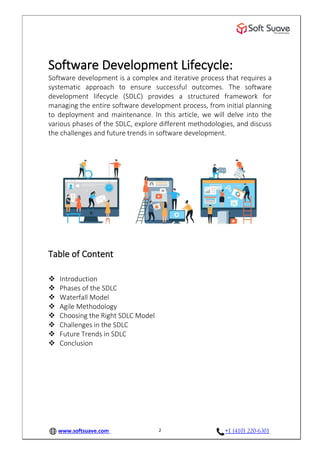
Software development is a complex and iterative process that requires a
systematic approach to ensure successful outcomes. The software
development lifecycle (SDLC) provides a structured framework for
managing the entire software development process, from initial planning
to deployment and maintenance. In this article, we will delve into the
various phases of the SDLC, explore different methodologies, and discuss
the challenges and future trends in software development.
Table of Content
 Introduction
 Phases of the SDLC
 Waterfall Model
 Agile Methodology
 Choosing the Right SDLC Model
 Challenges in the SDLC
 Future Trends in SDLC
 Conclusion
www.softsuave.com +1 (410) 220-6301
3
Introduction
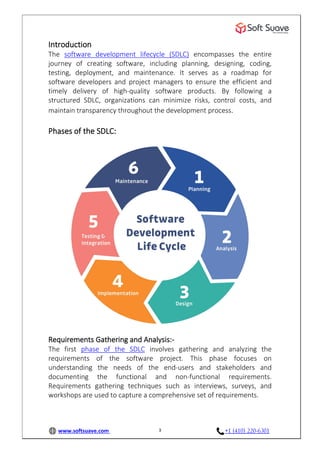
The software development lifecycle (SDLC) encompasses the entire
journey of creating software, including planning, designing, coding,
testing, deployment, and maintenance. It serves as a roadmap for
software developers and project managers to ensure the efficient and
timely delivery of high-quality software products. By following a
structured SDLC, organizations can minimize risks, control costs, and
maintain transparency throughout the development process.
Phases of the SDLC:
Requirements Gathering and Analysis:-
The first phase of the SDLC involves gathering and analyzing the
requirements of the software project. This phase focuses on
understanding the needs of the end-users and stakeholders and
documenting the functional and non-functional requirements.
Requirements gathering techniques such as interviews, surveys, and
workshops are used to capture a comprehensive set of requirements.
www.softsuave.com +1 (410) 220-6301
4
Design:-
Once the requirements are defined, the next phase is the design stage. In
this phase, software architects and designers create the blueprint for the
software system. They define the overall structure, modules, and
components of the software and determine the relationships between
them. The design phase also involves creating user interface mockups
and system architecture diagrams.
Implementation:-
The implementation phase involves the actual coding of the software
based on the design specifications. Programmers write code in
programming languages such as Java, C++, or Python, following coding
standards and best practices. This phase also includes unit testing to
identify and fix any defects in the code.
Testing and Quality Assurance:-
Testing is a crucial phase in the SDLC that ensures the software meets the
desired quality standards. Testers perform various types of testing,
including functional testing, performance testing, security testing, and
usability testing. Defects and bugs discovered during testing are reported,
fixed, and retested until the software is stable and bug-free.
Deployment:-
After successful testing, the software is ready for deployment. It is
packaged and released to the end-users or deployed on servers for
enterprise applications. This phase involves activities such as installation,
configuration, data migration, and user training. Deployment can be done
on-premises or in the cloud, depending on the project requirements.
Maintenance and Support:-
Once the software is deployed, it enters the maintenance and support
phase. This phase involves monitoring the software's performance,
addressing user feedback, and fixing any issues or bugs that arise. Regular
updates and enhancements are made to ensure the software remains
secure and up-to-date.
www.softsuave.com +1 (410) 220-6301
5
Waterfall Model
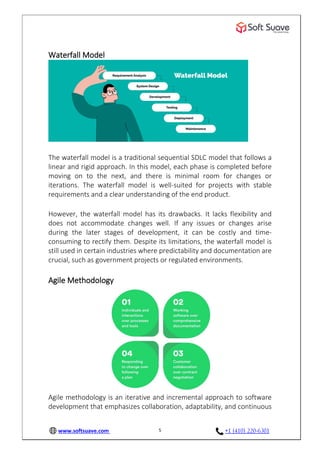
The waterfall model is a traditional sequential SDLC model that follows a
linear and rigid approach. In this model, each phase is completed before
moving on to the next, and there is minimal room for changes or
iterations. The waterfall model is well-suited for projects with stable
requirements and a clear understanding of the end product.
However, the waterfall model has its drawbacks. It lacks flexibility and
does not accommodate changes well. If any issues or changes arise
during the later stages of development, it can be costly and time-
consuming to rectify them. Despite its limitations, the waterfall model is
still used in certain industries where predictability and documentation are
crucial, such as government projects or regulated environments.
Agile Methodology
Agile methodology is an iterative and incremental approach to software
development that emphasizes collaboration, adaptability, and continuous
www.softsuave.com +1 (410) 220-6301
6
improvement. Unlike the waterfall model, agile development divides the
project into smaller iterations called sprints, allowing for flexibility and
feedback throughout the development process.
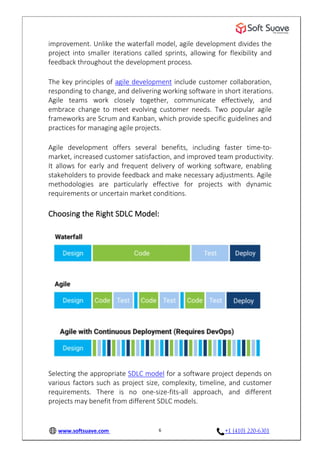
The key principles of agile development include customer collaboration,
responding to change, and delivering working software in short iterations.
Agile teams work closely together, communicate effectively, and
embrace change to meet evolving customer needs. Two popular agile
frameworks are Scrum and Kanban, which provide specific guidelines and
practices for managing agile projects.
Agile development offers several benefits, including faster time-to-
market, increased customer satisfaction, and improved team productivity.
It allows for early and frequent delivery of working software, enabling
stakeholders to provide feedback and make necessary adjustments. Agile
methodologies are particularly effective for projects with dynamic
requirements or uncertain market conditions.
Choosing the Right SDLC Model:
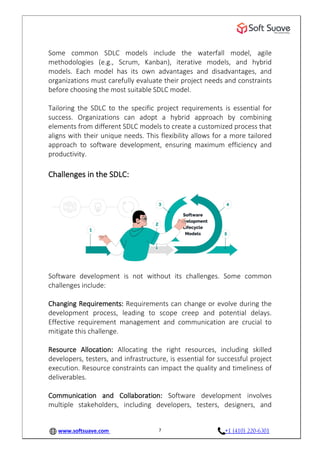
Selecting the appropriate SDLC model for a software project depends on
various factors such as project size, complexity, timeline, and customer
requirements. There is no one-size-fits-all approach, and different
projects may benefit from different SDLC models.
www.softsuave.com +1 (410) 220-6301
7
Some common SDLC models include the waterfall model, agile
methodologies (e.g., Scrum, Kanban), iterative models, and hybrid
models. Each model has its own advantages and disadvantages, and
organizations must carefully evaluate their project needs and constraints
before choosing the most suitable SDLC model.
Tailoring the SDLC to the specific project requirements is essential for
success. Organizations can adopt a hybrid approach by combining
elements from different SDLC models to create a customized process that
aligns with their unique needs. This flexibility allows for a more tailored
approach to software development, ensuring maximum efficiency and
productivity.
Challenges in the SDLC:
Software development is not without its challenges. Some common
challenges include:
Changing Requirements: Requirements can change or evolve during the
development process, leading to scope creep and potential delays.
Effective requirement management and communication are crucial to
mitigate this challenge.
Resource Allocation: Allocating the right resources, including skilled
developers, testers, and infrastructure, is essential for successful project
execution. Resource constraints can impact the quality and timeliness of
deliverables.
Communication and Collaboration: Software development involves
multiple stakeholders, including developers, testers, designers, and
www.softsuave.com +1 (410) 220-6301
8
Read More
project managers. Ensuring effective communication and collaboration
among team members is essential to avoid misunderstandings and
ensure project success.
Technical Complexity: Developing complex software systems requires
expertise in various technologies and frameworks. Managing the
technical complexity and ensuring scalability, security, and performance
can pose significant challenges.
Project Management: Efficient project management is crucial for
delivering software projects on time and within budget. Project managers
need to effectively plan, allocate resources, and manage risks to ensure
project success.
Conclusion
The software development lifecycle (SDLC) provides a structured
framework for managing the entire software development process. By
following a systematic approach, organizations can ensure the successful
delivery of high-quality software products. From requirements gathering
to deployment and maintenance, each phase of the SDLC plays a crucial
role in achieving project success.
Reach US:
Address: Contact:
SoftSuave Technologies Phone:+1 (410) 220-6301
3210 Vogel Rd, Mail: contact@softsuave.com
Ellicott City,
Maryland - 21043, USA

Understanding the Software Development Lifecycle [SDLC] | A Comprehensive Guide

  • 1.
    www.softsuave.com +1 (410)220-6301 1 Software Development Lifecycle: Comperhensive Guide Soft Suave Technologies
  • 2.
    www.softsuave.com +1 (410)220-6301 2 Software Development Lifecycle: Software development is a complex and iterative process that requires a systematic approach to ensure successful outcomes. The software development lifecycle (SDLC) provides a structured framework for managing the entire software development process, from initial planning to deployment and maintenance. In this article, we will delve into the various phases of the SDLC, explore different methodologies, and discuss the challenges and future trends in software development. Table of Content  Introduction  Phases of the SDLC  Waterfall Model  Agile Methodology  Choosing the Right SDLC Model  Challenges in the SDLC  Future Trends in SDLC  Conclusion
  • 3.
    www.softsuave.com +1 (410)220-6301 3 Introduction The software development lifecycle (SDLC) encompasses the entire journey of creating software, including planning, designing, coding, testing, deployment, and maintenance. It serves as a roadmap for software developers and project managers to ensure the efficient and timely delivery of high-quality software products. By following a structured SDLC, organizations can minimize risks, control costs, and maintain transparency throughout the development process. Phases of the SDLC: Requirements Gathering and Analysis:- The first phase of the SDLC involves gathering and analyzing the requirements of the software project. This phase focuses on understanding the needs of the end-users and stakeholders and documenting the functional and non-functional requirements. Requirements gathering techniques such as interviews, surveys, and workshops are used to capture a comprehensive set of requirements.
  • 4.
    www.softsuave.com +1 (410)220-6301 4 Design:- Once the requirements are defined, the next phase is the design stage. In this phase, software architects and designers create the blueprint for the software system. They define the overall structure, modules, and components of the software and determine the relationships between them. The design phase also involves creating user interface mockups and system architecture diagrams. Implementation:- The implementation phase involves the actual coding of the software based on the design specifications. Programmers write code in programming languages such as Java, C++, or Python, following coding standards and best practices. This phase also includes unit testing to identify and fix any defects in the code. Testing and Quality Assurance:- Testing is a crucial phase in the SDLC that ensures the software meets the desired quality standards. Testers perform various types of testing, including functional testing, performance testing, security testing, and usability testing. Defects and bugs discovered during testing are reported, fixed, and retested until the software is stable and bug-free. Deployment:- After successful testing, the software is ready for deployment. It is packaged and released to the end-users or deployed on servers for enterprise applications. This phase involves activities such as installation, configuration, data migration, and user training. Deployment can be done on-premises or in the cloud, depending on the project requirements. Maintenance and Support:- Once the software is deployed, it enters the maintenance and support phase. This phase involves monitoring the software's performance, addressing user feedback, and fixing any issues or bugs that arise. Regular updates and enhancements are made to ensure the software remains secure and up-to-date.
  • 5.
    www.softsuave.com +1 (410)220-6301 5 Waterfall Model The waterfall model is a traditional sequential SDLC model that follows a linear and rigid approach. In this model, each phase is completed before moving on to the next, and there is minimal room for changes or iterations. The waterfall model is well-suited for projects with stable requirements and a clear understanding of the end product. However, the waterfall model has its drawbacks. It lacks flexibility and does not accommodate changes well. If any issues or changes arise during the later stages of development, it can be costly and time- consuming to rectify them. Despite its limitations, the waterfall model is still used in certain industries where predictability and documentation are crucial, such as government projects or regulated environments. Agile Methodology Agile methodology is an iterative and incremental approach to software development that emphasizes collaboration, adaptability, and continuous
  • 6.
    www.softsuave.com +1 (410)220-6301 6 improvement. Unlike the waterfall model, agile development divides the project into smaller iterations called sprints, allowing for flexibility and feedback throughout the development process. The key principles of agile development include customer collaboration, responding to change, and delivering working software in short iterations. Agile teams work closely together, communicate effectively, and embrace change to meet evolving customer needs. Two popular agile frameworks are Scrum and Kanban, which provide specific guidelines and practices for managing agile projects. Agile development offers several benefits, including faster time-to- market, increased customer satisfaction, and improved team productivity. It allows for early and frequent delivery of working software, enabling stakeholders to provide feedback and make necessary adjustments. Agile methodologies are particularly effective for projects with dynamic requirements or uncertain market conditions. Choosing the Right SDLC Model: Selecting the appropriate SDLC model for a software project depends on various factors such as project size, complexity, timeline, and customer requirements. There is no one-size-fits-all approach, and different projects may benefit from different SDLC models.
  • 7.
    www.softsuave.com +1 (410)220-6301 7 Some common SDLC models include the waterfall model, agile methodologies (e.g., Scrum, Kanban), iterative models, and hybrid models. Each model has its own advantages and disadvantages, and organizations must carefully evaluate their project needs and constraints before choosing the most suitable SDLC model. Tailoring the SDLC to the specific project requirements is essential for success. Organizations can adopt a hybrid approach by combining elements from different SDLC models to create a customized process that aligns with their unique needs. This flexibility allows for a more tailored approach to software development, ensuring maximum efficiency and productivity. Challenges in the SDLC: Software development is not without its challenges. Some common challenges include: Changing Requirements: Requirements can change or evolve during the development process, leading to scope creep and potential delays. Effective requirement management and communication are crucial to mitigate this challenge. Resource Allocation: Allocating the right resources, including skilled developers, testers, and infrastructure, is essential for successful project execution. Resource constraints can impact the quality and timeliness of deliverables. Communication and Collaboration: Software development involves multiple stakeholders, including developers, testers, designers, and
  • 8.
    www.softsuave.com +1 (410)220-6301 8 Read More project managers. Ensuring effective communication and collaboration among team members is essential to avoid misunderstandings and ensure project success. Technical Complexity: Developing complex software systems requires expertise in various technologies and frameworks. Managing the technical complexity and ensuring scalability, security, and performance can pose significant challenges. Project Management: Efficient project management is crucial for delivering software projects on time and within budget. Project managers need to effectively plan, allocate resources, and manage risks to ensure project success. Conclusion The software development lifecycle (SDLC) provides a structured framework for managing the entire software development process. By following a systematic approach, organizations can ensure the successful delivery of high-quality software products. From requirements gathering to deployment and maintenance, each phase of the SDLC plays a crucial role in achieving project success. Reach US: Address: Contact: SoftSuave Technologies Phone:+1 (410) 220-6301 3210 Vogel Rd, Mail: contact@softsuave.com Ellicott City, Maryland - 21043, USA