



Content Auditing
Contributed by
The Content Science Team
2
Where auditing fits in
content strategy
© Content Science
3
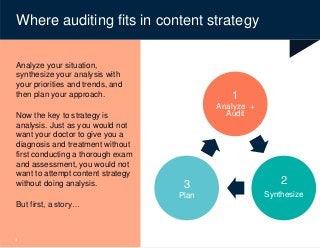
Analyze your situation,
synthesize your analysis with
your priorities and trends, and
then plan your approach.
Now the key to strategy is
analysis. Just as you would not
want your doctor to give you a
diagnosis and treatment without
first conducting a thorough exam
and assessment, you would not
want to attempt content strategy
without doing analysis.
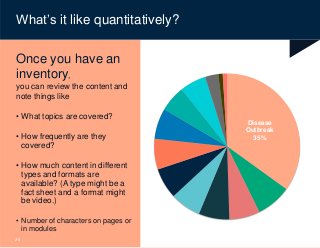
But first, a story…
Where auditing fits in content strategy
1
Analyze +
Audit
2
Synthesize
3
Plan
4 © Content Science
Content analysis
© Content Science
Content analysis
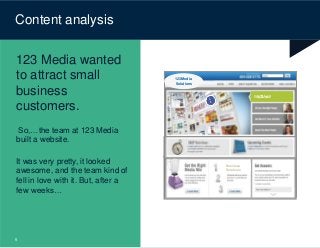
123 Media wanted
to attract small
business
customers.
So,…the team at 123 Media
built a website.
It was very pretty, it looked
awesome, and the team kind of
fell in love with it. But, after a
few weeks…
W
h
y
1
2
3
Media?
1
2
3
M
e
d
i
a
123 Media
Solutions
Business
Solutions
5
© Content Science
Content analysis
It wasn’t getting
off the ground.
The team realized the website
was not getting the traffic they
hoped for. They also weren’t
getting the calls and sales leads
they were hoping for. The new
website just wasn’t taking off.
6
© Content Science
Content analysis
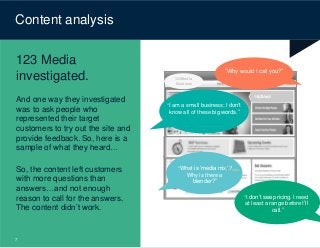
123 Media
investigated.
And one way they investigated
was to ask people who
represented their target
customers to try out the site and
provide feedback. So, here is a
sample of what they heard…
So, the content left customers
with more questions than
answers…and not enough
reason to call for the answers.
The content didn’t work.
W
h
y
1
2
3
Media?
1
2
3
M
e
d
i
a
123 Media
Solutions
Business
“Why would I call you?”
“I am a small business; I don’t
know all of these big words.”
“I don’t see pricing. I need
at least a range before I’ll
call.”
“What is ‘media mixS’o?lutions
7
Why is there a
blender?”
Content analysis
123 Media had to
say goodbye…
123 Media realized that this
relationship with their beautiful
website had to end. They had to start
over. They wasted the money they
spent creating the site and missed
out on potential sales.
8 © Content Science
“Build a pretty website and the
users will come.” is a mistake that
far too many companies make.
Content analysis
How could this
happen?
123 Media did NOT know
its CONTENT needs. But
rushed into a website
commitment anyway.
9 © Content Science
The tragic thing is this happens
everyday with all kinds of companies,
services, and organizations. The do-
over situation does not have to
happen. You can avoid the risk of
throwing away time and money on a
website that doesn’t work by knowing
your content needs.
© Content Science
The only way to know
your content needs is to
analyze them.
10
You might be wondering what this content
analysis thing is like. It’s like problem
analysis. Read this quote from Steve Jobs
about solving problems. He says…
Analyzing content needs
11 © Content Science
“When you START LOOKING at a
problem and see a simple solution, you
don’t understand the problem.
The really great person will KEEP GOING
and find….the underlying principle of the
problem [to] come up with a beautiful,
elegant solution that works.”
The main way to look is to audit.
Analyzing content needs
12 © Content Science
Let’s really “start looking.” Audit.
Many of us find ourselves developing
content strategy for a website or
interactive experience that already
has content or source material. We
start with auditing that content and
source material.
13 © Content Science
14
How to audit content
© Content Science
Let’s pretend…
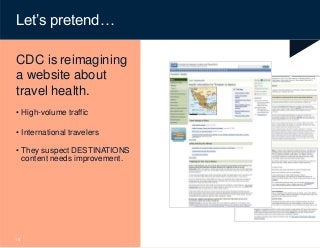
CDC is reimagining
a website about
travel health.
• High-volume traffic
• International travelers
• They suspect DESTINATIONS
content needs improvement.
15
© Content Science
Let’s really “start looking.” Audit.
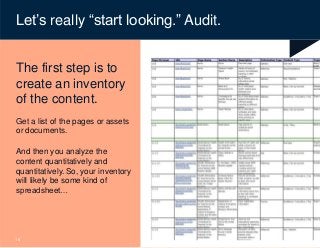
The first step is to
create an inventory
of the content.
Get a list of the pages or assets
or documents.
And then you analyze the
content quantitatively and
quantitatively. So, your inventory
will likely be some kind of
spreadsheet…
16
© Content Science
What content do we have?
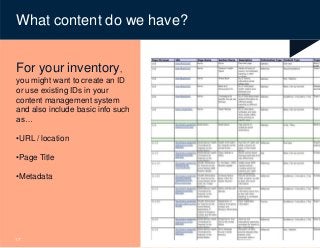
For your inventory,
you might want to create an ID
or use existing IDs in your
content management system
and also include basic info such
as…
•URL / location
•Page Title
•Metadata
17
© Content Science
Tools help create the base inventory for large sites
You can create this inventory
manually, which works well if
you’re talking in the range of
50-100 pages. If you’re talking
more content, then these tools
can help create the basic
inventory for you…
•Content Chimera
•Screaming Frog
•CMS (content management
system) exports
18
© Content Science
19
Tools help create the base inventory for large sites
Content Chimera and Screaming Frog do
involve a cost, but it’s very reasonable
Your content management system also might
export an inventory for you. Definitely look into
its reporting features.
© Content Science
What’s it like quantitatively?
Once you have an
inventory,
you can review the content and
note things like
• What topics are covered?
• How frequently are they
covered?
• How much content in different
types and formats are
available? (A type might be a
fact sheet and a format might
be video.)
• Number of characters on pages or
in modules
20
Disease
Outbreak
35%

Content Strategy Sample

  • 1.
  • 2.
    2 Where auditing fitsin content strategy
  • 3.
    © Content Science 3 Analyzeyour situation, synthesize your analysis with your priorities and trends, and then plan your approach. Now the key to strategy is analysis. Just as you would not want your doctor to give you a diagnosis and treatment without first conducting a thorough exam and assessment, you would not want to attempt content strategy without doing analysis. But first, a story… Where auditing fits in content strategy 1 Analyze + Audit 2 Synthesize 3 Plan
  • 4.
    4 © ContentScience Content analysis
  • 5.
    © Content Science Contentanalysis 123 Media wanted to attract small business customers. So,…the team at 123 Media built a website. It was very pretty, it looked awesome, and the team kind of fell in love with it. But, after a few weeks… W h y 1 2 3 Media? 1 2 3 M e d i a 123 Media Solutions Business Solutions 5
  • 6.
    © Content Science Contentanalysis It wasn’t getting off the ground. The team realized the website was not getting the traffic they hoped for. They also weren’t getting the calls and sales leads they were hoping for. The new website just wasn’t taking off. 6
  • 7.
    © Content Science Contentanalysis 123 Media investigated. And one way they investigated was to ask people who represented their target customers to try out the site and provide feedback. So, here is a sample of what they heard… So, the content left customers with more questions than answers…and not enough reason to call for the answers. The content didn’t work. W h y 1 2 3 Media? 1 2 3 M e d i a 123 Media Solutions Business “Why would I call you?” “I am a small business; I don’t know all of these big words.” “I don’t see pricing. I need at least a range before I’ll call.” “What is ‘media mixS’o?lutions 7 Why is there a blender?”
  • 8.
    Content analysis 123 Mediahad to say goodbye… 123 Media realized that this relationship with their beautiful website had to end. They had to start over. They wasted the money they spent creating the site and missed out on potential sales. 8 © Content Science “Build a pretty website and the users will come.” is a mistake that far too many companies make.
  • 9.
    Content analysis How couldthis happen? 123 Media did NOT know its CONTENT needs. But rushed into a website commitment anyway. 9 © Content Science The tragic thing is this happens everyday with all kinds of companies, services, and organizations. The do- over situation does not have to happen. You can avoid the risk of throwing away time and money on a website that doesn’t work by knowing your content needs.
  • 10.
    © Content Science Theonly way to know your content needs is to analyze them. 10
  • 11.
    You might bewondering what this content analysis thing is like. It’s like problem analysis. Read this quote from Steve Jobs about solving problems. He says… Analyzing content needs 11 © Content Science
  • 12.
    “When you STARTLOOKING at a problem and see a simple solution, you don’t understand the problem. The really great person will KEEP GOING and find….the underlying principle of the problem [to] come up with a beautiful, elegant solution that works.” The main way to look is to audit. Analyzing content needs 12 © Content Science
  • 13.
    Let’s really “startlooking.” Audit. Many of us find ourselves developing content strategy for a website or interactive experience that already has content or source material. We start with auditing that content and source material. 13 © Content Science
  • 14.
  • 15.
    © Content Science Let’spretend… CDC is reimagining a website about travel health. • High-volume traffic • International travelers • They suspect DESTINATIONS content needs improvement. 15
  • 16.
    © Content Science Let’sreally “start looking.” Audit. The first step is to create an inventory of the content. Get a list of the pages or assets or documents. And then you analyze the content quantitatively and quantitatively. So, your inventory will likely be some kind of spreadsheet… 16
  • 17.
    © Content Science Whatcontent do we have? For your inventory, you might want to create an ID or use existing IDs in your content management system and also include basic info such as… •URL / location •Page Title •Metadata 17
  • 18.
    © Content Science Toolshelp create the base inventory for large sites You can create this inventory manually, which works well if you’re talking in the range of 50-100 pages. If you’re talking more content, then these tools can help create the basic inventory for you… •Content Chimera •Screaming Frog •CMS (content management system) exports 18
  • 19.
    © Content Science 19 Toolshelp create the base inventory for large sites Content Chimera and Screaming Frog do involve a cost, but it’s very reasonable Your content management system also might export an inventory for you. Definitely look into its reporting features.
  • 20.
    © Content Science What’sit like quantitatively? Once you have an inventory, you can review the content and note things like • What topics are covered? • How frequently are they covered? • How much content in different types and formats are available? (A type might be a fact sheet and a format might be video.) • Number of characters on pages or in modules 20 Disease Outbreak 35%