



Content Marketing:
Insights, Landscape & Vendor Analysis
© 2014 Demand Metric Research Corporation. All Rights Reserved.
Solution Study
By: Clare Price, VP Research
With: Kristen Maida, Senior Research Analyst
June 2014
3
4
6
7
9
12
Executive Summary
What is Content Marketing?
Benefits of Content Marketing
Content Marketing Deployment Lifecycle
Vendor Selection Criteria
Content Marketing Solutions Landscape
Table of Contents
22
23
24
Analyst Bottom Line
About the Research Analysts
Our Solution Study Methodology
18
20
Content Marketing Maturity Model
Action Plan
25 About Demand Metric
EXECUTIVE SUMMARY
© 2014 Demand Metric Research Corporation. All Rights Reserved.
It has been said that “All Marketing is Digital Marketing,” and with good reason! In the last decade, marketing has been transformed.
Marketing has moved from an environment in which traditional marketing, brick and mortar storefronts and Digital Marketing options all
competed for the time, attention and resources of the marketing department to one in which Digital Marketing reigns supreme (with an
occasional nod in the direction of the storefront or traditional marketing channels, such as direct mail and print advertising).
In our Digital Marketing Solution Study Series, we examine five components of Digital Marketing components. In this report, we will focus on
the growing practice area of Content Marketing and cover the following sections:
 A Definition of Content Marketing
 The Benefits of Content Marketing
 Content Marketing Deployment Lifecycle
 Vendor Selection Criteria
 Content Marketing Solutions Landscape
 Content Marketing Maturity Model
 Action Plan & Toolkit
Content Marketing: Insights, Landscape & Vendor Analysis
3
Content is King. Its reign as the premier marketing focus for
Digital Marketing shows no signs of abating. Rather, the content is
becoming stronger, richer and more integrated as the ways and
means to deploy content for marketing rapidly expands.
It’s tempting to push as much content out as possible and hope that
some of it hits the right person at the right time. However, that
approach is akin to the old “broadcast” media approach. More
content is not the answer; it needs to be the right content.
Context is critical. As important as content is, it is equally true
that the world is awash in content. Few of us can keep up with the
our main interests, let alone other subjects pertaining to our careers
and lives. This makes context as valuable as content, more so if
you truly want to get a response to your content marketing.
Our Content Marketing Solution Study looks at the range of
content platforms. We will examine the landscape, vendors and
solutions for the three foundation platforms – Web Content
Management Platforms, Content Marketing Platforms and Content
Distribution Platforms. These platforms and toolsets provide the
WHAT IS CONTENT MARKETING?
Content Marketing: Insights, Landscape & Vendor Analysis
structure that content marketers need to create relevant,
personalized content for each of their individual audiences.
Demand Metric defines Content Marketing as the strategies,
processes and technologies that support the development,
deployment, management and measurement of content used
for marketing and advertising. Content Marketing involves
relevant, personalized content that creates or changes the
users’ experience, attitudes or preferences.
Role in Digital Marketing
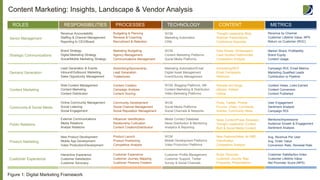
Demand Metric considers Content Marketing to be an integral part
of Digital Marketing as illustrated by our Digital Marketing
Framework on the next page (Figure 1).
Driven by the Content Marketing Manager, processes, technologies
and WCM platforms are used by Senior Management, Strategic
Comm, Community & Social Media Managers, PR and Product
Marketing. The common metrics for Content Marketing include
content views, links earned, content conversion and content
published. 4
TECHNOLOGY
Senior Management
ROLES RESPONSIBILITIES PROCESSES TECHNOLOGY CONTENT METRICS
Revenue Accountability
Staffing & Channel Management
Reporting to CEO/Board
Budgeting & Planning
Reviews & Coaching
Recruitment & Retention
WCM
Marketing Automation
CRM
Thought Leadership Blog
Webinar Presentations
Conference Keynotes
Revenue by Channel
Customer Lifetime Value, NPS
Return on Customer (ROC)
Strategic Communications
Brand Strategy
Digital Marketing Strategy
Social/Mobile Marketing Strategy
Marketing Budgeting
Agency Management
Communications Management
WCM
Content Marketing Platforms
Social Media Platforms
Data Sheets, Whitepapers
Case Studies/Testimonials
Competitive Analysis
Market Share, Profitability
Brand Equity
Content Usage
Demand Generation
Lead Generation & Events
Inbound/Outbound Marketing
Sales Opportunity Management
Advertising/Sponsorship
Lead Generation
Tradeshows
Marketing Automation/Email
Digital Asset Management
Event/Survey Management
Advertising/SEO
Email Campaigns
Webinars
Campaign ROI, Email Metrics
Marketing Qualified Leads
Contribution to Pipeline
Content Marketing
Web Content Management
Content Marketing
Content Distribution
Content Creation
Campaign Analysis
Content Scoring
Website and Blogs
eBooks, Articles
Videos
Content Views, Links Earned
Content Conversion
Content Published
WCM, Blogging Platforms, MA
Content Marketing & Distribution
Video Marketing Platforms
Community & Social Media
Online Community Management
Social Listening
Social Engagement
Community Development
Social Channel Management
Social Reputation Management
WCM
Social Media Platforms
Social Channels & Networks
Posts, Tweets, Photos
Forums, Chats, Comments
Articles, Community News
User Engagement
Sentiment Analysis
Campaign ROI
Public Relations
External Communications
Media Relations
Analyst Relations
Influencer Identification
Relationship Cultivation
Content Creation/Distribution
Media Contact Database
News Distribution & Monitoring
Analytics & Reporting
News Content/Press Releases
Thought Leadership Content
Rich & Social Media Content
Mentions/Impressions
Audience Growth & Engagement
Sentiment Analysis
Product Marketing
New Product Development
Mobile App Development
Video Production/Development
Product Launch
Product Positioning
Competitive Analysis
New Features/Ideas for R&D
Gamification
Competitive Analysis
Avg. Revenue Per User
Avg. Order Value
Conversion Rate, Renewal Rate
WCM
Mobile Development Platforms
Video Production Platforms
Customer Experience
Interactive Experience
Customer Satisfaction
Customer Advocacy
Customer Experience
Customer Journey Mapping
Customer Persona Creation
Buyer Personas
Customer Journey Map
Proposals, Presentations
Customer Satisfaction Index
Customer Lifetime Value
Net Promoter Score (NPS)
Customer Profile Management
Customer Support, Twitter
Survey & Social Channels
Figure 1: Digital Marketing Framework
Content Marketing: Insights, Landscape & Vendor Analysis
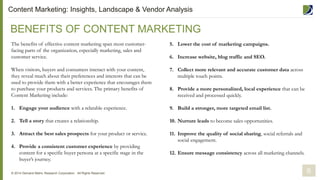
The benefits of effective content marketing span most customer-
facing parts of the organization, especially marketing, sales and
customer service.
When visitors, buyers and consumers interact with your content,
they reveal much about their preferences and interests that can be
used to provide them with a better experience that encourages them
to purchase your products and services. The primary benefits of
Content Marketing include:
1. Engage your audience with a relatable experience.
2. Tell a story that creates a relationship.
3. Attract the best sales prospects for your product or service.
4. Provide a consistent customer experience by providing
content for a specific buyer persona at a specific stage in the
buyer’s journey.
5. Lower the cost of marketing campaigns.
6. Increase website, blog traffic and SEO.
7. Collect more relevant and accurate customer data across
multiple touch points.
8. Provide a more personalized, local experience that can be
received and processed quickly.
9. Build a stronger, more targeted email list.
10. Nurture leads to become sales opportunities.
11. Improve the quality of social sharing, social referrals and
social engagement.
12. Ensure message consistency across all marketing channels.
BENEFITS OF CONTENT MARKETING
© 2014 Demand Metric Research Corporation. All Rights Reserved.
Content Marketing: Insights, Landscape & Vendor Analysis
6
Content Marketing platforms fall into two categories – Web
Content Management (WCM) and Content Marketing &
Distribution (CMS/CDS), which will be discussed in detail in the
Content Marketing Solutions Landscape portion of this report.
While both categories may include similar functionality and features,
each has a different end goal in mind. Consequently, the approach
to implementing and deploying solutions from each category vary.
In this section, we will discuss the separate lifecycles for WCM and
CMS/CDS platforms.
WCM Stages of Deployment
We see six stages in the deployment of WCM platform beginning
with content creation and circling to integration with other systems.
Figure 2 illustrates a common deployment lifecycle for WCM
platforms.
7
CONTENT MARKETING DEPLOYMENT LIFECYCLE
© 2014 Demand Metric Research Corporation. All Rights Reserved.
Content Marketing: Insights, Landscape & Vendor Analysis
1. Create
Content
2. Develop
Assets
3. Manage
Workflow
4. Deliver to
Channels
5. Manage &
Measure
6. Enterprise
System Integration
Figure 2: WCM Deployment Lifecycle
Web Content
Management
Deployment
Lifecycle
CMS/CDS Stages of Deployment
For CMS/CDS platforms, we see seven stages in the deployment
lifecycle, beginning with developing a content strategy and
progressing through to measurement.
Figure 3 illustrates a common deployment cycle for CMS/CDS
platforms.
Content Marketing: Insights, Landscape & Vendor Analysis
1. Develop
Content Strategy
2. Create
Content
3. Discover &
Curate
4. Manage
Workflow
5. Manage
Assets
6. Publish &
Distribute
7. Measure
Figure 3: Content Marketing & Distribution Deployment Lifecycle
Content
Marketing &
Distribution
Deployment
Lifecycle
8© 2014 Demand Metric Research Corporation. All Rights Reserved.
We recommend that organizations evaluate vendors in the
Content Marketing solution space based on the lifecycles
reviewed in the Content Marketing Deployment Lifecycle
section of this report. Web Content Management and Content
Marketing and Distribution platforms should be evaluated on a
case-by-case basis for each organization.
Download and complete Demand Metric’s Web Content
Management Vendor Evaluation or our Content Marketing &
Distribution Vendor Evaluation to assess several vendors at one
time to see which may work best for your organization.
Figure 5 (on the next page) highlights the key functionality of a
WCM platform according to the level of complexity from Basic to
Cutting-Edge.
Figure 6 (on Page 11) highlights the key functionality of
CMS/CDS platforms based on the same four tiers. Use these
graphics to determine the features that are right for your company.
VENDOR SELECTION CRITERIA
9© 2014 Demand Metric Research Corporation. All Rights Reserved.
Download
Figure 4: Web Content Management Vendor Evaluation
Content Marketing: Insights, Landscape & Vendor Analysis

Content Marketing Solution Study

  • 1.
    Content Marketing: Insights, Landscape& Vendor Analysis © 2014 Demand Metric Research Corporation. All Rights Reserved. Solution Study By: Clare Price, VP Research With: Kristen Maida, Senior Research Analyst June 2014
  • 2.
    3 4 6 7 9 12 Executive Summary What isContent Marketing? Benefits of Content Marketing Content Marketing Deployment Lifecycle Vendor Selection Criteria Content Marketing Solutions Landscape Table of Contents 22 23 24 Analyst Bottom Line About the Research Analysts Our Solution Study Methodology 18 20 Content Marketing Maturity Model Action Plan 25 About Demand Metric
  • 3.
    EXECUTIVE SUMMARY © 2014Demand Metric Research Corporation. All Rights Reserved. It has been said that “All Marketing is Digital Marketing,” and with good reason! In the last decade, marketing has been transformed. Marketing has moved from an environment in which traditional marketing, brick and mortar storefronts and Digital Marketing options all competed for the time, attention and resources of the marketing department to one in which Digital Marketing reigns supreme (with an occasional nod in the direction of the storefront or traditional marketing channels, such as direct mail and print advertising). In our Digital Marketing Solution Study Series, we examine five components of Digital Marketing components. In this report, we will focus on the growing practice area of Content Marketing and cover the following sections:  A Definition of Content Marketing  The Benefits of Content Marketing  Content Marketing Deployment Lifecycle  Vendor Selection Criteria  Content Marketing Solutions Landscape  Content Marketing Maturity Model  Action Plan & Toolkit Content Marketing: Insights, Landscape & Vendor Analysis 3
  • 4.
    Content is King.Its reign as the premier marketing focus for Digital Marketing shows no signs of abating. Rather, the content is becoming stronger, richer and more integrated as the ways and means to deploy content for marketing rapidly expands. It’s tempting to push as much content out as possible and hope that some of it hits the right person at the right time. However, that approach is akin to the old “broadcast” media approach. More content is not the answer; it needs to be the right content. Context is critical. As important as content is, it is equally true that the world is awash in content. Few of us can keep up with the our main interests, let alone other subjects pertaining to our careers and lives. This makes context as valuable as content, more so if you truly want to get a response to your content marketing. Our Content Marketing Solution Study looks at the range of content platforms. We will examine the landscape, vendors and solutions for the three foundation platforms – Web Content Management Platforms, Content Marketing Platforms and Content Distribution Platforms. These platforms and toolsets provide the WHAT IS CONTENT MARKETING? Content Marketing: Insights, Landscape & Vendor Analysis structure that content marketers need to create relevant, personalized content for each of their individual audiences. Demand Metric defines Content Marketing as the strategies, processes and technologies that support the development, deployment, management and measurement of content used for marketing and advertising. Content Marketing involves relevant, personalized content that creates or changes the users’ experience, attitudes or preferences. Role in Digital Marketing Demand Metric considers Content Marketing to be an integral part of Digital Marketing as illustrated by our Digital Marketing Framework on the next page (Figure 1). Driven by the Content Marketing Manager, processes, technologies and WCM platforms are used by Senior Management, Strategic Comm, Community & Social Media Managers, PR and Product Marketing. The common metrics for Content Marketing include content views, links earned, content conversion and content published. 4
  • 5.
    TECHNOLOGY Senior Management ROLES RESPONSIBILITIESPROCESSES TECHNOLOGY CONTENT METRICS Revenue Accountability Staffing & Channel Management Reporting to CEO/Board Budgeting & Planning Reviews & Coaching Recruitment & Retention WCM Marketing Automation CRM Thought Leadership Blog Webinar Presentations Conference Keynotes Revenue by Channel Customer Lifetime Value, NPS Return on Customer (ROC) Strategic Communications Brand Strategy Digital Marketing Strategy Social/Mobile Marketing Strategy Marketing Budgeting Agency Management Communications Management WCM Content Marketing Platforms Social Media Platforms Data Sheets, Whitepapers Case Studies/Testimonials Competitive Analysis Market Share, Profitability Brand Equity Content Usage Demand Generation Lead Generation & Events Inbound/Outbound Marketing Sales Opportunity Management Advertising/Sponsorship Lead Generation Tradeshows Marketing Automation/Email Digital Asset Management Event/Survey Management Advertising/SEO Email Campaigns Webinars Campaign ROI, Email Metrics Marketing Qualified Leads Contribution to Pipeline Content Marketing Web Content Management Content Marketing Content Distribution Content Creation Campaign Analysis Content Scoring Website and Blogs eBooks, Articles Videos Content Views, Links Earned Content Conversion Content Published WCM, Blogging Platforms, MA Content Marketing & Distribution Video Marketing Platforms Community & Social Media Online Community Management Social Listening Social Engagement Community Development Social Channel Management Social Reputation Management WCM Social Media Platforms Social Channels & Networks Posts, Tweets, Photos Forums, Chats, Comments Articles, Community News User Engagement Sentiment Analysis Campaign ROI Public Relations External Communications Media Relations Analyst Relations Influencer Identification Relationship Cultivation Content Creation/Distribution Media Contact Database News Distribution & Monitoring Analytics & Reporting News Content/Press Releases Thought Leadership Content Rich & Social Media Content Mentions/Impressions Audience Growth & Engagement Sentiment Analysis Product Marketing New Product Development Mobile App Development Video Production/Development Product Launch Product Positioning Competitive Analysis New Features/Ideas for R&D Gamification Competitive Analysis Avg. Revenue Per User Avg. Order Value Conversion Rate, Renewal Rate WCM Mobile Development Platforms Video Production Platforms Customer Experience Interactive Experience Customer Satisfaction Customer Advocacy Customer Experience Customer Journey Mapping Customer Persona Creation Buyer Personas Customer Journey Map Proposals, Presentations Customer Satisfaction Index Customer Lifetime Value Net Promoter Score (NPS) Customer Profile Management Customer Support, Twitter Survey & Social Channels Figure 1: Digital Marketing Framework Content Marketing: Insights, Landscape & Vendor Analysis
  • 6.
    The benefits ofeffective content marketing span most customer- facing parts of the organization, especially marketing, sales and customer service. When visitors, buyers and consumers interact with your content, they reveal much about their preferences and interests that can be used to provide them with a better experience that encourages them to purchase your products and services. The primary benefits of Content Marketing include: 1. Engage your audience with a relatable experience. 2. Tell a story that creates a relationship. 3. Attract the best sales prospects for your product or service. 4. Provide a consistent customer experience by providing content for a specific buyer persona at a specific stage in the buyer’s journey. 5. Lower the cost of marketing campaigns. 6. Increase website, blog traffic and SEO. 7. Collect more relevant and accurate customer data across multiple touch points. 8. Provide a more personalized, local experience that can be received and processed quickly. 9. Build a stronger, more targeted email list. 10. Nurture leads to become sales opportunities. 11. Improve the quality of social sharing, social referrals and social engagement. 12. Ensure message consistency across all marketing channels. BENEFITS OF CONTENT MARKETING © 2014 Demand Metric Research Corporation. All Rights Reserved. Content Marketing: Insights, Landscape & Vendor Analysis 6
  • 7.
    Content Marketing platformsfall into two categories – Web Content Management (WCM) and Content Marketing & Distribution (CMS/CDS), which will be discussed in detail in the Content Marketing Solutions Landscape portion of this report. While both categories may include similar functionality and features, each has a different end goal in mind. Consequently, the approach to implementing and deploying solutions from each category vary. In this section, we will discuss the separate lifecycles for WCM and CMS/CDS platforms. WCM Stages of Deployment We see six stages in the deployment of WCM platform beginning with content creation and circling to integration with other systems. Figure 2 illustrates a common deployment lifecycle for WCM platforms. 7 CONTENT MARKETING DEPLOYMENT LIFECYCLE © 2014 Demand Metric Research Corporation. All Rights Reserved. Content Marketing: Insights, Landscape & Vendor Analysis 1. Create Content 2. Develop Assets 3. Manage Workflow 4. Deliver to Channels 5. Manage & Measure 6. Enterprise System Integration Figure 2: WCM Deployment Lifecycle Web Content Management Deployment Lifecycle
  • 8.
    CMS/CDS Stages ofDeployment For CMS/CDS platforms, we see seven stages in the deployment lifecycle, beginning with developing a content strategy and progressing through to measurement. Figure 3 illustrates a common deployment cycle for CMS/CDS platforms. Content Marketing: Insights, Landscape & Vendor Analysis 1. Develop Content Strategy 2. Create Content 3. Discover & Curate 4. Manage Workflow 5. Manage Assets 6. Publish & Distribute 7. Measure Figure 3: Content Marketing & Distribution Deployment Lifecycle Content Marketing & Distribution Deployment Lifecycle 8© 2014 Demand Metric Research Corporation. All Rights Reserved.
  • 9.
    We recommend thatorganizations evaluate vendors in the Content Marketing solution space based on the lifecycles reviewed in the Content Marketing Deployment Lifecycle section of this report. Web Content Management and Content Marketing and Distribution platforms should be evaluated on a case-by-case basis for each organization. Download and complete Demand Metric’s Web Content Management Vendor Evaluation or our Content Marketing & Distribution Vendor Evaluation to assess several vendors at one time to see which may work best for your organization. Figure 5 (on the next page) highlights the key functionality of a WCM platform according to the level of complexity from Basic to Cutting-Edge. Figure 6 (on Page 11) highlights the key functionality of CMS/CDS platforms based on the same four tiers. Use these graphics to determine the features that are right for your company. VENDOR SELECTION CRITERIA 9© 2014 Demand Metric Research Corporation. All Rights Reserved. Download Figure 4: Web Content Management Vendor Evaluation Content Marketing: Insights, Landscape & Vendor Analysis