CONTEMPORARY
TRENDS IN TEACHING
AND LEARNING
Iain Doherty
12th November 2014
Section One – Educational
Developments
navitas-professional.edu.au navitasenglish.com
A Bit About My Perspective
 One of my roles at Navitas is to keep
current with learning and teaching
innovations and to ensure that current
thinking informs practice at Navitas. There
are two aspects to this:
 Pedagogies
 Technologies
 The big picture needs to be translated into
practical strategies for diverse teachers.
navitas-professional.edu.au navitasenglish.com
Shift in Teaching and Learning
 A pedagogical shift is occurring and we can
identify a number of drivers for this shift.
 Increasing openness of learning with e.g.
Open Courseware, Massive Open Online
Courses (MOOCs).
 Recognized need for life-long learning,
broadened skill set, on-going skill
development, 21st Century learners.
 The role of teacher is being re-conceived.
navitas-professional.edu.au navitasenglish.com
 Increasing access to [high quality] content
from the world’s top universities /
institutes of higher education.
 Psychology of Criminal Justice
 Introduction to Psychology
 Understanding Research Methods
 Understanding Research: Overview for
Health Professionals
There’s a Lot of Content Out There
navitas-professional.edu.au navitasenglish.com
 Even more content:
 Exploring English Language and Culture
 English Grammar and Style
 Principles of Written English (3 Parts)
 English for Doing Business in Asia
 English Composition 1: Achieving Expertise
There’s a Lot of Content Out There
navitas-professional.edu.au navitasenglish.com
 edX is beginning to develop “Curricula”, the
so called Xseries:
 “Some schools offer an XSeries certificate
of achievement when you complete and
pass a series of courses in a specific
subject . . . generally you must take and
pass a series of courses as outlined by the
school and receive a verified certificate in
those courses”.
There’s a Lot of Content Out There
navitas-professional.edu.au navitasenglish.com
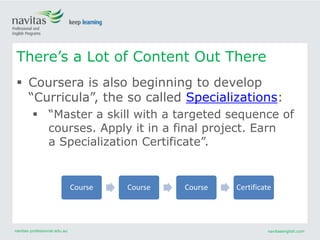
 Coursera is also beginning to develop
“Curricula”, the so called Specializations:
 “Master a skill with a targeted sequence of
courses. Apply it in a final project. Earn
a Specialization Certificate”.
There’s a Lot of Content Out There
Course Course Course Certificate
navitas-professional.edu.au navitasenglish.com
 To have a real impact on helping students
get their degrees, there seems to be two
choices:
 Option 1) Replace colleges and universities
as providers of for-credit courses or even
degree programs
 Option 2) Work with colleges and
universities to embed MOOC courses or
courseware into for-credit courses or
degree programs
There’s a Lot of Content Out There
navitas-professional.edu.au navitasenglish.com
 If you think about the nature of MOOCs
then it becomes obvious that teaching
presence is pretty minimal – thousands of
students relative to two or three
instructors.
 However, it is not entirely clear that this is
problematic from the point of view of
students achieving the intended learning
outcomes / completing a course.
The Role of The Teacher
navitas-professional.edu.au navitasenglish.com
 We can thinking of any particular learning
environment in terms of three types of
interaction:
 Teacher – student
 Student – content
 Student – student
 How much of each one is necessary for
success (Moore, 1989; Miayzoe &
Anderson, 2013)?
The Role of The Teacher
navitas-professional.edu.au navitasenglish.com
 Going back to MOOCs the vast majority of
participants have an undergraduate or
postgraduate qualification.
 Obviously very different from the situation
in Navitas where Higher Ed and VET
students represent a different
demographic.
 Still, the question of the extent to which
each interaction type is necessary.
The Role of The Teacher
navitas-professional.edu.au navitasenglish.com
 Another way to look at this is in terms of
what teachers do:
 Sage on the stage (King, 1993)
 Guide on the side (King, 1993)
 Meddler in the middle (McWilliam, 2007)
 Which role is most appropriate / most
productive in an age in which content is
everywhere?
The Role of The Teacher
navitas-professional.edu.au navitasenglish.com
 Interesting that the [didactic] lecture
remains central to teaching and learning
even though we know it is not an effective
way for students to learn (Gibbs, 1981).
 The alternative is more active learning
techniques that help students both to
retain information and to process learning
at a deeper level (Hart, 2006; Freeman et
al., 2014).
The Role of The Teacher
navitas-professional.edu.au navitasenglish.com
 There are no easy answers around the
question of the role of teacher.
 Certainly teachers remain crucial in the
educational process.
 Teachers are subject experts but there is a
need to recognize that there has been an
exponential growth in information.
 Probably opt for teachers as informed
facilitators.
The Role of the Teacher
navitas-professional.edu.au navitasenglish.com
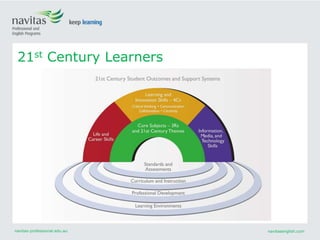
 21st Century learners:
 Developing knowledge and skills
 Creativity, communication, collaboration
 Digital literacy, technological ability
 Cultural sensitivity and civic responsibility
 Borderless, anywhere, anytime learning
 This is a holistic perspective / educational
ideal (Partnership for 21st Century Skills,
2011).
21st Century Learners
navitas-professional.edu.au navitasenglish.com
21st Century Learners
navitas-professional.edu.au navitasenglish.com
 2014 Office of Learning and Teaching (OLT)
Conference.
 A number of speakers including Geoffrey
Crisp, Peter Goodyear and David Boud
presented on the 21st century learning
scenario.
 Student centric, personalized, adaptive,
mobile, connected, collaborative,
compellingly evidenced, moral know-how.
Bringing It All Together
navitas-professional.edu.au navitasenglish.com
 The first MOOC was run by George
Siemens at Athabasca University in 2007.
 The MOOC embodied Siemen’s philosophy
of connected learning – Connectivism.
 Students as nodes in a network and co-
creators of content.
 This approach to teaching and learning at
least approximates the ideal.
Bringing It All Together
navitas-professional.edu.au navitasenglish.com
 For Siemens, students exist in a network of
animate and inanimate nodes e.g. people,
web pages, data bases, blogs, wikis, media
sources.
 Declarative knowledge remains important
but procedural knowledge is equally
important.
 Procedural – knowing how and where to
find information.
Bringing It All Together
navitas-professional.edu.au navitasenglish.com
 Siemens:
 He was truly innovative in the online
learning and teaching space;
 He ran a course where students were free
to use multiple technologies;
 Students were the authors as well as
consumers of content.
 This is the kind of disruptive innovation
that aligns with the rhetoric.
Bringing It All Together
Section Two – Technologies
navitas-professional.edu.au navitasenglish.com
Learning Management Systems
• Look at usage across any institutions and you’ll
see the LMS used as a file repository.
• Students have no control over their own learning.
• Plugins still poor as compared to freely available
counterparts.
• LTI offers expanded possibilities but still . . .
navitas-professional.edu.au navitasenglish.com
 A caveat before we take a look at some
external applications and services.
 There is risk:
 Data privacy and data ownership;
 Reliability of service / service provider;
 Availability of support when needed;
 How long will the service be around?
 Collaborate with LTT for support.
Connected
navitas-professional.edu.au navitasenglish.com
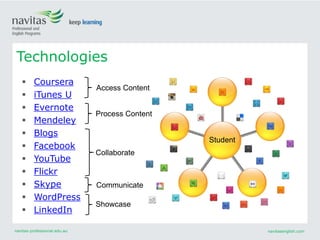
Technologies
 Coursera
 iTunes U
 Evernote
 Mendeley
 Blogs
 Facebook
 YouTube
 Flickr
 Skype
 WordPress
 LinkedIn
Student
Access Content
Process Content
Collaborate
Communicate
Showcase
navitas-professional.edu.au navitasenglish.com
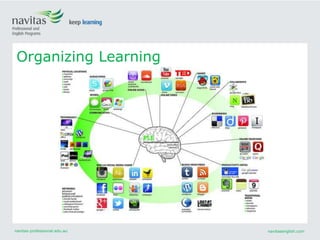
Organizing Learning
navitas-professional.edu.au navitasenglish.com
Access Content Anywhere Anytime
 Coursera
 edX
 iTunes U
 YouTube Edu
 MIT Open Courseware
 Open Educational Resources
navitas-professional.edu.au navitasenglish.com
Access Content Anywhere Anytime
 YouTube
 Flickr
 Free Images
 Stock Vault
 DexHaus
 KaveWall
 Freedigitalphotos
navitas-professional.edu.au navitasenglish.com
Process Content on the Go
 QuickOffice Pro
 Evernote
 GoodReader
 Mendeley
 Endnote
 iPad Photo Editors
navitas-professional.edu.au navitasenglish.com
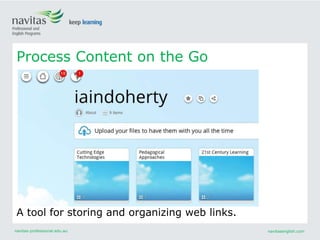
Process Content on the Go
A tool for storing and organizing web links.
navitas-professional.edu.au navitasenglish.com
 Google drive is a cloud service that offers
an office suite.
Collaborate Anywhere Anytime
navitas-professional.edu.au navitasenglish.com
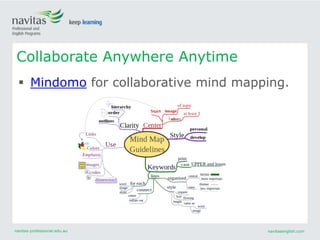
 Mindomo for collaborative mind mapping.
Collaborate Anywhere Anytime
navitas-professional.edu.au navitasenglish.com
Showcase Yourself on any Device
A tool for creating websites
navitas-professional.edu.au navitasenglish.com
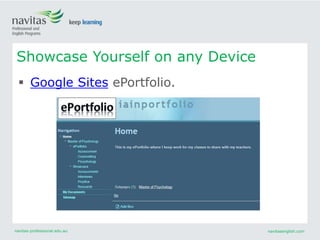
 Google Sites ePortfolio.
Showcase Yourself on any Device
navitas-professional.edu.au navitasenglish.com
 A YouTube channel enables teachers and
students to upload and share videos.
 Videos can be public, unlisted or private
requiring a password.
Showcase Yourself on any Device
navitas-professional.edu.au navitasenglish.com
References
• Freeman, S., Eddy, S. L., McDonough, M., Smith, M. K.,
Okoroafor, N., Jordt, H., & Wenderoth, M. P. (2014).
Active Learning Increases Student Performance in
Science, Engineering, and Mathematics. Proceedings of
the National Academy of Sciences.
doi:10.1073/pnas.1319030111
• Gibbs, G. (1981). Twenty Terrible Reasons for Lecturing.
SCED Occasional Paper, No.8.
http://dx.doi.org/10.1016/B978-0-12-800959-8.00021-3
navitas-professional.edu.au navitasenglish.com
References
 Hart, J. W. (2006). The Lecture as Active
Learning. AALL Spectrum, (April).
Retrieved from
http://www.aallnet.org/main-
menu/Publications/spectrum/Archives/Vol
-10/pub_sp0604/pub-sp0604-lecture.pdf
navitas-professional.edu.au navitasenglish.com
References
• King, A. (1993). From Sage on the Stage
to Guide on the Side. College Teaching,
41(1), 30–35. Retrieved from
http://www.jstor.org/stable/27558571
• McWilliam, E. (2008). Unlearning How To
Teach. Innovations in Education and
Teaching International, 45(3), 263–269.
http://dx.doi.org/10.1080/147032908021
76147
navitas-professional.edu.au navitasenglish.com
References
• Miayzoe, T., & Anderson, T. (2013). Interaction
Equivalency in an OER, MOOCS and Informal Learning
Era. Journal of Interactive Media in Education,
0(September), 2013. Retrieved from
http://jime.open.ac.uk/jime/issue/view/2013-Autumn
• Moore, M. G. (1989). Editorial: Three Types of
Interaction. American Journal of Distance Education,
3(2), 1–7. http://dx.doi.org/10.1080/08923648909526659
• Partnership for 21st Century Skills. (2011).
Framework for 21st Century Learning. Washington
D.C. Retrieved from http://www.p21.org
navitas-professional.edu.au navitasenglish.com
Contact
• Email: iain.doherty@navitas.com

Contemporary trends in teaching and learning - Iain Doherty

  • 1.
    CONTEMPORARY TRENDS IN TEACHING ANDLEARNING Iain Doherty 12th November 2014
  • 2.
    Section One –Educational Developments
  • 3.
    navitas-professional.edu.au navitasenglish.com A BitAbout My Perspective  One of my roles at Navitas is to keep current with learning and teaching innovations and to ensure that current thinking informs practice at Navitas. There are two aspects to this:  Pedagogies  Technologies  The big picture needs to be translated into practical strategies for diverse teachers.
  • 4.
    navitas-professional.edu.au navitasenglish.com Shift inTeaching and Learning  A pedagogical shift is occurring and we can identify a number of drivers for this shift.  Increasing openness of learning with e.g. Open Courseware, Massive Open Online Courses (MOOCs).  Recognized need for life-long learning, broadened skill set, on-going skill development, 21st Century learners.  The role of teacher is being re-conceived.
  • 5.
    navitas-professional.edu.au navitasenglish.com  Increasingaccess to [high quality] content from the world’s top universities / institutes of higher education.  Psychology of Criminal Justice  Introduction to Psychology  Understanding Research Methods  Understanding Research: Overview for Health Professionals There’s a Lot of Content Out There
  • 6.
    navitas-professional.edu.au navitasenglish.com  Evenmore content:  Exploring English Language and Culture  English Grammar and Style  Principles of Written English (3 Parts)  English for Doing Business in Asia  English Composition 1: Achieving Expertise There’s a Lot of Content Out There
  • 7.
    navitas-professional.edu.au navitasenglish.com  edXis beginning to develop “Curricula”, the so called Xseries:  “Some schools offer an XSeries certificate of achievement when you complete and pass a series of courses in a specific subject . . . generally you must take and pass a series of courses as outlined by the school and receive a verified certificate in those courses”. There’s a Lot of Content Out There
  • 8.
    navitas-professional.edu.au navitasenglish.com  Courserais also beginning to develop “Curricula”, the so called Specializations:  “Master a skill with a targeted sequence of courses. Apply it in a final project. Earn a Specialization Certificate”. There’s a Lot of Content Out There Course Course Course Certificate
  • 9.
    navitas-professional.edu.au navitasenglish.com  Tohave a real impact on helping students get their degrees, there seems to be two choices:  Option 1) Replace colleges and universities as providers of for-credit courses or even degree programs  Option 2) Work with colleges and universities to embed MOOC courses or courseware into for-credit courses or degree programs There’s a Lot of Content Out There
  • 10.
    navitas-professional.edu.au navitasenglish.com  Ifyou think about the nature of MOOCs then it becomes obvious that teaching presence is pretty minimal – thousands of students relative to two or three instructors.  However, it is not entirely clear that this is problematic from the point of view of students achieving the intended learning outcomes / completing a course. The Role of The Teacher
  • 11.
    navitas-professional.edu.au navitasenglish.com  Wecan thinking of any particular learning environment in terms of three types of interaction:  Teacher – student  Student – content  Student – student  How much of each one is necessary for success (Moore, 1989; Miayzoe & Anderson, 2013)? The Role of The Teacher
  • 12.
    navitas-professional.edu.au navitasenglish.com  Goingback to MOOCs the vast majority of participants have an undergraduate or postgraduate qualification.  Obviously very different from the situation in Navitas where Higher Ed and VET students represent a different demographic.  Still, the question of the extent to which each interaction type is necessary. The Role of The Teacher
  • 13.
    navitas-professional.edu.au navitasenglish.com  Anotherway to look at this is in terms of what teachers do:  Sage on the stage (King, 1993)  Guide on the side (King, 1993)  Meddler in the middle (McWilliam, 2007)  Which role is most appropriate / most productive in an age in which content is everywhere? The Role of The Teacher
  • 14.
    navitas-professional.edu.au navitasenglish.com  Interestingthat the [didactic] lecture remains central to teaching and learning even though we know it is not an effective way for students to learn (Gibbs, 1981).  The alternative is more active learning techniques that help students both to retain information and to process learning at a deeper level (Hart, 2006; Freeman et al., 2014). The Role of The Teacher
  • 15.
    navitas-professional.edu.au navitasenglish.com  Thereare no easy answers around the question of the role of teacher.  Certainly teachers remain crucial in the educational process.  Teachers are subject experts but there is a need to recognize that there has been an exponential growth in information.  Probably opt for teachers as informed facilitators. The Role of the Teacher
  • 16.
    navitas-professional.edu.au navitasenglish.com  21stCentury learners:  Developing knowledge and skills  Creativity, communication, collaboration  Digital literacy, technological ability  Cultural sensitivity and civic responsibility  Borderless, anywhere, anytime learning  This is a holistic perspective / educational ideal (Partnership for 21st Century Skills, 2011). 21st Century Learners
  • 17.
  • 18.
    navitas-professional.edu.au navitasenglish.com  2014Office of Learning and Teaching (OLT) Conference.  A number of speakers including Geoffrey Crisp, Peter Goodyear and David Boud presented on the 21st century learning scenario.  Student centric, personalized, adaptive, mobile, connected, collaborative, compellingly evidenced, moral know-how. Bringing It All Together
  • 19.
    navitas-professional.edu.au navitasenglish.com  Thefirst MOOC was run by George Siemens at Athabasca University in 2007.  The MOOC embodied Siemen’s philosophy of connected learning – Connectivism.  Students as nodes in a network and co- creators of content.  This approach to teaching and learning at least approximates the ideal. Bringing It All Together
  • 20.
    navitas-professional.edu.au navitasenglish.com  ForSiemens, students exist in a network of animate and inanimate nodes e.g. people, web pages, data bases, blogs, wikis, media sources.  Declarative knowledge remains important but procedural knowledge is equally important.  Procedural – knowing how and where to find information. Bringing It All Together
  • 21.
    navitas-professional.edu.au navitasenglish.com  Siemens: He was truly innovative in the online learning and teaching space;  He ran a course where students were free to use multiple technologies;  Students were the authors as well as consumers of content.  This is the kind of disruptive innovation that aligns with the rhetoric. Bringing It All Together
  • 22.
    Section Two –Technologies
  • 23.
    navitas-professional.edu.au navitasenglish.com Learning ManagementSystems • Look at usage across any institutions and you’ll see the LMS used as a file repository. • Students have no control over their own learning. • Plugins still poor as compared to freely available counterparts. • LTI offers expanded possibilities but still . . .
  • 24.
    navitas-professional.edu.au navitasenglish.com  Acaveat before we take a look at some external applications and services.  There is risk:  Data privacy and data ownership;  Reliability of service / service provider;  Availability of support when needed;  How long will the service be around?  Collaborate with LTT for support. Connected
  • 25.
    navitas-professional.edu.au navitasenglish.com Technologies  Coursera iTunes U  Evernote  Mendeley  Blogs  Facebook  YouTube  Flickr  Skype  WordPress  LinkedIn Student Access Content Process Content Collaborate Communicate Showcase
  • 26.
  • 27.
    navitas-professional.edu.au navitasenglish.com Access ContentAnywhere Anytime  Coursera  edX  iTunes U  YouTube Edu  MIT Open Courseware  Open Educational Resources
  • 28.
    navitas-professional.edu.au navitasenglish.com Access ContentAnywhere Anytime  YouTube  Flickr  Free Images  Stock Vault  DexHaus  KaveWall  Freedigitalphotos
  • 29.
    navitas-professional.edu.au navitasenglish.com Process Contenton the Go  QuickOffice Pro  Evernote  GoodReader  Mendeley  Endnote  iPad Photo Editors
  • 30.
    navitas-professional.edu.au navitasenglish.com Process Contenton the Go A tool for storing and organizing web links.
  • 31.
    navitas-professional.edu.au navitasenglish.com  Googledrive is a cloud service that offers an office suite. Collaborate Anywhere Anytime
  • 32.
    navitas-professional.edu.au navitasenglish.com  Mindomofor collaborative mind mapping. Collaborate Anywhere Anytime
  • 33.
    navitas-professional.edu.au navitasenglish.com Showcase Yourselfon any Device A tool for creating websites
  • 34.
    navitas-professional.edu.au navitasenglish.com  GoogleSites ePortfolio. Showcase Yourself on any Device
  • 35.
    navitas-professional.edu.au navitasenglish.com  AYouTube channel enables teachers and students to upload and share videos.  Videos can be public, unlisted or private requiring a password. Showcase Yourself on any Device
  • 36.
    navitas-professional.edu.au navitasenglish.com References • Freeman,S., Eddy, S. L., McDonough, M., Smith, M. K., Okoroafor, N., Jordt, H., & Wenderoth, M. P. (2014). Active Learning Increases Student Performance in Science, Engineering, and Mathematics. Proceedings of the National Academy of Sciences. doi:10.1073/pnas.1319030111 • Gibbs, G. (1981). Twenty Terrible Reasons for Lecturing. SCED Occasional Paper, No.8. http://dx.doi.org/10.1016/B978-0-12-800959-8.00021-3
  • 37.
    navitas-professional.edu.au navitasenglish.com References  Hart,J. W. (2006). The Lecture as Active Learning. AALL Spectrum, (April). Retrieved from http://www.aallnet.org/main- menu/Publications/spectrum/Archives/Vol -10/pub_sp0604/pub-sp0604-lecture.pdf
  • 38.
    navitas-professional.edu.au navitasenglish.com References • King,A. (1993). From Sage on the Stage to Guide on the Side. College Teaching, 41(1), 30–35. Retrieved from http://www.jstor.org/stable/27558571 • McWilliam, E. (2008). Unlearning How To Teach. Innovations in Education and Teaching International, 45(3), 263–269. http://dx.doi.org/10.1080/147032908021 76147
  • 39.
    navitas-professional.edu.au navitasenglish.com References • Miayzoe,T., & Anderson, T. (2013). Interaction Equivalency in an OER, MOOCS and Informal Learning Era. Journal of Interactive Media in Education, 0(September), 2013. Retrieved from http://jime.open.ac.uk/jime/issue/view/2013-Autumn • Moore, M. G. (1989). Editorial: Three Types of Interaction. American Journal of Distance Education, 3(2), 1–7. http://dx.doi.org/10.1080/08923648909526659 • Partnership for 21st Century Skills. (2011). Framework for 21st Century Learning. Washington D.C. Retrieved from http://www.p21.org
  • 40.