SUPPORT SYSTEMS,
INSTITUTIONS, AND
INITIATIVES ACROSS
THE REGIONS
LESSON 6
What is Support System of Arts?
◦ Support Systems can be government-initiated, community or
municipality-based, privately supported, university-oriented, artist-run,
or internet-based.Collectives and artist organizations are composed of
individuals who share similar or related practices.
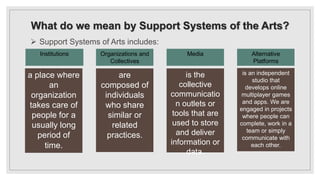
What do we mean by Support Systems of the Arts?
 Support Systems of Arts includes:
Institutions Organizations and
Collectives
Media Alternative
Platforms
a place where
an
organization
takes care of
people for a
usually long
period of
time.
are
composed of
individuals
who share
similar or
related
practices.
is the
collective
communicatio
n outlets or
tools that are
used to store
and deliver
information or
data.
is an independent
studio that
develops online
multiplayer games
and apps. We are
engaged in projects
where people can
complete, work in a
team or simply
communicate with
each other.
What are the different types of Institutions,
Organizations, and Platforms?
 Support Systems can be government-initiated, community or municipality-
based, privately supported, university-oriented, artist-run, or internet-based.
COLLECTIVES AND ARTIST ORGANIZATIONS
• are composed of individuals who share similar or related practices. They are committed to
experiment and develop their particular forms.
THE ANINO SHADOWPLAY COLLECTIVE AND THE SIPAT LAWIN ENSEMBLE
• are groups that challenge our concepts of theatre productions by mixing up performative
media and even trying out new modes of public engagement.
 Organizations can also emphasize their regional affiliation.
What are the different types of Institutions,
Organizations, and Platforms?
o Educational Institutions such as school and universities offer formal artistic training
and grant degrees upon completion of an academic program at the tertiary or post-
graduate level.
o Academy is an extensive training ground for artists, curators, scholar-critics, and
other practitioners in the arts.
 PHSA (Philippine High School for the Arts)
 Casa San Miguel
 PETA (Philippine Educational Theater Association)
 1970s
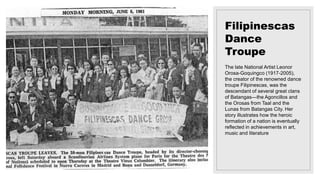
- A National Artist named Leonor Orosa Goquingco created the
Filipinescas Dance Troupe.
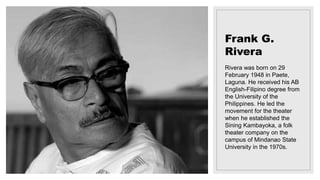
- Frank Rivera Frankformed the Sining Kambayoka Theater Group.
Philippine
High School
for Arts
The Philippine High School for the
Arts (PHSA) is a specialized public
high school in the Philippines offering
arts-focused education established in
1978 by virtue of Presidential Decree
1287.[2] An attached agency of the
Department of Education, it consults
with the Cultural Center of the
Philippines for policy and program
implementation of its arts program.
Aside from the Basic Education
curriculum prescribed by the
government, it offers various
specializations in the field of arts.
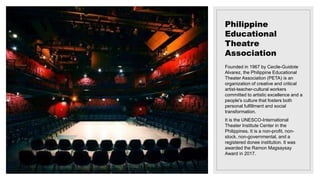
Philippine
Educational
Theatre
Association
Founded in 1967 by Cecile-Guidote
Alvarez, the Philippine Educational
Theater Association (PETA) is an
organization of creative and critical
artist-teacher-cultural workers
committed to artistic excellence and a
people's culture that fosters both
personal fulfillment and social
transformation.
It is the UNESCO-International
Theater Institute Center in the
Philippines. It is a non-profit, non-
stock, non-governmental, and a
registered donee institution. It was
awarded the Ramon Magsaysay
Award in 2017.
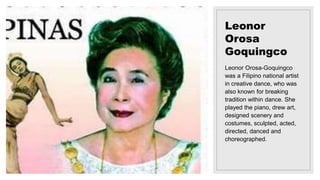
Leonor
Orosa
Goquingco
Leonor Orosa-Goquingco
was a Filipino national artist
in creative dance, who was
also known for breaking
tradition within dance. She
played the piano, drew art,
designed scenery and
costumes, sculpted, acted,
directed, danced and
choreographed.
Filipinescas
Dance
Troupe
The late National Artist Leonor
Orosa-Goquingco (1917-2005),
the creator of the renowned dance
troupe Filipinescas, was the
descendant of several great clans
of Batangas—the Agoncillos and
the Orosas from Taal and the
Lunas from Batangas City. Her
story illustrates how the heroic
formation of a nation is eventually
reflected in achievements in art,
music and literature
Frank G.
Rivera
Rivera was born on 29
February 1948 in Paete,
Laguna. He received his AB
English-Filipino degree from
the University of the
Philippines. He led the
movement for the theater
when he established the
Sining Kambayoka, a folk
theater company on the
campus of Mindanao State
University in the 1970s.
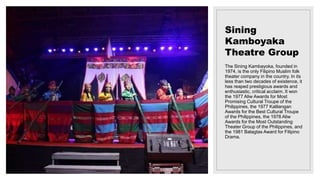
Sining
Kamboyaka
Theatre Group
The Sining Kambayoka, founded in
1974, is the only Filipino Muslim folk
theater company in the country. In its
less than two decades of existence, it
has reaped prestigious awards and
enthusiastic, critical acclaim. It won
the 1977 Aliw Awards for Most
Promising Cultural Troupe of the
Philippines, the 1977 Kalilangan
Awards for the Best Cultural Troupe
of the Philippines, the 1978 Aliw
Awards for the Most Outstanding
Theater Group of the Philippines, and
the 1981 Balagtas Award for Filipino
Drama.
What are the different types of Institutions,
Organizations, and Platforms?
 There are several provincial dance companies which still perform traditional
folk dances and compete regularly in folk dancing competitions.
 Kalilayan (old name of Tayabas, Quezon) Folkloric Dance Group
 The University of San Carlos Dance Troupe
 The Hiyas ng Maynilad Dance Troupe
 The Leyte Dance Theatre
 The University of the Philippines Filipiniana Dance Group
 The Lyceum of Batangas Folk Dance Company.
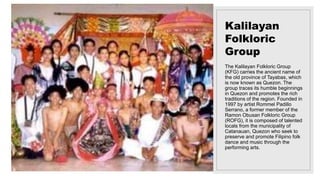
Kalilayan
Folkloric
Group
The Kalilayan Folkloric Group
(KFG) carries the ancient name of
the old province of Tayabas, which
is now known as Quezon. The
group traces its humble beginnings
in Quezon and promotes the rich
traditions of the region. Founded in
1997 by artist Rommel Padillo
Serrano, a former member of the
Ramon Obusan Folkloric Group
(ROFG), it is composed of talented
locals from the municipality of
Catanauan, Quezon who seek to
preserve and promote Filipino folk
dance and music through the
performing arts.
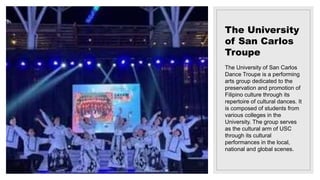
The University
of San Carlos
Troupe
The University of San Carlos
Dance Troupe is a performing
arts group dedicated to the
preservation and promotion of
Filipino culture through its
repertoire of cultural dances. It
is composed of students from
various colleges in the
University. The group serves
as the cultural arm of USC
through its cultural
performances in the local,
national and global scenes.
The Hiyas
Maynilad Dance
Group
The Hiyas ng Maynilad Dance Troupe is
the official and premiere cultural dance
company of the Pamantasan ng
Lungsod ng Maynila. The company,
consisting of student-performers under
the umbrella PLM President’s
Committee on Arts and Culture,[1] made
its debut performance during the
University’s anniversary celebration in
1982.[2] Since then, it has presented
dances in costumes that reflect the
traditional culture of the Philippines.
Together with the PLM Rondalla, the
company has also appeared as the
Hiyas ng Maynilad and Cultural Group.
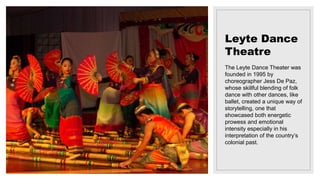
Leyte Dance
Theatre
The Leyte Dance Theater was
founded in 1995 by
choreographer Jess De Paz,
whose skillful blending of folk
dance with other dances, like
ballet, created a unique way of
storytelling, one that
showcased both energetic
prowess and emotional
intensity especially in his
interpretation of the country’s
colonial past.
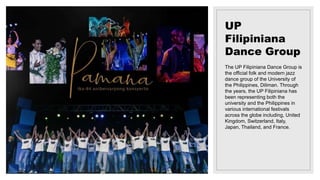
UP
Filipiniana
Dance Group
The UP Filipiniana Dance Group is
the official folk and modern jazz
dance group of the University of
the Philippines, Diliman. Through
the years, the UP Filipiniana has
been representing both the
university and the Philippines in
various international festivals
across the globe including, United
Kingdom, Switzerland, Italy,
Japan, Thailand, and France.
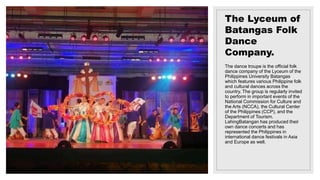
The Lyceum of
Batangas Folk
Dance
Company.
The dance troupe is the official folk
dance company of the Lyceum of the
Philippines University Batangas
which features various Philippine folk
and cultural dances across the
country. The group is regularly invited
to perform in important events of the
National Commission for Culture and
the Arts (NCCA), the Cultural Center
of the Philippines (CCP), and the
Department of Tourism.
LahingBatangan has produced their
own dance concerts and has
represented the Philippines in
international dance festivals in Asia
and Europe as well.
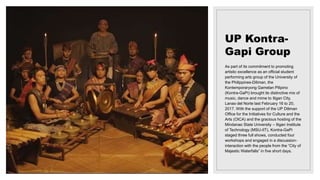
UP Kontra-
Gapi Group
As part of its commitment to promoting
artistic excellence as an official student
performing arts group of the University of
the Philippines-Diliman, the
Kontemporaryong Gamelan Pilipino
(Kontra-GaPi) brought its distinctive mix of
music, dance and mime to Iligan City,
Lanao del Norte last February 16 to 20,
2017. With the support of the UP Diliman
Office for the Initiatives for Culture and the
Arts (OICA) and the gracious hosting of the
Mindanao State University – Iligan Institute
of Technology (MSU-IIT), Kontra-GaPi
staged three full shows, conducted four
workshops and engaged in a discussion-
interaction with the people from the “City of
Majestic Waterfalls” in five short days.
What are the different types of Institutions,
Organizations, and Platforms?
MUSEUMS
• are traditionally based on a collection of objects.
• tasked to preserve heritage for the enjoyment and education of present and future generations,
museums are often linked to ideas of permanence and authority.
• a museum may be as large-scale as the National Museum, which houses an art gallery and
ethnographic collection in its main branch. Or it may also operate at a small-scale like
community museums that privilege memory and the local people’s pride of place.
Example:
The Museo San Ysidro de Pulilan in Bulacan
- founded by the town’s historical society comprising of young artists and cultural
workers.
What are the different types of Institutions,
Organizations, and Platforms?
NCCA (National Commission for Culture and the Arts
• provides the infrastructure for either wholly or partially government-funded projects on
Philippine art and culture.
• Sungdu-an
- is a Waray term which means “confluence”.
- is a national traveling exhibition funded by the National Commission for Culture and the Arts
(NCCA).
- It is the flagship project of the NCCA Committee on Visual Arts, featuring contemporary
works by visual artists from Mindanao, Visayas, Luzon, and National Capital Region (NCR).
What are the different types of Institutions,
Organizations, and Platforms?
CONTEMPORARY ART EXHIBITIONS
• need not be confined within the “white cube” environment of galleries and museums.
• It can take place in alternative spaces, or the outdoors, in public spaces within a limited period
of time.
• Alternative Space
- is an independent and/or artist-run initiative that deviates from rigid institutional models
where exhibition parameters are usually less flexible.
 Surrounded By Water
 Project Space Pilipinas (PSP)
What are the different types of Institutions,
Organizations, and Platforms?
FESTIVAL
• it is a mode of exhibition that is transitory and participatory.
• closely related to religion, ritual, culture, and tourism, the festival’s ebullience and significance
draw the multitude to publicly accessible and less intimidating spaces.
• Festival of contemporary art in some ways have appropriated the protocols of festivals in
order to link art more closely with everyday life.
> The Neo-Angono Public Art Festival
- its name comes from the artist collective that organizes the festival year after year just
before the official town fiesta.
PUBLIC ART FESTIVAL
• the buildings, the streets, and the waterways, are used as sites for exhibitions, performances,
film viewings, and other activities
What are the different types of Institutions,
Organizations, and Platforms?
 If museums are spaces of knowledge production, and galleries, of consumption, auction houses
and art fairs are places that specifically respond to the market. In this context, art is regarded as
a commodity and therefore potential property and investment.
GALLERIES
• provide representation for artists, exhibiting their works and transacting with patrons or “clients”
on their behalf.
ART FAIRS
• are short-term events where several galleries exhibit and sell art in one large venue, like a park,
or inside a mall or even a parking area converted into fairgrounds.

Contemporary L6.pptx

  • 1.
  • 2.
    What is SupportSystem of Arts? ◦ Support Systems can be government-initiated, community or municipality-based, privately supported, university-oriented, artist-run, or internet-based.Collectives and artist organizations are composed of individuals who share similar or related practices.
  • 3.
    What do wemean by Support Systems of the Arts?  Support Systems of Arts includes: Institutions Organizations and Collectives Media Alternative Platforms a place where an organization takes care of people for a usually long period of time. are composed of individuals who share similar or related practices. is the collective communicatio n outlets or tools that are used to store and deliver information or data. is an independent studio that develops online multiplayer games and apps. We are engaged in projects where people can complete, work in a team or simply communicate with each other.
  • 4.
    What are thedifferent types of Institutions, Organizations, and Platforms?  Support Systems can be government-initiated, community or municipality- based, privately supported, university-oriented, artist-run, or internet-based. COLLECTIVES AND ARTIST ORGANIZATIONS • are composed of individuals who share similar or related practices. They are committed to experiment and develop their particular forms. THE ANINO SHADOWPLAY COLLECTIVE AND THE SIPAT LAWIN ENSEMBLE • are groups that challenge our concepts of theatre productions by mixing up performative media and even trying out new modes of public engagement.  Organizations can also emphasize their regional affiliation.
  • 5.
    What are thedifferent types of Institutions, Organizations, and Platforms? o Educational Institutions such as school and universities offer formal artistic training and grant degrees upon completion of an academic program at the tertiary or post- graduate level. o Academy is an extensive training ground for artists, curators, scholar-critics, and other practitioners in the arts.  PHSA (Philippine High School for the Arts)  Casa San Miguel  PETA (Philippine Educational Theater Association)  1970s - A National Artist named Leonor Orosa Goquingco created the Filipinescas Dance Troupe. - Frank Rivera Frankformed the Sining Kambayoka Theater Group.
  • 6.
    Philippine High School for Arts ThePhilippine High School for the Arts (PHSA) is a specialized public high school in the Philippines offering arts-focused education established in 1978 by virtue of Presidential Decree 1287.[2] An attached agency of the Department of Education, it consults with the Cultural Center of the Philippines for policy and program implementation of its arts program. Aside from the Basic Education curriculum prescribed by the government, it offers various specializations in the field of arts.
  • 7.
    Philippine Educational Theatre Association Founded in 1967by Cecile-Guidote Alvarez, the Philippine Educational Theater Association (PETA) is an organization of creative and critical artist-teacher-cultural workers committed to artistic excellence and a people's culture that fosters both personal fulfillment and social transformation. It is the UNESCO-International Theater Institute Center in the Philippines. It is a non-profit, non- stock, non-governmental, and a registered donee institution. It was awarded the Ramon Magsaysay Award in 2017.
  • 8.
    Leonor Orosa Goquingco Leonor Orosa-Goquingco was aFilipino national artist in creative dance, who was also known for breaking tradition within dance. She played the piano, drew art, designed scenery and costumes, sculpted, acted, directed, danced and choreographed.
  • 9.
    Filipinescas Dance Troupe The late NationalArtist Leonor Orosa-Goquingco (1917-2005), the creator of the renowned dance troupe Filipinescas, was the descendant of several great clans of Batangas—the Agoncillos and the Orosas from Taal and the Lunas from Batangas City. Her story illustrates how the heroic formation of a nation is eventually reflected in achievements in art, music and literature
  • 10.
    Frank G. Rivera Rivera wasborn on 29 February 1948 in Paete, Laguna. He received his AB English-Filipino degree from the University of the Philippines. He led the movement for the theater when he established the Sining Kambayoka, a folk theater company on the campus of Mindanao State University in the 1970s.
  • 11.
    Sining Kamboyaka Theatre Group The SiningKambayoka, founded in 1974, is the only Filipino Muslim folk theater company in the country. In its less than two decades of existence, it has reaped prestigious awards and enthusiastic, critical acclaim. It won the 1977 Aliw Awards for Most Promising Cultural Troupe of the Philippines, the 1977 Kalilangan Awards for the Best Cultural Troupe of the Philippines, the 1978 Aliw Awards for the Most Outstanding Theater Group of the Philippines, and the 1981 Balagtas Award for Filipino Drama.
  • 12.
    What are thedifferent types of Institutions, Organizations, and Platforms?  There are several provincial dance companies which still perform traditional folk dances and compete regularly in folk dancing competitions.  Kalilayan (old name of Tayabas, Quezon) Folkloric Dance Group  The University of San Carlos Dance Troupe  The Hiyas ng Maynilad Dance Troupe  The Leyte Dance Theatre  The University of the Philippines Filipiniana Dance Group  The Lyceum of Batangas Folk Dance Company.
  • 13.
    Kalilayan Folkloric Group The Kalilayan FolkloricGroup (KFG) carries the ancient name of the old province of Tayabas, which is now known as Quezon. The group traces its humble beginnings in Quezon and promotes the rich traditions of the region. Founded in 1997 by artist Rommel Padillo Serrano, a former member of the Ramon Obusan Folkloric Group (ROFG), it is composed of talented locals from the municipality of Catanauan, Quezon who seek to preserve and promote Filipino folk dance and music through the performing arts.
  • 14.
    The University of SanCarlos Troupe The University of San Carlos Dance Troupe is a performing arts group dedicated to the preservation and promotion of Filipino culture through its repertoire of cultural dances. It is composed of students from various colleges in the University. The group serves as the cultural arm of USC through its cultural performances in the local, national and global scenes.
  • 15.
    The Hiyas Maynilad Dance Group TheHiyas ng Maynilad Dance Troupe is the official and premiere cultural dance company of the Pamantasan ng Lungsod ng Maynila. The company, consisting of student-performers under the umbrella PLM President’s Committee on Arts and Culture,[1] made its debut performance during the University’s anniversary celebration in 1982.[2] Since then, it has presented dances in costumes that reflect the traditional culture of the Philippines. Together with the PLM Rondalla, the company has also appeared as the Hiyas ng Maynilad and Cultural Group.
  • 16.
    Leyte Dance Theatre The LeyteDance Theater was founded in 1995 by choreographer Jess De Paz, whose skillful blending of folk dance with other dances, like ballet, created a unique way of storytelling, one that showcased both energetic prowess and emotional intensity especially in his interpretation of the country’s colonial past.
  • 17.
    UP Filipiniana Dance Group The UPFilipiniana Dance Group is the official folk and modern jazz dance group of the University of the Philippines, Diliman. Through the years, the UP Filipiniana has been representing both the university and the Philippines in various international festivals across the globe including, United Kingdom, Switzerland, Italy, Japan, Thailand, and France.
  • 18.
    The Lyceum of BatangasFolk Dance Company. The dance troupe is the official folk dance company of the Lyceum of the Philippines University Batangas which features various Philippine folk and cultural dances across the country. The group is regularly invited to perform in important events of the National Commission for Culture and the Arts (NCCA), the Cultural Center of the Philippines (CCP), and the Department of Tourism. LahingBatangan has produced their own dance concerts and has represented the Philippines in international dance festivals in Asia and Europe as well.
  • 19.
    UP Kontra- Gapi Group Aspart of its commitment to promoting artistic excellence as an official student performing arts group of the University of the Philippines-Diliman, the Kontemporaryong Gamelan Pilipino (Kontra-GaPi) brought its distinctive mix of music, dance and mime to Iligan City, Lanao del Norte last February 16 to 20, 2017. With the support of the UP Diliman Office for the Initiatives for Culture and the Arts (OICA) and the gracious hosting of the Mindanao State University – Iligan Institute of Technology (MSU-IIT), Kontra-GaPi staged three full shows, conducted four workshops and engaged in a discussion- interaction with the people from the “City of Majestic Waterfalls” in five short days.
  • 20.
    What are thedifferent types of Institutions, Organizations, and Platforms? MUSEUMS • are traditionally based on a collection of objects. • tasked to preserve heritage for the enjoyment and education of present and future generations, museums are often linked to ideas of permanence and authority. • a museum may be as large-scale as the National Museum, which houses an art gallery and ethnographic collection in its main branch. Or it may also operate at a small-scale like community museums that privilege memory and the local people’s pride of place. Example: The Museo San Ysidro de Pulilan in Bulacan - founded by the town’s historical society comprising of young artists and cultural workers.
  • 21.
    What are thedifferent types of Institutions, Organizations, and Platforms? NCCA (National Commission for Culture and the Arts • provides the infrastructure for either wholly or partially government-funded projects on Philippine art and culture. • Sungdu-an - is a Waray term which means “confluence”. - is a national traveling exhibition funded by the National Commission for Culture and the Arts (NCCA). - It is the flagship project of the NCCA Committee on Visual Arts, featuring contemporary works by visual artists from Mindanao, Visayas, Luzon, and National Capital Region (NCR).
  • 22.
    What are thedifferent types of Institutions, Organizations, and Platforms? CONTEMPORARY ART EXHIBITIONS • need not be confined within the “white cube” environment of galleries and museums. • It can take place in alternative spaces, or the outdoors, in public spaces within a limited period of time. • Alternative Space - is an independent and/or artist-run initiative that deviates from rigid institutional models where exhibition parameters are usually less flexible.  Surrounded By Water  Project Space Pilipinas (PSP)
  • 23.
    What are thedifferent types of Institutions, Organizations, and Platforms? FESTIVAL • it is a mode of exhibition that is transitory and participatory. • closely related to religion, ritual, culture, and tourism, the festival’s ebullience and significance draw the multitude to publicly accessible and less intimidating spaces. • Festival of contemporary art in some ways have appropriated the protocols of festivals in order to link art more closely with everyday life. > The Neo-Angono Public Art Festival - its name comes from the artist collective that organizes the festival year after year just before the official town fiesta. PUBLIC ART FESTIVAL • the buildings, the streets, and the waterways, are used as sites for exhibitions, performances, film viewings, and other activities
  • 24.
    What are thedifferent types of Institutions, Organizations, and Platforms?  If museums are spaces of knowledge production, and galleries, of consumption, auction houses and art fairs are places that specifically respond to the market. In this context, art is regarded as a commodity and therefore potential property and investment. GALLERIES • provide representation for artists, exhibiting their works and transacting with patrons or “clients” on their behalf. ART FAIRS • are short-term events where several galleries exhibit and sell art in one large venue, like a park, or inside a mall or even a parking area converted into fairgrounds.