Found in Lucban, Quezon; the
famous colorful most decorative
lanters of San Fernando,
Pampanga, and the noted
wood cravings in Paete,
Lagunan. They are just some
evidence that Filipinos are
talented and creative.
EMPTY BOTTLES AS
MATERIAL FOR ART
MAKING
 are arrowroot cookies that
have the image of St.
Nicholas molded on it ergo
the name Sanikulas. St.
Nicholas is also known as “
The Healer” from illnesses.
The wrapper was made out
the delicate Japanese paper.
The way to make it is so
delicate that only the ones
with skilled hands and perfect
control of their motor skills can
produce the best kind.
It is not an exclusive Pinoy art.
Paper Mache and
discouraging have been
around the centuries. In the
Philippines, the first recorded
or mention of a created
“Taka” was by a woman
named Maria Bangue in the
Taka making became more
popular during the American
colonization period when there
was an excess of news print, and
because Pinoy hates wasting
anything, the people of Paete
decided to create more Takas and
even diversified into different
animals, not just the traditional
horse.
 The art of embroiling is happily
alive and flourishing the towns.
Although its mostly done by the
women who are wives of the
farmers and fisherman, it is not
uncommon to see fisherman and
farmers are also carefully during
the “Off-Season”.
 It is the art of shaving bamboo into
artful creations that can be used as
decor for arches or the home. Skilled
craftsmen patiently shave off the
bamboo layer by layer, to create curls
and delicate twirls of their bamboo.
Ex. Designed bamboo arches for
fiestas, weddings, and other
celebrations that involve the entire
community.
 Was intended to create artful toys for
kids. However, puni can also be used
to create woven baskets, bags, and
even fans. The most common
presentation of Puni art is the “
Palaspas” we see every Holy Week.
1. Painting pottery
 Early Filipinos painting can be in red chip
(clay mixed with water) designs embelished
on the ritual pottery of the Philippines such
as the acclaimed “Manunggul Jar” which is
an example of a burial jar.
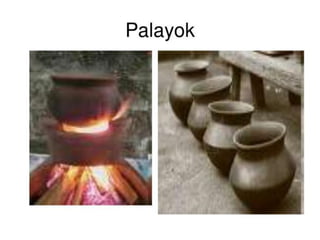
 Pottery began the making of earthenware
articles for domestic use as a cooking
vessels and storage container.
The pottery traditions of
Burnay is among the pottery
traditions that have
maintained.
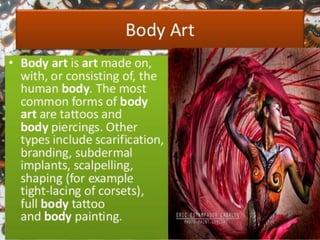
 painting is manifested in the tattoo
tradition of early Filipinos. Various designs
referring flora and facing with heavenly
bodies decorate their bodies various
colored pigmentation.
 ELITO CIRCA he is popularly known as
“Amang Pintor”, who gained recogntion
by using his hair to make his paint
brushes and reigns his painting with his
blood on the right side corner.
 The Itneg people are known for their
intricate woven fabrics. The “Binakol”,
which features designs that incorporate
optical illusions woven fabrics of the
“Gadang”, people usually bright red
tones.
 Other people such as Ilongot, make
jewelry from pearl, red hornbill beak,
plants and metals.
 The Lumad people of Mindanao such
as the ‘B’Lan”, “Mandaga”, and
“T’Boli” are skilled in the art of dying
abaca fiber.
 Abaca is a plant closely related to
bananas and its leaves are used to
make fiber known as “Manila Hemp”,
the fiber is dyed by a method called
“Ikat”.
 “Ikat fibers” are woven into cloth with
geometric patterns depicting human,
animal, and plant leaves.
 It is the most well-known design. The
figure represents a fowl with wings,
feathered tail and a head decorated
with ornmanents of scrolled and
painted motif of leaves, spirals and
feather-like forms. The wooden figure
usually perched atop a bamboo pole,
stands among decorative flags during
weddings and other festive occasions.
 A wooden chair of Ifugao, which
symbolizes his status as a citizen in their
community. It depicts the wealth and
power of the own who is called,
“Kadanagyan”, or a person who belongs
to the higher status in their society.
 This chair is made of narra or ipil-ipil and
the original design is called “Ginulding-
Gulding”, meaning like a goat-like head.
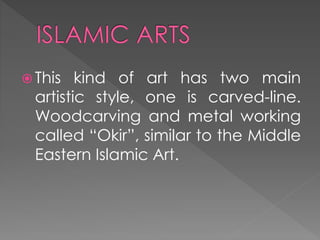
 This kind of art has two main
artistic style, one is carved-line.
Woodcarving and metal working
called “Okir”, similar to the Middle
Eastern Islamic Art.
 It is a technique combining Oriental and
European art process. Very few known
art pieces exist today.
 The techniques were practiced by the
indigenous people of Samar.
 It is an exotic Philippine art form based
on early century techniques ‘’Sgraffito”.
MUSIC
 The early music in the Philippines
featured a mixture of indigenous
Islamic and a variety of Asian sounds.
 Spanish settlers and Filipinos played a
variety of musical instruments,
including flutes, guitar, ukelele, violin,
trumphs and drums.
Modern day Philippines
music featured several
styles. Most music genres
are contemporary such as
Filipino rock, Filipino hip-
hop, and another musical
style.
Philippine folk dances include
the “Tinikling” and “Cariñosa”.
In the southern region of
Mindanao, some is a popular
dance showcasing the story of
prince and a princess in the
forest.
Spaniards introduced stones as
housing and building materials. In
the past, the Nipa hut (Bahay-
kubo) was the most common form
of housing among the native
Filipinos.
It is characterized by the us eof
simple materials such as Bamboo
and coconut as the main source
Contemporary architecture
has a distinctively Western
style although Pre-hispanic
housing is still common in
rural areas.
American style suburban
gated communities are
popular in the cities,
including Manila and the
surrounding provinces.
Islamic and often
Asian architecture are
depicted of building
such as Mosque and
Temples.
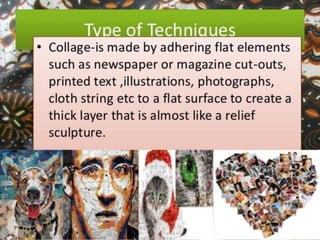
It include magazines and
newspaper clippings, ribbons,
paints, bits of colored or
handmade papers, portions of
other artwork or texts,
photographs and other found
objects, glued to a piece of
paper or canvas.
It is an art form that is created
in nature, using natural
materials such as soil, rock,
organic media and water
which introduced materials
such as concrete, metal,
asphalt or mineral pigments.
 Opposite of collage, instead of
an image is being built up all or
parts of existing image, it is
created by cutting, treating away
or otherwise removing pieces of
an original image.
 The French world “Decollage” in
English means “Take-Off” or “To
become unglued” or “To become

CONTEMPORARY ART TECHNIQUES AND PERFORMANCE222.pdf

  • 2.
    Found in Lucban,Quezon; the famous colorful most decorative lanters of San Fernando, Pampanga, and the noted wood cravings in Paete, Lagunan. They are just some evidence that Filipinos are talented and creative.
  • 3.
  • 4.
     are arrowrootcookies that have the image of St. Nicholas molded on it ergo the name Sanikulas. St. Nicholas is also known as “ The Healer” from illnesses.
  • 5.
    The wrapper wasmade out the delicate Japanese paper. The way to make it is so delicate that only the ones with skilled hands and perfect control of their motor skills can produce the best kind.
  • 6.
    It is notan exclusive Pinoy art. Paper Mache and discouraging have been around the centuries. In the Philippines, the first recorded or mention of a created “Taka” was by a woman named Maria Bangue in the
  • 7.
    Taka making becamemore popular during the American colonization period when there was an excess of news print, and because Pinoy hates wasting anything, the people of Paete decided to create more Takas and even diversified into different animals, not just the traditional horse.
  • 8.
     The artof embroiling is happily alive and flourishing the towns. Although its mostly done by the women who are wives of the farmers and fisherman, it is not uncommon to see fisherman and farmers are also carefully during the “Off-Season”.
  • 9.
     It isthe art of shaving bamboo into artful creations that can be used as decor for arches or the home. Skilled craftsmen patiently shave off the bamboo layer by layer, to create curls and delicate twirls of their bamboo. Ex. Designed bamboo arches for fiestas, weddings, and other celebrations that involve the entire community.
  • 10.
     Was intendedto create artful toys for kids. However, puni can also be used to create woven baskets, bags, and even fans. The most common presentation of Puni art is the “ Palaspas” we see every Holy Week.
  • 11.
    1. Painting pottery Early Filipinos painting can be in red chip (clay mixed with water) designs embelished on the ritual pottery of the Philippines such as the acclaimed “Manunggul Jar” which is an example of a burial jar.  Pottery began the making of earthenware articles for domestic use as a cooking vessels and storage container.
  • 12.
    The pottery traditionsof Burnay is among the pottery traditions that have maintained.
  • 13.
     painting ismanifested in the tattoo tradition of early Filipinos. Various designs referring flora and facing with heavenly bodies decorate their bodies various colored pigmentation.  ELITO CIRCA he is popularly known as “Amang Pintor”, who gained recogntion by using his hair to make his paint brushes and reigns his painting with his blood on the right side corner.
  • 14.
     The Itnegpeople are known for their intricate woven fabrics. The “Binakol”, which features designs that incorporate optical illusions woven fabrics of the “Gadang”, people usually bright red tones.  Other people such as Ilongot, make jewelry from pearl, red hornbill beak, plants and metals.
  • 15.
     The Lumadpeople of Mindanao such as the ‘B’Lan”, “Mandaga”, and “T’Boli” are skilled in the art of dying abaca fiber.  Abaca is a plant closely related to bananas and its leaves are used to make fiber known as “Manila Hemp”, the fiber is dyed by a method called “Ikat”.  “Ikat fibers” are woven into cloth with geometric patterns depicting human, animal, and plant leaves.
  • 16.
     It isthe most well-known design. The figure represents a fowl with wings, feathered tail and a head decorated with ornmanents of scrolled and painted motif of leaves, spirals and feather-like forms. The wooden figure usually perched atop a bamboo pole, stands among decorative flags during weddings and other festive occasions.
  • 17.
     A woodenchair of Ifugao, which symbolizes his status as a citizen in their community. It depicts the wealth and power of the own who is called, “Kadanagyan”, or a person who belongs to the higher status in their society.  This chair is made of narra or ipil-ipil and the original design is called “Ginulding- Gulding”, meaning like a goat-like head.
  • 18.
     This kindof art has two main artistic style, one is carved-line. Woodcarving and metal working called “Okir”, similar to the Middle Eastern Islamic Art.
  • 21.
     It isa technique combining Oriental and European art process. Very few known art pieces exist today.  The techniques were practiced by the indigenous people of Samar.  It is an exotic Philippine art form based on early century techniques ‘’Sgraffito”.
  • 22.
    MUSIC  The earlymusic in the Philippines featured a mixture of indigenous Islamic and a variety of Asian sounds.  Spanish settlers and Filipinos played a variety of musical instruments, including flutes, guitar, ukelele, violin, trumphs and drums.
  • 23.
    Modern day Philippines musicfeatured several styles. Most music genres are contemporary such as Filipino rock, Filipino hip- hop, and another musical style.
  • 24.
    Philippine folk dancesinclude the “Tinikling” and “Cariñosa”. In the southern region of Mindanao, some is a popular dance showcasing the story of prince and a princess in the forest.
  • 25.
    Spaniards introduced stonesas housing and building materials. In the past, the Nipa hut (Bahay- kubo) was the most common form of housing among the native Filipinos. It is characterized by the us eof simple materials such as Bamboo and coconut as the main source
  • 26.
    Contemporary architecture has adistinctively Western style although Pre-hispanic housing is still common in rural areas. American style suburban gated communities are popular in the cities, including Manila and the surrounding provinces.
  • 27.
    Islamic and often Asianarchitecture are depicted of building such as Mosque and Temples.
  • 29.
    It include magazinesand newspaper clippings, ribbons, paints, bits of colored or handmade papers, portions of other artwork or texts, photographs and other found objects, glued to a piece of paper or canvas.
  • 35.
    It is anart form that is created in nature, using natural materials such as soil, rock, organic media and water which introduced materials such as concrete, metal, asphalt or mineral pigments.
  • 36.
     Opposite ofcollage, instead of an image is being built up all or parts of existing image, it is created by cutting, treating away or otherwise removing pieces of an original image.  The French world “Decollage” in English means “Take-Off” or “To become unglued” or “To become