Contamination control –
Product and Facility
point of view
Content
2
I. Contamination
II. Consequences of Contamination
III. Regulatory perspective
Overview- Possible ways of contamination and its preventions
1- Contamination through Airborne with examples
2- Contamination through Mechanical transfer with examples
3- Contamination through retention with examples
4- Contamination through Mix up with examples
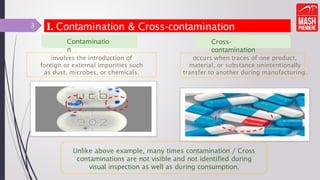
I. Contamination & Cross-contamination
Contaminatio
n
Cross-
contamination
involves the introduction of
foreign or external impurities such
as dust, microbes, or chemicals.
occurs when traces of one product,
material, or substance unintentionally
transfer to another during manufacturing.
Unlike above example, many times contamination / Cross
contaminations are not visible and not identified during
visual inspection as well as during consumption.
3
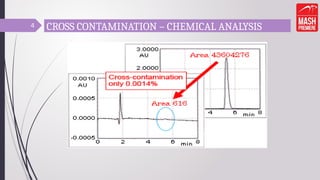
CROSS CONTAMINATION – CHEMICAL ANALYSIS
4
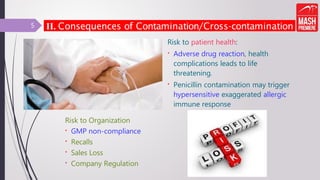
II. Consequences of Contamination/Cross-contamination
Risk to patient health:
• Adverse drug reaction, health
complications leads to life
threatening.
• Penicillin contamination may trigger
hypersensitive exaggerated allergic
immune response
Risk to Organization
• GMP non-compliance
• Recalls
• Sales Loss
• Company Regulation
5
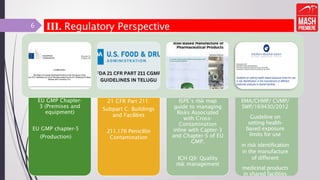
III. Regulatory Perspective
EU GMP Chapter-
3 (Premises and
equipment)
EU GMP chapter-5
(Production)
21 CFR Part 211:
Subpart C: Buildings
and Facilities
211.176 Penicillin
Contamination
ISPE’s risk map
guide to managing
Risks Associated
with Cross-
Contamination
inline with Capter-3
and Chapter-5 of EU
GMP.
ICH Q9: Quality
risk management
6
EMA/CHMP/ CVMP/
SWP/169430/2012
Guideline on
setting health-
based exposure
limits for use
in risk identification
in the manufacture
of different
medicinal products
in shared facilities
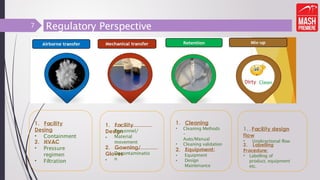
Regulatory Perspective
1. Facility
Desing
• Containment
2. HVAC
• Pressure
regimen
• Filtration
1. Facility
Design
•
Personnel/
Material
movement
2. Gowning/
Gloves
•
Decontaminatio
n
1. Cleaning
• Cleaning Methods
–
Auto/Manual
• Cleaning validation
2. Equipment:
•
•
Equipment
Design
Maintenance
1. Facility design
flow
• Unidirectional flow
7
2. Labelling
Procedure:
• Labelling of
product, equipment
etc.
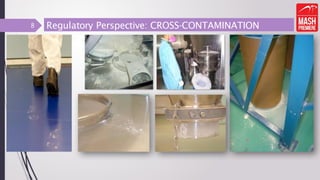
Regulatory Perspective: CROSS-CONTAMINATION
8
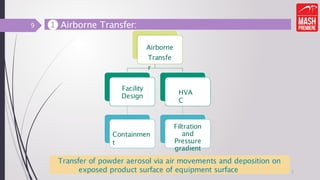
❶ Airborne Transfer:
7
Airborne
Transfe
r
Facility
Design
Containmen
t
HVA
C
Filtration
and
Pressure
gradient
Transfer of powder aerosol via air movements and deposition on
exposed product surface of equipment surface
9
WHY ALL THE CONCERN ABOUT DUST?
10
10
Typical size relationship between dust, bacteria and viruses
Virus
(0,006µm to 0,03µm)
Dust Particle
(0,5µm to 500µm)
Bacteria
(0,2µm to 2µm)
Dust Is a Bacteria Carrier
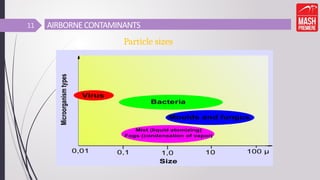
AIRBORNECONTAMINANTS
11
Particle sizes
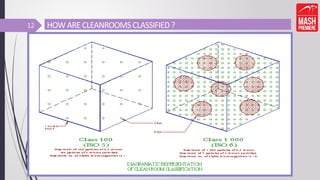
HOWARECLEANROOMSCLASSIFIED?
12
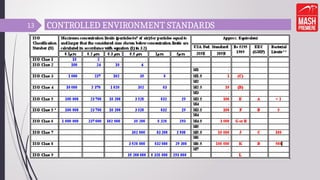
CONTROLLED ENVIRONMENT STANDARDS
13
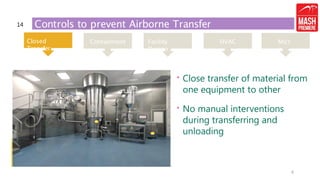
Controls to prevent Airborne Transfer
• Close transfer of material from
one equipment to other
• No manual interventions
during transferring and
unloading
8
Closed
Transfer
Containment Micr
o
HVAC
Facility
Design
14
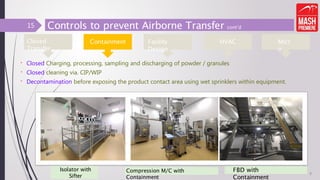
Controls to prevent Airborne Transfer cont’d
• Closed Charging, processing, sampling and discharging of powder / granules
• Closed cleaning via. CIP/WIP
• Decontamination before exposing the product contact area using wet sprinklers within equipment.
Closed
Transfer
Containment Micr
o
HVAC
Facility
Design
Isolator with
Sifter
Compression M/C with
Containment
FBD with
Containment
9
15
Controls to prevent Airborne Transfer cont’d
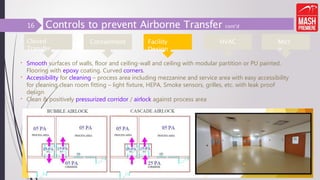
• Smooth surfaces of walls, floor and ceiling-wall and ceiling with modular partition or PU painted.
Flooring with epoxy coating. Curved corners.
• Accessibility for cleaning – process area including mezzanine and service area with easy accessibility
for cleaning clean room fitting – light fixture, HEPA, Smoke sensors, grilles, etc. with leak proof
design
• Clean & positively pressurized corridor / airlock against process area
10
Closed
Transfer
Containment Micr
o
HVAC
Facility
Design
16
Controls to prevent Airborne Transfer cont’d
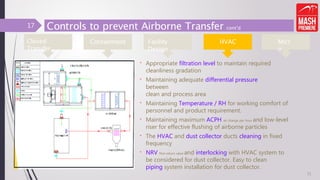
• Appropriate filtration level to maintain required
cleanliness gradation
• Maintaining adequate differential pressure
between
clean and process area
• Maintaining Temperature / RH for working comfort of
personnel and product requirement.
• Maintaining maximum ACPH air change per hour and low-level
riser for effective flushing of airborne particles
• The HVAC and dust collector ducts cleaning in fixed
frequency
• NRV Non return value and interlocking with HVAC system to
be considered for dust collector. Easy to clean
piping system installation for dust collector.
Closed
Transfer
Containment Micr
o
HVAC
Facility
Design
11
17
Controls to prevent Airborne Transfer cont’d
Closed
Transfer
Containment Micr
o
HVAC
Facility
Design
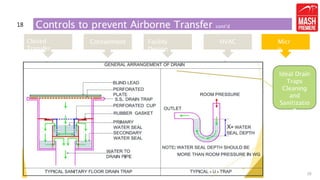
Ideal Drain
Traps
Cleaning
and
Sanitizatio
n
18
18
Controls to prevent Airborne Transfer cont’d
• Tanks should be pressurized with filtered
compressed air which is controlled through PLC
after SIP.
• PLC is tested and validated for intended control
logic.
• Equipment consist of below safety for prevention
of contamination
• Barrier filter
• Non Return Valve (NRV)
• Slow cooling with Filtered compressed air
Closed
Transfer
Containment Micr
o
HVAC
Facility
Design
19
19
❷ Mechanical transfer :
Mechanica
l
Transfer
14
Gowning
Decontaminatio
n
Facility Design
Personnel/
Material
Movement
20
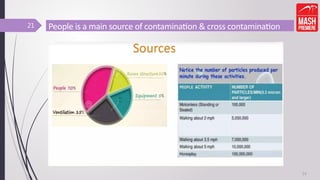
People is a main source of contamination & cross contamination
14
21
Mechanical transfer: Causes and controls
Proces
s flow
Unidirectiona
l process
flow
MAL and
PAL
Dirty
equipmen
thandlin
g
Procedure for
decontamination
and
covering/wrapping
of
equipment/parts
during transfer
from one area to
other area/wash
area.
Mist
showers
Gowning
and De-
gowning
Procedure
for de-
gowning,
removal of
gloves and
other gowns
before leaving
the area.
15
22
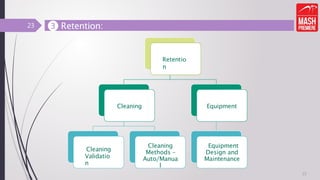
❸ Retention:
Retentio
n
Cleaning
Cleaning
Validatio
n
Cleaning
Methods –
Auto/Manua
l
Equipment
Equipment
Design and
Maintenance
23
23
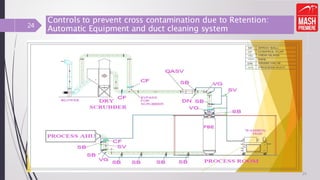
Controls to prevent cross contamination due to Retention:
Automatic Equipment and duct cleaning system
24
24
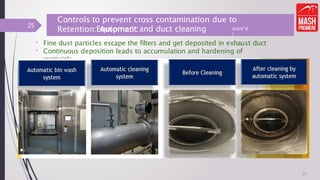
Controls to prevent cross contamination due to
Retention: Automatic
Equipment and duct cleaning
system
(cont’d
)
• Fine dust particles escape the filters and get deposited in exhaust duct
• Continuous deposition leads to accumulation and hardening of
materials.
25
25
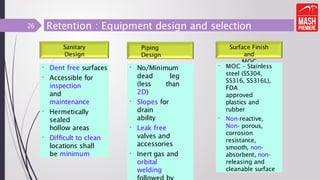
Retention : Equipment design and selection
Sanitary
Design
• Dent free surfaces
• Accessible for
inspection
and
maintenance
• Hermetically
sealed
hollow areas
• Difficult to clean
locations shall
be minimum
Piping
Design
Surface Finish
and
MOC
26
• No/Minimum
dead leg
(less than
2D)
• Slopes for
drain
ability
• Leak free
valves and
accessories
• Inert gas and
orbital
welding
• MOC – Stainless
steel (SS304,
SS316, SS316L),
FDA
approved
plastics and
rubber
• Non-reactive,
Non- porous,
corrosion
resistance,
smooth, non-
absorbent, non-
releasing and
cleanable surface
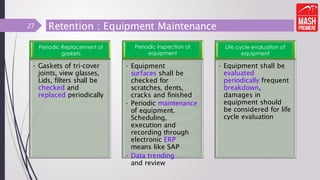
Retention : Equipment Maintenance
Periodic replacement
of
gaskets
• Gaskets of tri-cover
joints, view glasses,
Lids, filters shall be
checked and
replaced periodically
Periodic inspection
of
equipment
• Equipment
surfaces shall be
checked for
scratches, dents,
cracks and finished
• Periodic maintenance
of equipment.
Scheduling,
execution and
recording through
electronic ERP
means like SAP
• Data trending
and review
Life cycle evaluation
of
equipment
• Equipment shall be
evaluated
periodically frequent
breakdown,
damages in
equipment should
be considered for life
cycle evaluation
27
Periodic Replacement of
gaskets
Periodic inspection of
equipment
Life cycle evaluation of
equipment
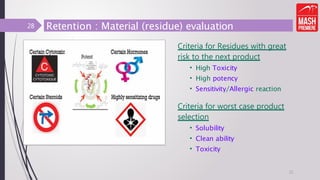
Retention : Material (residue) evaluation
Criteria for Residues with great
risk to the next product
• High Toxicity
• High potency
• Sensitivity/Allergic reaction
Criteria for worst case product
selection
• Solubility
• Clean ability
• Toxicity
21
28
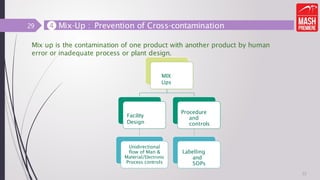
❹ Mix-Up : Prevention of Cross-contamination
22
MIX
Ups
Facility
Design
Unidirectional
flow of Man &
Material/Electronic
Process controls
Procedure
and
controls
Labelling
and
SOPs
Mix up is the contamination of one product with another product by human
error or inadequate process or plant design.
29
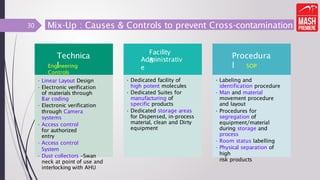
Mix-Up : Causes & Controls to prevent Cross-contamination
Technica
l
Engineering
Controls
• Linear Layout Design
• Electronic verification
of materials through
Bar coding
• Electronic verification
through Camera
systems
• Access control
for authorized
entry
• Access control
System
• Dust collectors –Swan
neck at point of use and
interlocking with AHU
Facility
&
Administrativ
e
Dedicated
Facility
• Dedicated facility of
high potent molecules
• Dedicated Suites for
manufacturing of
specific products
• Dedicated storage areas
for Dispensed, in-process
material, clean and Dirty
equipment
Procedura
l SOP
• Labeling and
identification procedure
• Man and material
movement procedure
and layout
• Procedures for
segregation of
equipment/material
during storage and
process
• Room status labelling
• Physical separation of
high
risk products
30
Consequences of Cross-contamination
31
• Penicillin can be a sensitizing agent that triggers a hypersensitive exaggerated
allergic immune response in some people. Differences in the 6-aminopenicillanic acid
side chain can generate allergic reactions ranging from skin rashes to life-
threatening anaphylaxis.
• All penicillin finished pharmaceutical manufacturers, including re-packers, are
required by the CGMP regulations to establish a comprehensive control strategy
designed to prevent cross-contamination of other drugs with penicillin.
• These requirements include:
21 CFR 211.42(d) : Separation of facility and equipment
21 CFR 211.46 (d) : Separate air handling systems (HVAC)
21 CFR 211.176: Test for traces of penicillin where possible exposure exists
Non-Penicillin Beta-Lactam Drugs: A CGMP Framework for Preventing Cross-Contamination,
2022
QRM for prevention of cross contamination
32
• Product profile review of products manufactured in shared
facility
• High risk products
• High vulnerability products
• Potent products
• Current containment approach review
• Process flows
• Equipment / room matrix
• HVAC evaluation (AHU matrix)
• Required Primary/minimum Controls (FMEA)
• Challenging controls for 4 probable pathways of cross
contamination
QRM for prevention of cross contamination cont’d
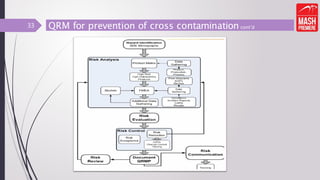
33
QRM for prevention of cross contamination cont’d
Review the risk profile:
• Change / Modification in the Facility & HVAC design.
• Change / Modification in equipment or utilities catering
the process area
• Change / Modification in Limit for pressure differential in
process area
• Change in procedure
• Introduction of new Equipment / HVAC / New
manufacturing process
•
34
35

Contamination & Cross contamination Mash.pptx

  • 1.
    Contamination control – Productand Facility point of view
  • 2.
    Content 2 I. Contamination II. Consequencesof Contamination III. Regulatory perspective Overview- Possible ways of contamination and its preventions 1- Contamination through Airborne with examples 2- Contamination through Mechanical transfer with examples 3- Contamination through retention with examples 4- Contamination through Mix up with examples
  • 3.
    I. Contamination &Cross-contamination Contaminatio n Cross- contamination involves the introduction of foreign or external impurities such as dust, microbes, or chemicals. occurs when traces of one product, material, or substance unintentionally transfer to another during manufacturing. Unlike above example, many times contamination / Cross contaminations are not visible and not identified during visual inspection as well as during consumption. 3
  • 4.
    CROSS CONTAMINATION –CHEMICAL ANALYSIS 4
  • 5.
    II. Consequences ofContamination/Cross-contamination Risk to patient health: • Adverse drug reaction, health complications leads to life threatening. • Penicillin contamination may trigger hypersensitive exaggerated allergic immune response Risk to Organization • GMP non-compliance • Recalls • Sales Loss • Company Regulation 5
  • 6.
    III. Regulatory Perspective EUGMP Chapter- 3 (Premises and equipment) EU GMP chapter-5 (Production) 21 CFR Part 211: Subpart C: Buildings and Facilities 211.176 Penicillin Contamination ISPE’s risk map guide to managing Risks Associated with Cross- Contamination inline with Capter-3 and Chapter-5 of EU GMP. ICH Q9: Quality risk management 6 EMA/CHMP/ CVMP/ SWP/169430/2012 Guideline on setting health- based exposure limits for use in risk identification in the manufacture of different medicinal products in shared facilities
  • 7.
    Regulatory Perspective 1. Facility Desing •Containment 2. HVAC • Pressure regimen • Filtration 1. Facility Design • Personnel/ Material movement 2. Gowning/ Gloves • Decontaminatio n 1. Cleaning • Cleaning Methods – Auto/Manual • Cleaning validation 2. Equipment: • • Equipment Design Maintenance 1. Facility design flow • Unidirectional flow 7 2. Labelling Procedure: • Labelling of product, equipment etc.
  • 8.
  • 9.
    ❶ Airborne Transfer: 7 Airborne Transfe r Facility Design Containmen t HVA C Filtration and Pressure gradient Transferof powder aerosol via air movements and deposition on exposed product surface of equipment surface 9
  • 10.
    WHY ALL THECONCERN ABOUT DUST? 10 10 Typical size relationship between dust, bacteria and viruses Virus (0,006µm to 0,03µm) Dust Particle (0,5µm to 500µm) Bacteria (0,2µm to 2µm) Dust Is a Bacteria Carrier
  • 11.
  • 12.
  • 13.
  • 14.
    Controls to preventAirborne Transfer • Close transfer of material from one equipment to other • No manual interventions during transferring and unloading 8 Closed Transfer Containment Micr o HVAC Facility Design 14
  • 15.
    Controls to preventAirborne Transfer cont’d • Closed Charging, processing, sampling and discharging of powder / granules • Closed cleaning via. CIP/WIP • Decontamination before exposing the product contact area using wet sprinklers within equipment. Closed Transfer Containment Micr o HVAC Facility Design Isolator with Sifter Compression M/C with Containment FBD with Containment 9 15
  • 16.
    Controls to preventAirborne Transfer cont’d • Smooth surfaces of walls, floor and ceiling-wall and ceiling with modular partition or PU painted. Flooring with epoxy coating. Curved corners. • Accessibility for cleaning – process area including mezzanine and service area with easy accessibility for cleaning clean room fitting – light fixture, HEPA, Smoke sensors, grilles, etc. with leak proof design • Clean & positively pressurized corridor / airlock against process area 10 Closed Transfer Containment Micr o HVAC Facility Design 16
  • 17.
    Controls to preventAirborne Transfer cont’d • Appropriate filtration level to maintain required cleanliness gradation • Maintaining adequate differential pressure between clean and process area • Maintaining Temperature / RH for working comfort of personnel and product requirement. • Maintaining maximum ACPH air change per hour and low-level riser for effective flushing of airborne particles • The HVAC and dust collector ducts cleaning in fixed frequency • NRV Non return value and interlocking with HVAC system to be considered for dust collector. Easy to clean piping system installation for dust collector. Closed Transfer Containment Micr o HVAC Facility Design 11 17
  • 18.
    Controls to preventAirborne Transfer cont’d Closed Transfer Containment Micr o HVAC Facility Design Ideal Drain Traps Cleaning and Sanitizatio n 18 18
  • 19.
    Controls to preventAirborne Transfer cont’d • Tanks should be pressurized with filtered compressed air which is controlled through PLC after SIP. • PLC is tested and validated for intended control logic. • Equipment consist of below safety for prevention of contamination • Barrier filter • Non Return Valve (NRV) • Slow cooling with Filtered compressed air Closed Transfer Containment Micr o HVAC Facility Design 19 19
  • 20.
    ❷ Mechanical transfer: Mechanica l Transfer 14 Gowning Decontaminatio n Facility Design Personnel/ Material Movement 20
  • 21.
    People is amain source of contamination & cross contamination 14 21
  • 22.
    Mechanical transfer: Causesand controls Proces s flow Unidirectiona l process flow MAL and PAL Dirty equipmen thandlin g Procedure for decontamination and covering/wrapping of equipment/parts during transfer from one area to other area/wash area. Mist showers Gowning and De- gowning Procedure for de- gowning, removal of gloves and other gowns before leaving the area. 15 22
  • 23.
  • 24.
    Controls to preventcross contamination due to Retention: Automatic Equipment and duct cleaning system 24 24
  • 25.
    Controls to preventcross contamination due to Retention: Automatic Equipment and duct cleaning system (cont’d ) • Fine dust particles escape the filters and get deposited in exhaust duct • Continuous deposition leads to accumulation and hardening of materials. 25 25
  • 26.
    Retention : Equipmentdesign and selection Sanitary Design • Dent free surfaces • Accessible for inspection and maintenance • Hermetically sealed hollow areas • Difficult to clean locations shall be minimum Piping Design Surface Finish and MOC 26 • No/Minimum dead leg (less than 2D) • Slopes for drain ability • Leak free valves and accessories • Inert gas and orbital welding • MOC – Stainless steel (SS304, SS316, SS316L), FDA approved plastics and rubber • Non-reactive, Non- porous, corrosion resistance, smooth, non- absorbent, non- releasing and cleanable surface
  • 27.
    Retention : EquipmentMaintenance Periodic replacement of gaskets • Gaskets of tri-cover joints, view glasses, Lids, filters shall be checked and replaced periodically Periodic inspection of equipment • Equipment surfaces shall be checked for scratches, dents, cracks and finished • Periodic maintenance of equipment. Scheduling, execution and recording through electronic ERP means like SAP • Data trending and review Life cycle evaluation of equipment • Equipment shall be evaluated periodically frequent breakdown, damages in equipment should be considered for life cycle evaluation 27 Periodic Replacement of gaskets Periodic inspection of equipment Life cycle evaluation of equipment
  • 28.
    Retention : Material(residue) evaluation Criteria for Residues with great risk to the next product • High Toxicity • High potency • Sensitivity/Allergic reaction Criteria for worst case product selection • Solubility • Clean ability • Toxicity 21 28
  • 29.
    ❹ Mix-Up :Prevention of Cross-contamination 22 MIX Ups Facility Design Unidirectional flow of Man & Material/Electronic Process controls Procedure and controls Labelling and SOPs Mix up is the contamination of one product with another product by human error or inadequate process or plant design. 29
  • 30.
    Mix-Up : Causes& Controls to prevent Cross-contamination Technica l Engineering Controls • Linear Layout Design • Electronic verification of materials through Bar coding • Electronic verification through Camera systems • Access control for authorized entry • Access control System • Dust collectors –Swan neck at point of use and interlocking with AHU Facility & Administrativ e Dedicated Facility • Dedicated facility of high potent molecules • Dedicated Suites for manufacturing of specific products • Dedicated storage areas for Dispensed, in-process material, clean and Dirty equipment Procedura l SOP • Labeling and identification procedure • Man and material movement procedure and layout • Procedures for segregation of equipment/material during storage and process • Room status labelling • Physical separation of high risk products 30
  • 31.
    Consequences of Cross-contamination 31 •Penicillin can be a sensitizing agent that triggers a hypersensitive exaggerated allergic immune response in some people. Differences in the 6-aminopenicillanic acid side chain can generate allergic reactions ranging from skin rashes to life- threatening anaphylaxis. • All penicillin finished pharmaceutical manufacturers, including re-packers, are required by the CGMP regulations to establish a comprehensive control strategy designed to prevent cross-contamination of other drugs with penicillin. • These requirements include: 21 CFR 211.42(d) : Separation of facility and equipment 21 CFR 211.46 (d) : Separate air handling systems (HVAC) 21 CFR 211.176: Test for traces of penicillin where possible exposure exists Non-Penicillin Beta-Lactam Drugs: A CGMP Framework for Preventing Cross-Contamination, 2022
  • 32.
    QRM for preventionof cross contamination 32 • Product profile review of products manufactured in shared facility • High risk products • High vulnerability products • Potent products • Current containment approach review • Process flows • Equipment / room matrix • HVAC evaluation (AHU matrix) • Required Primary/minimum Controls (FMEA) • Challenging controls for 4 probable pathways of cross contamination
  • 33.
    QRM for preventionof cross contamination cont’d 33
  • 34.
    QRM for preventionof cross contamination cont’d Review the risk profile: • Change / Modification in the Facility & HVAC design. • Change / Modification in equipment or utilities catering the process area • Change / Modification in Limit for pressure differential in process area • Change in procedure • Introduction of new Equipment / HVAC / New manufacturing process • 34
  • 35.