Banco de dados em Containers
Fernando IkePGConf.Brasil 2018
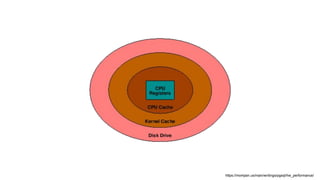
Cache/Buffer
Cache
An auxiliary memory from which high-speed retrieval is possible.
https://en.oxforddictionaries.com/definition/cache
Buffer
A temporary memory area in which data is stored while it is being processed or
transferred, especially one used while streaming video or downloading audio.
https://en.oxforddictionaries.com/definition/buffer
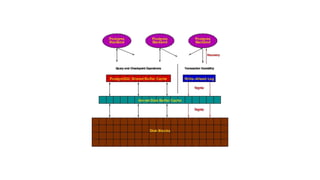
https://momjian.us/main/writings/pgsql/hw_performance/
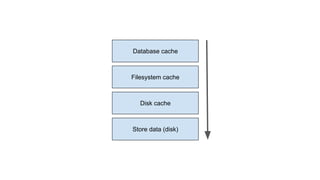
Database cache
Filesystem cache
Disk cache
Store data (disk)
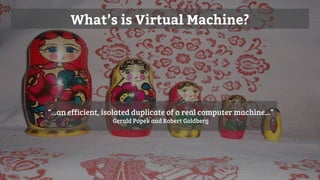
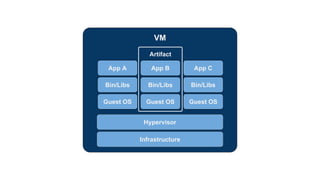
What’s is Virtual Machine?
“...an efficient, isolated duplicate of a real computer machine...”
Gerald Popek and Robert Goldberg
VM
Infrastructure
Hypervisor
App A
Artifact
Bin/Libs
App B
Bin/Libs
App C
Bin/Libs
Guest OS Guest OS Guest OS
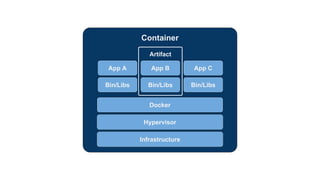
What’s container?
Container is a type of virtualization, more common call
“operating-system-level virtualization”
Container
Infrastructure
Hypervisor
Docker
App A
Artifact
Bin/Libs
App B
Bin/Libs
App C
Bin/Libs
Ephemera
Ephemera (singular: ephemeron) are any
transitory written or printed matter not meant to
be retained or preserved
Stateless application
Applications don’t need to store anything in a persistent disk. Data
application are storage in other part of architecture system
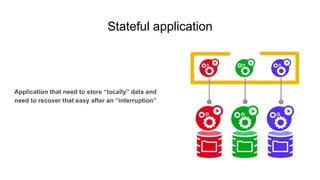
Stateful application
Application that need to store “locally” data and
need to recover that easy after an “interruption”
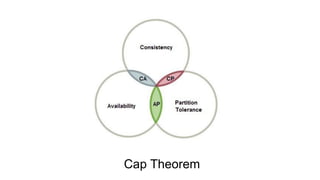
Cap Theorem
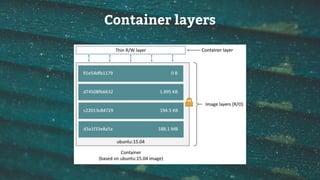
Union filesystem
It allows files and directories of separate file systems, known
as branches, to be transparently overlaid, forming a single
coherent file system.
Container layers
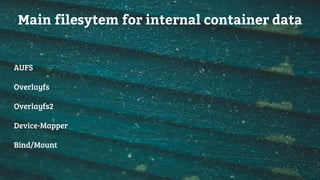
Main filesytem for internal container data
AUFS
Overlayfs
Overlayfs2
Device-Mapper
Bind/Mount
Databases operation
Plan what type of workload to use
Maintain, organize and “improve” dataset together application
Install security fix releases
Archive “old” data (sanitize)
Upgrade Database version
Tuning OS, Database and Application
What’s means in OS
handle...
sysctl
/proc
/sys
limits
overcommit
What’s means in the PostgreSQL
Shared Buffers
WAL
Max_connections
Effective_cache_size
Checkpoint_segments
Random_page_cost
Container Volumes
They are a mechanism for persisting data generated and/or
used by container
Why to use PostgreSQL within containers
Lower footprint to start
Easy to change postgresql.conf and use git to have history change (tracking)
Less surface attack in the “application
Can “restrict” Linux Capabilities within container
“Small” database by microservice
Use always a Container Storage
Tips
One database per type of workload
Take care to restrict network, consider restrict database access only own
application
Push database log to Monitoring system/service
Clusters and data replication are more complex
Database use intensive CPU and IO, think if there is another service with the same
workload type
Database is prepare to support two version of application (Deploy strategies without
downtime)
version: "3"
services:
db:
image: postgres
environment:
- POSTGRES_USER=postgres
- POSTGRES_PASSWORD=postgress
- POSTGRES_DB=postgres
ports:
- "5433:5432"
volumes:
- pgdata:/var/lib/postgresql/data
networks:
- postgres
volumes:
pgdata:
networks:
postgres:
Demo
Demo code
https://gist.github.com/fike/158204255cfbc368f36fad66ccd999a7
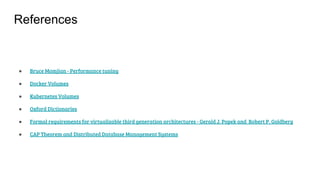
● Bruce Momjian - Performance tuning
● Docker Volumes
● Kubernetes Volumes
● Oxford Dictionaries
● Formal requirements for virtualizable third generation architectures - Gerald J. Popek and Robert P. Goldberg
● CAP Theorem and Distributed Database Management Systems
References
// http://www.10deploys.com
// fernando.ike@gmail.com
// https://twitter.com/fernandoike
// http://www.fernandoike.com
// https://www.linkedin.com/in/fernandoike/
Contacts

Containers and Databases