CONSUMER BEHAVIOR
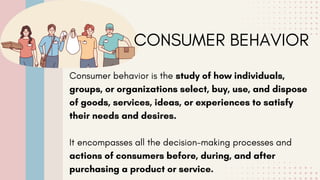
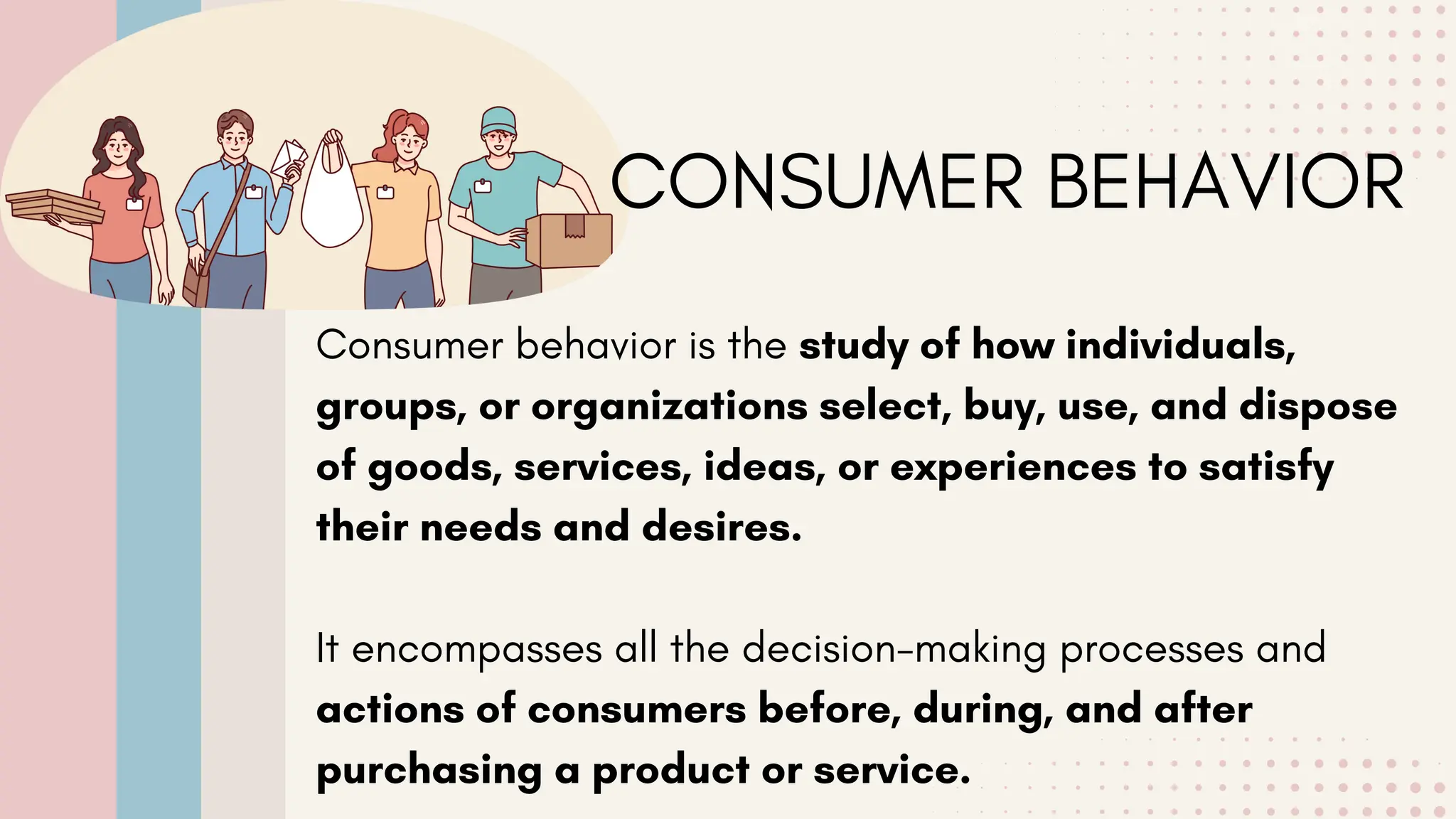
Consumer behavior is the study of how individuals,
groups, or organizations select, buy, use, and dispose
of goods, services, ideas, or experiences to satisfy
their needs and desires.
It encompasses all the decision-making processes and
actions of consumers before, during, and after
purchasing a product or service.
Psychological Processes: How consumers perceive, learn, and form
attitudes about products and services.
Decision-Making Processes: Steps consumers take from recognizing a
need to post-purchase evaluation.
External Influences: Cultural, social, and environmental factors that affect
consumer choices.
Personal Influences: Individual characteristics such as age, lifestyle, and
economic status.
KEY ASPECTS
IMPORTANCE
Developing Effective Marketing Strategies: Targeted Marketing, Product
Development
Enhancing Customer Satisfaction: Meeting Expectations, Building Loyalty
Improving Communication and Engagement: Effective Messaging, Engagement
Strategies
Forecasting Market Trends: Anticipating Changes, Innovation Opportunities
Optimizing Pricing Strategies: Value Perception, Promotional Tactics
Enhancing Product Positioning: Competitive Differentiation, Brand Image
TYPES OF BUYER BEHAVIOR
1. Complex Buying Behavior
2. Dissonance-Reducing Buying Behavior
3. Habitual Buying Behavior
4. Variety-Seeking Buying Behavior
DECIDING THE UNIVERSITY
COMPLEX BUYING BEHAVIOR
High involvement in the purchase decision.
Significant differences between brands.
Consumers engage in extensive information
search and evaluation of alternatives.
MARKETING IMPLICATIONS
Provide detailed and comprehensive
information about the product.
Highlight the unique features and benefits of
the product compared to competitors.
Use comparative advertising to help consumers
make informed decisions.
Offer demonstrations, free trials, and customer
testimonials to build confidence.
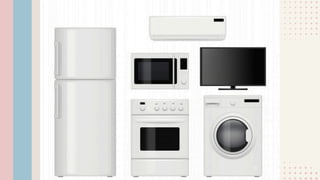
DISSONANCE-REDUCING
BUYING BEHAVIOR
High involvement in the purchase decision.
Few perceived differences between brands.
Consumers may experience post-purchase
dissonance (buyer’s remorse) and seek
reassurance.
MARKETING IMPLICATIONS
Emphasize the reliability and quality of the
product to reassure buyers.
Provide excellent post-purchase support and
customer service.
Highlight warranties, guarantees, and return
policies.
Encourage customer reviews and testimonials
to reduce post-purchase dissonance.
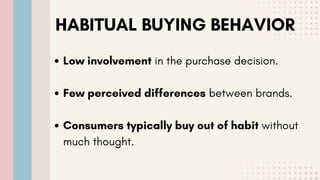
HABITUAL BUYING BEHAVIOR
Low involvement in the purchase decision.
Few perceived differences between brands.
Consumers typically buy out of habit without
much thought.
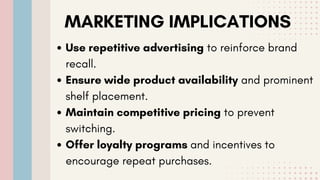
MARKETING IMPLICATIONS
Use repetitive advertising to reinforce brand
recall.
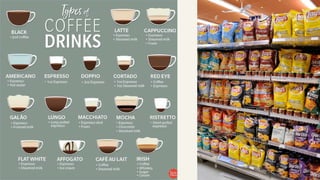
Ensure wide product availability and prominent
shelf placement.
Maintain competitive pricing to prevent
switching.
Offer loyalty programs and incentives to
encourage repeat purchases.
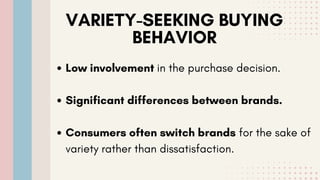
VARIETY-SEEKING BUYING
BEHAVIOR
Low involvement in the purchase decision.
Significant differences between brands.
Consumers often switch brands for the sake of
variety rather than dissatisfaction.
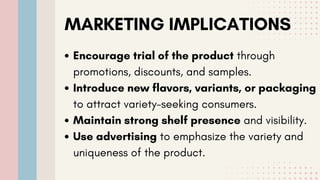
MARKETING IMPLICATIONS
Encourage trial of the product through
promotions, discounts, and samples.
Introduce new flavors, variants, or packaging
to attract variety-seeking consumers.
Maintain strong shelf presence and visibility.
Use advertising to emphasize the variety and
uniqueness of the product.
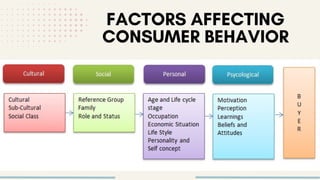
FACTORS AFFECTING
CONSUMER BEHAVIOR
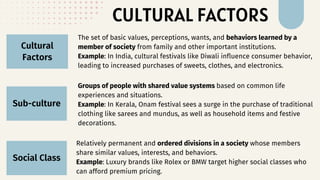
CULTURAL FACTORS
Cultural
Factors
Sub-culture
The set of basic values, perceptions, wants, and behaviors learned by a
member of society from family and other important institutions.
Example: In India, cultural festivals like Diwali influence consumer behavior,
leading to increased purchases of sweets, clothes, and electronics.
Social Class
Groups of people with shared value systems based on common life
experiences and situations.
Example: In Kerala, Onam festival sees a surge in the purchase of traditional
clothing like sarees and mundus, as well as household items and festive
decorations.
Relatively permanent and ordered divisions in a society whose members
share similar values, interests, and behaviors.
Example: Luxury brands like Rolex or BMW target higher social classes who
can afford premium pricing.
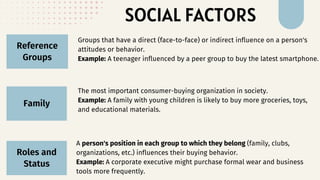
SOCIAL FACTORS
Reference
Groups
Family
Groups that have a direct (face-to-face) or indirect influence on a person's
attitudes or behavior.
Example: A teenager influenced by a peer group to buy the latest smartphone.
Roles and
Status
The most important consumer-buying organization in society.
Example: A family with young children is likely to buy more groceries, toys,
and educational materials.
A person's position in each group to which they belong (family, clubs,
organizations, etc.) influences their buying behavior.
Example: A corporate executive might purchase formal wear and business
tools more frequently.
PERSONAL FACTORS
Age and Life-
Cycle Stage
Occupation
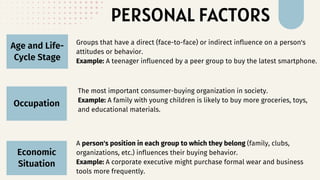
Groups that have a direct (face-to-face) or indirect influence on a person's
attitudes or behavior.
Example: A teenager influenced by a peer group to buy the latest smartphone.
Economic
Situation
The most important consumer-buying organization in society.
Example: A family with young children is likely to buy more groceries, toys,
and educational materials.
A person's position in each group to which they belong (family, clubs,
organizations, etc.) influences their buying behavior.
Example: A corporate executive might purchase formal wear and business
tools more frequently.
PERSONAL FACTORS
Lifestyle
Personality
and Self-
Concept
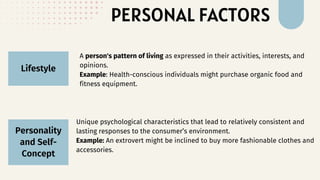
A person's pattern of living as expressed in their activities, interests, and
opinions.
Example: Health-conscious individuals might purchase organic food and
fitness equipment.
Unique psychological characteristics that lead to relatively consistent and
lasting responses to the consumer’s environment.
Example: An extrovert might be inclined to buy more fashionable clothes and
accessories.
PSYCHOLOGICAL FACTORS
Motivation
Perception
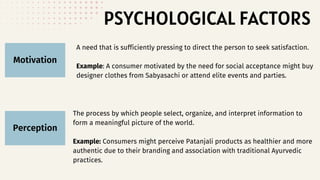
A need that is sufficiently pressing to direct the person to seek satisfaction.
Example: A consumer motivated by the need for social acceptance might buy
designer clothes from Sabyasachi or attend elite events and parties.
The process by which people select, organize, and interpret information to
form a meaningful picture of the world.
Example: Consumers might perceive Patanjali products as healthier and more
authentic due to their branding and association with traditional Ayurvedic
practices.
PSYCHOLOGICAL FACTORS
Learning
Beliefs and
Attitudes
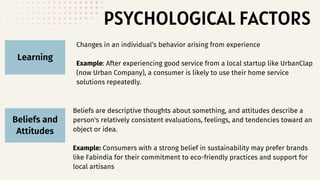
Changes in an individual’s behavior arising from experience
Example: After experiencing good service from a local startup like UrbanClap
(now Urban Company), a consumer is likely to use their home service
solutions repeatedly.
Beliefs are descriptive thoughts about something, and attitudes describe a
person's relatively consistent evaluations, feelings, and tendencies toward an
object or idea.
Example: Consumers with a strong belief in sustainability may prefer brands
like Fabindia for their commitment to eco-friendly practices and support for
local artisans

Comprehensive Guide to Consumer Behavior

  • 1.
    CONSUMER BEHAVIOR Consumer behavioris the study of how individuals, groups, or organizations select, buy, use, and dispose of goods, services, ideas, or experiences to satisfy their needs and desires. It encompasses all the decision-making processes and actions of consumers before, during, and after purchasing a product or service.
  • 2.
    Psychological Processes: Howconsumers perceive, learn, and form attitudes about products and services. Decision-Making Processes: Steps consumers take from recognizing a need to post-purchase evaluation. External Influences: Cultural, social, and environmental factors that affect consumer choices. Personal Influences: Individual characteristics such as age, lifestyle, and economic status. KEY ASPECTS
  • 3.
    IMPORTANCE Developing Effective MarketingStrategies: Targeted Marketing, Product Development Enhancing Customer Satisfaction: Meeting Expectations, Building Loyalty Improving Communication and Engagement: Effective Messaging, Engagement Strategies Forecasting Market Trends: Anticipating Changes, Innovation Opportunities Optimizing Pricing Strategies: Value Perception, Promotional Tactics Enhancing Product Positioning: Competitive Differentiation, Brand Image
  • 4.
    TYPES OF BUYERBEHAVIOR 1. Complex Buying Behavior 2. Dissonance-Reducing Buying Behavior 3. Habitual Buying Behavior 4. Variety-Seeking Buying Behavior
  • 6.
  • 7.
    COMPLEX BUYING BEHAVIOR Highinvolvement in the purchase decision. Significant differences between brands. Consumers engage in extensive information search and evaluation of alternatives.
  • 8.
    MARKETING IMPLICATIONS Provide detailedand comprehensive information about the product. Highlight the unique features and benefits of the product compared to competitors. Use comparative advertising to help consumers make informed decisions. Offer demonstrations, free trials, and customer testimonials to build confidence.
  • 10.
    DISSONANCE-REDUCING BUYING BEHAVIOR High involvementin the purchase decision. Few perceived differences between brands. Consumers may experience post-purchase dissonance (buyer’s remorse) and seek reassurance.
  • 11.
    MARKETING IMPLICATIONS Emphasize thereliability and quality of the product to reassure buyers. Provide excellent post-purchase support and customer service. Highlight warranties, guarantees, and return policies. Encourage customer reviews and testimonials to reduce post-purchase dissonance.
  • 13.
    HABITUAL BUYING BEHAVIOR Lowinvolvement in the purchase decision. Few perceived differences between brands. Consumers typically buy out of habit without much thought.
  • 14.
    MARKETING IMPLICATIONS Use repetitiveadvertising to reinforce brand recall. Ensure wide product availability and prominent shelf placement. Maintain competitive pricing to prevent switching. Offer loyalty programs and incentives to encourage repeat purchases.
  • 16.
    VARIETY-SEEKING BUYING BEHAVIOR Low involvementin the purchase decision. Significant differences between brands. Consumers often switch brands for the sake of variety rather than dissatisfaction.
  • 17.
    MARKETING IMPLICATIONS Encourage trialof the product through promotions, discounts, and samples. Introduce new flavors, variants, or packaging to attract variety-seeking consumers. Maintain strong shelf presence and visibility. Use advertising to emphasize the variety and uniqueness of the product.
  • 18.
  • 19.
    CULTURAL FACTORS Cultural Factors Sub-culture The setof basic values, perceptions, wants, and behaviors learned by a member of society from family and other important institutions. Example: In India, cultural festivals like Diwali influence consumer behavior, leading to increased purchases of sweets, clothes, and electronics. Social Class Groups of people with shared value systems based on common life experiences and situations. Example: In Kerala, Onam festival sees a surge in the purchase of traditional clothing like sarees and mundus, as well as household items and festive decorations. Relatively permanent and ordered divisions in a society whose members share similar values, interests, and behaviors. Example: Luxury brands like Rolex or BMW target higher social classes who can afford premium pricing.
  • 20.
    SOCIAL FACTORS Reference Groups Family Groups thathave a direct (face-to-face) or indirect influence on a person's attitudes or behavior. Example: A teenager influenced by a peer group to buy the latest smartphone. Roles and Status The most important consumer-buying organization in society. Example: A family with young children is likely to buy more groceries, toys, and educational materials. A person's position in each group to which they belong (family, clubs, organizations, etc.) influences their buying behavior. Example: A corporate executive might purchase formal wear and business tools more frequently.
  • 21.
    PERSONAL FACTORS Age andLife- Cycle Stage Occupation Groups that have a direct (face-to-face) or indirect influence on a person's attitudes or behavior. Example: A teenager influenced by a peer group to buy the latest smartphone. Economic Situation The most important consumer-buying organization in society. Example: A family with young children is likely to buy more groceries, toys, and educational materials. A person's position in each group to which they belong (family, clubs, organizations, etc.) influences their buying behavior. Example: A corporate executive might purchase formal wear and business tools more frequently.
  • 22.
    PERSONAL FACTORS Lifestyle Personality and Self- Concept Aperson's pattern of living as expressed in their activities, interests, and opinions. Example: Health-conscious individuals might purchase organic food and fitness equipment. Unique psychological characteristics that lead to relatively consistent and lasting responses to the consumer’s environment. Example: An extrovert might be inclined to buy more fashionable clothes and accessories.
  • 23.
    PSYCHOLOGICAL FACTORS Motivation Perception A needthat is sufficiently pressing to direct the person to seek satisfaction. Example: A consumer motivated by the need for social acceptance might buy designer clothes from Sabyasachi or attend elite events and parties. The process by which people select, organize, and interpret information to form a meaningful picture of the world. Example: Consumers might perceive Patanjali products as healthier and more authentic due to their branding and association with traditional Ayurvedic practices.
  • 24.
    PSYCHOLOGICAL FACTORS Learning Beliefs and Attitudes Changesin an individual’s behavior arising from experience Example: After experiencing good service from a local startup like UrbanClap (now Urban Company), a consumer is likely to use their home service solutions repeatedly. Beliefs are descriptive thoughts about something, and attitudes describe a person's relatively consistent evaluations, feelings, and tendencies toward an object or idea. Example: Consumers with a strong belief in sustainability may prefer brands like Fabindia for their commitment to eco-friendly practices and support for local artisans