TIME VALUE OF MONEY-
FUTURE VALUE
PRESENT VALUE
Introduction: What is Time Value of Money?
The Time Value of Money (TVM) is a financial
concept that highlights the importance of the
value of money over time. In simple terms, a
certain amount of money today is worth more
than the same amount in the future due to its
potential earning capacity. This concept is
foundational in finance because it acknowledges
the impact of time on the value of money, which
could be invested to earn interest or grow
through other investment opportunities.
Key Concepts of TVM:
Opportunity Cost: Money that is not invested or
spent today loses the potential to grow. Therefore,
a rupee today has more value than a rupee in the
future because it can be invested and earn
interest.
1.
Interest Rates: Interest is the return on
investment, either as a reward for saving or the
cost of borrowing.
2.
Inflation: Over time, the purchasing power of
money decreases due to inflation, meaning the
same amount will buy fewer goods and services in
the future.
3.
Future Value of Money (Compounding)
Future Value (FV) refers to the value of an investment or a sum of money at a
specific point in the future, after earning interest over time.
It answers the question: "How much will this money be worth in the future if it
grows at a given interest rate?"
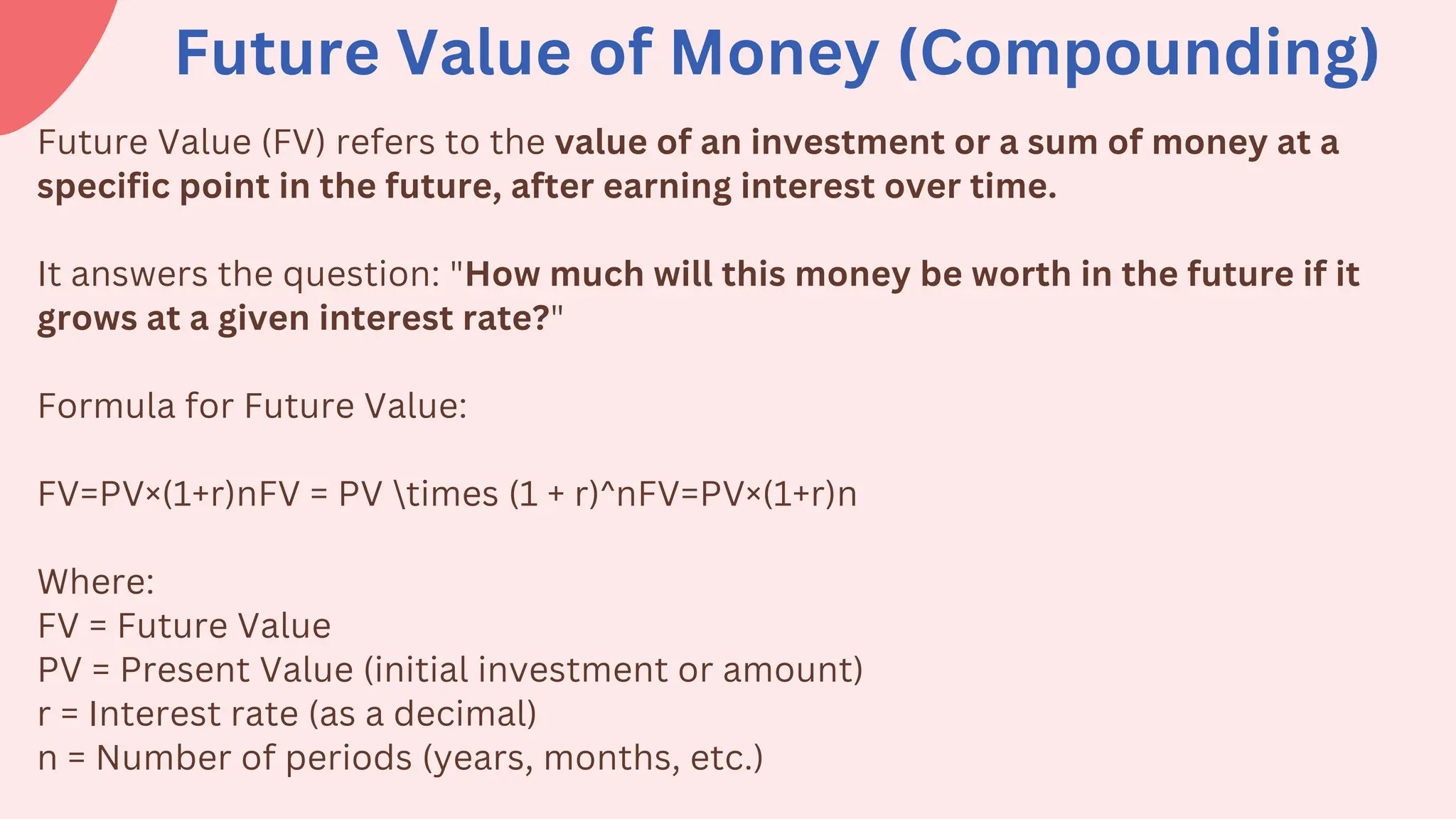
Formula for Future Value:
FV=PV×(1+r)nFV = PV times (1 + r)^nFV=PV×(1+r)n
Where:
FV = Future Value
PV = Present Value (initial investment or amount)
r = Interest rate (as a decimal)
n = Number of periods (years, months, etc.)
Present Value of Money (Discounting)
Present Value (PV) is the current value of a
future sum of money, discounted back to
the present at a specific interest rate.
It answers the question: "How much is a
future amount of money worth today, given
that money loses value over time?"
The concept of discounting helps to
determine the current worth of money to be
received or paid in the future, considering
factors such as interest rates and inflation.
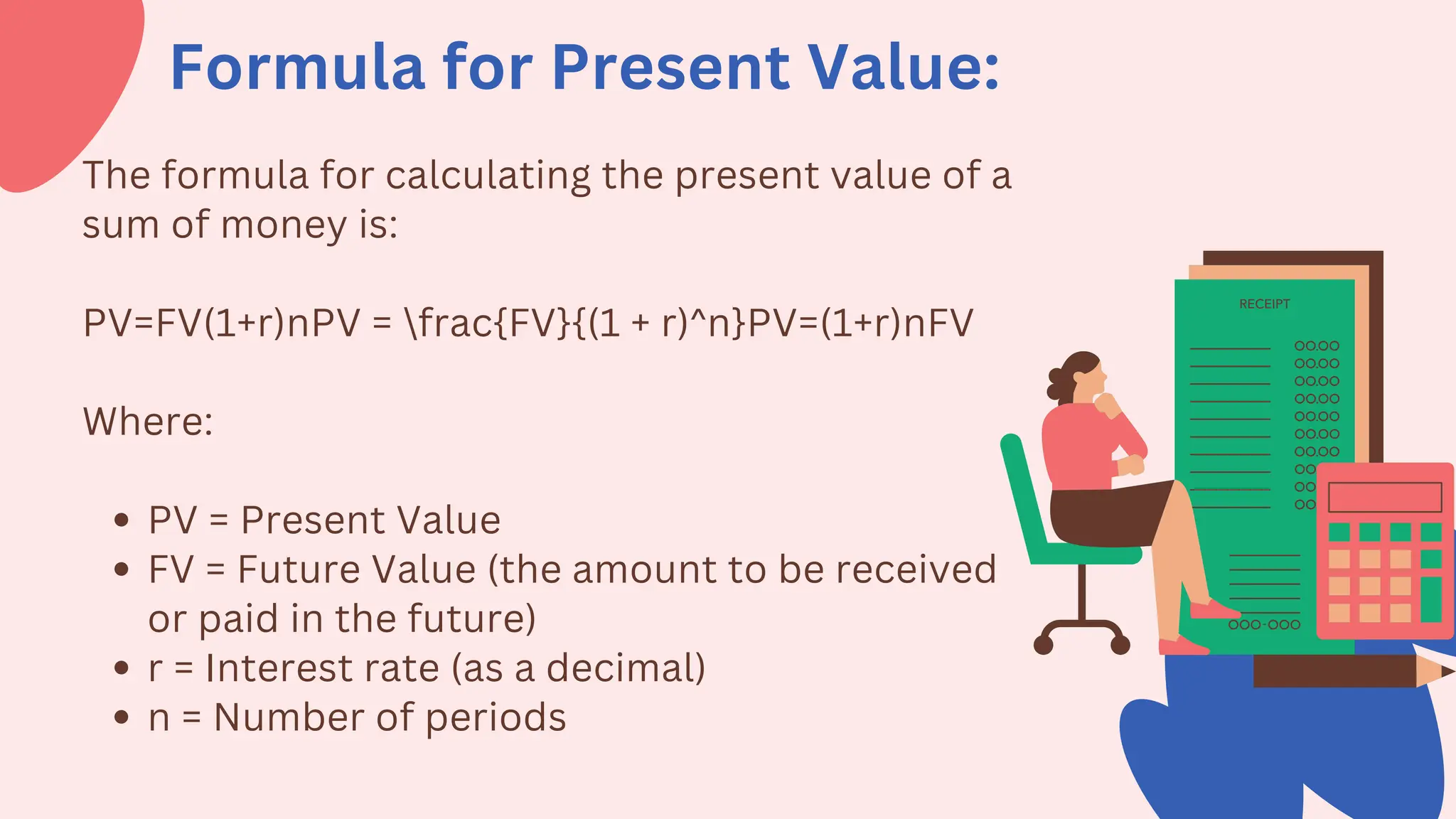
Formula for Present Value:
The formula for calculating the present value of a
sum of money is:
PV=FV(1+r)nPV = frac{FV}{(1 + r)^n}PV=(1+r)nFV​
Where:
PV = Present Value
FV = Future Value (the amount to be received
or paid in the future)
r = Interest rate (as a decimal)
n = Number of periods
Factors Affecting Time Value of Money:
Interest Rates: Higher interest rates increase the future value of
investments and reduce the present value of future cash flows.
Time Period: The longer the time period, the greater the impact
of compounding or discounting.
Frequency of Compounding: More frequent compounding
increases the future value of money.
Inflation: Reduces the purchasing power of money over time,
influencing how present and future values are perceived.
Practical Applications of TVM:
Investments: Investors use the time value of money to determine whether to invest
now or later, considering the potential returns (future value).
Loans and Mortgages: Borrowers and lenders use PV and FV calculations to
determine payment schedules and interest costs over time.
Project Management: In project management, TVM is used for project evaluation,
such as calculating the Net Present Value (NPV) and Internal Rate of Return (IRR) for
investments or long-term projects.
Retirement Planning: Individuals use time value calculations to estimate how much
they need to save to meet future financial goals.
Capital Budgeting: Companies use TVM to assess the profitability of investment
projects by discounting future cash flows back to their present value.

PM- Time Value of Money, Future Value, and Present Value.pdf

  • 1.
    TIME VALUE OFMONEY- FUTURE VALUE PRESENT VALUE
  • 2.
    Introduction: What isTime Value of Money? The Time Value of Money (TVM) is a financial concept that highlights the importance of the value of money over time. In simple terms, a certain amount of money today is worth more than the same amount in the future due to its potential earning capacity. This concept is foundational in finance because it acknowledges the impact of time on the value of money, which could be invested to earn interest or grow through other investment opportunities.
  • 3.
    Key Concepts ofTVM: Opportunity Cost: Money that is not invested or spent today loses the potential to grow. Therefore, a rupee today has more value than a rupee in the future because it can be invested and earn interest. 1. Interest Rates: Interest is the return on investment, either as a reward for saving or the cost of borrowing. 2. Inflation: Over time, the purchasing power of money decreases due to inflation, meaning the same amount will buy fewer goods and services in the future. 3.
  • 4.
    Future Value ofMoney (Compounding) Future Value (FV) refers to the value of an investment or a sum of money at a specific point in the future, after earning interest over time. It answers the question: "How much will this money be worth in the future if it grows at a given interest rate?" Formula for Future Value: FV=PV×(1+r)nFV = PV times (1 + r)^nFV=PV×(1+r)n Where: FV = Future Value PV = Present Value (initial investment or amount) r = Interest rate (as a decimal) n = Number of periods (years, months, etc.)
  • 5.
    Present Value ofMoney (Discounting) Present Value (PV) is the current value of a future sum of money, discounted back to the present at a specific interest rate. It answers the question: "How much is a future amount of money worth today, given that money loses value over time?" The concept of discounting helps to determine the current worth of money to be received or paid in the future, considering factors such as interest rates and inflation.
  • 6.
    Formula for PresentValue: The formula for calculating the present value of a sum of money is: PV=FV(1+r)nPV = frac{FV}{(1 + r)^n}PV=(1+r)nFV​ Where: PV = Present Value FV = Future Value (the amount to be received or paid in the future) r = Interest rate (as a decimal) n = Number of periods
  • 7.
    Factors Affecting TimeValue of Money: Interest Rates: Higher interest rates increase the future value of investments and reduce the present value of future cash flows. Time Period: The longer the time period, the greater the impact of compounding or discounting. Frequency of Compounding: More frequent compounding increases the future value of money. Inflation: Reduces the purchasing power of money over time, influencing how present and future values are perceived.
  • 8.
    Practical Applications ofTVM: Investments: Investors use the time value of money to determine whether to invest now or later, considering the potential returns (future value). Loans and Mortgages: Borrowers and lenders use PV and FV calculations to determine payment schedules and interest costs over time. Project Management: In project management, TVM is used for project evaluation, such as calculating the Net Present Value (NPV) and Internal Rate of Return (IRR) for investments or long-term projects. Retirement Planning: Individuals use time value calculations to estimate how much they need to save to meet future financial goals. Capital Budgeting: Companies use TVM to assess the profitability of investment projects by discounting future cash flows back to their present value.