Chapter 19
Consumer Behavior,
Electronic
Commerce, and
Channel Strategy
Copyright © 2010 by the McGraw-Hill Companies, Inc. All rights reserved.
McGraw-Hill/Irwin
19-2
What is consumer behavior?
Study of individuals, groups, or
organizations and their decision-making
processes for acquiring goods and services.
19-3
Factors Influencing Consumer Behavior:
Psychological Factors: Motivation, perception,
learning, beliefs, and attitudes.
Social Factors: Family, reference groups, social
roles, and status.
Cultural Factors: Culture, subculture, and social
class.
Personal Factors: Age, occupation, lifestyle,
economic situation, and personality.
19-4
Consumer Decision-Making Process:
• Problem recognition
• Information search
• Evaluation of alternatives
• Purchase decision
• Post-purchase behavior
19-5
A distribution channel refers to the path or
route through which goods and services flow
from the producer or manufacturer to the final
consumer.
Introduction
19-6
Types of Distribution Channels:
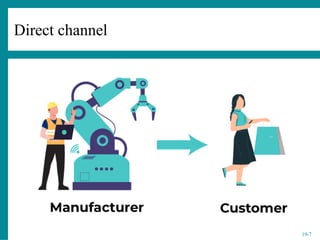
• Direct: Selling directly to the consumer (e.g.,
through company websites).
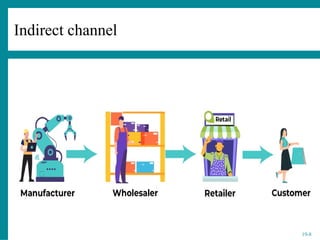
• Indirect: Using intermediaries such as retailers or
wholesalers.
• Hybrid: Combining direct and indirect channels.
Introduction
19-7
Direct channel
19-8
Indirect channel
19-9
Store image
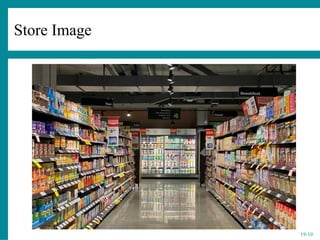
Is what consumers think about a particular store.
Includes perceptions and attitudes based on
sensations of store-related stimuli received through
the five senses.
Developing a consistent store image is a common
goal of retailers.
Store-Related Affect and Cognition
19-10
Store Image
19-11
Store atmosphere
Primarily involves affect in the form of in-store
emotional states that consumers may not be fully
conscious of when shopping.
Environmental stimuli affect consumers’ emotional
states, which in turn affect approach or avoidance
behaviors.
The four types of approach or avoidance behaviors
are physical, exploratory, communication, and
performance and satisfaction approach.
Store-Related Affect and Cognition (cont.)
19-12
19-13
Environmental stimuli influence emotional states
(pleasure, arousal), which drive approach or
avoidance behaviors like spending more time or
money.
A Model of Store Atmosphere Effects
19-14
Store Atmosphere (cont.)
Pleasure and arousal were found to influence
consumers’ state:
Enjoyment of shopping in the store.
Time spent browsing and exploring the store’s
offerings.
Willingness to talk to sales personnel.
Tendency to spend more money than originally
planned.
Likelihood of returning to the store.
19-15
Store contact
Involves the consumer locating, traveling to, and
entering a store.
A number of variables are concerned with obtaining
store contacts.
Store location decisions are strongly influenced by heavy
traffic and pedestrian patterns, which facilitate store
contact.
Visibility of the store and its distance from consumers are
used to select locations that can increase store contact.
Store-Related Behavior
19-16
Store Contact
19-17
Store loyalty
Repeat patronage intentions and behavior.
Strongly influenced by the arrangement of the
environment, particularly the reinforcing properties of
the retail store.
Is a major objective of retail channel strategy and has
an important financial impact.
Store-Related Behavior (cont.)
19-18
Store Environment
Three major decision areas in designing effective
store environments:
Store location
Store layout
In-store stimuli
19-19
Store Location
Good locations allow ready access, can attract
large numbers of consumers, and can
significantly alter consumer shopping and
purchasing patterns.
Store location decisions represent long-term
financial commitments, and changing poor
locations can be difficult and costly.
Retail location models are quite sophisticated and
can deal with a variety of criteria.
19-20
Store Location (cont.)
General approaches to selecting store location
Checklist method - A systematic evaluation of
potential sites based on a list of predefined
criteria.
Analog approach - Identifies an existing store
or stores similar to the one planned and uses
their performance data to evaluate potential
sites.
19-21
Store Location (cont.)
Regression models - A statistical approach that uses
historical data to identify factors affecting store
performance and predicts the success of potential
sites. Commonly used to investigate the factors that
affect the profitability of retail outlets at particular
sites.
Location allocation models - Involve the
simultaneous selection of several locations and
estimation of demand at those locations to optimize
some specified criteria.
19-22
Store Layout
Grid layout
The grid layout is more likely to be used in
department and specialty stores to direct customer
traffic down the main aisles.
Free-form layout
This arrangement is particularly useful for
encouraging relaxed shopping and impulse purchases.
19-23
Examples of Grid and Free-Form Store
Layouts
19-24
Advantages and Disadvantages of Grid and
Free-Form Layouts
19-25
In-Store Stimuli
Signs and price information
Benefit sign
Price-only sign
Color
Warm colors
Cool colors
Shelf space and displays
Normal display, expanded display, and special display
19-26
In-Store Stimuli (cont.)
Music
The tempo of background music influences consumer
behavior
Scent
Scents vary in terms of how pleasant they are
perceived to be, how likely they are to evoke
physiological responses, and how strong they are.
Ambient scent can influence feelings about stores and
their products.
Neutral and pleasant scent categories can be diffused
in a store to influence consumers.
19-27
Nonstore Consumer Behavior
Consumer purchase mode refers to the method
a consumer uses to shop and purchase from store
or nonstore alternatives.
Choices made among the various consumer
purchase modes are influenced by many factors.
19-28
Catalog and Direct Mail Purchases
Have grown dramatically with the increase in
dual-income families and the general need for
consumers to save time.
Catalogs have some disadvantages for
consumers.
Catalog prices are higher and consumers have to pay
shipping charges.
Do not allow the consumer to experience the feel, fit,
or other sensory stimuli of a product directly.
19-29
Catalog and Direct Mail Purchases (cont.)
Waiting time to receive merchandise.
Unsatisfactory product returned at consumer’s own
expense.
19-30
Vending Machine Purchases
Provide merchandise in convenient locations and
are often available for purchases twenty-four
hours a day.
Product prices are typically higher.
Recovery of money may not be possible when
vending machines fail to deliver the merchandise.
19-31
Television Home Shopping
Allows consumers to purchase conveniently from
their homes by telephone and can offer and
demonstrate products.
It also allows better visual display than catalogs.
Limitations:
Consumers must watch the channel when the
merchandise is offered.
Consumers must pay shipping charges
Less informative than experiencing products directly
in stores.
19-32
Direct Sales Purchases
Salespeople can provide in-depth product usage
information.
Merchandise is often priced higher than similar
merchandise in stores.
Consumers’ must spend time watching the
demonstration and discussing products.
Pressure by overzealous salespeople to purchase
unneeded products.
19-33
Electronic Exchanges
Involve consumers in collecting information,
shopping, and purchasing from Web sites.
Is the fastest growing purchase mode.
19-34
A Comparison of Six Consumer Purchase
Modes
19-35
Summary
Channels of distribution have a very important
impact on consumer affect, cognition, and
behavior.
The two most critical store-related affect and
cognitions for channel strategy are store image
and store atmosphere.
The store-related behaviors, store contact and
store loyalty, are primary objectives of retail
channel strategy.
19-36
Summary (cont.)
Store environment entails store location, store
layout, and in-store stimuli.
The six consumer purchase modes include stores,
catalogs/direct mail, vending machines, direct
sales, TV home shopping, and electronic
exchange.
It is the consumer and their relationships with
other criteria that determine appropriate channel
strategy.
19-37
QUIZ: TRUE OR FALSE
1. Store image is determined by the consumer's perception
of store-related stimuli received through the five senses.
2. Free-form store layouts discourage impulse purchases
and promote quick shopping.
3. Catalog shopping usually has lower prices and no
shipping charges compared to in-store shopping.
4. Regression models are used to predict the success of
store locations based on historical data.
5. Music tempo in stores does not influence consumer
behavior.
19-38
QUIZ: TRUE OR FALSE
6. In-store stimuli, such as expanded displays, can encourage
consumers to spend more time and money in the store.
7. Vending machine purchases are always cost-effective for
consumers.
8. Store loyalty is a key objective of retail channel strategy
because it has a financial impact.
9. Electronic exchanges are declining in popularity as a
consumer purchase mode.
10. Checklist methods and regression models are two common
approaches to store location decisions.
19-39
QUIZ: IDENTIFICATION
11. The study of individuals, groups, or organizations and their
decision-making processes for acquiring goods and services.
12. A distribution channel where goods are sold directly to the
consumer, such as through company websites.
13. The layout used in department stores to direct customer
traffic efficiently.
14. The systematic evaluation of potential store locations based
on predefined criteria.
15. The purchase mode that allows consumers to shop using
catalogs and direct mail.
19-40
QUIZ: IDENTIFICATION
16. The term for consumers returning to a store repeatedly
due to positive experiences.
17. The consumer behavior influenced by environmental
stimuli like scent, music, and lighting.
18. The purchase mode that enables consumers to buy
products from vending machines available 24/7.
19. The emotional states influenced by store atmosphere,
driving approach or avoidance behaviors.
20. The channel that combines both direct and indirect
distribution methods.

Consumer Behavior Finals (BSBA 21) .ppt

  • 1.
    Chapter 19 Consumer Behavior, Electronic Commerce,and Channel Strategy Copyright © 2010 by the McGraw-Hill Companies, Inc. All rights reserved. McGraw-Hill/Irwin
  • 2.
    19-2 What is consumerbehavior? Study of individuals, groups, or organizations and their decision-making processes for acquiring goods and services.
  • 3.
    19-3 Factors Influencing ConsumerBehavior: Psychological Factors: Motivation, perception, learning, beliefs, and attitudes. Social Factors: Family, reference groups, social roles, and status. Cultural Factors: Culture, subculture, and social class. Personal Factors: Age, occupation, lifestyle, economic situation, and personality.
  • 4.
    19-4 Consumer Decision-Making Process: •Problem recognition • Information search • Evaluation of alternatives • Purchase decision • Post-purchase behavior
  • 5.
    19-5 A distribution channelrefers to the path or route through which goods and services flow from the producer or manufacturer to the final consumer. Introduction
  • 6.
    19-6 Types of DistributionChannels: • Direct: Selling directly to the consumer (e.g., through company websites). • Indirect: Using intermediaries such as retailers or wholesalers. • Hybrid: Combining direct and indirect channels. Introduction
  • 7.
  • 8.
  • 9.
    19-9 Store image Is whatconsumers think about a particular store. Includes perceptions and attitudes based on sensations of store-related stimuli received through the five senses. Developing a consistent store image is a common goal of retailers. Store-Related Affect and Cognition
  • 10.
  • 11.
    19-11 Store atmosphere Primarily involvesaffect in the form of in-store emotional states that consumers may not be fully conscious of when shopping. Environmental stimuli affect consumers’ emotional states, which in turn affect approach or avoidance behaviors. The four types of approach or avoidance behaviors are physical, exploratory, communication, and performance and satisfaction approach. Store-Related Affect and Cognition (cont.)
  • 12.
  • 13.
    19-13 Environmental stimuli influenceemotional states (pleasure, arousal), which drive approach or avoidance behaviors like spending more time or money. A Model of Store Atmosphere Effects
  • 14.
    19-14 Store Atmosphere (cont.) Pleasureand arousal were found to influence consumers’ state: Enjoyment of shopping in the store. Time spent browsing and exploring the store’s offerings. Willingness to talk to sales personnel. Tendency to spend more money than originally planned. Likelihood of returning to the store.
  • 15.
    19-15 Store contact Involves theconsumer locating, traveling to, and entering a store. A number of variables are concerned with obtaining store contacts. Store location decisions are strongly influenced by heavy traffic and pedestrian patterns, which facilitate store contact. Visibility of the store and its distance from consumers are used to select locations that can increase store contact. Store-Related Behavior
  • 16.
  • 17.
    19-17 Store loyalty Repeat patronageintentions and behavior. Strongly influenced by the arrangement of the environment, particularly the reinforcing properties of the retail store. Is a major objective of retail channel strategy and has an important financial impact. Store-Related Behavior (cont.)
  • 18.
    19-18 Store Environment Three majordecision areas in designing effective store environments: Store location Store layout In-store stimuli
  • 19.
    19-19 Store Location Good locationsallow ready access, can attract large numbers of consumers, and can significantly alter consumer shopping and purchasing patterns. Store location decisions represent long-term financial commitments, and changing poor locations can be difficult and costly. Retail location models are quite sophisticated and can deal with a variety of criteria.
  • 20.
    19-20 Store Location (cont.) Generalapproaches to selecting store location Checklist method - A systematic evaluation of potential sites based on a list of predefined criteria. Analog approach - Identifies an existing store or stores similar to the one planned and uses their performance data to evaluate potential sites.
  • 21.
    19-21 Store Location (cont.) Regressionmodels - A statistical approach that uses historical data to identify factors affecting store performance and predicts the success of potential sites. Commonly used to investigate the factors that affect the profitability of retail outlets at particular sites. Location allocation models - Involve the simultaneous selection of several locations and estimation of demand at those locations to optimize some specified criteria.
  • 22.
    19-22 Store Layout Grid layout Thegrid layout is more likely to be used in department and specialty stores to direct customer traffic down the main aisles. Free-form layout This arrangement is particularly useful for encouraging relaxed shopping and impulse purchases.
  • 23.
    19-23 Examples of Gridand Free-Form Store Layouts
  • 24.
    19-24 Advantages and Disadvantagesof Grid and Free-Form Layouts
  • 25.
    19-25 In-Store Stimuli Signs andprice information Benefit sign Price-only sign Color Warm colors Cool colors Shelf space and displays Normal display, expanded display, and special display
  • 26.
    19-26 In-Store Stimuli (cont.) Music Thetempo of background music influences consumer behavior Scent Scents vary in terms of how pleasant they are perceived to be, how likely they are to evoke physiological responses, and how strong they are. Ambient scent can influence feelings about stores and their products. Neutral and pleasant scent categories can be diffused in a store to influence consumers.
  • 27.
    19-27 Nonstore Consumer Behavior Consumerpurchase mode refers to the method a consumer uses to shop and purchase from store or nonstore alternatives. Choices made among the various consumer purchase modes are influenced by many factors.
  • 28.
    19-28 Catalog and DirectMail Purchases Have grown dramatically with the increase in dual-income families and the general need for consumers to save time. Catalogs have some disadvantages for consumers. Catalog prices are higher and consumers have to pay shipping charges. Do not allow the consumer to experience the feel, fit, or other sensory stimuli of a product directly.
  • 29.
    19-29 Catalog and DirectMail Purchases (cont.) Waiting time to receive merchandise. Unsatisfactory product returned at consumer’s own expense.
  • 30.
    19-30 Vending Machine Purchases Providemerchandise in convenient locations and are often available for purchases twenty-four hours a day. Product prices are typically higher. Recovery of money may not be possible when vending machines fail to deliver the merchandise.
  • 31.
    19-31 Television Home Shopping Allowsconsumers to purchase conveniently from their homes by telephone and can offer and demonstrate products. It also allows better visual display than catalogs. Limitations: Consumers must watch the channel when the merchandise is offered. Consumers must pay shipping charges Less informative than experiencing products directly in stores.
  • 32.
    19-32 Direct Sales Purchases Salespeoplecan provide in-depth product usage information. Merchandise is often priced higher than similar merchandise in stores. Consumers’ must spend time watching the demonstration and discussing products. Pressure by overzealous salespeople to purchase unneeded products.
  • 33.
    19-33 Electronic Exchanges Involve consumersin collecting information, shopping, and purchasing from Web sites. Is the fastest growing purchase mode.
  • 34.
    19-34 A Comparison ofSix Consumer Purchase Modes
  • 35.
    19-35 Summary Channels of distributionhave a very important impact on consumer affect, cognition, and behavior. The two most critical store-related affect and cognitions for channel strategy are store image and store atmosphere. The store-related behaviors, store contact and store loyalty, are primary objectives of retail channel strategy.
  • 36.
    19-36 Summary (cont.) Store environmententails store location, store layout, and in-store stimuli. The six consumer purchase modes include stores, catalogs/direct mail, vending machines, direct sales, TV home shopping, and electronic exchange. It is the consumer and their relationships with other criteria that determine appropriate channel strategy.
  • 37.
    19-37 QUIZ: TRUE ORFALSE 1. Store image is determined by the consumer's perception of store-related stimuli received through the five senses. 2. Free-form store layouts discourage impulse purchases and promote quick shopping. 3. Catalog shopping usually has lower prices and no shipping charges compared to in-store shopping. 4. Regression models are used to predict the success of store locations based on historical data. 5. Music tempo in stores does not influence consumer behavior.
  • 38.
    19-38 QUIZ: TRUE ORFALSE 6. In-store stimuli, such as expanded displays, can encourage consumers to spend more time and money in the store. 7. Vending machine purchases are always cost-effective for consumers. 8. Store loyalty is a key objective of retail channel strategy because it has a financial impact. 9. Electronic exchanges are declining in popularity as a consumer purchase mode. 10. Checklist methods and regression models are two common approaches to store location decisions.
  • 39.
    19-39 QUIZ: IDENTIFICATION 11. Thestudy of individuals, groups, or organizations and their decision-making processes for acquiring goods and services. 12. A distribution channel where goods are sold directly to the consumer, such as through company websites. 13. The layout used in department stores to direct customer traffic efficiently. 14. The systematic evaluation of potential store locations based on predefined criteria. 15. The purchase mode that allows consumers to shop using catalogs and direct mail.
  • 40.
    19-40 QUIZ: IDENTIFICATION 16. Theterm for consumers returning to a store repeatedly due to positive experiences. 17. The consumer behavior influenced by environmental stimuli like scent, music, and lighting. 18. The purchase mode that enables consumers to buy products from vending machines available 24/7. 19. The emotional states influenced by store atmosphere, driving approach or avoidance behaviors. 20. The channel that combines both direct and indirect distribution methods.