BASIC MICROECONOMICS
FINALS
FREE MARKET
•The free market is an economic system based on
supply and demand with little or no government
control.
•One of the central principles of a free market is
the concept of voluntary exchange, which is
defined as any transaction in which two parties
freely trade goods or services.
FREE MARKET
•A free market is an economic system where the
prices of goods and services are determined by
the forces of supply and demand, with minimal
or no government intervention.
•In this system, individuals and businesses have
the freedom to engage in economic activities
such as production, exchange, and consumption
based on their own preferences and decisions.
Characteristics of a Free Market
•Private ownership: Individuals and companies in the
private sector own a large portion of resources, giving
them control over production, allocation, and exchange.
•Economic freedom: People are free to participate in the
economy without barriers, and can sell or buy as much
as they want.
•Competition: Businesses compete with each other to
attract customers, which can lead to innovation,
productivity, and better quality products.
Characteristics of a Free Market
•Free enterprise: People are free to choose what
they buy or sell, and both buyers and sellers
benefit from transactions.
•Efficient use of resources: Resources are
allocated more efficiently.
•Self-interest: Sellers provide products to make a
profit.
•Competition: Companies like Apple, Samsung,
Google, and others compete fiercely to create
better, more innovative products. This competition
drives innovation and lowers prices over time.
•Voluntary Exchange: Consumers freely choose
which brand or model of smartphone to purchase
based on their preferences, needs, and budgets.
•Price Determination: Prices of smartphones are
determined by supply and demand. Popular
models may command higher prices, while less
popular ones may be discounted.
•Minimal Regulation: In most countries,
governments play a limited role, mainly ensuring
product safety standards and protecting
intellectual property rights, without controlling
production or pricing.
•Profit Motive: Companies in the industry are
motivated by profit, leading them to invest in
research and development to create products
that meet consumer demand.
Other examples:
MARKET FAILURES
•an economic term applied to a situation where
consumer demand does not equal the amount of a good
or service supplied, and is, therefore, inefficient.
•This can happen when the supply of a product doesn't
match the demand for it.
•occur when private markets fail to bring about the
allocation of resources that best satisfies society’s wants.
•Market failures sometimes happen in competitive
markets.
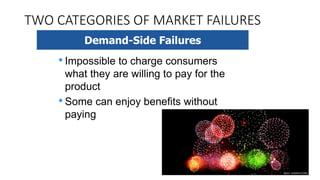
TWO CATEGORIES OF MARKET FAILURES
• Demand-side market failures occur when demand is not at
the socially optimal level, or when consumers are not charged
what they are willing to pay for a good or service.
• Free-rider problem: When consumers use goods without
paying for them. This is common with public goods, such as
parks and roads, where it's difficult to charge consumers
what they are willing to pay.
• Demand curves: When demand curves don't reflect
consumers' full willingness to pay for goods or services. This
can lead to market failure when demand doesn't meet supply
at equilibrium.
• Demerit goods: When demand for a good is too high.
TWO CATEGORIES OF MARKET FAILURES
KINDS OF MARKET FAILURE
•Public goods
These goods are non-excludable and
non-rival, meaning that they are
available to everyone and can be used
without reducing their availability to
others. Examples of public goods
include national defense, street
lighting, fresh air, and knowledge.
KINDS OF MARKET FAILURE
• Public goods
• Nonrivalry (in consumption) means that one person’s
consumption of a good does not preclude consumption of the
good by others. Everyone can simultaneously obtain the
benefit from a public good such as national defense, street
lighting, a global positioning system, or environmental
protection.
• No excludability means there is no effective way of excluding
individuals from the benefit of the good once it comes into
existence. Once in place, you cannot exclude someone from
benefiting from national defense, street lighting, a global
positioning system, or environmental protection.
KINDS OF MARKET FAILURE
These two characteristics create a free-rider
problem. Once a producer has provided a public good,
everyone, including nonpayers, can obtain the benefit.
Because most people do not voluntarily pay for
something that they can obtain for free, most people
become free riders. The low or even zero demand
caused by free riding makes it virtually impossible for
private firms to profitably provide public goods. With
little or no demand, firms cannot effectively “tap
market demand” for revenues and profits. As a result,
they will not produce public goods.
KINDS OF MARKET FAILURE
Thus, if society wants a public good to be
produced, it will have to direct government to
provide it. Because the public good will still feature
non-excludability, the government won’t have any
better luck preventing free riding or charging people
for it. But because the government can finance the
provision of the public good through the taxation
of other things, the government does not have to
worry about profitability. It can therefore provide
the public good even when private firms can’t.
KINDS OF MARKET FAILURE
• Externalities
An externality occurs when some of the costs or the
benefits of a good or service are passed onto or
“spill over to” someone other than the
immediate buyer or seller. Such spillovers are called
externalities because they are benefits or costs that accrue to
some third party that is external to the market transaction.
There are positive and negative externalities.
KINDS OF MARKET FAILURE
•Externalities
Positive externality
A benefit that a third party receives from a
transaction in which they did not participate.
Positive externalities cause demand-side market
failures. These failures happen because market
demand curves in such cases fail to include the
willingness to pay of the third parties who receive the
external benefits caused by the positive externality.
Government Intervention
Government can correct the under allocation of
resources and therefore the efficiency losses that result
from positive externalities in a particular market either
by subsidizing consumers (which increases market
demand) or by subsidizing producers (which increases
market supply). Such subsidies increase the equilibrium
output, reducing or eliminating the positive externality
and consequent under allocation of resources and
efficiency loss.
Government Intervention
• Subsidies to buyers.
Government could correct the under allocation of resources, for
example, to inoculations, by subsidizing consumers of the product.
• Subsidies to producers.
A subsidy to producers is a tax in reverse. Taxes are payments to
the government that increase producers’ costs. Subsidies are
payments from the government that decrease producers’ costs.
• Government provision.
When positive externalities are extremely large, the government
may decide to provide the product for free to everyone.
KINDS OF MARKET FAILURE
• Externalities
Negative externality
A cost that a third party bears due to a transaction in which
they did not participate. Negative externalities cause supply-
side market failures. These failures happen because producers
do not take into account the costs that their negative
externalities impose on others. For example, pollution is a
negative externality that results from both producing and
consuming certain products.
Government Intervention
Government intervention may be called upon to
achieve economic efficiency when externalities
affect large numbers of people or when
community interests are at stake. Government
can use direct controls and taxes to counter
negative externalities; it may provide subsidies or
public goods to deal with positive externalities.
Government Intervention
Direct Controls.
The direct way to reduce negative externalities from a certain
activity is to pass legislation limiting that activity. Such direct
controls force the offending firms to incur the actual costs of the
offending activity. Direct controls raise the marginal cost of
production because the firms must operate and maintain control
equipment.
Specific Taxes.
A second policy approach to negative externalities is for
government to levy taxes or charges specifically on the related
good.
KINDS OF MARKET FAILURE
•Information failure
Also known as asymmetric information, occurs when
one party in a transaction has more knowledge than
the other, usually about the quality of a product or
service. This can lead to market failure, which is when
the market is not operating efficiently.
KINDS OF MARKET FAILURE
• Buyers and sellers pay the wrong price
When buyers and sellers don't have all the information they need,
they may pay or sell a product at a price that doesn't reflect its true
value.
• Adverse selection
Buyers or sellers assume a pessimistic outcome to minimize risk. For
example, an insurance company may set higher premiums to protect
itself from high claims.
• Defective products
One party may defraud another by providing a product or service
that is not what was promised.
QUIZ: Multiple choice
1. What is the primary principle behind a free market?
A) Government control
B) Voluntary exchange
C) Fixed pricing by authorities
D) Equal distribution of resources
2. In a free market, who primarily determines the prices of goods and services?
E) Government policies
F) Forces of supply and demand
G) International trade organizations
H) Monopolistic corporations
QUIZ: Multiple choice
3. Which of the following is NOT a characteristic of a free market?
A) Private ownership
B) Economic freedom
C) Competition
D) Centralized resource allocation
4. What is a market failure?
E) When consumer demand equals the supply of goods
F) Inefficient allocation of resources in a market
G) When the government controls prices
H) When producers make excessive profits
QUIZ: Multiple choice
5. What is a common example of a negative externality?
A) Public education
B) Pollution from factories
C) Free healthcare
D) Research and development
Quiz: Identification
6. refers to an economic system where the prices of goods and
services are determined by supply and demand, with minimal
government intervention.
7. The concept of _________ refers to a situation where both parties
freely trade goods or services without coercion.
8. _________ is a situation where private markets fail to allocate
resources in a way that best satisfies society’s wants.
9. Goods that are both non-rival and non-excludable, such as national
defense, are called _________.
10. The _________ problem occurs when individuals use a good
without paying for it, such as public parks or street lighting.
Quiz: Identification
11. A benefit experienced by a third party, like the societal benefits of
education, is called a _________.
12. When producers impose costs on society, such as pollution, it is
referred to as a _________.
13. _________ occurs when one party in a transaction has more
knowledge than the other, leading to inefficiencies.
14. means that one person’s consumption of a good does not preclude
consumption of the good by others.
15. occurs when some of the costs or the benefits of a good or service
are passed onto or “spill over to” someone other than the
immediate buyer or seller.
Quiz: TRUE OR FALSE
16. The free market requires significant government
regulation to function effectively.
17.Private ownership and economic freedom are core
characteristics of a free market.
18.Market failures only occur in non-competitive
markets.
19.Public goods are rival and excludable by nature.
20.Negative externalities, like pollution, result in supply-
side market failures.
Quiz: TRUE OR FALSE
21. Positive externalities always lead to overproduction in the
market.
22.Adverse selection is an example of asymmetric information
causing market failure.
23.Governments can provide public goods directly to
overcome the free-rider problem.
24.Subsidies to producers decrease the overall cost of
production.
25.Direct controls can raise the marginal cost of production for
firms dealing with negative externalities.
Quiz: ANSWER
1. Why do public goods lead to the "free-rider
problem"? (2pts)
Because people are unwilling to pay for goods they
can access for free
2. How can government correct market failure caused
by positive and negative externalities? (3pts)
Through subsidies, direct control, and specific taxes

BASIC MICROECONOMICS FINALS Lesson .pptx

  • 1.
  • 2.
    FREE MARKET •The freemarket is an economic system based on supply and demand with little or no government control. •One of the central principles of a free market is the concept of voluntary exchange, which is defined as any transaction in which two parties freely trade goods or services.
  • 3.
    FREE MARKET •A freemarket is an economic system where the prices of goods and services are determined by the forces of supply and demand, with minimal or no government intervention. •In this system, individuals and businesses have the freedom to engage in economic activities such as production, exchange, and consumption based on their own preferences and decisions.
  • 4.
    Characteristics of aFree Market •Private ownership: Individuals and companies in the private sector own a large portion of resources, giving them control over production, allocation, and exchange. •Economic freedom: People are free to participate in the economy without barriers, and can sell or buy as much as they want. •Competition: Businesses compete with each other to attract customers, which can lead to innovation, productivity, and better quality products.
  • 5.
    Characteristics of aFree Market •Free enterprise: People are free to choose what they buy or sell, and both buyers and sellers benefit from transactions. •Efficient use of resources: Resources are allocated more efficiently. •Self-interest: Sellers provide products to make a profit.
  • 7.
    •Competition: Companies likeApple, Samsung, Google, and others compete fiercely to create better, more innovative products. This competition drives innovation and lowers prices over time. •Voluntary Exchange: Consumers freely choose which brand or model of smartphone to purchase based on their preferences, needs, and budgets. •Price Determination: Prices of smartphones are determined by supply and demand. Popular models may command higher prices, while less popular ones may be discounted.
  • 8.
    •Minimal Regulation: Inmost countries, governments play a limited role, mainly ensuring product safety standards and protecting intellectual property rights, without controlling production or pricing. •Profit Motive: Companies in the industry are motivated by profit, leading them to invest in research and development to create products that meet consumer demand.
  • 9.
  • 10.
    MARKET FAILURES •an economicterm applied to a situation where consumer demand does not equal the amount of a good or service supplied, and is, therefore, inefficient. •This can happen when the supply of a product doesn't match the demand for it. •occur when private markets fail to bring about the allocation of resources that best satisfies society’s wants. •Market failures sometimes happen in competitive markets.
  • 11.
    TWO CATEGORIES OFMARKET FAILURES • Demand-side market failures occur when demand is not at the socially optimal level, or when consumers are not charged what they are willing to pay for a good or service. • Free-rider problem: When consumers use goods without paying for them. This is common with public goods, such as parks and roads, where it's difficult to charge consumers what they are willing to pay. • Demand curves: When demand curves don't reflect consumers' full willingness to pay for goods or services. This can lead to market failure when demand doesn't meet supply at equilibrium. • Demerit goods: When demand for a good is too high.
  • 12.
    TWO CATEGORIES OFMARKET FAILURES
  • 13.
    TWO CATEGORIES OFMARKET FAILURES
  • 14.
    KINDS OF MARKETFAILURE •Public goods These goods are non-excludable and non-rival, meaning that they are available to everyone and can be used without reducing their availability to others. Examples of public goods include national defense, street lighting, fresh air, and knowledge.
  • 15.
    KINDS OF MARKETFAILURE • Public goods • Nonrivalry (in consumption) means that one person’s consumption of a good does not preclude consumption of the good by others. Everyone can simultaneously obtain the benefit from a public good such as national defense, street lighting, a global positioning system, or environmental protection. • No excludability means there is no effective way of excluding individuals from the benefit of the good once it comes into existence. Once in place, you cannot exclude someone from benefiting from national defense, street lighting, a global positioning system, or environmental protection.
  • 16.
    KINDS OF MARKETFAILURE These two characteristics create a free-rider problem. Once a producer has provided a public good, everyone, including nonpayers, can obtain the benefit. Because most people do not voluntarily pay for something that they can obtain for free, most people become free riders. The low or even zero demand caused by free riding makes it virtually impossible for private firms to profitably provide public goods. With little or no demand, firms cannot effectively “tap market demand” for revenues and profits. As a result, they will not produce public goods.
  • 17.
    KINDS OF MARKETFAILURE Thus, if society wants a public good to be produced, it will have to direct government to provide it. Because the public good will still feature non-excludability, the government won’t have any better luck preventing free riding or charging people for it. But because the government can finance the provision of the public good through the taxation of other things, the government does not have to worry about profitability. It can therefore provide the public good even when private firms can’t.
  • 18.
    KINDS OF MARKETFAILURE • Externalities An externality occurs when some of the costs or the benefits of a good or service are passed onto or “spill over to” someone other than the immediate buyer or seller. Such spillovers are called externalities because they are benefits or costs that accrue to some third party that is external to the market transaction. There are positive and negative externalities.
  • 19.
    KINDS OF MARKETFAILURE •Externalities Positive externality A benefit that a third party receives from a transaction in which they did not participate. Positive externalities cause demand-side market failures. These failures happen because market demand curves in such cases fail to include the willingness to pay of the third parties who receive the external benefits caused by the positive externality.
  • 20.
    Government Intervention Government cancorrect the under allocation of resources and therefore the efficiency losses that result from positive externalities in a particular market either by subsidizing consumers (which increases market demand) or by subsidizing producers (which increases market supply). Such subsidies increase the equilibrium output, reducing or eliminating the positive externality and consequent under allocation of resources and efficiency loss.
  • 21.
    Government Intervention • Subsidiesto buyers. Government could correct the under allocation of resources, for example, to inoculations, by subsidizing consumers of the product. • Subsidies to producers. A subsidy to producers is a tax in reverse. Taxes are payments to the government that increase producers’ costs. Subsidies are payments from the government that decrease producers’ costs. • Government provision. When positive externalities are extremely large, the government may decide to provide the product for free to everyone.
  • 22.
    KINDS OF MARKETFAILURE • Externalities Negative externality A cost that a third party bears due to a transaction in which they did not participate. Negative externalities cause supply- side market failures. These failures happen because producers do not take into account the costs that their negative externalities impose on others. For example, pollution is a negative externality that results from both producing and consuming certain products.
  • 23.
    Government Intervention Government interventionmay be called upon to achieve economic efficiency when externalities affect large numbers of people or when community interests are at stake. Government can use direct controls and taxes to counter negative externalities; it may provide subsidies or public goods to deal with positive externalities.
  • 24.
    Government Intervention Direct Controls. Thedirect way to reduce negative externalities from a certain activity is to pass legislation limiting that activity. Such direct controls force the offending firms to incur the actual costs of the offending activity. Direct controls raise the marginal cost of production because the firms must operate and maintain control equipment. Specific Taxes. A second policy approach to negative externalities is for government to levy taxes or charges specifically on the related good.
  • 25.
    KINDS OF MARKETFAILURE •Information failure Also known as asymmetric information, occurs when one party in a transaction has more knowledge than the other, usually about the quality of a product or service. This can lead to market failure, which is when the market is not operating efficiently.
  • 26.
    KINDS OF MARKETFAILURE • Buyers and sellers pay the wrong price When buyers and sellers don't have all the information they need, they may pay or sell a product at a price that doesn't reflect its true value. • Adverse selection Buyers or sellers assume a pessimistic outcome to minimize risk. For example, an insurance company may set higher premiums to protect itself from high claims. • Defective products One party may defraud another by providing a product or service that is not what was promised.
  • 27.
    QUIZ: Multiple choice 1.What is the primary principle behind a free market? A) Government control B) Voluntary exchange C) Fixed pricing by authorities D) Equal distribution of resources 2. In a free market, who primarily determines the prices of goods and services? E) Government policies F) Forces of supply and demand G) International trade organizations H) Monopolistic corporations
  • 28.
    QUIZ: Multiple choice 3.Which of the following is NOT a characteristic of a free market? A) Private ownership B) Economic freedom C) Competition D) Centralized resource allocation 4. What is a market failure? E) When consumer demand equals the supply of goods F) Inefficient allocation of resources in a market G) When the government controls prices H) When producers make excessive profits
  • 29.
    QUIZ: Multiple choice 5.What is a common example of a negative externality? A) Public education B) Pollution from factories C) Free healthcare D) Research and development
  • 30.
    Quiz: Identification 6. refersto an economic system where the prices of goods and services are determined by supply and demand, with minimal government intervention. 7. The concept of _________ refers to a situation where both parties freely trade goods or services without coercion. 8. _________ is a situation where private markets fail to allocate resources in a way that best satisfies society’s wants. 9. Goods that are both non-rival and non-excludable, such as national defense, are called _________. 10. The _________ problem occurs when individuals use a good without paying for it, such as public parks or street lighting.
  • 31.
    Quiz: Identification 11. Abenefit experienced by a third party, like the societal benefits of education, is called a _________. 12. When producers impose costs on society, such as pollution, it is referred to as a _________. 13. _________ occurs when one party in a transaction has more knowledge than the other, leading to inefficiencies. 14. means that one person’s consumption of a good does not preclude consumption of the good by others. 15. occurs when some of the costs or the benefits of a good or service are passed onto or “spill over to” someone other than the immediate buyer or seller.
  • 32.
    Quiz: TRUE ORFALSE 16. The free market requires significant government regulation to function effectively. 17.Private ownership and economic freedom are core characteristics of a free market. 18.Market failures only occur in non-competitive markets. 19.Public goods are rival and excludable by nature. 20.Negative externalities, like pollution, result in supply- side market failures.
  • 33.
    Quiz: TRUE ORFALSE 21. Positive externalities always lead to overproduction in the market. 22.Adverse selection is an example of asymmetric information causing market failure. 23.Governments can provide public goods directly to overcome the free-rider problem. 24.Subsidies to producers decrease the overall cost of production. 25.Direct controls can raise the marginal cost of production for firms dealing with negative externalities.
  • 34.
    Quiz: ANSWER 1. Whydo public goods lead to the "free-rider problem"? (2pts) Because people are unwilling to pay for goods they can access for free 2. How can government correct market failure caused by positive and negative externalities? (3pts) Through subsidies, direct control, and specific taxes

Editor's Notes

  • #27 B B
  • #28 D B
  • #29 B
  • #30 Free market Voluntary exchange Market failure Public goods Free-rider
  • #31 Positive externality Negative externality Asymmetric information non-rivalry externalities
  • #32 False true false false true
  • #33 False true true true true
  • #34 By providing subsidies to consumers or producers