Enterprise Architecture Consultancy
Author:
Consulting Interview Framework v1.0
(edition 1, workbook format)
Dmitry Barsukov
22 May 2017
info@ea-consulti.co
Why this reference framework is needed?
(1)
When providing Enterprise Architecture consultancy services the architects often
focus on deliverables, not paying enough attention on structuring the interviews
and building professional communication channels with the key stakeholders.
Consulting Enterprise Architects may only have a few minutes to deliver their
message and capturing feedback from the executives. To make matters more
challenging the interview time slot could be allocated on a very short notice.
Such a compressed timeframe assumes that consultants will only have one shot
and this interview attempt should be used the most effectively. An inefficient use
of time could prove to be a big mistake.
Why this reference framework is needed?
(2)
The interview framework proposed was developed to facilitate preparation for the
interview with top management of the organisations.
• It helps to prepare interviews quicker in a structured manner and avoid derailing the
interview process.
• It highlights main points for considerations when preparing the interview.
• It gives food for thoughts in case if the interviewer decides to cut corners in the
preparations process.
• It helps those who are new in the consultancy business to get them up to speed with
preparations of the interview.
• It helps experienced consultants to sync up amongst themselves on the interview
preparation process.
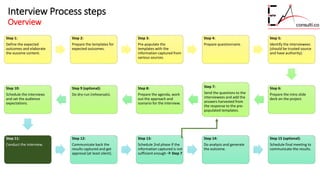
Framework Process steps
Overview
Step 1:
Define the expected
outcomes and elaborate
the oucome content.
Step 2:
Prepare the templates for
expected outcomes.
Step 3:
Pre-populate the
templates with the
information captured from
various sources.
Step 4:
Prepare questionnaire.
Step 5:
Identify the interviewees
(should be trusted source
and have authority).
Step 6:
Prepare the intro slide
deck on the project.
Step 7:
Send the questions to the
interviewees and add the
answers harvested from
the response to the pre-
populated templates.
Step 8:
Prepare the agenda, work
out the approach and
scenario for the interview.
Step 9 (optional):
Do dry-run (rehearsals).
Step 10:
Schedule the interviews
and set the audience
expectations.
Step 11:
Conduct the interview.
Step 12:
Communicate back the
results captured and get
approval (at least silent).
Step 13:
Schedule 2nd phase if the
information captured is not
sufficient enough  Step 7
Step 14:
Do analysis and generate
the outcome.
Step 15 (optional):
Schedule final meeting to
communicate the results.
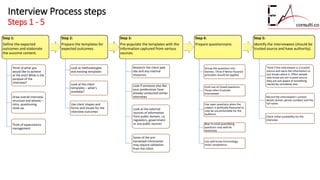
Framework Process steps
Steps 1 - 5
Step 1:
Define the expected
outcomes and elaborate
the oucome content.
Think of what you
would like to achieve
at the end? What is the
purpose of the
interview?
Draw overall interview
structure and phases –
intro, questioning,
close-up.
Think of expectations
management
Step 2:
Prepare the templates for
expected outcomes.
Look at methodologies
and existing templates
Look at the client
templates – what’s
available?
Use client shapes and
forms and visuals for the
interview outcomes
Step 3:
Pre-populate the templates with the
information captured from various
sources.
Research the client web
site and any internal
resources.
Look if someone else like
your predecessor have
already conducted similar
interviews
Look at the external
sources of information
from public domain, i.e.
regulators, government
or any public sources
Some of the pre-
harvested information
may require validation
from the client.
Step 4:
Prepare questionnaire.
Group the questions into
themes. Think if Minto Pyramid
principles should be applied.
Limit use of closed questions.
Those often frustrate
interviewee.
Use open questions when the
subject is politically flavoured or
may be uncomfortable for the
audience.
Bear in mind quantifying
questions may well be
restrictive.
Use well know terminology,
show competence.
Step 5:
Identify the interviewees (should be
trusted source and have authority).
Think if the interviewee is a trusted
source and owns the information or
just knows about it. Often people
who know are not trusted source
they are just aware of something
owned by somebody else.
Record the interviewee’s contact
details (email, phone number) and the
full name.
Check initial availability for the
interview
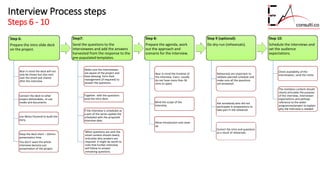
Framework Process steps
Steps 6 - 10
Step 6:
Prepare the intro slide deck
on the project.
Bear in mind the deck will not
only be shown but also sent
over the email and shared
after the interview
Connect the deck to other
project deliverables, re-use
media and documents
Use Minto Pyramid to build the
story.
Keep the deck short – 10mins
presentation time.
You don’t want the whole
interview become just
presentation of the project.
Step7:
Send the questions to the
interviewees and add the answers
harvested from the response to the
pre-populated templates.
Make sure the interviewees
are aware of the project and
have blessing form their
management (if required) to
answer the questions.
Together with the questions
send the Intro deck.
If the interview is scheduled as
a part of the series update the
scheduled with the proposed
interview date.
When questions are sent the
email content should clearly
articulate why answers are
required. It might be worth to
note that further interview
will follow to answer
remaining questions.
Step 8:
Prepare the agenda, work
out the approach and
scenario for the interview.
Bear in mind the timeline of
the interview. Execs usually
do not have more than 30
mins to spare.
Mind the scope of the
interview.
Allow introduction and close-
up.
Step 9 (optional):
Do dry-run (rehearsals).
Rehearsals are important to
validate planned schedule and
make sure all the questions
are answered.
Ask somebody who did not
participate in preparations to
take part in the rehearsal.
Correct the intro and questions
as a result of rehearsals.
Step 10:
Schedule the interviews and
set the audience
expectations.
Check availability of the
interviewees, send the invite.
The invitation content should
clearly articulate the purpose
of the interview, interviewer
expectations and perhaps
reference to the wider
programme/project to explain
why the interview is needed.
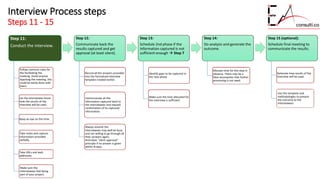
Framework Process steps
Steps 11 - 15
Step 11:
Conduct the interview.
Follow common rules for
the facilitating the
meeting. Avoid anyone
hijacking the meeting, this
could be easily done with
Execs.
Let the interviewee know
how the results of the
interview will be used.
Keep an eye on the time.
Take notes and capture
information provided
verbally.
Take URLs and web
addresses.
Make sure the
interviewees feel being
part of your project.
Step 12:
Communicate back the
results captured and get
approval (at least silent).
Record all the answers provided
into the formalized interview
template created earlier.
Communicate all the
information captured back to
the interviewees and request
confirmation of he captured
information.
Always assume the
interviewees may well be busy
and not willing to go through all
their answers again.
Articulate “silent approval”
principle if no answer is given
within N days.
Step 13:
Schedule 2nd phase if the
information captured is not
sufficient enough  Step 7
Identify gaps to be captured in
the next phase.
Make sure the time allocated for
the interview is sufficient.
Step 14:
Do analysis and generate the
outcome.
Allocate time for this step in
advance. There may be a
false assumption that further
processing is not need.
Step 15 (optional):
Schedule final meeting to
communicate the results.
Reiterate how results of the
interview will be used.
Use the template and
methodologies to present
the outcome to the
interviewees.
Interview Materials
• Templates (pre-populated)
• Questionnaire
• Project introduction slide deck
• Interview Agenda
For series of interviews
• Interview schedule
• Interviewees catalogue
info@ea-consulti.co

Consulting interview framework v1.0

  • 1.
    Enterprise Architecture Consultancy Author: ConsultingInterview Framework v1.0 (edition 1, workbook format) Dmitry Barsukov 22 May 2017 info@ea-consulti.co
  • 2.
    Why this referenceframework is needed? (1) When providing Enterprise Architecture consultancy services the architects often focus on deliverables, not paying enough attention on structuring the interviews and building professional communication channels with the key stakeholders. Consulting Enterprise Architects may only have a few minutes to deliver their message and capturing feedback from the executives. To make matters more challenging the interview time slot could be allocated on a very short notice. Such a compressed timeframe assumes that consultants will only have one shot and this interview attempt should be used the most effectively. An inefficient use of time could prove to be a big mistake.
  • 3.
    Why this referenceframework is needed? (2) The interview framework proposed was developed to facilitate preparation for the interview with top management of the organisations. • It helps to prepare interviews quicker in a structured manner and avoid derailing the interview process. • It highlights main points for considerations when preparing the interview. • It gives food for thoughts in case if the interviewer decides to cut corners in the preparations process. • It helps those who are new in the consultancy business to get them up to speed with preparations of the interview. • It helps experienced consultants to sync up amongst themselves on the interview preparation process.
  • 4.
    Framework Process steps Overview Step1: Define the expected outcomes and elaborate the oucome content. Step 2: Prepare the templates for expected outcomes. Step 3: Pre-populate the templates with the information captured from various sources. Step 4: Prepare questionnaire. Step 5: Identify the interviewees (should be trusted source and have authority). Step 6: Prepare the intro slide deck on the project. Step 7: Send the questions to the interviewees and add the answers harvested from the response to the pre- populated templates. Step 8: Prepare the agenda, work out the approach and scenario for the interview. Step 9 (optional): Do dry-run (rehearsals). Step 10: Schedule the interviews and set the audience expectations. Step 11: Conduct the interview. Step 12: Communicate back the results captured and get approval (at least silent). Step 13: Schedule 2nd phase if the information captured is not sufficient enough  Step 7 Step 14: Do analysis and generate the outcome. Step 15 (optional): Schedule final meeting to communicate the results.
  • 5.
    Framework Process steps Steps1 - 5 Step 1: Define the expected outcomes and elaborate the oucome content. Think of what you would like to achieve at the end? What is the purpose of the interview? Draw overall interview structure and phases – intro, questioning, close-up. Think of expectations management Step 2: Prepare the templates for expected outcomes. Look at methodologies and existing templates Look at the client templates – what’s available? Use client shapes and forms and visuals for the interview outcomes Step 3: Pre-populate the templates with the information captured from various sources. Research the client web site and any internal resources. Look if someone else like your predecessor have already conducted similar interviews Look at the external sources of information from public domain, i.e. regulators, government or any public sources Some of the pre- harvested information may require validation from the client. Step 4: Prepare questionnaire. Group the questions into themes. Think if Minto Pyramid principles should be applied. Limit use of closed questions. Those often frustrate interviewee. Use open questions when the subject is politically flavoured or may be uncomfortable for the audience. Bear in mind quantifying questions may well be restrictive. Use well know terminology, show competence. Step 5: Identify the interviewees (should be trusted source and have authority). Think if the interviewee is a trusted source and owns the information or just knows about it. Often people who know are not trusted source they are just aware of something owned by somebody else. Record the interviewee’s contact details (email, phone number) and the full name. Check initial availability for the interview
  • 6.
    Framework Process steps Steps6 - 10 Step 6: Prepare the intro slide deck on the project. Bear in mind the deck will not only be shown but also sent over the email and shared after the interview Connect the deck to other project deliverables, re-use media and documents Use Minto Pyramid to build the story. Keep the deck short – 10mins presentation time. You don’t want the whole interview become just presentation of the project. Step7: Send the questions to the interviewees and add the answers harvested from the response to the pre-populated templates. Make sure the interviewees are aware of the project and have blessing form their management (if required) to answer the questions. Together with the questions send the Intro deck. If the interview is scheduled as a part of the series update the scheduled with the proposed interview date. When questions are sent the email content should clearly articulate why answers are required. It might be worth to note that further interview will follow to answer remaining questions. Step 8: Prepare the agenda, work out the approach and scenario for the interview. Bear in mind the timeline of the interview. Execs usually do not have more than 30 mins to spare. Mind the scope of the interview. Allow introduction and close- up. Step 9 (optional): Do dry-run (rehearsals). Rehearsals are important to validate planned schedule and make sure all the questions are answered. Ask somebody who did not participate in preparations to take part in the rehearsal. Correct the intro and questions as a result of rehearsals. Step 10: Schedule the interviews and set the audience expectations. Check availability of the interviewees, send the invite. The invitation content should clearly articulate the purpose of the interview, interviewer expectations and perhaps reference to the wider programme/project to explain why the interview is needed.
  • 7.
    Framework Process steps Steps11 - 15 Step 11: Conduct the interview. Follow common rules for the facilitating the meeting. Avoid anyone hijacking the meeting, this could be easily done with Execs. Let the interviewee know how the results of the interview will be used. Keep an eye on the time. Take notes and capture information provided verbally. Take URLs and web addresses. Make sure the interviewees feel being part of your project. Step 12: Communicate back the results captured and get approval (at least silent). Record all the answers provided into the formalized interview template created earlier. Communicate all the information captured back to the interviewees and request confirmation of he captured information. Always assume the interviewees may well be busy and not willing to go through all their answers again. Articulate “silent approval” principle if no answer is given within N days. Step 13: Schedule 2nd phase if the information captured is not sufficient enough  Step 7 Identify gaps to be captured in the next phase. Make sure the time allocated for the interview is sufficient. Step 14: Do analysis and generate the outcome. Allocate time for this step in advance. There may be a false assumption that further processing is not need. Step 15 (optional): Schedule final meeting to communicate the results. Reiterate how results of the interview will be used. Use the template and methodologies to present the outcome to the interviewees.
  • 8.
    Interview Materials • Templates(pre-populated) • Questionnaire • Project introduction slide deck • Interview Agenda For series of interviews • Interview schedule • Interviewees catalogue
  • 9.