The value of
interpersonal skills
Interpersonal skills
Lip-reading or speechreading, is a technique of understanding speech by visually interpreting
the movements of the lips, face and tongue when normal sound is not available, relying also on
information provided by the context, knowledge of the language, and any residual hearing. Lip
reading could be useful when trying to pass a message across the room so communicating from
a distance in a crowded room; if you do not want to let others know what you are talking about
you could use this technique. Another way in which lip reading is a benefit is that in group
discussions it helps the lip reader to eliminate the feeling of self-consciousness or frustration, lip
readers can gain confidence knowing that they could converse anywhere without help of sign
language interpreters. Lip reading is not limited to reading the other person’s lips. Being able to
see the person’s entire face, expressions, gestures and even body movement can help with
reading and better communication. Facial expressions, in particular, can give very important
clues about the topic and the speaker’s mood. However some scenarios make it difficult to use
the lip reading technique such as group discussions because many people in a group could
change the subject easily and its easier for a lip reader to lip read when they just have to follow
on 1 subject. Lip-reading is not a essential skill that is required in all IT jobs but it’s a useful to
have to advance your communication skills.
Interpersonal skills
Having a strong work ethic is viewed favourably by many managers. Work ethic can be split into
three distinct strands, the first of which is professionalism. This incorporates everything from
how you present yourself through to your appearance and the way in which you treat others.
The next strand is respectfulness. All workplaces require you to work under pressure at some
time or another, and exercising grace under stress will earn you more recognition. No matter
how short the deadline or how heated things may get, always retain your diplomacy and poise.
Whether you are communicating with a difficult customer or trying to collaborate on a complex
project fraught with difficulty, do your best to respect everyone’s opinion and understand the
value that they bring to the project. The final strand of a strong work ethic is dependability.
Employers need to know they have employees they can count on. If you are always on time, well
prepared and deliver work when you say you will, this demonstrates your strong work ethic and
commitment to the business. In an uncertain business environment, colleagues, customers and
management will certainly appreciate the stability that you can bring.
Interpersonal skills
When verbally communicating as part of a team working on an IT project it is important to try to
excite and engage the people that you are talking to. As an IT Manager raising and lowering your tone
makes people listen to you better as it makes communication more interesting and captures their
attention. Think of a movie that has exciting background music that constantly changes to set the
scene. This change in volume and pitch makes us excited and engaged in the movie and people who
verbally communicate using these techniques will be much better at engaging their audience and
communicating effectively. As an IT Manager raising and lowering your tone makes people listen to
you better as it makes communication more interesting and captures their attention. Think of a movie
that has exciting background music that constantly changes to set the scene. This change in volume
and pitch makes us excited and engaged in the movie and people who verbally communicate using
these techniques will be much better at engaging their audience and communicating effectively. An
example of how intonation is used could be in presentations when you vary your tone to get your
point across and make it easier for the audience to understand what you are talking about, this
method makes your points more clear. You can do this by emphases a word to show your audience
that is a key word that they should keep mind on. This is a required skill that is used as a tool to
interact and communicate with individuals in an organizational environment
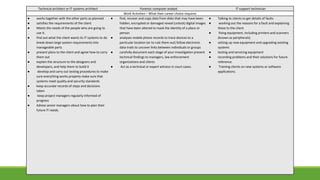
Technical architect or IT systems architect Forensic computer analyst IT support technician
Work Activities – What their career choice requires
● works together with the other parts as planned
● satisfies the requirements of the client
● Meets the needs of the people who are going to
use it.
● find out what the client wants its IT systems to do
break down large system requirements into
manageable parts
● present plans to the client and agree how to carry
them out
● explain the structure to the designers and
developers, and help them to build it
● develop and carry out testing procedures to make
sure everything works properly make sure that
systems meet quality and security standards
● keep accurate records of steps and decisions
taken
● keep project managers regularly informed of
progress
● Advise senior managers about how to plan their
future IT needs.
● find, recover and copy data from disks that may have been
hidden, encrypted or damaged reveal (unlock) digital images
that have been altered to mask the identity of a place or
person
● analyses mobile phone records to trace devices to a
particular location (or to rule them out) follow electronic
data trails to uncover links between individuals or groups
● carefully document each stage of your investigation present
technical findings to managers, law enforcement
organizations and clients
● Act as a technical or expert witness in court cases.
● Talking to clients to get details of faults
● working out the reasons for a fault and explaining
these to the client
● fixing equipment, including printers and scanners
(known as peripherals)
● setting up new equipment and upgrading existing
systems
● testing and servicing equipment
● recording problems and their solutions for future
reference
● Training clients on new systems or software
applications.
Skills, interests and qualities
● Strong problem-solving skills the ability to build
good relationships with clients and colleagues
● The ability to gather and interpret data
● Excellent presentation skills
● A broad knowledge of technologies and
applications
● The ability to explain ideas clearly to technical
and non-technical staff
● A knowledge of industry quality standards,
legislation and best practice
● The ability to work effectively under pressure
and to deadlines
● A flexible and adaptable approach
● A commitment to keep up to date with
technology.
● A creative approach to solving problems
● Attention to detail excellent IT skills
● The ability to spot trends and patterns in large amounts of
data
● A well organized and methodical approach to work
knowledge of information security standards and
legislation
● Excellent communication and presentation skills
● The ability to work under pressure and to deadlines
● The ability to remain objective.
● A thorough knowledge of operating systems,
networking, hardware and software
● Excellent problem-solving skills
● The ability to explain problems and solutions
clearly to non-technical users
● The ability to priorities, work under pressure and
meet deadlines
● A patient and methodical approach
● The ability to work alone or as part of a team
● An awareness of health and safety.
Communication skills
Technical architect requires excellent communication
skills, with the ability to understand client
requirements because they need to meet the needs of
the people who are going to use it. They also need to
present plans to the client and agree how to carry
them out, when facing clients, you need to be able to
be clear and confident when speaking and while
you’re addressing the audience. Most of their time
during their career they need to explain the structure
to the designers and developers, and help them to
build it
To be a forensic computer analyst you need good
communication skills because they need to be able to inform
police or security services, a bank, or for an IT firm that
specializes in computer security. You might also work in a
broader security role so need to be able to present with full
detail. They need to be work under pressure, so they need to be
a confident speaker.
IT support technician needs to be able to communicate
with people in order to locate the problem or fault in
the system and then be able to fix it according to their
needs. IT Support technicians need to train clients on
new systems or software applications, being able to
clearly and succinctly describe what you want done is
extremely important. If you want your team to relate
and work towards the goal.
Working conditions
Technical architect or IT systems architect normal working week would be
around 37 to 40 hours. The ability to prioritize, work under pressure and
meet deadlines. They would be mainly office-based, but you may have to
travel to meet clients. They need the ability to explain ideas clearly too
technical and non-technical staff depending on the contract, and overnight
stays away from home may sometimes be necessary.
Forensic computer analyst work number of hours each week that will
depend on the type of investigation, when it needs to be completed, and
how complex it is. The majority of your work would be office-based, but you
would also go meetings with colleagues and other agencies working on the
case. You may also have to go to court to give evidence, so they need to be
able to keep calm and confident as well as working hard and producing
quality content.
They usually work around 37 hours a week. Their jobs involve being on call
and doing shift work, including weekends. So they are always busy and
need to be very flexible with their time.
Their work is sometimes office based, but may have to visit other
departments within the company. This means they need to communicate
with numbers of different of people in and out of the department.
To travel to external clients or to different locations if your department
supports several sites, they might need to speak a variety of languages.
Specific ICT Skills
Technical architects, also called IT systems architects, work closely with
project managers, software developers and designers to build IT systems.
make sure that systems meet quality and security standards Skills in
different programming languages, frameworks and processes will be
needed for this job. Here are just a few examples:
C# (C sharp) and C++
Java and J2EE
.NET
SQL Server
SharePoint, MS Exchange and cloud services
Oracle and SAP business software applications.
Find, recover and copy data from disks that may have been hidden,
encrypted or damaged. Follow electronic data trails to uncover links
between individuals or groups. Analyse mobile phone records to trace
devices to a particular location .
IT support technician need a thorough knowledge of operating systems,
networking, hardware and software excellent problem-solving skills
Ability To Deal With Pressure
A Technical architect or IT systems architect
Should be able to deal with pressure in the work place. As a Technical
architect or IT systems architect will have a lot of deadlines that may cause
stress. It is essential that you are able to deal with pressure and complete
any task within the time limit given.
As a Forensic computer analyst they will encounter a lot of pressure as you
are given tasks with deadlines and if you use your organizational skills you
can be stress free. Although there are some challenging tasks and you are
given less time to complete.

Skills

  • 1.
  • 2.
    Interpersonal skills Lip-reading orspeechreading, is a technique of understanding speech by visually interpreting the movements of the lips, face and tongue when normal sound is not available, relying also on information provided by the context, knowledge of the language, and any residual hearing. Lip reading could be useful when trying to pass a message across the room so communicating from a distance in a crowded room; if you do not want to let others know what you are talking about you could use this technique. Another way in which lip reading is a benefit is that in group discussions it helps the lip reader to eliminate the feeling of self-consciousness or frustration, lip readers can gain confidence knowing that they could converse anywhere without help of sign language interpreters. Lip reading is not limited to reading the other person’s lips. Being able to see the person’s entire face, expressions, gestures and even body movement can help with reading and better communication. Facial expressions, in particular, can give very important clues about the topic and the speaker’s mood. However some scenarios make it difficult to use the lip reading technique such as group discussions because many people in a group could change the subject easily and its easier for a lip reader to lip read when they just have to follow on 1 subject. Lip-reading is not a essential skill that is required in all IT jobs but it’s a useful to have to advance your communication skills.
  • 3.
    Interpersonal skills Having astrong work ethic is viewed favourably by many managers. Work ethic can be split into three distinct strands, the first of which is professionalism. This incorporates everything from how you present yourself through to your appearance and the way in which you treat others. The next strand is respectfulness. All workplaces require you to work under pressure at some time or another, and exercising grace under stress will earn you more recognition. No matter how short the deadline or how heated things may get, always retain your diplomacy and poise. Whether you are communicating with a difficult customer or trying to collaborate on a complex project fraught with difficulty, do your best to respect everyone’s opinion and understand the value that they bring to the project. The final strand of a strong work ethic is dependability. Employers need to know they have employees they can count on. If you are always on time, well prepared and deliver work when you say you will, this demonstrates your strong work ethic and commitment to the business. In an uncertain business environment, colleagues, customers and management will certainly appreciate the stability that you can bring.
  • 4.
    Interpersonal skills When verballycommunicating as part of a team working on an IT project it is important to try to excite and engage the people that you are talking to. As an IT Manager raising and lowering your tone makes people listen to you better as it makes communication more interesting and captures their attention. Think of a movie that has exciting background music that constantly changes to set the scene. This change in volume and pitch makes us excited and engaged in the movie and people who verbally communicate using these techniques will be much better at engaging their audience and communicating effectively. As an IT Manager raising and lowering your tone makes people listen to you better as it makes communication more interesting and captures their attention. Think of a movie that has exciting background music that constantly changes to set the scene. This change in volume and pitch makes us excited and engaged in the movie and people who verbally communicate using these techniques will be much better at engaging their audience and communicating effectively. An example of how intonation is used could be in presentations when you vary your tone to get your point across and make it easier for the audience to understand what you are talking about, this method makes your points more clear. You can do this by emphases a word to show your audience that is a key word that they should keep mind on. This is a required skill that is used as a tool to interact and communicate with individuals in an organizational environment
  • 5.
    Technical architect orIT systems architect Forensic computer analyst IT support technician Work Activities – What their career choice requires ● works together with the other parts as planned ● satisfies the requirements of the client ● Meets the needs of the people who are going to use it. ● find out what the client wants its IT systems to do break down large system requirements into manageable parts ● present plans to the client and agree how to carry them out ● explain the structure to the designers and developers, and help them to build it ● develop and carry out testing procedures to make sure everything works properly make sure that systems meet quality and security standards ● keep accurate records of steps and decisions taken ● keep project managers regularly informed of progress ● Advise senior managers about how to plan their future IT needs. ● find, recover and copy data from disks that may have been hidden, encrypted or damaged reveal (unlock) digital images that have been altered to mask the identity of a place or person ● analyses mobile phone records to trace devices to a particular location (or to rule them out) follow electronic data trails to uncover links between individuals or groups ● carefully document each stage of your investigation present technical findings to managers, law enforcement organizations and clients ● Act as a technical or expert witness in court cases. ● Talking to clients to get details of faults ● working out the reasons for a fault and explaining these to the client ● fixing equipment, including printers and scanners (known as peripherals) ● setting up new equipment and upgrading existing systems ● testing and servicing equipment ● recording problems and their solutions for future reference ● Training clients on new systems or software applications.
  • 6.
    Skills, interests andqualities ● Strong problem-solving skills the ability to build good relationships with clients and colleagues ● The ability to gather and interpret data ● Excellent presentation skills ● A broad knowledge of technologies and applications ● The ability to explain ideas clearly to technical and non-technical staff ● A knowledge of industry quality standards, legislation and best practice ● The ability to work effectively under pressure and to deadlines ● A flexible and adaptable approach ● A commitment to keep up to date with technology. ● A creative approach to solving problems ● Attention to detail excellent IT skills ● The ability to spot trends and patterns in large amounts of data ● A well organized and methodical approach to work knowledge of information security standards and legislation ● Excellent communication and presentation skills ● The ability to work under pressure and to deadlines ● The ability to remain objective. ● A thorough knowledge of operating systems, networking, hardware and software ● Excellent problem-solving skills ● The ability to explain problems and solutions clearly to non-technical users ● The ability to priorities, work under pressure and meet deadlines ● A patient and methodical approach ● The ability to work alone or as part of a team ● An awareness of health and safety. Communication skills Technical architect requires excellent communication skills, with the ability to understand client requirements because they need to meet the needs of the people who are going to use it. They also need to present plans to the client and agree how to carry them out, when facing clients, you need to be able to be clear and confident when speaking and while you’re addressing the audience. Most of their time during their career they need to explain the structure to the designers and developers, and help them to build it To be a forensic computer analyst you need good communication skills because they need to be able to inform police or security services, a bank, or for an IT firm that specializes in computer security. You might also work in a broader security role so need to be able to present with full detail. They need to be work under pressure, so they need to be a confident speaker. IT support technician needs to be able to communicate with people in order to locate the problem or fault in the system and then be able to fix it according to their needs. IT Support technicians need to train clients on new systems or software applications, being able to clearly and succinctly describe what you want done is extremely important. If you want your team to relate and work towards the goal.
  • 7.
    Working conditions Technical architector IT systems architect normal working week would be around 37 to 40 hours. The ability to prioritize, work under pressure and meet deadlines. They would be mainly office-based, but you may have to travel to meet clients. They need the ability to explain ideas clearly too technical and non-technical staff depending on the contract, and overnight stays away from home may sometimes be necessary. Forensic computer analyst work number of hours each week that will depend on the type of investigation, when it needs to be completed, and how complex it is. The majority of your work would be office-based, but you would also go meetings with colleagues and other agencies working on the case. You may also have to go to court to give evidence, so they need to be able to keep calm and confident as well as working hard and producing quality content. They usually work around 37 hours a week. Their jobs involve being on call and doing shift work, including weekends. So they are always busy and need to be very flexible with their time. Their work is sometimes office based, but may have to visit other departments within the company. This means they need to communicate with numbers of different of people in and out of the department. To travel to external clients or to different locations if your department supports several sites, they might need to speak a variety of languages. Specific ICT Skills Technical architects, also called IT systems architects, work closely with project managers, software developers and designers to build IT systems. make sure that systems meet quality and security standards Skills in different programming languages, frameworks and processes will be needed for this job. Here are just a few examples: C# (C sharp) and C++ Java and J2EE .NET SQL Server SharePoint, MS Exchange and cloud services Oracle and SAP business software applications. Find, recover and copy data from disks that may have been hidden, encrypted or damaged. Follow electronic data trails to uncover links between individuals or groups. Analyse mobile phone records to trace devices to a particular location . IT support technician need a thorough knowledge of operating systems, networking, hardware and software excellent problem-solving skills Ability To Deal With Pressure A Technical architect or IT systems architect Should be able to deal with pressure in the work place. As a Technical architect or IT systems architect will have a lot of deadlines that may cause stress. It is essential that you are able to deal with pressure and complete any task within the time limit given. As a Forensic computer analyst they will encounter a lot of pressure as you are given tasks with deadlines and if you use your organizational skills you can be stress free. Although there are some challenging tasks and you are given less time to complete.