
CONSULTATIVE NEGOTIATIONS
1% 8%=
Discount
Operating
Margin
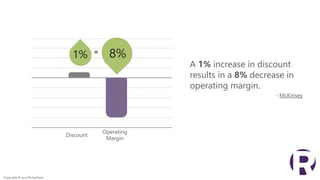
A 1% increase in discount
results in a 8% decrease in
operating margin.
- McKinsey
Copyright © 2017 Richardson
Harvard Business Review reported on a study from
Wharton and MIT which “shows that people with
higher EQ [emotional intelligence] are more likely to
induce positive mood states in their negotiation
counterparts and leave them more satisfied with the
outcome of the negotiation."
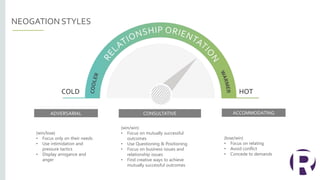
NEOGATION STYLES
COLD HOT
ADVERSARIAL CONSULTATIVE ACCOMMODATING
(win/lose)
• Focus only on their needs
• Use intimidation and
pressure tactics
• Display arrogance and
anger
(win/win)
• Focus on mutually successful
outcomes
• Use Questioning & Positioning
• Focus on business issues and
relationship issues
• Find creative ways to achieve
mutually successful outcomes
(lose/win)
• Focus on relating
• Avoid conflict
• Concede to demands
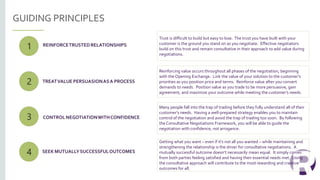
GUIDING PRINCIPLES
Trust is difficult to build but easy to lose. The trust you have built with your
customer is the ground you stand on as you negotiate. Effective negotiators
build on this trust and remain consultative in their approach to add value during
negotiations.
Reinforcing value occurs throughout all phases of the negotiation, beginning
with the Opening Exchange. Link the value of your solution to the customer’s
priorities as you position price and terms. Reinforce value after you convert
demands to needs. Position value as you trade to be more persuasive, gain
agreement, and maximize your outcome while meeting the customer’s needs.
Many people fall into the trap of trading before they fully understand all of their
customer’s needs. Having a well-prepared strategy enables you to maintain
control of the negotiation and avoid the trap of trading too soon. By following
the Consultative Negotiations Framework, you will be able to guide the
negotiation with confidence, not arrogance.
Getting what you want – even if it’s not all you wanted – while maintaining and
strengthening the relationship is the driver for consultative negotiations. A
mutually successful outcome doesn’t necessarily mean equal. It simply comes
from both parties feeling satisfied and having their essential needs met. Using
the consultative approach will contribute to the most rewarding and creative
outcomes for all.
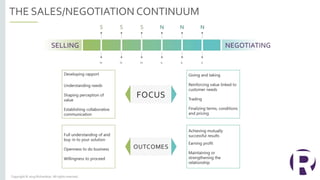
THE SALES/NEGOTIATION CONTINUUM
Copyright © 2019 Richardson.All rights reserved.
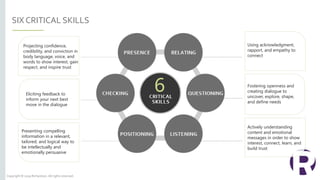
SIX CRITICAL SKILLS
Copyright © 2019 Richardson.All rights reserved.
Using acknowledgment,
rapport, and empathy to
connect
Actively understanding
content and emotional
messages in order to show
interest, connect, learn, and
build trust
Fostering openness and
creating dialogue to
uncover, explore, shape,
and define needs
Projecting confidence,
credibility, and conviction in
body language, voice, and
words to show interest, gain
respect, and inspire trust
Presenting compelling
information in a relevant,
tailored, and logical way to
be intellectually and
emotionally persuasive
Eliciting feedback to
inform your next best
move in the dialogue
OPEN
Your actions during the
opening exchange enable
you to gain control of the
process, set the tone, and
anchor the negotiation.
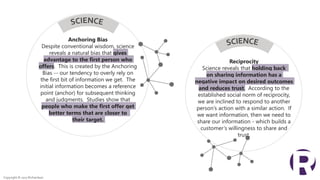
Anchoring Bias
Despite conventional wisdom, science
reveals a natural bias that gives
advantage to the first person who
offers. This is created by the Anchoring
Bias -- our tendency to overly rely on
the first bit of information we get. The
initial information becomes a reference
point (anchor) for subsequent thinking
and judgments. Studies show that
people who make the first offer get
better terms that are closer to
their target.
Reciprocity
Science reveals that holding back
on sharing information has a
negative impact on desired outcomes
and reduces trust. According to the
established social norm of reciprocity,
we are inclined to respond to another
person’s action with a similar action. If
we want information, then we need to
share our information - which builds a
customer’s willingness to share and
trust.
Copyright © 2017 Richardson
CONTROL
Customer requests and demands
are a starting point. What you
do with them determines
your outcome.
Copyright © 2017 Richardson
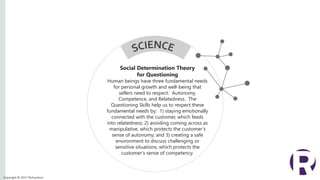
Social Determination Theory
for Questioning
Human beings have three fundamental needs
for personal growth and well-being that
sellers need to respect: Autonomy,
Competence, and Relatedness. The
Questioning Skills help us to respect these
fundamental needs by: 1) staying emotionally
connected with the customer, which feeds
into relatedness; 2) avoiding coming across as
manipulative, which protects the customer’s
sense of autonomy; and 3) creating a safe
environment to discuss challenging or
sensitive situations, which protects the
customer’s sense of competency.
Copyright © 2017 Richardson
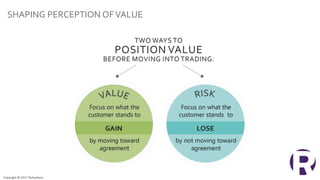
SHAPING PERCEPTION OFVALUE
TRADE
Change the price,
change the deal.
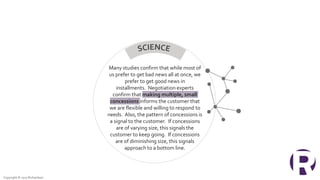
Many studies confirm that while most of
us prefer to get bad news all at once, we
prefer to get good news in
installments. Negotiation experts
confirm that making multiple, small
concessions informs the customer that
we are flexible and willing to respond to
needs. Also, the pattern of concessions is
a signal to the customer. If concessions
are of varying size, this signals the
customer to keep going. If concessions
are of diminishing size, this signals
approach to a bottom line.
Copyright © 2017 Richardson
HOW
CAN WE HELP YOU DRIVE
SALES EXCELLENCE?
Richardson’s Consultative
Negotiations
 Blended Solution
 One-day facilitated
workshop (Richardson-
led or train-the-trainer)
 Accelerate Digital
Learning Platform
RICHARDSON ACCELERATETM
DIGITAL LEARNING PLATFORM
Copyright © 2019 Richardson.All rights reserved.
ANY DEVICE. ANYWHERE.
www.Richardson.com
215-940-9255
Meghan.Steiner@Richardson.comLET’S GET IN TOUCH
Consultative Negotiations

Consultative Negotiations

  • 1.
  • 2.
    1% 8%= Discount Operating Margin A 1%increase in discount results in a 8% decrease in operating margin. - McKinsey Copyright © 2017 Richardson
  • 3.
    Copyright © 2017Richardson Harvard Business Review reported on a study from Wharton and MIT which “shows that people with higher EQ [emotional intelligence] are more likely to induce positive mood states in their negotiation counterparts and leave them more satisfied with the outcome of the negotiation."
  • 4.
    NEOGATION STYLES COLD HOT ADVERSARIALCONSULTATIVE ACCOMMODATING (win/lose) • Focus only on their needs • Use intimidation and pressure tactics • Display arrogance and anger (win/win) • Focus on mutually successful outcomes • Use Questioning & Positioning • Focus on business issues and relationship issues • Find creative ways to achieve mutually successful outcomes (lose/win) • Focus on relating • Avoid conflict • Concede to demands
  • 5.
    GUIDING PRINCIPLES Trust isdifficult to build but easy to lose. The trust you have built with your customer is the ground you stand on as you negotiate. Effective negotiators build on this trust and remain consultative in their approach to add value during negotiations. Reinforcing value occurs throughout all phases of the negotiation, beginning with the Opening Exchange. Link the value of your solution to the customer’s priorities as you position price and terms. Reinforce value after you convert demands to needs. Position value as you trade to be more persuasive, gain agreement, and maximize your outcome while meeting the customer’s needs. Many people fall into the trap of trading before they fully understand all of their customer’s needs. Having a well-prepared strategy enables you to maintain control of the negotiation and avoid the trap of trading too soon. By following the Consultative Negotiations Framework, you will be able to guide the negotiation with confidence, not arrogance. Getting what you want – even if it’s not all you wanted – while maintaining and strengthening the relationship is the driver for consultative negotiations. A mutually successful outcome doesn’t necessarily mean equal. It simply comes from both parties feeling satisfied and having their essential needs met. Using the consultative approach will contribute to the most rewarding and creative outcomes for all.
  • 6.
    THE SALES/NEGOTIATION CONTINUUM Copyright© 2019 Richardson.All rights reserved.
  • 7.
    SIX CRITICAL SKILLS Copyright© 2019 Richardson.All rights reserved. Using acknowledgment, rapport, and empathy to connect Actively understanding content and emotional messages in order to show interest, connect, learn, and build trust Fostering openness and creating dialogue to uncover, explore, shape, and define needs Projecting confidence, credibility, and conviction in body language, voice, and words to show interest, gain respect, and inspire trust Presenting compelling information in a relevant, tailored, and logical way to be intellectually and emotionally persuasive Eliciting feedback to inform your next best move in the dialogue
  • 8.
    OPEN Your actions duringthe opening exchange enable you to gain control of the process, set the tone, and anchor the negotiation.
  • 9.
    Anchoring Bias Despite conventionalwisdom, science reveals a natural bias that gives advantage to the first person who offers. This is created by the Anchoring Bias -- our tendency to overly rely on the first bit of information we get. The initial information becomes a reference point (anchor) for subsequent thinking and judgments. Studies show that people who make the first offer get better terms that are closer to their target. Reciprocity Science reveals that holding back on sharing information has a negative impact on desired outcomes and reduces trust. According to the established social norm of reciprocity, we are inclined to respond to another person’s action with a similar action. If we want information, then we need to share our information - which builds a customer’s willingness to share and trust. Copyright © 2017 Richardson
  • 10.
    CONTROL Customer requests anddemands are a starting point. What you do with them determines your outcome.
  • 11.
    Copyright © 2017Richardson Social Determination Theory for Questioning Human beings have three fundamental needs for personal growth and well-being that sellers need to respect: Autonomy, Competence, and Relatedness. The Questioning Skills help us to respect these fundamental needs by: 1) staying emotionally connected with the customer, which feeds into relatedness; 2) avoiding coming across as manipulative, which protects the customer’s sense of autonomy; and 3) creating a safe environment to discuss challenging or sensitive situations, which protects the customer’s sense of competency.
  • 12.
    Copyright © 2017Richardson SHAPING PERCEPTION OFVALUE
  • 13.
  • 14.
    Many studies confirmthat while most of us prefer to get bad news all at once, we prefer to get good news in installments. Negotiation experts confirm that making multiple, small concessions informs the customer that we are flexible and willing to respond to needs. Also, the pattern of concessions is a signal to the customer. If concessions are of varying size, this signals the customer to keep going. If concessions are of diminishing size, this signals approach to a bottom line. Copyright © 2017 Richardson
  • 15.
    HOW CAN WE HELPYOU DRIVE SALES EXCELLENCE? Richardson’s Consultative Negotiations  Blended Solution  One-day facilitated workshop (Richardson- led or train-the-trainer)  Accelerate Digital Learning Platform
  • 16.
    RICHARDSON ACCELERATETM DIGITAL LEARNINGPLATFORM Copyright © 2019 Richardson.All rights reserved. ANY DEVICE. ANYWHERE. www.Richardson.com 215-940-9255 Meghan.Steiner@Richardson.comLET’S GET IN TOUCH

Editor's Notes

  • #7  In a typical measurement journey, our story has 4 chapters. (Where are these results from? All of our clients?) - We begin with Learner Satisfaction – The primary job of this stage of your sales transformation is to drive engagement and participation from your sales audience. You can’t be successful with any change initiative, unless the participants are 100% participating . Selecting the right content, applying a design approach that drives relevancy to the sellers environment and facilitation / delivery of content that challenges and inspires the seller must leave your audience with an intention to change. Here we measure content relevancy, seller satisfaction, and commitment to change. - Chapter 2 of the journey is knowledge retention. To what degree can sellers recall the relevant, best practices when faced with customer scenarios after the formal learning phase has been completed? Sellers can practice new skills unless then can remember what they are trying to do – he we measure knowledge recall, with an expectation that this will improve (not deteriorate) over time. Here, learner engagement with QuickCheck in the 12 weeks after training drove knowledge retention up 17 points or 25% - Chapter 3 is The extent to which behaviors of sellers change over time – here we measure changes in discreet skill proficiency against both pre-training baselines and established benchmarks. Here, even 6 months after training, learners report to have incorporated significantly more of the desired sales behaviors into their daily activity. - Only when sellers are committed to change, can recall what they need to know / do and are practicing these new skills will we arrive at our final chapter – changes in operational / business outcomes. Here we can quantify impact and return. Here, 16% more of the learner population reported being at quota for 3 quarters after training – a 76% improvement ((John and Alan – you might want to be prepared to answer what good looks like in each level. I.e. someone might ask – is 83% knowledge retention good or not? We don’t really give a best practice benchmark here.)) **Only 3 quarters worth of data available for 2017 as survey was completed during Q4 Lets take a closer look at these sales metrics
  • #8 <<SLIDE INSTRUCTIONS>> <<SPEAKER NOTES>>
  • #16 For those of you who are interested in learning more about how Richardson can support you in improving the negotiation skills of your sales team, contact us to learn about our blended solution, featuring a two day ILT program, TTT options, blended with our digital learning platform, Richardson Accelerate. 
  • #17  In a typical measurement journey, our story has 4 chapters. (Where are these results from? All of our clients?) - We begin with Learner Satisfaction – The primary job of this stage of your sales transformation is to drive engagement and participation from your sales audience. You can’t be successful with any change initiative, unless the participants are 100% participating . Selecting the right content, applying a design approach that drives relevancy to the sellers environment and facilitation / delivery of content that challenges and inspires the seller must leave your audience with an intention to change. Here we measure content relevancy, seller satisfaction, and commitment to change. - Chapter 2 of the journey is knowledge retention. To what degree can sellers recall the relevant, best practices when faced with customer scenarios after the formal learning phase has been completed? Sellers can practice new skills unless then can remember what they are trying to do – he we measure knowledge recall, with an expectation that this will improve (not deteriorate) over time. Here, learner engagement with QuickCheck in the 12 weeks after training drove knowledge retention up 17 points or 25% - Chapter 3 is The extent to which behaviors of sellers change over time – here we measure changes in discreet skill proficiency against both pre-training baselines and established benchmarks. Here, even 6 months after training, learners report to have incorporated significantly more of the desired sales behaviors into their daily activity. - Only when sellers are committed to change, can recall what they need to know / do and are practicing these new skills will we arrive at our final chapter – changes in operational / business outcomes. Here we can quantify impact and return. Here, 16% more of the learner population reported being at quota for 3 quarters after training – a 76% improvement ((John and Alan – you might want to be prepared to answer what good looks like in each level. I.e. someone might ask – is 83% knowledge retention good or not? We don’t really give a best practice benchmark here.)) **Only 3 quarters worth of data available for 2017 as survey was completed during Q4 Lets take a closer look at these sales metrics