


Part of the BRE Trust 
Overheating in UK Dwellings Mich Swainson 
BRE 
5th November 2014 
2014 | BRE – HVAC Engineering
Overheating and excess heat
CIBSE Overheating risk (CIBSE Guide A 2006) 
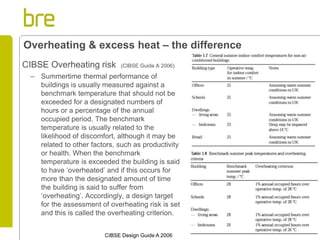
–Summertime thermal performance of buildings is usually measured against a benchmark temperature that should not be exceeded for a designated numbers of hours or a percentage of the annual occupied period. The benchmark temperature is usually related to the likelihood of discomfort, although it may be related to other factors, such as productivity or health. When the benchmark temperature is exceeded the building is said to have ‘overheated’ and if this occurs for more than the designated amount of time the building is said to suffer from ‘overheating’. Accordingly, a design target for the assessment of overheating risk is set and this is called the overheating criterion. 
Overheating & excess heat – the difference 
CIBSE Design Guide A 2006
–Assessment of risk of overheating through SAP 
–Prior to the 2005 version of SAP, no overheating calculation was undertaken 
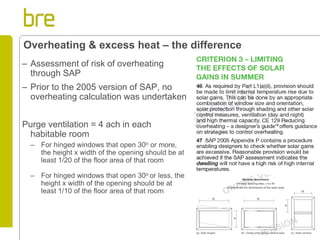
Purge ventilation = 4 ach in each habitable room 
–For hinged windows that open 30o or more, the height x width of the opening should be at least 1/20 of the floor area of that room 
–For hinged windows that open 30o or less, the height x width of the opening should be at least 1/10 of the floor area of that room 
Overheating & excess heat – the difference
Excess heat and heat stress 
–As temperatures rise, thermal stress increases, initially triggering the body’s defence mechanisms such as sweating. High temperatures can increase cardiovascular strain and trauma, and where temperatures exceed 25°C, mortality increases and there is an increase in strokes. Dehydration is a problem primarily for the elderly and the very young. 
Excess heat is the elevation of internal temperatures within a building over a sustained period. The evidence suggests that the key to recovering from a hot day is a cool night, and a good sleep. If this is disturbed over a long period then we have moved from overheating and thermal comfort criteria to a potential hazard to health. 
Overheating & excess heat – the difference
Sources of heat
Heat is either generated inside the building or is transmitted (and drawn) through the building fabric from outside. 
External sources of heat 
–The outside air temperature around the dwelling is greater than that internally. This will result in conduction of heat through the building fabric and increase the internal air temperature as this air is used for ventilation. 
Sources of heat 
–Solar gains, direct through glazing or indirect through opaque elements of building fabric. Internal sources of heat 
–Occupants and equipment used by occupants. 
–Heat liberated from systems in dwelling – DHW cylinders, etc. 
–Heat liberated from communal heating systems.
Conduction of heat through the opaque fabric of the building 
–This heat transfer is a direct function of the U Value of each of the fabric elements, However the heat transferred is not only a function of the outside air temperature – incident solar radiation heats the outside surface of the fabric raising the temperature. Therefore colour of the outside surface is also important. 
Ventilation 
–During hot periods of weather the outside air temperature is above that internally and ventilation results in the internal air temperature increasing rather than reducing. 
Sources of heat – External
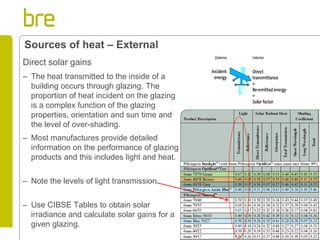
Direct solar gains 
– The heat transmitted to the inside of a 
building occurs through glazing. The 
proportion of heat incident on the glazing 
is a complex function of the glazing 
properties, orientation and sun time and 
the level of over-shading. 
– Most manufactures provide detailed 
information on the performance of glazing 
products and this includes light and heat. 
– Note the levels of light transmission 
– Use CIBSE Tables to obtain solar 
irradiance and calculate solar gains for a 
given glazing. 
Sources of heat – External
Sources of heat – Internal 
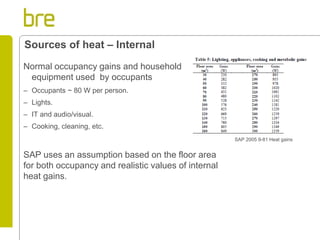
Normal occupancy gains and household 
equipment used by occupants 
– Occupants ~ 80 W per person. 
– Lights. 
– IT and audio/visual. 
– Cooking, cleaning, etc. 
SAP uses an assumption based on the floor area 
for both occupancy and realistic values of internal 
heat gains. 
SAP 2005 9-81 Heat gains
Sources of heat – Internal 
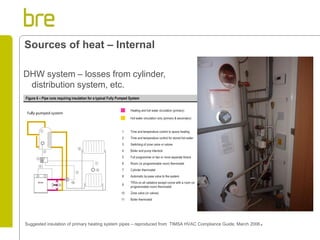
DHW system – losses from cylinder, 
distribution system, etc. 
Suggested insulation of primary heating system pipes – reproduced from TIMSA HVAC Compliance Guide, March 2006.
Sources of heat – Internal 
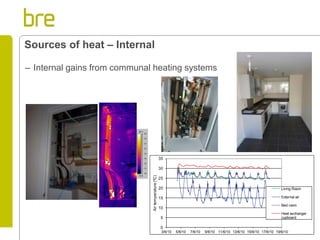
–Internal gains from communal heating systems 051015202530353/6/105/6/107/6/109/6/1011/6/1013/6/1015/6/1017/6/1019/6/10 Air temperature (ºC) Living RoomExternal airBed roomHeat exchangercupboard
Factors influencing the risk of overheating
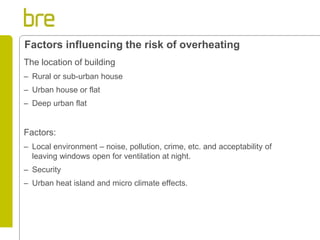
The location of building 
–Rural or sub-urban house 
–Urban house or flat 
–Deep urban flat 
Factors: 
–Local environment – noise, pollution, crime, etc. and acceptability of leaving windows open for ventilation at night. 
–Security 
–Urban heat island and micro climate effects. 
Factors influencing the risk of overheating
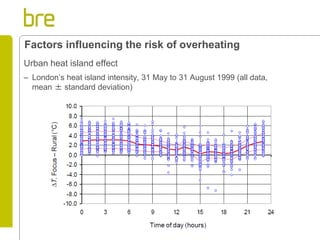
Urban heat island effect 
–London’s heat island intensity, 31 May to 31 August 1999 (all data, mean ± standard deviation) 
Factors influencing the risk of overheating
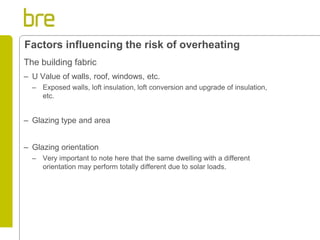
The building fabric 
–U Value of walls, roof, windows, etc. 
–Exposed walls, loft insulation, loft conversion and upgrade of insulation, etc. 
–Glazing type and area 
–Glazing orientation 
–Very important to note here that the same dwelling with a different orientation may perform totally different due to solar loads. 
Factors influencing the risk of overheating
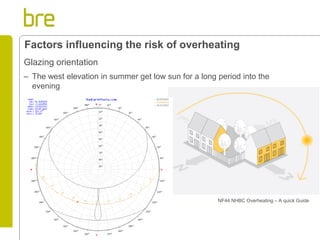
Glazing orientation 
– The west elevation in summer get low sun for a long period into the 
evening 
Factors influencing the risk of overheating 
NF44 NHBC Overheating – A quick Guide
Solar gains 
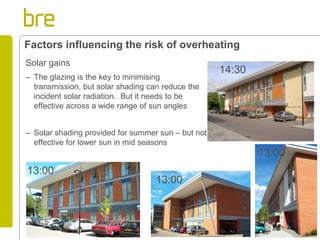
–The glazing is the key to minimising transmission, but solar shading can reduce the incident solar radiation. But it needs to be effective across a wide range of sun angles 
–Solar shading provided for summer sun – but not effective for lower sun in mid seasons 
Factors influencing the risk of overheating 
13:00 
13:00 
13:00 
14:30
Factors influencing the risk of overheating 
Solar gains 
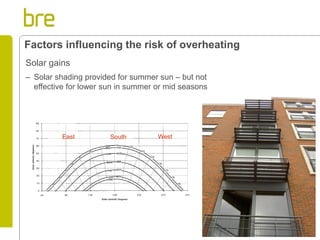
–Solar shading provided for summer sun – but not effective for lower sun in summer or mid seasons 
South 
West 
East
Factors influencing the risk of overheating 
The effect of thermal mass 
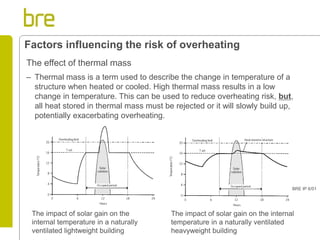
– Thermal mass is a term used to describe the change in temperature of a 
structure when heated or cooled. High thermal mass results in a low 
change in temperature. This can be used to reduce overheating risk, but, 
all heat stored in thermal mass must be rejected or it will slowly build up, 
potentially exacerbating overheating. 
BRE IP 6/01 
The impact of solar gain on the internal 
temperature in a naturally ventilated 
heavyweight building 
The impact of solar gain on the 
internal temperature in a naturally 
ventilated lightweight building
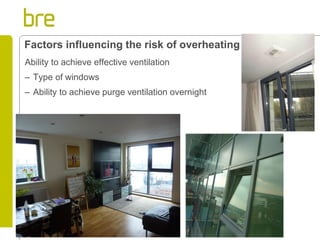
Ability to achieve effective ventilation 
–Type of windows 
–Ability to achieve purge ventilation overnight 
Factors influencing the risk of overheating
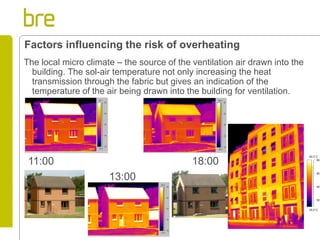
The local micro climate – the source of the ventilation air drawn into the building. The sol-air temperature not only increasing the heat transmission through the fabric but gives an indication of the temperature of the air being drawn into the building for ventilation. 
Factors influencing the risk of overheating 
11:00 
13:00 
18:00
Factors influencing the risk of overheating 
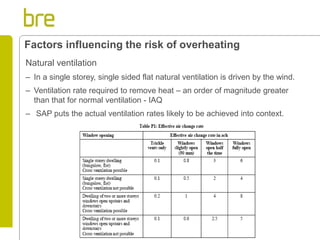
Natural ventilation 
–In a single storey, single sided flat natural ventilation is driven by the wind. 
–Ventilation rate required to remove heat – an order of magnitude greater than that for normal ventilation - IAQ 
– SAP puts the actual ventilation rates likely to be achieved into context.
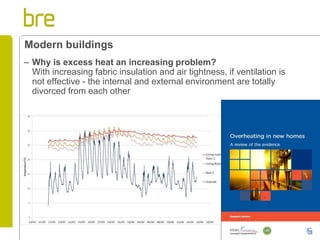
–Why is excess heat an increasing problem? With increasing fabric insulation and air tightness, if ventilation is not effective - the internal and external environment are totally divorced from each other 
Modern buildings
Thank you 
swainsonm@bre.co.uk 
2014| BRE – HVAC Engineering

Overheating in UK dwellings

  • 1.
    Part of theBRE Trust Overheating in UK Dwellings Mich Swainson BRE 5th November 2014 2014 | BRE – HVAC Engineering
  • 2.
  • 3.
    CIBSE Overheating risk(CIBSE Guide A 2006) –Summertime thermal performance of buildings is usually measured against a benchmark temperature that should not be exceeded for a designated numbers of hours or a percentage of the annual occupied period. The benchmark temperature is usually related to the likelihood of discomfort, although it may be related to other factors, such as productivity or health. When the benchmark temperature is exceeded the building is said to have ‘overheated’ and if this occurs for more than the designated amount of time the building is said to suffer from ‘overheating’. Accordingly, a design target for the assessment of overheating risk is set and this is called the overheating criterion. Overheating & excess heat – the difference CIBSE Design Guide A 2006
  • 4.
    –Assessment of riskof overheating through SAP –Prior to the 2005 version of SAP, no overheating calculation was undertaken Purge ventilation = 4 ach in each habitable room –For hinged windows that open 30o or more, the height x width of the opening should be at least 1/20 of the floor area of that room –For hinged windows that open 30o or less, the height x width of the opening should be at least 1/10 of the floor area of that room Overheating & excess heat – the difference
  • 5.
    Excess heat andheat stress –As temperatures rise, thermal stress increases, initially triggering the body’s defence mechanisms such as sweating. High temperatures can increase cardiovascular strain and trauma, and where temperatures exceed 25°C, mortality increases and there is an increase in strokes. Dehydration is a problem primarily for the elderly and the very young. Excess heat is the elevation of internal temperatures within a building over a sustained period. The evidence suggests that the key to recovering from a hot day is a cool night, and a good sleep. If this is disturbed over a long period then we have moved from overheating and thermal comfort criteria to a potential hazard to health. Overheating & excess heat – the difference
  • 6.
  • 7.
    Heat is eithergenerated inside the building or is transmitted (and drawn) through the building fabric from outside. External sources of heat –The outside air temperature around the dwelling is greater than that internally. This will result in conduction of heat through the building fabric and increase the internal air temperature as this air is used for ventilation. Sources of heat –Solar gains, direct through glazing or indirect through opaque elements of building fabric. Internal sources of heat –Occupants and equipment used by occupants. –Heat liberated from systems in dwelling – DHW cylinders, etc. –Heat liberated from communal heating systems.
  • 8.
    Conduction of heatthrough the opaque fabric of the building –This heat transfer is a direct function of the U Value of each of the fabric elements, However the heat transferred is not only a function of the outside air temperature – incident solar radiation heats the outside surface of the fabric raising the temperature. Therefore colour of the outside surface is also important. Ventilation –During hot periods of weather the outside air temperature is above that internally and ventilation results in the internal air temperature increasing rather than reducing. Sources of heat – External
  • 9.
    Direct solar gains – The heat transmitted to the inside of a building occurs through glazing. The proportion of heat incident on the glazing is a complex function of the glazing properties, orientation and sun time and the level of over-shading. – Most manufactures provide detailed information on the performance of glazing products and this includes light and heat. – Note the levels of light transmission – Use CIBSE Tables to obtain solar irradiance and calculate solar gains for a given glazing. Sources of heat – External
  • 10.
    Sources of heat– Internal Normal occupancy gains and household equipment used by occupants – Occupants ~ 80 W per person. – Lights. – IT and audio/visual. – Cooking, cleaning, etc. SAP uses an assumption based on the floor area for both occupancy and realistic values of internal heat gains. SAP 2005 9-81 Heat gains
  • 11.
    Sources of heat– Internal DHW system – losses from cylinder, distribution system, etc. Suggested insulation of primary heating system pipes – reproduced from TIMSA HVAC Compliance Guide, March 2006.
  • 12.
    Sources of heat– Internal –Internal gains from communal heating systems 051015202530353/6/105/6/107/6/109/6/1011/6/1013/6/1015/6/1017/6/1019/6/10 Air temperature (ºC) Living RoomExternal airBed roomHeat exchangercupboard
  • 13.
    Factors influencing therisk of overheating
  • 14.
    The location ofbuilding –Rural or sub-urban house –Urban house or flat –Deep urban flat Factors: –Local environment – noise, pollution, crime, etc. and acceptability of leaving windows open for ventilation at night. –Security –Urban heat island and micro climate effects. Factors influencing the risk of overheating
  • 15.
    Urban heat islandeffect –London’s heat island intensity, 31 May to 31 August 1999 (all data, mean ± standard deviation) Factors influencing the risk of overheating
  • 16.
    The building fabric –U Value of walls, roof, windows, etc. –Exposed walls, loft insulation, loft conversion and upgrade of insulation, etc. –Glazing type and area –Glazing orientation –Very important to note here that the same dwelling with a different orientation may perform totally different due to solar loads. Factors influencing the risk of overheating
  • 17.
    Glazing orientation –The west elevation in summer get low sun for a long period into the evening Factors influencing the risk of overheating NF44 NHBC Overheating – A quick Guide
  • 18.
    Solar gains –Theglazing is the key to minimising transmission, but solar shading can reduce the incident solar radiation. But it needs to be effective across a wide range of sun angles –Solar shading provided for summer sun – but not effective for lower sun in mid seasons Factors influencing the risk of overheating 13:00 13:00 13:00 14:30
  • 19.
    Factors influencing therisk of overheating Solar gains –Solar shading provided for summer sun – but not effective for lower sun in summer or mid seasons South West East
  • 20.
    Factors influencing therisk of overheating The effect of thermal mass – Thermal mass is a term used to describe the change in temperature of a structure when heated or cooled. High thermal mass results in a low change in temperature. This can be used to reduce overheating risk, but, all heat stored in thermal mass must be rejected or it will slowly build up, potentially exacerbating overheating. BRE IP 6/01 The impact of solar gain on the internal temperature in a naturally ventilated heavyweight building The impact of solar gain on the internal temperature in a naturally ventilated lightweight building
  • 21.
    Ability to achieveeffective ventilation –Type of windows –Ability to achieve purge ventilation overnight Factors influencing the risk of overheating
  • 22.
    The local microclimate – the source of the ventilation air drawn into the building. The sol-air temperature not only increasing the heat transmission through the fabric but gives an indication of the temperature of the air being drawn into the building for ventilation. Factors influencing the risk of overheating 11:00 13:00 18:00
  • 23.
    Factors influencing therisk of overheating Natural ventilation –In a single storey, single sided flat natural ventilation is driven by the wind. –Ventilation rate required to remove heat – an order of magnitude greater than that for normal ventilation - IAQ – SAP puts the actual ventilation rates likely to be achieved into context.
  • 24.
    –Why is excessheat an increasing problem? With increasing fabric insulation and air tightness, if ventilation is not effective - the internal and external environment are totally divorced from each other Modern buildings
  • 25.
    Thank you swainsonm@bre.co.uk 2014| BRE – HVAC Engineering