CONSTRUCTION TECHNOLOGY &
maintenance
CEM 417
SOURCES FROM slide:
MOHD AMIZAN MOHAMD
MOHD FADZIL ARSHAD
SITI RASHIDAH MOHD NASIR
FKA, UiTM Shah Alam.
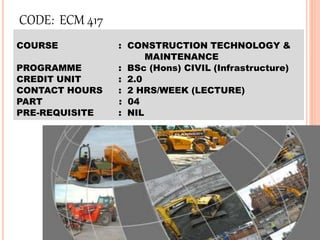
CODE: ECM 417
COURSE : CONSTRUCTION TECHNOLOGY &
MAINTENANCE
PROGRAMME : BSc (Hons) CIVIL (Infrastructure)
CREDIT UNIT : 2.0
CONTACT HOURS : 2 HRS/WEEK (LECTURE)
PART : 04
PRE-REQUISITE : NIL
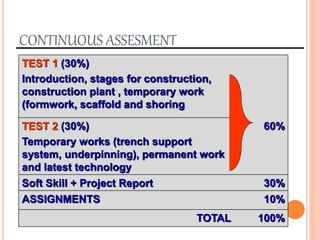
CONTINUOUS ASSESMENT
TEST 1 (30%)
Introduction, stages for construction,
construction plant , temporary work
(formwork, scaffold and shoring
TEST 2 (30%)
Temporary works (trench support
system, underpinning), permanent work
and latest technology
60%
Soft Skill + Project Report 30%
ASSIGNMENTS 10%
TOTAL 100%
COURSE OUTCOME
At the end of this course, student should be able to:-
1) Explain the various construction processes in
construction of building, infrastructures and
maintenance.(PO2)
2) Choose and explain suitable construction plants,
equipment and machineries used in construction
processes and maintenance works.(PO6)
3) Analyze various techniques and problems in
construction processes, infrastructure services and
maintenance works.(PO6)
4) Show the ability to explain the new technology for
sustainable development in the construction industry
including infrastructure services and maintenance
works. (P10)
SYNOPSIS
 This course covers basic construction
techniques, equipments, plants and
methods used in construction.
 This is to enable the students to
understand the construction methods,
techniques and plants adopted at the site
and the considerations made in selecting
them
LESSON PLAN
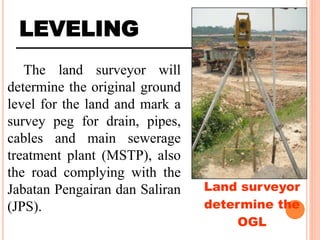
Week Topics Learning Outcomes Lecture
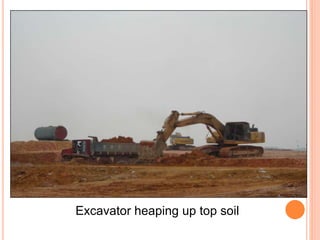
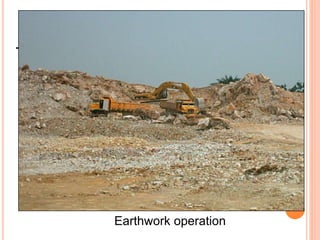
Hours
1 Introduction to
the construction
systems
Stages for
construction:
Building
- Identify the various divisions in construction
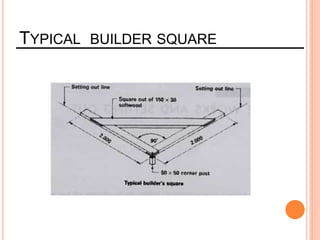
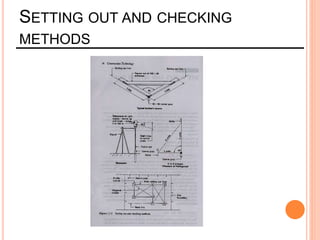
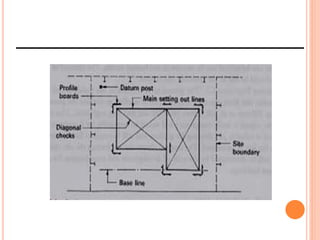
industry, i.e., vertical construction and
horizontal construction. (CO1)
2
- Identify setting out works involve in building
construction, i.e., site clearing, setting out and
establish the building datum level. (CO1)
- Identify the accommodations, storage and
security requirements during the building
construction stage. (CO1)
- Describe the detail building stages involved
during the building construction process. (CO1)
LESSON PLAN
Week Topics Learning Outcomes Lecture
Hours
2 Stages for
construction:
Retaining wall
- Identify the different types of retaining
walls and their respective functions. (CO1;
CO3)
2
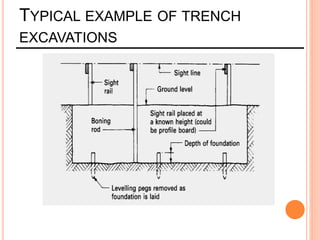
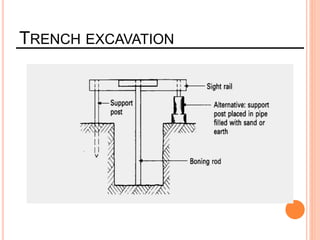
Stages for
construction:
Drainage
- Identify the functions of various subsoil
drainage system. (CO1; CO3)
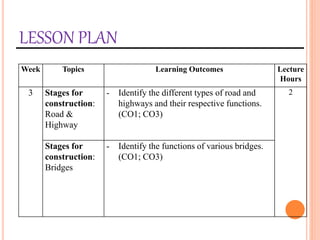
LESSON PLAN
Week Topics Learning Outcomes Lecture
Hours
3 Stages for
construction:
Road &
Highway
- Identify the different types of road and
highways and their respective functions.
(CO1; CO3)
2
Stages for
construction:
Bridges
- Identify the functions of various bridges.
(CO1; CO3)
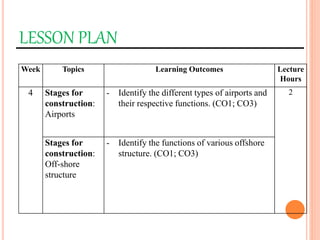
LESSON PLAN
Week Topics Learning Outcomes Lecture
Hours
4 Stages for
construction:
Airports
- Identify the different types of airports and
their respective functions. (CO1; CO3)
2
Stages for
construction:
Off-shore
structure
- Identify the functions of various offshore
structure. (CO1; CO3)
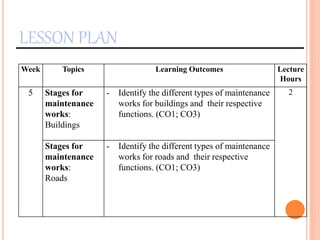
LESSON PLAN
Week Topics Learning Outcomes Lecture
Hours
5 Stages for
maintenance
works:
Buildings
- Identify the different types of maintenance
works for buildings and their respective
functions. (CO1; CO3)
2
Stages for
maintenance
works:
Roads
- Identify the different types of maintenance
works for roads and their respective
functions. (CO1; CO3)
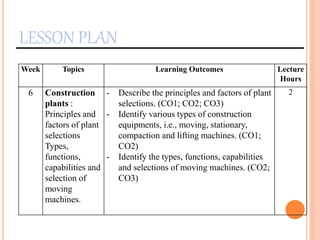
LESSON PLAN
Week Topics Learning Outcomes Lecture
Hours
6 Construction
plants :
Principles and
factors of plant
selections
Types,
functions,
capabilities and
selection of
moving
machines.
- Describe the principles and factors of plant
selections. (CO1; CO2; CO3)
- Identify various types of construction
equipments, i.e., moving, stationary,
compaction and lifting machines. (CO1;
CO2)
- Identify the types, functions, capabilities
and selections of moving machines. (CO2;
CO3)
2
LESSON PLAN
Week Topics Learning Outcomes Lecture
Hours
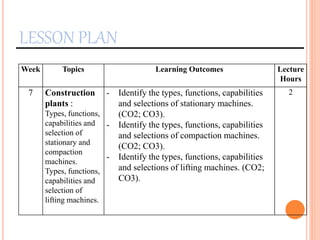
7 Construction
plants :
Types, functions,
capabilities and
selection of
stationary and
compaction
machines.
Types, functions,
capabilities and
selection of
lifting machines.
- Identify the types, functions, capabilities
and selections of stationary machines.
(CO2; CO3).
- Identify the types, functions, capabilities
and selections of compaction machines.
(CO2; CO3).
- Identify the types, functions, capabilities
and selections of lifting machines. (CO2;
CO3).
2
LESSON PLAN
Week Topics Learning Outcomes Lecture
Hours
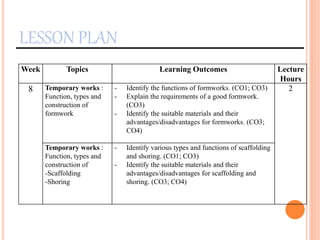
8 Temporary works :
Function, types and
construction of
formwork
- Identify the functions of formworks. (CO1; CO3)
- Explain the requirements of a good formwork.
(CO3)
- Identify the suitable materials and their
advantages/disadvantages for formworks. (CO3;
CO4)
2
Temporary works :
Function, types and
construction of
-Scaffolding
-Shoring
- Identify various types and functions of scaffolding
and shoring. (CO1; CO3)
- Identify the suitable materials and their
advantages/disadvantages for scaffolding and
shoring. (CO3; CO4)
LESSON PLAN
Week Topics Learning Outcomes Lecture
Hours
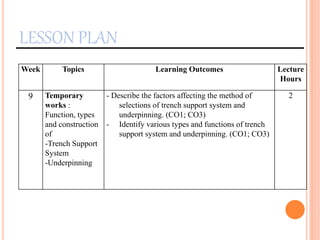
9 Temporary
works :
Function, types
and construction
of
-Trench Support
System
-Underpinning
- Describe the factors affecting the method of
selections of trench support system and
underpinning. (CO1; CO3)
- Identify various types and functions of trench
support system and underpinning. (CO1; CO3)
2
LESSON PLAN
Week Topics Learning Outcomes Lecture
Hours
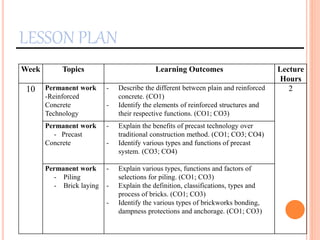
10 Permanent work
-Reinforced
Concrete
Technology
- Describe the different between plain and reinforced
concrete. (CO1)
- Identify the elements of reinforced structures and
their respective functions. (CO1; CO3)
2
Permanent work
- Precast
Concrete
- Explain the benefits of precast technology over
traditional construction method. (CO1; CO3; CO4)
- Identify various types and functions of precast
system. (CO3; CO4)
Permanent work
- Piling
- Brick laying
- Explain various types, functions and factors of
selections for piling. (CO1; CO3)
- Explain the definition, classifications, types and
process of bricks. (CO1; CO3)
- Identify the various types of brickworks bonding,
dampness protections and anchorage. (CO1; CO3)
LESSON PLAN
Week Topics Learning Outcomes Lecture
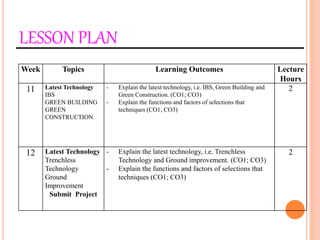
Hours
11 Latest Technology
IBS
GREEN BUILDING
GREEN
CONSTRUCTION
- Explain the latest technology, i.e. IBS, Green Building and
Green Construction. (CO1; CO3)
- Explain the functions and factors of selections that
techniques (CO1; CO3)
2
12 Latest Technology
Trenchless
Technology
Ground
Improvement
Submit Project
- Explain the latest technology, i.e. Trenchless
Technology and Ground improvement. (CO1; CO3)
- Explain the functions and factors of selections that
techniques (CO1; CO3)
2
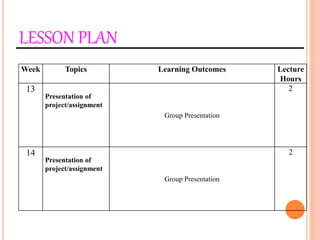
LESSON PLAN
Week Topics Learning Outcomes Lecture
Hours
13
Presentation of
project/assignment
Group Presentation
2
14
Presentation of
project/assignment
Group Presentation
2
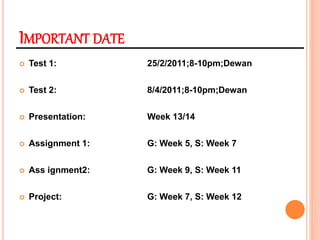
IMPORTANT DATE
 Test 1: 25/2/2011;8-10pm;Dewan
 Test 2: 8/4/2011;8-10pm;Dewan
 Presentation: Week 13/14
 Assignment 1: G: Week 5, S: Week 7
 Ass ignment2: G: Week 9, S: Week 11
 Project: G: Week 7, S: Week 12
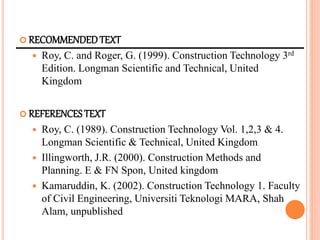
 RECOMMENDEDTEXT
 Roy, C. and Roger, G. (1999). Construction Technology 3rd
Edition. Longman Scientific and Technical, United
Kingdom
 REFERENCESTEXT
 Roy, C. (1989). Construction Technology Vol. 1,2,3 & 4.
Longman Scientific & Technical, United Kingdom
 Illingworth, J.R. (2000). Construction Methods and
Planning. E & FN Spon, United kingdom
 Kamaruddin, K. (2002). Construction Technology 1. Faculty
of Civil Engineering, Universiti Teknologi MARA, Shah
Alam, unpublished
Introduction to the
Construction System
WEEK 1
LEARNING OUTCOME
At the end of week 1 lectures, student will be
able to :
Identify the various groups in construction
industry, i.e., vertical construction and horizontal
construction. (CO1)
CONSTRUCTION IN CIVIL
ENGINEERING
 construction is a process that consists of the building or
assembling of infrastructure. Far from being a single
activity, large scale construction is a feat of multitasking.
Normally the job is managed by the project manager and
supervised by the construction manager, design engineer,
construction engineer or project architect.
 For the successful execution of a project, effective planning
is essential. Those involved with the design and execution
of the infrastructure in question must consider the
environmental impact of the job, the successful scheduling,
budgeting, site safety, availability of materials, logistics,
inconvenience to the public caused by construction delays,
preparing tender documents,
CONSTRUCTION TECHNOLOGY
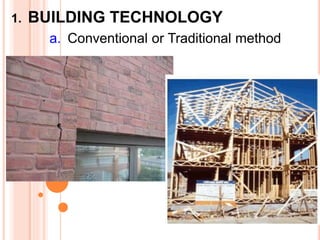
1. BUILDING TECHNOLOGY
a. Conventional or Traditional method
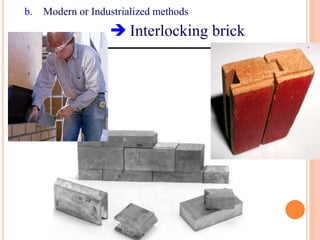
 Interlocking brick
b. Modern or Industrialized methods
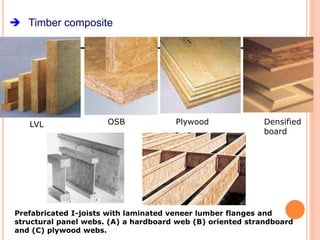
 Timber composite
Prefabricated I-joists with laminated veneer lumber flanges and
structural panel webs. (A) a hardboard web (B) oriented strandboard
and (C) plywood webs.
LVL OSB Plywood Densified
board
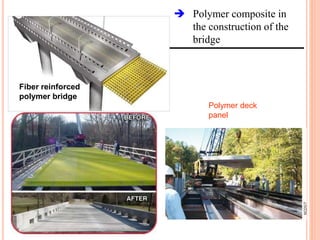
 Polymer composite in
the construction of the
bridge
Polymer deck
panel
Fiber reinforced
polymer bridge
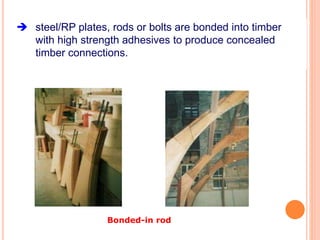
 steel/RP plates, rods or bolts are bonded into timber
with high strength adhesives to produce concealed
timber connections.
Bonded-in rod
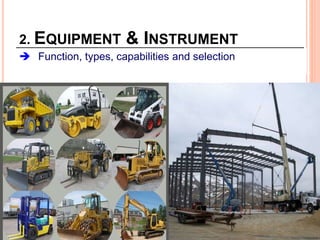
2. EQUIPMENT & INSTRUMENT
 Function, types, capabilities and selection
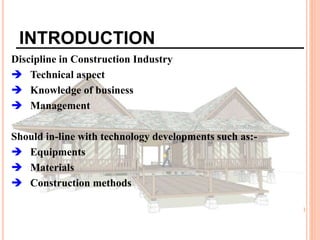
INTRODUCTION
Discipline in Construction Industry
 Technical aspect
 Knowledge of business
 Management
Should in-line with technology developments such as:-
 Equipments
 Materials
 Construction methods
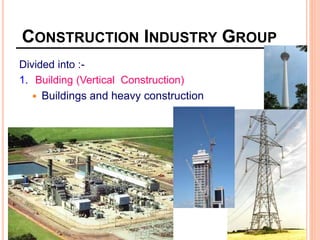
CONSTRUCTION INDUSTRY GROUP
Divided into :-
1. Building (Vertical Construction)
 Buildings and heavy construction
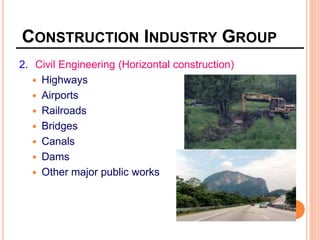
2. Civil Engineering (Horizontal construction)
 Highways
 Airports
 Railroads
 Bridges
 Canals
 Dams
 Other major public works
CONSTRUCTION INDUSTRY GROUP
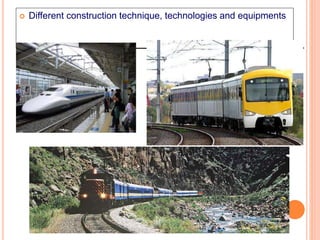
 Different construction technique, technologies and equipments
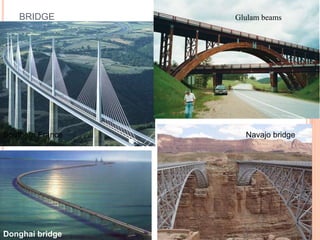
BRIDGE
Navajo bridge
Southern France
Donghai bridge
Glulam beams
TYPES OF CONSTRUCTION
PROJECTS
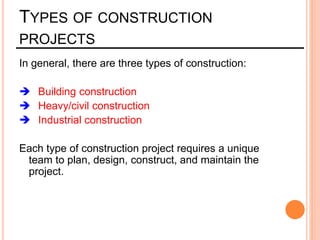
In general, there are three types of construction:
 Building construction
 Heavy/civil construction
 Industrial construction
Each type of construction project requires a unique
team to plan, design, construct, and maintain the
project.
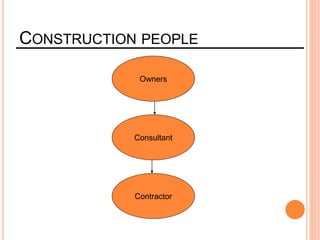
CONSTRUCTION PEOPLE
Owners
Consultant
Contractor
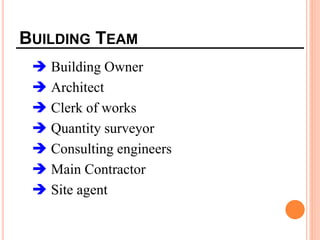
BUILDING TEAM
 Building Owner
 Architect
 Clerk of works
 Quantity surveyor
 Consulting engineers
 Main Contractor
 Site agent
 Estimator
 Buyer
 Accountant
 Administrator
 Assistance contract manager
 Nominated sub contractor
 Domestic sub contractor
 Operatives
BUILDING TEAM
OWNER
Owner is the people that have exclusive rights and
control over property. Owner can be:-
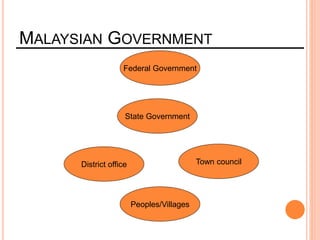
Government (biggest owner in Malaysia)
Private sector
Cooperate sector
Individual
Developer
MALAYSIAN GOVERNMENT
Federal Government
State Government
District office Town council
Peoples/Villages
AGENCIES IN MINISTRY OF
WORKS
CONSULTANT
 A consultant is a professional who provides
advice in a particular area of expertise.
 A consultant is usually an expert or a
professional in a specific field and has a wide
knowledge of the subject matter.
 A consultant usually works for a consultancy firm
or is self-employed, and engages with multiple and
changing clients.
 The biggest construction consultant in Malaysia is
JKR
JKR core business
• Consulting services
• Project management services
• Maintenance management services
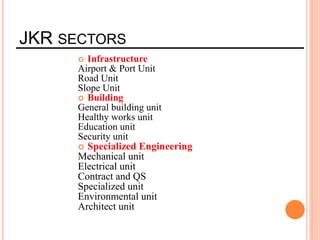
JKR SECTORS
 Infrastructure
Airport & Port Unit
Road Unit
Slope Unit
 Building
General building unit
Healthy works unit
Education unit
Security unit
 Specialized Engineering
Mechanical unit
Electrical unit
Contract and QS
Specialized unit
Environmental unit
Architect unit
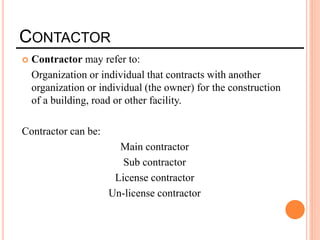
CONTACTOR
 Contractor may refer to:
Organization or individual that contracts with another
organization or individual (the owner) for the construction
of a building, road or other facility.
Contractor can be:
Main contractor
Sub contractor
License contractor
Un-license contractor
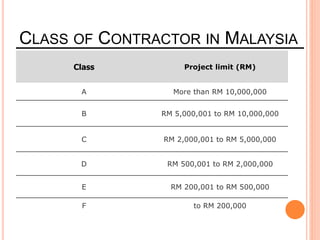
CLASS OF CONTRACTOR IN MALAYSIA
Class Project limit (RM)
A More than RM 10,000,000
B RM 5,000,001 to RM 10,000,000
C RM 2,000,001 to RM 5,000,000
D RM 500,001 to RM 2,000,000
E RM 200,001 to RM 500,000
F to RM 200,000
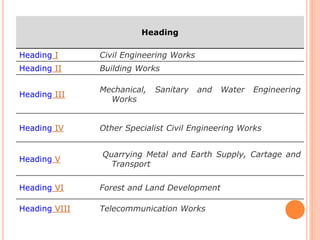
Heading
Heading I Civil Engineering Works
Heading II Building Works
Heading III
Mechanical, Sanitary and Water Engineering
Works
Heading IV Other Specialist Civil Engineering Works
Heading V
Quarrying Metal and Earth Supply, Cartage and
Transport
Heading VI Forest and Land Development
Heading VIII Telecommunication Works
CONSTRUCTION PROCESS
In general (differs from small to big project):-
 Recognizing the need for the project
 Determining the technical and financial feasibility
 Preparing detail plans, specifications and cost
estimation
 Obtaining approval from regulatory agencies such
as zoning regulations, building codes and
environmental. Needs, idea, conceptual design,
financial and legal considerations.
 Details design, budgeting and contract document.
 Tendering, project offer and construction works
Stages for construction
WEEK 1
1. Building
2. Retaining walls, Drainage
3. Road, Highway, Bridges
4. Airports, Offshore/Marine structure
Stages for construction
WEEK 1
1. Building
2. Retaining walls, Drainage
3. Road, Highway, Bridges
4. Airports, Offshore/Marine structure
BUILDING
At the end of week 1 lectures, student will be able to :
- Identify setting out works involve in building
construction, i.e., site clearing, setting out and
establish the building datum level. (CO1)
- identify the accommodations, storage and security
requirements during the building construction
stage. (CO1)
- describe the detail building stages involved during
the building construction process. (CO1)
WEEK 1
BUILDING
1. Site works and setting out
2. Accommodation, storage
and security
3. Detail building stages
1. SITE WORKS AND SETTING
OUT
 Contractors responsibility after being
given possession and site layout plan
and detail drawings necessary
 Commencing tasks:-
a. Clearing the site
b. Setting out the building
c. Establishing a datum level
Land surveyor
determine the
OGL
LEVELING
The land surveyor will
determine the original ground
level for the land and mark a
survey peg for drain, pipes,
cables and main sewerage
treatment plant (MSTP), also
the road complying with the
Jabatan Pengairan dan Saliran
(JPS).
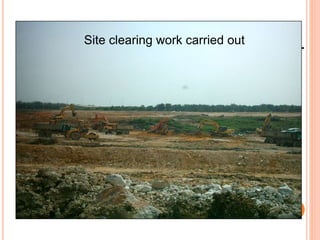
CLEARING THE SITE
 May involve:-
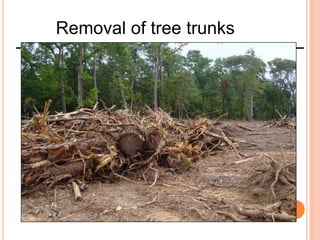
 Demolition of existing buildings (by experienced
contractor)
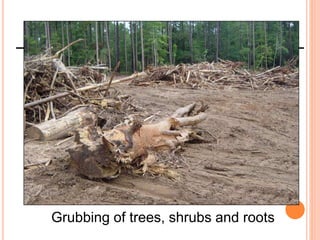
 Grubbing out bushes and tress (by manual or
mechanical means, or by specialist for the large
tress)
 Removal of soil to reduce levels following to Building
Regulation C1 (sterilize the top 300 mm to contain
plant life and decaying vegetation)
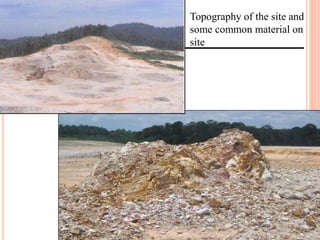
Topography of the site and
some common material on
site
Removal of tree trunks
Grubbing of trees, shrubs and roots
Site clearing work carried out
Excavator heaping up top soil
Earthwork operation
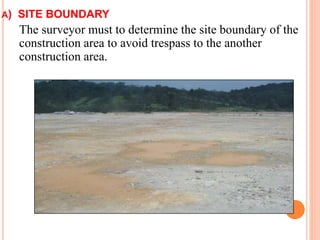
A) SITE BOUNDARY
The surveyor must to determine the site boundary of the
construction area to avoid trespass to the another
construction area.
The boundary had determine
SETTING OUT THE SITE
1. Establish a base line from which the whole of the
building can be set out.
 Marked on site clearly so that it can be re-established
at any time
 Using steel tape (30 meters and not stretchable is
more suitable)
 Marked each corner with a stout peg
 Check on the right angle and correct lengths
(advisable using different method)
TYPICAL BUILDER SQUARE
SETTING OUT AND CHECKING
METHODS
SETTING OUT THE SITE
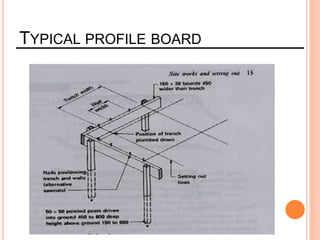
2. Set up profile board-after the main building lines
 Should set up clear of the foundations trench
positions to locate the trench, foundations and walls
 Required at all trench and wall intersections
TYPICAL PROFILE BOARD
ESTABLISHING A DATUM LEVEL
 All levels in a building are taken from a
fixed point called a ‘datum’
 Should establish after the setting out and
related to ordnance benchmark
 An arrow with a horizontal mark above the
arrow
 The centerline of the horizontal being the
actual level indicated on an ordnance
survey maps
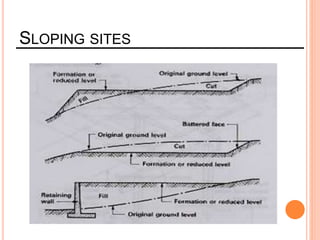
SLOPING SITES
Three methods in reducing levels:-
1. Cut and Fill - usual method, the amount of cut will
equal the amount of fill
2. Cut – Advantages of having undisturbed soil over the
site, but having disadvantages of cost of removing
the spoil from the site
3. Fill – Not to be recommended, deep foundation
would be needed, the risk of settlement and the
amount of fill should be limited to 600 mm
SLOPING SITES
ACCOMMODATION,
STORAGE AND
SECURITY
ACCOMMODATION
 Regulations 1996 (Health, safety and
welfare)
 Requirements defers due to numbers of site
workers and duration of contract
 Staff accommodations usually:-
 Sectional timber huts
 Mobile caravan or cabins
 Facilities provided:-
 First aid, stretcher ambulance, first aid room,
shelter and clothing, meals room, washing
facilities and sanitary facilities
STORAGE
 Type of storage depend on:-
 Durability
 Vulnerability to damage
 Vulnerability to theft
Examples..
 Cement and plaster (in bag form) – dry store free from
moist air
 Aggregates and sand – clean firm base, separate
different materials and grade, watch on moisture content
 Bricks and blocks – stacked in stable piles, covered
adequately
SECURITY AND PROTECTION-
FENCING
 To defines limit of site and acts as a deterrent to
trespasser or thief
 To provide a physical barrier or visual barrier
 Should start at the beginning of construction
 Type depend on degree of security, cost,
neighborhood and duration of contract
 At least 1.8m high
 Minimum number of access and with lockable
barrier
 Standard fences – BS 1722
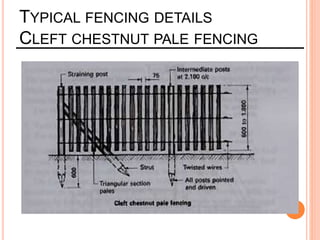
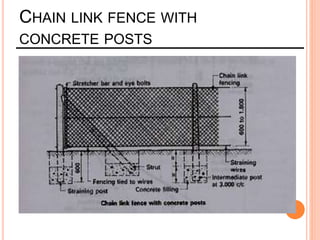
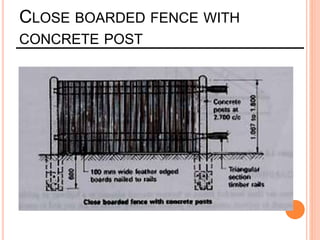
TYPICAL FENCING DETAILS
CLEFT CHESTNUT PALE FENCING
CHAIN LINK FENCE WITH
CONCRETE POSTS
CLOSE BOARDED FENCE WITH
CONCRETE POST
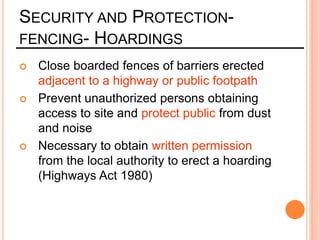
SECURITY AND PROTECTION-
FENCING- HOARDINGS
 Close boarded fences of barriers erected
adjacent to a highway or public footpath
 Prevent unauthorized persons obtaining
access to site and protect public from dust
and noise
 Necessary to obtain written permission
from the local authority to erect a hoarding
(Highways Act 1980)
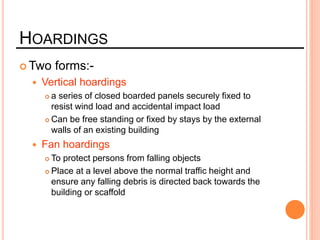
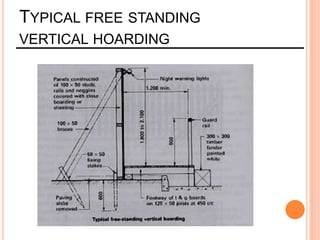
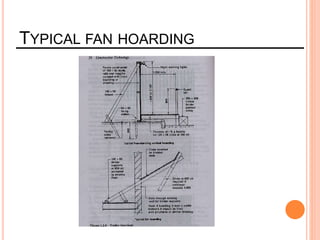
HOARDINGS
 Two forms:-
 Vertical hoardings
 a series of closed boarded panels securely fixed to
resist wind load and accidental impact load
 Can be free standing or fixed by stays by the external
walls of an existing building
 Fan hoardings
 To protect persons from falling objects
 Place at a level above the normal traffic height and
ensure any falling debris is directed back towards the
building or scaffold
TYPICAL FREE STANDING
VERTICAL HOARDING
TYPICAL FAN HOARDING
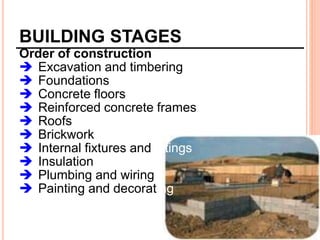
BUILDING STAGES
Order of construction
 Excavation and timbering
 Foundations
 Concrete floors
 Reinforced concrete frames
 Roofs
 Brickwork
 Internal fixtures and fittings
 Insulation
 Plumbing and wiring
 Painting and decorating
EXCAVATION AND TIMBERING
 Before a foundation can be laid, it is necessary to excavate a
trench of the required depth and width (by hand or mechanical
excavator)
Timbering – term used to cover temporary supports to the sides
of excavations and is sometimes called planking and strutting
 Type and amount – depend on the depth, nature of subsoil,
weather conditions and duration
TYPICAL EXAMPLE OF TRENCH
EXCAVATIONS
TRENCH EXCAVATION
FOUNDATIONS
 Foundation is the base on which a building rests and its
purpose is to safely transfer the load of a building to
suitable subsoil
 Building regulations :-
 Safely sustain and submit to the ground the combined
dead and imposed loads so as not to imposed any
settlement or other movement in any part of the building
or of any adjoining buildings or works
 Be a such a depth, or be so constructed, as to avoid any
damage by swelling, shrinkage or freezing of the subsoil
 Be capable of resisting attack by deleterious material, such as
sulphates, in the subsoil

Construction maintenance

  • 1.
    CONSTRUCTION TECHNOLOGY & maintenance CEM417 SOURCES FROM slide: MOHD AMIZAN MOHAMD MOHD FADZIL ARSHAD SITI RASHIDAH MOHD NASIR FKA, UiTM Shah Alam.
  • 2.
    CODE: ECM 417 COURSE: CONSTRUCTION TECHNOLOGY & MAINTENANCE PROGRAMME : BSc (Hons) CIVIL (Infrastructure) CREDIT UNIT : 2.0 CONTACT HOURS : 2 HRS/WEEK (LECTURE) PART : 04 PRE-REQUISITE : NIL
  • 3.
    CONTINUOUS ASSESMENT TEST 1(30%) Introduction, stages for construction, construction plant , temporary work (formwork, scaffold and shoring TEST 2 (30%) Temporary works (trench support system, underpinning), permanent work and latest technology 60% Soft Skill + Project Report 30% ASSIGNMENTS 10% TOTAL 100%
  • 4.
    COURSE OUTCOME At theend of this course, student should be able to:- 1) Explain the various construction processes in construction of building, infrastructures and maintenance.(PO2) 2) Choose and explain suitable construction plants, equipment and machineries used in construction processes and maintenance works.(PO6) 3) Analyze various techniques and problems in construction processes, infrastructure services and maintenance works.(PO6) 4) Show the ability to explain the new technology for sustainable development in the construction industry including infrastructure services and maintenance works. (P10)
  • 5.
    SYNOPSIS  This coursecovers basic construction techniques, equipments, plants and methods used in construction.  This is to enable the students to understand the construction methods, techniques and plants adopted at the site and the considerations made in selecting them
  • 6.
    LESSON PLAN Week TopicsLearning Outcomes Lecture Hours 1 Introduction to the construction systems Stages for construction: Building - Identify the various divisions in construction industry, i.e., vertical construction and horizontal construction. (CO1) 2 - Identify setting out works involve in building construction, i.e., site clearing, setting out and establish the building datum level. (CO1) - Identify the accommodations, storage and security requirements during the building construction stage. (CO1) - Describe the detail building stages involved during the building construction process. (CO1)
  • 7.
    LESSON PLAN Week TopicsLearning Outcomes Lecture Hours 2 Stages for construction: Retaining wall - Identify the different types of retaining walls and their respective functions. (CO1; CO3) 2 Stages for construction: Drainage - Identify the functions of various subsoil drainage system. (CO1; CO3)
  • 8.
    LESSON PLAN Week TopicsLearning Outcomes Lecture Hours 3 Stages for construction: Road & Highway - Identify the different types of road and highways and their respective functions. (CO1; CO3) 2 Stages for construction: Bridges - Identify the functions of various bridges. (CO1; CO3)
  • 9.
    LESSON PLAN Week TopicsLearning Outcomes Lecture Hours 4 Stages for construction: Airports - Identify the different types of airports and their respective functions. (CO1; CO3) 2 Stages for construction: Off-shore structure - Identify the functions of various offshore structure. (CO1; CO3)
  • 10.
    LESSON PLAN Week TopicsLearning Outcomes Lecture Hours 5 Stages for maintenance works: Buildings - Identify the different types of maintenance works for buildings and their respective functions. (CO1; CO3) 2 Stages for maintenance works: Roads - Identify the different types of maintenance works for roads and their respective functions. (CO1; CO3)
  • 11.
    LESSON PLAN Week TopicsLearning Outcomes Lecture Hours 6 Construction plants : Principles and factors of plant selections Types, functions, capabilities and selection of moving machines. - Describe the principles and factors of plant selections. (CO1; CO2; CO3) - Identify various types of construction equipments, i.e., moving, stationary, compaction and lifting machines. (CO1; CO2) - Identify the types, functions, capabilities and selections of moving machines. (CO2; CO3) 2
  • 12.
    LESSON PLAN Week TopicsLearning Outcomes Lecture Hours 7 Construction plants : Types, functions, capabilities and selection of stationary and compaction machines. Types, functions, capabilities and selection of lifting machines. - Identify the types, functions, capabilities and selections of stationary machines. (CO2; CO3). - Identify the types, functions, capabilities and selections of compaction machines. (CO2; CO3). - Identify the types, functions, capabilities and selections of lifting machines. (CO2; CO3). 2
  • 13.
    LESSON PLAN Week TopicsLearning Outcomes Lecture Hours 8 Temporary works : Function, types and construction of formwork - Identify the functions of formworks. (CO1; CO3) - Explain the requirements of a good formwork. (CO3) - Identify the suitable materials and their advantages/disadvantages for formworks. (CO3; CO4) 2 Temporary works : Function, types and construction of -Scaffolding -Shoring - Identify various types and functions of scaffolding and shoring. (CO1; CO3) - Identify the suitable materials and their advantages/disadvantages for scaffolding and shoring. (CO3; CO4)
  • 14.
    LESSON PLAN Week TopicsLearning Outcomes Lecture Hours 9 Temporary works : Function, types and construction of -Trench Support System -Underpinning - Describe the factors affecting the method of selections of trench support system and underpinning. (CO1; CO3) - Identify various types and functions of trench support system and underpinning. (CO1; CO3) 2
  • 15.
    LESSON PLAN Week TopicsLearning Outcomes Lecture Hours 10 Permanent work -Reinforced Concrete Technology - Describe the different between plain and reinforced concrete. (CO1) - Identify the elements of reinforced structures and their respective functions. (CO1; CO3) 2 Permanent work - Precast Concrete - Explain the benefits of precast technology over traditional construction method. (CO1; CO3; CO4) - Identify various types and functions of precast system. (CO3; CO4) Permanent work - Piling - Brick laying - Explain various types, functions and factors of selections for piling. (CO1; CO3) - Explain the definition, classifications, types and process of bricks. (CO1; CO3) - Identify the various types of brickworks bonding, dampness protections and anchorage. (CO1; CO3)
  • 16.
    LESSON PLAN Week TopicsLearning Outcomes Lecture Hours 11 Latest Technology IBS GREEN BUILDING GREEN CONSTRUCTION - Explain the latest technology, i.e. IBS, Green Building and Green Construction. (CO1; CO3) - Explain the functions and factors of selections that techniques (CO1; CO3) 2 12 Latest Technology Trenchless Technology Ground Improvement Submit Project - Explain the latest technology, i.e. Trenchless Technology and Ground improvement. (CO1; CO3) - Explain the functions and factors of selections that techniques (CO1; CO3) 2
  • 17.
    LESSON PLAN Week TopicsLearning Outcomes Lecture Hours 13 Presentation of project/assignment Group Presentation 2 14 Presentation of project/assignment Group Presentation 2
  • 18.
    IMPORTANT DATE  Test1: 25/2/2011;8-10pm;Dewan  Test 2: 8/4/2011;8-10pm;Dewan  Presentation: Week 13/14  Assignment 1: G: Week 5, S: Week 7  Ass ignment2: G: Week 9, S: Week 11  Project: G: Week 7, S: Week 12
  • 19.
     RECOMMENDEDTEXT  Roy,C. and Roger, G. (1999). Construction Technology 3rd Edition. Longman Scientific and Technical, United Kingdom  REFERENCESTEXT  Roy, C. (1989). Construction Technology Vol. 1,2,3 & 4. Longman Scientific & Technical, United Kingdom  Illingworth, J.R. (2000). Construction Methods and Planning. E & FN Spon, United kingdom  Kamaruddin, K. (2002). Construction Technology 1. Faculty of Civil Engineering, Universiti Teknologi MARA, Shah Alam, unpublished
  • 20.
  • 21.
    LEARNING OUTCOME At theend of week 1 lectures, student will be able to : Identify the various groups in construction industry, i.e., vertical construction and horizontal construction. (CO1)
  • 22.
    CONSTRUCTION IN CIVIL ENGINEERING construction is a process that consists of the building or assembling of infrastructure. Far from being a single activity, large scale construction is a feat of multitasking. Normally the job is managed by the project manager and supervised by the construction manager, design engineer, construction engineer or project architect.  For the successful execution of a project, effective planning is essential. Those involved with the design and execution of the infrastructure in question must consider the environmental impact of the job, the successful scheduling, budgeting, site safety, availability of materials, logistics, inconvenience to the public caused by construction delays, preparing tender documents,
  • 23.
    CONSTRUCTION TECHNOLOGY 1. BUILDINGTECHNOLOGY a. Conventional or Traditional method
  • 24.
     Interlocking brick b.Modern or Industrialized methods
  • 25.
     Timber composite PrefabricatedI-joists with laminated veneer lumber flanges and structural panel webs. (A) a hardboard web (B) oriented strandboard and (C) plywood webs. LVL OSB Plywood Densified board
  • 26.
     Polymer compositein the construction of the bridge Polymer deck panel Fiber reinforced polymer bridge
  • 27.
     steel/RP plates,rods or bolts are bonded into timber with high strength adhesives to produce concealed timber connections. Bonded-in rod
  • 28.
    2. EQUIPMENT &INSTRUMENT  Function, types, capabilities and selection
  • 29.
    INTRODUCTION Discipline in ConstructionIndustry  Technical aspect  Knowledge of business  Management Should in-line with technology developments such as:-  Equipments  Materials  Construction methods
  • 30.
    CONSTRUCTION INDUSTRY GROUP Dividedinto :- 1. Building (Vertical Construction)  Buildings and heavy construction
  • 31.
    2. Civil Engineering(Horizontal construction)  Highways  Airports  Railroads  Bridges  Canals  Dams  Other major public works CONSTRUCTION INDUSTRY GROUP
  • 32.
     Different constructiontechnique, technologies and equipments
  • 33.
  • 34.
    TYPES OF CONSTRUCTION PROJECTS Ingeneral, there are three types of construction:  Building construction  Heavy/civil construction  Industrial construction Each type of construction project requires a unique team to plan, design, construct, and maintain the project.
  • 35.
  • 36.
    BUILDING TEAM  BuildingOwner  Architect  Clerk of works  Quantity surveyor  Consulting engineers  Main Contractor  Site agent
  • 37.
     Estimator  Buyer Accountant  Administrator  Assistance contract manager  Nominated sub contractor  Domestic sub contractor  Operatives BUILDING TEAM
  • 38.
    OWNER Owner is thepeople that have exclusive rights and control over property. Owner can be:- Government (biggest owner in Malaysia) Private sector Cooperate sector Individual Developer
  • 39.
    MALAYSIAN GOVERNMENT Federal Government StateGovernment District office Town council Peoples/Villages
  • 40.
  • 41.
    CONSULTANT  A consultantis a professional who provides advice in a particular area of expertise.  A consultant is usually an expert or a professional in a specific field and has a wide knowledge of the subject matter.  A consultant usually works for a consultancy firm or is self-employed, and engages with multiple and changing clients.  The biggest construction consultant in Malaysia is JKR
  • 42.
    JKR core business •Consulting services • Project management services • Maintenance management services
  • 43.
    JKR SECTORS  Infrastructure Airport& Port Unit Road Unit Slope Unit  Building General building unit Healthy works unit Education unit Security unit  Specialized Engineering Mechanical unit Electrical unit Contract and QS Specialized unit Environmental unit Architect unit
  • 44.
    CONTACTOR  Contractor mayrefer to: Organization or individual that contracts with another organization or individual (the owner) for the construction of a building, road or other facility. Contractor can be: Main contractor Sub contractor License contractor Un-license contractor
  • 45.
    CLASS OF CONTRACTORIN MALAYSIA Class Project limit (RM) A More than RM 10,000,000 B RM 5,000,001 to RM 10,000,000 C RM 2,000,001 to RM 5,000,000 D RM 500,001 to RM 2,000,000 E RM 200,001 to RM 500,000 F to RM 200,000
  • 46.
    Heading Heading I CivilEngineering Works Heading II Building Works Heading III Mechanical, Sanitary and Water Engineering Works Heading IV Other Specialist Civil Engineering Works Heading V Quarrying Metal and Earth Supply, Cartage and Transport Heading VI Forest and Land Development Heading VIII Telecommunication Works
  • 47.
    CONSTRUCTION PROCESS In general(differs from small to big project):-  Recognizing the need for the project  Determining the technical and financial feasibility  Preparing detail plans, specifications and cost estimation  Obtaining approval from regulatory agencies such as zoning regulations, building codes and environmental. Needs, idea, conceptual design, financial and legal considerations.  Details design, budgeting and contract document.  Tendering, project offer and construction works
  • 48.
    Stages for construction WEEK1 1. Building 2. Retaining walls, Drainage 3. Road, Highway, Bridges 4. Airports, Offshore/Marine structure
  • 49.
    Stages for construction WEEK1 1. Building 2. Retaining walls, Drainage 3. Road, Highway, Bridges 4. Airports, Offshore/Marine structure
  • 50.
  • 51.
    At the endof week 1 lectures, student will be able to : - Identify setting out works involve in building construction, i.e., site clearing, setting out and establish the building datum level. (CO1) - identify the accommodations, storage and security requirements during the building construction stage. (CO1) - describe the detail building stages involved during the building construction process. (CO1) WEEK 1
  • 52.
    BUILDING 1. Site worksand setting out 2. Accommodation, storage and security 3. Detail building stages
  • 53.
    1. SITE WORKSAND SETTING OUT  Contractors responsibility after being given possession and site layout plan and detail drawings necessary  Commencing tasks:- a. Clearing the site b. Setting out the building c. Establishing a datum level
  • 54.
    Land surveyor determine the OGL LEVELING Theland surveyor will determine the original ground level for the land and mark a survey peg for drain, pipes, cables and main sewerage treatment plant (MSTP), also the road complying with the Jabatan Pengairan dan Saliran (JPS).
  • 55.
    CLEARING THE SITE May involve:-  Demolition of existing buildings (by experienced contractor)  Grubbing out bushes and tress (by manual or mechanical means, or by specialist for the large tress)  Removal of soil to reduce levels following to Building Regulation C1 (sterilize the top 300 mm to contain plant life and decaying vegetation)
  • 56.
    Topography of thesite and some common material on site
  • 57.
  • 58.
    Grubbing of trees,shrubs and roots
  • 59.
    Site clearing workcarried out
  • 60.
  • 61.
  • 62.
    A) SITE BOUNDARY Thesurveyor must to determine the site boundary of the construction area to avoid trespass to the another construction area. The boundary had determine
  • 63.
    SETTING OUT THESITE 1. Establish a base line from which the whole of the building can be set out.  Marked on site clearly so that it can be re-established at any time  Using steel tape (30 meters and not stretchable is more suitable)  Marked each corner with a stout peg  Check on the right angle and correct lengths (advisable using different method)
  • 64.
  • 65.
    SETTING OUT ANDCHECKING METHODS
  • 67.
    SETTING OUT THESITE 2. Set up profile board-after the main building lines  Should set up clear of the foundations trench positions to locate the trench, foundations and walls  Required at all trench and wall intersections
  • 68.
  • 69.
    ESTABLISHING A DATUMLEVEL  All levels in a building are taken from a fixed point called a ‘datum’  Should establish after the setting out and related to ordnance benchmark  An arrow with a horizontal mark above the arrow  The centerline of the horizontal being the actual level indicated on an ordnance survey maps
  • 70.
    SLOPING SITES Three methodsin reducing levels:- 1. Cut and Fill - usual method, the amount of cut will equal the amount of fill 2. Cut – Advantages of having undisturbed soil over the site, but having disadvantages of cost of removing the spoil from the site 3. Fill – Not to be recommended, deep foundation would be needed, the risk of settlement and the amount of fill should be limited to 600 mm
  • 71.
  • 72.
  • 73.
    ACCOMMODATION  Regulations 1996(Health, safety and welfare)  Requirements defers due to numbers of site workers and duration of contract  Staff accommodations usually:-  Sectional timber huts  Mobile caravan or cabins  Facilities provided:-  First aid, stretcher ambulance, first aid room, shelter and clothing, meals room, washing facilities and sanitary facilities
  • 74.
    STORAGE  Type ofstorage depend on:-  Durability  Vulnerability to damage  Vulnerability to theft Examples..  Cement and plaster (in bag form) – dry store free from moist air  Aggregates and sand – clean firm base, separate different materials and grade, watch on moisture content  Bricks and blocks – stacked in stable piles, covered adequately
  • 75.
    SECURITY AND PROTECTION- FENCING To defines limit of site and acts as a deterrent to trespasser or thief  To provide a physical barrier or visual barrier  Should start at the beginning of construction  Type depend on degree of security, cost, neighborhood and duration of contract  At least 1.8m high  Minimum number of access and with lockable barrier  Standard fences – BS 1722
  • 76.
    TYPICAL FENCING DETAILS CLEFTCHESTNUT PALE FENCING
  • 77.
    CHAIN LINK FENCEWITH CONCRETE POSTS
  • 78.
    CLOSE BOARDED FENCEWITH CONCRETE POST
  • 79.
    SECURITY AND PROTECTION- FENCING-HOARDINGS  Close boarded fences of barriers erected adjacent to a highway or public footpath  Prevent unauthorized persons obtaining access to site and protect public from dust and noise  Necessary to obtain written permission from the local authority to erect a hoarding (Highways Act 1980)
  • 80.
    HOARDINGS  Two forms:- Vertical hoardings  a series of closed boarded panels securely fixed to resist wind load and accidental impact load  Can be free standing or fixed by stays by the external walls of an existing building  Fan hoardings  To protect persons from falling objects  Place at a level above the normal traffic height and ensure any falling debris is directed back towards the building or scaffold
  • 81.
  • 82.
  • 83.
    BUILDING STAGES Order ofconstruction  Excavation and timbering  Foundations  Concrete floors  Reinforced concrete frames  Roofs  Brickwork  Internal fixtures and fittings  Insulation  Plumbing and wiring  Painting and decorating
  • 84.
    EXCAVATION AND TIMBERING Before a foundation can be laid, it is necessary to excavate a trench of the required depth and width (by hand or mechanical excavator) Timbering – term used to cover temporary supports to the sides of excavations and is sometimes called planking and strutting  Type and amount – depend on the depth, nature of subsoil, weather conditions and duration
  • 85.
    TYPICAL EXAMPLE OFTRENCH EXCAVATIONS
  • 86.
  • 87.
    FOUNDATIONS  Foundation isthe base on which a building rests and its purpose is to safely transfer the load of a building to suitable subsoil  Building regulations :-  Safely sustain and submit to the ground the combined dead and imposed loads so as not to imposed any settlement or other movement in any part of the building or of any adjoining buildings or works  Be a such a depth, or be so constructed, as to avoid any damage by swelling, shrinkage or freezing of the subsoil  Be capable of resisting attack by deleterious material, such as sulphates, in the subsoil