Constitution
Daffodil International University
Name: Abdullah Al Amin
ID: 171-15-9365
What is a constitution?
A constitution is a collection of fundamental rules, written or unwritten, which
determines the organization or structure of the government, distribute powers and
determines the relationship among the organs of the government.
Aristotle: Constitution is the way of life the state has chosen for itself.
Lord Bryce: Constitution is the aggregate of laws and customs under
which the life of the state goes on.
HISTORY OF THE CONSTITUTION OF BANGLADESH
 On December 16, 1971 Bangladesh achieved its full formal independence.
 On 11th January 1972, Bangabandhu Sheikh Mujibur Rahman promulgated the Provisional
Constitution of Bangladesh Order,1972.
 After that thirty-four member Draft Committee headed by the then Law Minister Dr. Kamal Hossain.
On November 4,1972 Assembly adopted the Constitution for Bangladesh.
 Constitution divided into 11 parts with 1preamble,7 schedule and 153 articles.
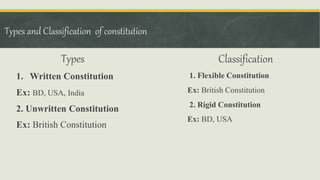
Types
1. Written Constitution
Ex: BD, USA, India
2. Unwritten Constitution
Ex: British Constitution
Types and Classification of constitution
Classification
1. Flexible Constitution
Ex: British Constitution
2. Rigid Constitution
Ex: BD, USA
Main Features of Constitution of BD
1. Written Constitution
2. Rigid Constitution
3. Preamble
4. Supremacy of the Constitution (Article-7)
5. Unicameral Legislature (Article-65)
6. Unitary Government System (Article-1)
7. Fundamental Principle of the State (Article-8)
8. Fundamental Rights (Part III)
9. Parliamentary form of Government
10. Independence of judiciary (Article-22)
11. Ombudsman (Article-77)
12. Westminster type of parliamentary
government.
Essentials of a good constitution?
1. Definiteness (Articles 8,27,29)
2. Flexibility (Article 142)
3. Declaration of rights (Article 26-47)
4. Comprehensiveness
5. Independence of judiciary (Article 22)
6. Directive of state policy (Article 25)
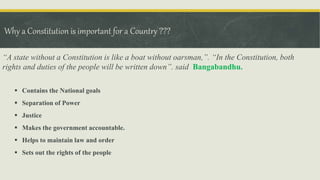
Why a Constitution is important for a Country ???
“A state without a Constitution is like a boat without oarsman,”. “In the Constitution, both
rights and duties of the people will be written down”. said Bangabandhu.
 Contains the National goals
 Separation of Power
 Justice
 Makes the government accountable.
 Helps to maintain law and order
 Sets out the rights of the people
of constitution
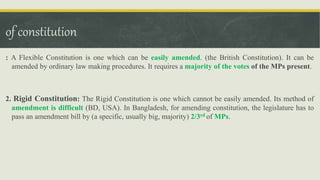
: A Flexible Constitution is one which can be easily amended. (the British Constitution). It can be
amended by ordinary law making procedures. It requires a majority of the votes of the MPs present.
2. Rigid Constitution: The Rigid Constitution is one which cannot be easily amended. Its method of
amendment is difficult (BD, USA). In Bangladesh, for amending constitution, the legislature has to
pass an amendment bill by (a specific, usually big, majority) 2/3rd of MPs.
Constitution

Constitution

  • 1.
  • 2.
    What is aconstitution? A constitution is a collection of fundamental rules, written or unwritten, which determines the organization or structure of the government, distribute powers and determines the relationship among the organs of the government. Aristotle: Constitution is the way of life the state has chosen for itself. Lord Bryce: Constitution is the aggregate of laws and customs under which the life of the state goes on.
  • 3.
    HISTORY OF THECONSTITUTION OF BANGLADESH  On December 16, 1971 Bangladesh achieved its full formal independence.  On 11th January 1972, Bangabandhu Sheikh Mujibur Rahman promulgated the Provisional Constitution of Bangladesh Order,1972.  After that thirty-four member Draft Committee headed by the then Law Minister Dr. Kamal Hossain. On November 4,1972 Assembly adopted the Constitution for Bangladesh.  Constitution divided into 11 parts with 1preamble,7 schedule and 153 articles.
  • 4.
    Types 1. Written Constitution Ex:BD, USA, India 2. Unwritten Constitution Ex: British Constitution Types and Classification of constitution Classification 1. Flexible Constitution Ex: British Constitution 2. Rigid Constitution Ex: BD, USA
  • 5.
    Main Features ofConstitution of BD 1. Written Constitution 2. Rigid Constitution 3. Preamble 4. Supremacy of the Constitution (Article-7) 5. Unicameral Legislature (Article-65) 6. Unitary Government System (Article-1) 7. Fundamental Principle of the State (Article-8) 8. Fundamental Rights (Part III) 9. Parliamentary form of Government 10. Independence of judiciary (Article-22) 11. Ombudsman (Article-77) 12. Westminster type of parliamentary government.
  • 6.
    Essentials of agood constitution? 1. Definiteness (Articles 8,27,29) 2. Flexibility (Article 142) 3. Declaration of rights (Article 26-47) 4. Comprehensiveness 5. Independence of judiciary (Article 22) 6. Directive of state policy (Article 25)
  • 7.
    Why a Constitutionis important for a Country ??? “A state without a Constitution is like a boat without oarsman,”. “In the Constitution, both rights and duties of the people will be written down”. said Bangabandhu.  Contains the National goals  Separation of Power  Justice  Makes the government accountable.  Helps to maintain law and order  Sets out the rights of the people
  • 9.
    of constitution : AFlexible Constitution is one which can be easily amended. (the British Constitution). It can be amended by ordinary law making procedures. It requires a majority of the votes of the MPs present. 2. Rigid Constitution: The Rigid Constitution is one which cannot be easily amended. Its method of amendment is difficult (BD, USA). In Bangladesh, for amending constitution, the legislature has to pass an amendment bill by (a specific, usually big, majority) 2/3rd of MPs.