CHAPTER SEVEN
UNDERSTANDING THE NATURE AND
ESSENTIALS OF CONSTITUTION AND
CONSTITUTIONALISM
This straightforward question admits more than one answers
depending upon the context in which the word ‘constitution’
is used. In its narrow sense, the term constitution is used to
refer to a single, authoritative document (written
constitution), the aim of which is to codify major
constitutional provisions: it constitutes the highest law in
the land.
A constitution is, broadly, a set of fundamental rules,
written or unwritten, that seek to establish the duties,
powers and functions of the various institutions of a
government, regulate the relationships between them, and
define the relationship between the state and the individual
What is Constitution to You?
The character of a government which defines the basic principles to
which a society must conform; describes the organization of the
government, its regulation, distribution, and limitations on the
functions of different government departments; and prescribes the
extent and manner of the exercise of its sovereign powers.
This statement can be broken down into the following specific
points:
A constitution is an organic and fundamental law of a state which
prescribes primarily:
 the way how a government is organized
 The specific powers and functions to be given to the principal
organs of government and its agencies.
 The limitation imposed upon the extent and method of exercising
political power
 The relationship that will exist between the government and the
governed that live under it.
 The basic principles and philosophical values followed by the
political society in regard to their political, economic, cultural, and
social perspectives or orientations.
 The substantive rights of citizens
What differentiates a constitution from other forms of laws
of a state?
1. The constitution states only the general principles. It
builds a substantial foundation or basic and general
frame work for the laws of a government.
2. The constitution includes only principles which are
designed and qualified enough to be elastic. It
accommodates various questions and can further be
interpreted. It leaves possibilities for the derivation of
other specific laws
3. Relatively speaking, constitutions include principles that
are permanent in their duration.
Unique Features of Constitutional Law
 Constitutional provisions are adopted based on identifying
problems existing in the past, present and in the future life of the
society.
The process of developing and endorsement of constitutional
laws is based on wide public participation. Consequently,
Constitutional laws are made to be stable for undefined and
expanding future.
Constitutional laws don`t adapt to work by the temper of the time
 It will not rise or fall by occasional and emotional events
Unlike to the above, laws other than the constitution are tentative
and occasional and capable of changing frequently
The main reasons for this among others include:
Constitutions include principles that are the primary and supreme
laws of the land.
 A constitution is primary, being the command of the sovereign,
the people in the case of democracy.
 All laws other than the constitution are secondary and derivative
being the command of the representative or delegate of the
sovereign, in most case the government and its agencies.
 Constitutions rule over all components of the state:
 The government and its established agents
 Institutions / laws of the state
 The society in general
 Interest groups
 Individual persons
It is imperatively important to see constitutions via categorical
approach thereby reaching to understand the heart of the nature
of constitutions and constitutional order. The nature of the
structures designed as constitutional, varies among political
systems. Some may operate on the basis of a more general
document (USA…), while some others operate on the basis of a
very detailed document. (For example, India…) and still others
have no single document as key to their constitution (For
example, Britain…..). Overall, things such as systems may also
vary in the degree of observing their constitutional frame works.
It is also attractive to see distinctions among constitutions on the
basis of mode of amendments and procedural requirements.
Beyond that, it is also helpful to look at constitutions in terms of
their content, particularly by the type of institutional structure
they underpin or support.
Typologies of Constitutions and Constitutional Structures
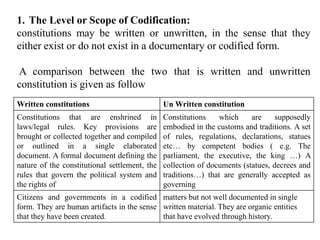
1. The Level or Scope of Codification:
constitutions may be written or unwritten, in the sense that they
either exist or do not exist in a documentary or codified form.
A comparison between the two that is written and unwritten
constitution is given as follow
Written constitutions Un Written constitution
Constitutions that are enshrined in
laws/legal rules. Key provisions are
brought or collected together and compiled
or outlined in a single elaborated
document. A formal document defining the
nature of the constitutional settlement, the
rules that govern the political system and
the rights of
Constitutions which are supposedly
embodied in the customs and traditions. A set
of rules, regulations, declarations, statues
etc… by competent bodies ( e.g. The
parliament, the executive, the king …) A
collection of documents (statues, decrees and
traditions…) that are generally accepted as
governing
Citizens and governments in a codified
form. They are human artifacts in the sense
that they have been created.
matters but not well documented in single
written material. They are organic entities
that have evolved through history.
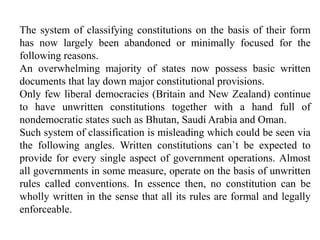
The system of classifying constitutions on the basis of their form
has now largely been abandoned or minimally focused for the
following reasons.
An overwhelming majority of states now possess basic written
documents that lay down major constitutional provisions.
Only few liberal democracies (Britain and New Zealand) continue
to have unwritten constitutions together with a hand full of
nondemocratic states such as Bhutan, Saudi Arabia and Oman.
Such system of classification is misleading which could be seen via
the following angles. Written constitutions can`t be expected to
provide for every single aspect of government operations. Almost
all governments in some measure, operate on the basis of unwritten
rules called conventions. In essence then, no constitution can be
wholly written in the sense that all its rules are formal and legally
enforceable.
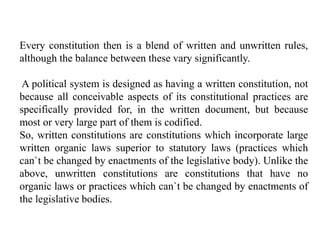
Every constitution then is a blend of written and unwritten rules,
although the balance between these vary significantly.
A political system is designed as having a written constitution, not
because all conceivable aspects of its constitutional practices are
specifically provided for, in the written document, but because
most or very large part of them is codified.
So, written constitutions are constitutions which incorporate large
written organic laws superior to statutory laws (practices which
can`t be changed by enactments of the legislative body). Unlike the
above, unwritten constitutions are constitutions that have no
organic laws or practices which can`t be changed by enactments of
the legislative bodies.
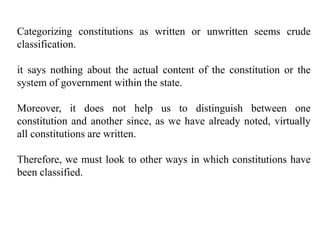
Categorizing constitutions as written or unwritten seems crude
classification.
it says nothing about the actual content of the constitution or the
system of government within the state.
Moreover, it does not help us to distinguish between one
constitution and another since, as we have already noted, virtually
all constitutions are written.
Therefore, we must look to other ways in which constitutions have
been classified.
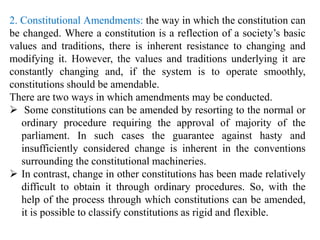
2. Constitutional Amendments: the way in which the constitution can
be changed. Where a constitution is a reflection of a society’s basic
values and traditions, there is inherent resistance to changing and
modifying it. However, the values and traditions underlying it are
constantly changing and, if the system is to operate smoothly,
constitutions should be amendable.
There are two ways in which amendments may be conducted.
 Some constitutions can be amended by resorting to the normal or
ordinary procedure requiring the approval of majority of the
parliament. In such cases the guarantee against hasty and
insufficiently considered change is inherent in the conventions
surrounding the constitutional machineries.
 In contrast, change in other constitutions has been made relatively
difficult to obtain it through ordinary procedures. So, with the
help of the process through which constitutions can be amended,
it is possible to classify constitutions as rigid and flexible.
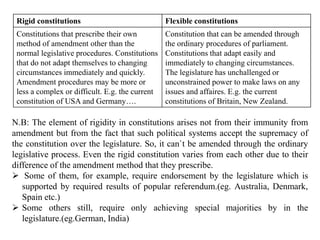
Rigid constitutions Flexible constitutions
Constitutions that prescribe their own
method of amendment other than the
normal legislative procedures. Constitutions
that do not adapt themselves to changing
circumstances immediately and quickly.
Amendment procedures may be more or
less a complex or difficult. E.g. the current
constitution of USA and Germany….
Constitution that can be amended through
the ordinary procedures of parliament.
Constitutions that adapt easily and
immediately to changing circumstances.
The legislature has unchallenged or
unconstrained power to make laws on any
issues and affaires. E.g. the current
constitutions of Britain, New Zealand.
N.B: The element of rigidity in constitutions arises not from their immunity from
amendment but from the fact that such political systems accept the supremacy of
the constitution over the legislature. So, it can`t be amended through the ordinary
legislative process. Even the rigid constitution varies from each other due to their
difference of the amendment method that they prescribe.
 Some of them, for example, require endorsement by the legislature which is
supported by required results of popular referendum.(eg. Australia, Denmark,
Spain etc.)
 Some others still, require only achieving special majorities by in the
legislature.(eg.German, India)
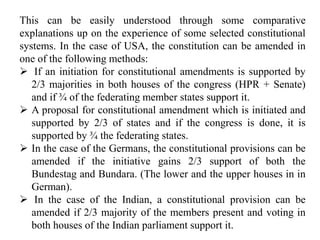
This can be easily understood through some comparative
explanations up on the experience of some selected constitutional
systems. In the case of USA, the constitution can be amended in
one of the following methods:
 If an initiation for constitutional amendments is supported by
2/3 majorities in both houses of the congress (HPR + Senate)
and if ¾ of the federating member states support it.
 A proposal for constitutional amendment which is initiated and
supported by 2/3 of states and if the congress is done, it is
supported by ¾ the federating states.
 In the case of the Germans, the constitutional provisions can be
amended if the initiative gains 2/3 support of both the
Bundestag and Bundara. (The lower and the upper houses in in
German).
 In the case of the Indian, a constitutional provision can be
amended if 2/3 majority of the members present and voting in
both houses of the Indian parliament support it.
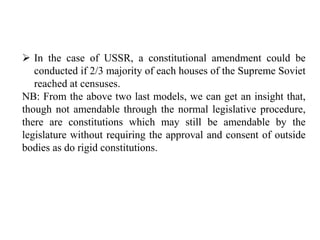
 In the case of USSR, a constitutional amendment could be
conducted if 2/3 majority of each houses of the Supreme Soviet
reached at censuses.
NB: From the above two last models, we can get an insight that,
though not amendable through the normal legislative procedure,
there are constitutions which may still be amendable by the
legislature without requiring the approval and consent of outside
bodies as do rigid constitutions.
understanding Constitution and constitution and constitutionalism

understanding Constitution and constitution and constitutionalism

  • 1.
    CHAPTER SEVEN UNDERSTANDING THENATURE AND ESSENTIALS OF CONSTITUTION AND CONSTITUTIONALISM
  • 2.
    This straightforward questionadmits more than one answers depending upon the context in which the word ‘constitution’ is used. In its narrow sense, the term constitution is used to refer to a single, authoritative document (written constitution), the aim of which is to codify major constitutional provisions: it constitutes the highest law in the land. A constitution is, broadly, a set of fundamental rules, written or unwritten, that seek to establish the duties, powers and functions of the various institutions of a government, regulate the relationships between them, and define the relationship between the state and the individual What is Constitution to You?
  • 3.
    The character ofa government which defines the basic principles to which a society must conform; describes the organization of the government, its regulation, distribution, and limitations on the functions of different government departments; and prescribes the extent and manner of the exercise of its sovereign powers. This statement can be broken down into the following specific points: A constitution is an organic and fundamental law of a state which prescribes primarily:
  • 4.
     the wayhow a government is organized  The specific powers and functions to be given to the principal organs of government and its agencies.  The limitation imposed upon the extent and method of exercising political power  The relationship that will exist between the government and the governed that live under it.  The basic principles and philosophical values followed by the political society in regard to their political, economic, cultural, and social perspectives or orientations.  The substantive rights of citizens
  • 5.
    What differentiates aconstitution from other forms of laws of a state? 1. The constitution states only the general principles. It builds a substantial foundation or basic and general frame work for the laws of a government. 2. The constitution includes only principles which are designed and qualified enough to be elastic. It accommodates various questions and can further be interpreted. It leaves possibilities for the derivation of other specific laws 3. Relatively speaking, constitutions include principles that are permanent in their duration. Unique Features of Constitutional Law
  • 6.
     Constitutional provisionsare adopted based on identifying problems existing in the past, present and in the future life of the society. The process of developing and endorsement of constitutional laws is based on wide public participation. Consequently, Constitutional laws are made to be stable for undefined and expanding future. Constitutional laws don`t adapt to work by the temper of the time  It will not rise or fall by occasional and emotional events Unlike to the above, laws other than the constitution are tentative and occasional and capable of changing frequently The main reasons for this among others include:
  • 7.
    Constitutions include principlesthat are the primary and supreme laws of the land.  A constitution is primary, being the command of the sovereign, the people in the case of democracy.  All laws other than the constitution are secondary and derivative being the command of the representative or delegate of the sovereign, in most case the government and its agencies.  Constitutions rule over all components of the state:  The government and its established agents  Institutions / laws of the state  The society in general  Interest groups  Individual persons
  • 8.
    It is imperativelyimportant to see constitutions via categorical approach thereby reaching to understand the heart of the nature of constitutions and constitutional order. The nature of the structures designed as constitutional, varies among political systems. Some may operate on the basis of a more general document (USA…), while some others operate on the basis of a very detailed document. (For example, India…) and still others have no single document as key to their constitution (For example, Britain…..). Overall, things such as systems may also vary in the degree of observing their constitutional frame works. It is also attractive to see distinctions among constitutions on the basis of mode of amendments and procedural requirements. Beyond that, it is also helpful to look at constitutions in terms of their content, particularly by the type of institutional structure they underpin or support. Typologies of Constitutions and Constitutional Structures
  • 9.
    1. The Levelor Scope of Codification: constitutions may be written or unwritten, in the sense that they either exist or do not exist in a documentary or codified form. A comparison between the two that is written and unwritten constitution is given as follow Written constitutions Un Written constitution Constitutions that are enshrined in laws/legal rules. Key provisions are brought or collected together and compiled or outlined in a single elaborated document. A formal document defining the nature of the constitutional settlement, the rules that govern the political system and the rights of Constitutions which are supposedly embodied in the customs and traditions. A set of rules, regulations, declarations, statues etc… by competent bodies ( e.g. The parliament, the executive, the king …) A collection of documents (statues, decrees and traditions…) that are generally accepted as governing Citizens and governments in a codified form. They are human artifacts in the sense that they have been created. matters but not well documented in single written material. They are organic entities that have evolved through history.
  • 10.
    The system ofclassifying constitutions on the basis of their form has now largely been abandoned or minimally focused for the following reasons. An overwhelming majority of states now possess basic written documents that lay down major constitutional provisions. Only few liberal democracies (Britain and New Zealand) continue to have unwritten constitutions together with a hand full of nondemocratic states such as Bhutan, Saudi Arabia and Oman. Such system of classification is misleading which could be seen via the following angles. Written constitutions can`t be expected to provide for every single aspect of government operations. Almost all governments in some measure, operate on the basis of unwritten rules called conventions. In essence then, no constitution can be wholly written in the sense that all its rules are formal and legally enforceable.
  • 11.
    Every constitution thenis a blend of written and unwritten rules, although the balance between these vary significantly. A political system is designed as having a written constitution, not because all conceivable aspects of its constitutional practices are specifically provided for, in the written document, but because most or very large part of them is codified. So, written constitutions are constitutions which incorporate large written organic laws superior to statutory laws (practices which can`t be changed by enactments of the legislative body). Unlike the above, unwritten constitutions are constitutions that have no organic laws or practices which can`t be changed by enactments of the legislative bodies.
  • 12.
    Categorizing constitutions aswritten or unwritten seems crude classification. it says nothing about the actual content of the constitution or the system of government within the state. Moreover, it does not help us to distinguish between one constitution and another since, as we have already noted, virtually all constitutions are written. Therefore, we must look to other ways in which constitutions have been classified.
  • 13.
    2. Constitutional Amendments:the way in which the constitution can be changed. Where a constitution is a reflection of a society’s basic values and traditions, there is inherent resistance to changing and modifying it. However, the values and traditions underlying it are constantly changing and, if the system is to operate smoothly, constitutions should be amendable. There are two ways in which amendments may be conducted.  Some constitutions can be amended by resorting to the normal or ordinary procedure requiring the approval of majority of the parliament. In such cases the guarantee against hasty and insufficiently considered change is inherent in the conventions surrounding the constitutional machineries.  In contrast, change in other constitutions has been made relatively difficult to obtain it through ordinary procedures. So, with the help of the process through which constitutions can be amended, it is possible to classify constitutions as rigid and flexible.
  • 14.
    Rigid constitutions Flexibleconstitutions Constitutions that prescribe their own method of amendment other than the normal legislative procedures. Constitutions that do not adapt themselves to changing circumstances immediately and quickly. Amendment procedures may be more or less a complex or difficult. E.g. the current constitution of USA and Germany…. Constitution that can be amended through the ordinary procedures of parliament. Constitutions that adapt easily and immediately to changing circumstances. The legislature has unchallenged or unconstrained power to make laws on any issues and affaires. E.g. the current constitutions of Britain, New Zealand. N.B: The element of rigidity in constitutions arises not from their immunity from amendment but from the fact that such political systems accept the supremacy of the constitution over the legislature. So, it can`t be amended through the ordinary legislative process. Even the rigid constitution varies from each other due to their difference of the amendment method that they prescribe.  Some of them, for example, require endorsement by the legislature which is supported by required results of popular referendum.(eg. Australia, Denmark, Spain etc.)  Some others still, require only achieving special majorities by in the legislature.(eg.German, India)
  • 15.
    This can beeasily understood through some comparative explanations up on the experience of some selected constitutional systems. In the case of USA, the constitution can be amended in one of the following methods:  If an initiation for constitutional amendments is supported by 2/3 majorities in both houses of the congress (HPR + Senate) and if ¾ of the federating member states support it.  A proposal for constitutional amendment which is initiated and supported by 2/3 of states and if the congress is done, it is supported by ¾ the federating states.  In the case of the Germans, the constitutional provisions can be amended if the initiative gains 2/3 support of both the Bundestag and Bundara. (The lower and the upper houses in in German).  In the case of the Indian, a constitutional provision can be amended if 2/3 majority of the members present and voting in both houses of the Indian parliament support it.
  • 16.
     In thecase of USSR, a constitutional amendment could be conducted if 2/3 majority of each houses of the Supreme Soviet reached at censuses. NB: From the above two last models, we can get an insight that, though not amendable through the normal legislative procedure, there are constitutions which may still be amendable by the legislature without requiring the approval and consent of outside bodies as do rigid constitutions.