By Niharika Agrawal
Roll No 61
Consent is dealt under sec. 13 of INDIAN
CONTRACT ACT
• 2 or more person are said to be in consent,
when they agree upon the same thing and in
the same manner.
Consent to be valid…
• According to Sec 14 of INDIAN CONTRACT
ACT-
• Free, voluntary, without undue influence
• Given by a competent person
• Is informed about – nature of illness,
prognosis, options available and risks involved.
Consent is invalid if-
• It is not well informed consent for further
examinations.
• Given for committing a crime or an illegal act,
such as criminal abortion.
• Obtained for misinterpretation or fraud
• According to Sec 90 of IPC and B.N.S 28-
Consent is invalid if a person has no legal
capacity to give it ( a minor or an insane
person).
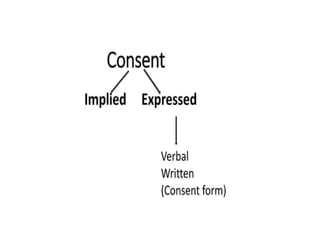
Implied consent
• Patient presents himself at the doctor’s clinic
or outpatient department
• Implied that he is agreeable to be examined
only for procedures like inspection, palpation,
percussion and auscultation.
Expressed consent-
• Stated in the language that patient
understands clearly.
• ORAL/ VERBAL CONSENT-
• For relatively minor examinations or
therapeutic procedures.
• For withdrawal of blood for diagnostic
purposes.
Doctrine of Informed consent
• Patient should be informed in vernacular
language about-
• Condition or nature of the illness.
• Procedure or treatment proposed.
• Risks and benefits of treatment or procedure.
• Risks and benefits of alternative treatment or
procedure.
• Prospect of success or failure (prognosis)
• Prognosis in the absence of the intervention.
• Acceptance or refusal of the said procedure or
intervention.
Exceptions to informed consent-
• 1. Therapeutic Privilege-
• Doctor can withhold information from the
patient if-
• If the disclosure would pose serious
psychological threat to the patient.
• So the doctor can disclose full information to a
competent relative of the patient.
Exceptions to informed consent-
• 2. Therapeutic Waiver-
• Competent person who is aware of being
entitled to informed consent may give up his
right by waiving it.
Exceptions to informed consent-
• 3. Medico legal postmortems (Sec. 174 CrPC)
• 4. Treatment of the patient suffering from
‘notifiable diseases’ for greater community
interest.
Exceptions to informed consent-
According to [Sec. 53 (1) CrPC]-
• An accused can be examined by a doctor by
using reasonable force, if requested by a
police officer.
Exceptions to informed consent-
• 6. Psychiatric examination or treatment by
court order.
• 7. Prisoners.
Exceptions to informed consent-
• 8. Extension doctrine-
• During the course of procedure for which the
doctor has taken consent, if the doctor
discovers a new finding, which was not
anticipated and which is dangerous for the
patient, so in good faith, doctor can extend
the consent to do the procedure which is
legally valid.
Proxy Consent
• Proxy consent (Guardian) in the case of
mentally retarded.
Universal Consent-
• Universal consent- Consent is given by state or
government or law.
Age for obtaining consent-
• Legally accepted minimum age of consent for
medical examination and treatment: 12 years
• Guardian can give the consent for the child
less than 12 years or a patient of unsound
mind
Age for obtaining consent-
• Legally accepted minimum age of consent for
organ donation is 18 years.
Rules of the consent-
• Consent of spouse is not necessary for the
treatment of the other.
• CONTRACEPTIVE STERILIZATION and
ARTIFICIAL INSEMINATION: consent of both ,
husband and wife is must.
Rules of the consent
• Pathological autopsy-
• Consent of next of kin of the deceased is
required.
• Medico Legal autopsy-
• It does not require any consent from the
relatives of the deceased.
Rules of the consent-
• Loco parentis-
• Consent of the PERSON IN CHARGE of the
child can give the consent in case when
parents or guardians are not available.
Medico Legal importance
• Reasons for obtaining consent-
• Assault in law- To examine/treat patient
without consent is assault in law.
• Negligence- If a doctor fails to ask for consent,
he may be charged for negligence.

Consent forensic medicine ppt.... (1).pptx

  • 1.
  • 2.
    Consent is dealtunder sec. 13 of INDIAN CONTRACT ACT • 2 or more person are said to be in consent, when they agree upon the same thing and in the same manner.
  • 3.
    Consent to bevalid… • According to Sec 14 of INDIAN CONTRACT ACT- • Free, voluntary, without undue influence • Given by a competent person • Is informed about – nature of illness, prognosis, options available and risks involved.
  • 4.
    Consent is invalidif- • It is not well informed consent for further examinations. • Given for committing a crime or an illegal act, such as criminal abortion. • Obtained for misinterpretation or fraud
  • 5.
    • According toSec 90 of IPC and B.N.S 28- Consent is invalid if a person has no legal capacity to give it ( a minor or an insane person).
  • 8.
    Implied consent • Patientpresents himself at the doctor’s clinic or outpatient department • Implied that he is agreeable to be examined only for procedures like inspection, palpation, percussion and auscultation.
  • 9.
    Expressed consent- • Statedin the language that patient understands clearly. • ORAL/ VERBAL CONSENT- • For relatively minor examinations or therapeutic procedures. • For withdrawal of blood for diagnostic purposes.
  • 10.
    Doctrine of Informedconsent • Patient should be informed in vernacular language about- • Condition or nature of the illness. • Procedure or treatment proposed. • Risks and benefits of treatment or procedure. • Risks and benefits of alternative treatment or procedure.
  • 11.
    • Prospect ofsuccess or failure (prognosis) • Prognosis in the absence of the intervention. • Acceptance or refusal of the said procedure or intervention.
  • 12.
    Exceptions to informedconsent- • 1. Therapeutic Privilege- • Doctor can withhold information from the patient if- • If the disclosure would pose serious psychological threat to the patient. • So the doctor can disclose full information to a competent relative of the patient.
  • 13.
    Exceptions to informedconsent- • 2. Therapeutic Waiver- • Competent person who is aware of being entitled to informed consent may give up his right by waiving it.
  • 14.
    Exceptions to informedconsent- • 3. Medico legal postmortems (Sec. 174 CrPC) • 4. Treatment of the patient suffering from ‘notifiable diseases’ for greater community interest.
  • 15.
    Exceptions to informedconsent- According to [Sec. 53 (1) CrPC]- • An accused can be examined by a doctor by using reasonable force, if requested by a police officer.
  • 16.
    Exceptions to informedconsent- • 6. Psychiatric examination or treatment by court order. • 7. Prisoners.
  • 17.
    Exceptions to informedconsent- • 8. Extension doctrine- • During the course of procedure for which the doctor has taken consent, if the doctor discovers a new finding, which was not anticipated and which is dangerous for the patient, so in good faith, doctor can extend the consent to do the procedure which is legally valid.
  • 18.
    Proxy Consent • Proxyconsent (Guardian) in the case of mentally retarded.
  • 19.
    Universal Consent- • Universalconsent- Consent is given by state or government or law.
  • 20.
    Age for obtainingconsent- • Legally accepted minimum age of consent for medical examination and treatment: 12 years • Guardian can give the consent for the child less than 12 years or a patient of unsound mind
  • 21.
    Age for obtainingconsent- • Legally accepted minimum age of consent for organ donation is 18 years.
  • 22.
    Rules of theconsent- • Consent of spouse is not necessary for the treatment of the other. • CONTRACEPTIVE STERILIZATION and ARTIFICIAL INSEMINATION: consent of both , husband and wife is must.
  • 23.
    Rules of theconsent • Pathological autopsy- • Consent of next of kin of the deceased is required. • Medico Legal autopsy- • It does not require any consent from the relatives of the deceased.
  • 24.
    Rules of theconsent- • Loco parentis- • Consent of the PERSON IN CHARGE of the child can give the consent in case when parents or guardians are not available.
  • 25.
    Medico Legal importance •Reasons for obtaining consent- • Assault in law- To examine/treat patient without consent is assault in law. • Negligence- If a doctor fails to ask for consent, he may be charged for negligence.