Connected Product Experiences
on scale, experience and business models
Alexandra Deschamps-Sonsino
@iotwatch
April 30th 2021
My name is
Alexandra Deschamps-Sonsino
@iotwatch on Twitter
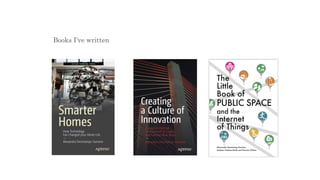
Books I’ve written
Designing services that are
valued over time and
developing customer loyalty.
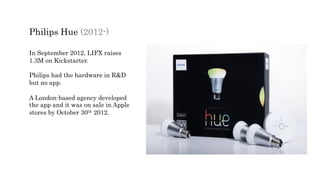
Philips Hue (2012-)
In September 2012, LIFX raises
1.3M on Kickstarter.
Philips had the hardware in R&D
but no app.
A London-based agency developed
the app and it was on sale in Apple
stores by October 30th 2012.
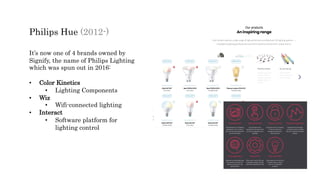
Philips Hue (2012-)
It’s now one of 4 brands owned by
Signify, the name of Philips Lighting
which was spun out in 2016:
• Color Kinetics
• Lighting Components
• Wiz
• Wifi-connected lighting
• Interact
• Software platform for
lighting control
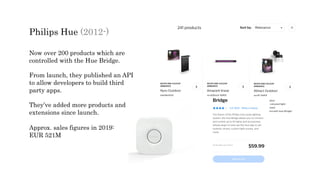
Philips Hue (2012-)
Now over 200 products which are
controlled with the Hue Bridge.
From launch, they published an API
to allow developers to build third
party apps.
They’ve added more products and
extensions since launch.
Approx. sales figures in 2019:
EUR 521M
Lessons from Philips Hue
• React quickly to early adopters interest (LIFX) in the same way
Pebble paved the way for wearables.
• Keep investing while de-risking and spinning off
• Built on the strength of an already recognised brand
Centrica Hive (2012-)
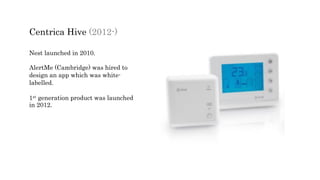
Nest launched in 2010.
AlertMe (Cambridge) was hired to
design an app which was white-
labelled.
1st generation product was launched
in 2012.
Centrica Hive (2012-)
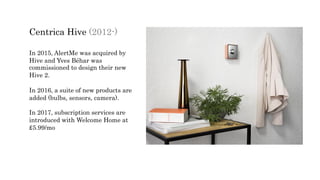
In 2015, AlertMe was acquired by
Hive and Yves Béhar was
commissioned to design their new
Hive 2.
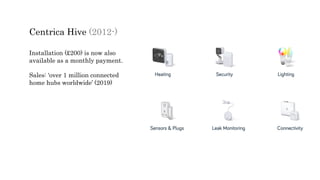
In 2016, a suite of new products are
added (bulbs, sensors, camera).
In 2017, subscription services are
introduced with Welcome Home at
£5.99/mo
Centrica Hive (2012-)
Installation (£200) is now also
available as a monthly payment.
Sales: ‘over 1 million connected
home hubs worldwide’ (2019)
Lessons from Philips Hue
• React quickly to competitors (Nest) while bringing in expertise
from others (AlertMe).
• Build a suite of products that feel related to the core product
experience (boiler management & leak prevention)
• The space gets busy (Netatmo, Tado, Nest, Honeywell) so offering
more flexible paying methods that feel closer to a utility payment
becomes key.
• Being clear about the savings (if any) is also crucial to buy-in.
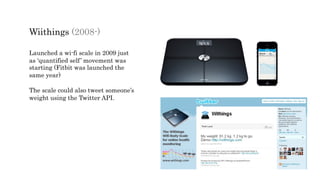
Wiithings (2008-)
Launched a wi-fi scale in 2009 just
as ‘quantified self’ movement was
starting (Fitbit was launched the
same year)
The scale could also tweet someone’s
weight using the Twitter API.
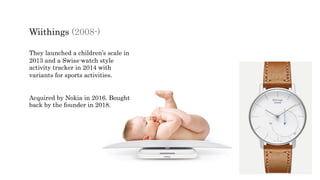
Wiithings (2008-)
They launched a children’s scale in
2013 and a Swiss-watch style
activity tracker in 2014 with
variants for sports activities.
Acquired by Nokia in 2016. Bought
back by the founder in 2018.
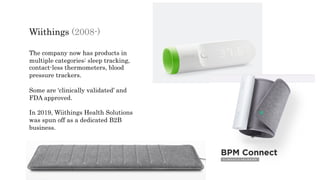
Wiithings (2008-)
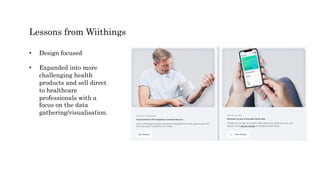
The company now has products in
multiple categories: sleep tracking,
contact-less thermometers, blood
pressure trackers.
Some are ‘clinically validated’ and
FDA approved.
In 2019, Wiithings Health Solutions
was spun off as a dedicated B2B
business.
Lessons from Wiithings
• Design focused
• Expanded into more
challenging health
products and sell direct
to healthcare
professionals with a
focus on the data
gathering/visualisation.
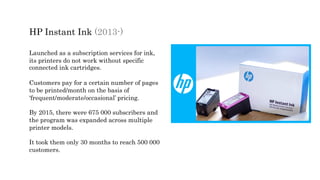
HP Instant Ink (2013-)
Launched as a subscription services for ink,
its printers do not work without specific
connected ink cartridges.
Customers pay for a certain number of pages
to be printed/month on the basis of
‘frequent/moderate/occasional’ pricing.
By 2015, there were 675 000 subscribers and
the program was expanded across multiple
printer models.
It took them only 30 months to reach 500 000
customers.
Lessons from HP Instant Ink
• For customers who are more focused on convenience than price.
• Reviews from 2020 highlight the need for diligence when signing
up as the product hasn’t fundamentally adapted to a paperless
office / wfh reality.
• The recycling scheme that is built into the service will help the
business with its ESG reporting but need to align with WEEE
directive and e-waste policies coming in with the Green Deal.
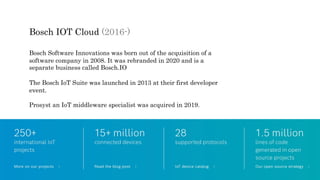
Bosch IOT Cloud (2016-)
Bosch Software Innovations was born out of the acquisition of a
software company in 2008. It was rebranded in 2020 and is a
separate business called Bosch.IO
The Bosch IoT Suite was launched in 2013 at their first developer
event.
Prosyst an IoT middleware specialist was acquired in 2019.
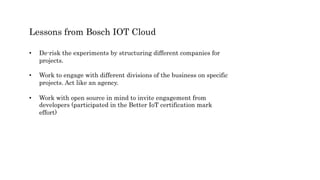
Lessons from Bosch IOT Cloud
• De-risk the experiments by structuring different companies for
projects.
• Work to engage with different divisions of the business on specific
projects. Act like an agency.
• Work with open source in mind to invite engagement from
developers (participated in the Better IoT certification mark
effort)
Questions?
alex@designswarm.com
Alexandra Deschamps-Sonsino
@iotwatch

Connected Product Experiences

  • 1.
    Connected Product Experiences onscale, experience and business models Alexandra Deschamps-Sonsino @iotwatch April 30th 2021
  • 2.
    My name is AlexandraDeschamps-Sonsino @iotwatch on Twitter
  • 3.
  • 4.
    Designing services thatare valued over time and developing customer loyalty.
  • 5.
    Philips Hue (2012-) InSeptember 2012, LIFX raises 1.3M on Kickstarter. Philips had the hardware in R&D but no app. A London-based agency developed the app and it was on sale in Apple stores by October 30th 2012.
  • 6.
    Philips Hue (2012-) It’snow one of 4 brands owned by Signify, the name of Philips Lighting which was spun out in 2016: • Color Kinetics • Lighting Components • Wiz • Wifi-connected lighting • Interact • Software platform for lighting control
  • 7.
    Philips Hue (2012-) Nowover 200 products which are controlled with the Hue Bridge. From launch, they published an API to allow developers to build third party apps. They’ve added more products and extensions since launch. Approx. sales figures in 2019: EUR 521M
  • 8.
    Lessons from PhilipsHue • React quickly to early adopters interest (LIFX) in the same way Pebble paved the way for wearables. • Keep investing while de-risking and spinning off • Built on the strength of an already recognised brand
  • 9.
    Centrica Hive (2012-) Nestlaunched in 2010. AlertMe (Cambridge) was hired to design an app which was white- labelled. 1st generation product was launched in 2012.
  • 10.
    Centrica Hive (2012-) In2015, AlertMe was acquired by Hive and Yves Béhar was commissioned to design their new Hive 2. In 2016, a suite of new products are added (bulbs, sensors, camera). In 2017, subscription services are introduced with Welcome Home at £5.99/mo
  • 11.
    Centrica Hive (2012-) Installation(£200) is now also available as a monthly payment. Sales: ‘over 1 million connected home hubs worldwide’ (2019)
  • 12.
    Lessons from PhilipsHue • React quickly to competitors (Nest) while bringing in expertise from others (AlertMe). • Build a suite of products that feel related to the core product experience (boiler management & leak prevention) • The space gets busy (Netatmo, Tado, Nest, Honeywell) so offering more flexible paying methods that feel closer to a utility payment becomes key. • Being clear about the savings (if any) is also crucial to buy-in.
  • 13.
    Wiithings (2008-) Launched awi-fi scale in 2009 just as ‘quantified self’ movement was starting (Fitbit was launched the same year) The scale could also tweet someone’s weight using the Twitter API.
  • 14.
    Wiithings (2008-) They launcheda children’s scale in 2013 and a Swiss-watch style activity tracker in 2014 with variants for sports activities. Acquired by Nokia in 2016. Bought back by the founder in 2018.
  • 15.
    Wiithings (2008-) The companynow has products in multiple categories: sleep tracking, contact-less thermometers, blood pressure trackers. Some are ‘clinically validated’ and FDA approved. In 2019, Wiithings Health Solutions was spun off as a dedicated B2B business.
  • 16.
    Lessons from Wiithings •Design focused • Expanded into more challenging health products and sell direct to healthcare professionals with a focus on the data gathering/visualisation.
  • 17.
    HP Instant Ink(2013-) Launched as a subscription services for ink, its printers do not work without specific connected ink cartridges. Customers pay for a certain number of pages to be printed/month on the basis of ‘frequent/moderate/occasional’ pricing. By 2015, there were 675 000 subscribers and the program was expanded across multiple printer models. It took them only 30 months to reach 500 000 customers.
  • 18.
    Lessons from HPInstant Ink • For customers who are more focused on convenience than price. • Reviews from 2020 highlight the need for diligence when signing up as the product hasn’t fundamentally adapted to a paperless office / wfh reality. • The recycling scheme that is built into the service will help the business with its ESG reporting but need to align with WEEE directive and e-waste policies coming in with the Green Deal.
  • 19.
    Bosch IOT Cloud(2016-) Bosch Software Innovations was born out of the acquisition of a software company in 2008. It was rebranded in 2020 and is a separate business called Bosch.IO The Bosch IoT Suite was launched in 2013 at their first developer event. Prosyst an IoT middleware specialist was acquired in 2019.
  • 20.
    Lessons from BoschIOT Cloud • De-risk the experiments by structuring different companies for projects. • Work to engage with different divisions of the business on specific projects. Act like an agency. • Work with open source in mind to invite engagement from developers (participated in the Better IoT certification mark effort)
  • 21.