Connected Care for Complex
Chronic Patients in Lleida
Eloisa VARGIU, Juan Manuel FERNÀNDEZ, Felip MIRALLES
Mireia Massip, Gerard TORRES
Felix MICHEL, Florian MATTHES
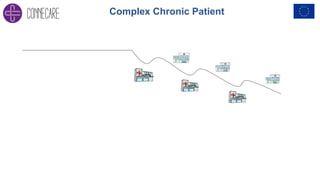
Complex Chronic Patient
• It is a clinical assistive concept
• There is not a unified definition
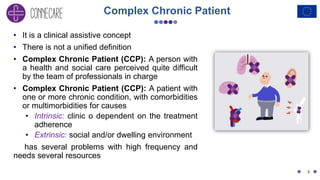
• Complex Chronic Patient (CCP): A person with
a health and social care perceived quite difficult
by the team of professionals in charge
• Complex Chronic Patient (CCP): A patient with
one or more chronic condition, with comorbidities
or multimorbidities for causes
• Intrinsic: clinic o dependent on the treatment
adherence
• Extrinsic: social and/or dwelling environment
has several problems with high frequency and
needs several resources
2
Complex Chronic Patient
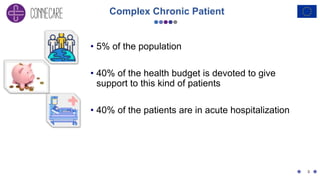
• 5% of the population
• 40% of the health budget is devoted to give
support to this kind of patients
• 40% of the patients are in acute hospitalization
3
Complex Chronic Patient
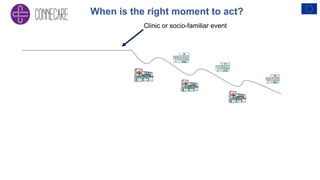
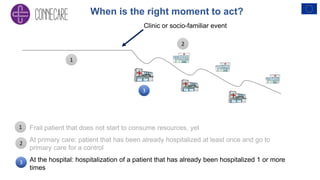
Clinic or socio-familiar event
When is the right moment to act?
Clinic or socio-familiar event
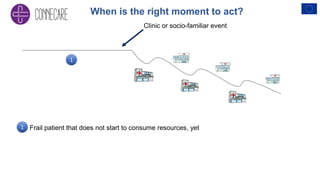
Frail patient that does not start to consume resources, yet
When is the right moment to act?
1
1
Clinic or socio-familiar event
Frail patient that does not start to consume resources, yet
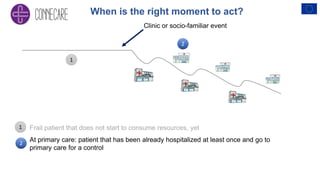
At primary care: patient that has been already hospitalized at least once and go to
primary care for a control
When is the right moment to act?
1
1
2
2
Clinic or socio-familiar event
Frail patient that does not start to consume resources, yet
At primary care: patient that has been already hospitalized at least once and go to
primary care for a control
At the hospital: hospitalization of a patient that has already been hospitalized 1 or more
times
When is the right moment to act?
1
1
2
2
3
3
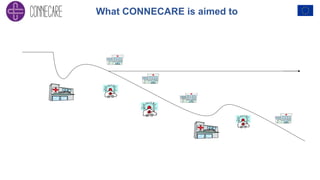
What CONNECARE is aimed to
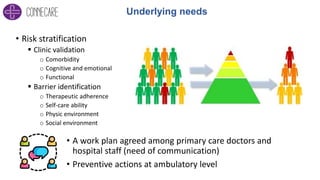
• Risk stratification
 Clinic validation
o Comorbidity
o Cognitive and emotional
o Functional
 Barrier identification
o Therapeutic adherence
o Self-care ability
o Physic environment
o Social environment
Underlying needs
• A work plan agreed among primary care doctors and
hospital staff (need of communication)
• Preventive actions at ambulatory level
11
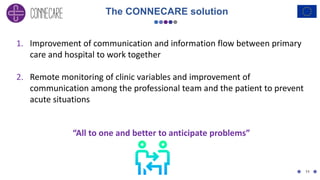
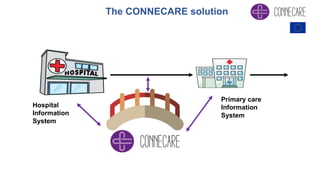
1. Improvement of communication and information flow between primary
care and hospital to work together
2. Remote monitoring of clinic variables and improvement of
communication among the professional team and the patient to prevent
acute situations
“All to one and better to anticipate problems”
The CONNECARE solution
Hospital
Information
System
Primary care
Information
System
The CONNECARE solution
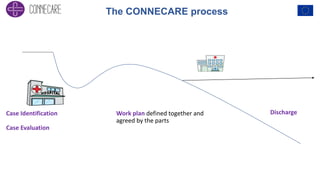
Case Identification
Case Evaluation
Work plan defined together and
agreed by the parts
Discharge
The CONNECARE process
14
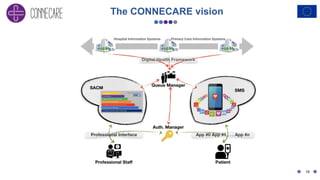
The CONNECARE vision
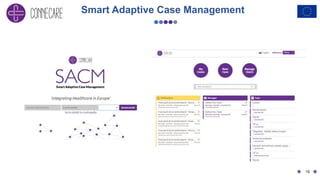
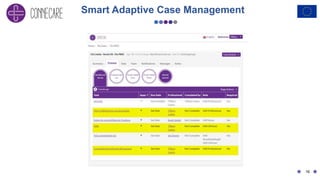
Smart Adaptive Case Management
15
Smart Adaptive Case Management
16
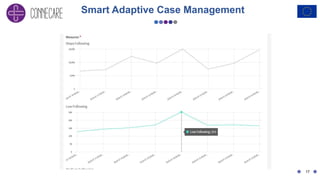
Smart Adaptive Case Management
17
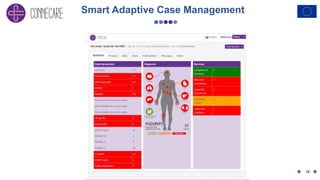
Smart Adaptive Case Management
18
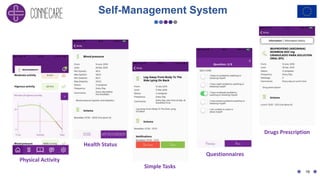
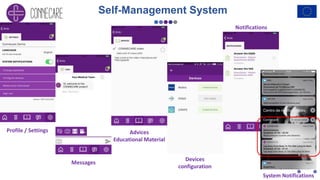
Self-Management System
19
Health Status
Physical Activity
Simple Tasks
Questionnaires
Drugs Prescription
Self-Management System
Profile / Settings
Notifications
Messages
Advices
Educational Material
System Notifications
Devices
configuration
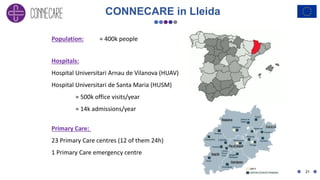
CONNECARE in Lleida
21
Population: ≈ 400k people
Hospitals:
Hospital Universitari Arnau de Vilanova (HUAV)
Hospital Universitari de Santa Maria (HUSM)
≈ 500k office visits/year
≈ 14k admissions/year
Primary Care:
23 Primary Care centres (12 of them 24h)
1 Primary Care emergency centre
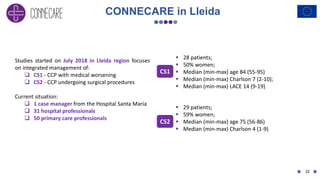
CONNECARE in Lleida
22
 28 patients;
 50% women;
 Median (min-max) age 84 (55-95)
 Median (min-max) Charlson 7 (2-10);
 Median (min-max) LACE 14 (9-19)
Studies started on July 2018 in Lleida region focuses
on integrated management of:
 CS1 - CCP with medical worsening
 CS2 - CCP undergoing surgical procedures
Current situation:
 1 case manager from the Hospital Santa Maria
 31 hospital professionals
 50 primary care professionals
CS1
 29 patients;
 59% women;
 Median (min-max) age 75 (56-86)
 Median (min-max) Charlson 4 (1-9)
CS2
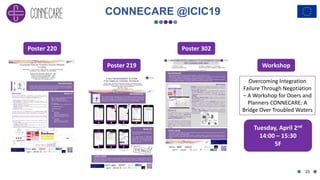
CONNECARE @ICIC19
23
Poster 220
Poster 219
Poster 302
Overcoming Integration
Failure Through Negotiation
– A Workshop for Doers and
Planners CONNECARE: A
Bridge Over Troubled Waters
Workshop
Tuesday, April 2nd
14:00 – 15:30
5F
Thanks
Gràcies
This project has received funding from the European Union’s Horizon 2020 research and innovation programme under grant agreement No 689802
Bedankt ‫תודה‬
Grazie Danke
eloisa.vargiu@eurecat.org

Connected Care for Complex Chronic Patients in Lleida

  • 1.
    Connected Care forComplex Chronic Patients in Lleida Eloisa VARGIU, Juan Manuel FERNÀNDEZ, Felip MIRALLES Mireia Massip, Gerard TORRES Felix MICHEL, Florian MATTHES
  • 2.
    Complex Chronic Patient •It is a clinical assistive concept • There is not a unified definition • Complex Chronic Patient (CCP): A person with a health and social care perceived quite difficult by the team of professionals in charge • Complex Chronic Patient (CCP): A patient with one or more chronic condition, with comorbidities or multimorbidities for causes • Intrinsic: clinic o dependent on the treatment adherence • Extrinsic: social and/or dwelling environment has several problems with high frequency and needs several resources 2
  • 3.
    Complex Chronic Patient •5% of the population • 40% of the health budget is devoted to give support to this kind of patients • 40% of the patients are in acute hospitalization 3
  • 4.
  • 5.
    Clinic or socio-familiarevent When is the right moment to act?
  • 6.
    Clinic or socio-familiarevent Frail patient that does not start to consume resources, yet When is the right moment to act? 1 1
  • 7.
    Clinic or socio-familiarevent Frail patient that does not start to consume resources, yet At primary care: patient that has been already hospitalized at least once and go to primary care for a control When is the right moment to act? 1 1 2 2
  • 8.
    Clinic or socio-familiarevent Frail patient that does not start to consume resources, yet At primary care: patient that has been already hospitalized at least once and go to primary care for a control At the hospital: hospitalization of a patient that has already been hospitalized 1 or more times When is the right moment to act? 1 1 2 2 3 3
  • 9.
  • 10.
    • Risk stratification Clinic validation o Comorbidity o Cognitive and emotional o Functional  Barrier identification o Therapeutic adherence o Self-care ability o Physic environment o Social environment Underlying needs • A work plan agreed among primary care doctors and hospital staff (need of communication) • Preventive actions at ambulatory level
  • 11.
    11 1. Improvement ofcommunication and information flow between primary care and hospital to work together 2. Remote monitoring of clinic variables and improvement of communication among the professional team and the patient to prevent acute situations “All to one and better to anticipate problems” The CONNECARE solution
  • 12.
  • 13.
    Case Identification Case Evaluation Workplan defined together and agreed by the parts Discharge The CONNECARE process
  • 14.
  • 15.
    Smart Adaptive CaseManagement 15
  • 16.
    Smart Adaptive CaseManagement 16
  • 17.
    Smart Adaptive CaseManagement 17
  • 18.
    Smart Adaptive CaseManagement 18
  • 19.
    Self-Management System 19 Health Status PhysicalActivity Simple Tasks Questionnaires Drugs Prescription
  • 20.
    Self-Management System Profile /Settings Notifications Messages Advices Educational Material System Notifications Devices configuration
  • 21.
    CONNECARE in Lleida 21 Population:≈ 400k people Hospitals: Hospital Universitari Arnau de Vilanova (HUAV) Hospital Universitari de Santa Maria (HUSM) ≈ 500k office visits/year ≈ 14k admissions/year Primary Care: 23 Primary Care centres (12 of them 24h) 1 Primary Care emergency centre
  • 22.
    CONNECARE in Lleida 22 28 patients;  50% women;  Median (min-max) age 84 (55-95)  Median (min-max) Charlson 7 (2-10);  Median (min-max) LACE 14 (9-19) Studies started on July 2018 in Lleida region focuses on integrated management of:  CS1 - CCP with medical worsening  CS2 - CCP undergoing surgical procedures Current situation:  1 case manager from the Hospital Santa Maria  31 hospital professionals  50 primary care professionals CS1  29 patients;  59% women;  Median (min-max) age 75 (56-86)  Median (min-max) Charlson 4 (1-9) CS2
  • 23.
    CONNECARE @ICIC19 23 Poster 220 Poster219 Poster 302 Overcoming Integration Failure Through Negotiation – A Workshop for Doers and Planners CONNECARE: A Bridge Over Troubled Waters Workshop Tuesday, April 2nd 14:00 – 15:30 5F
  • 24.
    Thanks Gràcies This project hasreceived funding from the European Union’s Horizon 2020 research and innovation programme under grant agreement No 689802 Bedankt ‫תודה‬ Grazie Danke eloisa.vargiu@eurecat.org