

AI-AM / NetMed 2015
4th International Workshop
on Artificial Intelligence
and Assistive Medicine
June 20, 2015
Monitoring People that Need
Assistance through a
Sensor-based System:
Evaluation and First Results
Xavier Rafael-Palou, Eloisa Vargiu, Felip Miralles
EURECAT
Barcelona, Spain
1. Assisting elderly and disabled people
2. A sensor-based telemonitoring system
3. Evaluation and Results
4. The SAAPHO project
5. The BackHome project
6. Conclusions
2
Outline
3
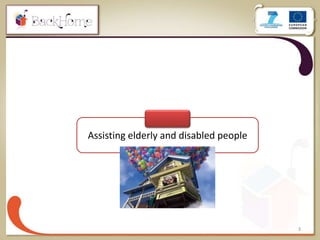
Assisting elderly and disabled people
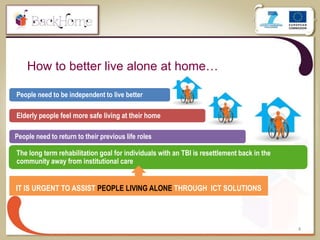
How to better live alone at home…
4
People need to be independent to live better
Elderly people feel more safe living at their home
People need to return to their previous life roles
The long term rehabilitation goal for individuals with an TBI is resettlement back in the
community away from institutional care
IT IS URGENT TO ASSIST PEOPLE LIVING ALONE THROUGH ICT SOLUTIONS
5
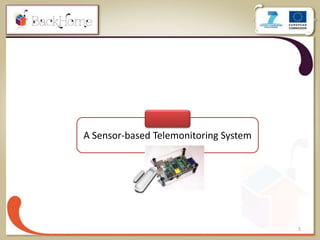
A Sensor-based Telemonitoring System
6
7
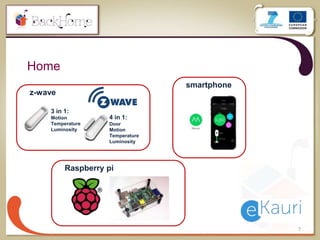
Home
4 in 1:
Door
Motion
Temperature
Luminosity
3 in 1:
Motion
Temperature
Luminosity
z-wave
smartphone
Raspberry pi
8
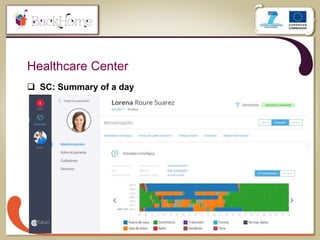
Healthcare Center
 SC: Summary of a day
9
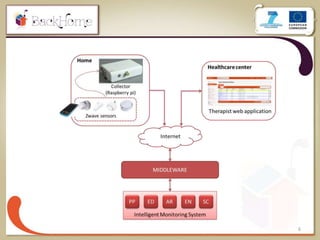
Intelligent Monitoring
10
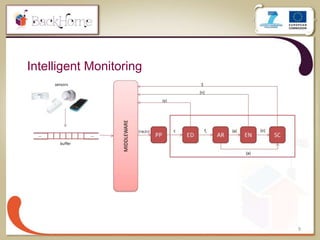
Intelligent Monitoring
 PP
 Its goal is to preprocess the data iteratively sending a chunk
c to both ED and RE according to a sliding window
approach
 Starting from the overall data streaming, the system
sequentially considers a range of time |ti - ti+1| between a
sensor measure si at time ti and the subsequent measure
si+1 at time ti+1
 The output of PP is a window c from ts to ta, where ts is the
starting time of a given period and ta is the actual time
11
Intelligent Monitoring
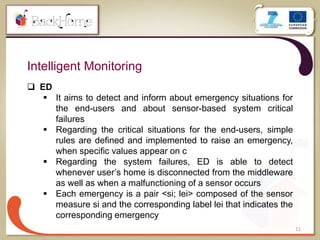
 ED
 It aims to detect and inform about emergency situations for
the end-users and about sensor-based system critical
failures
 Regarding the critical situations for the end-users, simple
rules are defined and implemented to raise an emergency,
when specific values appear on c
 Regarding the system failures, ED is able to detect
whenever user’s home is disconnected from the middleware
as well as when a malfunctioning of a sensor occurs
 Each emergency is a pair <si; lei> composed of the sensor
measure si and the corresponding label lei that indicates the
corresponding emergency
12
Intelligent Monitoring
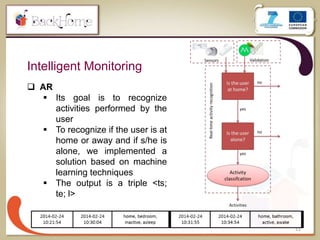
 AR
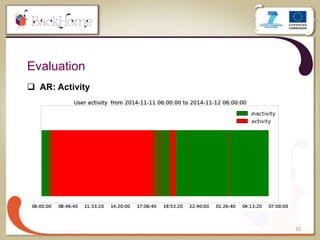
 Its goal is to recognize
activities performed by the
user
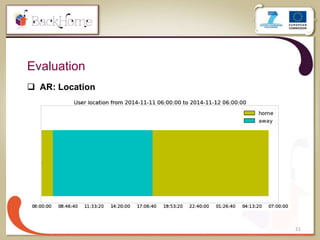
 To recognize if the user is at
home or away and if s/he is
alone, we implemented a
solution based on machine
learning techniques
 The output is a triple <ts;
te; l>
13
Intelligent Monitoring
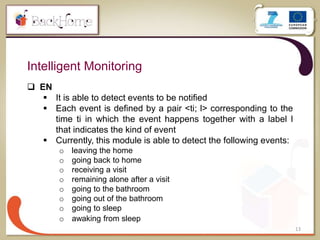
 EN
 It is able to detect events to be notified
 Each event is defined by a pair <ti; l> corresponding to the
time ti in which the event happens together with a label l
that indicates the kind of event
 Currently, this module is able to detect the following events:
o leaving the home
o going back to home
o receiving a visit
o remaining alone after a visit
o going to the bathroom
o going out of the bathroom
o going to sleep
o awaking from sleep
14
Intelligent Monitoring
 SC
 Once all the activities and events have been classified,
measures aimed at representing the summary of the user’s
monitoring during a given period are performed
 Two kinds of summary are provided
o Historical
o Actual
 A QoL assessment system is also provided to assess a
specific QoL items
o Mobility
o Sleeping
o Mood
15
Evaluation and Results
16
Evaluation
 An abled-body woman who lives alone
 a window of 4 months for training and evaluation (training
dataset)
 a window of 1 month for the test (testing dataset)
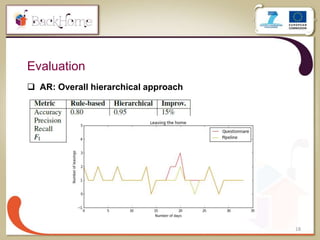
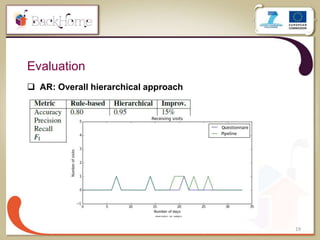
 experiments have been performed on AR and EN
17
Evaluation
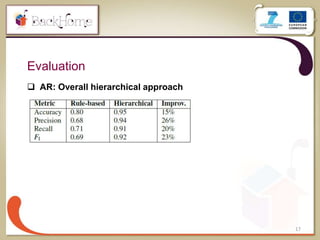
 AR: Overall hierarchical approach
18
Evaluation
 AR: Overall hierarchical approach
19
Evaluation
 AR: Overall hierarchical approach
20
Evaluation
 AR: Activity
21
Evaluation
 AR: Location
22
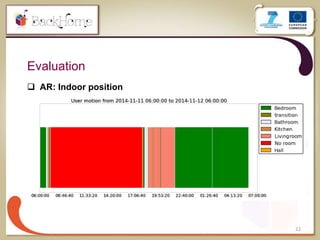
Evaluation
 AR: Indoor position
23
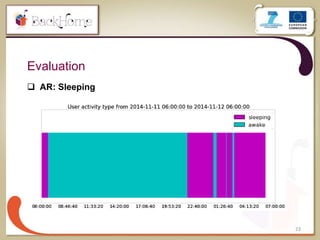
Evaluation
 AR: Sleeping
24
The SAAPHO project
AAL-2010-3-035
The Project
25
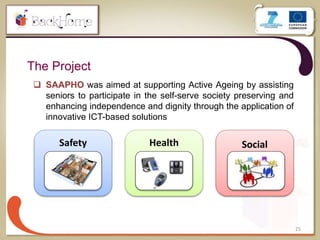
 SAAPHO was aimed at supporting Active Ageing by assisting
seniors to participate in the self-serve society preserving and
enhancing independence and dignity through the application of
innovative ICT-based solutions
Safety Health Social
26
The BackHome project
FP7/2007-2013
The Project
27
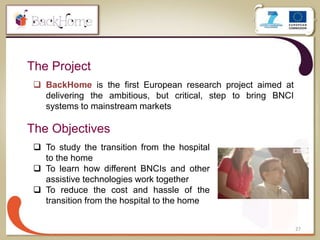
 BackHome is the first European research project aimed at
delivering the ambitious, but critical, step to bring BNCI
systems to mainstream markets
The Objectives
 To study the transition from the hospital
to the home
 To learn how different BNCIs and other
assistive technologies work together
 To reduce the cost and hassle of the
transition from the hospital to the home
28
Conclusions
 The proposed solution provides
 An no-intrusive sensor-based system installed at user’s
home
 An intelligent system that mines data to study habits and
quality-of-life of monitored users
 A web application for therapists and caregivers to stay
aware about the user status, condition, habits and quality-of-
life
 The overall system is part of the SAAPHO and BackHome EU
projects
29
Closing Remarks
eloisa.vargiu@eurecat.org

Monitoring People that Need Assistance through a Sensor-based System: Evaluation and First Results

  • 1.
    AI-AM / NetMed2015 4th International Workshop on Artificial Intelligence and Assistive Medicine June 20, 2015 Monitoring People that Need Assistance through a Sensor-based System: Evaluation and First Results Xavier Rafael-Palou, Eloisa Vargiu, Felip Miralles EURECAT Barcelona, Spain
  • 2.
    1. Assisting elderlyand disabled people 2. A sensor-based telemonitoring system 3. Evaluation and Results 4. The SAAPHO project 5. The BackHome project 6. Conclusions 2 Outline
  • 3.
    3 Assisting elderly anddisabled people
  • 4.
    How to betterlive alone at home… 4 People need to be independent to live better Elderly people feel more safe living at their home People need to return to their previous life roles The long term rehabilitation goal for individuals with an TBI is resettlement back in the community away from institutional care IT IS URGENT TO ASSIST PEOPLE LIVING ALONE THROUGH ICT SOLUTIONS
  • 5.
  • 6.
  • 7.
    7 Home 4 in 1: Door Motion Temperature Luminosity 3in 1: Motion Temperature Luminosity z-wave smartphone Raspberry pi
  • 8.
  • 9.
  • 10.
    10 Intelligent Monitoring  PP Its goal is to preprocess the data iteratively sending a chunk c to both ED and RE according to a sliding window approach  Starting from the overall data streaming, the system sequentially considers a range of time |ti - ti+1| between a sensor measure si at time ti and the subsequent measure si+1 at time ti+1  The output of PP is a window c from ts to ta, where ts is the starting time of a given period and ta is the actual time
  • 11.
    11 Intelligent Monitoring  ED It aims to detect and inform about emergency situations for the end-users and about sensor-based system critical failures  Regarding the critical situations for the end-users, simple rules are defined and implemented to raise an emergency, when specific values appear on c  Regarding the system failures, ED is able to detect whenever user’s home is disconnected from the middleware as well as when a malfunctioning of a sensor occurs  Each emergency is a pair <si; lei> composed of the sensor measure si and the corresponding label lei that indicates the corresponding emergency
  • 12.
    12 Intelligent Monitoring  AR Its goal is to recognize activities performed by the user  To recognize if the user is at home or away and if s/he is alone, we implemented a solution based on machine learning techniques  The output is a triple <ts; te; l>
  • 13.
    13 Intelligent Monitoring  EN It is able to detect events to be notified  Each event is defined by a pair <ti; l> corresponding to the time ti in which the event happens together with a label l that indicates the kind of event  Currently, this module is able to detect the following events: o leaving the home o going back to home o receiving a visit o remaining alone after a visit o going to the bathroom o going out of the bathroom o going to sleep o awaking from sleep
  • 14.
    14 Intelligent Monitoring  SC Once all the activities and events have been classified, measures aimed at representing the summary of the user’s monitoring during a given period are performed  Two kinds of summary are provided o Historical o Actual  A QoL assessment system is also provided to assess a specific QoL items o Mobility o Sleeping o Mood
  • 15.
  • 16.
    16 Evaluation  An abled-bodywoman who lives alone  a window of 4 months for training and evaluation (training dataset)  a window of 1 month for the test (testing dataset)  experiments have been performed on AR and EN
  • 17.
    17 Evaluation  AR: Overallhierarchical approach
  • 18.
    18 Evaluation  AR: Overallhierarchical approach
  • 19.
    19 Evaluation  AR: Overallhierarchical approach
  • 20.
  • 21.
  • 22.
  • 23.
  • 24.
  • 25.
    The Project 25  SAAPHOwas aimed at supporting Active Ageing by assisting seniors to participate in the self-serve society preserving and enhancing independence and dignity through the application of innovative ICT-based solutions Safety Health Social
  • 26.
  • 27.
    The Project 27  BackHomeis the first European research project aimed at delivering the ambitious, but critical, step to bring BNCI systems to mainstream markets The Objectives  To study the transition from the hospital to the home  To learn how different BNCIs and other assistive technologies work together  To reduce the cost and hassle of the transition from the hospital to the home
  • 28.
  • 29.
     The proposedsolution provides  An no-intrusive sensor-based system installed at user’s home  An intelligent system that mines data to study habits and quality-of-life of monitored users  A web application for therapists and caregivers to stay aware about the user status, condition, habits and quality-of- life  The overall system is part of the SAAPHO and BackHome EU projects 29 Closing Remarks
  • 30.