Personalized Connected Care for
Complex Chronic Patients
Eloisa Vargiu & The CONNECARE Consortium
Aim & Objectives
eHealth Research 2016 – October 12th, 2016 – Paris (France)
Aim & Objectives
The Challenge
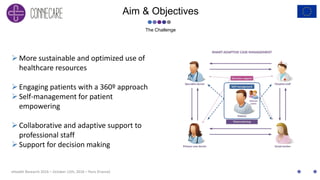
More sustainable and optimized use of
healthcare resources
Engaging patients with a 360º approach
Self-management for patient
empowering
Collaborative and adaptive support to
professional staff
Support for decision making
eHealth Research 2016 – October 12th, 2016 – Paris (France)
Aim & Objectives
The chronic complex patient
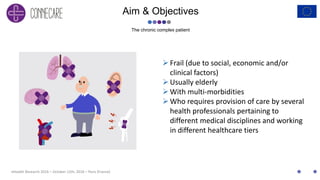
Frail (due to social, economic and/or
clinical factors)
Usually elderly
With multi-morbidities
Who requires provision of care by several
health professionals pertaining to
different medical disciplines and working
in different healthcare tiers
A 3D Paradigmatic Shift
eHealth Research 2016 – October 12th, 2016 – Paris (France)
A 3D Paradigm Shift
Organizational Shift
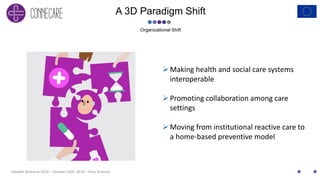
Making health and social care systems
interoperable
Promoting collaboration among care
settings
Moving from institutional reactive care to
a home-based preventive model
eHealth Research 2016 – October 12th, 2016 – Paris (France)
A 3D Paradigm Shift
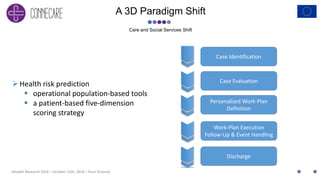
Care and Social Services Shift
Health risk prediction
 operational population-based tools
 a patient-based five-dimension
scoring strategy
Case Identification
Case Evaluation
Personalized Work-Plan
Definition
Work-Plan Execution
Follow-Up & Event Handling
Discharge
eHealth Research 2016 – October 12th, 2016 – Paris (France)
A 3D Paradigm Shift
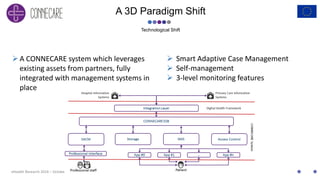
Technological Shift
A CONNECARE system which leverages
existing assets from partners, fully
integrated with management systems in
place
 Smart Adaptive Case Management
 Self-management
 3-level monitoring features
The Approach
eHealth Research 2016 – October 12th, 2016 – Paris (France)
The Approach
The Basic Concept
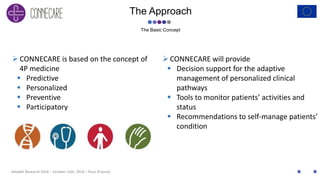
CONNECARE is based on the concept of
4P medicine
 Predictive
 Personalized
 Preventive
 Participatory
CONNECARE will provide
 Decision support for the adaptive
management of personalized clinical
pathways
 Tools to monitor patients’ activities and
status
 Recommendations to self-manage patients’
condition
eHealth Research 2016 – October 12th, 2016 – Paris (France)
The Approach
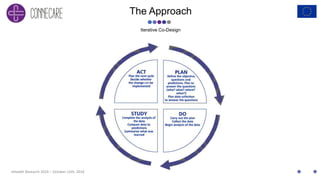
Iterative Co-Design
eHealth Research 2016 – October 12th, 2016 – Paris (France)
The Approach
Clinical Studies
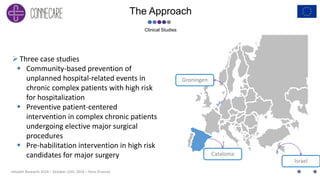
Three case studies
 Community-based prevention of
unplanned hospital-related events in
chronic complex patients with high risk
for hospitalization
 Preventive patient-centered
intervention in complex chronic patients
undergoing elective major surgical
procedures
 Pre-habilitation intervention in high risk
candidates for major surgery
Israel
Catalonia
Groningen
Conclusion
eHealth Research 2016 – October 12th, 2016 – Paris (France)
Conclusion
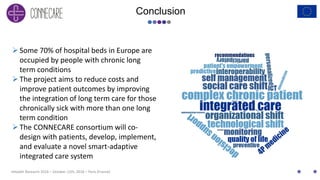
Some 70% of hospital beds in Europe are
occupied by people with chronic long
term conditions
The project aims to reduce costs and
improve patient outcomes by improving
the integration of long term care for those
chronically sick with more than one long
term condition
The CONNECARE consortium will co-
design with patients, develop, implement,
and evaluate a novel smart-adaptive
integrated care system
Thanks
Gràcies
This project has received funding from the European Union’s Horizon 2020 research and innovation programme under grant agreement No 689802
Bedankt ‫תודה‬
Grazie Danke
eloisa.vargiu@eurecat.org

The CONNECARE project at a glance

  • 1.
    Personalized Connected Carefor Complex Chronic Patients Eloisa Vargiu & The CONNECARE Consortium
  • 2.
  • 3.
    eHealth Research 2016– October 12th, 2016 – Paris (France) Aim & Objectives The Challenge More sustainable and optimized use of healthcare resources Engaging patients with a 360º approach Self-management for patient empowering Collaborative and adaptive support to professional staff Support for decision making
  • 4.
    eHealth Research 2016– October 12th, 2016 – Paris (France) Aim & Objectives The chronic complex patient Frail (due to social, economic and/or clinical factors) Usually elderly With multi-morbidities Who requires provision of care by several health professionals pertaining to different medical disciplines and working in different healthcare tiers
  • 5.
  • 6.
    eHealth Research 2016– October 12th, 2016 – Paris (France) A 3D Paradigm Shift Organizational Shift Making health and social care systems interoperable Promoting collaboration among care settings Moving from institutional reactive care to a home-based preventive model
  • 7.
    eHealth Research 2016– October 12th, 2016 – Paris (France) A 3D Paradigm Shift Care and Social Services Shift Health risk prediction  operational population-based tools  a patient-based five-dimension scoring strategy Case Identification Case Evaluation Personalized Work-Plan Definition Work-Plan Execution Follow-Up & Event Handling Discharge
  • 8.
    eHealth Research 2016– October 12th, 2016 – Paris (France) A 3D Paradigm Shift Technological Shift A CONNECARE system which leverages existing assets from partners, fully integrated with management systems in place  Smart Adaptive Case Management  Self-management  3-level monitoring features
  • 9.
  • 10.
    eHealth Research 2016– October 12th, 2016 – Paris (France) The Approach The Basic Concept CONNECARE is based on the concept of 4P medicine  Predictive  Personalized  Preventive  Participatory CONNECARE will provide  Decision support for the adaptive management of personalized clinical pathways  Tools to monitor patients’ activities and status  Recommendations to self-manage patients’ condition
  • 11.
    eHealth Research 2016– October 12th, 2016 – Paris (France) The Approach Iterative Co-Design
  • 12.
    eHealth Research 2016– October 12th, 2016 – Paris (France) The Approach Clinical Studies Three case studies  Community-based prevention of unplanned hospital-related events in chronic complex patients with high risk for hospitalization  Preventive patient-centered intervention in complex chronic patients undergoing elective major surgical procedures  Pre-habilitation intervention in high risk candidates for major surgery Israel Catalonia Groningen
  • 13.
  • 14.
    eHealth Research 2016– October 12th, 2016 – Paris (France) Conclusion Some 70% of hospital beds in Europe are occupied by people with chronic long term conditions The project aims to reduce costs and improve patient outcomes by improving the integration of long term care for those chronically sick with more than one long term condition The CONNECARE consortium will co- design with patients, develop, implement, and evaluate a novel smart-adaptive integrated care system
  • 15.
    Thanks Gràcies This project hasreceived funding from the European Union’s Horizon 2020 research and innovation programme under grant agreement No 689802 Bedankt ‫תודה‬ Grazie Danke eloisa.vargiu@eurecat.org