
Eloisa Vargiu
EURECAT
Barcelona
Rome, July 31, 2015
Brain Computer Interfaces on Track
to Home: Results and Lessons Learnt
2
The BackHome project
FP7/2007-2013
grant agreement n. 288566
3
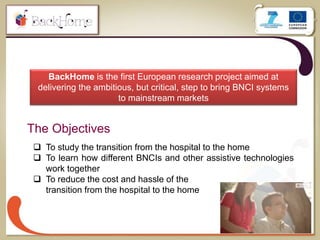
BackHome is the first European research project aimed at
delivering the ambitious, but critical, step to bring BNCI systems
to mainstream markets
The Objectives
 To study the transition from the hospital to the home
 To learn how different BNCIs and other assistive technologies
work together
 To reduce the cost and hassle of the
transition from the hospital to the home
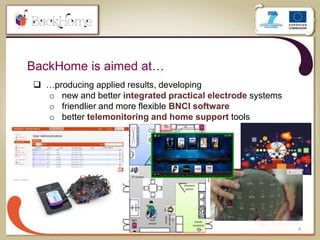
BackHome is aimed at…
4
 …producing applied results, developing
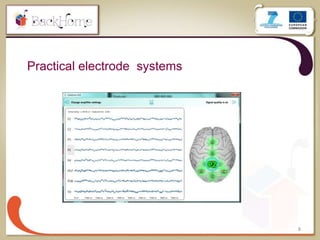
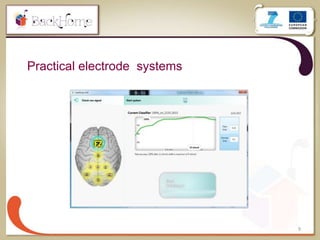
o new and better integrated practical electrode systems
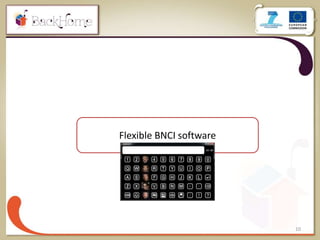
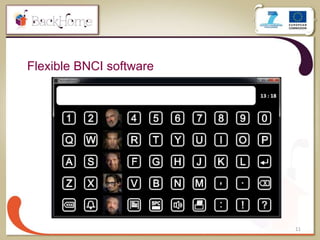
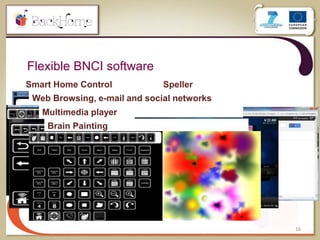
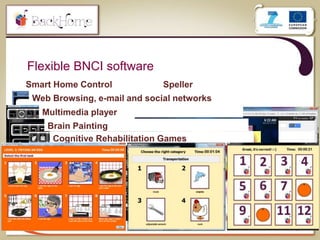
o friendlier and more flexible BNCI software
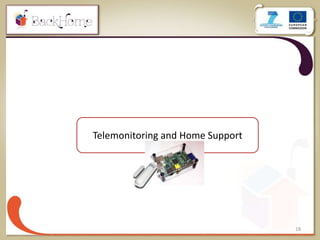
o better telemonitoring and home support tools
5
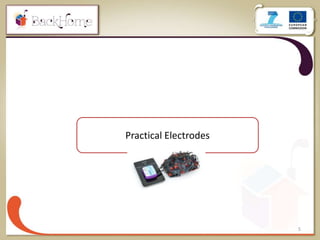
Practical Electrodes
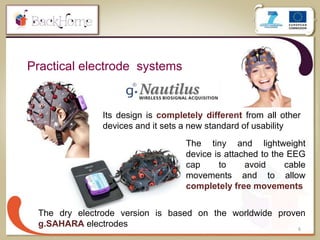
Practical electrode systems
6
Its design is completely different from all other
devices and it sets a new standard of usability
The dry electrode version is based on the worldwide proven
g.SAHARA electrodes
The tiny and lightweight
device is attached to the EEG
cap to avoid cable
movements and to allow
completely free movements
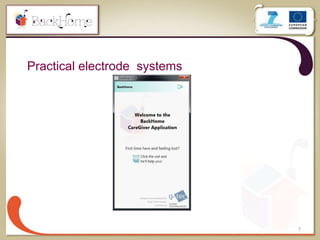
Practical electrode systems
7
Practical electrode systems
8
Practical electrode systems
9
10
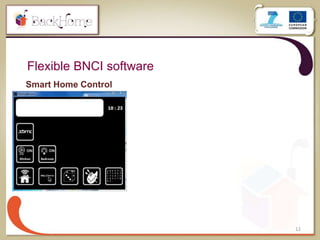
Flexible BNCI software
11
Flexible BNCI software
12
Smart Home Control
Flexible BNCI software
13
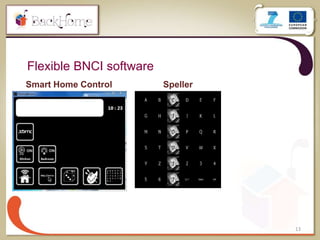
Smart Home Control Speller
Flexible BNCI software
14
Smart Home Control Speller
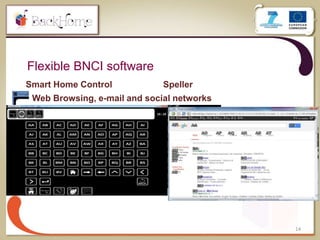
Web Browsing, e-mail and social networks
Flexible BNCI software
15
Smart Home Control Speller
Web Browsing, e-mail and social networks
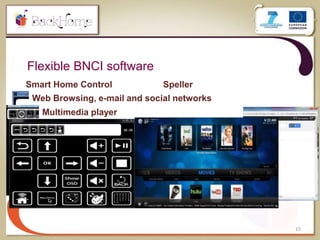
Multimedia player
Flexible BNCI software
16
Smart Home Control Speller
Web Browsing, e-mail and social networks
Multimedia player
Brain Painting
Flexible BNCI software
17
Smart Home Control Speller
Web Browsing, e-mail and social networks
Multimedia player
Brain Painting
Cognitive Rehabilitation Games
18
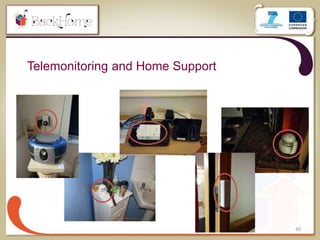
Telemonitoring and Home Support
19
20
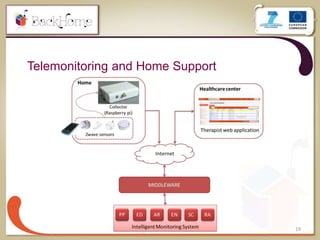
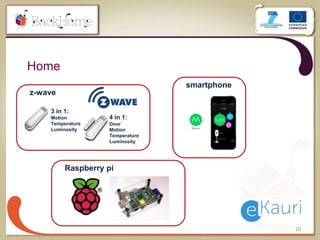
Home
4 in 1:
Door
Motion
Temperature
Luminosity
3 in 1:
Motion
Temperature
Luminosity
z-wave
smartphone
Raspberry pi
21
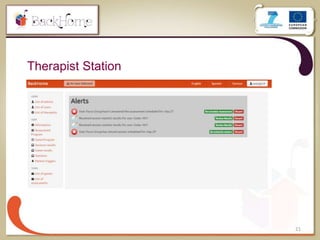
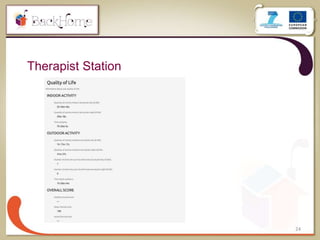
Therapist Station
22
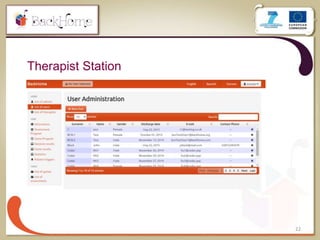
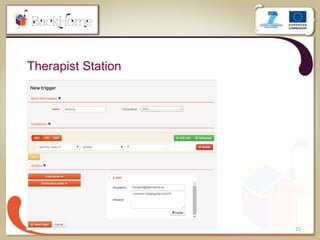
Therapist Station
23
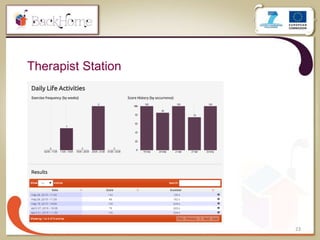
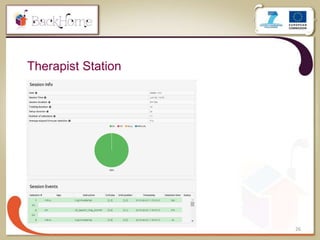
Therapist Station
24
Therapist Station
25
Therapist Station
26
Therapist Station
27
Intelligent Monitoring
28
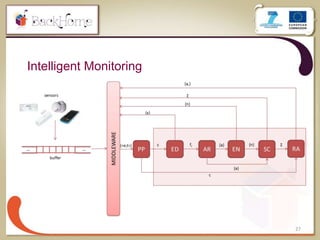
Intelligent Monitoring
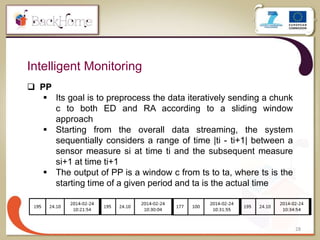
 PP
 Its goal is to preprocess the data iteratively sending a chunk
c to both ED and RA according to a sliding window
approach
 Starting from the overall data streaming, the system
sequentially considers a range of time |ti - ti+1| between a
sensor measure si at time ti and the subsequent measure
si+1 at time ti+1
 The output of PP is a window c from ts to ta, where ts is the
starting time of a given period and ta is the actual time
29
Intelligent Monitoring
 ED
 It aims to detect and inform about emergency situations for
the end-users and about sensor-based system critical
failures
 Regarding the critical situations for the end-users, simple
rules are defined and implemented to raise an emergency,
when specific values appear on c
 Regarding the system failures, ED is able to detect
whenever user’s home is disconnected from the middleware
as well as when a malfunctioning of a sensor occurs
 Each emergency is a pair <si; lei> composed of the sensor
measure si and the corresponding label lei that indicates the
corresponding emergency
30
Intelligent Monitoring
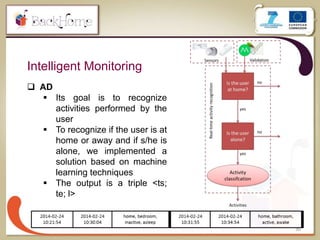
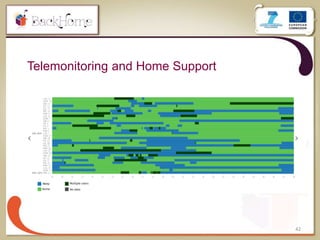
 AD
 Its goal is to recognize
activities performed by the
user
 To recognize if the user is at
home or away and if s/he is
alone, we implemented a
solution based on machine
learning techniques
 The output is a triple <ts;
te; l>
31
Intelligent Monitoring
 EN
 It is able to detect events to be notified
 Each event is defined by a pair <ti; l> corresponding to the
time ti in which the event happens together with a label l
that indicates the kind of event
 Currently, this module is able to detect the following events:
o leaving the home
o going back to home
o receiving a visit
o remaining alone after a visit
o going to the bathroom
o going out of the bathroom
o going to sleep
o awaking from sleep
32
Intelligent Monitoring
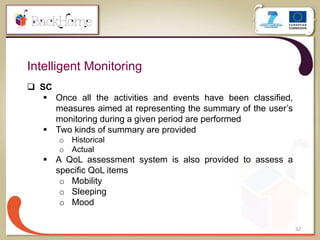
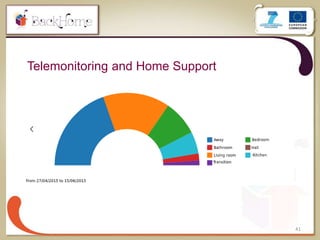
 SC
 Once all the activities and events have been classified,
measures aimed at representing the summary of the user’s
monitoring during a given period are performed
 Two kinds of summary are provided
o Historical
o Actual
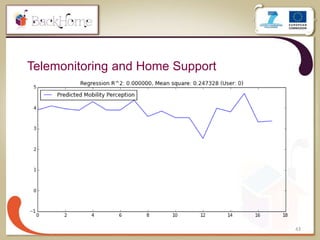
 A QoL assessment system is also provided to assess a
specific QoL items
o Mobility
o Sleeping
o Mood
33
Intelligent Monitoring
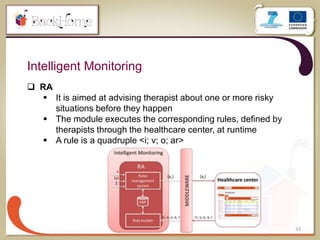
 RA
 It is aimed at advising therapist about one or more risky
situations before they happen
 The module executes the corresponding rules, defined by
therapists through the healthcare center, at runtime
 A rule is a quadruple <i; v; o; ar>
34
Results
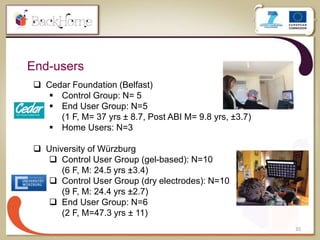
 Cedar Foundation (Belfast)
 Control Group: N= 5
 End User Group: N=5
(1 F, M= 37 yrs ± 8.7, Post ABI M= 9.8 yrs, ±3.7)
 Home Users: N=3
 University of Würzburg
 Control User Group (gel-based): N=10
(6 F, M: 24.5 yrs ±3.4)
 Control User Group (dry electrodes): N=10
(9 F, M: 24.4 yrs ±2.7)
 End User Group: N=6
(2 F, M=47.3 yrs ± 11)
35
End-users
36
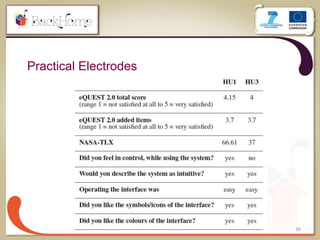
Practical Electrodes
37
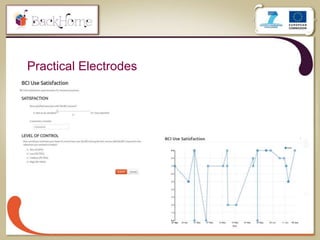
Practical Electrodes
38
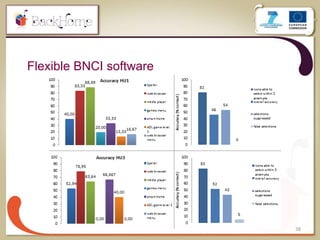
Flexible BNCI software
39
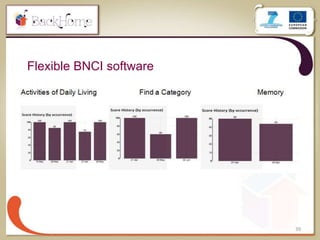
Flexible BNCI software
40
Telemonitoring and Home Support
41
Telemonitoring and Home Support
42
Telemonitoring and Home Support
43
Telemonitoring and Home Support
44
Lessons Learnt
 BCI can now be considered as an assistive technology
 To move a technology from the lab to a real home is a very
difficult task
 Testing in a controlled environment is essential
 Data are nothing if you don’t know how to read them
 A user center design approach helps in building a system
accepted by end-users
 A continuous assistance must be given to
caregivers
 Therapists and engineers don’t speak the
same language
45
Lessons learned
46
BackHome
Acknowledgements
 Web
• www.Backhome-FP7.eu
 LinkedIn
• BackHome-FP7-Research-Innovation
 Twitter
• @BackHomeFP7
 Youtube
• BackHomeFP7
Consortium EURECAT/BDigital Team
And also…
Javier Baustista
Eloi Casals
José Alejandro Cordero
Juan Manuel Fernández
Joan Prota
Alexander Steblin
47
eloisa.vargiu@eurecat.org

Brain Computer Interfaces on Track to Home: Results and Lessons Learnt