Congressional
Committees
Purpose of Committees
• To divide work of Congress into smaller
specialized groups
• To select bills that will be allowed to
move forward
• To hold public hearings and
investigations
Committee Hearings
General Truths About
All Committees
• Party in power selects chairperson
• Membership in each committee is divided
in proportion to percentage of control in
House/Senate
• All committees have
subcommittees
• Members of Congress fight for certain
chairperson positions.
• Chairpersons often have great power.
• Certain committees are more prestigious.
• Each member of Congress can only serve
on a limited number of committees.
General Truths About
All Committees
Unwritten Rule:
Seniority
System
General Truths About
All Committees
Kinds of Committees
• Standing Committees
• Subcommittees
• Select Committees
• Joint Committees
• Conference Committees
Standing Committees
• They are permanent committees.
• They represent major areas of
government.
Subcommittees
• Work with a smaller part of the larger
committee’s responsibilities.
• These subcommittees are usually
permanent but change occasionally.
Subcommittee Example
Ways and Means Committee
• Health
• Human Resources
• Oversight
• Select Revenue Measures
• Social Security
• Trade
Select Committees
• Usually created to study one specific issue
• Usually deal with some large issue of
great concern
• Usually temporary
• Purpose: Investigate
and report findings to
House or Senate
Joint Committees
• Have members from both House and Senate
• Serve as study groups
• Report findings to House and Senate
• Limited authority since representing both
House and Senate
Conference Committees
• Members from both House and Senate
• Temporary – for one bill only
• Only Job = Negotiate the final form of a bill
• Report the bill back to both House and
Senate
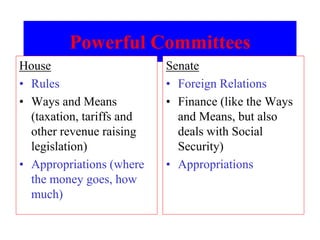
Powerful Committees
House
• Rules
• Ways and Means
(taxation, tariffs and
other revenue raising
legislation)
• Appropriations (where
the money goes, how
much)
Senate
• Foreign Relations
• Finance (like the Ways
and Means, but also
deals with Social
Security)
• Appropriations

Congressional Committees.ppt

  • 1.
  • 2.
    Purpose of Committees •To divide work of Congress into smaller specialized groups • To select bills that will be allowed to move forward • To hold public hearings and investigations
  • 3.
  • 4.
    General Truths About AllCommittees • Party in power selects chairperson • Membership in each committee is divided in proportion to percentage of control in House/Senate • All committees have subcommittees
  • 5.
    • Members ofCongress fight for certain chairperson positions. • Chairpersons often have great power. • Certain committees are more prestigious. • Each member of Congress can only serve on a limited number of committees. General Truths About All Committees
  • 6.
  • 7.
    Kinds of Committees •Standing Committees • Subcommittees • Select Committees • Joint Committees • Conference Committees
  • 8.
    Standing Committees • Theyare permanent committees. • They represent major areas of government.
  • 9.
    Subcommittees • Work witha smaller part of the larger committee’s responsibilities. • These subcommittees are usually permanent but change occasionally.
  • 10.
    Subcommittee Example Ways andMeans Committee • Health • Human Resources • Oversight • Select Revenue Measures • Social Security • Trade
  • 11.
    Select Committees • Usuallycreated to study one specific issue • Usually deal with some large issue of great concern • Usually temporary • Purpose: Investigate and report findings to House or Senate
  • 12.
    Joint Committees • Havemembers from both House and Senate • Serve as study groups • Report findings to House and Senate • Limited authority since representing both House and Senate
  • 13.
    Conference Committees • Membersfrom both House and Senate • Temporary – for one bill only • Only Job = Negotiate the final form of a bill • Report the bill back to both House and Senate
  • 14.
    Powerful Committees House • Rules •Ways and Means (taxation, tariffs and other revenue raising legislation) • Appropriations (where the money goes, how much) Senate • Foreign Relations • Finance (like the Ways and Means, but also deals with Social Security) • Appropriations