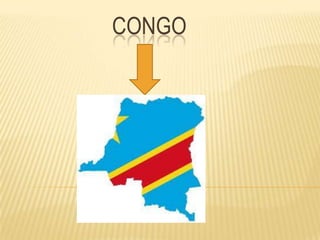
CONGO
The capital of Congo is Brazzville.
The official language is French.
The Population is 4,243,929 as for July 2011.
The nationality is Congolese.
 The religion is Christian , Animist and Muslim.


.
The president of Congo is

 Denis Sassou Nguesso.
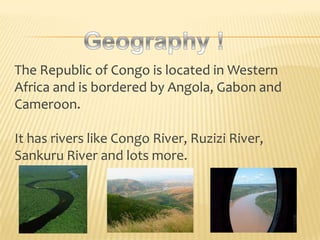
The Republic of Congo is located in Western
Africa and is bordered by Angola, Gabon and
Cameroon.

It has rivers like Congo River, Ruzizi River,
Sankuru River and lots more.
   Poverty has risen in the Republic of Congo since the 1980’s.
   Most of the country’s poor people, which is 64.8 per
    cent, live in rural areas and women are hit the most in
    poverty because almost a third of new born children
    suffered from malnutrition.
   Access to water is also poor in rural areas where only 11 per
    cent of people can get water.
   Unemployment is still growing because over 50        of
    people are out of work.Young people and vulnerable groups
    are particularly hit.
 Transportation has always been difficult in
  the poor parts of Congo.
 Approximately two-thirds of the country
  refers to water transports because the
  distance between the places are vast.
 Roads were ruined a long time ago in Congo
  and there is no money to rebuild
  them.Almost a third of the population were
  displaced.
Health Problems !
Hiv and Aids affects 5.3 per cent of
the population, but affects the 15-49
year age the most.

An estimated number of about 90,000
adults and children were living with
HIV/AIDS at the end of 2003.

The government supports these with
those illness issues and help them out
as much as possible.
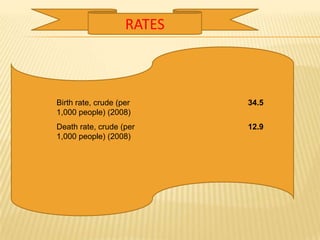
RATES


Birth rate, crude (per      34.5
1,000 people) (2008)
Death rate, crude (per      12.9
1,000 people) (2008)
“Our village was completely
burned to the ground,” says
Malima Dominique. “We all
ran into the forest to hide
when we heard the guns and
the shooting. We only had the
clothes on our back. The
children were scared and
hungry and the elders were
exhausted. We stayed hidden
in the forest until it was quiet
again, but when a few of us
returned to Nko, we found
that it had been completely
burned to the ground – all our
houses and even the village
school. We have lost
everything we had”.


       CONFLICTS IN THE COUNTRY
Congo
Congo
Congo

Congo

  • 1.
  • 2.
    The capital ofCongo is Brazzville. The official language is French. The Population is 4,243,929 as for July 2011. The nationality is Congolese. The religion is Christian , Animist and Muslim. .
  • 3.
    The president ofCongo is Denis Sassou Nguesso.
  • 4.
    The Republic ofCongo is located in Western Africa and is bordered by Angola, Gabon and Cameroon. It has rivers like Congo River, Ruzizi River, Sankuru River and lots more.
  • 5.
    Poverty has risen in the Republic of Congo since the 1980’s.  Most of the country’s poor people, which is 64.8 per cent, live in rural areas and women are hit the most in poverty because almost a third of new born children suffered from malnutrition.  Access to water is also poor in rural areas where only 11 per cent of people can get water.  Unemployment is still growing because over 50 of people are out of work.Young people and vulnerable groups are particularly hit.
  • 6.
     Transportation hasalways been difficult in the poor parts of Congo.  Approximately two-thirds of the country refers to water transports because the distance between the places are vast.  Roads were ruined a long time ago in Congo and there is no money to rebuild them.Almost a third of the population were displaced.
  • 8.
    Health Problems ! Hivand Aids affects 5.3 per cent of the population, but affects the 15-49 year age the most. An estimated number of about 90,000 adults and children were living with HIV/AIDS at the end of 2003. The government supports these with those illness issues and help them out as much as possible.
  • 9.
    RATES Birth rate, crude(per 34.5 1,000 people) (2008) Death rate, crude (per 12.9 1,000 people) (2008)
  • 10.
    “Our village wascompletely burned to the ground,” says Malima Dominique. “We all ran into the forest to hide when we heard the guns and the shooting. We only had the clothes on our back. The children were scared and hungry and the elders were exhausted. We stayed hidden in the forest until it was quiet again, but when a few of us returned to Nko, we found that it had been completely burned to the ground – all our houses and even the village school. We have lost everything we had”. CONFLICTS IN THE COUNTRY