Guide to
Conducting Meetings
2
Contents
 Conducting meetings
 Planning the meeting
 Running the meeting
 After the meeting
 What is a RAP sessions?
 Why hold a RAP session?
 Guidelines for holding a RAP session
 Preparing a Question List for RAP Session.
3
Conducting meetings
There are three stages to conducting meetings:
• planning the meeting
• running the meeting
• after the meeting
CONDUCTING
A MEETING
4
5
Planning the meeting
Guidelines to planning effective meetings:
• determine the outcomes that are wanted from the meeting
• identify who needs to attend
• prepare an agenda to satisfy the outcomes
• ensure all the agenda items can be realistically covered in the
allotted time for the meeting
• book the meeting room
• notify the participants of the meeting
(why, where, when, how long, agenda)
6
Running the meeting
Guidelines to running effective meetings:
• arrive early and make sure the meeting room is set up
• start on time, do not wait for late arrivals as it encourages lateness
• identify a chairperson to coordinate the meeting
• identify someone to take minutes
• state the purpose of the meeting at the start
• allocate time on each agenda item and do not run over time for each item
• avoid getting bogged down in too much detail or in side issues.
• If more information or a solution needs to be worked
through make this an action item to be addressed
prior to the next meeting.
7
Running the meeting (cont.)…
Guidelines to running effective meetings:
• chairperson must control the meeting and not let
individuals dominate
• record minutes
• identify action items, assign to one owner and specify
when to be actioned by
• finish on time
• if some agenda items are not covered agree to
reconvene
• If it is a regular meeting, or a follow up meeting is
required, state when the next meeting will be
8
After the meeting
• file a updated record of the meeting (minutes and
action items)
• distribute minutes and action items to all participants
of the meeting.
• follow up with people assigned action
items near to the “action by” date.
RAP SESSIONS
9
10
What is a RAP session?
There are various type of RAP sessions.
• RAP - Rapid Planning.
• RAP - Rapport Building Sessions.
• RAP – Review and Action Planning
11
RAP Session
• We at TGB are following Rapport Building
Session Format.
• The Common Principle of RAPO Session
is to engage Participants into a One to
One session and to gather information
required and create a rapport , Faith and
confidence in them.
12
Why hold a RAP session?
• increases the involvement of stakeholders.
• improves communication
• Improves Faith and confidence in Leaders.
• Provides for Smooth flow of Information from Bottom to Top.
• Provides Information for resolution of issues and also provides
data for building Leadership qualities in your second in command.
• facilitates team building
• develops team commitment to the Operations and Organisational
Goals
• Ensures the key players in the Organisation are
on the same page
13
Guidelines for holding a RAP session
• A RAP session is a One to One meeting, and as such should be
done keeping in mind the normal rules for any meeting.
• RAP sessions are normally shorter sessions (15-20 Minutes)
• RAP session will have a Standard agenda as per the Information
sought .
• RAP sessions involves more Listening by the person who has
called for the meeting But with timely questions to keep the
meeting on Line.
• Minutes must be recorded for Action and future follow-up.
• The RAP session must be repeated again after a proper Gap
between 15-45 days with the same Person to ensure follow-up
and continuity of Rapport Building.
14
Guidelines for holding a RAP session (Contd...)
• It may be difficult and uncomfortable for employees to respond to the
initial questions. There are two primary reasons for this reluctance:
1. Employees may not have experienced such an interview before and
consequently do not know what to make of the process.
2. For many employees, there has been enough evidence of broken trust
and confidence that they fear recrimination--after everything is said and
done, they still have to work for some of the people they are providing
information on.
• Be prepared to be supportive and patient.
• the interviewer may have to follow up an employee's response with a
clarification question in order to understand and use the point being
made.
•
15
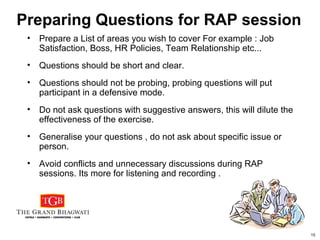
Preparing Questions for RAP session
• Prepare a List of areas you wish to cover For example : Job
Satisfaction, Boss, HR Policies, Team Relationship etc...
• Questions should be short and clear.
• Questions should not be probing, probing questions will put
participant in a defensive mode.
• Do not ask questions with suggestive answers, this will dilute the
effectiveness of the exercise.
• Generalise your questions , do not ask about specific issue or
person.
• Avoid conflicts and unnecessary discussions during RAP
sessions. Its more for listening and recording .
16
Preparing Questions for RAP session
The questions should focused on three areas:
1. Biographical data: These questions are designed to set the stage, ease the
interviewee's fears and provide relevant data on the person's background, family
etc.
2. Individuals and their jobs: These questions are designed to give input on the
employees' feelings and understanding of their jobs as well as their perception of
the values and rewards of their micro-organization. Also, this phase may provide an
opportunity for them to disclose their aspirations, frustrations, and satisfactions
with their jobs.
3. Organization and management: These questions are designed to gather data
about the managerial styles people work under, including the amount of feedback
and leadership they receive. Also, this phase of questioning will often provide
employees an opportunity to talk about the obstacles in the organization that
prevent them from doing their jobs more effectively and may bring
forth their suggestions for positive change in the organization.
SKIP MEETINGS
17
18
What is Skip Meeting.
• Rap should not be confused with RAP as that is also a type of Skip
meeting .
• Skip can be with one person alone or with a Group of staff.
• Skip Meeting is a meeting between a Manager and staff with one or
two levels skipped.
• An Excellent method for managers to get to know employees one or
more levels down and to build trust.
• Tapping into One of the best sources of information which is
employees.
• No doubt managers will want to speak with their new direct reports to
get their viewpoints and information. But there is another source of
information available. By skipping a level or two and getting
acquainted with the employees who are removed from their direct
supervision, managers may gain even more insight into how things
work.
19
Skip Meeting (contd).
• The skip-level meeting is also a way for managers to inform employees about
their goals, standards, the type of work culture they would like to establish,
and--most importantly—show that they care about the employees.
• skip-level meetings can provide detailed, firsthand data that are useful in
refining the operation and in improving work relationships.
• But employees are quite likely to be a bit suspicious of these meetings and
uncertain about how the information will be used. If the manager can ensure
confidentiality, the trust level between him or her and the employees will be
enhanced.
• Skip Involves essentially a sequence of events and questions to assist managers
in uncovering valuable information from the employees.
• Ask specific questions.
• At The end do ask the staff if they wish to ask a Question, provide answers if
known or take specific time to reply back.
• Ensure a reply is sent within the fixed deadline.

Conducting meetings , skip & Rap sessions

  • 1.
  • 2.
    2 Contents  Conducting meetings Planning the meeting  Running the meeting  After the meeting  What is a RAP sessions?  Why hold a RAP session?  Guidelines for holding a RAP session  Preparing a Question List for RAP Session.
  • 3.
    3 Conducting meetings There arethree stages to conducting meetings: • planning the meeting • running the meeting • after the meeting
  • 4.
  • 5.
    5 Planning the meeting Guidelinesto planning effective meetings: • determine the outcomes that are wanted from the meeting • identify who needs to attend • prepare an agenda to satisfy the outcomes • ensure all the agenda items can be realistically covered in the allotted time for the meeting • book the meeting room • notify the participants of the meeting (why, where, when, how long, agenda)
  • 6.
    6 Running the meeting Guidelinesto running effective meetings: • arrive early and make sure the meeting room is set up • start on time, do not wait for late arrivals as it encourages lateness • identify a chairperson to coordinate the meeting • identify someone to take minutes • state the purpose of the meeting at the start • allocate time on each agenda item and do not run over time for each item • avoid getting bogged down in too much detail or in side issues. • If more information or a solution needs to be worked through make this an action item to be addressed prior to the next meeting.
  • 7.
    7 Running the meeting(cont.)… Guidelines to running effective meetings: • chairperson must control the meeting and not let individuals dominate • record minutes • identify action items, assign to one owner and specify when to be actioned by • finish on time • if some agenda items are not covered agree to reconvene • If it is a regular meeting, or a follow up meeting is required, state when the next meeting will be
  • 8.
    8 After the meeting •file a updated record of the meeting (minutes and action items) • distribute minutes and action items to all participants of the meeting. • follow up with people assigned action items near to the “action by” date.
  • 9.
  • 10.
    10 What is aRAP session? There are various type of RAP sessions. • RAP - Rapid Planning. • RAP - Rapport Building Sessions. • RAP – Review and Action Planning
  • 11.
    11 RAP Session • Weat TGB are following Rapport Building Session Format. • The Common Principle of RAPO Session is to engage Participants into a One to One session and to gather information required and create a rapport , Faith and confidence in them.
  • 12.
    12 Why hold aRAP session? • increases the involvement of stakeholders. • improves communication • Improves Faith and confidence in Leaders. • Provides for Smooth flow of Information from Bottom to Top. • Provides Information for resolution of issues and also provides data for building Leadership qualities in your second in command. • facilitates team building • develops team commitment to the Operations and Organisational Goals • Ensures the key players in the Organisation are on the same page
  • 13.
    13 Guidelines for holdinga RAP session • A RAP session is a One to One meeting, and as such should be done keeping in mind the normal rules for any meeting. • RAP sessions are normally shorter sessions (15-20 Minutes) • RAP session will have a Standard agenda as per the Information sought . • RAP sessions involves more Listening by the person who has called for the meeting But with timely questions to keep the meeting on Line. • Minutes must be recorded for Action and future follow-up. • The RAP session must be repeated again after a proper Gap between 15-45 days with the same Person to ensure follow-up and continuity of Rapport Building.
  • 14.
    14 Guidelines for holdinga RAP session (Contd...) • It may be difficult and uncomfortable for employees to respond to the initial questions. There are two primary reasons for this reluctance: 1. Employees may not have experienced such an interview before and consequently do not know what to make of the process. 2. For many employees, there has been enough evidence of broken trust and confidence that they fear recrimination--after everything is said and done, they still have to work for some of the people they are providing information on. • Be prepared to be supportive and patient. • the interviewer may have to follow up an employee's response with a clarification question in order to understand and use the point being made. •
  • 15.
    15 Preparing Questions forRAP session • Prepare a List of areas you wish to cover For example : Job Satisfaction, Boss, HR Policies, Team Relationship etc... • Questions should be short and clear. • Questions should not be probing, probing questions will put participant in a defensive mode. • Do not ask questions with suggestive answers, this will dilute the effectiveness of the exercise. • Generalise your questions , do not ask about specific issue or person. • Avoid conflicts and unnecessary discussions during RAP sessions. Its more for listening and recording .
  • 16.
    16 Preparing Questions forRAP session The questions should focused on three areas: 1. Biographical data: These questions are designed to set the stage, ease the interviewee's fears and provide relevant data on the person's background, family etc. 2. Individuals and their jobs: These questions are designed to give input on the employees' feelings and understanding of their jobs as well as their perception of the values and rewards of their micro-organization. Also, this phase may provide an opportunity for them to disclose their aspirations, frustrations, and satisfactions with their jobs. 3. Organization and management: These questions are designed to gather data about the managerial styles people work under, including the amount of feedback and leadership they receive. Also, this phase of questioning will often provide employees an opportunity to talk about the obstacles in the organization that prevent them from doing their jobs more effectively and may bring forth their suggestions for positive change in the organization.
  • 17.
  • 18.
    18 What is SkipMeeting. • Rap should not be confused with RAP as that is also a type of Skip meeting . • Skip can be with one person alone or with a Group of staff. • Skip Meeting is a meeting between a Manager and staff with one or two levels skipped. • An Excellent method for managers to get to know employees one or more levels down and to build trust. • Tapping into One of the best sources of information which is employees. • No doubt managers will want to speak with their new direct reports to get their viewpoints and information. But there is another source of information available. By skipping a level or two and getting acquainted with the employees who are removed from their direct supervision, managers may gain even more insight into how things work.
  • 19.
    19 Skip Meeting (contd). •The skip-level meeting is also a way for managers to inform employees about their goals, standards, the type of work culture they would like to establish, and--most importantly—show that they care about the employees. • skip-level meetings can provide detailed, firsthand data that are useful in refining the operation and in improving work relationships. • But employees are quite likely to be a bit suspicious of these meetings and uncertain about how the information will be used. If the manager can ensure confidentiality, the trust level between him or her and the employees will be enhanced. • Skip Involves essentially a sequence of events and questions to assist managers in uncovering valuable information from the employees. • Ask specific questions. • At The end do ask the staff if they wish to ask a Question, provide answers if known or take specific time to reply back. • Ensure a reply is sent within the fixed deadline.