Conducting Job Interviews
A Guide for Federal Judges
by David K. Hendrickson
Federal Judicial Center
1999
This Federal Judicial Center publication was undertaken in furtherance
of the Center’s statutory mission to develop and conduct education pro-
grams for judicial branch employees. The views expressed are those
of the author and not necessarily those of the Federal Judicial Center.
This page is left blank intentionally to facilitate proper pagination
when printing two-sided
Contents
Acknowledgments . . . . . . . . . . . . . . . . . . . . . . . . . . v
Introduction . . . . . . . . . . . . . . . . . . . . . . . . . . . . . 1
Interviewing Guidelines . . . . . . . . . . . . . . . . . . . . . . 5
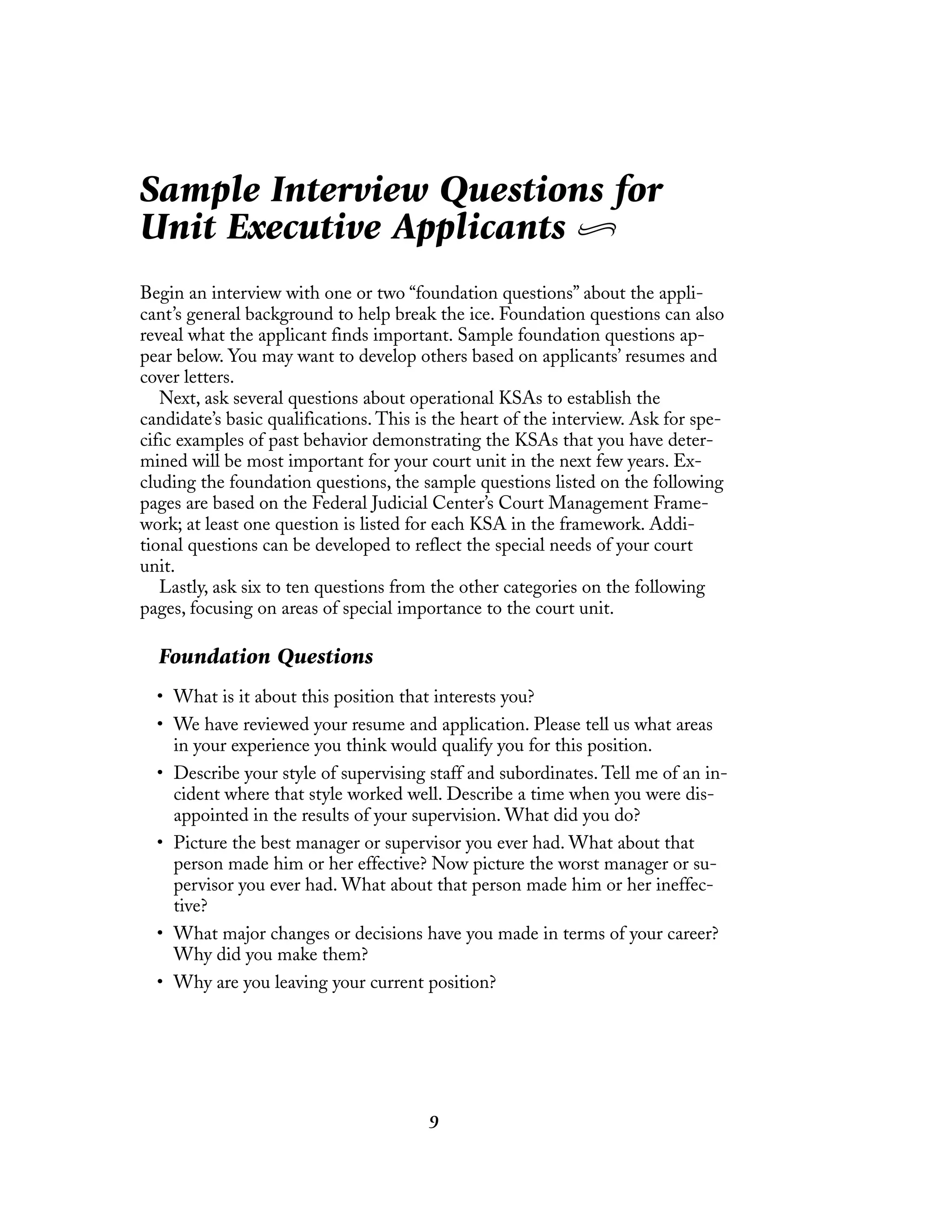
Sample Interview Questions for Unit Executive Applicants . . . 9
Sample Interview Plans for Unit Executive Applicants . . . . . 19
Sample Interview Questions for Law Clerk Applicants . . . . . 25
iii
This page is left blank intentionally to facilitate proper pagination
when printing two-sided
Richard Dargan
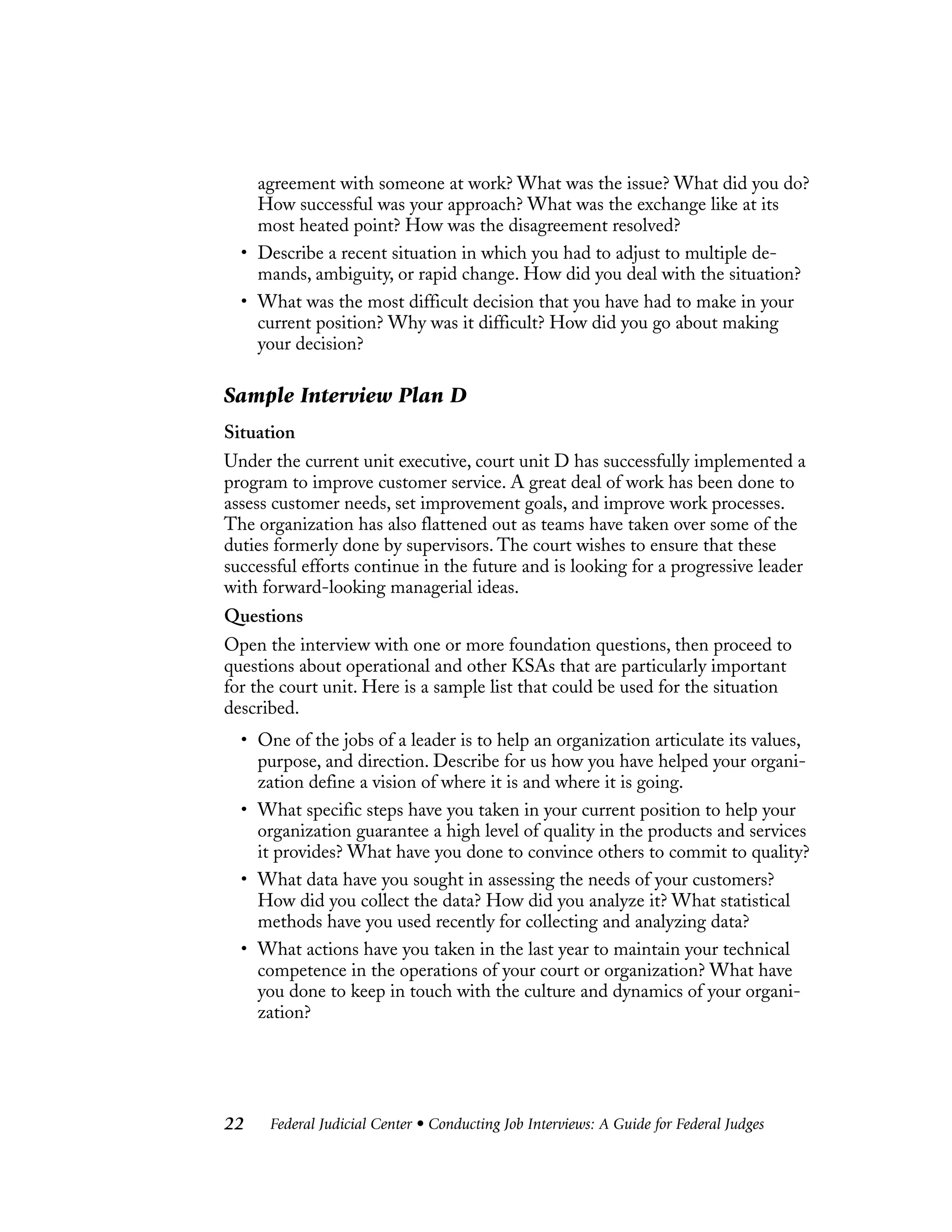
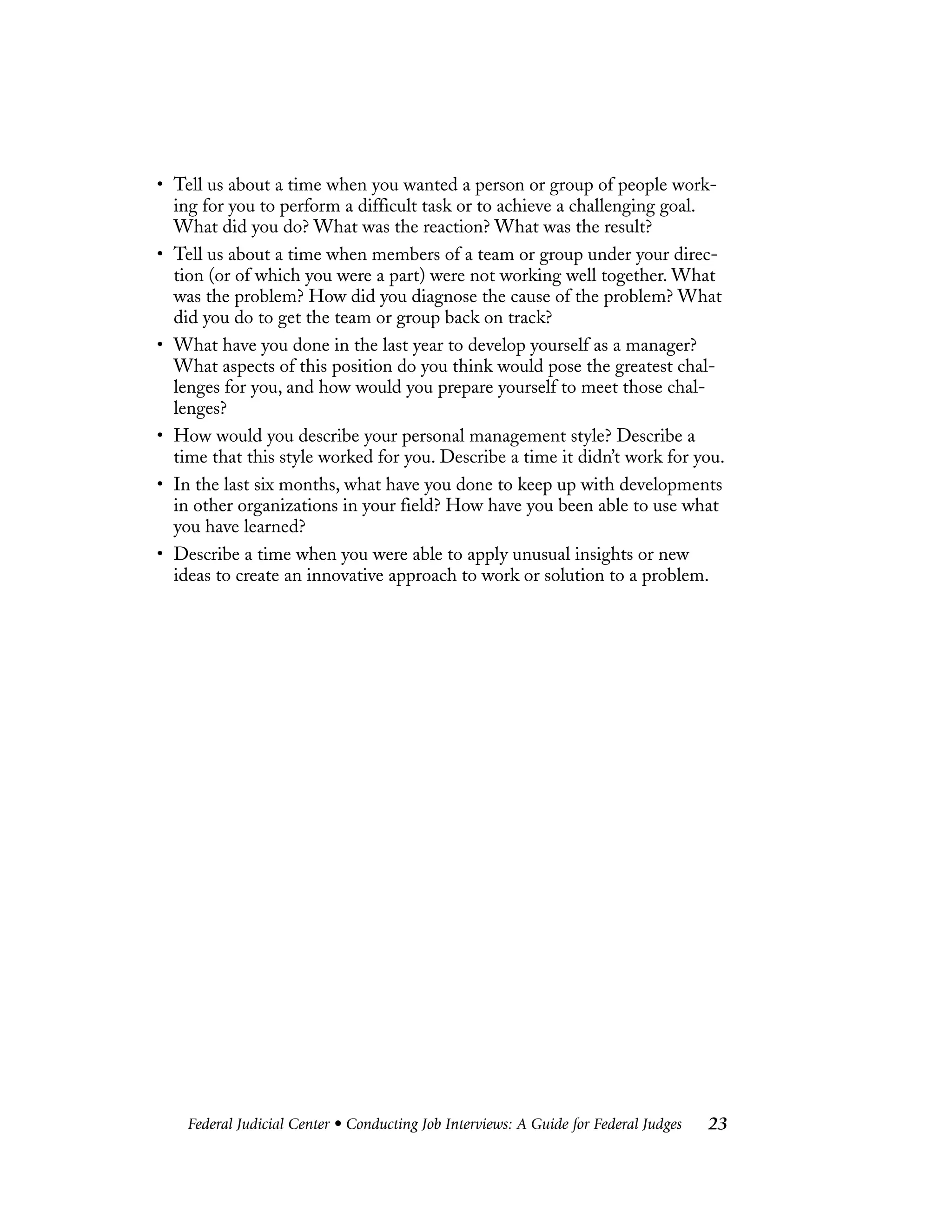
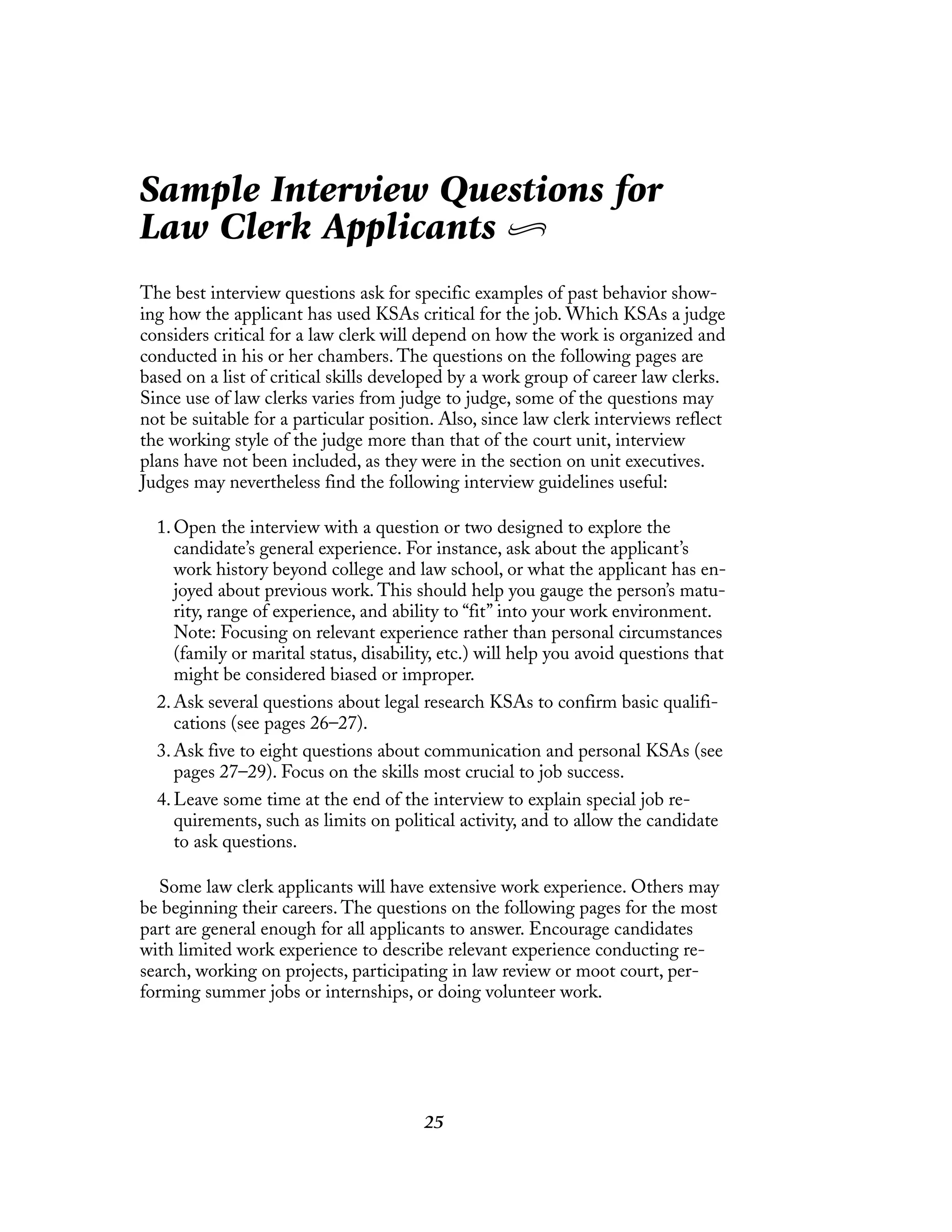
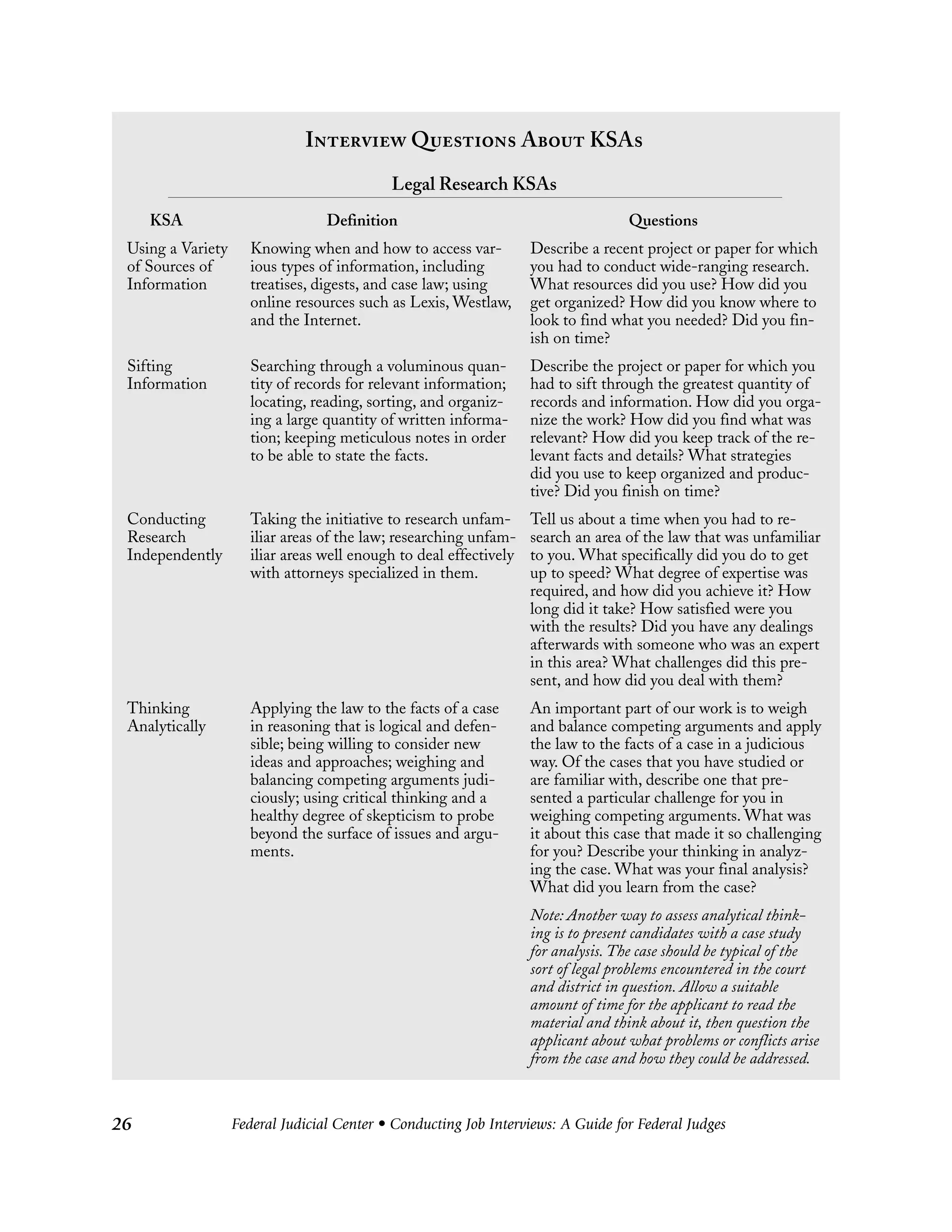
Judicial Education Division
v
Acknowledgments
The following people contributed to the development of this guide:
Administrative Office of the United States Courts
Robert Loesche
Office of General Counsel
United States Courts
Larry Baerman
U.S. District Court
Northern District of New York
Chris Langello
U.S. District Court
District of the District of Columbia
Monica Bigley
U.S. District Court
District of Maine
Dana McWay
U.S. Bankruptcy Court
Eastern District of Missouri
Debbie Branscum
U.S. District Court
Northern District of Texas
Nancy O’Brien
U.S. District Court
Southern District of Iowa
Tom Carter
U.S. Court of Appeals for the
Ninth Circuit
Carolyn Ortwein
U.S. Pretrial Services Office
Eastern District of Virginia
Michael Dobbins
U.S. District Court
Northern District of Illinois
George Prentice
U.S. Bankruptcy Court
Northern District of Iowa
Chuck Freas
U.S. District Court
Western District of Texas
Michael Sheppard
U.S. Bankruptcy Court
District of New Mexico
Haven Gracey
U.S. District Court
Eastern District of California
Bob Sibille
U.S. Probation and Pretrial Services Office
Middle District of Louisiana
Richard Heltzel
U.S. Bankruptcy Court
Eastern District of California
Elaine Terenzi
U.S. Probation Office
Middle District of Florida
Magdeline Jensen
U.S. Probation Office
District of Arizona
Federal Judicial Center
Barbara M. Anderson
Court Education Division
This page is left blank intentionally to facilitate proper pagination
when printing two-sided
1
Introduction
The Federal Judicial Center developed this guide to help federal judges inter-
view applicants for two key positions: court unit executive (clerk of court and
chief probation/pretrial services officer) and law clerk (both permanent and
one-year). An advisory group of court unit executives provided input on the
essential qualifications for each unit executive job and suggested questions that
could be used to assess those qualifications. For assistance identifying law clerk
qualifications, the Center consulted an advisory group of career law clerks who
had experience helping judges conduct interviews for that position.
Do judges really need advice on conducting interviews? It is true that most
will already have considerable experience interviewing law clerk candidates
and will have developed particular approaches to the selection process. This
guide can help them refine current methods. As for court unit executive posi-
tions, most courts are obliged to fill them relatively infrequently; it is likely
therefore that many judges overseeing unit executive selection will not have
had an opportunity to develop tried-and-true approaches to interviewing. This
guide spells out a process for interviewing prospective unit executives that is
simple, effective, and fair.
Effective interviewing not only aids in the identification of the best candi-
date for a job, it also indicates to candidates that the interviewer understands
the position and the demands it will impose on the person selected. Asking
the right questions is the key to effective interviewing. This guide provides ex-
amples of interview questions for both unit executive and law clerk positions.
These questions can be used as is or adapted, or they can be viewed as models
for developing other questions tailored to the needs of the court or judge. Ad-
ditional suggestions about the hiring process for unit executives are also pro-
vided.
Knowledge, Skills, and Abilities
A three-step process can help interviewers analyze a job and get evidence of
experience needed to fill it. Step one is to identify the knowledge, skills, and
abilities (KSAs) needed to perform effectively in the position. Step two is to
develop questions about how applicants have demonstrated those essential
KSAs. Step three is to ask for specific information about past performance—
a better predictor of future behavior than candidates’ generalized assertions
about their approach to work.
The strength of this three-step approach is that it focuses on experience
Federal Judicial Center • Conducting Job Interviews: A Guide for Federal Judges2
that is relevant to key job skills rather than on generalities. The interview
questions in this guide require applicants to give specific examples of past be-
havior. Candidates may need some time to recall suitable examples before they
respond. To streamline interviews, you may wish to provide candidates with
the list of questions they will be asked half an hour or so beforehand. Experi-
enced interviewers make clear that they are looking for specific examples and
wait for the applicant to respond, rather than move quickly to the next ques-
tion if the person seems to be having difficulty.
It is good hiring practice to ask all candidates the same basic questions, so
that opportunities to discuss experience are more or less equal. You may, how-
ever, wish to tailor follow-up questions individually to explore candidates’ an-
swers to the basic questions. Frequently, candidates are seen by more than one
person, either in separate interviews or in a group setting (panel interview). It
is helpful to brief all interviewers in advance about what questions to ask.
Fairness in Interviewing
The Judicial Conference has adopted a Model Employment Dispute Resolu-
tion Plan and directed each court to create a plan based on the model. The
model plan (and thus every court plan) prohibits discrimination on the basis of
race, color, religion, sex, national origin, disability, or age for people 40 or older
(except for probation or pretrial services officers). These provisions apply to all
judicial branch employing units, including chambers staff. Individual court
plans may expand the categories protected.
Like all hiring officials, judges need to take care to avoid interview ques-
tions that create even an appearance of bias. The best way to do this is to make
sure that questions address only the KSAs required for the position. Here are
some examples:
• Rather than ask about a candidate’s marital or family status, ask whether
the candidate has any obligations that would prevent him or her from
meeting the position’s work schedule.
• Ask whether the candidate can work on Saturdays or Sundays, if such
work is an expected part of the job, not whether the candidate’s religion
precludes it.
• Be wary of selective questions. Ask all candidates, not just female candi-
dates with children, whether occasional travel would be a problem.
• Don’t ask whether a candidate has a disability. Instead, after explaining
the duties of the job, ask whether the candidate can perform them with or
without reasonable accommodation.
Federal Judicial Center • Conducting Job Interviews: A Guide for Federal Judges 3
Also, take care not to misrepresent job security in the courts, where person-
nel serve at will and (except for probation officers) can be removed without
the courts showing cause. Avoid statements like “No one gets fired here with-
out good reason” and “You don’t have to worry about your job as long as you
perform well.”
This page is left blank intentionally to facilitate proper pagination
when printing two-sided
5
Interviewing Guidelines
Although general approaches to interviewing vary, there are basic procedures
that all courts should follow in setting up and conducting job interviews.
These procedures are listed below. Judges, of course, will delegate many of the
administrative tasks to human resources staff and others. The Human Resource
Manual, published by the Administrative Office of the U.S. Courts, provides
relevant information on the judicial branch’s court personnel system, position
classification, and other personnel matters.
Before the Interviews
• Identify the KSAs that are crucial for the job and that should thus be cov-
ered in the interview. If interviews of an hour to an hour and a half are
planned, it should be possible to ask in-depth questions in about eight to
ten different areas.
• Prepare a job announcement that accurately describes the KSAs consid-
ered crucial for the job. (Usually, assistance in writing and placing job an-
nouncements is provided by the court’s personnel office or elsewhere
within the clerk’s office if there is no personnel office in the court.)
• Arrange for primary screening of applications. Whoever is reviewing ap-
plications needs to know what the essential criteria for selection are in or-
der to eliminate applicants who fall short. It is a good idea to document
the selection criteria being used, especially if there are multiple decision
makers.
• Arrange for secondary screening of applications. Once applicants who do
not meet basic criteria have been eliminated, review the remaining pool
and select the top candidates to go on to the interview stage.
• Decide who will be involved in conducting the interviews and whether
interviewers will each meet with candidates or will interview as a panel.
• Develop questions for each of the previously identified KSAs. (Questions
may be drawn or adapted from the ones listed in this guide, or new ones
can be developed using these as a model.)
• Decide on a time frame for the interviews. For instance, you may decide
to limit each interview to one hour.
• Set up the interviews. Provide candidates with information about who
Federal Judicial Center • Conducting Job Interviews: A Guide for Federal Judges6
will be conducting the interview and what type of questions will be asked.
Without distributing the actual interview questions, let candidates know
they will be asked questions about specific instances of past experience. In
addition, it is a good idea to send candidates any brochures or other
printed information you have describing work benefits and the court/
chambers generally and explaining how to get to the interview.
• Review the interview plan with all interviewers. Decide who will ask what
questions. Review things to avoid, such as asking inappropriate questions
and making promises of employment during the interview.
During the Interviews
• Greet candidates and set them at their ease. Explain the type of interview
that you will be conducting. Tell candidates whom they will be meeting
and how long the interview will last.
• You may wish to provide candidates with a list of the questions they will
be asked about half an hour before the actual interview begins, so that
they will have time to recall relevant experiences. This streamlines the in-
terview.
• You may wish to open the interview with one or more questions designed
to explore candidates’ general background before moving on to questions
about specific past experience.
• To reduce any potential doubts about the fairness of the interview process,
ask all candidates the same basic questions about their past experience.
Follow-up questions to explore answers given may vary from candidate to
candidate.
• Take notes on candidates’ responses to help you evaluate all candidates at
the conclusion of the interview cycle.
• Towards the end of the interview, ask applicants if they have any ques-
tions they would like to ask you. For example, candidates for unit execu-
tive might ask the following:
— What performance expectations do you have for the unit executive?
— What would you like to see accomplished in the first year?
— Will spending authority be delegated to me?
— How much latitude will I have to organize and manage human and finan-
cial resources?
Federal Judicial Center • Conducting Job Interviews: A Guide for Federal Judges 7
Candidates for law clerk might ask questions like these:
— What is the work environment like? What is your leave policy? Will I
typically be expected to work long days or to come in on weekends?
— What is the judge’s involvement in cases? Does the judge read all parties’
submissions or let the law clerk do that? Does the judge do the first review of
material? Does the judge give the law clerk an outline to guide his or her
writing or let the law clerk do a first draft and react to it?
— What’s the proportion of civil versus criminal cases? What types of cases does
this court typically hear? Do law clerks work on all types of cases that come
into chambers?
— What is a typical day like in the position?
— What is the work configuration in the office? Who does what? How do
people interact? Is work more collaborative or more independent?
— What is the pay for the position? How is it affected by bar membership?
Applicants for either position may appreciate some information at this
time about the city or area where they would be working if they accepted
the position.
• Do not make an offer of employment during the interview. All scheduled
interviews should be completed before a decision is reached.
• Tell candidates what the next steps are and how long the process will take.
In particular, tell them when they can expect to be notified of a decision.
After the Interviews
• Call references for candidates still in the running.
• Before making an offer of employment, ensure that all interviews are con-
cluded, that all candidates have been evaluated, and that reference checks
are complete. A security check, if one is required for the position, should
also be concluded before a final employment offer is made.
• Make a verbal offer of employment to the first-choice candidate. If the
verbal offer is accepted, follow up with a written offer stating the condi-
tions of employment. (It is a good idea to engage the court’s personnel
specialist, or person in charge of personnel issues, in the sending of writ-
ten correspondence regarding hiring.) If the first-choice candidate does
not accept the verbal offer, proceed to the second-choice candidate.
• After the position has been filled, notify applicants who have been inter-
viewed but not selected.
This page is left blank intentionally to facilitate proper pagination
when printing two-sided
9
Sample Interview Questions for
Unit Executive Applicants
Begin an interview with one or two “foundation questions” about the appli-
cant’s general background to help break the ice. Foundation questions can also
reveal what the applicant finds important. Sample foundation questions ap-
pear below. You may want to develop others based on applicants’ resumes and
cover letters.
Next, ask several questions about operational KSAs to establish the
candidate’s basic qualifications. This is the heart of the interview. Ask for spe-
cific examples of past behavior demonstrating the KSAs that you have deter-
mined will be most important for your court unit in the next few years. Ex-
cluding the foundation questions, the sample questions listed on the following
pages are based on the Federal Judicial Center’s Court Management Frame-
work; at least one question is listed for each KSA in the framework. Addi-
tional questions can be developed to reflect the special needs of your court
unit.
Lastly, ask six to ten questions from the other categories on the following
pages, focusing on areas of special importance to the court unit.
Foundation Questions
• What is it about this position that interests you?
• We have reviewed your resume and application. Please tell us what areas
in your experience you think would qualify you for this position.
• Describe your style of supervising staff and subordinates. Tell me of an in-
cident where that style worked well. Describe a time when you were dis-
appointed in the results of your supervision. What did you do?
• Picture the best manager or supervisor you ever had. What about that
person made him or her effective? Now picture the worst manager or su-
pervisor you ever had. What about that person made him or her ineffec-
tive?
• What major changes or decisions have you made in terms of your career?
Why did you make them?
• Why are you leaving your current position?
Federal Judicial Center • Conducting Job Interviews: A Guide for Federal Judges10
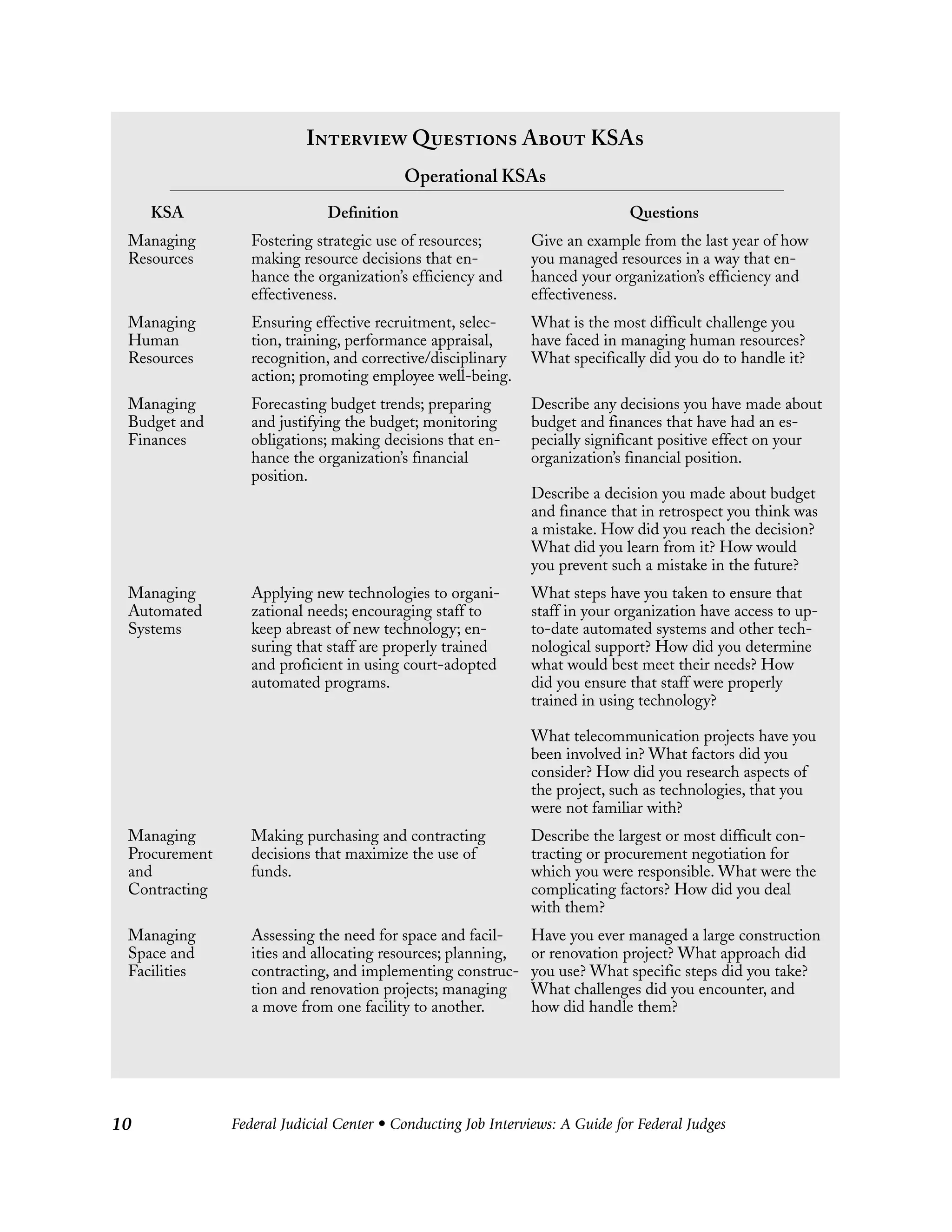
Operational KSAs
KSA Definition Questions
Managing Fostering strategic use of resources; Give an example from the last year of how
Resources making resource decisions that en- you managed resources in a way that en-
hance the organization’s efficiency and hanced your organization’s efficiency and
effectiveness. effectiveness.
Managing Ensuring effective recruitment, selec- What is the most difficult challenge you
Human tion, training, performance appraisal, have faced in managing human resources?
Resources recognition, and corrective/disciplinary What specifically did you do to handle it?
action; promoting employee well-being.
Managing Forecasting budget trends; preparing Describe any decisions you have made about
Budget and and justifying the budget; monitoring budget and finances that have had an es-
Finances obligations; making decisions that en- pecially significant positive effect on your
hance the organization’s financial organization’s financial position.
position.
Describe a decision you made about budget
and finance that in retrospect you think was
a mistake. How did you reach the decision?
What did you learn from it? How would
you prevent such a mistake in the future?
Managing Applying new technologies to organi- What steps have you taken to ensure that
Automated zational needs; encouraging staff to staff in your organization have access to up-
Systems keep abreast of new technology; en- to-date automated systems and other tech-
suring that staff are properly trained nological support? How did you determine
and proficient in using court-adopted what would best meet their needs? How
automated programs. did you ensure that staff were properly
trained in using technology?
What telecommunication projects have you
been involved in? What factors did you
consider? How did you research aspects of
the project, such as technologies, that you
were not familiar with?
Managing Making purchasing and contracting Describe the largest or most difficult con-
Procurement decisions that maximize the use of tracting or procurement negotiation for
and funds. which you were responsible. What were the
Contracting complicating factors? How did you deal
with them?
Managing Assessing the need for space and facil- Have you ever managed a large construction
Space and ities and allocating resources; planning, or renovation project? What approach did
Facilities contracting, and implementing construc- you use? What specific steps did you take?
tion and renovation projects; managing What challenges did you encounter, and
a move from one facility to another. how did handle them?
Interview Questions About KSAs
Federal Judicial Center • Conducting Job Interviews: A Guide for Federal Judges 11
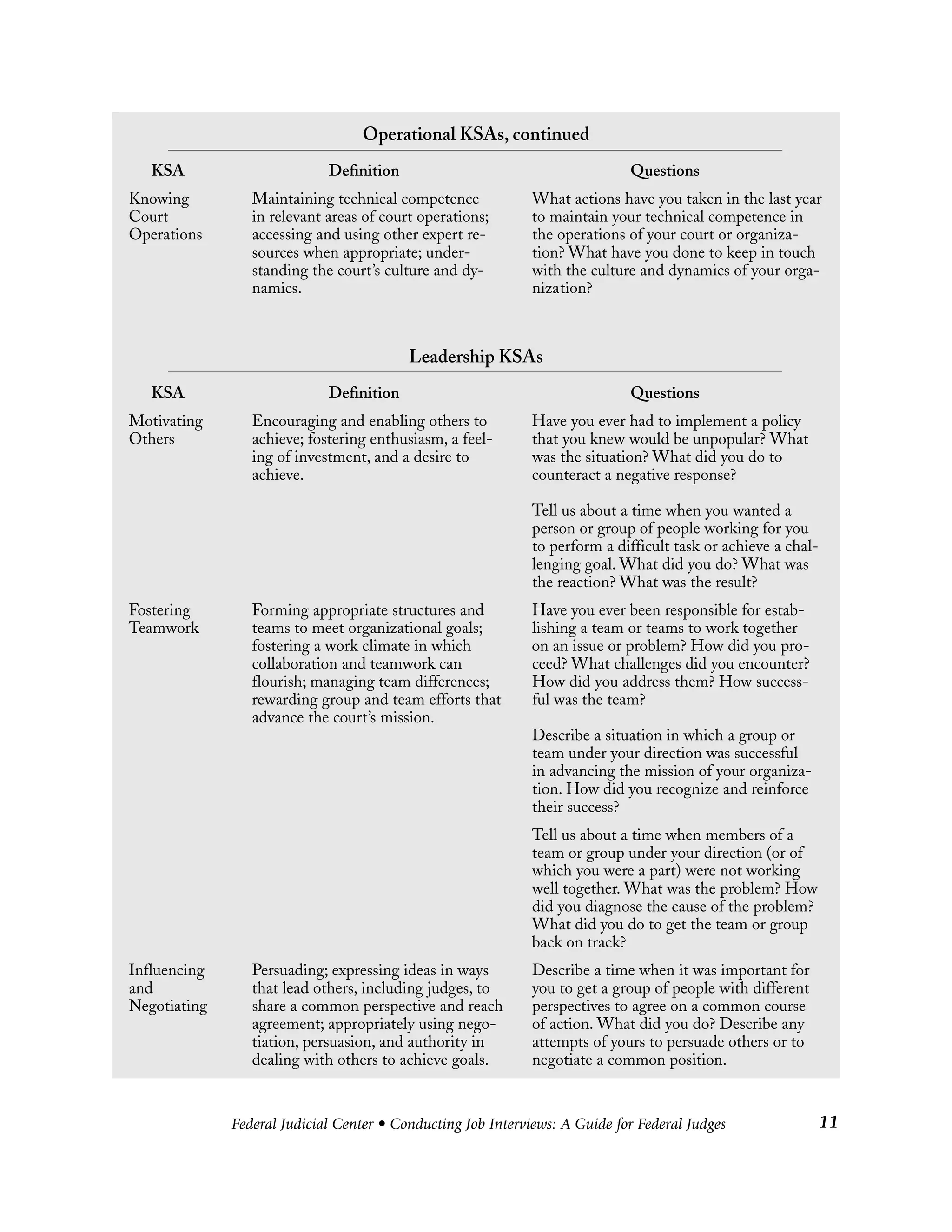
Operational KSAs, continued
KSA Definition Questions
Knowing Maintaining technical competence What actions have you taken in the last year
Court in relevant areas of court operations; to maintain your technical competence in
Operations accessing and using other expert re- the operations of your court or organiza-
sources when appropriate; under- tion? What have you done to keep in touch
standing the court’s culture and dy- with the culture and dynamics of your orga-
namics. nization?
Leadership KSAs
KSA Definition Questions
Motivating Encouraging and enabling others to Have you ever had to implement a policy
Others achieve; fostering enthusiasm, a feel- that you knew would be unpopular? What
ing of investment, and a desire to was the situation? What did you do to
achieve. counteract a negative response?
Tell us about a time when you wanted a
person or group of people working for you
to perform a difficult task or achieve a chal-
lenging goal. What did you do? What was
the reaction? What was the result?
Fostering Forming appropriate structures and Have you ever been responsible for estab-
Teamwork teams to meet organizational goals; lishing a team or teams to work together
fostering a work climate in which on an issue or problem? How did you pro-
collaboration and teamwork can ceed? What challenges did you encounter?
flourish; managing team differences; How did you address them? How success-
rewarding group and team efforts that ful was the team?
advance the court’s mission.
Describe a situation in which a group or
team under your direction was successful
in advancing the mission of your organiza-
tion. How did you recognize and reinforce
their success?
Tell us about a time when members of a
team or group under your direction (or of
which you were a part) were not working
well together. What was the problem? How
did you diagnose the cause of the problem?
What did you do to get the team or group
back on track?
Influencing Persuading; expressing ideas in ways Describe a time when it was important for
and that lead others, including judges, to you to get a group of people with different
Negotiating share a common perspective and reach perspectives to agree on a common course
agreement; appropriately using nego- of action. What did you do? Describe any
tiation, persuasion, and authority in attempts of yours to persuade others or to
dealing with others to achieve goals. negotiate a common position.
Federal Judicial Center • Conducting Job Interviews: A Guide for Federal Judges12
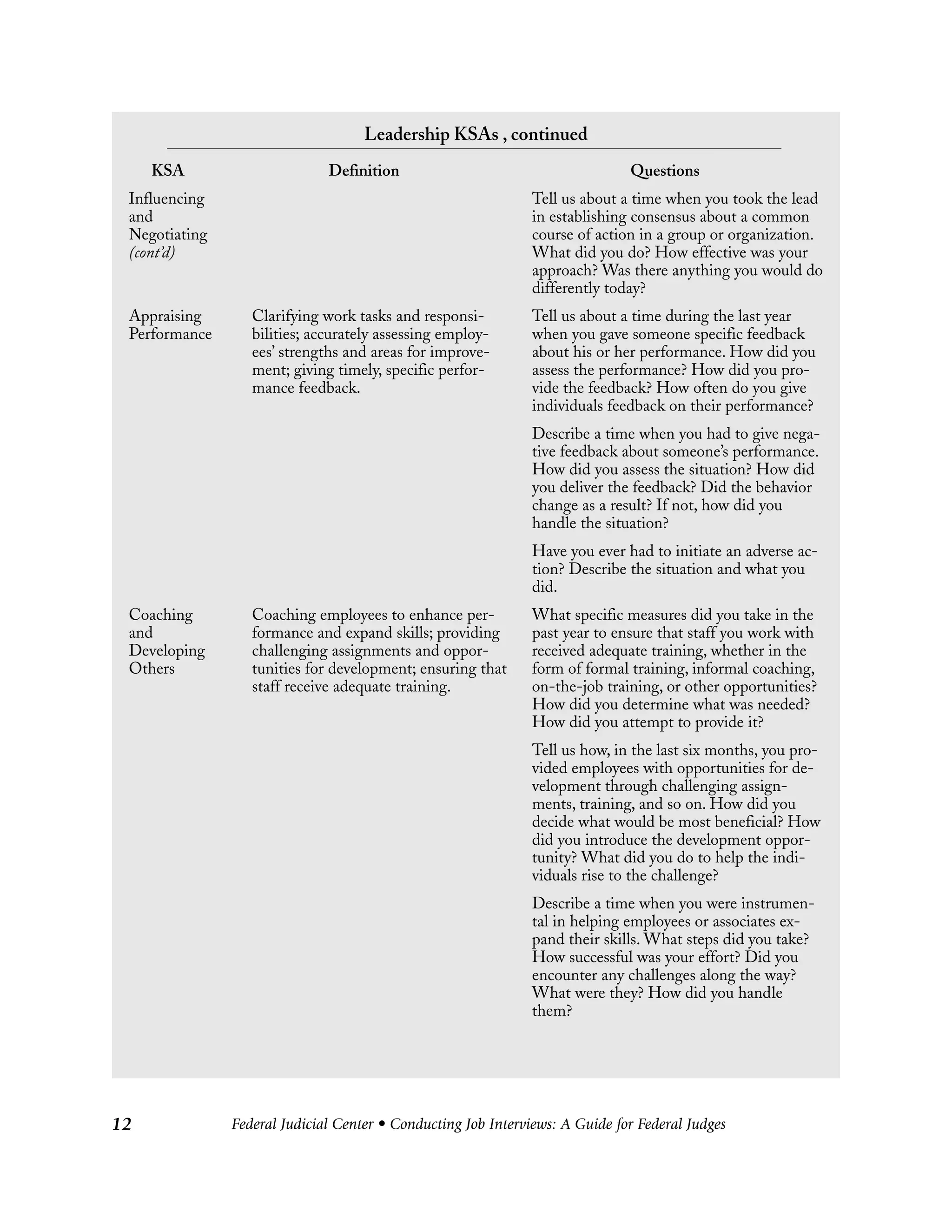
Leadership KSAs , continued
KSA Definition Questions
Influencing Tell us about a time when you took the lead
and in establishing consensus about a common
Negotiating course of action in a group or organization.
(cont’d) What did you do? How effective was your
approach? Was there anything you would do
differently today?
Appraising Clarifying work tasks and responsi- Tell us about a time during the last year
Performance bilities; accurately assessing employ- when you gave someone specific feedback
ees’ strengths and areas for improve- about his or her performance. How did you
ment; giving timely, specific perfor- assess the performance? How did you pro-
mance feedback. vide the feedback? How often do you give
individuals feedback on their performance?
Describe a time when you had to give nega-
tive feedback about someone’s performance.
How did you assess the situation? How did
you deliver the feedback? Did the behavior
change as a result? If not, how did you
handle the situation?
Have you ever had to initiate an adverse ac-
tion? Describe the situation and what you
did.
Coaching Coaching employees to enhance per- What specific measures did you take in the
and formance and expand skills; providing past year to ensure that staff you work with
Developing challenging assignments and oppor- received adequate training, whether in the
Others tunities for development; ensuring that form of formal training, informal coaching,
staff receive adequate training. on-the-job training, or other opportunities?
How did you determine what was needed?
How did you attempt to provide it?
Tell us how, in the last six months, you pro-
vided employees with opportunities for de-
velopment through challenging assign-
ments, training, and so on. How did you
decide what would be most beneficial? How
did you introduce the development oppor-
tunity? What did you do to help the indi-
viduals rise to the challenge?
Describe a time when you were instrumen-
tal in helping employees or associates ex-
pand their skills. What steps did you take?
How successful was your effort? Did you
encounter any challenges along the way?
What were they? How did you handle
them?
Federal Judicial Center • Conducting Job Interviews: A Guide for Federal Judges 13
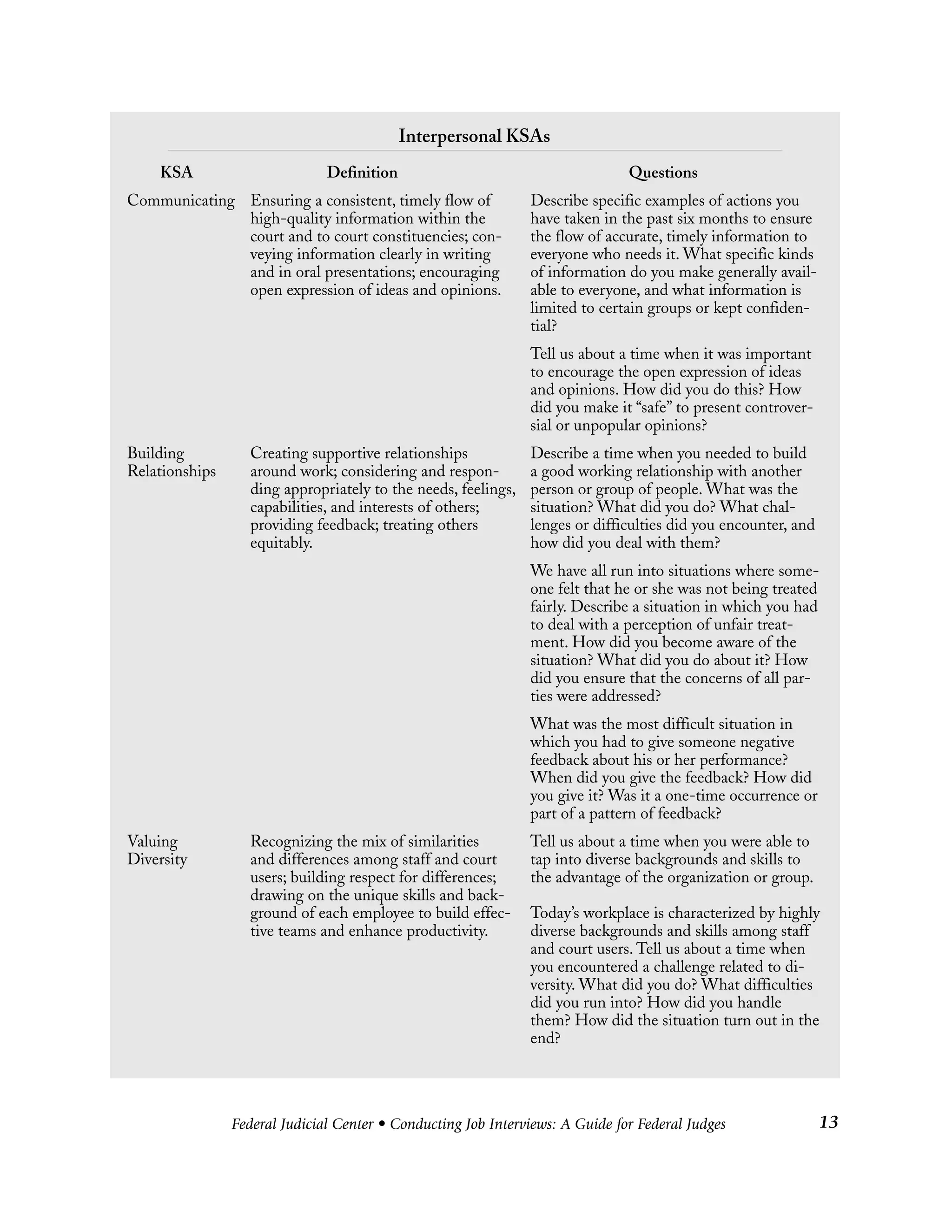
Interpersonal KSAs
KSA Definition Questions
Communicating Ensuring a consistent, timely flow of Describe specific examples of actions you
high-quality information within the have taken in the past six months to ensure
court and to court constituencies; con- the flow of accurate, timely information to
veying information clearly in writing everyone who needs it. What specific kinds
and in oral presentations; encouraging of information do you make generally avail-
open expression of ideas and opinions. able to everyone, and what information is
limited to certain groups or kept confiden-
tial?
Tell us about a time when it was important
to encourage the open expression of ideas
and opinions. How did you do this? How
did you make it “safe” to present controver-
sial or unpopular opinions?
Building Creating supportive relationships Describe a time when you needed to build
Relationships around work; considering and respon- a good working relationship with another
ding appropriately to the needs, feelings, person or group of people. What was the
capabilities, and interests of others; situation? What did you do? What chal-
providing feedback; treating others lenges or difficulties did you encounter, and
equitably. how did you deal with them?
We have all run into situations where some-
one felt that he or she was not being treated
fairly. Describe a situation in which you had
to deal with a perception of unfair treat-
ment. How did you become aware of the
situation? What did you do about it? How
did you ensure that the concerns of all par-
ties were addressed?
What was the most difficult situation in
which you had to give someone negative
feedback about his or her performance?
When did you give the feedback? How did
you give it? Was it a one-time occurrence or
part of a pattern of feedback?
Valuing Recognizing the mix of similarities Tell us about a time when you were able to
Diversity and differences among staff and court tap into diverse backgrounds and skills to
users; building respect for differences; the advantage of the organization or group.
drawing on the unique skills and back-
ground of each employee to build effec- Today’s workplace is characterized by highly
tive teams and enhance productivity. diverse backgrounds and skills among staff
and court users. Tell us about a time when
you encountered a challenge related to di-
versity. What did you do? What difficulties
did you run into? How did you handle
them? How did the situation turn out in the
end?
Federal Judicial Center • Conducting Job Interviews: A Guide for Federal Judges14
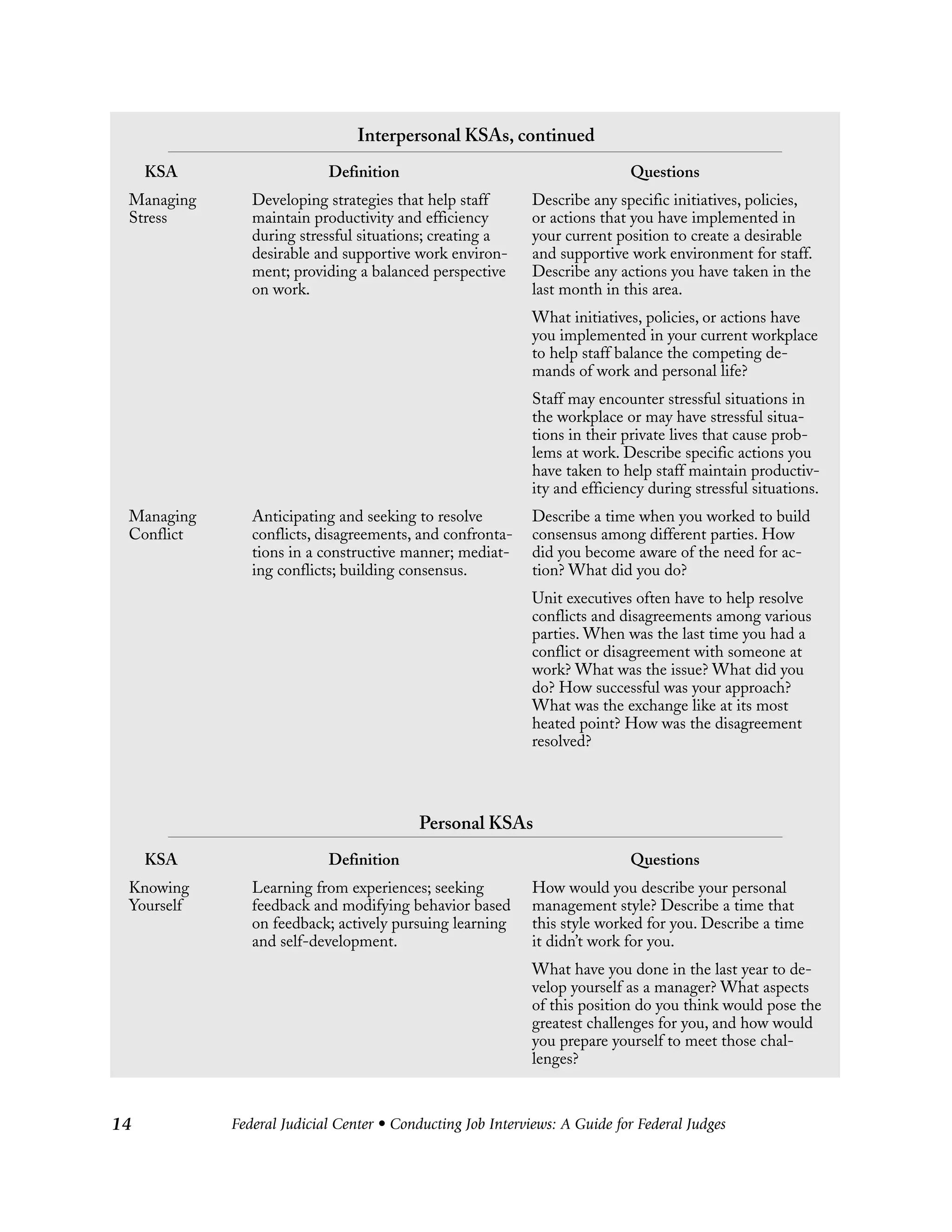
Interpersonal KSAs, continued
KSA Definition Questions
Managing Developing strategies that help staff Describe any specific initiatives, policies,
Stress maintain productivity and efficiency or actions that you have implemented in
during stressful situations; creating a your current position to create a desirable
desirable and supportive work environ- and supportive work environment for staff.
ment; providing a balanced perspective Describe any actions you have taken in the
on work. last month in this area.
What initiatives, policies, or actions have
you implemented in your current workplace
to help staff balance the competing de-
mands of work and personal life?
Staff may encounter stressful situations in
the workplace or may have stressful situa-
tions in their private lives that cause prob-
lems at work. Describe specific actions you
have taken to help staff maintain productiv-
ity and efficiency during stressful situations.
Managing Anticipating and seeking to resolve Describe a time when you worked to build
Conflict conflicts, disagreements, and confronta- consensus among different parties. How
tions in a constructive manner; mediat- did you become aware of the need for ac-
ing conflicts; building consensus. tion? What did you do?
Unit executives often have to help resolve
conflicts and disagreements among various
parties. When was the last time you had a
conflict or disagreement with someone at
work? What was the issue? What did you
do? How successful was your approach?
What was the exchange like at its most
heated point? How was the disagreement
resolved?
Personal KSAs
KSA Definition Questions
Knowing Learning from experiences; seeking How would you describe your personal
Yourself feedback and modifying behavior based management style? Describe a time that
on feedback; actively pursuing learning this style worked for you. Describe a time
and self-development. it didn’t work for you.
What have you done in the last year to de-
velop yourself as a manager? What aspects
of this position do you think would pose the
greatest challenges for you, and how would
you prepare yourself to meet those chal-
lenges?
Federal Judicial Center • Conducting Job Interviews: A Guide for Federal Judges 15
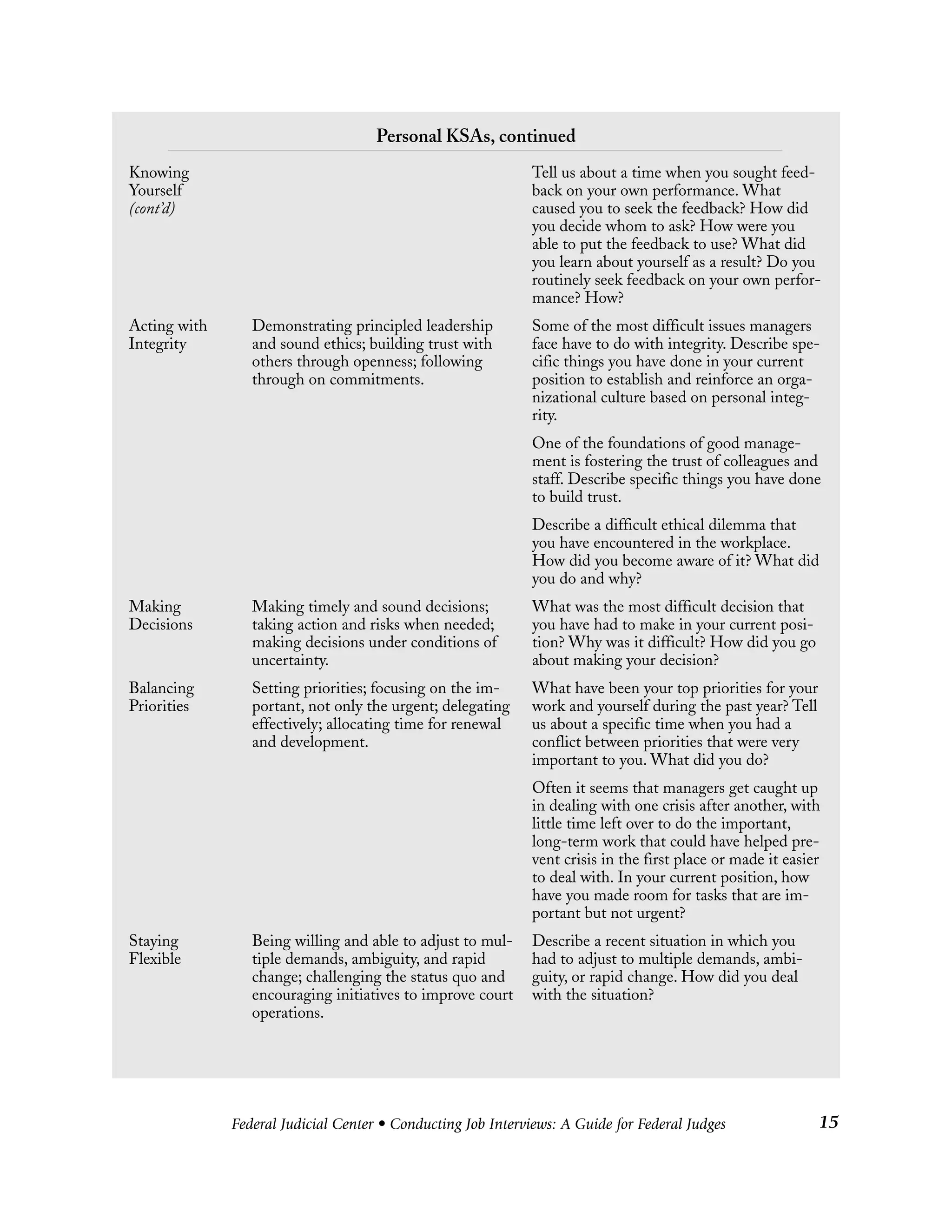
Personal KSAs, continued
Knowing Tell us about a time when you sought feed-
Yourself back on your own performance. What
(cont’d) caused you to seek the feedback? How did
you decide whom to ask? How were you
able to put the feedback to use? What did
you learn about yourself as a result? Do you
routinely seek feedback on your own perfor-
mance? How?
Acting with Demonstrating principled leadership Some of the most difficult issues managers
Integrity and sound ethics; building trust with face have to do with integrity. Describe spe-
others through openness; following cific things you have done in your current
through on commitments. position to establish and reinforce an orga-
nizational culture based on personal integ-
rity.
One of the foundations of good manage-
ment is fostering the trust of colleagues and
staff. Describe specific things you have done
to build trust.
Describe a difficult ethical dilemma that
you have encountered in the workplace.
How did you become aware of it? What did
you do and why?
Making Making timely and sound decisions; What was the most difficult decision that
Decisions taking action and risks when needed; you have had to make in your current posi-
making decisions under conditions of tion? Why was it difficult? How did you go
uncertainty. about making your decision?
Balancing Setting priorities; focusing on the im- What have been your top priorities for your
Priorities portant, not only the urgent; delegating work and yourself during the past year? Tell
effectively; allocating time for renewal us about a specific time when you had a
and development. conflict between priorities that were very
important to you. What did you do?
Often it seems that managers get caught up
in dealing with one crisis after another, with
little time left over to do the important,
long-term work that could have helped pre-
vent crisis in the first place or made it easier
to deal with. In your current position, how
have you made room for tasks that are im-
portant but not urgent?
Staying Being willing and able to adjust to mul- Describe a recent situation in which you
Flexible tiple demands, ambiguity, and rapid had to adjust to multiple demands, ambi-
change; challenging the status quo and guity, or rapid change. How did you deal
encouraging initiatives to improve court with the situation?
operations.
Federal Judicial Center • Conducting Job Interviews: A Guide for Federal Judges16
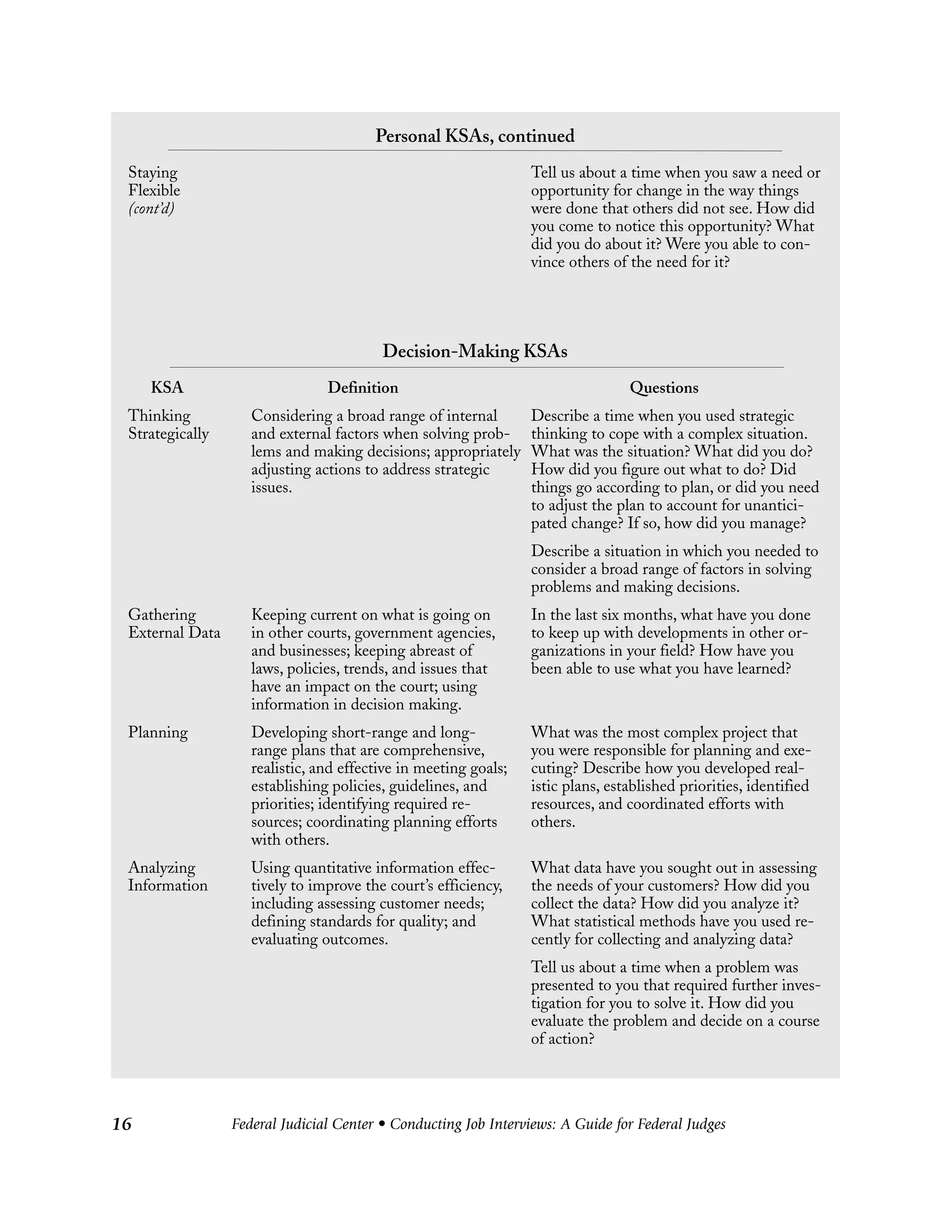
Personal KSAs, continued
Staying Tell us about a time when you saw a need or
Flexible opportunity for change in the way things
(cont’d) were done that others did not see. How did
you come to notice this opportunity? What
did you do about it? Were you able to con-
vince others of the need for it?
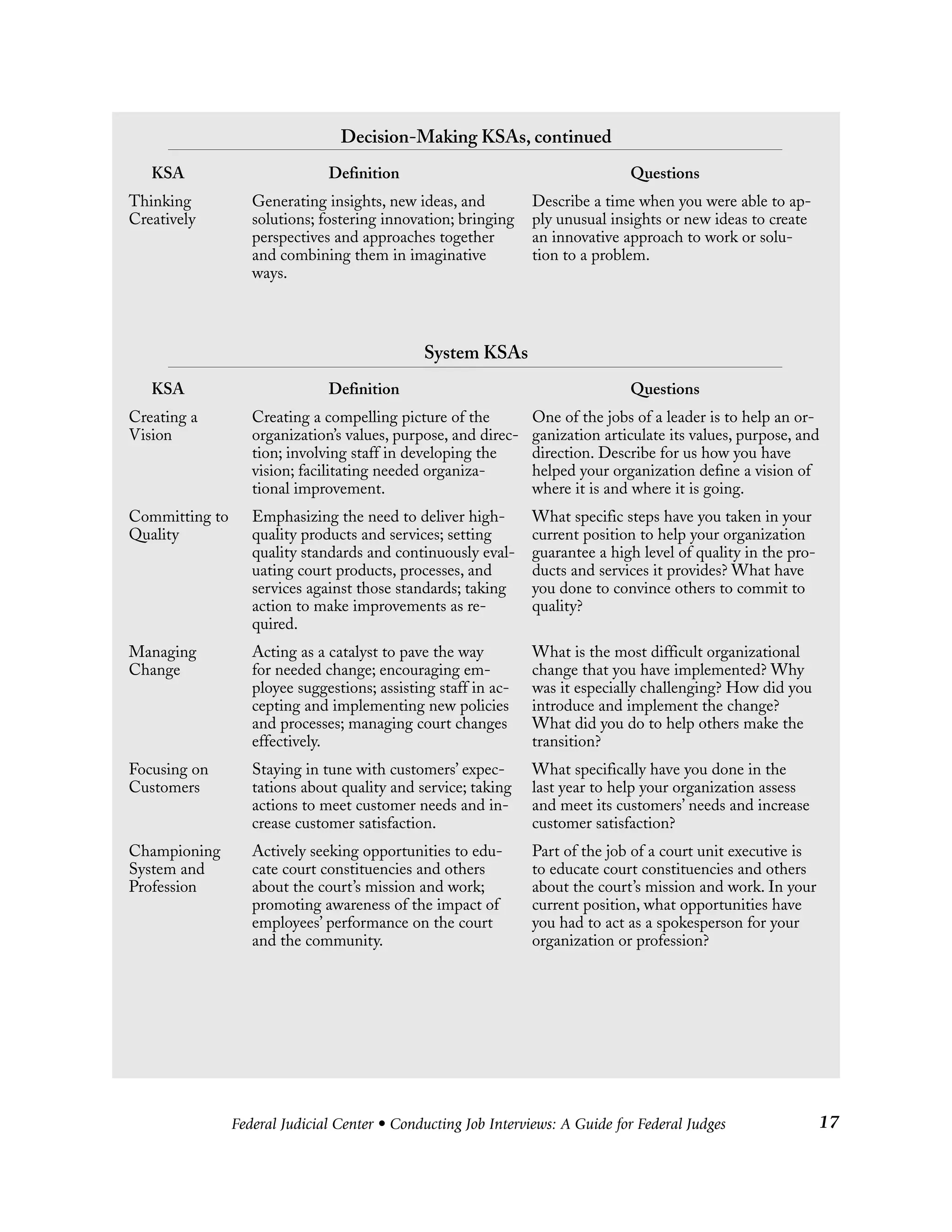
Decision-Making KSAs
KSA Definition Questions
Thinking Considering a broad range of internal Describe a time when you used strategic
Strategically and external factors when solving prob- thinking to cope with a complex situation.
lems and making decisions; appropriately What was the situation? What did you do?
adjusting actions to address strategic How did you figure out what to do? Did
issues. things go according to plan, or did you need
to adjust the plan to account for unantici-
pated change? If so, how did you manage?
Describe a situation in which you needed to
consider a broad range of factors in solving
problems and making decisions.
Gathering Keeping current on what is going on In the last six months, what have you done
External Data in other courts, government agencies, to keep up with developments in other or-
and businesses; keeping abreast of ganizations in your field? How have you
laws, policies, trends, and issues that been able to use what you have learned?
have an impact on the court; using
information in decision making.
Planning Developing short-range and long- What was the most complex project that
range plans that are comprehensive, you were responsible for planning and exe-
realistic, and effective in meeting goals; cuting? Describe how you developed real-
establishing policies, guidelines, and istic plans, established priorities, identified
priorities; identifying required re- resources, and coordinated efforts with
sources; coordinating planning efforts others.
with others.
Analyzing Using quantitative information effec- What data have you sought out in assessing
Information tively to improve the court’s efficiency, the needs of your customers? How did you
including assessing customer needs; collect the data? How did you analyze it?
defining standards for quality; and What statistical methods have you used re-
evaluating outcomes. cently for collecting and analyzing data?
Tell us about a time when a problem was
presented to you that required further inves-
tigation for you to solve it. How did you
evaluate the problem and decide on a course
of action?
Federal Judicial Center • Conducting Job Interviews: A Guide for Federal Judges 17
Decision-Making KSAs, continued
KSA Definition Questions
Thinking Generating insights, new ideas, and Describe a time when you were able to ap-
Creatively solutions; fostering innovation; bringing ply unusual insights or new ideas to create
perspectives and approaches together an innovative approach to work or solu-
and combining them in imaginative tion to a problem.
ways.
System KSAs
KSA Definition Questions
Creating a Creating a compelling picture of the One of the jobs of a leader is to help an or-
Vision organization’s values, purpose, and direc- ganization articulate its values, purpose, and
tion; involving staff in developing the direction. Describe for us how you have
vision; facilitating needed organiza- helped your organization define a vision of
tional improvement. where it is and where it is going.
Committing to Emphasizing the need to deliver high- What specific steps have you taken in your
Quality quality products and services; setting current position to help your organization
quality standards and continuously eval- guarantee a high level of quality in the pro-
uating court products, processes, and ducts and services it provides? What have
services against those standards; taking you done to convince others to commit to
action to make improvements as re- quality?
quired.
Managing Acting as a catalyst to pave the way What is the most difficult organizational
Change for needed change; encouraging em- change that you have implemented? Why
ployee suggestions; assisting staff in ac- was it especially challenging? How did you
cepting and implementing new policies introduce and implement the change?
and processes; managing court changes What did you do to help others make the
effectively. transition?
Focusing on Staying in tune with customers’ expec- What specifically have you done in the
Customers tations about quality and service; taking last year to help your organization assess
actions to meet customer needs and in- and meet its customers’ needs and increase
crease customer satisfaction. customer satisfaction?
Championing Actively seeking opportunities to edu- Part of the job of a court unit executive is
System and cate court constituencies and others to educate court constituencies and others
Profession about the court’s mission and work; about the court’s mission and work. In your
promoting awareness of the impact of current position, what opportunities have
employees’ performance on the court you had to act as a spokesperson for your
and the community. organization or profession?
This page is left blank intentionally to facilitate proper pagination
when printing two-sided
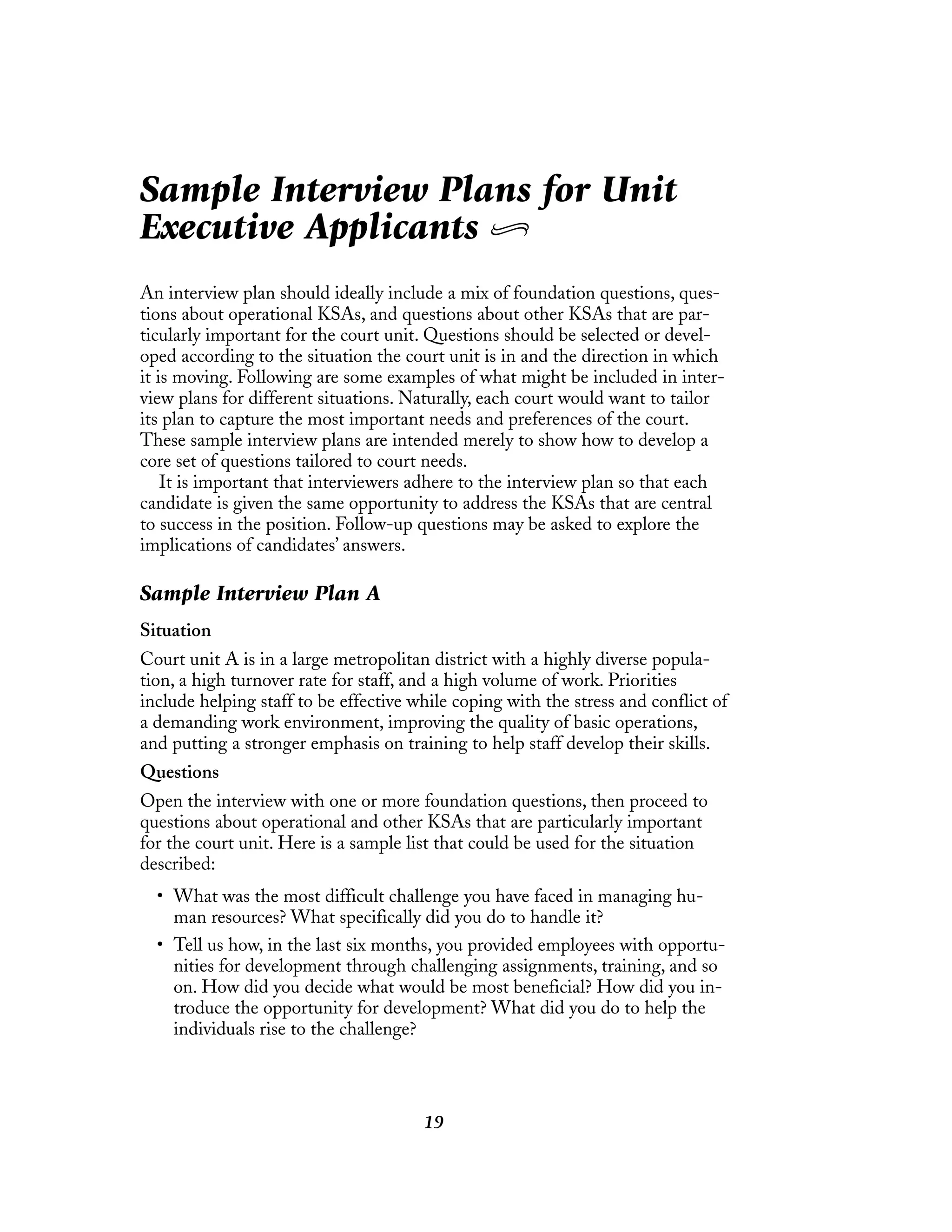
19
Sample Interview Plans for Unit
Executive Applicants
An interview plan should ideally include a mix of foundation questions, ques-
tions about operational KSAs, and questions about other KSAs that are par-
ticularly important for the court unit. Questions should be selected or devel-
oped according to the situation the court unit is in and the direction in which
it is moving. Following are some examples of what might be included in inter-
view plans for different situations. Naturally, each court would want to tailor
its plan to capture the most important needs and preferences of the court.
These sample interview plans are intended merely to show how to develop a
core set of questions tailored to court needs.
It is important that interviewers adhere to the interview plan so that each
candidate is given the same opportunity to address the KSAs that are central
to success in the position. Follow-up questions may be asked to explore the
implications of candidates’ answers.
Sample Interview Plan A
Situation
Court unit A is in a large metropolitan district with a highly diverse popula-
tion, a high turnover rate for staff, and a high volume of work. Priorities
include helping staff to be effective while coping with the stress and conflict of
a demanding work environment, improving the quality of basic operations,
and putting a stronger emphasis on training to help staff develop their skills.
Questions
Open the interview with one or more foundation questions, then proceed to
questions about operational and other KSAs that are particularly important
for the court unit. Here is a sample list that could be used for the situation
described:
• What was the most difficult challenge you have faced in managing hu-
man resources? What specifically did you do to handle it?
• Tell us how, in the last six months, you provided employees with opportu-
nities for development through challenging assignments, training, and so
on. How did you decide what would be most beneficial? How did you in-
troduce the opportunity for development? What did you do to help the
individuals rise to the challenge?
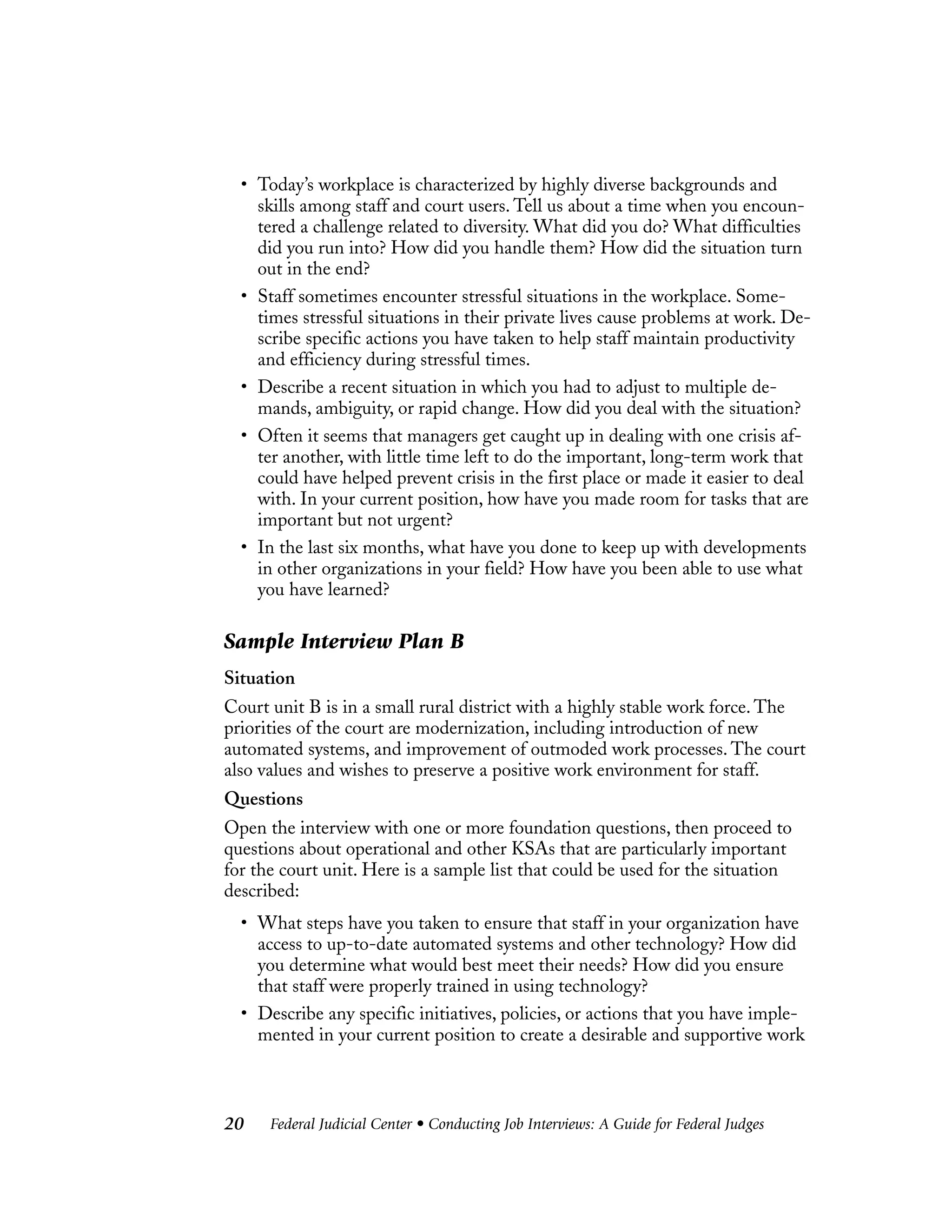
Federal Judicial Center • Conducting Job Interviews: A Guide for Federal Judges20
• Today’s workplace is characterized by highly diverse backgrounds and
skills among staff and court users. Tell us about a time when you encoun-
tered a challenge related to diversity. What did you do? What difficulties
did you run into? How did you handle them? How did the situation turn
out in the end?
• Staff sometimes encounter stressful situations in the workplace. Some-
times stressful situations in their private lives cause problems at work. De-
scribe specific actions you have taken to help staff maintain productivity
and efficiency during stressful times.
• Describe a recent situation in which you had to adjust to multiple de-
mands, ambiguity, or rapid change. How did you deal with the situation?
• Often it seems that managers get caught up in dealing with one crisis af-
ter another, with little time left to do the important, long-term work that
could have helped prevent crisis in the first place or made it easier to deal
with. In your current position, how have you made room for tasks that are
important but not urgent?
• In the last six months, what have you done to keep up with developments
in other organizations in your field? How have you been able to use what
you have learned?
Sample Interview Plan B
Situation
Court unit B is in a small rural district with a highly stable work force. The
priorities of the court are modernization, including introduction of new
automated systems, and improvement of outmoded work processes. The court
also values and wishes to preserve a positive work environment for staff.
Questions
Open the interview with one or more foundation questions, then proceed to
questions about operational and other KSAs that are particularly important
for the court unit. Here is a sample list that could be used for the situation
described:
• What steps have you taken to ensure that staff in your organization have
access to up-to-date automated systems and other technology? How did
you determine what would best meet their needs? How did you ensure
that staff were properly trained in using technology?
• Describe any specific initiatives, policies, or actions that you have imple-
mented in your current position to create a desirable and supportive work
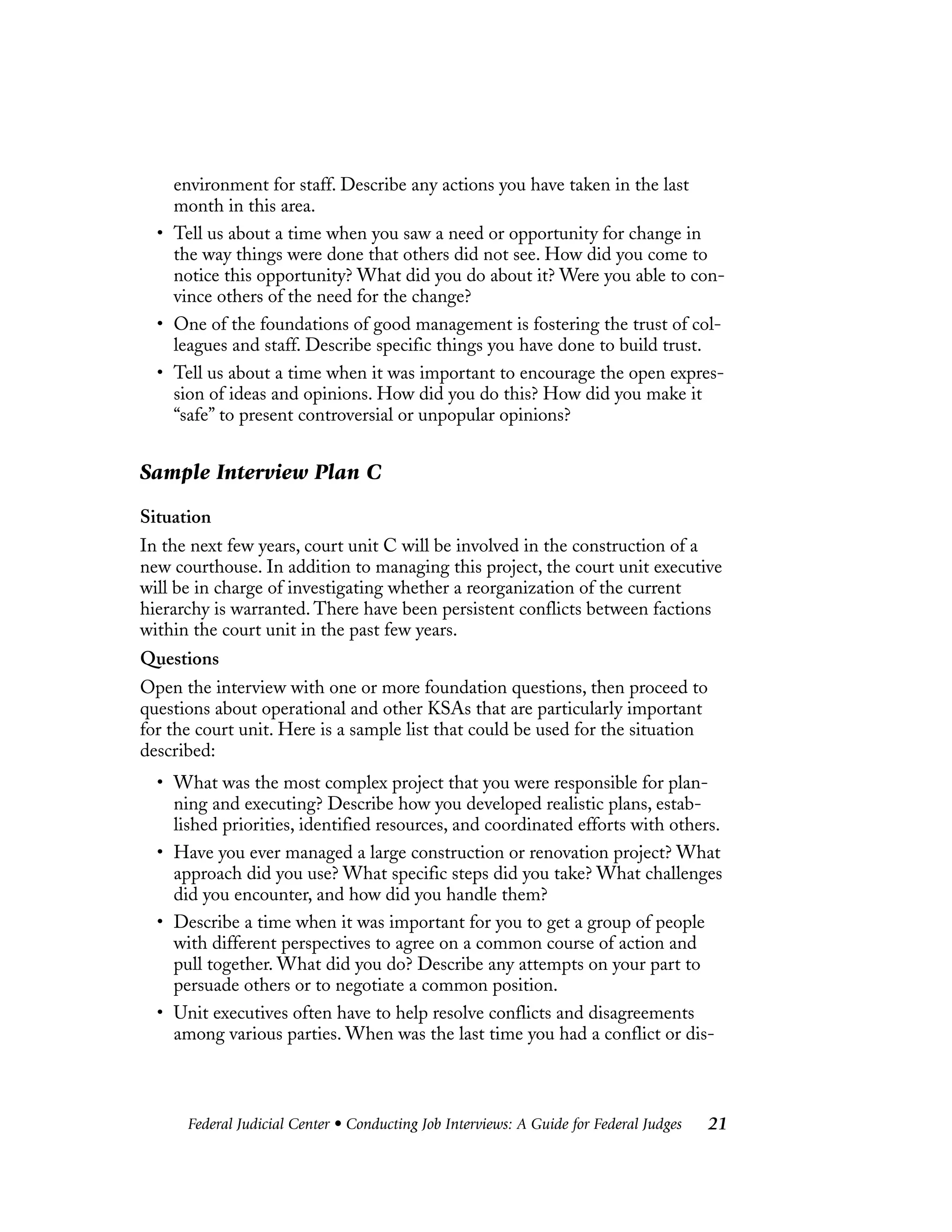
Federal Judicial Center • Conducting Job Interviews: A Guide for Federal Judges 21
environment for staff. Describe any actions you have taken in the last
month in this area.
• Tell us about a time when you saw a need or opportunity for change in
the way things were done that others did not see. How did you come to
notice this opportunity? What did you do about it? Were you able to con-
vince others of the need for the change?
• One of the foundations of good management is fostering the trust of col-
leagues and staff. Describe specific things you have done to build trust.
• Tell us about a time when it was important to encourage the open expres-
sion of ideas and opinions. How did you do this? How did you make it
“safe” to present controversial or unpopular opinions?
Sample Interview Plan C
Situation
In the next few years, court unit C will be involved in the construction of a
new courthouse. In addition to managing this project, the court unit executive
will be in charge of investigating whether a reorganization of the current
hierarchy is warranted. There have been persistent conflicts between factions
within the court unit in the past few years.
Questions
Open the interview with one or more foundation questions, then proceed to
questions about operational and other KSAs that are particularly important
for the court unit. Here is a sample list that could be used for the situation
described:
• What was the most complex project that you were responsible for plan-
ning and executing? Describe how you developed realistic plans, estab-
lished priorities, identified resources, and coordinated efforts with others.
• Have you ever managed a large construction or renovation project? What
approach did you use? What specific steps did you take? What challenges
did you encounter, and how did you handle them?
• Describe a time when it was important for you to get a group of people
with different perspectives to agree on a common course of action and
pull together. What did you do? Describe any attempts on your part to
persuade others or to negotiate a common position.
• Unit executives often have to help resolve conflicts and disagreements
among various parties. When was the last time you had a conflict or dis-
Federal Judicial Center • Conducting Job Interviews: A Guide for Federal Judges22
agreement with someone at work? What was the issue? What did you do?
How successful was your approach? What was the exchange like at its
most heated point? How was the disagreement resolved?
• Describe a recent situation in which you had to adjust to multiple de-
mands, ambiguity, or rapid change. How did you deal with the situation?
• What was the most difficult decision that you have had to make in your
current position? Why was it difficult? How did you go about making
your decision?
Sample Interview Plan D
Situation
Under the current unit executive, court unit D has successfully implemented a
program to improve customer service. A great deal of work has been done to
assess customer needs, set improvement goals, and improve work processes.
The organization has also flattened out as teams have taken over some of the
duties formerly done by supervisors. The court wishes to ensure that these
successful efforts continue in the future and is looking for a progressive leader
with forward-looking managerial ideas.
Questions
Open the interview with one or more foundation questions, then proceed to
questions about operational and other KSAs that are particularly important
for the court unit. Here is a sample list that could be used for the situation
described.
• One of the jobs of a leader is to help an organization articulate its values,
purpose, and direction. Describe for us how you have helped your organi-
zation define a vision of where it is and where it is going.
• What specific steps have you taken in your current position to help your
organization guarantee a high level of quality in the products and services
it provides? What have you done to convince others to commit to quality?
• What data have you sought in assessing the needs of your customers?
How did you collect the data? How did you analyze it? What statistical
methods have you used recently for collecting and analyzing data?
• What actions have you taken in the last year to maintain your technical
competence in the operations of your court or organization? What have
you done to keep in touch with the culture and dynamics of your organi-
zation?
Federal Judicial Center • Conducting Job Interviews: A Guide for Federal Judges 23
• Tell us about a time when you wanted a person or group of people work-
ing for you to perform a difficult task or to achieve a challenging goal.
What did you do? What was the reaction? What was the result?
• Tell us about a time when members of a team or group under your direc-
tion (or of which you were a part) were not working well together. What
was the problem? How did you diagnose the cause of the problem? What
did you do to get the team or group back on track?
• What have you done in the last year to develop yourself as a manager?
What aspects of this position do you think would pose the greatest chal-
lenges for you, and how would you prepare yourself to meet those chal-
lenges?
• How would you describe your personal management style? Describe a
time that this style worked for you. Describe a time it didn’t work for you.
• In the last six months, what have you done to keep up with developments
in other organizations in your field? How have you been able to use what
you have learned?
• Describe a time when you were able to apply unusual insights or new
ideas to create an innovative approach to work or solution to a problem.
This page is left blank intentionally to facilitate proper pagination
when printing two-sided
25
Sample Interview Questions for
Law Clerk Applicants
The best interview questions ask for specific examples of past behavior show-
ing how the applicant has used KSAs critical for the job. Which KSAs a judge
considers critical for a law clerk will depend on how the work is organized and
conducted in his or her chambers. The questions on the following pages are
based on a list of critical skills developed by a work group of career law clerks.
Since use of law clerks varies from judge to judge, some of the questions may
not be suitable for a particular position. Also, since law clerk interviews reflect
the working style of the judge more than that of the court unit, interview
plans have not been included, as they were in the section on unit executives.
Judges may nevertheless find the following interview guidelines useful:
1.Open the interview with a question or two designed to explore the
candidate’s general experience. For instance, ask about the applicant’s
work history beyond college and law school, or what the applicant has en-
joyed about previous work. This should help you gauge the person’s matu-
rity, range of experience, and ability to “fit” into your work environment.
Note: Focusing on relevant experience rather than personal circumstances
(family or marital status, disability, etc.) will help you avoid questions that
might be considered biased or improper.
2.Ask several questions about legal research KSAs to confirm basic qualifi-
cations (see pages 26–27).
3.Ask five to eight questions about communication and personal KSAs (see
pages 27–29). Focus on the skills most crucial to job success.
4.Leave some time at the end of the interview to explain special job re-
quirements, such as limits on political activity, and to allow the candidate
to ask questions.
Some law clerk applicants will have extensive work experience. Others may
be beginning their careers. The questions on the following pages for the most
part are general enough for all applicants to answer. Encourage candidates
with limited work experience to describe relevant experience conducting re-
search, working on projects, participating in law review or moot court, per-
forming summer jobs or internships, or doing volunteer work.
Federal Judicial Center • Conducting Job Interviews: A Guide for Federal Judges26
Legal Research KSAs
KSA Definition Questions
Using a Variety Knowing when and how to access var- Describe a recent project or paper for which
of Sources of ious types of information, including you had to conduct wide-ranging research.
Information treatises, digests, and case law; using What resources did you use? How did you
online resources such as Lexis, Westlaw, get organized? How did you know where to
and the Internet. look to find what you needed? Did you fin-
ish on time?
Sifting Searching through a voluminous quan- Describe the project or paper for which you
Information tity of records for relevant information; had to sift through the greatest quantity of
locating, reading, sorting, and organiz- records and information. How did you orga-
ing a large quantity of written informa- nize the work? How did you find what was
tion; keeping meticulous notes in order relevant? How did you keep track of the re-
to be able to state the facts. levant facts and details? What strategies
did you use to keep organized and produc-
tive? Did you finish on time?
Conducting Taking the initiative to research unfam- Tell us about a time when you had to re-
Research iliar areas of the law; researching unfam- search an area of the law that was unfamiliar
Independently iliar areas well enough to deal effectively to you. What specifically did you do to get
with attorneys specialized in them. up to speed? What degree of expertise was
required, and how did you achieve it? How
long did it take? How satisfied were you
with the results? Did you have any dealings
afterwards with someone who was an expert
in this area? What challenges did this pre-
sent, and how did you deal with them?
Thinking Applying the law to the facts of a case An important part of our work is to weigh
Analytically in reasoning that is logical and defen- and balance competing arguments and apply
sible; being willing to consider new the law to the facts of a case in a judicious
ideas and approaches; weighing and way. Of the cases that you have studied or
balancing competing arguments judi- are familiar with, describe one that pre-
ciously; using critical thinking and a sented a particular challenge for you in
healthy degree of skepticism to probe weighing competing arguments. What was
beyond the surface of issues and argu- it about this case that made it so challenging
ments. for you? Describe your thinking in analyz-
ing the case. What was your final analysis?
What did you learn from the case?
Note: Another way to assess analytical think-
ing is to present candidates with a case study
for analysis. The case should be typical of the
sort of legal problems encountered in the court
and district in question. Allow a suitable
amount of time for the applicant to read the
material and think about it, then question the
applicant about what problems or conflicts arise
from the case and how they could be addressed.
Interview Questions About KSAs
Federal Judicial Center • Conducting Job Interviews: A Guide for Federal Judges 27
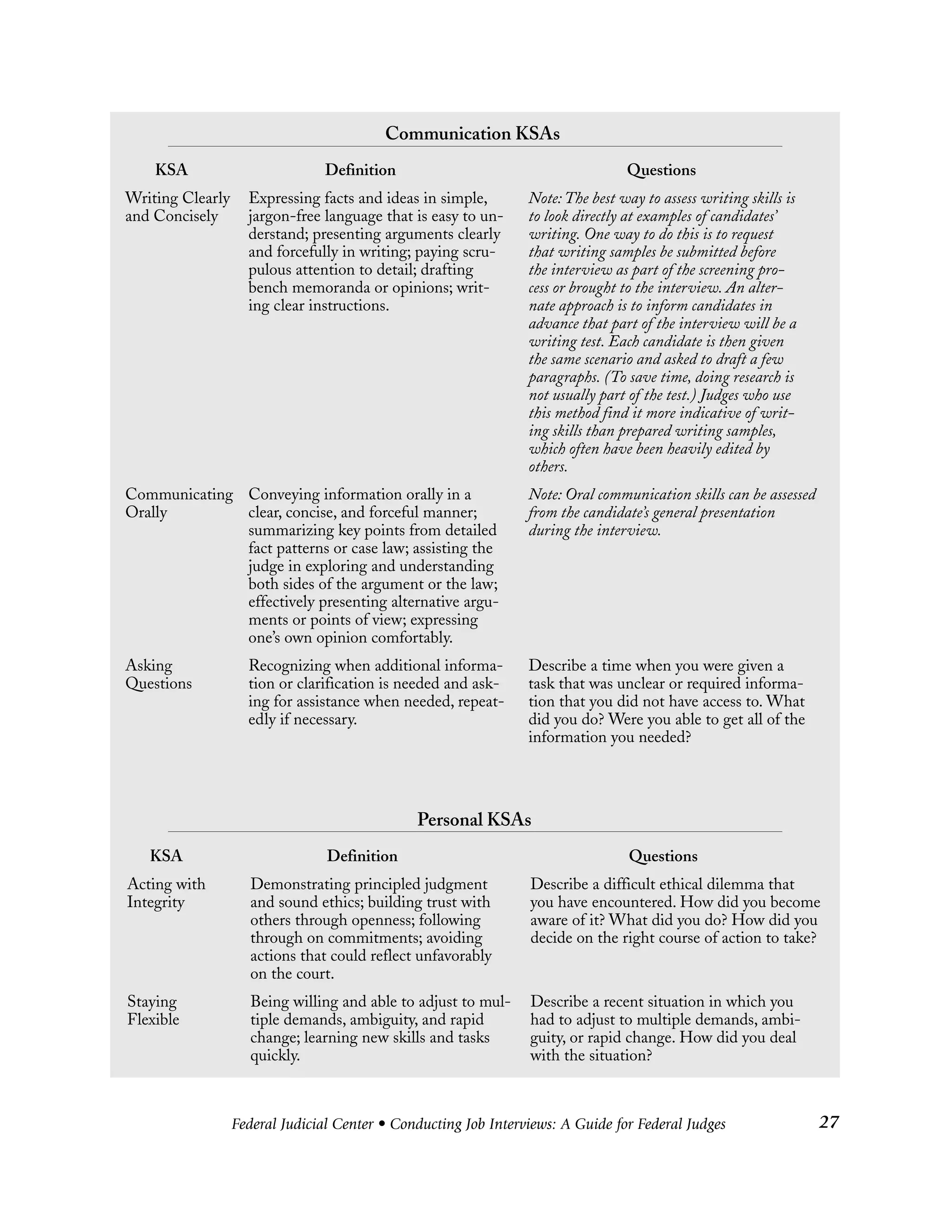
Communication KSAs
KSA Definition Questions
Writing Clearly Expressing facts and ideas in simple, Note:The best way to assess writing skills is
and Concisely jargon-free language that is easy to un- to look directly at examples of candidates’
derstand; presenting arguments clearly writing. One way to do this is to request
and forcefully in writing; paying scru- that writing samples be submitted before
pulous attention to detail; drafting the interview as part of the screening pro-
bench memoranda or opinions; writ- cess or brought to the interview. An alter-
ing clear instructions. nate approach is to inform candidates in
advance that part of the interview will be a
writing test. Each candidate is then given
the same scenario and asked to draft a few
paragraphs. (To save time, doing research is
not usually part of the test.) Judges who use
this method find it more indicative of writ-
ing skills than prepared writing samples,
which often have been heavily edited by
others.
Communicating Conveying information orally in a Note: Oral communication skills can be assessed
Orally clear, concise, and forceful manner; from the candidate’s general presentation
summarizing key points from detailed during the interview.
fact patterns or case law; assisting the
judge in exploring and understanding
both sides of the argument or the law;
effectively presenting alternative argu-
ments or points of view; expressing
one’s own opinion comfortably.
Asking Recognizing when additional informa- Describe a time when you were given a
Questions tion or clarification is needed and ask- task that was unclear or required informa-
ing for assistance when needed, repeat- tion that you did not have access to. What
edly if necessary. did you do? Were you able to get all of the
information you needed?
Personal KSAs
KSA Definition Questions
Acting with Demonstrating principled judgment Describe a difficult ethical dilemma that
Integrity and sound ethics; building trust with you have encountered. How did you become
others through openness; following aware of it? What did you do? How did you
through on commitments; avoiding decide on the right course of action to take?
actions that could reflect unfavorably
on the court.
Staying Being willing and able to adjust to mul- Describe a recent situation in which you
Flexible tiple demands, ambiguity, and rapid had to adjust to multiple demands, ambi-
change; learning new skills and tasks guity, or rapid change. How did you deal
quickly. with the situation?
Federal Judicial Center • Conducting Job Interviews: A Guide for Federal Judges28
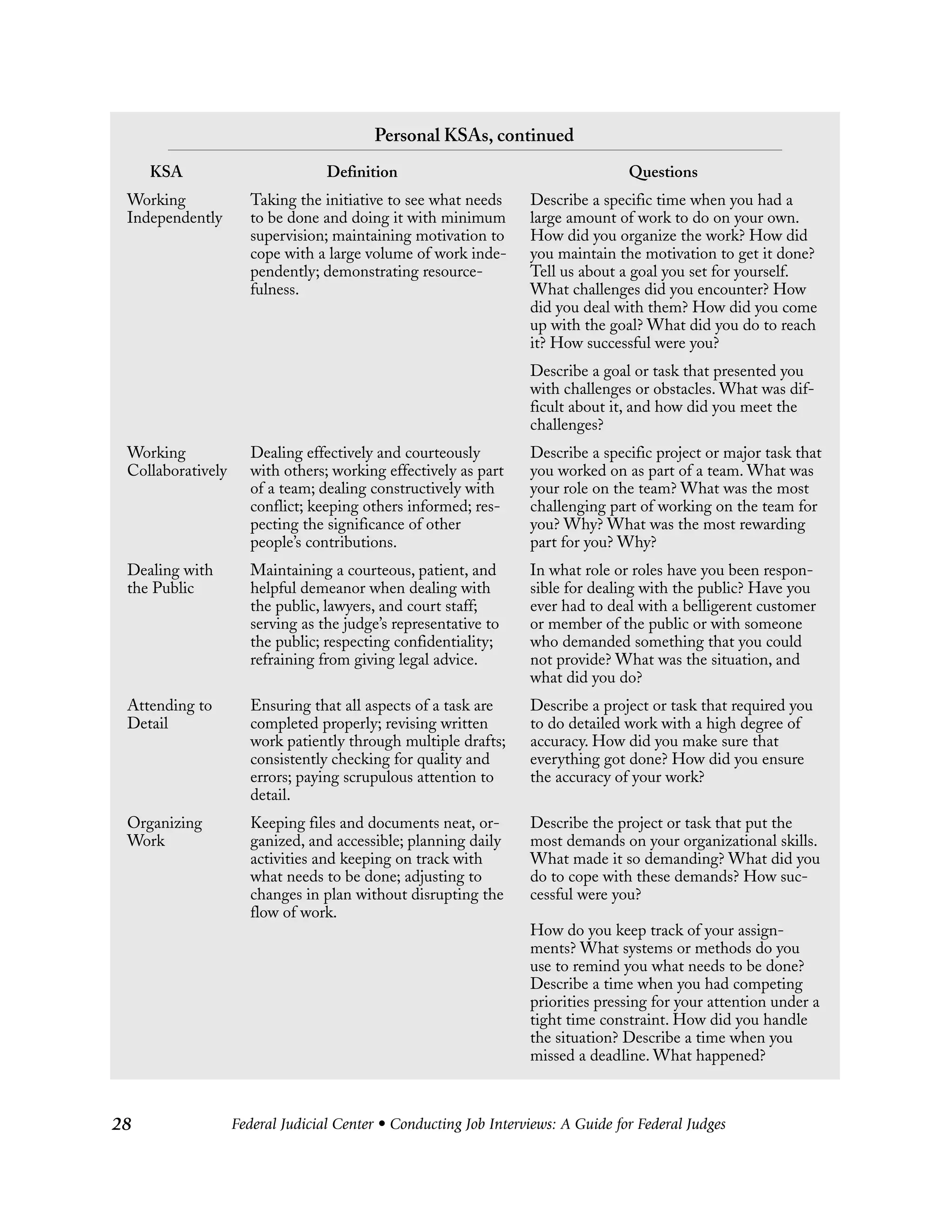
Personal KSAs, continued
KSA Definition Questions
Working Taking the initiative to see what needs Describe a specific time when you had a
Independently to be done and doing it with minimum large amount of work to do on your own.
supervision; maintaining motivation to How did you organize the work? How did
cope with a large volume of work inde- you maintain the motivation to get it done?
pendently; demonstrating resource- Tell us about a goal you set for yourself.
fulness. What challenges did you encounter? How
did you deal with them? How did you come
up with the goal? What did you do to reach
it? How successful were you?
Describe a goal or task that presented you
with challenges or obstacles. What was dif-
ficult about it, and how did you meet the
challenges?
Working Dealing effectively and courteously Describe a specific project or major task that
Collaboratively with others; working effectively as part you worked on as part of a team. What was
of a team; dealing constructively with your role on the team? What was the most
conflict; keeping others informed; res- challenging part of working on the team for
pecting the significance of other you? Why? What was the most rewarding
people’s contributions. part for you? Why?
Dealing with Maintaining a courteous, patient, and In what role or roles have you been respon-
the Public helpful demeanor when dealing with sible for dealing with the public? Have you
the public, lawyers, and court staff; ever had to deal with a belligerent customer
serving as the judge’s representative to or member of the public or with someone
the public; respecting confidentiality; who demanded something that you could
refraining from giving legal advice. not provide? What was the situation, and
what did you do?
Attending to Ensuring that all aspects of a task are Describe a project or task that required you
Detail completed properly; revising written to do detailed work with a high degree of
work patiently through multiple drafts; accuracy. How did you make sure that
consistently checking for quality and everything got done? How did you ensure
errors; paying scrupulous attention to the accuracy of your work?
detail.
Organizing Keeping files and documents neat, or- Describe the project or task that put the
Work ganized, and accessible; planning daily most demands on your organizational skills.
activities and keeping on track with What made it so demanding? What did you
what needs to be done; adjusting to do to cope with these demands? How suc-
changes in plan without disrupting the cessful were you?
flow of work.
How do you keep track of your assign-
ments? What systems or methods do you
use to remind you what needs to be done?
Describe a time when you had competing
priorities pressing for your attention under a
tight time constraint. How did you handle
the situation? Describe a time when you
missed a deadline. What happened?
Federal Judicial Center • Conducting Job Interviews: A Guide for Federal Judges 29
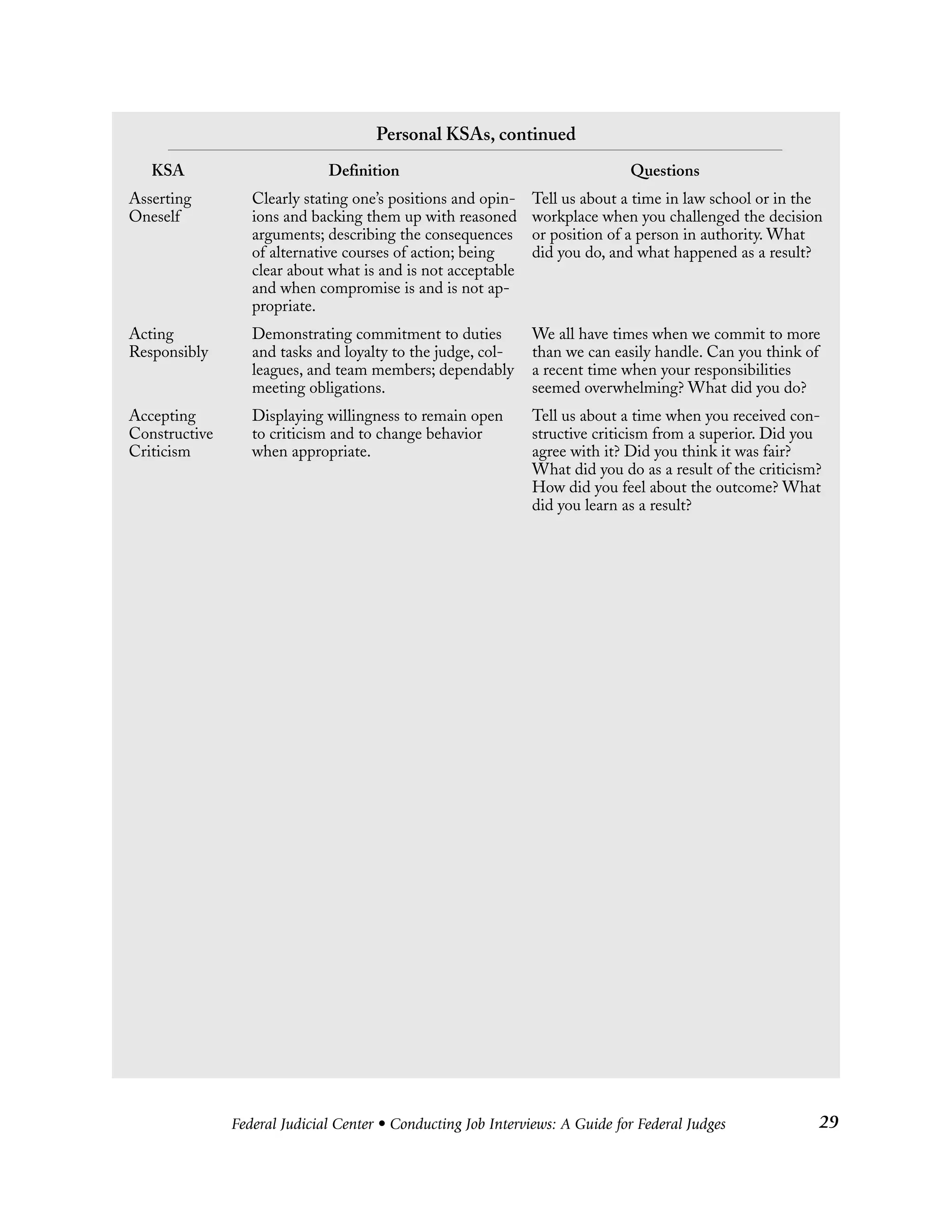
Personal KSAs, continued
KSA Definition Questions
Asserting Clearly stating one’s positions and opin- Tell us about a time in law school or in the
Oneself ions and backing them up with reasoned workplace when you challenged the decision
arguments; describing the consequences or position of a person in authority. What
of alternative courses of action; being did you do, and what happened as a result?
clear about what is and is not acceptable
and when compromise is and is not ap-
propriate.
Acting Demonstrating commitment to duties We all have times when we commit to more
Responsibly and tasks and loyalty to the judge, col- than we can easily handle. Can you think of
leagues, and team members; dependably a recent time when your responsibilities
meeting obligations. seemed overwhelming? What did you do?
Accepting Displaying willingness to remain open Tell us about a time when you received con-
Constructive to criticism and to change behavior structive criticism from a superior. Did you
Criticism when appropriate. agree with it? Did you think it was fair?
What did you do as a result of the criticism?
How did you feel about the outcome? What
did you learn as a result?

Conducting Job Interviews

  • 1.
    Conducting Job Interviews AGuide for Federal Judges by David K. Hendrickson Federal Judicial Center 1999 This Federal Judicial Center publication was undertaken in furtherance of the Center’s statutory mission to develop and conduct education pro- grams for judicial branch employees. The views expressed are those of the author and not necessarily those of the Federal Judicial Center.
  • 2.
    This page isleft blank intentionally to facilitate proper pagination when printing two-sided
  • 3.
    Contents Acknowledgments . .. . . . . . . . . . . . . . . . . . . . . . . . v Introduction . . . . . . . . . . . . . . . . . . . . . . . . . . . . . 1 Interviewing Guidelines . . . . . . . . . . . . . . . . . . . . . . 5 Sample Interview Questions for Unit Executive Applicants . . . 9 Sample Interview Plans for Unit Executive Applicants . . . . . 19 Sample Interview Questions for Law Clerk Applicants . . . . . 25 iii
  • 4.
    This page isleft blank intentionally to facilitate proper pagination when printing two-sided
  • 5.
    Richard Dargan Judicial EducationDivision v Acknowledgments The following people contributed to the development of this guide: Administrative Office of the United States Courts Robert Loesche Office of General Counsel United States Courts Larry Baerman U.S. District Court Northern District of New York Chris Langello U.S. District Court District of the District of Columbia Monica Bigley U.S. District Court District of Maine Dana McWay U.S. Bankruptcy Court Eastern District of Missouri Debbie Branscum U.S. District Court Northern District of Texas Nancy O’Brien U.S. District Court Southern District of Iowa Tom Carter U.S. Court of Appeals for the Ninth Circuit Carolyn Ortwein U.S. Pretrial Services Office Eastern District of Virginia Michael Dobbins U.S. District Court Northern District of Illinois George Prentice U.S. Bankruptcy Court Northern District of Iowa Chuck Freas U.S. District Court Western District of Texas Michael Sheppard U.S. Bankruptcy Court District of New Mexico Haven Gracey U.S. District Court Eastern District of California Bob Sibille U.S. Probation and Pretrial Services Office Middle District of Louisiana Richard Heltzel U.S. Bankruptcy Court Eastern District of California Elaine Terenzi U.S. Probation Office Middle District of Florida Magdeline Jensen U.S. Probation Office District of Arizona Federal Judicial Center Barbara M. Anderson Court Education Division
  • 6.
    This page isleft blank intentionally to facilitate proper pagination when printing two-sided
  • 7.
    1 Introduction The Federal JudicialCenter developed this guide to help federal judges inter- view applicants for two key positions: court unit executive (clerk of court and chief probation/pretrial services officer) and law clerk (both permanent and one-year). An advisory group of court unit executives provided input on the essential qualifications for each unit executive job and suggested questions that could be used to assess those qualifications. For assistance identifying law clerk qualifications, the Center consulted an advisory group of career law clerks who had experience helping judges conduct interviews for that position. Do judges really need advice on conducting interviews? It is true that most will already have considerable experience interviewing law clerk candidates and will have developed particular approaches to the selection process. This guide can help them refine current methods. As for court unit executive posi- tions, most courts are obliged to fill them relatively infrequently; it is likely therefore that many judges overseeing unit executive selection will not have had an opportunity to develop tried-and-true approaches to interviewing. This guide spells out a process for interviewing prospective unit executives that is simple, effective, and fair. Effective interviewing not only aids in the identification of the best candi- date for a job, it also indicates to candidates that the interviewer understands the position and the demands it will impose on the person selected. Asking the right questions is the key to effective interviewing. This guide provides ex- amples of interview questions for both unit executive and law clerk positions. These questions can be used as is or adapted, or they can be viewed as models for developing other questions tailored to the needs of the court or judge. Ad- ditional suggestions about the hiring process for unit executives are also pro- vided. Knowledge, Skills, and Abilities A three-step process can help interviewers analyze a job and get evidence of experience needed to fill it. Step one is to identify the knowledge, skills, and abilities (KSAs) needed to perform effectively in the position. Step two is to develop questions about how applicants have demonstrated those essential KSAs. Step three is to ask for specific information about past performance— a better predictor of future behavior than candidates’ generalized assertions about their approach to work. The strength of this three-step approach is that it focuses on experience
  • 8.
    Federal Judicial Center• Conducting Job Interviews: A Guide for Federal Judges2 that is relevant to key job skills rather than on generalities. The interview questions in this guide require applicants to give specific examples of past be- havior. Candidates may need some time to recall suitable examples before they respond. To streamline interviews, you may wish to provide candidates with the list of questions they will be asked half an hour or so beforehand. Experi- enced interviewers make clear that they are looking for specific examples and wait for the applicant to respond, rather than move quickly to the next ques- tion if the person seems to be having difficulty. It is good hiring practice to ask all candidates the same basic questions, so that opportunities to discuss experience are more or less equal. You may, how- ever, wish to tailor follow-up questions individually to explore candidates’ an- swers to the basic questions. Frequently, candidates are seen by more than one person, either in separate interviews or in a group setting (panel interview). It is helpful to brief all interviewers in advance about what questions to ask. Fairness in Interviewing The Judicial Conference has adopted a Model Employment Dispute Resolu- tion Plan and directed each court to create a plan based on the model. The model plan (and thus every court plan) prohibits discrimination on the basis of race, color, religion, sex, national origin, disability, or age for people 40 or older (except for probation or pretrial services officers). These provisions apply to all judicial branch employing units, including chambers staff. Individual court plans may expand the categories protected. Like all hiring officials, judges need to take care to avoid interview ques- tions that create even an appearance of bias. The best way to do this is to make sure that questions address only the KSAs required for the position. Here are some examples: • Rather than ask about a candidate’s marital or family status, ask whether the candidate has any obligations that would prevent him or her from meeting the position’s work schedule. • Ask whether the candidate can work on Saturdays or Sundays, if such work is an expected part of the job, not whether the candidate’s religion precludes it. • Be wary of selective questions. Ask all candidates, not just female candi- dates with children, whether occasional travel would be a problem. • Don’t ask whether a candidate has a disability. Instead, after explaining the duties of the job, ask whether the candidate can perform them with or without reasonable accommodation.
  • 9.
    Federal Judicial Center• Conducting Job Interviews: A Guide for Federal Judges 3 Also, take care not to misrepresent job security in the courts, where person- nel serve at will and (except for probation officers) can be removed without the courts showing cause. Avoid statements like “No one gets fired here with- out good reason” and “You don’t have to worry about your job as long as you perform well.”
  • 10.
    This page isleft blank intentionally to facilitate proper pagination when printing two-sided
  • 11.
    5 Interviewing Guidelines Although generalapproaches to interviewing vary, there are basic procedures that all courts should follow in setting up and conducting job interviews. These procedures are listed below. Judges, of course, will delegate many of the administrative tasks to human resources staff and others. The Human Resource Manual, published by the Administrative Office of the U.S. Courts, provides relevant information on the judicial branch’s court personnel system, position classification, and other personnel matters. Before the Interviews • Identify the KSAs that are crucial for the job and that should thus be cov- ered in the interview. If interviews of an hour to an hour and a half are planned, it should be possible to ask in-depth questions in about eight to ten different areas. • Prepare a job announcement that accurately describes the KSAs consid- ered crucial for the job. (Usually, assistance in writing and placing job an- nouncements is provided by the court’s personnel office or elsewhere within the clerk’s office if there is no personnel office in the court.) • Arrange for primary screening of applications. Whoever is reviewing ap- plications needs to know what the essential criteria for selection are in or- der to eliminate applicants who fall short. It is a good idea to document the selection criteria being used, especially if there are multiple decision makers. • Arrange for secondary screening of applications. Once applicants who do not meet basic criteria have been eliminated, review the remaining pool and select the top candidates to go on to the interview stage. • Decide who will be involved in conducting the interviews and whether interviewers will each meet with candidates or will interview as a panel. • Develop questions for each of the previously identified KSAs. (Questions may be drawn or adapted from the ones listed in this guide, or new ones can be developed using these as a model.) • Decide on a time frame for the interviews. For instance, you may decide to limit each interview to one hour. • Set up the interviews. Provide candidates with information about who
  • 12.
    Federal Judicial Center• Conducting Job Interviews: A Guide for Federal Judges6 will be conducting the interview and what type of questions will be asked. Without distributing the actual interview questions, let candidates know they will be asked questions about specific instances of past experience. In addition, it is a good idea to send candidates any brochures or other printed information you have describing work benefits and the court/ chambers generally and explaining how to get to the interview. • Review the interview plan with all interviewers. Decide who will ask what questions. Review things to avoid, such as asking inappropriate questions and making promises of employment during the interview. During the Interviews • Greet candidates and set them at their ease. Explain the type of interview that you will be conducting. Tell candidates whom they will be meeting and how long the interview will last. • You may wish to provide candidates with a list of the questions they will be asked about half an hour before the actual interview begins, so that they will have time to recall relevant experiences. This streamlines the in- terview. • You may wish to open the interview with one or more questions designed to explore candidates’ general background before moving on to questions about specific past experience. • To reduce any potential doubts about the fairness of the interview process, ask all candidates the same basic questions about their past experience. Follow-up questions to explore answers given may vary from candidate to candidate. • Take notes on candidates’ responses to help you evaluate all candidates at the conclusion of the interview cycle. • Towards the end of the interview, ask applicants if they have any ques- tions they would like to ask you. For example, candidates for unit execu- tive might ask the following: — What performance expectations do you have for the unit executive? — What would you like to see accomplished in the first year? — Will spending authority be delegated to me? — How much latitude will I have to organize and manage human and finan- cial resources?
  • 13.
    Federal Judicial Center• Conducting Job Interviews: A Guide for Federal Judges 7 Candidates for law clerk might ask questions like these: — What is the work environment like? What is your leave policy? Will I typically be expected to work long days or to come in on weekends? — What is the judge’s involvement in cases? Does the judge read all parties’ submissions or let the law clerk do that? Does the judge do the first review of material? Does the judge give the law clerk an outline to guide his or her writing or let the law clerk do a first draft and react to it? — What’s the proportion of civil versus criminal cases? What types of cases does this court typically hear? Do law clerks work on all types of cases that come into chambers? — What is a typical day like in the position? — What is the work configuration in the office? Who does what? How do people interact? Is work more collaborative or more independent? — What is the pay for the position? How is it affected by bar membership? Applicants for either position may appreciate some information at this time about the city or area where they would be working if they accepted the position. • Do not make an offer of employment during the interview. All scheduled interviews should be completed before a decision is reached. • Tell candidates what the next steps are and how long the process will take. In particular, tell them when they can expect to be notified of a decision. After the Interviews • Call references for candidates still in the running. • Before making an offer of employment, ensure that all interviews are con- cluded, that all candidates have been evaluated, and that reference checks are complete. A security check, if one is required for the position, should also be concluded before a final employment offer is made. • Make a verbal offer of employment to the first-choice candidate. If the verbal offer is accepted, follow up with a written offer stating the condi- tions of employment. (It is a good idea to engage the court’s personnel specialist, or person in charge of personnel issues, in the sending of writ- ten correspondence regarding hiring.) If the first-choice candidate does not accept the verbal offer, proceed to the second-choice candidate. • After the position has been filled, notify applicants who have been inter- viewed but not selected.
  • 14.
    This page isleft blank intentionally to facilitate proper pagination when printing two-sided
  • 15.
    9 Sample Interview Questionsfor Unit Executive Applicants Begin an interview with one or two “foundation questions” about the appli- cant’s general background to help break the ice. Foundation questions can also reveal what the applicant finds important. Sample foundation questions ap- pear below. You may want to develop others based on applicants’ resumes and cover letters. Next, ask several questions about operational KSAs to establish the candidate’s basic qualifications. This is the heart of the interview. Ask for spe- cific examples of past behavior demonstrating the KSAs that you have deter- mined will be most important for your court unit in the next few years. Ex- cluding the foundation questions, the sample questions listed on the following pages are based on the Federal Judicial Center’s Court Management Frame- work; at least one question is listed for each KSA in the framework. Addi- tional questions can be developed to reflect the special needs of your court unit. Lastly, ask six to ten questions from the other categories on the following pages, focusing on areas of special importance to the court unit. Foundation Questions • What is it about this position that interests you? • We have reviewed your resume and application. Please tell us what areas in your experience you think would qualify you for this position. • Describe your style of supervising staff and subordinates. Tell me of an in- cident where that style worked well. Describe a time when you were dis- appointed in the results of your supervision. What did you do? • Picture the best manager or supervisor you ever had. What about that person made him or her effective? Now picture the worst manager or su- pervisor you ever had. What about that person made him or her ineffec- tive? • What major changes or decisions have you made in terms of your career? Why did you make them? • Why are you leaving your current position?
  • 16.
    Federal Judicial Center• Conducting Job Interviews: A Guide for Federal Judges10 Operational KSAs KSA Definition Questions Managing Fostering strategic use of resources; Give an example from the last year of how Resources making resource decisions that en- you managed resources in a way that en- hance the organization’s efficiency and hanced your organization’s efficiency and effectiveness. effectiveness. Managing Ensuring effective recruitment, selec- What is the most difficult challenge you Human tion, training, performance appraisal, have faced in managing human resources? Resources recognition, and corrective/disciplinary What specifically did you do to handle it? action; promoting employee well-being. Managing Forecasting budget trends; preparing Describe any decisions you have made about Budget and and justifying the budget; monitoring budget and finances that have had an es- Finances obligations; making decisions that en- pecially significant positive effect on your hance the organization’s financial organization’s financial position. position. Describe a decision you made about budget and finance that in retrospect you think was a mistake. How did you reach the decision? What did you learn from it? How would you prevent such a mistake in the future? Managing Applying new technologies to organi- What steps have you taken to ensure that Automated zational needs; encouraging staff to staff in your organization have access to up- Systems keep abreast of new technology; en- to-date automated systems and other tech- suring that staff are properly trained nological support? How did you determine and proficient in using court-adopted what would best meet their needs? How automated programs. did you ensure that staff were properly trained in using technology? What telecommunication projects have you been involved in? What factors did you consider? How did you research aspects of the project, such as technologies, that you were not familiar with? Managing Making purchasing and contracting Describe the largest or most difficult con- Procurement decisions that maximize the use of tracting or procurement negotiation for and funds. which you were responsible. What were the Contracting complicating factors? How did you deal with them? Managing Assessing the need for space and facil- Have you ever managed a large construction Space and ities and allocating resources; planning, or renovation project? What approach did Facilities contracting, and implementing construc- you use? What specific steps did you take? tion and renovation projects; managing What challenges did you encounter, and a move from one facility to another. how did handle them? Interview Questions About KSAs
  • 17.
    Federal Judicial Center• Conducting Job Interviews: A Guide for Federal Judges 11 Operational KSAs, continued KSA Definition Questions Knowing Maintaining technical competence What actions have you taken in the last year Court in relevant areas of court operations; to maintain your technical competence in Operations accessing and using other expert re- the operations of your court or organiza- sources when appropriate; under- tion? What have you done to keep in touch standing the court’s culture and dy- with the culture and dynamics of your orga- namics. nization? Leadership KSAs KSA Definition Questions Motivating Encouraging and enabling others to Have you ever had to implement a policy Others achieve; fostering enthusiasm, a feel- that you knew would be unpopular? What ing of investment, and a desire to was the situation? What did you do to achieve. counteract a negative response? Tell us about a time when you wanted a person or group of people working for you to perform a difficult task or achieve a chal- lenging goal. What did you do? What was the reaction? What was the result? Fostering Forming appropriate structures and Have you ever been responsible for estab- Teamwork teams to meet organizational goals; lishing a team or teams to work together fostering a work climate in which on an issue or problem? How did you pro- collaboration and teamwork can ceed? What challenges did you encounter? flourish; managing team differences; How did you address them? How success- rewarding group and team efforts that ful was the team? advance the court’s mission. Describe a situation in which a group or team under your direction was successful in advancing the mission of your organiza- tion. How did you recognize and reinforce their success? Tell us about a time when members of a team or group under your direction (or of which you were a part) were not working well together. What was the problem? How did you diagnose the cause of the problem? What did you do to get the team or group back on track? Influencing Persuading; expressing ideas in ways Describe a time when it was important for and that lead others, including judges, to you to get a group of people with different Negotiating share a common perspective and reach perspectives to agree on a common course agreement; appropriately using nego- of action. What did you do? Describe any tiation, persuasion, and authority in attempts of yours to persuade others or to dealing with others to achieve goals. negotiate a common position.
  • 18.
    Federal Judicial Center• Conducting Job Interviews: A Guide for Federal Judges12 Leadership KSAs , continued KSA Definition Questions Influencing Tell us about a time when you took the lead and in establishing consensus about a common Negotiating course of action in a group or organization. (cont’d) What did you do? How effective was your approach? Was there anything you would do differently today? Appraising Clarifying work tasks and responsi- Tell us about a time during the last year Performance bilities; accurately assessing employ- when you gave someone specific feedback ees’ strengths and areas for improve- about his or her performance. How did you ment; giving timely, specific perfor- assess the performance? How did you pro- mance feedback. vide the feedback? How often do you give individuals feedback on their performance? Describe a time when you had to give nega- tive feedback about someone’s performance. How did you assess the situation? How did you deliver the feedback? Did the behavior change as a result? If not, how did you handle the situation? Have you ever had to initiate an adverse ac- tion? Describe the situation and what you did. Coaching Coaching employees to enhance per- What specific measures did you take in the and formance and expand skills; providing past year to ensure that staff you work with Developing challenging assignments and oppor- received adequate training, whether in the Others tunities for development; ensuring that form of formal training, informal coaching, staff receive adequate training. on-the-job training, or other opportunities? How did you determine what was needed? How did you attempt to provide it? Tell us how, in the last six months, you pro- vided employees with opportunities for de- velopment through challenging assign- ments, training, and so on. How did you decide what would be most beneficial? How did you introduce the development oppor- tunity? What did you do to help the indi- viduals rise to the challenge? Describe a time when you were instrumen- tal in helping employees or associates ex- pand their skills. What steps did you take? How successful was your effort? Did you encounter any challenges along the way? What were they? How did you handle them?
  • 19.
    Federal Judicial Center• Conducting Job Interviews: A Guide for Federal Judges 13 Interpersonal KSAs KSA Definition Questions Communicating Ensuring a consistent, timely flow of Describe specific examples of actions you high-quality information within the have taken in the past six months to ensure court and to court constituencies; con- the flow of accurate, timely information to veying information clearly in writing everyone who needs it. What specific kinds and in oral presentations; encouraging of information do you make generally avail- open expression of ideas and opinions. able to everyone, and what information is limited to certain groups or kept confiden- tial? Tell us about a time when it was important to encourage the open expression of ideas and opinions. How did you do this? How did you make it “safe” to present controver- sial or unpopular opinions? Building Creating supportive relationships Describe a time when you needed to build Relationships around work; considering and respon- a good working relationship with another ding appropriately to the needs, feelings, person or group of people. What was the capabilities, and interests of others; situation? What did you do? What chal- providing feedback; treating others lenges or difficulties did you encounter, and equitably. how did you deal with them? We have all run into situations where some- one felt that he or she was not being treated fairly. Describe a situation in which you had to deal with a perception of unfair treat- ment. How did you become aware of the situation? What did you do about it? How did you ensure that the concerns of all par- ties were addressed? What was the most difficult situation in which you had to give someone negative feedback about his or her performance? When did you give the feedback? How did you give it? Was it a one-time occurrence or part of a pattern of feedback? Valuing Recognizing the mix of similarities Tell us about a time when you were able to Diversity and differences among staff and court tap into diverse backgrounds and skills to users; building respect for differences; the advantage of the organization or group. drawing on the unique skills and back- ground of each employee to build effec- Today’s workplace is characterized by highly tive teams and enhance productivity. diverse backgrounds and skills among staff and court users. Tell us about a time when you encountered a challenge related to di- versity. What did you do? What difficulties did you run into? How did you handle them? How did the situation turn out in the end?
  • 20.
    Federal Judicial Center• Conducting Job Interviews: A Guide for Federal Judges14 Interpersonal KSAs, continued KSA Definition Questions Managing Developing strategies that help staff Describe any specific initiatives, policies, Stress maintain productivity and efficiency or actions that you have implemented in during stressful situations; creating a your current position to create a desirable desirable and supportive work environ- and supportive work environment for staff. ment; providing a balanced perspective Describe any actions you have taken in the on work. last month in this area. What initiatives, policies, or actions have you implemented in your current workplace to help staff balance the competing de- mands of work and personal life? Staff may encounter stressful situations in the workplace or may have stressful situa- tions in their private lives that cause prob- lems at work. Describe specific actions you have taken to help staff maintain productiv- ity and efficiency during stressful situations. Managing Anticipating and seeking to resolve Describe a time when you worked to build Conflict conflicts, disagreements, and confronta- consensus among different parties. How tions in a constructive manner; mediat- did you become aware of the need for ac- ing conflicts; building consensus. tion? What did you do? Unit executives often have to help resolve conflicts and disagreements among various parties. When was the last time you had a conflict or disagreement with someone at work? What was the issue? What did you do? How successful was your approach? What was the exchange like at its most heated point? How was the disagreement resolved? Personal KSAs KSA Definition Questions Knowing Learning from experiences; seeking How would you describe your personal Yourself feedback and modifying behavior based management style? Describe a time that on feedback; actively pursuing learning this style worked for you. Describe a time and self-development. it didn’t work for you. What have you done in the last year to de- velop yourself as a manager? What aspects of this position do you think would pose the greatest challenges for you, and how would you prepare yourself to meet those chal- lenges?
  • 21.
    Federal Judicial Center• Conducting Job Interviews: A Guide for Federal Judges 15 Personal KSAs, continued Knowing Tell us about a time when you sought feed- Yourself back on your own performance. What (cont’d) caused you to seek the feedback? How did you decide whom to ask? How were you able to put the feedback to use? What did you learn about yourself as a result? Do you routinely seek feedback on your own perfor- mance? How? Acting with Demonstrating principled leadership Some of the most difficult issues managers Integrity and sound ethics; building trust with face have to do with integrity. Describe spe- others through openness; following cific things you have done in your current through on commitments. position to establish and reinforce an orga- nizational culture based on personal integ- rity. One of the foundations of good manage- ment is fostering the trust of colleagues and staff. Describe specific things you have done to build trust. Describe a difficult ethical dilemma that you have encountered in the workplace. How did you become aware of it? What did you do and why? Making Making timely and sound decisions; What was the most difficult decision that Decisions taking action and risks when needed; you have had to make in your current posi- making decisions under conditions of tion? Why was it difficult? How did you go uncertainty. about making your decision? Balancing Setting priorities; focusing on the im- What have been your top priorities for your Priorities portant, not only the urgent; delegating work and yourself during the past year? Tell effectively; allocating time for renewal us about a specific time when you had a and development. conflict between priorities that were very important to you. What did you do? Often it seems that managers get caught up in dealing with one crisis after another, with little time left over to do the important, long-term work that could have helped pre- vent crisis in the first place or made it easier to deal with. In your current position, how have you made room for tasks that are im- portant but not urgent? Staying Being willing and able to adjust to mul- Describe a recent situation in which you Flexible tiple demands, ambiguity, and rapid had to adjust to multiple demands, ambi- change; challenging the status quo and guity, or rapid change. How did you deal encouraging initiatives to improve court with the situation? operations.
  • 22.
    Federal Judicial Center• Conducting Job Interviews: A Guide for Federal Judges16 Personal KSAs, continued Staying Tell us about a time when you saw a need or Flexible opportunity for change in the way things (cont’d) were done that others did not see. How did you come to notice this opportunity? What did you do about it? Were you able to con- vince others of the need for it? Decision-Making KSAs KSA Definition Questions Thinking Considering a broad range of internal Describe a time when you used strategic Strategically and external factors when solving prob- thinking to cope with a complex situation. lems and making decisions; appropriately What was the situation? What did you do? adjusting actions to address strategic How did you figure out what to do? Did issues. things go according to plan, or did you need to adjust the plan to account for unantici- pated change? If so, how did you manage? Describe a situation in which you needed to consider a broad range of factors in solving problems and making decisions. Gathering Keeping current on what is going on In the last six months, what have you done External Data in other courts, government agencies, to keep up with developments in other or- and businesses; keeping abreast of ganizations in your field? How have you laws, policies, trends, and issues that been able to use what you have learned? have an impact on the court; using information in decision making. Planning Developing short-range and long- What was the most complex project that range plans that are comprehensive, you were responsible for planning and exe- realistic, and effective in meeting goals; cuting? Describe how you developed real- establishing policies, guidelines, and istic plans, established priorities, identified priorities; identifying required re- resources, and coordinated efforts with sources; coordinating planning efforts others. with others. Analyzing Using quantitative information effec- What data have you sought out in assessing Information tively to improve the court’s efficiency, the needs of your customers? How did you including assessing customer needs; collect the data? How did you analyze it? defining standards for quality; and What statistical methods have you used re- evaluating outcomes. cently for collecting and analyzing data? Tell us about a time when a problem was presented to you that required further inves- tigation for you to solve it. How did you evaluate the problem and decide on a course of action?
  • 23.
    Federal Judicial Center• Conducting Job Interviews: A Guide for Federal Judges 17 Decision-Making KSAs, continued KSA Definition Questions Thinking Generating insights, new ideas, and Describe a time when you were able to ap- Creatively solutions; fostering innovation; bringing ply unusual insights or new ideas to create perspectives and approaches together an innovative approach to work or solu- and combining them in imaginative tion to a problem. ways. System KSAs KSA Definition Questions Creating a Creating a compelling picture of the One of the jobs of a leader is to help an or- Vision organization’s values, purpose, and direc- ganization articulate its values, purpose, and tion; involving staff in developing the direction. Describe for us how you have vision; facilitating needed organiza- helped your organization define a vision of tional improvement. where it is and where it is going. Committing to Emphasizing the need to deliver high- What specific steps have you taken in your Quality quality products and services; setting current position to help your organization quality standards and continuously eval- guarantee a high level of quality in the pro- uating court products, processes, and ducts and services it provides? What have services against those standards; taking you done to convince others to commit to action to make improvements as re- quality? quired. Managing Acting as a catalyst to pave the way What is the most difficult organizational Change for needed change; encouraging em- change that you have implemented? Why ployee suggestions; assisting staff in ac- was it especially challenging? How did you cepting and implementing new policies introduce and implement the change? and processes; managing court changes What did you do to help others make the effectively. transition? Focusing on Staying in tune with customers’ expec- What specifically have you done in the Customers tations about quality and service; taking last year to help your organization assess actions to meet customer needs and in- and meet its customers’ needs and increase crease customer satisfaction. customer satisfaction? Championing Actively seeking opportunities to edu- Part of the job of a court unit executive is System and cate court constituencies and others to educate court constituencies and others Profession about the court’s mission and work; about the court’s mission and work. In your promoting awareness of the impact of current position, what opportunities have employees’ performance on the court you had to act as a spokesperson for your and the community. organization or profession?
  • 24.
    This page isleft blank intentionally to facilitate proper pagination when printing two-sided
  • 25.
    19 Sample Interview Plansfor Unit Executive Applicants An interview plan should ideally include a mix of foundation questions, ques- tions about operational KSAs, and questions about other KSAs that are par- ticularly important for the court unit. Questions should be selected or devel- oped according to the situation the court unit is in and the direction in which it is moving. Following are some examples of what might be included in inter- view plans for different situations. Naturally, each court would want to tailor its plan to capture the most important needs and preferences of the court. These sample interview plans are intended merely to show how to develop a core set of questions tailored to court needs. It is important that interviewers adhere to the interview plan so that each candidate is given the same opportunity to address the KSAs that are central to success in the position. Follow-up questions may be asked to explore the implications of candidates’ answers. Sample Interview Plan A Situation Court unit A is in a large metropolitan district with a highly diverse popula- tion, a high turnover rate for staff, and a high volume of work. Priorities include helping staff to be effective while coping with the stress and conflict of a demanding work environment, improving the quality of basic operations, and putting a stronger emphasis on training to help staff develop their skills. Questions Open the interview with one or more foundation questions, then proceed to questions about operational and other KSAs that are particularly important for the court unit. Here is a sample list that could be used for the situation described: • What was the most difficult challenge you have faced in managing hu- man resources? What specifically did you do to handle it? • Tell us how, in the last six months, you provided employees with opportu- nities for development through challenging assignments, training, and so on. How did you decide what would be most beneficial? How did you in- troduce the opportunity for development? What did you do to help the individuals rise to the challenge?
  • 26.
    Federal Judicial Center• Conducting Job Interviews: A Guide for Federal Judges20 • Today’s workplace is characterized by highly diverse backgrounds and skills among staff and court users. Tell us about a time when you encoun- tered a challenge related to diversity. What did you do? What difficulties did you run into? How did you handle them? How did the situation turn out in the end? • Staff sometimes encounter stressful situations in the workplace. Some- times stressful situations in their private lives cause problems at work. De- scribe specific actions you have taken to help staff maintain productivity and efficiency during stressful times. • Describe a recent situation in which you had to adjust to multiple de- mands, ambiguity, or rapid change. How did you deal with the situation? • Often it seems that managers get caught up in dealing with one crisis af- ter another, with little time left to do the important, long-term work that could have helped prevent crisis in the first place or made it easier to deal with. In your current position, how have you made room for tasks that are important but not urgent? • In the last six months, what have you done to keep up with developments in other organizations in your field? How have you been able to use what you have learned? Sample Interview Plan B Situation Court unit B is in a small rural district with a highly stable work force. The priorities of the court are modernization, including introduction of new automated systems, and improvement of outmoded work processes. The court also values and wishes to preserve a positive work environment for staff. Questions Open the interview with one or more foundation questions, then proceed to questions about operational and other KSAs that are particularly important for the court unit. Here is a sample list that could be used for the situation described: • What steps have you taken to ensure that staff in your organization have access to up-to-date automated systems and other technology? How did you determine what would best meet their needs? How did you ensure that staff were properly trained in using technology? • Describe any specific initiatives, policies, or actions that you have imple- mented in your current position to create a desirable and supportive work
  • 27.
    Federal Judicial Center• Conducting Job Interviews: A Guide for Federal Judges 21 environment for staff. Describe any actions you have taken in the last month in this area. • Tell us about a time when you saw a need or opportunity for change in the way things were done that others did not see. How did you come to notice this opportunity? What did you do about it? Were you able to con- vince others of the need for the change? • One of the foundations of good management is fostering the trust of col- leagues and staff. Describe specific things you have done to build trust. • Tell us about a time when it was important to encourage the open expres- sion of ideas and opinions. How did you do this? How did you make it “safe” to present controversial or unpopular opinions? Sample Interview Plan C Situation In the next few years, court unit C will be involved in the construction of a new courthouse. In addition to managing this project, the court unit executive will be in charge of investigating whether a reorganization of the current hierarchy is warranted. There have been persistent conflicts between factions within the court unit in the past few years. Questions Open the interview with one or more foundation questions, then proceed to questions about operational and other KSAs that are particularly important for the court unit. Here is a sample list that could be used for the situation described: • What was the most complex project that you were responsible for plan- ning and executing? Describe how you developed realistic plans, estab- lished priorities, identified resources, and coordinated efforts with others. • Have you ever managed a large construction or renovation project? What approach did you use? What specific steps did you take? What challenges did you encounter, and how did you handle them? • Describe a time when it was important for you to get a group of people with different perspectives to agree on a common course of action and pull together. What did you do? Describe any attempts on your part to persuade others or to negotiate a common position. • Unit executives often have to help resolve conflicts and disagreements among various parties. When was the last time you had a conflict or dis-
  • 28.
    Federal Judicial Center• Conducting Job Interviews: A Guide for Federal Judges22 agreement with someone at work? What was the issue? What did you do? How successful was your approach? What was the exchange like at its most heated point? How was the disagreement resolved? • Describe a recent situation in which you had to adjust to multiple de- mands, ambiguity, or rapid change. How did you deal with the situation? • What was the most difficult decision that you have had to make in your current position? Why was it difficult? How did you go about making your decision? Sample Interview Plan D Situation Under the current unit executive, court unit D has successfully implemented a program to improve customer service. A great deal of work has been done to assess customer needs, set improvement goals, and improve work processes. The organization has also flattened out as teams have taken over some of the duties formerly done by supervisors. The court wishes to ensure that these successful efforts continue in the future and is looking for a progressive leader with forward-looking managerial ideas. Questions Open the interview with one or more foundation questions, then proceed to questions about operational and other KSAs that are particularly important for the court unit. Here is a sample list that could be used for the situation described. • One of the jobs of a leader is to help an organization articulate its values, purpose, and direction. Describe for us how you have helped your organi- zation define a vision of where it is and where it is going. • What specific steps have you taken in your current position to help your organization guarantee a high level of quality in the products and services it provides? What have you done to convince others to commit to quality? • What data have you sought in assessing the needs of your customers? How did you collect the data? How did you analyze it? What statistical methods have you used recently for collecting and analyzing data? • What actions have you taken in the last year to maintain your technical competence in the operations of your court or organization? What have you done to keep in touch with the culture and dynamics of your organi- zation?
  • 29.
    Federal Judicial Center• Conducting Job Interviews: A Guide for Federal Judges 23 • Tell us about a time when you wanted a person or group of people work- ing for you to perform a difficult task or to achieve a challenging goal. What did you do? What was the reaction? What was the result? • Tell us about a time when members of a team or group under your direc- tion (or of which you were a part) were not working well together. What was the problem? How did you diagnose the cause of the problem? What did you do to get the team or group back on track? • What have you done in the last year to develop yourself as a manager? What aspects of this position do you think would pose the greatest chal- lenges for you, and how would you prepare yourself to meet those chal- lenges? • How would you describe your personal management style? Describe a time that this style worked for you. Describe a time it didn’t work for you. • In the last six months, what have you done to keep up with developments in other organizations in your field? How have you been able to use what you have learned? • Describe a time when you were able to apply unusual insights or new ideas to create an innovative approach to work or solution to a problem.
  • 30.
    This page isleft blank intentionally to facilitate proper pagination when printing two-sided
  • 31.
    25 Sample Interview Questionsfor Law Clerk Applicants The best interview questions ask for specific examples of past behavior show- ing how the applicant has used KSAs critical for the job. Which KSAs a judge considers critical for a law clerk will depend on how the work is organized and conducted in his or her chambers. The questions on the following pages are based on a list of critical skills developed by a work group of career law clerks. Since use of law clerks varies from judge to judge, some of the questions may not be suitable for a particular position. Also, since law clerk interviews reflect the working style of the judge more than that of the court unit, interview plans have not been included, as they were in the section on unit executives. Judges may nevertheless find the following interview guidelines useful: 1.Open the interview with a question or two designed to explore the candidate’s general experience. For instance, ask about the applicant’s work history beyond college and law school, or what the applicant has en- joyed about previous work. This should help you gauge the person’s matu- rity, range of experience, and ability to “fit” into your work environment. Note: Focusing on relevant experience rather than personal circumstances (family or marital status, disability, etc.) will help you avoid questions that might be considered biased or improper. 2.Ask several questions about legal research KSAs to confirm basic qualifi- cations (see pages 26–27). 3.Ask five to eight questions about communication and personal KSAs (see pages 27–29). Focus on the skills most crucial to job success. 4.Leave some time at the end of the interview to explain special job re- quirements, such as limits on political activity, and to allow the candidate to ask questions. Some law clerk applicants will have extensive work experience. Others may be beginning their careers. The questions on the following pages for the most part are general enough for all applicants to answer. Encourage candidates with limited work experience to describe relevant experience conducting re- search, working on projects, participating in law review or moot court, per- forming summer jobs or internships, or doing volunteer work.
  • 32.
    Federal Judicial Center• Conducting Job Interviews: A Guide for Federal Judges26 Legal Research KSAs KSA Definition Questions Using a Variety Knowing when and how to access var- Describe a recent project or paper for which of Sources of ious types of information, including you had to conduct wide-ranging research. Information treatises, digests, and case law; using What resources did you use? How did you online resources such as Lexis, Westlaw, get organized? How did you know where to and the Internet. look to find what you needed? Did you fin- ish on time? Sifting Searching through a voluminous quan- Describe the project or paper for which you Information tity of records for relevant information; had to sift through the greatest quantity of locating, reading, sorting, and organiz- records and information. How did you orga- ing a large quantity of written informa- nize the work? How did you find what was tion; keeping meticulous notes in order relevant? How did you keep track of the re- to be able to state the facts. levant facts and details? What strategies did you use to keep organized and produc- tive? Did you finish on time? Conducting Taking the initiative to research unfam- Tell us about a time when you had to re- Research iliar areas of the law; researching unfam- search an area of the law that was unfamiliar Independently iliar areas well enough to deal effectively to you. What specifically did you do to get with attorneys specialized in them. up to speed? What degree of expertise was required, and how did you achieve it? How long did it take? How satisfied were you with the results? Did you have any dealings afterwards with someone who was an expert in this area? What challenges did this pre- sent, and how did you deal with them? Thinking Applying the law to the facts of a case An important part of our work is to weigh Analytically in reasoning that is logical and defen- and balance competing arguments and apply sible; being willing to consider new the law to the facts of a case in a judicious ideas and approaches; weighing and way. Of the cases that you have studied or balancing competing arguments judi- are familiar with, describe one that pre- ciously; using critical thinking and a sented a particular challenge for you in healthy degree of skepticism to probe weighing competing arguments. What was beyond the surface of issues and argu- it about this case that made it so challenging ments. for you? Describe your thinking in analyz- ing the case. What was your final analysis? What did you learn from the case? Note: Another way to assess analytical think- ing is to present candidates with a case study for analysis. The case should be typical of the sort of legal problems encountered in the court and district in question. Allow a suitable amount of time for the applicant to read the material and think about it, then question the applicant about what problems or conflicts arise from the case and how they could be addressed. Interview Questions About KSAs
  • 33.
    Federal Judicial Center• Conducting Job Interviews: A Guide for Federal Judges 27 Communication KSAs KSA Definition Questions Writing Clearly Expressing facts and ideas in simple, Note:The best way to assess writing skills is and Concisely jargon-free language that is easy to un- to look directly at examples of candidates’ derstand; presenting arguments clearly writing. One way to do this is to request and forcefully in writing; paying scru- that writing samples be submitted before pulous attention to detail; drafting the interview as part of the screening pro- bench memoranda or opinions; writ- cess or brought to the interview. An alter- ing clear instructions. nate approach is to inform candidates in advance that part of the interview will be a writing test. Each candidate is then given the same scenario and asked to draft a few paragraphs. (To save time, doing research is not usually part of the test.) Judges who use this method find it more indicative of writ- ing skills than prepared writing samples, which often have been heavily edited by others. Communicating Conveying information orally in a Note: Oral communication skills can be assessed Orally clear, concise, and forceful manner; from the candidate’s general presentation summarizing key points from detailed during the interview. fact patterns or case law; assisting the judge in exploring and understanding both sides of the argument or the law; effectively presenting alternative argu- ments or points of view; expressing one’s own opinion comfortably. Asking Recognizing when additional informa- Describe a time when you were given a Questions tion or clarification is needed and ask- task that was unclear or required informa- ing for assistance when needed, repeat- tion that you did not have access to. What edly if necessary. did you do? Were you able to get all of the information you needed? Personal KSAs KSA Definition Questions Acting with Demonstrating principled judgment Describe a difficult ethical dilemma that Integrity and sound ethics; building trust with you have encountered. How did you become others through openness; following aware of it? What did you do? How did you through on commitments; avoiding decide on the right course of action to take? actions that could reflect unfavorably on the court. Staying Being willing and able to adjust to mul- Describe a recent situation in which you Flexible tiple demands, ambiguity, and rapid had to adjust to multiple demands, ambi- change; learning new skills and tasks guity, or rapid change. How did you deal quickly. with the situation?
  • 34.
    Federal Judicial Center• Conducting Job Interviews: A Guide for Federal Judges28 Personal KSAs, continued KSA Definition Questions Working Taking the initiative to see what needs Describe a specific time when you had a Independently to be done and doing it with minimum large amount of work to do on your own. supervision; maintaining motivation to How did you organize the work? How did cope with a large volume of work inde- you maintain the motivation to get it done? pendently; demonstrating resource- Tell us about a goal you set for yourself. fulness. What challenges did you encounter? How did you deal with them? How did you come up with the goal? What did you do to reach it? How successful were you? Describe a goal or task that presented you with challenges or obstacles. What was dif- ficult about it, and how did you meet the challenges? Working Dealing effectively and courteously Describe a specific project or major task that Collaboratively with others; working effectively as part you worked on as part of a team. What was of a team; dealing constructively with your role on the team? What was the most conflict; keeping others informed; res- challenging part of working on the team for pecting the significance of other you? Why? What was the most rewarding people’s contributions. part for you? Why? Dealing with Maintaining a courteous, patient, and In what role or roles have you been respon- the Public helpful demeanor when dealing with sible for dealing with the public? Have you the public, lawyers, and court staff; ever had to deal with a belligerent customer serving as the judge’s representative to or member of the public or with someone the public; respecting confidentiality; who demanded something that you could refraining from giving legal advice. not provide? What was the situation, and what did you do? Attending to Ensuring that all aspects of a task are Describe a project or task that required you Detail completed properly; revising written to do detailed work with a high degree of work patiently through multiple drafts; accuracy. How did you make sure that consistently checking for quality and everything got done? How did you ensure errors; paying scrupulous attention to the accuracy of your work? detail. Organizing Keeping files and documents neat, or- Describe the project or task that put the Work ganized, and accessible; planning daily most demands on your organizational skills. activities and keeping on track with What made it so demanding? What did you what needs to be done; adjusting to do to cope with these demands? How suc- changes in plan without disrupting the cessful were you? flow of work. How do you keep track of your assign- ments? What systems or methods do you use to remind you what needs to be done? Describe a time when you had competing priorities pressing for your attention under a tight time constraint. How did you handle the situation? Describe a time when you missed a deadline. What happened?
  • 35.
    Federal Judicial Center• Conducting Job Interviews: A Guide for Federal Judges 29 Personal KSAs, continued KSA Definition Questions Asserting Clearly stating one’s positions and opin- Tell us about a time in law school or in the Oneself ions and backing them up with reasoned workplace when you challenged the decision arguments; describing the consequences or position of a person in authority. What of alternative courses of action; being did you do, and what happened as a result? clear about what is and is not acceptable and when compromise is and is not ap- propriate. Acting Demonstrating commitment to duties We all have times when we commit to more Responsibly and tasks and loyalty to the judge, col- than we can easily handle. Can you think of leagues, and team members; dependably a recent time when your responsibilities meeting obligations. seemed overwhelming? What did you do? Accepting Displaying willingness to remain open Tell us about a time when you received con- Constructive to criticism and to change behavior structive criticism from a superior. Did you Criticism when appropriate. agree with it? Did you think it was fair? What did you do as a result of the criticism? How did you feel about the outcome? What did you learn as a result?