




The Improv Encyclopedia
Version 1.2.4 - 13Jul2002
www.humanpingpongball.com
Introduction
Hello, reader! This is the paper version of The Improv Encyclopedia. This is a text version of the site
found on www.humanpingpongball.com. The site gets updated more often than the paper version, so
check the Internet for the latest version.
In this booklet you will find tons of Improv games and handles, show formats, warm-ups, references and
improv keywords. The Internet version is more fun to wander around in because of the hyperlinks in
there, but we’ve done our best to organize this paper version as comfortably as possible.
Organization
This booklet is organised in 4 chapters:
Categories: every game, exercise or handle is classified in one or more categories. The categories
are listed alphabetically, and you will find an index of all games in each category following the
category. A game, handle or exercise can be in more that one category.
Games: this is the main chapter, listing all games alphabetically. For every game you will find the
category/categories the game belongs in printed next to the game description.
Keywords: a chapter that lists some important improv terms, each with a short explanation.
References: a list of interesting people, books or websites.
At the end of the booklet you will find an index of all contents.
Referencing
The original text on www.humanpingpongball.com is heavily cross-linked. Wherever useful, we use
superscript to refer to games, categories, keywords or references. This works as follows:
Warm-upC would refer to the Warm-up category
AerobicsG would refer to the game Aerobics
ChivalryK would refer to the keyword Chivalry
Keith JohnstoneR would refer to a reference to someone named Keith Johnstone
Copyrights
Feel free to print this, copy it, give it to your friends and foes, use it (by all means, use it) , put it on your
website, change it, add to it. Just don’t claim that you’re the original author, and leave the references to
www.humanpingpongball in the text. If you want to make money off this text you would need to contact
us first: mail to webmaster@humanpingpongball.com.
You can also download the whole site, and the programs that were used to generate both the site and
this text. If you want to know more about how these programs work see the FAQ page on
www.humanpingpongball.com. Oh, one more thing - this text is machine generated off a database, so
page breaks and layout may be a bit quirky - sorry for that.
Feedback
Let us know what you think of the Improv Encyclopedia; any feedback, positive or negative, is welcome
by email to webmaster@humanpingpongball.com. Enjoy!
The Improv Encyclopedia V1.2.4 @ www.humanpingpongball.com 13Jul2002
1
Categories
Acceptance
Category These are exercises to teach AcceptingK .
Total 7 games.
- 6 Episodes
- Accepting Circle
- Open Offer
- Pass Catch (see Sound Circle)
- Sound Circle
- Tug-O-War
- Yes Lets
Association
Category These are exercises that train fast-thinking. You will find that a lot of the exercises in
this category are variations on the traditional Free AssociationG game. Others train fast
thinking in other ways, and a few even focus on dissociation - you can use the latter to
make the point that association is easy and natural (see Introducing AssociationG for
more ).
Total 29 games.
- Alliterations
- Animalistics
- Become
- Blind Freeze
- Clap Snap Association
- CopyCat
- Dissociation
- FLIP (see CopyCat)
- Family Portraits
- Firing Squad
- Free Association Circle
- Free Association
- Free Association Lines
- Freeze Tag
- Gibberish Dictionary (see Translate Gibberish)
- Introducing Association
- Just Gibberish
- Last Letter
- Malapropism
- Name 6 Circle
- Open Offer
The Improv Encyclopedia V1.2.4 @ www.humanpingpongball.com 13Jul2002
2
- Props
- Space Jump
- Surprise Movement
- Translate Gibberish
- Walk-over Association
- What are you doing
- What would she be if
- Word Ball
Audience Participation
Category These are games in which the audience participates to some extent. Evidently, in just
about any improv show there we use audience suggestions, so to some extent each
game should be in this category. Instead, we’ve listed only games in which during the
game, the audience is involved. See also Ask-forK for examples of what you can ask
the audience.
Total 11 games.
- Alphabet Game
- Day in the Life
- Last Letter Scene
- No P
- Only Questions
- Pockets
- Puppets
- Rhymes
- Story Story Die
- The Good, the Bad and the Ugly Advice
- Zulu(2)
Characters
Category The focus of these games and exercises is on building characters.
Total 14 games.
- Aerobics
- Animalistics
- Animals
- Coming Home
- Fast Food Laban
- Fast Food Stanislawski
- Front Desk
- Hitch Hiker
- Old Job New Job
- Opposites
- Split Screen
The Improv Encyclopedia V1.2.4 @ www.humanpingpongball.com 13Jul2002
3
- The Bag
- Voices From Heaven
- You’re Fired
Concentration
Category These exercises train concentration skills.
Total 41 games.
- 1-2-3-4
- 7-up
- Accepting Circle
- Ali Baba and the 40 Robbers
- Alliteration Introduction
- Alliterations
- Alphabet Circle
- Bappety Boo (see Bippety Bop)
- Bear of Poitiers (see Catch’em)
- Bippety Bop
- Catch’em
- Concentration Circle
- Cross Circle
- Digits (see No Doubles 1-10)
- Distorting Mirror
- Fruit Basket
- Fuzzy Ducky
- Group Environment
- Group Freeze
- Group Mirror (see Mirror)
- Kitty in the Corner
- Letter Number Name
- Mirror
- Name Game (see Cross Circle)
- No Doubles 1-10
- Non Sequitor
- One Duck
- Peruvian Ball Game
- Receiver Right Clap
- Shootout
- Shriner’s Warm-up (see Cross Circle)
- Simon Says
- Sitting Standing Lying
- SloMo Tag
- Statues (see Group Freeze)
- Synchro Clap
- The Magnet
- Turning Circle
- Walking by Numbers
The Improv Encyclopedia V1.2.4 @ www.humanpingpongball.com 13Jul2002
4
- What Has Changed
- Zapping
Continuation
Category These are games that consist of continuations of the previous scene. See also Scene
ReplayC .
In many cases one will ask the audience how to continue the scene - see Ask-forK for
examples.
Total 8 games.
- Actor Switch (see Simple Continuation)
- Bermuda Triangle (see Hat Continuation)
- Continuing Emotions
- Continuing Styles
- Hat Continuation
- Simple Continuation
- Switcheroo
- Understudy (see Simple Continuation)
Die
Category These are games in which the audience decides to ’throw out’ players by yelling ’Die’
when a player doesn’t stick to the rules of the game, or does not manage to get the
task/game done properly. After a die the game either ends or the player is replaced by
another one.
Total 8 games.
- Alphabet Game
- Last Letter Scene
- No P
- Only Questions
- Rhymes
- Story Story Die
- The Good, the Bad and the Ugly Advice
- Zulu(2)
Endowment
Category Endowment is attributing other players with physical, emotional or other characteristics,
or getting other players to do something, or to behave in a particular way.
Total 15 games.
- Card Status
The Improv Encyclopedia V1.2.4 @ www.humanpingpongball.com 13Jul2002
5
- Chain Murder (see LCD)
- Dating Game
- Double Endowment
- He Said She Said
- He Said While She (see He Said She Said)
- Hijacker
- LCD
- LOW (see LCD)
- Party Quirks (see The Party)
- Press Conference
- Rebel without a Clue (see Hijacker)
- Silly Stinky Sexy
- The Party
- Who Where Why Am I
Energy
Category These games are meant to get the blood pumping through those veins. These can be
used as a Warm-upC , or to get the class moving again at the end of a long day.
Total 20 games.
- 3 Noses
- Ali Baba and the 40 Robbers
- Bear of Poitiers (see Catch’em)
- Bunny
- Catch’em
- Energy 1-10
- Exaggeration Circle
- Jeepers Peepers (see The Scream)
- Killer Bunny
- Man Overboard
- My Fault
- Pass Clap
- Popcorn
- Primal Screams
- Shootout
- Supernova
- Synchro Clap
- The Scream
- Whoosh
- Zip Zap Zoop (see Whoosh)
The Improv Encyclopedia V1.2.4 @ www.humanpingpongball.com 13Jul2002
6
Environment
Category These are games that teach players how to build an environment, as part of a
PlatformK . By environment we mean defining where we are, and placing (mimed)
props we in that location.
When working with groups new to improv, you may want to teach environment first, and
then move on to PlatformK , by extending the where by incorporating the Who (and the
Why).
Total 6 games.
- 3 Line Environment
- Coming Home
- Doors
- Front Desk
- Group Environment
- Human Props
Exercise
Category This is rehearsal and workshop stuff. Most of the games and exercises listed here
would probably not be used in front of an audience.
Some exercises train particular aspects, others are just plain silly and might just as well
be used by girl scouts on a rainy day...
Total 161 games.
- 1-2-3-4
- 3 Line Environment
- 3 Noses
- 3 Sentence Story
- 3 Word Sentences
- 6 Episodes
- 7-up
- Accepting Circle
- Advancing and Expanding (see Make More Interesting)
- Aerobics
- Airplane (see Blind Lead)
- Alien Tiger Cow
- Alliances (see Excluding)
- Alliteration Introduction
- Alliterations
- Alphabet Circle
- And Then (see What Happens Next)
- Animalistics
- Animals
- Artist Model Clay
- Back Dancing
The Improv Encyclopedia V1.2.4 @ www.humanpingpongball.com 13Jul2002
7
- Bappety Boo (see Bippety Bop)
- Bear of Poitiers (see Catch’em)
- Become
- Bippety Bop
- Blind Freeze
- Blind Hunt (see Scorpion)
- Blind Lead
- Blind Stalker (see Scorpion)
- Body Hide
- Boris
- Bunny
- Catch’em
- Circle of Knots
- Clap Snap Association
- Columbian Hypnosis
- Coming Home
- Concentration Circle
- CopyCat
- Cross Circle
- Death and Retriever
- Digits (see No Doubles 1-10)
- Ding
- Disc(1)
- Disc(2)
- Dissociation
- Distance Game
- Distorting Mirror
- Doors
- Double Opening
- Duck Duck Goose
- Energy 1-10
- Exaggeration Circle
- Excluding
- FLIP (see CopyCat)
- Fast Food Laban
- Fast Food Stanislawski
- Flock Dance
- Follow the Leader
- Follow your Nose
- Foot Soldiers (see Follow your Nose)
- Free Association Circle
- Free Association
- Free Association Lines
- Free Falling
- Freeze Tag
- Front Desk
- Fruit Basket
- Fuzzy Ducky
- Gibberish Dictionary (see Translate Gibberish)
The Improv Encyclopedia V1.2.4 @ www.humanpingpongball.com 13Jul2002
8
- Greetings
- Group Environment
- Group Freeze
- Group Mirror (see Mirror)
- Group Order
- Hands (see Squeezer)
- Haunted House (see Scorpion)
- He Said She Said
- He Said While She (see He Said She Said)
- Hello (see Greetings)
- Hitch Hiker
- Honey Walk
- Human Props
- Introducing Association
- Just Gibberish
- Killer Bunny
- King Game
- Last Letter
- Letter Number Name
- Line Mirror
- Lost Friend (see Greetings)
- Machines
- Make More Interesting
- Man Overboard
- Mantra
- Mantra Introduction
- Master Servant Disaster
- Mirror
- My Fault
- Name 6 Circle
- Name Game (see Cross Circle)
- Name Volley
- No Doubles 1-10
- Non Sequitor
- Objects
- Obstacle Course (see Blind Lead)
- One Line Scene
- One Mouth
- One Word Sentences (see 3 Word Sentences)
- Only Questions
- Open Offer
- Open Your Hand
- Opposites
- Other Choice (see Ding)
- Pass Ball
- Pass Catch (see Sound Circle)
- Pass Clap
- Peruvian Ball Game
- Pivot (see Disc(1))
The Improv Encyclopedia V1.2.4 @ www.humanpingpongball.com 13Jul2002
9
- Poison Arms (see SloMo Samurai)
- Popcorn
- Presents
- Primal Screams
- Queen Game (see King Game)
- Rash
- Receiver Right Clap
- Reverse Chair Dance
- Rock Paper Scissors (see Alien Tiger Cow)
- Scorpion
- Screamers (see Scorpion)
- Sculptors
- Shriner’s Warm-up (see Cross Circle)
- Simon Says
- Sitting Standing Lying
- Slide Show
- SloMo Samurai
- Sound Circle
- Squeezer
- Statues (see Group Freeze)
- Supernova
- Surprise Movement
- Swedish Sculptors
- Synchro Clap
- The Bag
- The Magnet
- Translate Gibberish
- Tug-O-War
- Vampire Game (see Scorpion)
- Voices From Heaven
- Walking by Numbers
- Walk-over Association
- Warehouse
- What are you doing
- What Happens Next
- What Has Changed
- What would she be if
- Word at a Time Letter
- Word at a Time Story
- Word Ball
- Yes Lets
- You’re Fired
Experts
Category This is a series of games in which experts about some subject are interviewed. The
topic for the interview is often provided by the audience (see Ask-forK ).
The Improv Encyclopedia V1.2.4 @ www.humanpingpongball.com 13Jul2002
10
Total 2 games.
- Gibberish Expert
- Translation for the Deaf
Format
Category These are show formats. Here you will find Long FormC formats, and formats that
consist of series of shorter games.
Total 11 games.
- 5-4-3-2-1
- BarPro
- Cut
- French Braid
- Gorilla Theatre
- Harold
- Impro Match
- Micetro
- Tapestry (see 5-4-3-2-1)
- Theatresports
- Triptych (see 5-4-3-2-1)
Gibberish
Category Gibberish is nonsense-language. Scenes in Gibberish are done in a non-existing
language. When doing gibberish scenes, remember that you can speak different kinds
of gibberish languages. Try experimenting with Japanese, French, Swedish, Zulu,
German, and so on.
Total 10 games.
- Chain Murder (see LCD)
- Foreign Movie
- Gibberish Dictionary (see Translate Gibberish)
- Gibberish Expert
- Just Gibberish
- LCD
- LOW (see LCD)
- Non Sequitor
- Subtitles (see Foreign Movie)
- Translate Gibberish
Group
Category These exercises help the players work together as a group. You’d certainly use these
early on in a series of workshops, but repeating these, even with a well established
group, never does any harm. See also TrustC .
The Improv Encyclopedia V1.2.4 @ www.humanpingpongball.com 13Jul2002
11
Total 47 games.
- 6 Episodes
- Airplane (see Blind Lead)
- Alien Tiger Cow
- Alliances (see Excluding)
- And Then (see What Happens Next)
- Artist Model Clay
- Back Dancing
- Blind Lead
- Blind Line Up
- Body Hide
- Circle of Knots
- Circle Sitting
- Death and Retriever
- Duck Duck Goose
- Energy 1-10
- Excluding
- Family Portraits
- Follow the Leader
- Group Environment
- Group Order
- Hands (see Squeezer)
- Heave Ho
- Hot Spot
- Human Props
- Line Mirror
- Machines
- Massage
- Millipede
- Objects
- Obstacle Course (see Blind Lead)
- One Mouth
- Popcorn
- Rash
- Reverse Chair Dance
- Rock Paper Scissors (see Alien Tiger Cow)
- Sculptors
- Slide Show
- Solitaire
- Squeezer
- Swedish Sculptors
- The Magnet
- Tossing
- Tug-O-War
- What Happens Next
- Word at a Time Story
- Yes Lets
- Yes Lets - or Rather Not
The Improv Encyclopedia V1.2.4 @ www.humanpingpongball.com 13Jul2002
12
Introduction
Category These exercises are intended to get everybody acquainted and to learn each other’s
names. Use these early on in a workshop, if players don’t know each other. See also
GroupC and TrustC .
Total 17 games.
- 3 Noses
- Aerobics
- Alliteration Introduction
- Blind Line Up
- Body Hide
- Cross Circle
- Flock Dance
- Greetings
- Hello (see Greetings)
- Letter Number Name
- Lost Friend (see Greetings)
- Massage
- Name Game (see Cross Circle)
- Name Volley
- Reverse Chair Dance
- Shootout
- Shriner’s Warm-up (see Cross Circle)
Limitations
Category In these games the physicality or verbosity of the players or the scene is defined or
limited.
Total 43 games.
- 3 Rules
- 3 Word Sentences
- Actor’s Nightmare
- Ahab and the Whale (see 3 Rules)
- Blindfolded Scene
- Bucket of Death (see Dry Cleaning Bag of Death)
- Card Status
- Death in a Minute
- Disc(1)
- Disc(2)
- Distance Game
- Double Opening
- Dry Cleaning Bag of Death
- Emotional Quadrants
- Exit Game (see Walkout)
The Improv Encyclopedia V1.2.4 @ www.humanpingpongball.com 13Jul2002
13
- Helping Hands
- Last Letter Scene
- Last Line
- Marshmallow Mania
- Mousetraps (see Blindfolded Scene)
- No P
- One Line Scene
- One Word Sentences (see 3 Word Sentences)
- Only Questions
- Oracle (see Word at a Time Expert)
- Ping Pong (see Word at a Time Scene)
- Pivot (see Disc(1))
- Playbook (see Actor’s Nightmare)
- Rhymes
- Scene in the Dark
- Sideways
- Sitting Standing Lying
- Split Screen
- Timeline
- Touch to Talk
- Verses
- Walkout
- Without Sound
- Without Words
- Word at a Time Expert
- Word at a Time Scene
- Word at a Time Song
- You’re Fired
Long Form
Category These are formats for longer improvised scenes, or even series of scenes.
Total 6 games.
- 5-4-3-2-1
- Cut
- French Braid
- Harold
- Tapestry (see 5-4-3-2-1)
- Triptych (see 5-4-3-2-1)
Narration
Category In these games and exercises, the focus is on StorytellingK .
Total 22 games.
The Improv Encyclopedia V1.2.4 @ www.humanpingpongball.com 13Jul2002
14
- 3 Sentence Story
- 6 Episodes
- And Then (see What Happens Next)
- Boris
- Double Endowment
- Double Opening
- Guest Game
- Just Gibberish
- Lets Not
- Master Servant Disaster
- Movie Review
- Name the Monster
- Only Questions
- Rhymes
- Slide Show
- Story Story Die
- Typewriter
- Voices From Heaven
- What Happens Next
- Word at a Time Letter
- Word at a Time Story
- Yes Lets - or Rather Not
Performance
Category These are games you’d use for performance.
Total 129 games.
- 185
- 3 Rules
- 3 Word Sentences
- Actor’s Nightmare
- Actor Switch (see Simple Continuation)
- Ahab and the Whale (see 3 Rules)
- Alphabet Game
- Alter Ego (see Asides)
- Animalistics
- Asides
- Audience Warm-ups
- Backwards Scene (see Scene Replay)
- Bermuda Triangle (see Hat Continuation)
- Black Box
- Blindfolded Scene
- Blind Freeze
- Boris
- Bucket of Death (see Dry Cleaning Bag of Death)
- Cards
- Card Status
The Improv Encyclopedia V1.2.4 @ www.humanpingpongball.com 13Jul2002
15
- Chain Murder (see LCD)
- Consciences (see Asides)
- Continuing Emotions
- Continuing Styles
- CopyCat
- Dating Game
- Day in the Life
- Death in a Minute
- Ding
- Directors Cut (see Fast Forward)
- Do Ron Ron
- Double Endowment
- Dry Cleaning Bag of Death
- Dubbed Movie
- Emotion Replay (see Scene Replay)
- Emotional Quadrants
- Evil Twin
- Exit Game (see Walkout)
- FLIP (see CopyCat)
- Famous Last Words
- Fast Forward
- Foreign Movie
- Freeze Tag
- French Braid
- Game-O-Matic
- Gibberish Expert
- Guest Game
- Harold
- Hat Continuation
- He Said While She (see He Said She Said)
- Helping Hands
- He Said She Said
- Hijacker
- Historical Replay (see Scene Replay)
- Hitch Hiker
- Human Props
- Jeopardy
- Just Gibberish
- LOW (see LCD)
- Last Letter Scene
- Last Line
- LCD
- Little Voice
- Machines
- Marshmallow Mania
- Mousetraps (see Blindfolded Scene)
- No P
- Old Job New Job
- One Mouth
The Improv Encyclopedia V1.2.4 @ www.humanpingpongball.com 13Jul2002
16
- One Word Sentences (see 3 Word Sentences)
- Only Questions
- Oracle (see Word at a Time Expert)
- Other Choice (see Ding)
- Party Quirks (see The Party)
- Ping Pong (see Word at a Time Scene)
- Playbook (see Actor’s Nightmare)
- Pockets
- Press Conference
- Props
- Puppets
- Rebel without a Clue (see Hijacker)
- Repair Shop
- Reverse Trivial Pursuit
- Rewind (see Fast Forward)
- Rhymes
- Rituals
- Scene in the Dark
- Scene Replay
- Sideways
- Silly Stinky Sexy
- Simple Continuation
- Sitting Standing Lying
- Slide Show
- SloMo World Champion (see Sportz Center)
- Space Jump
- Speck (see Little Voice)
- Split Screen
- Sportz Center
- Story Story Die
- Stunt Double
- Style Replay (see Scene Replay)
- Subtitles (see Foreign Movie)
- Switcheroo
- The Gerbil
- The Good, the Bad and the Ugly Advice
- The Party
- Through the Ages (see Scene Replay)
- Timed Scenes
- Timeline
- Touch to Talk
- Translation for the Deaf
- Trivial Pursuit
- TV News
- Typewriter
- Understudy (see Simple Continuation)
- Verses
- Voices From Heaven
- Walkout
The Improv Encyclopedia V1.2.4 @ www.humanpingpongball.com 13Jul2002
17
- Who Where Why Am I
- Without Sound
- Without Words
- Word at a Time Expert
- Word at a Time Scene
- Word at a Time Song
- Worlds Worst
- You’re Fired
- Zapping
- Zulu(1)
- Zulu(2)
SingSong
Category These are games that involve music or songs.
Total 3 games.
- Do Ron Ron
- Hot Spot
- Word at a Time Song
Spontaneity
Category These games help you blank your mind, and train players to acknowledge the things
they subconsciously think.
Total 14 games.
- Become
- Ding
- Gibberish Dictionary (see Translate Gibberish)
- Mantra
- Mantra Introduction
- Name the Monster
- Open Your Hand
- Other Choice (see Ding)
- Pass Catch (see Sound Circle)
- Presents
- Sound Circle
- Surprise Movement
- Translate Gibberish
- Warehouse
Timed
Category These are games that are somehow timed. See Timed ScenesG for suggestions.
The Improv Encyclopedia V1.2.4 @ www.humanpingpongball.com 13Jul2002
18
Total 7 games.
- Backwards Scene (see Scene Replay)
- Emotion Replay (see Scene Replay)
- Historical Replay (see Scene Replay)
- Scene Replay
- Style Replay (see Scene Replay)
- Through the Ages (see Scene Replay)
- Timed Scenes
Trust
Category These exercises are great for the group to build trust. You would use these early on in
a workshop to teach the players to rely on each other. It’s part of the team building; see
also IntroductionC and GroupC .
Total 24 games.
- Airplane (see Blind Lead)
- Back Dancing
- Blind Hunt (see Scorpion)
- Blind Stalker (see Scorpion)
- Blindfolded Scene
- Blind Lead
- Body Hide
- Circle Sitting
- Columbian Hypnosis
- Death and Retriever
- Fingertips
- Free Falling
- Haunted House (see Scorpion)
- Heave Ho
- Massage
- Mousetraps (see Blindfolded Scene)
- Obstacle Course (see Blind Lead)
- Scorpion
- Screamers (see Scorpion)
- Solitaire
- Swedish Sculptors
- The Magnet
- Tossing
- Vampire Game (see Scorpion)
Verbal wit
Category These games usually do not develop into scenes, and quite often turn into (or
deteriorate into) series of one-liners. Can still be fun, if played well, but it’s not exactly
improvised theater .
The Improv Encyclopedia V1.2.4 @ www.humanpingpongball.com 13Jul2002
19
Total 11 games.
- 185
- Alphabet Game
- Famous Last Words
- Jeopardy
- Reverse Trivial Pursuit
- Rhymes
- The Good, the Bad and the Ugly Advice
- Trivial Pursuit
- Worlds Worst
- Zulu(1)
- Zulu(2)
Warm-up
Category These games are meant to get everybody in a cheery mood, establish trust between
the players, and sharpen concentration. Apart from that, most have no performance
value, and are rarely used to teach any particular skill. Most of these games would just
as well work to entertain the kids on a rainy day at the girl scouts.
You’d use these games at the start of a rehearsal, or as part of the preparation for a
show.
Total 87 games.
- 1-2-3-4
- 3 Noses
- 7-up
- Accepting Circle
- Ali Baba and the 40 Robbers
- Alien Tiger Cow
- Alliterations
- Alphabet Circle
- Audience Warm-ups
- Bappety Boo (see Bippety Bop)
- Bear of Poitiers (see Catch’em)
- Bippety Bop
- Blind Freeze
- Blind Line Up
- Bunny
- Catch’em
- Circle Sitting
- Clap Snap Association
- Concentration Circle
- Cross Circle
- Digits (see No Doubles 1-10)
- Dissociation
- Duck Duck Goose
- Eights
- Energy 1-10
The Improv Encyclopedia V1.2.4 @ www.humanpingpongball.com 13Jul2002
20
- Exaggeration Circle
- Family Portraits
- Firing Squad
- Flock Dance
- Follow your Nose
- Foot Soldiers (see Follow your Nose)
- Free Association Circle
- Free Association
- Freeze Tag
- Fruit Basket
- Fuzzy Ducky
- Greetings
- Group Mirror (see Mirror)
- Group Order
- Hands (see Squeezer)
- Hello (see Greetings)
- Honey Walk
- Hot Spot
- Jeepers Peepers (see The Scream)
- Killer Bunny
- Kitty in the Corner
- Last Letter
- Letter Number Name
- Lost Friend (see Greetings)
- Malapropism
- Man Overboard
- Massage
- Millipede
- Mirror
- Name Game (see Cross Circle)
- No Doubles 1-10
- Non Sequitor
- Objects
- One Duck
- Pass Ball
- Pass Catch (see Sound Circle)
- Pass Clap
- Play Tag
- Poison Arms (see SloMo Samurai)
- Popcorn
- Presents
- Primal Screams
- Rash
- Receiver Right Clap
- Rock Paper Scissors (see Alien Tiger Cow)
- Shootout
- Shriner’s Warm-up (see Cross Circle)
- SloMo Samurai
- SloMo Tag
The Improv Encyclopedia V1.2.4 @ www.humanpingpongball.com 13Jul2002
21
- Sound Circle
- Squeezer
- Stretching
- Supernova
- Synchro Clap
- The Scream
- Turning Circle
- Walking by Numbers
- What are you doing
- Whoosh
- Word Ball
- Yes Lets
- Zip Zap Zoop (see Whoosh)
The Improv Encyclopedia V1.2.4 @ www.humanpingpongball.com 13Jul2002
22
Games
1-2-3-4
Game
Concentration
Exercise
Warm-up
Ok, this is harder to explain than it is to play. This game is a repetition of 4 movements:
1 : touch your head with both hands
2 : touch your shoulders with both hands
3 : touch your hips with both hands
4 : slap right foot with right hand
We repeat this 10 times, as follows:
just say 1,2,3,4 - no movements, do this twice
touch your head (on ’1’ but don’t say ’1’) and say 2,3,4. Repeat twice.
touch head (on ’1’) touch shoulders (on ’2’, but don’t say ’1’ or ’2’). Follow by 3,4,
spoken. Repeat twice
touch head, touch shoulders, touch hips (on the rhythm on 1,2,3, but don’t say 1,2,3).
Say ’4’. Repeat twice
touch head, shoulders, hips, slap foot. Don’t say anything but stay in the rhythm and
repeat twice
Then just start all over again by saying 1,2,3,4 twice.
Increase tempo as you go along.
185
Game
Performance
Verbal wit
Not really improv theater but done by a quite a few troupw, and fun when done well. Get a
term, e.g. ’Elephants’. The lines go like
185 elephants walk into a bar
The bartender says "Sorry but we don’t serve elephants here"
3 Line Environment
Game
Environment
Exercise
Played with 2 players. They get 3 lines (first player gets 2 lines, second one gets one line).
Using no more than 3 lines (A-B-A) they need to establish their PlatformK ; who they are,
where they are, when and why.
See also DoorsG .
3 Noses
Game
Energy
Exercise
Introduction
Warm-up
A fun and silly game. Let everyone walk leisurely around the room. When you shout ’3
Noses’ the players must form little groups, each group consisting of 3 touching noses.
Use your imagination - as for 7 left big toes, 2 earlobes, 9 fingers, 4 nipples, 5
bellybuttons. Repeat till everyone is giggling.
Notes
This is a great game for new groups, as it lets the players get a feel (literally) for each
other.
The Improv Encyclopedia V1.2.4 @ www.humanpingpongball.com 13Jul2002
23
3 Rules
Game
Limitations
Performance
Get 3 rules from the audience, e.g. players have only one arm, players can’t use a word
that contains an ’s’ and after every question uttered players needs to yell ’Yess!’. Players
then play a scene, obeying the 3 rules. For examples of what else might be used as a rule
see the other games in the LimitationsC category.
Also known as Ahab and the WhaleG. (beats me why)
3 Sentence Story
Game
Exercise
Narration
2 players. 3 unconnected sentences are provided by one player; the other builds the
shortest possible story incorporating the 3 sentences.
3 Word Sentences
Game
Exercise
Limitations
Performance
This one can be used to correct players that are WafflingK . Play a scene in which player’s
lines may only consist of 3 words.
Variations
You can limit to other numbers. Try limiting every line to one word. Also known as One
Word SentencesG.
5-4-3-2-1
Game
Format
Long Form
This is a long format, origin unknown, and has resemblance to a HaroldG .
5-4-3-2-1 can be played with 4 to 12 players. In this format the audience provides 5
different themes, objects, emotions, locations or situations. Then, the game is played in 5
rounds.
In the first round 5 scenes are played, each based on one of the audience suggestions.
These scenes are totally unrelated. After the first round the audience decides which of the
5 scenes seen should be discontinued.
In the second round, the 4 remaining scenes are continued, and links start to appear
between these scenes. Again, after this, the audience decides which scene to dump.
This continues until after 4 rounds there are only 2 scenes left. In the fifth round these
scenes come together in one final scene. This format can be played with or without props
and/or director(s).
Variations
This can also be played without dropping a scene line. In that case you’d probably use 3
rather than 5 scenes. Also known as TriptychG. Also known as TapestryG.
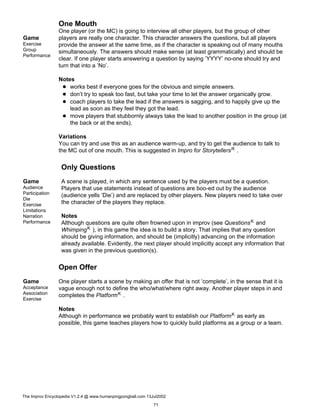
The Improv Encyclopedia V1.2.4 @ www.humanpingpongball.com 13Jul2002
24
6 Episodes
Game
Acceptance
Exercise
Group
Narration
Excellent game to teach group storytelling. Give a big task, like ’The launch of a new
flavor of coke’, or ’Building a new clubhouse for the girl scouts’. The players get 1 minute
to prepare 6 scenes, in which the given task needs to be completed. After 1 minute there
is no more discussing, they just play the 6 scenes.
Time it and see if they can make their minds up. Quarreling will just slow them down, so
this will only work if players agree; they should be immediately AcceptingK any usable
ides.
7-up
Game
Concentration
Exercise
Warm-up
Everyone in a circle, start counting to 7 while waving right arm up and down to the same
rhythm you’re counting. After 7 switch to the other arm, then the right leg, then the other
leg. At the end of the last leg of 7 go back to the original arm and do the same thing
counting to 6, and so on down to 1-1-1-1.
Accepting Circle
Game
Acceptance
Concentration
Exercise
Warm-up
Get everyone in a big circle. One player starts by making a little gesture, perhaps with a
little sound. His or her neighbor then tries and does exactly the same. And so on. Although
we expect the gesture/sound not to change, it will.
Notes
Watch for movements that suddenly change left/right arm or leg. This is not really
supposed to happen, but it will. Once happened, it should be accepted by the next player.
Also watch/listen for little moans or sighs that players might make before or after their turn
- these should also be taken over by the next player.
Actor’s Nightmare
Game
Limitations
Performance
This one is played by 2 players, one of which gets their lines on paper (like a script). The
other player should justify whatever the scripted player says.
Notes
You can use existing plays for this, but also lines from comics.
Whoever gets the script should not forget to play/act - only her lines are defined, not what
she does, or how she does the lines.
Also known as PlaybookG.
The Improv Encyclopedia V1.2.4 @ www.humanpingpongball.com 13Jul2002
25
Aerobics
Game
Characters
Exercise
Introduction
This is a fun observation game.
Place all players in a line. The first player starts walking around the room, walking a large
circle. The second player starts following the first one, and tries to move like the first
player. After a few rounds, the first player goes to the back of the line, and the third player
starts following and imitating the second one.
Notes
Tell players to be themselves; don’t try and walk around funny (it’s not the Ministry of Silly
Walks after all).
Ali Baba and the 40 Robbers
Game
Concentration
Energy
Warm-up
Excellent warm-up. Everyone in a circle. We are going to establish a rhythm, by saying, all
together ’Ali Baba and the 40 Robbers’. Keep repeating this.
One person starts making a gesture to this rhythm, say, tapping your head with you left
hand. When the sentence is repeated, the player next to her takes over this gesture, while
the first one starts a completely different new gesture. Third time the sentence is done,
player three does the first gesture, player two does the second gesture and player one
invents a new one again. And so on.
This is also a concentration game, though it’s not really difficult. All one has to do is watch
the previous player, and next time, take over her gesture. When you’re watching what
everyone else is doing you’re going to get lost though.
Alien Tiger Cow
Game
Exercise
Group
Warm-up
Fun game to warm up and to teach players some ChivalryK .
Everyone in a circle. There are 3 things a player can be:
An alien: hold you index fingers up next to your head, as little antenna’s and say
’Bleeb bleeb’, bending inwards into the circle;
A cow: bend forward, hold your right hand on your tummy and go ’Moooo’
A tiger: push your right hand forward, imitating a claw and roar.
On your sign, every player decides to become one of the three. The idea is for everyone
to become the same, which obviously won’t be the case, the first time. We re-do this until
everyone is in sync.
Variations
Invent your own animals (or things) and let players become juke boxes, birds, whatever.
Play ’majority wins’: animals/things that are most in the minority drop out. Also known as
Rock Paper ScissorsG.
The Improv Encyclopedia V1.2.4 @ www.humanpingpongball.com 13Jul2002
26
Alliteration Introduction
Game
Concentration
Exercise
Introduction
Excellent game for players to get to know each other’s names.
Everyone in a circle. A player starts the game by introducing himself by making a gesture,
and alliterating to his name, e.g. "I’m Wonderful Wendy" or "I’m Smart Steve". The next
player point to the first, repeats the previous player’s name, attribute and gesture, and
does something similar about himself.
And so on. Game ends with the first player having to do each other player’s gesture,
repeating their names and attributes.
Alliterations
Game
Association
Concentration
Exercise
Warm-up
You will need a tennis ball or a towel tied in a knot for this one. Everyone sitting or
standing in a circle. You give one person the ball, and ask him to name as many words as
possible that start with a ’P’ (or any other letter), in the time it takes for the ball to get
passed along the circle. Doubles don’t count, obviously.
Notes
Tell players not to watch the ball go round when they’re ’it’ - they’ll just panic and freeze.
Tell them to try this with closed eyes.
Variations
Pair up the players and use a stopwatch. Ask the left players on the left to name as many
words as possible starting with a ’t’, and ask their partners to count, for 15 or 20 seconds.
Then switch.
Alphabet Circle
Game
Concentration
Exercise
Warm-up
Great warm-up game to sharpen concentration.
Everyone in a circle. One player starts by throwing an ’A’ to another player. That player
throws as fast as possible a ’B’ to someone else. And so on.
If you work with a large group, you can divide them into 2 circles, call ’em Team Gold and
Team Silver, and time how fast they can get to ’Z’.
Variations
Any player has the option to change the sequence from A-Z to 1-10 and vice versa. Time
it. Or change to 1-10
Alphabet Game
Game
Audience
Participation
Die
Performance
Verbal wit
This is a scene consisting of 26 lines of dialog. The first line starts with a given letter
(say ’R’). The reply to that line must start with a ’S’, and so on, until the whole alphabet
has been covered. After ’Z’ comes ’A’.
Players that hesitate, or use the wrong letter ’Die’, and are replaced by another player.
The replacement needs to take over the character of the player she replaces.
Notes
Urge players not to ’stick’ to the game - if you can’t think of a good sentence to advance
the story, it’s better to just ’die’ than to screw up the story (see ChivalryK ).
The Improv Encyclopedia V1.2.4 @ www.humanpingpongball.com 13Jul2002
27
Animalistics
Game
Association
Characters
Exercise
Performance
Ask the audience for animals. Players play a scene, in which the characters are based on
these animals.
Notes
Players do not ’become’ the animals, they only take over characteristics of the animals.
Characteristics may be physical, vocal or StatusK based. For example, ’chicken’ might
inspire a player to a cowardly character, moving about jerkily.
Animals
Game
Characters
Exercise
Make sure you have an even number of players. Give everyone an animal, but make sure
that there are 2 of each, and that nobody knows which other player is which animal.
Then give a number of activities, which the animals perform. Try
Eating. Eating when you’re really hungry
Drinking. Drinking when you’re really thirsty
Lovemaking
Grooming
Fighting
Sleeping
At the end, ask the players to find the other animal of their kind. Ask the others if they
found out who was which animal.
Variations
Let 2 players be humans.
Artist Model Clay
Game
Exercise
Group
3 players. One is a lump of clay - behind her is a second player who is a model. Model
takes a pose, which the ’clay’ is not supposed to see. The third player becomes the artist,
who will model the clay after the model. The artist is not supposed to touch the clay, can’t
speak and it not allowed to show the clay what to do or to become.
When done, let the model inspect the artwork and see if details fit.
Variations
Limit the time the artist has to build to statue.
The Improv Encyclopedia V1.2.4 @ www.humanpingpongball.com 13Jul2002
28
Asides
Game
Performance
A scene is played, which any player can stop at any time by yelling freeze. At that point,
the player steps out of the scene, and tells the audience what his character is really
thinking, after which the scene continues. The other characters of course are not
supposed to know what players are thinking, but the players do, and should use this.
Notes
Players can use this to reveal their hidden motives. Other players can play into this, or
purposely ignore this knowledge.
Gimmick: characters may actually have other things on their minds than what’s going on in
the scene. E.g. a driver stopped by a cop may be thinking about the groceries his wife told
him to get at the supermarket.
See also CommentingK .
Variations
The thoughts of the players can also be provided by players off-stage. Also known as Alter
EgoG. Also known as ConsciencesG.
Audience Warm-ups
Game
Performance
Warm-up
Often an improvised show starts with an audience warm-up. Here are some suggestions:
Do a Mexican wave (audience making fluent waves with their hands above their
head).
Have he pianist/keyboard man make all kinds of sounds and have the audience
imitate them
Ask the audience to stand up and do some physical warmup. Have them shake their
arms and legs.
Have the audience introduce themselves to strangers, tell a secret their
spouse/partner doesn’t know about to a stranger, have them hug a stranger
Do an interview with the audience, where the MC is one character (say, a
headmaster) and all of the audience another (say a naughty child). The audience
needs to reply to the interview in one voice (all saying the same at the same time -
see One MouthG ). Not an easy one, and if the audience does not feel like doing this
it really sucks. When it works it’s a real thrill.
divide the audience in 3 or 4 groups, and give each group a sound. Rehearse the
sound with each group. Then tell a silly story, and use these sounds as sound effects.
(We saw a pretty gruesome one in which one group was a car (roar), another a dog
(bark) and the third group got a kind of splashing sound. The poor dog got run over by
the car... not exactly nice but the audience had fun with it)
Do a cheering competition between the men and the women.
Rehearse different kinds of applause (from the ’polite’ applause when a scene sucks,
over an ’ooh’ appause for a touching scene, to a wild roar for a hilarious scene). Have
them rehearse voting for a team by cheering the team name (if that’s your format).
Rehearse a ’Die’ ( see DieC ) if i you’re going to be playing scenes in which the
audience can decide to throw a player out of the game.
Give the men and the women a different sound and play with that. Tell them they are
members of a wild tribe, the women go ’Ugh’ when you raise your left hand and the
man go ’Hagawaga’ when you raise your right hand.
The Improv Encyclopedia V1.2.4 @ www.humanpingpongball.com 13Jul2002
29
Back Dancing
Game
Exercise
Group
Trust
Played in pairs. Actors stand back to back, and dance on different kinds of music. Back
must stay in touch at all times.
BarPro
Game
Format
The (slightly negative sounding) name is attributed to Keith JohnstoneR and refers to
shows consisting of short games, played in small rooms, like bars and tiny comedy clubs.
In this simple format, a limited number of players (4-6) play improv games, introduced,
and usually directed by an MC. In certain troupes the players take turns MC-ing and/or
directing.
There are usually no judges, no score boards and no prizes to be won. Suggestions are
taken from the audience, drawn out of a hat or provided by the MC.
Due to the lack of space, there are usually no props or attributes, except for perhaps a
coat hanger with clothes and a couple of hats; players typically mime their props.
As far as we know the name BarPro is not copyrighted.
Become
Game
Association
Exercise
Spontaneity
This one can be player with all players at a time, or you can ask the group to watch as
players come up with different ideas on how to do this.
Ask the players to become
A jar of mayonnaise
A pack of sigarettes
Dentures
At first, this will probably not lead to much. Add side coachings, like:
You are a jar of mayonnaise. Opened or not? Full or empty? Fresh or not? Show it.
You are a pack of smoked. Empty or full. Filter sigarettes or not? Where are you? In
someone’s pocket or on a shelve in a shop? Show it.
You are a flower. What kind of flower? Blooming or not? In a vase or in a field? What
color? Freshly picked or not? A present to a lover or at a funeral?
You are water. Still or not? In a glass? A jar, a puddle, a lake or an ocean? Fresh or
dirty?
You are stone, air, sand, fire.
Your are blue, red, green. You are a clock. Big Ben or grandfather clock? Working or
not. Is your time right or not? A watch? Who is wearing you? A nun or a pimp? How
could you show that?
You are french fries. McDonalds or Wendy’s? Hot or cold? Any ketchup? On a plate
or in a cardboard box? Eaten or not? Yummy or yuck?
After a while, players should be able to come up with the side coachings for themselves.
Encourage the players to try out different kind of stuff, see what they come up with.
The Improv Encyclopedia V1.2.4 @ www.humanpingpongball.com 13Jul2002
30
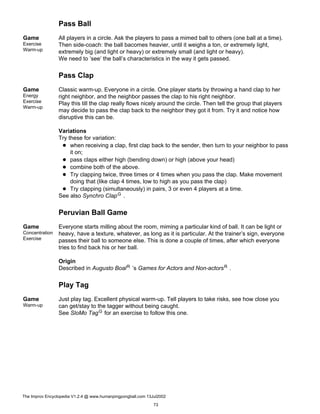
Bippety Bop
Game
Concentration
Exercise
Warm-up
Silly warm-up to get the blood flowing. A players in a circle, one player in the middle. The
player in the middle closes his eyes, holds right hand pointing in front of him, and spins
around. When done spinning, open your eyes and say, as fast as you can ’Bippety
Bippety Bop’.
The player you’re pointing to, and his 2 neighbors, need to build an elephant in less than
the time the middle player needs to say ’Bippety Bippety Bop’. An elephant consists of a
trunk, made by the middle player, by holding your nose with one hand, and extending your
other arm through the arm that holds the hand that holds the nose (does this make any
sense?). The neighboring players each form a big ear, using both arms. Don’t forget to
attach the ears to the elephant’s head.
Any player that cannot get his/her part done by the time the middle player does ’Bippety
Bippety Bop’ becomes ’it’ and takes place in the middle of the circle.
Variations
You can really invent any object or create to replace the elephant. Try
a car, with 2 wheels and a set of wind screen wipers
a cow, with an udder and 2 horns
a washing machine, with 2 players building a ’box’ with both arms, and the middle
player waving her arms in a circle in front of her. All go ’rumble rumble’
a bunny, with 2 paws (middle player) and 2 rabbit ears (neighbors)
Also known as Also known as Bappety BooG. See also BunnyG
Black Box
Game
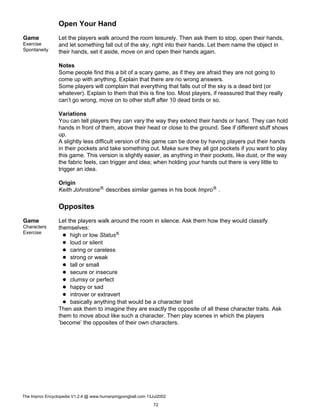
Performance
This one is played by 2 players. One holds a (mimed) black box, which has 3 buttons, one
of which is red. These buttons control a player; one button might be the ’jerk your leg’
button. The exact functions of each button are not defined.
The other player enters and asks if he can play with the box. Player 1 agrees, but adds
something like "Whatever you do, don’t push the red button".
Player 2 begins to play with the buttons, controlling player 2. Then, we slowly work up to
the use of the dreaded red button, which will make player 2 do something not-so-obvious.
This can be anything, but it should not be preconceived. The red button might become a
Mood swing button, a Start Screaming, Start Giggling, Sing Opera, or Switch-to-
GibberishC button.
Blindfolded Scene
Game
Limitations
Performance
Trust
Players are blindfolded and then play a scene.
Variations
Have the players play barefoot and have mousetraps on the stage. Not very nice but
we’ve seen it done. Also known as MousetrapsG.
The Improv Encyclopedia V1.2.4 @ www.humanpingpongball.com 13Jul2002
31
Blind Freeze
Game
Association
Exercise
Performance
Warm-up
This one is just like Freeze TagG , but here the MC calls Freeze, and calls in another
player. If you’re not using an MC, any player might call Freeze and call in any other player.
Many groups find this game more exciting than Freeze TagG , as players don’t know
when they get pushed in the game, and hence are less prepared, and crazier, more
exciting stuff tends to happen.
Blind Lead
Game
Exercise
Group
Trust
One player is blindfolded, and the room is filled with obstacles (put a couple of chairs
everywhere, leave all kinds of junk on the floor). The idea is that the rest of the group will
lead the blindfolded player through the room, by talking.
Also known as AirplaneG. (strange but true - don’t ask me why) Also known as Obstacle
CourseG. See also FingertipsG for a similar exercise.
Blind Line Up
Game
Group
Introduction
Warm-up
This one is like Group OrderG , except that everyone keeps their eyes closed, and no
talking is allowed while the group lines up.
Notes
This is more a group exercise than Group OrderG (which is more about agreement),
so initially you probably want to take it easy on the silly stuff, like line up by order of
mental health...
Always interesting to see what strategies the group comes up with.
You can’t really use alphabetical order if the group does not really know each other.
Body Hide
Game
Exercise
Group
Introduction
Trust
Excellent exercise to get to know each other, and to learn to trust and touch each other. 5
volunteers. 4 of these must try and hide the fifth person, using nothing but their bodies.
The other students stand around the group and try and see pieces of the fifth’s clothes,
shoes, skin.
It’s great fun for the other students to watch and try and find uncovered pieces of person.
Don’t tell them they go next, with one person less.
Variations
Try this game with less and less ’hiders’. If the task becomes impossible, tell them they
can use parts of walls. Using a corner is easiest, of course, but let them figure that out
themselves.
The Improv Encyclopedia V1.2.4 @ www.humanpingpongball.com 13Jul2002
32
Boris
Game
Exercise
Narration
Performance
2 players play an interrogation scene. One is the interrogator, the other is a suspect. The
interrogator randomly throws unconnected elements to the suspect, who needs to
incorporate these and get himself into (even more) trouble.
And then we have Boris, who is a nasty, huge, but invisible thug assisting the interrogator.
Every time the interrogator does not like the suspect’s answers (and also when the
suspect does not incriminate himself enough), the interrogator calls on Boris to torture the
suspect, prodding him to confess or incriminate him even further.
Notes
we do not establish the crime beforehand
the suspect mimes being tortured by Boris
the investigator can tell Boris what to do (break his leg), but it is more fun to leave the
choice of torture up to the suspect
if the torture does not go far enough to the investigator’s taste, he can always call in
Boris’ evil twin brother, Igor (also invisible)
as a gag, the suspect can also incriminate Boris (who can turn out to be a
witness/accomplice to the crime).
Origin
Attributed to Keith JohnstoneR .
Bunny
Game
Energy
Exercise
Warm-up
Extremely silly game, to pump up the energy. Get everyone in a circle. One player
becomes the body of a bunny - this is done by holding both arms in front of your chest,
elbows touching your rib cage, and letting hands hang. Her 2 neighbors become the ’ears’
of the bunny, by waving a hand next to the middle player’s ears. All 3 say ’bunny bunny
bunny’ together, until the middle player ’throws’ a ’bunny’ to another player in the circle.
This player becomes the bunny body, and his neighbors get to do the ears.
Play this game at a high speed. Mumbling ’bunny bunny’ en masse gives a nice energy
boost.
Variations
Play in slow motion. Hilarious!
Alternatively, you can really invent any object or create or replace the bunny, as long as
you invent a sound along with it. Try
a car, with 2 wheels and a set of wind screen wipers, going ’vroom vroom’
a cow, with an udder and 2 horns, going ’moo moo’
a washing machine, with 2 players building a ’box’ with both arms, and the middle
player waving her arms in a circle in front of her. All go ’rumble rumble’
an elephant, with 2 big ears and a trunk, making an elephant sound (if you don’t know
what an elephant sounds like, just invent a sound).
See also Bippety BopG . See also Killer BunnyG .
The Improv Encyclopedia V1.2.4 @ www.humanpingpongball.com 13Jul2002
33
Cards
Game
Performance
Ask the audience to write short sentences on cards. Give 2 players 3 cards, which they
put in their pockets. Then they play a scene. At any point in time, instead of saying
whatever they think they might say, they take a card, and read what’s on the card.
Whatever is said should be justified.
See also Actor’s NightmareG .
Card Status
Game
Endowment
Limitations
Performance
Excellent StatusK game.
4 players. Ask an audience member to pick 4 cards out of a deck, and attach a card to
each player’s forehead, so that players can see each other’s card, but not their own. Use
a rubber band or a piece of string for that.
The idea is to play a scene, in which the status order of the characters is defined by the
cards. Evidently, players don’t know their own status, so the other players will have to
endow them.
Notes
Set up a location where status is important. Examples would be a Royal Palace or a highly
organized bureaucracy (the White House ?).
Catch’em
Game
Concentration
Energy
Exercise
Warm-up
One player is ’it’ and stands at one end of the room, facing the wall. The other players at
the other end of the room. Players need to try and get to the player who is ’it’ without ’it’
seeing them move. The player who is ’it’ can turn around at any time - at that point
everybody else needs to freeze. Anyone who is caught moving is out.
Also known as Bear of PoitiersG. (see Games for Actors and Non-actorsR )
Circle of Knots
Game
Exercise
Group
Form a circle, holding hands. Then, any player can start moving about, making knots in
the circle. Do this gently, and keep holding hands.
Variations
Try a line instead of a circle
Try with eyes closed or blindfolded
Circle Sitting
Game
Group
Trust
Warm-up
Have everyone stand in a circle, really close to each other, facing inwards. Then ask
everyone to make a quarter turn left. Make everyone stand even closer to each other.
When ask the whole group to sit down. If everyone is really close, they will end up sitting
on one another’s knees, and the whole construction supports itself.
If well done it’s even possible to make the circle walk. Indicate which foot to start with ;-)
The Improv Encyclopedia V1.2.4 @ www.humanpingpongball.com 13Jul2002
34
Clap Snap Association
Game
Association
Exercise
Warm-up
This one is like a Free Association CircleG , except that the rhythm is more explicit. Here’s
how to do the rhythm: each beat consists of 4 phases:
Slap both hands on your thighs
Clap your hands
Snap your left hand fingers
Snap your right hand fingers
With every right hand snap, a word should be thrown to your neighbor. Once the rhythm is
established, you can leave out the snaps - that’ll make things more understandable.
Variations
You can use this for both Last LetterG games or Free Association CircleG .
Try this with two circles. Have one circle associate freely, and another circle on Last
LetterG . Whenever a player misses a beat she should switch circles.
Notes
If you do this with 2 circles, you will probably find that the rhythms for both circles
synchronize.
Columbian Hypnosis
Game
Exercise
Trust
Played in pairs. One player holds her open hand, fingers upward, about 2-3 inches from
her partner’s face. She then starts moving her hand about slowly, while her partner tried to
keep his face at exactly the same distance from her hand, like her hand is pulling of
pushing his face about.
Switch sides and partners after a couple of minutes.
Notes
This is really also an exercise for the hypnotized, as she needs to ensure that her partner
is able to follow her.
Variations
Use both hands.
Origin
Described in Augusto BoalR ’s Games for Actors and Non-actorsR .
ComedySportz
Game
ComedySports was started by Dick Chudnow in 1884 in Milwaukee. It’s a format iof
competitive improvisational comedy that resembles Keith JohnstoneR ’s TheatresportsR .
The format is currently played by a dozen-plus teams all over the USA, united in the
Comedy League of America.
In a comedySportz show 2 teams complete for points given by tha audience. A referee
oversees the match, times the games, calls fouls and gets audience suggestions. A match
consists of something like 7 to 12 games, drawn from a repertoire of over a hundred
games (you’ll find most of these games in the Games section of Improv Encyclopedia).
In terms of gimmicks, you have the ’brown bag foul’, which is a brown paper bag placed
over the offending player’s head.
The Improv Encyclopedia V1.2.4 @ www.humanpingpongball.com 13Jul2002
35
Coming Home
Game
Characters
Environment
Exercise
Ask players to think of someone they know. Then ask them to play how that person would
come home from work. Players need to pay attention to
The environment: what does that person’s house look like? Is it neat and tidy or is it a
mess? Big house or small apartment?
What does he do? Does the character change clothes or showers or has a beer first?
Does he eat? If so, what? Microwave dinner, carryout, pizza delivery or cornflakes?
What mood is that character in?
How was work today?
Variations
You can come up with other situations in which characters enter a location.
Concentration Circle
Game
Concentration
Exercise
Warm-up
Place all players in a circle and number them sequentially, starting with a random player.
The players then establish a rhythm, for example by swinging their left hands up and
down. Have player 1 start; when her arm is up she shouts/throws a number. The player
with that number needs to throw another number at the next beat.
Players that fail (if they did not recognize their own number) or that break the rhythm
become the last player in the circle, and that changes the numbers for a bunch of players.
Restart with player one.
Continuing Emotions
Game
Continuation
Performance
A ’neutral’ scene is started, and is then interrupted (frozen) several times by the MC. The
scene is then continued but all characters switch to an emotion provided by the audience.
Continuing Styles
Game
Continuation
Performance
A ’neutral’ scene is started. This scene gets interrupted several times by the MC, and then
continued in a film/ literature/ drama/ TV-program style provided by the audience.
The platform and the story need to continue flawlessly.
The Improv Encyclopedia V1.2.4 @ www.humanpingpongball.com 13Jul2002
36
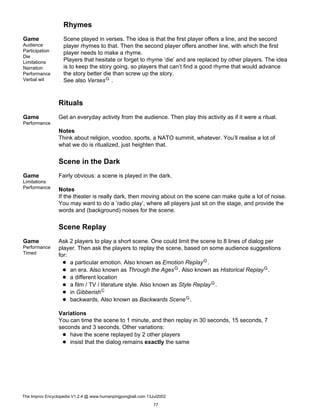
CopyCat
Game
Association
Exercise
Performance
CopyCat goes like a verbal Freeze TagG . A scene is started. At any time, a player at the
side can step forward (the playing players hold off for a moment) and repeats a line that
was said in the scene. Whoever originally siad that line, steps aside, and the remaining
players start a new scene starting with the line that was repeated.
Variations
Feel free to actually continue the ongoing scene rather than to start a completely new one.
Feel free to replace all the players instead of just the player who said the last line.
Rather than just stepping in and repeating a line, you might want to call ’FLIP’ (or freeze).
This variation is known as Also known as FLIPG. .
Cross Circle
Game
Concentration
Exercise
Introduction
Warm-up
Perfect game to learn each other’s names.
Everyone in a circle. One person (A) starts by calling another person’s name (B). At that
point, A starts walking towards B. Before A gets to B, B needs to call another name (C), so
B frees her spot in the circle, for A to take. C then needs to call yet another name and start
walking, so B can take C’s spot.
Variations
Instead of calling names, players can pick another player by making eye contact (and
nodding to acknowledge that eye contact has been made). This demands a lot of
concentration.
You can have more than one cycle going, if the group is big enough. Also known as Name
GameG. Also known as Shriner’s Warm-upG.
Cut
Game
Format
Long Form
This Long FormC game is played with 6 to 15 players. 2 players start a scene, perhaps
based on an audience suggestion. In the middle of the scene, any other player can call
’Cut’, and start another scene, dragging one or more other players in the scene.
All scenes are interrupted this way, and the idea is that all scenes come together in one
story. Cut scenes can be continued later. Usually, every player sticks to one character.
This game can be played with or without a director.
Variations
Usually, we decide on a category before the start of this game. Possible categories are
Soap series, like The Bold and the Beautiful, Dallas, Eastenders
Hospital drama, like E.R.
Cop drama, like Hill Street Blues
Romantic Comedy, like The Love Boat
Crime series or murder mysteries
The Improv Encyclopedia V1.2.4 @ www.humanpingpongball.com 13Jul2002
37
Dating Game
Game
Endowment
Performance
This is played like a Blind Date show. One player leaves the stage, and the audience
provides endowments for the 3 others. Examples might be No. 1 is stupid, No. 2 is a serial
killer and No. 3 thinks he’s a macho.
4th player gets to ask 3 questions, and each of the others answers it. After the questions
player 4 should guess what the endowments were.
Day in the Life
Game
Audience
Participation
Performance
The MC picks a member of the audience and interviews this person about their average
(work) day. Questions asked may include ’What is your job?", "Where do you live, with
who?", "What are your hobbies?", "How do you get to work?", "Who are your
colleagues?", and more. The players then improvise a day in the life of this audience
member, based on the elements provided by the interview.
Death and Retriever
Game
Exercise
Group
Trust
This one is like ScorpionG , but in this version killed players are not ’out’, but can be
revived. Everyone eyes closed, one player becomes the killer (tap him on the shoulder)
and another one becomes the retriever. The retriever gets a towel of a scarf around her
neck.
Dead players scream when they are killed, keep their eyes closed and stand still. When
the retriever bumps into someone that does not move (a dead body) she can revive the
dead by rubbing them with the towel.
When the retriever gets killed, she screams and stops moving. When another living
person bumps into the retriever (recognized by the scarf), the retriever is revived, and the
one that revived the retriever becomes the new retriever.
Play till everyone is dead or bored.
Death in a Minute
Game
Limitations
Performance
2 or 3 players play a 1 minute scene, in which one player must die.
Notes
Tell players to take risks. Why not just drop dead after 5 seconds and leave it up to the
other player to justify the death.
The Improv Encyclopedia V1.2.4 @ www.humanpingpongball.com 13Jul2002
38
Ding
Game
Exercise
Performance
Spontaneity
A scene is played. Whenever the MC ring a bell (or yells ’Ding’), the player that is doing
something/saying something needs to say/do something else.
Notes
Doing ’something else’ is quite often interpreted as doing/saying the opposite of what you
did before. One can be more creative, e.g. repeat what was said in a different emotion.
If you use this as an exercise on SpontaneityC the trainer can ’Ding’ quite often (very
frustrating for the players, but they will come up with stuff they never would have thought
of before). Disadvantage of this is that the story/characters tend to get lost. Use sparingly
for performance. Also known as Other ChoiceG.
Disc(1)
Game
Exercise
Limitations
Tell the players to imagine the stage is a disc, only supported right in the center of the
stage. We are going to play a scene, in which the disc needs to be balanced at all times.
Anytime a player moves, or a new player enters, the others need to rebalance the disc,
and every move needs to be justified.
Notes
Also known as PivotG. There is another version of this game - see Disc(2)G .
Disc(2)
Game
Exercise
Limitations
Imagine the stage is a large disc, supported in the middle. The goal is to keep the disc
balanced.
Game starts with a player entering the disc; he is the leader. As soon as the leader stops
milling about on the disc, another player must jump in and restore the balance. The new
player becomes the new leader, and the previous leader becomes a follower.
As soon as the balance is restored, the leader can start walking around; the other player
stays where he is. As soon as the leader stops again, the follower(s) move and restore the
balance. After that, the leader becomes one of the followers, and a new leader jumps in.
The group of followers may split into groups of equal size, and restore the balance that
way.
Keep in mind that followers don’t start moving until the leader stops.
See also Disc(1)G .
Dissociation
Game
Association
Exercise
Warm-up
This game can be done individually, or you can have one player do it in front of the class.
Players say as many words that have nothing to do with each other, until they start
associating. Restart as soon as you’ve got an association.
Example: cat, deodorizer, house, green, grass. Here we restart, because grass is
obviously an association on green.
Notes
You can use this game to show that association is natural, and that it is actually difficult
not to associate. See also MalapropismG .
The Improv Encyclopedia V1.2.4 @ www.humanpingpongball.com 13Jul2002
39
Distance Game
Game
Exercise
Limitations
Two players stand a few feet apart facing each other and have the most boring 4-line
interchange possible. They then each secretly pick a specific distance they want to be
from the other person and repeat the interchange while maintaining the distance. The
maintaining of distance automatically seems to affect people’s emotional commitment and
inflection. The key is to have a specific distance in mind down to the inch. If one person
picks 1 foot but the other picks a foot and a half. You will see some interesting conflict
because of that extra half a foot.
Variations
Play a scene where the improvisors are connected by a stick, a piece of rope or wood.
You can even use a match stick.
Distorting Mirror
Game
Concentration
Exercise
This is a variation of the classic MirrorG exercise. Played in pairs, one player is
designated as the mirror. This mirror distorts the image; perhaps it blows everything up,
makes everything wider, taller, smaller, narrower, prettier, uglier.
Doors
Game
Environment
Exercise
Excellent introductory exercise for building environments and PlatformK . All players in 2
rows. 2 facing players play the exercise, the others watch.
Player 1 sets a (part of a) platform by miming a door. As soon as player 2 has an idea
about where player 1 might be, player 2 steps into the scene and offers a line of dialog,
expressing where we are. Player 2 answers player 1, acknowledging player 1’s offer. This
ends the scene.
The audience should know after these 2 lines of dialog where the players are, and who
they are, or what their relationship is to one another.
Notes
’Doors’ can be anything that separates one physical location from another. Players can
mime real doors, but also gates, curtains, you name it. Encourage players to try out as
many types of ’doors’ as possible. Use sound to enhance the platform, e.g. a door in a
submarine makes a different kind of noise than an elevator door.
See also 3 Line EnvironmentG .
Do Ron Ron
Game
Performance
SingSong
4 players sing a song about a subject, given by the audience, on the tune of Do Ron Ron.
Variations
Invent your own choreography and have the players dance as they sing.
The Improv Encyclopedia V1.2.4 @ www.humanpingpongball.com 13Jul2002
40
Double Endowment
Game
Endowment
Narration
Performance
Another great game to train listening skills.
Pick a place where a scene will be played, and 2 players. Tell each player what they need
to get the other player to do, without the other player knowing this. Players are not allowed
to explicitly tell the other player what to do.
Example: an arena in ancient Rome. Player 1 needs player 2 to taste the sand in the
arena, and player 2 needs to get player 1 to tie a knot in a lion’s tail.
Notes
Works best is players take risks. If they to the ’wrong’ thing the audience will probably just
laugh, and that should be enough to signal the player he’s going the wrong way.
Double Opening
Game
Exercise
Limitations
Narration
2 players each make a (strong) opening sentence, at the same time. After that, adhering
to both openings, find the scene that makes sense for both.
Variations
Do the same, but have both players react to each other’s opening simultaneously. Then
have the original players react to the reaction simultaneously. Rather difficult, but teaches
the importance of listening to one another.
Dry Cleaning Bag of Death
Game
Limitations
Performance
We need three or four players. During the scene, one player is always off-stage, with his
head inside a dry cleaning bag, slowly suffocating. He is not allowed out of the bag until
some other player finds a way to to exit the scene and ’liberate’ the suffocating player.
New player puts his head into the bag until freed by another player, and first liberated
player finds a way to justify his entrance into the scene.
Variations
Use a bucket of water instead of a dry cleaning bag - that’s called Also known as Bucket
of DeathG. .
Dubbed Movie
Game
Performance
2 or more actors play a scene, but they don’t speak, although they can move their mouths
as if they are speaking. 2 or more players sit in front of the action, and provide the speech.
The effect is (or should be) like watching a dubbed movie.
The Improv Encyclopedia V1.2.4 @ www.humanpingpongball.com 13Jul2002
41
Duck Duck Goose
Game
Exercise
Group
Warm-up
Invent a name for a non-existing but simple children’s game. As soon as you call out the
name, all players start to play the game. They can use sounds and gibberish, but no real
language.
See if the group can come to playing along the same rules.
Variations
Just have the group start playing the game, and afterwards have the group come up with
the name.
Eights
Game
Warm-up
Excellent game to warm up those muscles.
Everybody scatter around, stand up relaxedly. Ask the players to make an ’8’ movement
with their left big toe, then their left foot, then whole left leg. Repeat with right toe/foot/leg.
Repeat with left index finger, left hand, left lower arm, left arm. Repeat with right
hand/finger/arm. Try both arms. In opposite directions.
Make 8-shaped movements with your pelvis. Try horizontally and vertically. Try changing
direction.
Ditto for left shoulder, right shoulder, both shoulders. Ditto for your head.
End exercise by making eights simultaneously with as many parts of your body as
possible.
Emotional Quadrants
Game
Limitations
Performance
Divide the scene in 4 quadrants, and allocate 4 different emotions to each quadrant.
Players play a scene, but need to take on the emotion of the quadrant they are in.
Notes
Encourage players to move about, in order to force changes of emotions. Don’t forget to
justify emotion changes.
Energy 1-10
Game
Energy
Exercise
Group
Warm-up
Everyone in a big circle, squatting down. We will count 1 to 10, all together, moving up,
with increasing energy level. 1 is hardly audible, 10 is as loud as possible, everyone
standing straight, hands reaching up.
It’s important to watch each other, to ensure we’re all at the same energy level. Also make
sure that the increase in energy is nicely gradual.
The Improv Encyclopedia V1.2.4 @ www.humanpingpongball.com 13Jul2002
42
Evil Twin
Game
Performance
4 players. 2 will play a scene. The other players are the other’s evil twins. At any point, the
’twins’ can shout ’freeze’ after which they tag out their twin, and continue the scene and do
something evil. After that, they move out again, and the original twin brother needs to
justify the evil, correct or repair the damage done and continue the scene.
Notes
Great setups for this game are things like first dates, or meeting your in-laws for the very
first time.
Exaggeration Circle
Game
Energy
Exercise
Warm-up
All players in a circle, or a long line. One player starts a little gesture, with or without a little
sound.. The next player takes it over and makes it bigger. The last player does the whole
thing to the extreme.
Notes
Make sure the players stick to the original gesture/sound, and don’t just do their own thing.
We should be able to see the movement grow organically.
Excluding
Game
Exercise
Group
4 players play a scene, in which one of the players gets excluded.
Notes
This is a group exercise, in the sense that players should be sensing where the majority of
the group is going (see Alien Tiger CowG ).
Tell players not to be afraid of ’being nasty’ - be extreme in your exclusion (that makes it
easier, also for the player that is excluded - see Mr. Nice GuyK ). Whoever gets excluded
should gladly accept this and react accordingly.
Excluded players can go to extremes to be re-included - hilariously funny if even this is
thoroughly ignored by the others.
Variations
Let the exclusion evolve; allow a player that got excluded to get 2 others to join him and
exclude the fourth one. This only works if the excluded player first allows herself to be
excluded (a little ChivalryK here).
Also known as AlliancesG.
The Improv Encyclopedia V1.2.4 @ www.humanpingpongball.com 13Jul2002
43
Family Portraits
Game
Association
Group
Warm-up
Fun game to get everyone to work together.
Players are going to ’build’ family portraits. Ask for e.g.
Family of accountants, bean counters
Family of fat/skinny people
Family of Pop Stars
Family of snakes, rats, cats
Family of garden tools
Tell the players you will want to see who’s who in the family. We also want to see who
gets along with who, who’s the black sheep of the family, and so on. This only works if
players watch each other closely.
Famous Last Words
Game
Performance
Verbal wit
MC asks the audience for famous (living or dead) people, or characters in movies,
cartoons or songs. Players line up and invent ’famous last words’ for the subjects given by
the audience.
The Improv Encyclopedia V1.2.4 @ www.humanpingpongball.com 13Jul2002
44
Fast Food Laban
Game
Characters
Exercise
Laban was a movement theorist, and this exercise is based on (a simplified form of some
of) his ideas. Take 3 categories:
Timing: Sudden or Sustained
Weight: Heavy or Light
Space: Direct or Indirect
Then try and make characters that behave/speak following combinations of the 3
categories:
punching : sudden / heavy / direct
slashing : sudden / heavy / indirect
wringing : sustained / heavy / indirect
stroking : sustained / light / indirect
dabbing : sudden / light / direct
smoothing : sustained / light / direct
pushing : sustained / heavy / direct
Notes
The attributes go with the characters, not necessarily with the actual performer’s body. A
heavyset person may move about delicately.
Variations
You can introduce this in a fairly simple way, by asking the players to move about the
room, according to directions or orientations:
be a ’horizontal’ or ’vertical’ person
be downward, or upward
be light or heavy
Then experiment with these: be suddenly light (bird taking off from a tree) or continuously
light (be a cloud).
You can do this using different kinds of music. What direction / weight / movement does a
certain song or theme inspire?
Then try to experiment with characters: who or what would be vertical person be (a
general?). What/how would be continuously light person be (stoned?). Suddenly light
(flirty?). See also Fast Food StanislawskiG .
Origin
Attributed to Keith JohnstoneR . See Impro for StorytellersR .
The Improv Encyclopedia V1.2.4 @ www.humanpingpongball.com 13Jul2002
45
Fast Food Stanislawski
Game
Characters
Exercise
Have 2 players perform a scene, perhaps give them a title or a location, but also give
them a subtext for their character. Subtexts might be:
you want to seduce the other
you are a nerd
you like to make people laugh
you want to impress others
you are a nasty person
you try to be ordinary
you are an optimist/pessimist
you will never find a girlfriend/boyfriend
Notes
If you are using this in a workshop it might be a good idea to ask the players how one
would behave given a certain subtext. Stress that you are looking for TruthfulnessK .
This is an excellent technique to find a character. You can actually use this for
performance - just give yourself a subtext when you jump onto the stage and see what
happens.
See also StatusK .
Origin
Described in Impro for StorytellersR : the book contains an appendix on how to play for
different subtexts.
Fast Forward
Game
Performance
For this handle we need a ’director’, or the MC can take on this role. A scene is started.
The director can at any point interrupt the scene, and fast-forward (or backward) to
another point in time. The story is then continued in that time. This technique can create
flash backs. Also known as RewindG. Also known as Directors CutG.
Fingertips
Game
Trust
Played in pairs. Players touch all ten fingers, and one player closes her eyes. The other
player leads the blind player by his fingertips. Make sure you have some obstacles in the
room to navigate around/over/under.
See also Blind LeadG for a similar exercise.
The Improv Encyclopedia V1.2.4 @ www.humanpingpongball.com 13Jul2002
46
Firing Squad
Game
Association
Warm-up
This is an association game, sometimes used in workshops to ’punish’ a silly or inattentive
student.
All players, except one, the victim, form a long line. The first player in the line throws any
word to the victim, who responds as fast as he/she can with the first word that comes to
mind. The next player in the line then throws another word, usually unrelated to the
previous word, and again the victim needs to respond as fast as possible. Repeat till
everyone has thrown a word.
Variations
This can be done as a continuation game: when done, the victim takes last place in the
line, and the first player becomes the victim.
You can even have multiple victims walking the line at the same time. Make sure there is
enough ’space’ between the victims, otherwise, with the first hesitation, victims will start
bumping into one another.
Flock Dance
Game
Exercise
Introduction
Warm-up
This is a physical warm-up. The group forms a pyramid: one player becomes the top, 2
players behind her, 3 players on a third line, and so on.
The top player starts moving about the room (perhaps use music to guide the players).
The second line follows the first player, and mimics her movements, and the third line
follows the second line. The top player can alternate however she wants (and can be
guided with e.g. a change in the music).
The top player can even turn around, and face the second line. Confusion will be
complete. Other variations can happen when the top player bumps into the last line, and
takes over their movements. See also AerobicsG
Follow the Leader
Game
Exercise
Group
All but one in a circle, one player in the middle. The middle player closes her eyes, and
the rest of the group quietly chooses a leader.
Middle player opens her eyes and tries to find the leader. The whole group follows the
leader, in everything he does. As soon as the middle player finds out who the leader was
the game is over.
This only works if movements are clear, not too fast, and if the group ’follows the leader’
as fast and as precisely as possible.
Follow your Nose
Game
Exercise
Warm-up
Silly physical warm-up. Have everybody mill around the room, and shout a body part.
Players then start moving around as if they are leaded by that body part. Continue with
another body part.
End the game on a really silly note by leading with e.g. your internal organs. Also known
as Foot SoldiersG.
The Improv Encyclopedia V1.2.4 @ www.humanpingpongball.com 13Jul2002
47
Foreign Movie
Game
Gibberish
Performance
2 players play a story in GibberishC , 2 others translate. The idea is to build the story
together: the ’actors’ give elements to the translators, and the translators can help steer
the action for the ’actors’. Also known as SubtitlesG.
Free Association Circle
Game
Association
Exercise
Warm-up
Everyone in a circle and we establish a rhythm, by swinging a hand. Once a rhythm is
established, one player starts by tossing a word to his neighbor, who associates on the
word and tosses another word to his neighbor.
It’s important to stay in the rhythm. Tell the players to just say ’banana’ if they feel they
can’t think of a word, as long as the rhythms does not get broken. See also Word BallG
and Clap Snap AssociationG .
Variations
Try this in combination with Last LetterG .
Free Association
Game
Association
Exercise
Warm-up
This is the classic association exercise. There are various ways of playing this (see
Variations and see other games in the AssociationC category.
The Basics
In a free association we will ask players to say the first thing they think about when
hearing (or seeing, feeling, smelling or tasting) anything another player provides.
It should be stressed that anything is valid, as long as it is not preconceived: the
association should be based on what the previous player has offered.
Variations
Here is are list of Free Association games:
Free Association CircleG
Free Association LinesG
Walk-over AssociationG
Word BallG
Firing SquadG
Free Association Lines
Game
Association
Exercise
Yet another way to play association games. Place all players on 2 lines, facing each other.
One player starts walking to another player in the other line. Just before he gets to that
other player, he throws her a word. The receiver starts crossing the line towards someone
else, and the first player takes her place in the line. The receiver now becomes the
thrower, throwing the first word she can think of to another player, who then starts walking,
and so on.
Variations
Try with 2 or more walkers at the same time.
Can be combined with Last LetterG .
The Improv Encyclopedia V1.2.4 @ www.humanpingpongball.com 13Jul2002
48
Free Falling
Game
Exercise
Trust
Nice, but a bit dangerous exercise to build trust. In it’s simplest (and safest) form all
players stand in a circle, one player in the middle. The player in the middle closes her
eyes, slowly turns around, and then lets herself fall backwards (or forwards). The other
players need to catch her.
Variations
Be careful with this: have one player stand on a chair or a table , the others in front of him.
Player closes his eyes and lets himself fall, hopefully he will be caught by the others.
Freeze Tag
Game
Association
Exercise
Performance
Warm-up
2 actors start a scene. At any point in time another player can call Freeze. This player
then tags out one of the 2 actors, and takes his place. Both players then start a new
scene, justifying their positions.
Notes
The way this game is played quite often goes a bit against good improv, as many groups
hardly take the time to develop a story line. If played this way, it’s more a game of wit, and
you would probably use it early in a show as an audience (and player) warm-up.
Alternatively, you can take your time and play every scene for several minutes, see what
develops, and only at the end of each scene tag into another scene.
To avoid preconceptions, see Blind FreezeG . See also Space JumpG for an extension of
this game.
French Braid
Game
Format
Long Form
Performance
This is a very simple format, which consists of a number of (unrelated) scenes, that get
interrupted, and then continues at a later point.
It is played as follows: 2 or more players start a scene. At any time, when another player
or players enters the stage, the scene is interrupted (or fades out) and the new player(s)
start a new scene. This is repeated until all players have played.
Then the series is restarted with the first scene. This scene continues, or starts at a later
point in time (or later in the story, like a Fast ForwardG ). The scene gets interrupted
again, and so forth.
The whole is repeated several times.
This is typically played without a director - the players decide when to interrupt an ongoing
scene. Players typically play one character.
Front Desk
Game
Characters
Environment
Exercise
We play a scene, set in the lobby of a hotel. One or more players play the receptionist(s)
and the others play guests arriving or checking out, bell boys, repairmen, you name it.
Players construct the environment together - as soon as a door, a plant, a desk or
whatever is ’placed’ by any player, all other players should respect it. See also Group
EnvironmentG .
The Improv Encyclopedia V1.2.4 @ www.humanpingpongball.com 13Jul2002
49
Fruit Basket
Game
Concentration
Exercise
Warm-up
All players but one sitting a circle, one person in the middle. The person in the middle calls
out a category or some descriptive that might apply to some or all of the other players.
E.g. all women, all blondes. When called, if a player matches the description must leave
her chair and find another chair. Person that doesn’t find a chair becomes the next in the
middle.
Fuzzy Ducky
Game
Concentration
Exercise
Warm-up
Silly concentration game and great warm-up. All players in a circle. We will count numbers
clockwise, except that:
any number that is a multiple of 3, or contains a 3 (like 13) becomes ’Fuzzy’
any number that is a multiple of 7 or contains a 7 (like 17) becomes ’Ducky’
any number that is a multiple of 3 and 7 (like 21) or contains both 3 and 7 (like 73 and
37) becomes ’Fuzzy Ducky’)
Any player that ends up muttering ’Duzzy Fucky’ is put in front of the Firing SquadG .
Game-O-Matic
Game
Performance
This is like ’invent-your-won-game’ : ask the audience for the name of an unexisting
improv game, then invent the rules on the spot, and play it.
Kind of risky, but if the group has been playing short form improv games for quite a while,
coming up with rules is easy.
Gibberish Expert
Game
Experts
Gibberish
Performance
One player is an expert on a subject, often provided by the audience. Furthermore, he’s
from a foreign country (perhaps also supplied by the audience). The expert gives a lecture
in GibberishC and a second player translates.
Variations
Have the expert tell a story, instead of giving a lecture.
The Improv Encyclopedia V1.2.4 @ www.humanpingpongball.com 13Jul2002
50
Gorilla Theatre
Game
Format
This format is played with 3 experienced players, one MC and another player, dressed up
as a Gorilla. The Gorilla is the prize to be won; the best player of the evening gets to
spend a week with the Gorilla, and of course this is quite a privilege!
The Gorilla enters with last week’s winning player (real or faked). The MC explains that
the score for the evening will be counted by means of bananas; the player that end up
with most bananas at the end of the game wins another week with the Gorilla.
The audience is trained to ’vote’ by yelling ’Banana’ (for a good performance) or
something else, like ’Die’ or ’Forfeit’ for a bad performance.
Each scene is then played by 2 players, and directed by the third. The beauty of it all is
the fact that not the players are judged by the audience, but the director.
Players take turns directing, and after each game the audience either awards the director
a banana, or a forfeit. Bananas are pinned on a scoreboard, or pinned onto the winning
player’s costume - cardboard bananas are preferable in the latter case.
A forfeit is like a punishment for a poorly directed scene. Possible forfeits might be calling
your mom and explaining why you’ve been such a lousy director, or having to sing a song
about your bad scene. A list of Gorilla forfeits can be found in the Lists section on
ImprovlandR .
The director gets to choose the scene or the game to be played. Perhaps a list of games
to be played this night is on the stage, and directors can write their names next to the
games they want to direct. The director directs the scene, gives players side-coachings,
can interrupt the scene, introduce tilts or make the players repeat (part of) the scene. To
ensure that bad scenes don’t drag on forever, or to prevent directors to play tons of
30-second scenes in order to improve their chances, certain troupes limit the amount of
time for directing to like 20 minutes per player.
This format can be played with or without attributes and props. The Gorilla might even be
used as a prop, or even as a player, although the Gorilla should not try and steal the
show. The Gorilla is a player, so he too should be prepared to take risks, and he’s
supposed to be naughty.
This is a fairly advanced format, as the players not only need to play well, they also need
enough insight to effectively direct scenes. This is also a rather nice format, as players are
not rewarded; 2 players playing well together generate a banana for the director, and this
way the format prevents competition between the players.
Origin
Attributed to Keith JohnstoneR , and described in Impro for StorytellersR .
The Improv Encyclopedia V1.2.4 @ www.humanpingpongball.com 13Jul2002
51
Greetings
Game
Exercise
Introduction
Warm-up
All players start milling about the room. You then ask them to greet each other, perhaps
just by shaking hands. Players just shake hands, move on, and greet the next player they
meet. Then ask the players to greet each other in a more specific way. Possibilities are:
greet each other like you greet a long lost friend
greet someone you don’t really trust
greet an ex-lover
greet someone you really hate
someone you have a secret crush on
someone you had a one-night stand with
someone that sold you a crappy used car
someone with bad breath
greet someone like you are a cowboy, a soldier, a nanny, a Russian farmer,...
Also known as HelloG. Also known as Lost FriendG. See also PresentsG .
Group Environment
Game
Concentration
Environment
Exercise
Group
This is a group exercise in building environments. One player starts by entering a ’space’
through a ’door’, and then leaves that space, through the same or through another door.
Any doors placed remain where they are, and the characteristics of the door are not to
change.
Then another player enters the same space, and places a mimed object in that space,
either by physically placing the object (carrying, wheeling or pushing it into the space, or
by just ’using’ it, for example by hanging her coat over a chair. Second players leaves the
room, either through one of the established doors, or by placing a new exit.
This continues until every player has done their thing. Each player needs to respect, and
perhaps use all objects placed by previous players.
Notes
Watch for players GaggingK - anyone placing a jukebox in what has clearly been defined
as a church is just trying to be funny and screwing up the scene.
Group Freeze
Game
Concentration
Exercise
Everyone starts milling about the room. Any player may decide to stop walking at any
time. As soon as one player stops walking, everyone needs to freeze in position. As soon
as everyone is froze, start walking again.
Obviously, the idea is for the group to freeze as quickly as possible.
Variations
Let all players make noises, hum, whistle as they mill about. The noisier, the more
challenging the exercise becomes. Also known as StatuesG. See also Walking by
NumbersG .
The Improv Encyclopedia V1.2.4 @ www.humanpingpongball.com 13Jul2002
52
Group Order
Game
Exercise
Group
Warm-up
Nice warm-up exercise to help the group function/agree as a whole.
Everybody starts milling about the room. You then ask them to line up , according to
various criteria. Examples are:
order by age
order by weight
order by shoe size
order by mental health
order by personal hygiene
order by number of ex-lovers
order by blue
Notes
Keep the silly criteria (order by blue) till the end. Usually, the players will start realizing that
it doesn’t really matter what the order is, as long as the group agrees on the order.
Criteria like mental health or personal hygiene are quite interesting to train on ChivalryK .
See also Blind Line UpG .
Guest Game
Game
Narration
Performance
In this game we play in scene in which one player is a guest, somewhere. We do not know
who he is, or why he is visiting, or what his relation might be with the characters at the
location. All other characters in the scene behave strangely or suspiciously, as if they
have a secret. The idea is that by the end of the scene we understand their secret.
For example, a player might ring a doorbell at a house, ready to pick up his date. We
never get to see the date, and all characters in the scene slowly provide hints as to what
might have happened to the date. The game is over when e.g. we (the audience) discover
thatall occupants of the house have been hauling garbage bags out of the hous, all
containing body parts of the date... It need not always be gruesome, though...
The Improv Encyclopedia V1.2.4 @ www.humanpingpongball.com 13Jul2002
53
Harold
Game
Format
Long Form
Performance
Harold is a long format, and consists of a number of sub-formats. It basically consists of 3
components:
Scenes, with 2 to 4 players
Games
Monologues
The format starts with a suggestion from the audience - this could really be anything.
Players will start associating around the suggestion, and then an opening game is played.
In this game, a lot of associated elements round the audience suggestion are presented.
The opening game might be a song, a monologue, or simply a group association based on
the audience suggestion. The idea is to use the elements and themes that come up or
about in the opening game in what follows.
Then follow 3 rounds of scenes, all based on the themes found in the opening game. Each
round exists out of 3 scenes, all unrelated, but each loosely based on the themes and
associations form the opening game. Since these themes originated for the same
audience suggestion, the audience will (hopefully) feel some links between the scenes.
After the first round of 3 scenes, an improv game is played; this game is unrelated to the 3
scenes played before. Then, in the second round, each of the 3 previous scenes is
continued, and more or less obvious links between the scenes start to emerge. This is
again followed by an improv game, and then the 3 scenes are played into a conclusion.
It’s quite possible that in the third round not every scene is continued; scenes may
disappear or even merge with one another.
A Harold can be played with a decent number of players (up to 12 or so), players can act
in multiple scenes, as the same or as different characters. A Harold can be played with or
without props, with or without directors.
Whether one sticks to the 3 rounds or not is really not relevant; anything and any
combination of games and loose scenes that finally more or less come together can be
considered a Harold.
Origin
This is an American format, described in Del CloseR ’s book Truth in ComedyR . We’re
not sure whether it’s copyrighted - if you know please let us know.
Hat Continuation
Game
Continuation
Performance
Start a scene, and identify each of the characters by means of a hat. The MC will interrupt
(freeze) the game from time to time, and switch the players’ hats. After the switch each
player becomes the character that previously wore his or her hat.
The story needs to continue and should make sense.
Notes
A gimmick is CommentingK on the fact that characters ’jump’ in space when the hats gets
switched. Use sparingly.
Also known as Bermuda TriangleG.
The Improv Encyclopedia V1.2.4 @ www.humanpingpongball.com 13Jul2002
54
Heave Ho
Game
Group
Trust
This is like an extended version of TossingG to be played with 16+ players. All players but
one form 2 lines, facing each other, and link hands to form a platform, which is used to
heave the last player from one end of the line to the other.
Best to remove shoes, coins, and any other objects that might fall or hurt someone.
Helping Hands
Game
Limitations
Performance
Scene played by 4 players, playing 2 characters. Each character consists of one player,
who does the voice, holding his hands behind his back. Another player stands behind
player 1, and provides the ’hands’.
The story should be a give and take between voices and hands.
Variations
Have 2 players provide the arms, one each.
He Said She Said
Game
Endowment
Exercise
Performance
Excellent game to show how EndowmentC works. 2 players; each player will state the
action the other player must perform, followed by his own line.
Example:
1: "I want a divorce"
2: "She said, while grabbing a knife from the kitchen table." At this point player 1
needs to take a knife. Player 2 continues with his own line. "Sure Honey"
1: "He said, while turning to the sports page of the paper". Now, it’s quite clear that
player 2 should be paying more attention to the paper than to his wife. Player 1
continues with her own line. "You’re not listening to me"
and so on.
Players refer to each other as ’he’ and ’she’, and endow each other with the next action to
take. This can be quite funny, if you endow your partner to do crazy or not-so-nice things
to you (or to themselves, but that’s would not be Mr. Nice GuyK ).
Variations
Can be done with 4 players: 2 provide the lines, and the 2 others provide the ’directions’ -
each director provides the action for one of the 2 talkers.
Can also be one with 3 players: one provides directions and both other players do their
own dialogs.
Notes
Keep the action do-able and active. Making someone else ’think about something’ is hard
to play, and not very active. Also known as He Said While SheG.
The Improv Encyclopedia V1.2.4 @ www.humanpingpongball.com 13Jul2002
55
Hijacker
Game
Endowment
Performance
Excellent game to train listening skills.
4 players, one leaves the room. Pick a means of transportation, and an object. The idea is
that player number 4 needs to guess the means of transportation, and then use the object
to hijack the others. Finally pick a goal for the hijacker to achieve.
The players need to provide hints to the hijacker, but they cannot explicitly tell the hijacker
what to do, with what or why. Also known as Rebel without a ClueG.
Notes
Works best is players take risks. If they to the ’wrong’ thing or use the wrong object the
audience will probably just laugh, and that should be enough to signal the player he’s
going the wrong way.
Hitch Hiker
Game
Characters
Exercise
Performance
Use 4 chairs to build the interior of a car. One player starts driving the car, and another
player becomes a hitch hiker, hiking a ride. The hitch hiker character has a particular
character tick or particular emotion, which the driver takes over.
Other hitch hikers join in, each with their own characteristics or emotions, taken over by
the driver and the passengers in the car as the hiker joins. When the car is full, one of the
players leaves the car to make room for the new guest.
Notes
Don’t forget to justify leaving the car.
Honey Walk
Game
Exercise
Warm-up
This is a group exercise. Tell the players they have an oxygen mask, and then talk them
thru the exercise: players are to move about in successively thicker substances. Go from
thin air, mist, warm water, oil, honey, Jell-O, wet cement to hard cement.
End the game by having them ’frozen’ in cement and break out with a big bang.
Notes
Coach the players to imagine really moving about these substances. They should be able
to ’feel’ the mist between their fingers, the honey in their hair.
Hot Spot
Game
Group
SingSong
Warm-up
All players in a circle. One player steps into the circle and starts singing a known song. As
soon as this player shows any signs of stopping (because she doesn’t know the lines any
more, gets tired or embarrassed) another player needs to step in and take over (singing a
different song).
Notes
This exercise is not about improvising songs, but more of a group thing. Players need to
know that the group will support them when they’re out of breath. The idea is to keep
singing.
The Improv Encyclopedia V1.2.4 @ www.humanpingpongball.com 13Jul2002
56
Human Props
Game
Environment
Exercise
Group
Performance
Excellent exercise for building environments. Ask one player to start doing an activity that
somehow defines (broadly) a location. E.g. when someone starts typing she might be in a
(home) office. The other players then become the other objects in the environment.
Notes
Tell the first player she can start using the props built by other players in the environment
(if she recognizes them). Tell players to go for the obvious: in just about any room you
could be a plant, a door or a table, after all.
When done, ask the first player to name any ’object’ built in the environment.
Variations
You can use this as a handle for a performance. When a player is asked to sit down, and
there are no chairs on the scene, another player can become the chair for the first player
to sit on. Other examples are ticking clocks in haunted houses, cabinets and closets, you
name it.
The Improv Encyclopedia V1.2.4 @ www.humanpingpongball.com 13Jul2002
57
Impro Match
Game
Format
This format does not have a specific name and is mainly popular in French speaking
countries. There seem to be leagues in just about every French speaking country; there’s
even a league playing this format in the Congo! These leagues meet every year to play a
world championship.
The game is modeled after an ice hockey match: 2 teams of 6 players, 3 men and 3
women, perhaps with one coach per team play each other during 3 30-minute rounds, in a
’ring’ resembling an ice hockey field. The game is lead by a referee and 2 aides.
The referee draws challenges out of a bin; challenges can be mixed or separated. A
mixed scene is played by players of both teams; a separated scene is played twice, each
time by players from one team. Challenges consist of:
Title for the scene: can be anything
Number of players per team: can be unlimited, or specified. In some countries they
may even specify the genders, like ’2 females for the red team, unlimited for the blue
team’
Category: could be anything, but examples would be Science Fiction, Drama,
Dostojewski, Western, Musical, Opera, Without words or Without sound, or To Be
Continued. For the latter one, the scene played by the first team is to be continued by
the second team
Duration: a number of minutes, ranging from 20 minutes to 30 seconds
During the scene the referee walks though the scenes, and blows ’faults’ on a whistle.
Possible faults would be: Dragging (slow play), Invalid number of players, Violation of the
theme (or title), Confusion, Obstruction or Foul Play, Blocking, etc. Every fault is indicated
by a particular gesture. When entering the theatre, the audience receives a ’fault card’
explaining which gesture indicates which fault. Fault can be awarded to an entire team, or
to individual players. When a team collects 3 faults, the other team receives an extra
point. When a player collects 3 personal faults, he or she is expelled from the game for 5
or 10 minutes.
Every member of the audience also receives a slipper. This can be thrown into the ring
when the audience doesn’t like a scene, or even better, at the referee, whenever he or
she makes an unpopular decision.
After each round the team captains may ask the referee for an explanation on the faults
that were blown, and then the audience gets to vote. Every team has a color, and the
audience gets colored cards to vote with.
After 3 30-minute rounds we know which team won the match. Finally, a celebrity or local
hero gets to award ’stars’ to the 3 best players.
This is a very rigid format, in which just about anything, except the scenes themselves, are
fixed. There is a whole protocol to be followed to play a match, and even the number of
separated and mixed scenes is set in stone. The idea is that the rigidity of the format
contrast well with the anything-is-possible concept of the improvised scenes.
This is a difficult format, as teams really play against each other. Quite often even players
in the same team will play against each other, as everyone wants to get awarded a star at
the end of the night.
Origin
This (copyrighted) format was developed by 2 Canadians: Yvon Leduc and Robert Gravel.
The Improv Encyclopedia V1.2.4 @ www.humanpingpongball.com 13Jul2002
58
Introducing Association
Game
Association
Exercise
This little technique can be used to show a new group how natural associating really is.
You can only do this with a new group, that has not played any association games before.
Place all players in a circle. Ask one player to say a word, no matter which one. The
player to her right then says no matter what word, and so on. Do not tell them they should
try and ’associate’.
You (and hopefully the group) will notice that patterns of ’related’ or ’associated’ words
emerge. Use this as an introduction to show how natural associating is to humans, and
then proceed with the other association games.
Jeopardy
Game
Performance
Verbal wit
This games is not unlike Worlds WorstG : have the players close/cover their ears. Then
ask the audience for questions and answers. Examples would be:
What is the color of an American school bus? Yellow.
What is dyslexia? Not being able to make words out of letters.
Write down the answers, not the question.
Then give the players an answer and let them come up with questions that might be
answered correctly by that answer. It’s kind of like ’what would the worst/sillies/funniest
question be that could have this answer?’
Just Gibberish
Game
Association
Exercise
Gibberish
Narration
Performance
Excellent exercise for players that suffer from chronic WafflingK .
Play a scene, completely in gibberish, no translations provided. The scene should be
perfectly clear to the audience - we should be perfectly able to translate every gibberish
sentence, and the story should make sense.
Notes
This will only work if the stories are extremely simple, and if the PlatformK is made
clear right from the start.
Some players tend to do this as a scene without words, but that is not the idea of the
exercise.
Killer Bunny
Game
Energy
Exercise
Warm-up
This is like BunnyG except that at any time, the middle bunny is allowed to lift her hands
above her head, lunge to either right or left side and eat one of her own ears, after which
the ear player would be out. However, any other player in the circle can preven any ear
from being chewed by yelling Die what bunny’s arms are up in the air, in which case the
middle bunny would be out.
Silly, indeed.
The Improv Encyclopedia V1.2.4 @ www.humanpingpongball.com 13Jul2002
59
King Game
Game
Exercise
One player is the king or the queen. Other players are to try and pleas his/her Royal
Highness. They do this by entering the room, and offering something. The queen either
tells them to
continue, in case she’s interested.
die, in case the queen is bored
freeze, if the queen might be interested
Players that are allowed to continue may approach the queen and the queen may
unfreeze frozen players at her discretion. The game is over when a player is close enough
to actually touch the queen.
Notes
The queen can kill a player for any reason: she may not like the message, or she may not
like the way the message is presented. The queen can give hints why she does not like
the offer: "You know I don’t drink coffee, so die!". The queen should be really difficult..
Also known as Queen GameG. . This is a PC site/document after all.
Kitty in the Corner
Game
Concentration
Warm-up
Classic children’s game. 4 to 6 players stand at corners of the playing area, one player in
the middle. 2 players try to make eye contact, and then switch places, while the middle
player tries to capture a corner.
The faster the pace, and the higher the stakes (make diagonal eye contacts!) the more
fun.
Last Letter
Game
Association
Exercise
Warm-up
This is an AssociationC game, where instead of naming the first word you think of upon
hearing a previous word, you name the first word you think of starting with the last letter of
the previously heard word.
Variations
Try in combination with Walk-over AssociationG or Word BallG .
Last Letter Scene
Game
Audience
Participation
Die
Limitations
Performance
A scene is played, in which every next line spoken needs to start with the last letter of
the previous line.
The Improv Encyclopedia V1.2.4 @ www.humanpingpongball.com 13Jul2002
60
Last Line
Game
Limitations
Performance
Get a line (any line) from the audience. Players play a scene that concludes with the given
line.
LCD
Game
Endowment
Gibberish
Performance
This game is called Location, Career, Death (LCD).
One player on stage, the others off stage. The audience provides a location, an
occupation and an object, only known to the player on stage. Second player enters and a
scene is played in gibberish. Player one needs to communicate the location to player 2; as
soon as player 2 thinks he’s got it, her claps his hands and spins around. Then player 2
needs to guess the occupation; clap and spin when you think you got it. Finally, the object
needs to be revealed. As soon as player 2 has the object, he needs to kill player 1 with it.
Then the next player comes on stage and the game recommences, until all players have
played. Afterwards, line up the players and ask them where they think they were, what
their occupation was and what the murder weapon was - usually quite far off the original
suggestion, much to the audience’s amusement.
Also known as LOWG. (Location, Occupation, Weapon). Also known as Chain MurderG.
See also HijackerG for a similar game without the GibberishC component.
Variations
Use a bell, every 10 seconds or so; at the bell players need to clap and spin and proceed
to the next step, even if they are not sure about the where, who and what. Kind of LCD on
speed.
Lets Not
Game
Narration
Excellent game to train narrative skills, but a bit controversial.
Play in pairs: start with a location (e.g. a beach). One player give the suggestions (e.g.
let’s find a talking crab). The other player either accepts the offer, and both play
accordingly, or refuses the offer. When an offer is refused the first player needs to make a
better offer.
Notes
This is a bit controversial in the sense that players may object to refusing offers; after all,
we teach players to accept offers. Explain that the goal of this exercise is twofold:
teach players to drop their own ideas (see ChivalryK ) and happily change course in
their story
teach players which offers are ’fun’ and which ones are not. The player accepting or
refusing the offers should accept any offer that ’feels good’ or that advances the story,
and only reject offers that don’t sound like fun or don’t seem to offer any potential for
an interesting story.
See DingG and Yes Lets - or Rather NotG for similar exercises.
The Improv Encyclopedia V1.2.4 @ www.humanpingpongball.com 13Jul2002
61
Letter Number Name
Game
Concentration
Exercise
Introduction
Warm-up
Warm-up game that’s also good to get to know each other’s names.
Everyone in a big circle. You start by ’giving’ your neighbor your name. Just lift your right
arm and call your name to your neighbor. He does the same to his neighbor, and names
run around the circle.
Then do the same with the letters of the alphabet. Give an ’a’ to your neighbor, making a
’giving’ gesture with your right hand. Your neighbor continues by passing a ’b’ to his
neighbor, and so on.
Ditto with the numbers 1 to 9. Use another gesture, e.g. pass the number by tipping your
right foot in the direction of your neighbor.
When everyone’s got this, try all of this at the same time. Start by passing your name, and
as soon as the name thing has advanced 2 or 3 players across the circle, set a letter thing
in motion, and then a number thing. If you have enough players, just mix and match.
Notes
Pay attention to how much gets lost - does everything you set in motion eventually get
back to you or not? You can coach players by saying they only need to pay attention to
what their neighbor does, not what’s going on elsewhere in the circle.
Variations
Feel free to pass other things, each with it’s own gesture. Possibilities are:
months of the year;
notes (like ’do’, ’re, ’mi’, ....)
Line Mirror
Game
Exercise
Group
This is an extension of the MirrorG game. Have all players line up in two face-to face
rows, about three feet apart, holding hands (within a row). All players can slowly start
moving, but keep holding hands, and all movements get mirrored by the other row.
Variations
If you have enough players, form one long U-shaped row, so that the ends of the U face
each other. The repeat the exercise as described above.
The Improv Encyclopedia V1.2.4 @ www.humanpingpongball.com 13Jul2002
62
Little Voice
Game
Performance
One player plays a scene. The other player(s) play the voice(s) of objects in the
environment in which the first player plays.
Anything can have a voice. Examples:
a player walks in a forest and an ant starts talking to him
a player is in the bathroom and his toothbrush starts talking
Variations
You can script the text of the little voice, and have the player justify anything that is said.
See Actor’s NightmareG .
Notes
Make sure players immediately make clear what exactly is doing the talking. Either the
voice makes this clear, or the other player:
Oh my god, a talking duck with a machine gun!
Bet you’ve never seen a talking couch, have you?
Play Name the MonsterG in combination with this game. Also known as SpeckG.
Machines
Game
Exercise
Group
Performance
MC/trainer comes up with a (real or invented) machine. The players make the machine;
every player becomes a part of the machine. We want to see/hear the machine work.
Variations
Tell the players the machine goes into overdrive, until it explodes. Or tell the players the
power’s out, and the machine slowly grinds to a halt.
Make More Interesting
Game
Exercise
Simple exercise, useful for players that are too verbal.
One player starts a scene. As soon as the trainer claps his hands, the player needs to
make whatever he was doing more interesting, without advancing. If our player was
opening a briefcase at the clap, he needs to make ’opening a briefcase’ more interesting;
he is not allowed to take something out of the briefcase, as that would be advancing;
player needs to stick to ’opening the briefcase’.
Notes
Simple to explain but not so easy to play. When done well you move into the clownesque.
Think about Chaplin, Laurel & Hardy or Mr. Bean.
Variations
At a second clap, allow the player to advance the scene. Also known as Advancing and
ExpandingG.
The Improv Encyclopedia V1.2.4 @ www.humanpingpongball.com 13Jul2002
63
Malapropism
Game
Association
Warm-up
This game flexes your mind. Have the players walk about in the room, point to any object,
and give it another name.
Notes
You can use this game for players that have difficulty with association: it shows that
association is natural, and that it is actually difficult not to associate. See also
DissociationG .
Man Overboard
Game
Energy
Exercise
Warm-up
This is a nice elimintaion warm-up. Everyone spreads out in a staggered line, like in an
aerobics class. Then someone calls one of the following:
’Land ahoy’ - and everyone hops on one foot, doing a salute with one hand
’Hit the deck’ - all down on the floor in a pushup position
’octopus’ - make groups of 2, one person on hands and knees and someone else
over him or her in the same position
’Man overboard’ - groups of 2, one bending back and knees and the other on the
first’s back (piggy-back style)
’two three four’ - all sit down and start rowing
Whoever is last drops out. Repeat till all but one are out.
Mantra
Game
Exercise
Spontaneity
Let the players play a short scene. Then ask them to repeat the following mantra in their
head, and replay the scene ’I’m so happy, I’m so happy’. In many cases, you will find that
the whole scene becomes happier.
Variations
Try with other mantras, like ’I hate you’, and see what the effect is.
Let players choose a mantra, and then play a scene.
See Mantra IntroductionG for more about mantras. See also Impro for StorytellersR for a
discussion on the use of Mantras.
The Improv Encyclopedia V1.2.4 @ www.humanpingpongball.com 13Jul2002
64
Mantra Introduction
Game
Exercise
Spontaneity
Here’s a way to make a point about blanking one’s mind, subconscious thinking and
spontaneity.
Have all players sit down comfortably, if they want to close their eyes they can do so.
Then ask them to blank their mind, to try and think about nothing at all. Let them do this
for 2 minutes or so. While they do so, make sure to walk around, to make some minor
noise (blow your nose, clear your throat, walk around) - but don’t overdo this. If you can
hear cars drive by in the street, or other people in the building, or hear birds sing then you
don’t even have to make a noise.
Then ask the players who managed to think about absolutely nothing at all. Ask those who
say they did whether they heard the birds, the cards, you clearing your throat. If they did,
weren’t they thinking about that, then?
Now ask the players to close their eyes, and to keep repeating the sound ’mihad’ in their
heads. Have them do this for about 3 minutes. Then ask them again who thought about
nothing but ’mihad’. If they are honest they should all admit they thought of all kinds of
stuff.
The point is that our minds just never stop working. Even if you’re trying to concentrate on
a repeating sound in your head - a Mantra - your mind will still wander.
We are all capable of thinking about several things at a time, some people can keep up to
7 lines of thought going in their minds. Who has never driven a car, being perfectly
concentrated on the traffic, without thinking about work, the groceries, the kids ?
You can use this exercise to show students they never need to be afraid of a brain freeze
- our brains manage to come up with so many things all the time - if you let them.
Mantras are used as a technique for (Transcendental and other) meditation. The idea is to
keep the most active part of your consciousness busy, and at the same time let
unconscious processes and lines of thought surface. This is similar to what happens in our
dreams, but it has been proven (we’ve been told) that these meditation techniques can be
more relaxing or cleansing than sleep. Don’t take our word for that, though.
Notes
You can choose any gobbledygook word for a mantra for this exercise, as long as it’s not
an existing word (don’t use ’banana’) or strongly resembles an existing word (’banano’
wouldn’t do either) - that could trigger people to think about monkeys, or a jungle, or
whatever.
Don’t use ’mihad’ if you’re working with a class of Muslim fundamentalists; they might start
thinking about a Jihad ;-)
See also MantraG for examples how you might use Mantras to play scenes.
Marshmallow Mania
Game
Limitations
Performance
Play a scene in which the audience is not supposed to laugh. Any player who provokes a
laugh, gets a piece of marshmallow in his/her mouth. Players are allowed to chew, but
may not swallow.
See also The GerbilG .
Variations
Use grapes instead of marshmallow.
The Improv Encyclopedia V1.2.4 @ www.humanpingpongball.com 13Jul2002
65
Massage
Game
Group
Introduction
Trust
Warm-up
Place all players in a circle. Have everyone put their hands on their right neighbor’s
shoulders and give ’em a shoulder massage. Turn directions after a minute or so.
Variations
Use some judgment to see what is appropriate; that will depend on the group/ the people
you are working with. You can place players in pairs, and have everyone massage the
other’s temples, calves, etc.
Master Servant Disaster
Game
Exercise
Narration
2 players, one is the master, the other is the servant. The master will ask the servant for
something simple. The servant always blocks the question, and explains why this should
not be possible. The master always accepts this, and asks for something else (which turns
out to be impossible as well). Every time the servant has to explain why this should not be
possible, the situation gets worse, until the whole thing turns out to be a disaster.
An example:
Perkins, get me a glass of brandy.
Yes sir. Oh, sir, that won’t be possible sir, we’re out of brandy.
Well, get me a glas of whisky, then.
Yes sir. Ah, sir, um, we’re out of whisky too, sir.
Oh? Well get my any kind of alcohol, then.
Ah sir, we’re out of alcohol sir.
Perkins, have you been drinking again?
Well, the staff had a little party last night, sir.
I see. Well get me a glass of water from the kitchen then.
Yes sir. Ah, sir, the water pipes are bust sir, sorry.
Well, get me some water from the pond then.
Ah, yes, sir, uh, sorry sir, the pond is dry, sir.
And so on, until it turns out that the staff had a little party, accidentily set the kitchen on
fire, used the water from the pond to fight the fire, and so on. Eventually, the only room
still standing is the master’s study, the rest of the castle has burnt down and all staff are
dead. And all this for a perfectly logical explanation.
The idea is for the servant to connect all elements the master brings up, into one and the
same disaster. In this respect this game resembles BorisG .
The Improv Encyclopedia V1.2.4 @ www.humanpingpongball.com 13Jul2002
66
Micetro
Game
Format
Pronounce as ’Maestro’. Comparable to Gorilla TheatreG , but a bit easier, and can be
played with a fairly large number of players (up to 20), and 2 directors. The names of all
players are on a big score board. The directors choose for every game the appropriate
number of players, perhaps by fishing nametags out of a hat. The directors explain the
game, perhaps ask the audience for suggestions, direct and correct the scene.
After each scene the audience decided, by cheering or applause how many points the
scene should be awarded. Each player gets as many points as the scene he or she
played in was awarded.
Once everyone has played in a scene, the players with the lowest score drop off, and the
whole thing starts again. The directors ensure that (certainly with large groups of players)
that there are more group-scenes at the start of the evening, and more 2-person scenes
or even monologues toward the end of the evening.
This is a fun format that can be played with mixed bunches of experienced and
not-so-experienced players. Since players are immediately judged, it is perfectly possible
to pitch a start player after the first round. Since this system is basically somewhat unfair,
and everybody knows this, no one should take elimination too personal (well, that’s the
idea anyway).
For beginners it’s a nice format, as the directors will correct obvious blunders. And since
all players in a scene get the same score, this format limits competition between players in
a scene.
Origin
The (copyrighted) format is attributed to Keith JohnstoneR , and also described in his book
Impro for StorytellersR .
Millipede
Game
Group
Warm-up
Great fun but be careful not to hurt each other. Make sure there are no objects along the
walls of the room. All players in a circle, linking arms. Then move the circle to one of the
walls, and ’squash’ the circle, until is becomes 2 lines, one line of players with their backs
to the wall, and another line in front of the first, players facing each other.
Have this whole construction wheel along the walls of the room at high speed. Tell players
to be careful and not to make fists or they might slam into someone’s face.
Mirror
Game
Concentration
Exercise
Warm-up
Players per 2, facing each other. They can move (arms, legs, eyebrows) slowly, and the
other player will mirror them. This is a game of give and take - no-one should be
(continuously) leading. Keep movements slow.
Variations
Do this with the whole group: everyone in a big circle, and everybody mirrors everybody
else. Also known as Group MirrorG.
See also Line MirrorG .
The Improv Encyclopedia V1.2.4 @ www.humanpingpongball.com 13Jul2002
67
Movie Review
Game
Narration
4-10 players. Ask the audience for a movie title. 2 players will do an interview: one will be
the reviewer. As the movie is discussed, other players play parts of the movie.
My Fault
Game
Energy
Exercise
You need 2 plastic bottles, each with a little bit of water (not too much or they’d be too
heavy). Make sure your bottles are sturdy. or everyone will get wet.
Have everyone walk around leisurely, and hand 2 players the bottles. The idea is to make
eye contact with someone. As soon as a player has eye contact with a player with a bottle,
the bottle is thrown. If at any point the bottle is dropped, both the thrower and the receiver
lie down on the floor and shout ’My Fault’ as loud as possible. After than, one of them
picks up the bottle and the game continues.
Side coaching: tell the players to take risks, to try and make eye contact with a player at
the other side of the room.
Variations
Tell the players the bottle is red hot, and they need to throw it as fast as possible, or
they’ll burn their hand.
The bottle becomes extremely light, or extremely heavy, and the players act
accordingly.
Name 6 Circle
Game
Association
Exercise
You will need a tennis ball or a towel tied in a knot for this one. Everyone sitting or
standing in a circle. You give one person the ball, and ask him to name at least 6 (or any
other number, depending on the size of the circle), in the time it takes for the ball to get
passed along the circle. Things to ask for might be
sour tasting fruit
foreign makes of cars
names of seas
B-movies
Italian foods
Variations
Have one person in the middle of the circle. This person provides the category, and
indicates how many replies are expected from a player in the circle. If that player does not
live up to the challenge, he takes the place in the middle of the circle.
Notes
Tell players not to watch the ball go round when they’re ’it’ - they’ll just panic and
freeze. Try this with closed eyes.
Don’t ask for 1940’s Nobel Prize winners, or simply ’emotions’.
The Improv Encyclopedia V1.2.4 @ www.humanpingpongball.com 13Jul2002
68
Name the Monster
Game
Narration
Spontaneity
Play in pairs, one word at a time (see Word at a Time SceneG ). Choose a location (e.g.
walk in the forest). Players must meet a monster, give it a name, and run away from it.
The ’monster’ can be anything: an evail witch, a dragon, a frog with a machine gun, a
smelly french cheese, anything.
Variations
Take this game a bit further, and ask the players not to run away from the monster, but do
something. Fight it, beat it, get eaten (and continue in the mosnter’s stomach or in
heaven/hell), make friends with it,i tame it, capture it, ride it, whatever.
Notes
The real goal of the excerise is to get used to explicitly naming the problem (the ’monster’
in this case).
Use this game e.g. in combination with Little VoiceG , to teach players to actually name
whatever is talking to them.
Name Volley
Game
Exercise
Introduction
Divide the class into 2 groups, maximum 6 players per group. We are going to play a
mimed game of volleyball, in which every player, as they pass a ball, shouts the name of
another player, who then needs to catch and pass the ball.
We want to be able to ’see’ the ball at any point in time.
No Doubles 1-10
Game
Concentration
Exercise
Warm-up
Nice concentration game.
Everyone in a circle. We will count from 1 to 10. Any player can start by saying ’1’. Then
any other player can say ’2’ and so one. If 2 players say a number at the same time we
start all over again. Also known as DigitsG.
Non Sequitor
Game
Concentration
Exercise
Gibberish
Warm-up
Place players in pairs, let them hold a casual conversation about their work, the wheather,
anything. There will be 4 signals (hand clap or blw a whistle):
First signal: keep the conversation going, but behave strange, make bizarre gestures
and jerky body movements
second signal: keep the strange movements going, and continue the conversation in
gibberish
third signal: keep calm, but continue the conversation in gibberish
forth signal: stay calm and talk normal
The Improv Encyclopedia V1.2.4 @ www.humanpingpongball.com 13Jul2002
69
No P
Game
Audience
Participation
Die
Limitations
Performance
Players play a scene (perhaps based on an audience suggestion) but they cannot use
the letter ’P’ (or any other letter). When a player uses a ’P’, the audience screams ’Die’
and the player is replaced by another on. The scene continues, and the new player
needs to take over the character of the player he replaces.
Objects
Game
Exercise
Group
Warm-up
Divide the class in 2 groups. Give one group the name of an object, and they become, as
a group, the object. Other group guesses.
Old Job New Job
Game
Characters
Performance
Play a scene with 2 players, and give them a job (or let the audience provide the job).
Then tell them what job they had in a previous life.
The idea is that somehow in the scene players reflect their previous jobs in their actual
life. The idea is not to ’play’ the old job, but to show character traits of someone with the
old job while performing the new job (are we making sense here?)
One Duck
Game
Concentration
Warm-up
Everyone in a circle. We are going to say a pattern, one word per player, going clockwise.
It goes like:
One Duck, two Legs, Quack
Two Ducks, four legs, Quack Quack
Three Ducks, six legs, Quack Quack Quack
And so on, till someone misses.
Variations
Try with an insect instead of a duck (6 legs per insect), or a spider (eight legs) and invent
a sound the insect might make.
One Line Scene
Game
Exercise
Limitations
Play a one or two minute scene, where only one line of dialog can be spoken. Indicate to
the players when they have, say, 20 seconds left.
This exercise teaches players what can be communicated using non-verbal
communication. Things like, ’thank you’, ’I love you’, ’I appreciate this’, ’I’m sorry" and so
forth can all be communicated non-verbally.
The Improv Encyclopedia V1.2.4 @ www.humanpingpongball.com 13Jul2002
70
One Mouth
Game
Exercise
Group
Performance
One player (or the MC) is going to interview all other players, but the group of other
players are really one character. This character answers the questions, but all players
provide the answer at the same time, as if the character is speaking out of many mouths
simultaneously. The answers should make sense (at least grammatically) and should be
clear. If one player starts answering a question by saying ’YYYY’ no-one should try and
turn that into a ’No’.
Notes
works best if everyone goes for the obvious and simple answers.
don’t try to speak too fast, but take your time to let the answer organically grow.
coach players to take the lead if the answers is sagging, and to happily give up the
lead as soon as they feel they got the lead.
move players that stubbornly always take the lead to another position in the group (at
the back or at the ends).
Variations
You can try and use this as an audience warm-up, and try to get the audience to talk to
the MC out of one mouth. This is suggested in Impro for StorytellersR .
Only Questions
Game
Audience
Participation
Die
Exercise
Limitations
Narration
Performance
A scene is played, in which any sentence used by the players must be a question.
Players that use statements instead of questions are boo-ed out by the audience
(audience yells ’Die’) and are replaced by other players. New players need to take over
the character of the players they replace.
Notes
Although questions are quite often frowned upon in improv (see QuestionsK and
WhimpingK ), in this game the idea is to build a story. That implies that any question
should be giving information, and should be (implicitly) advancing on the information
already available. Evidently, the next player should implicitly accept any information that
was given in the previous question(s).
Open Offer
Game
Acceptance
Association
Exercise
One player starts a scene by making an offer that is not ’complete’, in the sense that it is
vague enough not to define the who/what/where right away. Another player steps in and
completes the PlatformK .
Notes
Although in performance we probably want to establish our PlatformK as early as
possible, this game teaches players how to quickly build platforms as a group or a team.
The Improv Encyclopedia V1.2.4 @ www.humanpingpongball.com 13Jul2002
71
Open Your Hand
Game
Exercise
Spontaneity
Let the players walk around the room leisurely. Then ask them to stop, open their hands,
and let something fall out of the sky, right into their hands. Let them name the object in
their hands, set it aside, move on and open their hands again.
Notes
Some people find this a bit of a scary game, as if they are afraid they are not going to
come up with anything. Explain that there are no wrong answers.
Some players will complain that everything that falls out of the sky is a dead bird (or
whatever). Explain to them that this is fine too. Most players, if reassured that they really
can’t go wrong, move on to other stuff after 10 dead birds or so.
Variations
You can tell players they can vary the way they extend their hands or hand. They can hold
hands in front of them, above their head or close to the ground. See if different stuff shows
up.
A slightly less difficult version of this game can be done by having players put their hands
in their pockets and take something out. Make sure they all got pockets if you want to play
this game. This version is slightly easier, as anything in their pockets, like dust, or the way
the fabric feels, can trigger and idea; when holding your hands out there is very little to
trigger an idea.
Origin
Keith JohnstoneR describes similar games in his book ImproR .
Opposites
Game
Characters
Exercise
Let the players walk around the room in silence. Ask them how they would classify
themselves:
high or low StatusK
loud or silent
caring or careless
strong or weak
tall or small
secure or insecure
clumsy or perfect
happy or sad
introver or extravert
basically anything that would be a character trait
Then ask them to imagine they are exactly the opposite of all these character traits. Ask
them to move about like such a character. Then play scenes in which the players
’become’ the opposites of their own characters.
The Improv Encyclopedia V1.2.4 @ www.humanpingpongball.com 13Jul2002
72
Pass Ball
Game
Exercise
Warm-up
All players in a circle. Ask the players to pass a mimed ball to others (one ball at a time).
Then side-coach: the ball bacomes heavier, until it weighs a ton, or extremely light,
extremely big (and light or heavy) or extremely small (and light or heavy).
We need to ’see’ the ball’s characteristics in the way it gets passed.
Pass Clap
Game
Energy
Exercise
Warm-up
Classic warm-up. Everyone in a circle. One player starts by throwing a hand clap to her
right neighbor, and the neighbor passes the clap to his right neighbor.
Play this till the clap really flows nicely around the circle. Then tell the group that players
may decide to pass the clap back to the neighbor they got it from. Try it and notice how
disruptive this can be.
Variations
Try these for variation:
when receiving a clap, first clap back to the sender, then turn to your neighbor to pass
it on;
pass claps either high (bending down) or high (above your head)
combine both of the above.
Try clapping twice, three times or 4 times when you pass the clap. Make movement
doing that (like clap 4 times, low to high as you pass the clap)
Try clapping (simultaneously) in pairs, 3 or even 4 players at a time.
See also Synchro ClapG .
Peruvian Ball Game
Game
Concentration
Exercise
Everyone starts milling about the room, miming a particular kind of ball. It can be light or
heavy, have a texture, whatever, as long as it is particular. At the trainer’s sign, everyone
passes their ball to someone else. This is done a couple of times, after which everyone
tries to find back his or her ball.
Origin
Described in Augusto BoalR ’s Games for Actors and Non-actorsR .
Play Tag
Game
Warm-up
Just play tag. Excellent physical warm-up. Tell players to take risks, see how close you
can get/stay to the tagger without being caught.
See SloMo TagG for an exercise to follow this one.
The Improv Encyclopedia V1.2.4 @ www.humanpingpongball.com 13Jul2002
73
Pockets
Game
Audience
Participation
Performance
Befor the show, ask the audience to write simple sentences on slips of paoer. Anything
goes.
The game is played by 2 players. Ask for a location, or a profession, and have every
player draw 3 of these slips. Players put these in their pockets without reading them.
Then a scene is played, in which at any point in time, players replace what they might
have said, by whatever is on the piece of paper they draw out of their pocket. Try to
incorporate/justify whatever is your line into the scene.
Notes
Tryh to avoid thinks like ’My granny always said’ - you want your character to say
whatever is on the piece of paper - don’t try to put those words into soneone else’s
mouth.
Popcorn
Game
Energy
Exercise
Group
Warm-up
Everyone finds themselves a nice spot, and squat down. The teacher now talks the group
through this exercise. Everyone is a piece of corn, the floor is a big pan, and we’re going
to make popcorn. We slowly start heating the pan; as the pan gets hotter, corn starts to
’pop’. A player can ’pop’ by jumping up, clapping hands above their head, and saying
’pop’.
Make sure the ’popping’ starts gradually, ’popping’ is a group thing, and in the end,
’popping’ should stop.
Variations
Forget to take the pan off the fireplace, and have the popcorn start charring.
Presents
Game
Exercise
Spontaneity
Warm-up
Great warm-up exercise that helps you blank your mind. Good for control freaks.
Players stand in pairs and give each other presents. To give a present, you just open your
arms/hands to indicate you’re holding something. Don’t try to think about what you’re
holding, but give it to your companion.
Upon receiving the present, you give it a name, the first thing that comes to mind. You say
something like ’Oh, thanks, a little dead bird’. You promptly ignore your present and return
something else to your companion.
This game works best if it’s played fast, so players really don’t have the time to
preconceive. It’s also nice and positive, as everybody is always extremely happy with their
presents, no matter what they are.
If players complain they always receive the same present ("It’s always a book") tell them
this is quite ok - they should be happy to receive so many books. See also SpontaneityC
for related games.
The Improv Encyclopedia V1.2.4 @ www.humanpingpongball.com 13Jul2002
74
Press Conference
Game
Endowment
Performance
3 to 8 players. One player leaves the room, while the audience provides the name of a
famous or historical person. The ’absent’ player will give a press conference, but he does
not know who he is. The other players are journalists, whose questions should provide
indications to who the mystery guest might be.
Game ends when our player guesses who he is.
Notes
The ’journalists’ should really play journalist characters. They can take photographs, or
have a fight about who gets to ask the next question.
Primal Screams
Game
Energy
Exercise
Warm-up
All players in a circle. On player steps into the circle, making a big gesture and a loud
sound. Player then steps back, and the rest of the circle imitates the sound and gesture.
Try and do this with open sounds, as loud as possible. As Keith JohnstoneR says: "Yelling
’en masse’ is good for the soul".
Props
Game
Association
Performance
In this game the players need to come up with an original/funny use of a prop. They
cannot use the prop the way it is supposed to be used for, obviously.
Notes
You could really use any object as if it were a cell phone, but that is not the idea of the
exercise. Look at the object (or it’s parts) and see what inspires you. We once saw a
player, given a chair, who turned into a prisoner. The back of the chair became the bars of
this cell.
Puppets
Game
Audience
Participation
Performance
4 players. 2 players will be puppets; these players offer the lines of dialog in the scene,
but they are not allowed to move about themselves. The other 2 players are the puppet
masters, that will provide the movements for the puppets.
Variations
Some groups use audience members to play the puppets or the puppet masters.
Rash
Game
Exercise
Group
Warm-up
Make sure you have as many peices of paper as there are players. Write ’cure’ on all but
one, and a disease (like ’rash’) on one. Each player draws a piece of paper, but no-one
knows who’s got the disease. Then find the disease and cure it.
Variations
Have one ’cure’ and all the others the same disease.
The Improv Encyclopedia V1.2.4 @ www.humanpingpongball.com 13Jul2002
75
Receiver Right Clap
Game
Concentration
Exercise
Warm-up
Nice concentration and warmiup exercise. All players in a circle. Players can throw a ’clap’
to any other player by pushing their hands together in front of their chest (like a praying
gesture), and then pushing both hands towards the receiving player, opening up their
arms as they do so. Sending a ’clap’ makes a ’Whoof’ sound; receiving a clap makes a
sucking sound.
The receiver receives the clap by making the inverse gesture, and uttering a sucking
sound.
Once a clap is received, the player to the right of the receiver sends a new clap to any
other player. And so one.
Once everyone’s got it, switch to left-hand side player of the receiver to send the next
clap.
Variations
If all players are really concentrating, and this game goes particularly well, try ’skipping’ a
neighbor. E.g. the second player to the left of the receiver sends the next clap.
Repair Shop
Game
Performance
OIne player leaves the stage (or gets a headphone). Audience provides an object, and
something not-so-obvious that is wrong with the object. Example: an airlines for which the
keys to open the door have been lost. In the game the player that is ’it’ needs to solve the
problem, without knowing what the problem is. As soon as she finds out the game is over.
Reverse Chair Dance
Game
Exercise
Group
Introduction
You will need music for this exercise; provide a tape deck or a ghetto blaster, and a bunch
of chairs.
Start by placing chairs in a circle, one chair less than the number of players. Play music,
and have the players dance around the chairs. When the music stops, everyone should
find a chair to sit on. The player that doesn’t find a chair needs to find some other way to
get his/her feet off the ground.
Remove a chair and repeat. In the end, all players will have to find a way to not to touch
the ground, by climbing and clinging on to each other. Make sure you got sturdy chairs;
we’ve known chairs to collapse under the weight of 10 players ...
It’s important not to side coach - the group needs to figure out themselves how to solve
the problem.
Reverse Trivial Pursuit
Game
Performance
Verbal wit
Like most of the games in the Verbal witC category, no exactly theater, but fun if played
well.
Ask the audience for statements or facts, to which the players need to come up with the
funniest question to which the statement/fact might be the answer.
Example:
Statement: "Green Bananas"
Question: "What is best avoided if you got constipation?"
The Improv Encyclopedia V1.2.4 @ www.humanpingpongball.com 13Jul2002
76
Rhymes
Game
Audience
Participation
Die
Limitations
Narration
Performance
Verbal wit
Scene played in verses. The idea is that the first player offers a line, and the second
player rhymes to that. Then the second player offers another line, with which the first
player needs to make a rhyme.
Players that hesitate or forget to rhyme ’die’ and are replaced by other players. The idea
is to keep the story going, so players that can’t find a good rhyme that would advance
the story better die than screw up the story.
See also VersesG .
Rituals
Game
Performance
Get an everyday activity from the audience. Then play this activity as if it were a ritual.
Notes
Think about religion, voodoo, sports, a NATO summit, whatever. You’ll realise a lot of
what we do is ritualized, just heighten that.
Scene in the Dark
Game
Limitations
Performance
Fairly obvious: a scene is played in the dark.
Notes
If the theater is really dark, then moving about on the scene can make quite a lot of noise.
You may want to do a ’radio play’, where all players just sit on the stage, and provide the
words and (background) noises for the scene.
Scene Replay
Game
Performance
Timed
Ask 2 players to play a short scene. One could limit the scene to 8 lines of dialog per
player. Then ask the players to replay the scene, based on some audience suggestions
for:
a particular emotion. Also known as Emotion ReplayG.
an era. Also known as Through the AgesG. Also known as Historical ReplayG.
a different location
a film / TV / literature style. Also known as Style ReplayG.
in GibberishC
backwards. Also known as Backwards SceneG.
Variations
You can time the scene to 1 minute, and then replay in 30 seconds, 15 seconds, 7
seconds and 3 seconds. Other variations:
have the scene replayed by 2 other players
insist that the dialog remains exactly the same
The Improv Encyclopedia V1.2.4 @ www.humanpingpongball.com 13Jul2002
77
Scorpion
Game
Exercise
Trust
A number of players stand in the middle of the room, eyes closed the others stand by the
walls. One of the middle players is tapped on the shoulder, she become the ’killer’ or the
’vampire’. The trainer give a go-sign, and all ’blinded’ players start milling around the
room. When the killer bumps into someone, she squeezes that persons forearm to ’kill’
him. When a victim dies, he utters a scream, opens his eyes and is ’out’.
Game is over when all potential victims are dead.
Audience by the walls make sure that blind players don’t bump into stuff or hurt
themselves.
Variations
When a ’vampire’ runs into a victim, the victim becomes a vampire too
When 2 vampires bump into one anther, they become normal mortal souls again
Also known as Blind HuntG. Also known as ScreamersG. Also known as Haunted
HouseG. Also known as Blind StalkerG. Also known as Vampire GameG. See also Death
and RetrieverG
Sculptors
Game
Exercise
Group
Works best with an even number of players. Split the group in 2. One half forms a circle in
the middle of the room, facing outwards. The other half positions themselves, each player
in front of one of the players in the middle circle.
The middle players are clay, or stone, and the outsiders are sculptors. Let each sculptor
do something to his lump of clay, then make the sculptors rotate clockwise. Everyone now
stands in front of someone else’s block of stone or lump of clay. Have them work some
more on the sculpture and rotate again. Repeat till every player is in front of his original
piece of stone again.
Then ask the sculptors to introduce their work, and give it a name.
Variations
Each statue or sculpture has a built in voice chip that can utter exactly one sentence. Let
the sculptors switch on the voice chip at the end of their explanation.
Notes
Excellent exercise to try with a new group to see who is Mr. Nice GuyK . Players that keep
placing the sculptures in positions that are impossible to maintain or physically painful can
easily be spotted with this exercise.
Other thing to watch for is which players undo the work the previous artists made. The
idea is to build art together, not to destroy previously done work in order to push your own
ideas. Make this clear by asking the sculptors, when they’re in front of their original work
again, to what extent the works still looks anything like what they started with.
The Improv Encyclopedia V1.2.4 @ www.humanpingpongball.com 13Jul2002
78
Shootout
Game
Concentration
Energy
Introduction
Warm-up
Excellent game to get to know each other’s names.
Everybody’s a cowboy or cowgirl, you get them in a circle and ask them to test their
revolvers. Have them shoot up in air, not at each other (yet). Then ask the group to
concentrate; when everybody’s quiet, call someone’s name. That person needs to drop to
the floor as fast as he can. His neighbors take a shot a him; if he’s not down fast enough,
he dies (making grueling sounds). If he’s down before a gun is fired, the neighbor who
fired last dies.
Insist that for every shot there should be at least one victim. If’s there’s any confusion
about who shot first, they should all spontaneously die.
Repeat till only 2 players are alive. Place those 2 back to back in the middle of the room,
and give them a sign to start walking away from each other. When they hear you drop a
coin (or a key ring, or whatever) they turn around as fast as they can and shoot the other.
Again, at least one victim, and if they’re not sure who shot first they should both gladly die.
Variations
A shot can only be fired after a player has made a 360 degree spin.
Notes
This is really a game about ChivalryC and not about winning. Use this game early in a
workshop to spot the students that stubbornly refuse to be shot and correct them. You
could consider your moment of death you moment of glory - show off how willing you are
to accept you own death, and die with enthusiasm.
Sideways
Game
Limitations
Performance
In this game we play a scene, in which the back wall is the ’floor’, and the floor is a wall.
So, if you are ’standing’ in the scene, you would be lying on the floor, and if you’re lying
down, you’d really be standing against the back wall.
This setup allows players to so all kinds of weird things, like defying gravity, or become a
bat that’s hanging upside down off the wall.
Silly Stinky Sexy
Game
Endowment
Performance
4 players. Each player endows each of the other players with either sexy-ness, silly-ness
or stinky-ness. Have them play a scene in which people come together, at a party, a
picnic, in church. Afterwards, ask the audience if they could see who endowed who with
what.
Simon Says
Game
Concentration
Exercise
You are Simon, and you tell the players to do exactly what Simon tells them to do, but only
if Simon’s sentence starts with "Simon says". Any time a player does what Simon tells her
to do, without preceding that with "Simon says" is out.
Tell the players the game starts when you say "Simon says the game has started". Then
try to trick them into doing stuff they’re not supposed to do. Ask them e.g. if they
understand the rules; whoever nods is out. Try telling players that are out they can join in
again; if they do they’re out again.
The Improv Encyclopedia V1.2.4 @ www.humanpingpongball.com 13Jul2002
79
Simple Continuation
Game
Continuation
Performance
A scene is started, played by 2 to 4 players. Mid-scene the MC interrupts, and all
characters are replaced by new players. The new players should take over the original
characters, and stick to the story that was being developed.
Also known as UnderstudyG. Also known as Actor SwitchG.
Sitting Standing Lying
Game
Concentration
Exercise
Limitations
Performance
Silly game to teach fast acting.
3 players play a scene. At any point in time, there should always be one player standing,
one player sitting and one player lying down. As soon as a sitter stands up, the stander
needs to sit down.
Try to justify the moves !
Slide Show
Game
Exercise
Group
Narration
Performance
Give one player a big activity, perhaps a trip through the jungle, or the construction of a
home. This player needs to present a slide show; the other players will play what’s in the
slides.
Notes
The idea is that the story is built both by the presenter, and by the images the other
players present in the slides.
SloMo Samurai
Game
Exercise
Warm-up
Tell the players they are Samurai, and their right forearm is a poisoned sword. Then have
them do a slow motion sword fight.
The only way to fend off a ’sword’ is by blocking it with your right arm. If another player’s
sword touches your body on any other part than your right forearm, you die a gruesome
death (also in slow motion).
Notes
Players should not speed up when they are about to get ’killed’, but rather ’let themselves
be killed’. Good game to teach a little ChivalryK .
Also known as Poison ArmsG.
SloMo Tag
Game
Concentration
Warm-up
Play tag, but in slow motion. Immensely entertaining if played well; players are not to
escape the tagger by making a sudden movement, and the tagger cannot lash out to tag
another player. Tell players to breathe, scream and groan in slow motion.
You may want to have the players exercise walking in slow motion first, to make sure they
are aware of how they (naturally) move, and learn how to stick with that in slow motion.
The Improv Encyclopedia V1.2.4 @ www.humanpingpongball.com 13Jul2002
80
Solitaire
Game
Group
Trust
All players but one spread along oposing edges of a wide surface. The player in the
middle runs from one end of the space with closed eyes. The others prevent the runner
from deviating too much left/right, and catch the runner at the end.
This is more difficult than it sounds - it’s like after a couple of steps most people start
sensing a looming wall in front of them.
Sound Circle
Game
Acceptance
Exercise
Spontaneity
Warm-up
Everybody in a big circle. One player starts the game by making a gesture and a sound to
his right neighbor. The neighbor immediately imitates gesture and sound, then turns to his
right neighbor and makes a totally different gesture and sound.
Tell players not to preconceive, ask them to throw themselves into this exercise.
Variations
Instead of passing the sound/gesture to your neighbor, players can pass it to any
player in the circle.
Try the game without imitating the sound/gesture received; just have players turn
around and throw a new gesture/sound to their neighbors as fast as possible.
Also known as Pass CatchG.
Space Jump
Game
Association
Performance
This is like an extended Freeze TagG game.
4 players. One player starts miming an every day activity or routine. A second player (or
the MC) calls Freeze and the first one freezes. Second player builds another scene based
on the frozen position of the first player.
The other 2 players enter the same way. Once players 3 and 4 are in, as soon as Freeze
is called, 2 and 3 take on their positions in which they were frozen, and continue their
scene. And so on backwards.
As soon as player 1 is back alone in his activity, he needs to finish it and that ends the
game.
Split Screen
Game
Characters
Limitations
Performance
Divide the stage in a left and a right half. The right part becomes the left and vice versa,
and the division in the middle becomes a ’wall’.
Then play a scene with 4 players and only 2 characters. When a player leaves the stage
to the left hand side, his character, played by another player, should enter from the right.
The character should stay the same, even though it’s played by a different player.
Notes
The center of the stage cannot be crossed as it is a wall. As a gimmick one might decide
to make a hole in the wall, but stepping through this hole would make the character
appear at the other side of the ’room’ - hard to justify...
The Improv Encyclopedia V1.2.4 @ www.humanpingpongball.com 13Jul2002
81
Sportz Center
Game
Performance
3 players, and an every day activity (brushing your teeth, washing your car).
In this game, the every day activity is performed as if it were done at the olumpics or at a
world championship. One player is the athlete, and the two others are in a TV studio - one
is the interviewer who interviews the athlete’s trainer, as the athlete performs the task.
Usually, something goes wrong and the athlete fails miserably. Gimmicks may include:
Interviewing the athlete on the field after the win (or the disaster)
Asking for a replay of a particularly dramatic moment
Asking for a replay with a different camera (different angle)
Also known as Also known as SloMo World ChampionG. .
Squeezer
Game
Exercise
Group
Warm-up
Get everyone into a circle, holding hands. One player starts the game by squeezing the
hand of one of his neighbors. The receive then squeezes the hand of his other neighbor,
thus generating a ’squeeze wave’ through the circle.
Variations
Squeezes can run in different directions, and you can have more than one squeeze
wave cycling through the circle at a time
Instead of squeezing, you can make players communicate by pressing (or even
slapping) hands together
Squeezes can run at different rates - this can be controlled by letting nobody squeeze
their neighbors as long as the squeeze they receive is not over yet
You can have one player try to ’detect’ the squeeze (try and squeeze as unnoticeably
as possible)
Also known as HandsG.
Story Story Die
Game
Audience
Participation
Die
Narration
Performance
Players form a line on the stage. A title for a story, and a story genre is obtained from the
audience. The MC starts the game by pointing to a player, who needs to start telling the
story. At any point in time the MC can switch to another player, who needs to continue
the story flawlessly, even if the switch happened in the middle of a sentence or even in
the middle of a word.
Players that hesitate, or whose sentences are not grammatically correct or don’t make
sense, are boo-ed out of the game, by the audience yelling ’Die’. The last player left ends
the story.
The Improv Encyclopedia V1.2.4 @ www.humanpingpongball.com 13Jul2002
82
Stretching
Game
Warm-up
As a warm-up, let’s do some simple stretching exercises. Everyone in the group shows a
stretch of a body part, and that is then done by all others. Repeat until the whole body has
been stretched.
Notes
On a silly note, try stretching unstretchable body parts: eye balls, ears, hair, noses,
toenails.
Stunt Double
Game
Performance
A scene is played by 2 players. Every time a player needs to do something
difficult/unpleasant, another player jumps in as a stunt double. When done, the stunt
double freezes the scene and the original player continues the scene.
Supernova
Game
Energy
Exercise
Warm-up
Nice energy builder.
All players dispersed around the room, have everyone stand up comfortably, feet apart,
eyes closed. Ask your players to imagine they’ve got a ball of energy hiding in their
chests, radiating warm light. Ask them to imagine this light and energy starts filling their
chest, their arms and legs, their hands and feet, their head, their whole body.
Then ask the players to imaging this light starts shining out of their bodies, through their
eyes, their fingers and toes, filling the whole room. Then imagine the light starts filling the
whole building, the street, the city, the country, the whole world.
Finally, imagine this warm light starts reaching into the skies, up to the moon,
overpowering the sun, filling the whole of the universe.
End the exercise by asking the players to open their eyes.
Surprise Movement
Game
Association
Exercise
Spontaneity
Have everyone walk around leisurely. Tel them to stop and start make a movement, a
gesture, a sound, anything really. Let the players repeat the gesture until they know what
they ’are’.
The idea is not to preconceive, but to let it happen. Players may turn out to be dish
washers, ushers, lawn mowers, ping pong balls, whatever. Explain that there are no
wrong answers.
Tell the players just to acknowledge what they ’are’ for themselves, and then move on,
stop again and make another gesture/movement/sound.
The Improv Encyclopedia V1.2.4 @ www.humanpingpongball.com 13Jul2002
83
Swedish Sculptors
Game
Exercise
Group
Trust
This one is an extension of SculptorsG . Divide the class in 2 groups, same number of
players in every group. One group is clay, and they close their eyes. The other group are
sculptors.
The sculptors build one sculpture out of all the ’clay’ players. The sculpture is finished
when all of the players touch someone else (so all are connected to the sculpture). The
artists cannot ’push’ the clay into position - they need to ’pull’ parts of the clay into position
without actually pulling. ’Pulling’ is done by touching a body part with an open hand, and
then moving the hand about. They ’clay’ players need to ’follow’ the moving open hands.
As soon as the sculpture is finished, the sculptors moves away, and re-build the statue,
themselves now becoming clay. The (original) clay players keep their eyes closed. As
soon as the imitation sculpture is finished, the clay players, eyes still closed, try to find
’themselves’ in the imitation. When everybody has found themselves the game is over,
and the clay players assess to what extent they found ’themselves’ and to what extent the
imitation is exact.
Origin
Described in Augusto BoalR ’s Games for Actors and Non-actorsR .
Switcheroo
Game
Continuation
Performance
This is like Simple ContinuationG , except that the MC interrupts the scene several times,
and at each interruption all actors in the scene get switched; no new actors join in, and no
actors leave. See also Hat ContinuationG .
Synchro Clap
Game
Concentration
Energy
Exercise
Warm-up
All players in a circle. One player starts the game by making eye contact with another
player. Then, both clap their hands simultaneously. The ’receiving’ player then makes eye
contact with another player, and they synchro-clap. And so on.
Once a firm rhythm is established, start accelerating slowly.
The Improv Encyclopedia V1.2.4 @ www.humanpingpongball.com 13Jul2002
84
Theatresports
Game
Format
Theatre Sports is really a collection of formats. We’ll summarize the general rules, and
then describe the variations for the different sub-formats:
The game is introduced by an MC, who does a warm-up and then introduces the
judges and the 2 teams
The game is lead by judges
Each game has a fixed duration
A toss decides which team starts with a challenge
Challengers go first. Possible challenges are the classic games, but anything goes.
One might challenge the other team to play the dullest scene possible.
Teams can protest or baulk at a challenge. The judges may accept the baulk, in
which case the challengers need to come up with a new challenge. Reason for
baulking at a challenge might be "we’ve already done this game tonight".
The judges carry a horn, which they use to issue a warning for boring. After a warning
the scene should be concluded ASAP.
Judges can issue penalties, for e.g. obscenities, smart-assing or whatever. A
punished player gets a basket over his head for a number of minutes
Scenes must end on time; the judges indicate the time, and warn the players e.g.
when they got 30 seconds left. Or they honk a warning for boring, after which the
scene must end.
After each challenge (played by both teams) the audience decided by means of
cheering, yelling of applause which team won, as interpreted by the judges. Winners
get 5 points, losers get nothing.
The whole show lasts about 45 minutes.
Variations
Some troupes let the judges issue the challenges. Other troupes allow the winning team a
free scene.
Danish variety: in this format there is only one judge, called an Ombuds. The Ombuds is
both Commentator, MC and scorekeeper.
This format is quite often played with props, in a décor. Sound and light effects are also
used. The Danish version is a bit simpler, and can be used to play with beginners.
Some troupes start an evening off with a 20-minute Danish game, and then play a
45-minute full version after the intermission.
Theatre sports are played all over the world, and teams from different cities and troupes
quite often meet in competition.
Origin
Theatresports is a registered trademark by Keith JohnstoneR . A complete overview can
be found in his book Impro for StorytellersR .
The Improv Encyclopedia V1.2.4 @ www.humanpingpongball.com 13Jul2002
85
The Bag
Game
Characters
Exercise
This is a group exercise for building CharactersC . One player on a chair, up to 5 other
players sit in front of her. The player on the chair starts by taking something out of a big
mimed bag. She holds the object in front of her and names the object - anything that
comes to mind is just fine (see WarehouseG , Open Your HandG or PresentsG ).
The other players start asking the middle player questions about the object, why she has
it, what it might mean to her. After a few questions, she is asked to take another object
from the bag - again, this can be anything and need not be related to the first object that
came up. This prompts more questions, and more objects.
Continue until we know the character that is sitting on the chair.
Notes
The idea of the exercise is to construct the character as a group. Both objects, questions
and answers to the questions will provide cues to who the person on the chair might be.
Avoid very leading questions, although any element in the questions should probably be
accepted.
As soon as the person on the chair has an idea of who she might be, what her state of
mind might be, how old she might be, what her StatusK might be, she should start
showing these qualities, until she really ’becomes’ the character. Use voice and body
language to express this.
The Gerbil
Game
Performance
Invent a silly dramatic story, and explain it to the audience. Classic example is the
following: "After fixing the roof, Roger decided to clean the house, including the cage of
Mary’s gerbil. He put the animal in a frying pan, from which it escaped to the roof, where it
got stuck in some fresh tar. Roger put it back in it’s cage, where it got smothered by the
fresh woodchips. Roger tried to use a solvent to clean the creature, but the solvent fumes
cause the creature to die of a cardiac arrest. At that point Mary walks in".
This is when the scene starts: Roger needs to explain what happens, but as soon as the
audience starts laughing Roger is replaced by another player who gets a new shot. The
idea is to try and play the scene without getting the audience to laugh.
Notes
Don’t stick to the gerbil story - you can invent any silly story for this game.
Origin
Attributed to Keith JohnstoneR and described in Impro for StorytellersR .
The Good, the Bad and the Ugly Advice
Game
Audience
Participation
Die
Performance
Verbal wit
3 players, form a line (or sit down). The audience provides questions or problems for
which they need advice. The 3 players provide good, bad, and really bad advice.
Have the MC choose who provide what advice, so everyone can have a stab at really
bad advice. If the ’bad advice’ is really bad, then the Ugly advice should be even worse.
You can play this as a DieC game - if a bad advice is not followed by an even worse
adive, replace the last player by another one.
The Improv Encyclopedia V1.2.4 @ www.humanpingpongball.com 13Jul2002
86
The Magnet
Game
Concentration
Exercise
Group
Trust
Played in pairs. One player becomes a sculpture, standing still, while his partner closes
her eyes. She needs to explore the statue, with her eyes closed, and then tries to become
the same statue.
See also Swedish SculptorsG for a similar exercise.
The Party
Game
Endowment
Performance
One player plays a character that is having a party. The other players will be the guests,
and the audience provides us with who the guests might be. Of course the host does not
know who the guests are. His task is to guess who the guests might be, based on hints
the guests offer.
The games is over as soon as the host has guessed all guests.
Variations
Use quirks instead of characters - Also known as Party QuirksG.
The Scream
Game
Energy
Warm-up
Everybody in a circle, watch the ground. On your sign, everybody lifts their head and
either looks straight, left or right. Whenever 2 people look each other in the eyes, they
scream as loud as they can, as if they’re startled, and then drop dead.
Repeat till only one or 2 players are alive. Also known as Jeepers PeepersG.
Timed Scenes
Game
Performance
Timed
Here are a couple of different ways to time scenes (apart from using your watch)
time a player can keep his head immersed in a bucket of water
time it takes the audience to throw 20 socks onto the stage
time it takes for an audience member to finish a beer (or a series of beers)
time it takes a player to go get a burger
See also Scene ReplayG for timed replayed scenes.
Timeline
Game
Limitations
Performance
A scene is played, number of players unlimited. The scene starts in prehistoric times, and
evolves through the ages, till it ends in the future.
The idea is to stick to one and the same story line, but as time progresses, characters
may take on characteristics or use attributes appropriate to the ’time’. Of course, every
characteristic and attribute needs to be justified and take the scene forward.
The Improv Encyclopedia V1.2.4 @ www.humanpingpongball.com 13Jul2002
87
Tossing
Game
Group
Trust
Eight players form 2 lines, facing each other, and mesh their forearms together, to form a
platform to ’launch’ another player up in the air and catch him again. Do make sure that
your platform is sturdy (holding the other players by the wrists seems to be most solid).
See also Free FallingG and Heave HoG for similar games.
Touch to Talk
Game
Limitations
Performance
In this handle players play a scene in which they can only use speech when they touch
each other.
Notes
Fun when played in locations when people don’t usually touch each other, like a
confession chair, a sauna.
Don’t go for the easy option of just touching your partner’s forearm or shoulder - there
are so many ways to touch each other. Try hugging, fighting, baptizing, tickling.
Translate Gibberish
Game
Association
Exercise
Gibberish
Spontaneity
This is best played with an odd number of players. Everyone in a circle. The first player
gives a gibberish word to her right neighbor, who translates the word. The next player
provides the next gibberish word, and so on.
Variations
The receiver can provide both the translation, and a new gibberish word.
You may want to add the origin of the language along with the translation.
Notes
Any gibberish word might be translated as ’banana’ of course, but that is not the idea of
the exercise. For your translation, use the first thing that comes to mind. You may be
inspired by the whole sound of the word (it might sound like something ’known’), or parts
of the word (only the vowels, or only the consonants), or by the intonation of the ’giver’, or
even by her expression or body language.
Try gibberish in different ’languages’ or ’accents’. Also known as Gibberish DictionaryG.
Translation for the Deaf
Game
Experts
Performance
We need 3 players for this game. One will be an expert on a topic provided by the
audience; another will be the interviewer. The third will provide simultaneous translation
for the hearing impaired, using ’sign language’.
Notes
This works best if the interview itself does not go too fast, so the translator has plenty of
time to translate. Also helpful are returning keywords that the translator can always
translate the same way.
A gimmick is to translate everything literally, even ’dummy’ words, like ’oh’, ’great’, ’hm
hm’.
The Improv Encyclopedia V1.2.4 @ www.humanpingpongball.com 13Jul2002
88
Trivial Pursuit
Game
Performance
Verbal wit
MC asks the audience to pick Trivial Pursuit cards. Players line up, and the MC reads
questions from the cards picked by the audience. Players invent the funniest answer to
these questions.
Notes
The MC needs to screen the questions; a question like ’In what year electricity was
invented’ should be avoided. As there are 6 questions on a card, go for the question that
is vaguest and offers most options.
Variations
Read the answer, and let the players come up with the question. See also Reverse Trivial
PursuitG .
Tug-O-War
Game
Acceptance
Exercise
Group
Divide the class in 2 groups and have them mime a Tug-o-war fight. See if
the mimed rope does not stretch of shrink
somebody wins (i.e. one group gladly looses (see ChivalryK )
Variations
Do 2 per 2. Or try men against women.
Turning Circle
Game
Concentration
Warm-up
Fun game to warm up those muscles and get the blood pumping.
Everyone in a circle. The circle starts running (slowly) clockwise. As soon as anybody
shouts ’go’, the circle changes direction, without anybody bumping into someone else.
TV News
Game
Performance
3 players, who play characters in a TV newscast. One will be the lead anchor, another will
do the weather, and the third is a reporter at a location. Then, a newscast is played.
Variations
Ask for an audience suggestion for a central theme in the newscast.
Typewriter
Game
Narration
Performance
This is a nice handle to structure scenes. One of the players is the Narrator. He has a
(mimed) typewriter and starts the scene by reading aloud as he types. As soon as the
Narrator has given a few elements, the players take over and start playing the scene.
At any point, the Narrator can take over again, perhaps switch to another location,
introduce new character, provide tilts or flashbacks.
Variations
When a scene goes bad, the Narrator can mime ripping a couple of pages of his story
apart, and restart the scene (or the story).
The Improv Encyclopedia V1.2.4 @ www.humanpingpongball.com 13Jul2002
89
Verses
Game
Limitations
Performance
Scene is played in verses, that is, every player need to rhyme to herself. Nice handle to
combine with a Shakespeare style.
See also RhymesG .
Voices From Heaven
Game
Characters
Exercise
Narration
Performance
Excellent game for building characters and group-storytelling.
4 players, ask the audience who they are, what their occupation would be.
These 4 characters have died together, and they are going to tell us how that came about.
Players line up. The game is played in 3 rounds. In every round, each player offers some
information about how they happened to die. At the end of the thirds round, they should all
be dead.
Notes
It’s fun to take risks - if in the first round each of the players just offers what they
happened to be doing the day they died, and where. It is quite a challenge to get these 4
stories together, including the deaths of all characters, by the end of the third round.
Walking by Numbers
Game
Concentration
Exercise
Warm-up
Every player finds himself a spot in the room, make sure players can see each other.
When you give a sign, exactly 1 person starts walking. Whenever that person halts, one
person, and only one person starts walking.
Gradually increase the number of walkers. See also Group FreezeG .
Walkout
Game
Limitations
Performance
You need at least 3 players for this one. Give each player a word. Start playing a scene
with 2 players. As soon as a player hears her word, she has to leave the scene. As soon
as she hear her word again, she needs to walk into the scene again. Walkouts and
re-entrances need to be justified.
Also known as Exit GameG.
The Improv Encyclopedia V1.2.4 @ www.humanpingpongball.com 13Jul2002
90
Walk-over Association
Game
Association
Exercise
Another way of playing association games. Place all players at one end of the room. Ask
them to name, for themselves, all the things they think of when you throw them the word
’Banana’ (or anything else).
For every word they come up with they can take a step. They should keep thinking of stuff
until they reach the other side of the room. Then throw them another word.
Notes
Watch for players that take unreasonably big steps. Ask them if they are afraid they will
run out of ideas.
Variations
You can combine this with Last LetterG .
Warehouse
Game
Exercise
Spontaneity
Let the players walk around leisurely. Tell them they are in a big warehouse, with lots of
shelves and cabinets, packed with junk.
Let the players reach out, take something from an shelve, and name it. Players should not
preconceive, just open their hands and mime taking something from a shelf, and see what
it becomes. Once they’ve named it for themselves, they place the object back, move on to
another shelf and pick up something else.
Notes
If players find this difficult, have them play PresentsG first.
See also Open Your HandG .
What are you doing
Game
Association
Exercise
Warm-up
This is really a DissociationG game, but fun to play.
Everyone at one end of the room, form a long line. The first player of the line steps into the
room and starts miming an activity. As soon as the activity is clear, player 2 approaches
player 1 and asks ’What are you doing’.
The first player answers something that has nothing to do with what he’s actually doing.
E.g. if player 1 is cutting someone’s hair, when asked what he’s doing he might say "I’m
reading the newspaper".
First player moves away, and the second player starts miming the activity stated by the
previous player. A third player comes up to player 2, asks what he is doing, and so on.
Play until everyone has mimed something, and has answered the question.
Notes
Other dissociation games are MalapropismG and DissociationG .
The Improv Encyclopedia V1.2.4 @ www.humanpingpongball.com 13Jul2002
91
What Happens Next
Game
Exercise
Group
Narration
One player in the middle, the others sit aside. Any person can give the middle player a
task, which she performs, and then she asks ’What happens next’ ? Any player may
suggest what needs to happen next, but the idea is for the group to construct a coherent
story.
Notes
The player in the middle should only and strictly be doing what she’s told; it is up to the
players at the side to construct the story.
Also known as And ThenG.
What Has Changed
Game
Concentration
Exercise
Played in pairs. One player observes another closely. Then shje closes her eyes, and her
partner changes three things in his appearce. She open her eyes again and tries to
discover what has changed.
What would she be if
Game
Association
Exercise
Choose one player and let her stand in front of the class. Then ask the whole class to
think what she would be if she were a car, a flower, a building, a era, a foreign country, a
mineral, a beverage, your name it.
Notes
Tell the group there are no wrong answers. You may want to ask players what triggered
their responses - the answers will probably vary widely.
If you are doing a series of workshops, it may also be interesting to play this game early
on, before people know each other, and then again after a couple of weeks, when
everyone has gotten to know everyone a bit better. See if the answers are any different.
The Improv Encyclopedia V1.2.4 @ www.humanpingpongball.com 13Jul2002
92
Whoosh
Game
Energy
Warm-up
Everybody in a circle. Start with one person, who waves both hands to his/her neighbor,
saying ’Whoosh’. The next person passes the Whoosh to his neighbor, and that way the
Whoosh is passed around the circle.
There’s 4 other sounds/movements that can be made.
’Wow’: indicated by saying Wow, and moving both arms down. A Wow changes the
direction of the Whoosh
’Zap’: instead of passing the Whoosh to your neighbor, it gets zapped to the person
you point to. The receiver continues with either a Whoosh to his neighbor, or another
Zap to another person. A Wow after a Zap returns to the Zapper.
’Groooooooovelicious’: for this one the whole group bends down and up again in a
kinda groovy way, all saying Groooooooovelicious. Afterwards, the person who
started the Groovelicious sets the Whoosh in motion again, in any direction.
’Freakout’: indicated by waving both hands in the air. Everybody starts screaming and
moves to the center of the circle. When everybody’s freaked out a new circle is
formed, and the starter of the Freakout sets the Whoosh in motion again (or Zaps, or
does a Grooooooovelicious).
Variations
You can invent other sounds and gestures. You might replace Whoosh by a kind of
Vroom-Vroom, as is you’re in a car, and replace Wow by the sounds of brakes (’iiiii’) etc.
Also known as Zip Zap ZoopG.
Who Where Why Am I
Game
Endowment
Performance
One player leaves the room. The audience provides:
where we are, and when (what era)
who the player will be (can be a person, or just his occupation)
a physical handicap for the player (perhaps he’s blind ?)
a problem the player has
Then a scene is played, in which the other players need to coach player 1 into guessing
each of the items above, without giving any explicit clues. Example: scene is played on
the Red Square in Moscow, in 2050, where a limping salesman of vacuum cleaners never
sells any vacuum cleaners, since his prices are quoted in rubels instead of Euros (Russia
is obviously part of the Eurodollar zone in 2050).
See also HijackerG .
Without Sound
Game
Limitations
Performance
A scene in played, in which no talk of no sounds are allowed.
See also Without WordsG
The Improv Encyclopedia V1.2.4 @ www.humanpingpongball.com 13Jul2002
93
Without Words
Game
Limitations
Performance
A scene is played, in which the players are not allowed to talk. Sounds, like slamming
doors, running water, singing birds, echoing footsteps are allowed.
See also Without SoundG .
Word at a Time Expert
Game
Limitations
Performance
3 players: one is the interviewer, and the other 2 are an expert on a subject chosen by the
audience. The expert is really one person, with 2 heads, and answers to the interviewer’s
question are provided word by word, one word at a time per player.
Also known as OracleG. ; use an ancient Greek oracle instead of an expert, and have the
audience ask the oracle questions about life & love.
Variations
The interviewer can raise the stakes, e.g. by pimping the expert into a
word-at-a-time-song.
Word at a Time Letter
Game
Exercise
Narration
Play in pairs. The 2 players will compose a letter, one word at a time. Have them actually
write down the letter. Anything, even ’where’ on the paper one starts writing, is an offer.
No need to sidecoach, but the possibilities are endless; thing about greeting cards, love
letters, legal stuff, promotional letters, suicide notes, etc.
Word at a Time Scene
Game
Limitations
Performance
This is like Word at a Time ExpertG , but with a bit more scene work. 2 players, speaking
one word at a time, alternating between the players. The scene is starting by stating who
they are, or where they are. Example: "We-are-on-a-sunny-beach". The players then
actually play that, and build a story, word at a time, and actually playing the story at the
same time.
For example: "We-see-a-dead-whale"; the players should actually see the whale, and do
something with it. There is no need to ’say’ everything before doing it ( use our motto: Play
it, don’t say it).
Notes
Players have an adventure together; the story needs to happen to both of them, they are
not to play against each other.
As many players tend to verbosity, use a director that ’cuts’ the scene and tells the players
what to do. Example: "Give the whale mouth-to-mouth".
Variations
Allow a third character to enter the scene, playing against the two others. Now the lines
are done word per word, by 3 players, but we have 2 characters. This gets extremely
silly/messy - to create some order out of this chaos make sure the third player (i.e. the
second character) has a different voice (different accent or pitch). Unlikely to produce
interesting stories, but quite hilarious. Also known as Ping PongG. .
The Improv Encyclopedia V1.2.4 @ www.humanpingpongball.com 13Jul2002
94
Word at a Time Song
Game
Limitations
Performance
SingSong
This is like Word at a Time SceneG , but here the players improvise a song. Song can be
sung to a konwn melody (makes things a bit easier), or on a tune playerd on the piano.
Tell the piano player not to play too fast, though.
Word at a Time Story
Game
Exercise
Group
Narration
This is an exercise to train group narrative. All players sit in a circle. We are going to tell a
story one word at a time. Each player provides one word of a sentence. End of a sentence
can be indicates by a player saying ’period’, although that is not necessary.
Notes
This is more difficult than it sounds, especially with newbies. If you’re working with novice
players have them try a familiar story. like Snow White & the Seven Dwarfs first.
Summarize the story before they get started, to make sure they’re all on the same story.
Don’t be surprised if gagsters manage to smuggle atomic bombs and crashing aircraft into
the story. Ask the group if they can see/understand the reasons why their story sucks.
You can also play this a challenge with newbies: divide the group into 2 circles, and have
them compete each other - see which group can finish the story first.
Word Ball
Game
Association
Exercise
Warm-up
Another association game. All players in a circle. One player starts by tossing a word to
another player. The receiver associates on this word, and throws his association to yet
another player.
Variations
Try this in combination with Last LetterG or Free Association LinesG
Instead of just tossing word, have the players throw a soft ball, or a towel tied in a
knot to each other
try with multiple ’tossers’ at once.
Worlds Worst
Game
Performance
Verbal wit
Not exactly theater, but fun if played well.
Players line up, and the audience provides verbs, hobbies and occupations. The players
need to come up with the worst possible way of doing/being what the audience suggests.
The Improv Encyclopedia V1.2.4 @ www.humanpingpongball.com 13Jul2002
95
Yes Lets
Game
Acceptance
Exercise
Group
Warm-up
Excellent warm-up, and great introduction to AcceptingK .
Pick a group activity, like throwing a party or organizing a picnic. One player starts, saying
"Let’s ..." filling in what she wants to do. Then she starts actually doing what she said she
wanted to do. A second player jumps in, saying "Let’s ..." do something else, to advance
the group activity. Both players say "Yes, let’s do that" and start doing whatever
suggested. Third player jumps in, suggests what to do, and again all players loudly agree
to do it, and actually do it. Continue till everyone has suggested something.
See also Yes Lets - or Rather NotG for a more advanced version of this exercise.
Yes Lets - or Rather Not
Game
Group
Narration
This is a bit controversial, and you probably don’t want to do this with newbies.
This one goes a bit like Yes LetsG : all players on stage, someone provides a location,
e.g. a beach. One player suggests an action. All players that like the action yell ’Yes, Let’s
do that’ and start doing it. Whoever does not like the suggestion steps out sits down.
Game continues till only one player is left.
Notes
This one is a bit controversial as players will object that (one of) the main ideas in Improv
is to accept, and in this game one can reject a suggestion.
The idea behind this exercise is that we want our players to be Mr. Nice GuyK - players
should try to make their co-players happy. The problem is to learn what suggestions are
’good’, which suggestions make our other players happy. And that’s what we’re trying to
learn with this exercise.
Attitude is important for this one:
players should not feel inhibited to step out (i.e. they should not feel that they are not
accepting
players should not feel rejected when others step out. Be happy about that - you are
learning which suggestions make others happy! (see ChivalryK ).
The Improv Encyclopedia V1.2.4 @ www.humanpingpongball.com 13Jul2002
96
You’re Fired
Game
Characters
Exercise
Limitations
Performance
This is a scene with 2 players, in which the lines are scripted. Here’s the script:
(1) {Knocks on a door}
(2) Come in. You know why I called you?
(1) {Indicates she does not know why}
(2) {Hands 1 a (mimed) piece of paper}
(1) I thought you wouldn’t take that into account?
(2) You’re fired.
(1) Fine. I hated that stupid job anyway.
Have the players play that scene. They need to stick to the script, but can really do
anything as long as they don’t add any lines. It probably won’t be all that interesting.
Then make them replay the scene, but give them a side coaching (which the other player
and the audience or the rest of the group don’t hear). See if the scenes become any more
interesting. Things you might give a player could be
You’re nervous, happy, sad, afraid of the other
The other smells nice/stinks
You’ve been eating beans/garlic
You turn into a crow/monkey/cow
You are in a wheelchair
You try to make a pass at the other
Your underware doesn’t quite fit (too small)
You are a bit deaf, you can’t find your glasses, you loose a contact, loose your
dentures
You are a kleptomaniac
Notes
Players can do quite a lot without deviating from the script. They can build/open doors,
windows, cabinets, make all kinds of noises or faces.
Remind players they can switch status. Perhaps they could try and make clear what’s on
the note? Is it bad, or petty, or funny, or sad?
Variations
Feel free to come up with a different scene, with different lines.
See also Fast Food StanislawskiG .
Zapping
Game
Concentration
Performance
4 players, each chooses a TV format, like the News, a documentary, a Pokemon show,
you name it. The audience provides a central theme, and the MC will ’zap’ through the
channels. Miraculously, all broadcasts cover the same theme.
The Improv Encyclopedia V1.2.4 @ www.humanpingpongball.com 13Jul2002
97
Zulu(1)
Game
Performance
Verbal wit
All players form a line, facing the audience. Audience suggests a general product
category, like soup or family cars. Players then have to come up with original new names
for (new) products in that category.
Variations
There is another game named Zulu - see Zulu(2)G .
Zulu(2)
Game
Audience
Participation
Die
Performance
Verbal wit
All players form a line, facing the audience. Audience suggests a general product
category, like soup or family cars or candy bars.
The MC now points to a player, who needs to keep coming up with original names for a
product of that category. No doubles are allowed, neither are existing brand names. A
player that makes a mistake ’dies’ (when the audience yells ’Die’). The MC can switch
players at any time, and the game lasts till there is only one player left.
Variations
There is another game named Zulu - see Zulu(1)G .
The Improv Encyclopedia V1.2.4 @ www.humanpingpongball.com 13Jul2002
98
Keywords
Accepting
Keyword Embracing each OfferK made by other players to advance the scene.
A good thing.
Ask-for
The Improv Encyclopedia V1.2.4 @ www.humanpingpongball.com 13Jul2002
99
Keyword Question asked of the audience to get some input to steer a scene. See Audience
ParticipationC .
Here are some ’classic questions’ :
Can I have a non-geographical location?
Can I have an occupation, a hobby?
Can I have a room in a building?
Can I have a title for a book/a song?
Can I have an emotion?
Can I have a genre of film/literature/theatre/song?
Can I have a relationship between 2 people?
Can I have an item you would find in the kitchen/garage?
Can I have a problem that needs to be solved?
Can I have an important moment in history?
Can I have an era? A year?
Can I have a mode of transportation?
Can I have a foreign country? (see GibberishC )
Can I have an animal? (see AnimalisticsG )
If you want to be a little more original try things like
What did you want to be when you grew up?
What is this? (open your hands or arms as if you hold something)
Give me a place where you have been lost
Why was my spouse limping this morning?
Give me a place you would not want to be alone at night
What would be a nasty/annoying habit?
Give me a place where you would likely meet unusual people?
What would you never want to hear from your q4 year old daughter?
Can I have a state of mind?
What was the best birthday present you ever got?
If I kissed you now how would that feel?
What are the things your spouse does to drive you crazy?
Can I have a non-green vegetable?
What is a tradition in your family?
What is the opposite of green (or any other color)?
Give me something you would want but would never buy yourself
Can you give me an annoying personal habit?
What would the eleventh commandment be?
Can I have an excuse for not having sex?
Where would you (never) want to go on vacation?
Can I have a problem that a repairman can fix?
What would be your grandfather’s hobby?
Give me an occupation what involves (no) risk of physical harm
What do you have in your basement/attick/boot of your car?
What would be a lousy excuse for not getting a speeding ticket?
If you’re tired of asking the same old stuff over and over again, buy a summary history
book (you know - something like "History of the 19th Century" - a book that summarises
the historical highlights of every year withing a century), ask for a page number and
pick anything off that page. You’ll get plenty of different locations, characters, objects
(the invention of the light bulb) and so on.
Variations
Instead of asking for something specific, you can also just start talking to an
audience member. Ask them where they live, what their job is, who are their
co-workers, do they like them, why or why not. Then just pick anything they
mention as a scene starter. Asking for that much information may even be
necessary for games like Day in the LifeG .
Be creative with the suggestions. Classic example is using the location ’Batchroom’
only to step through th emirror into a kind of Alice in Wonderland location.
Instead of just asking for suggestions before a scene, why not ask the audience to
write down suggestions on slips of paper before the performance? Put these in a
hat and just draw suggestions before the scene. Or stick them on a dartboard and
have an audience pick the suggestion by ’darting’ it.
Notes
There is a long list of ask-fors at LearnImprov.comR .
The Improv Encyclopedia V1.2.4 @ www.humanpingpongball.com 13Jul2002
100
Blocking
Keyword Not AcceptingK other players’ offers, and actually destroying these offers. Not the same
as IgnoringK .
Not a good thing.
Canceling
Keyword Canceling is destroying what has been established. Better is to use all elements that
have been introduced - see ReincorporatingK .
Chivalry
Keyword Chivalry means not clinging to your own ideas, your own StatusK , or even your own
life (as a character). Chivalry is daring to give up control. As Keith JohnstoneR teaches,
players should allow themselves to be changed by other players. Be happy to be forced
to change, and change .
Obviously a good thing.
Commenting
Keyword Stepping out of the scene and commenting on what’s going on. Use sparingly.
This is basically the handle for AsidesG .
Conflict
Keyword Conflict usually makes a story; once you’ve established a PlatformK you will probably
use a conflict to advance the scene.
A good thing if the conflict fits within the platform, and if it advances the scene, but you
usually do not want to start a scene with Instant Trouble.
Gagging
Keyword Joking, doing funny things, using Verbal witC without advancing the scene.
Might make you popular with the audience but not with your fellow players. Not a good
thing.
The Improv Encyclopedia V1.2.4 @ www.humanpingpongball.com 13Jul2002
101
Gossiping
Keyword Talking about the action instead of doing it. Or talking about what other people do, or
about things in the past or the future.
Not a good thing. Try and stick to the motto "Play it, don’t say it".
Ignoring
Keyword Ignoring others’ offers. Not a nice thing to do. Note that this is even worse than
BlockingK .
Joining
Keyword Having the same reactions as your fellow players. This is basically a security blanket
that avoids changing the StatusK between players.
A quote from Keith JohnstoneR : "Never accept joining as proof that the players are
working well together." See Mr. Nice GuyK , TiltsK and StatusK .
Mr. Nice Guy
Keyword A good improv player is one that makes it easy for other players to play with him or her.
This encompasses AcceptingK what your fellow players have to OfferK , and some
ChivalryK .
This does not mean you always need to play nice characters. You can still be an evil
character and be easy to play with!
Also known as Mrs. Nice Girl.
Offer
Keyword Any action or dialog that may advance a scene. Usually a good thing. Offers are
supposed to be accepted.
A strong offer is an offer that clearly gives a direction into which a scene might evolve.
An Open OfferG is an offer that leaves a lot of possible directions for the scene to
evolve in.
Overloading
Keyword Overloading is throwing unnecessary elements into a scene; this will usually lead to
SidetrackingK . Another common cause of overloading is often the introduction of a
new and un-needed character, which will usually prevent whatever was going to
happen from happening.
The Improv Encyclopedia V1.2.4 @ www.humanpingpongball.com 13Jul2002
102
Pimping
Keyword Playfully getting another player to do something unpleasant or difficult. Not really a
good thing as it doesn’t show much ChivalryK . Used sparingly if can be quite funny (if
accepted).
Platform
Keyword The who, what and where of a scene. Success of a scene often depends on a solid and
clear platform, so we probably want to establish the platform as early as possible.
You probably want to stick to your platform, to avoid SidetrackingK .
Postponing
Keyword Postponing is the opposite of advancing. Not a good thing to do. There are 2 kinds of
postponing:
WafflingK by lack of ideas
WhimpingK , as if being afraid to do anything with the other players’ offers.
Questions
Keyword Questions are generally frowned upon in improv, though they are not always a bad
thing. A question that gives no information and leaves the rest of the action/the story to
be defined by the other players is a form of WhimpingK . But a question that implies a
lot of information about how the story might continue can be quite useful - assuming of
course, that all replies to questions are positive, in the sense of AcceptingK the
information in the question.
See also Only QuestionsG .
Reincorporating
Keyword Recycling or re-using ideas or situations from earlier in the scene, or from previous
scenes.
While it’s always interesting to use elements that were introduced earlier and were
neglected or forgotten, you don’t want to overdo this, and turn things into running gags.
The Improv Encyclopedia V1.2.4 @ www.humanpingpongball.com 13Jul2002
103
Sidetracking
Keyword Sidetracking is changing the main story line for no reason. Happens usually for one of 2
reasons:
OverloadingK because of introduction of unnecessary characters/elements
GaggingK
Status
Keyword Status is a character’s sense of self-esteem.
When building characters, make sure to play different statuses (statii ?). And allow your
status to be changed (see ChivalryK ); a lot of interesting stories are built around status
transformations.
Storytelling
Keyword In any scene we (and the audience) will want to see something happen, or a story
developing.
In Improv Handbook for the ActorR , Greg Atkins states the improv is ’Storytelling on
your Feet’. More accurately, improv should be ’Storytelling on each other’s Feet’, as
several players will be trying to build one story, although none of them will know which
direction the others might be going.
In that respect, improv is GroupC storytelling.
For most stories, we will want to know who/what/where we are ( PlatformK ), and then
something should happen ( TiltsK , ConflictK ), that perhaps changes the StatusK
between characters. Finally we want a solution, to conclude the scene.
Since we are playing theatre, we should not be afraid of a little TruthfulnessK in our
stories. After all, the truth is funny (see Truth in ComedyR ).
Tilts
Keyword Interesting twitch to advance a scene, or to cause status change. A classic tilt would be
a couple at the breakfast table, where the woman announces out of the blue that she’s
pregnant. There is an interesting list of tilts in the appendix section of Impro for
StorytellersR .
Truthfulness
Keyword We play theater, and theatre is supposed to somehow touch the audience, and that’s
usually done by creating recognizable situations. Audiences naturally laugh when they
recognize things they do, or things they know others do. Hence keeping things truthful
is pretty powerful. Absurdity is usually cheap and not very interesting (very few of us
are Ionesco’s after all).
The Improv Encyclopedia V1.2.4 @ www.humanpingpongball.com 13Jul2002
104
Waffling
Keyword Waffling is PostponingK by lack of ideas; you just keep on babbling in the hope you’ll
have an idea. Another example of waffling is WhimpingK , when you accept the other’s
OfferK but babble about them without doing anything constructive with the offer.
Not a good thing, obviously.
Whimping
Keyword Whimping is accepting offers but refusing to do anything with them.
Examples are
asking open QuestionsK , thus leaving the action to be decided by the other player
WafflingK , babbling without accomplishing any action.
The Improv Encyclopedia V1.2.4 @ www.humanpingpongball.com 13Jul2002
105
References
Augusto Boal
Reference Augusto Boal developed his Theater of the OppressedR in Sao Paulo, Brasil, and is
currently working in Paris at the CEDITADE (Centre d’Etude et de Diffusion des
Techniques Actives d’Expression). He also travels and lectures extensively in other
countries.
Check out his book Games for Actors and Non-actorsR for tons of good games and
techniques.
Books
Reference Here are some good books on Improv:
ImproR
Impro for StorytellersR
Improvization for the TheatreR
Something Wonderful Right AwayR
Truth in ComedyR
Improv Handbook for the ActorR
Games for Actors and Non-actorsR
Interactive ActingR
See New Improv PageR and Improv PageR for massive bibliographies. ImprovlandR
also has a book section to check out.
Del Close
Reference Del Close, who died in 1999, dedicated most of his life to Improv. In 1957 he became
part of the Compass players, a troupe that evolved into Second City, and he is
considered as one of the world’s Improv Guru’s.
Del Close is the inventor of the HaroldG - a long format that is wildly popular in the US.
You can find out more details (and gossip!) about Del Close at the Improv PageR Hall
of Fame . See also Something Wonderful Right AwayR .
Discussion Boards
Reference Here are some links to discussion boards on Improv on the internet:
ImprovlandR
YesAnd.comR
Improvisation.wsR
The Improv Encyclopedia V1.2.4 @ www.humanpingpongball.com 13Jul2002
106
Game Lists
Reference Here are references to other lists of improv games.
New Improv PageR
ImprovlandR
Living PlaybookR
LearnImprov.comR
SheerIdiocyR
Games for Actors and Non-actors
Reference Games for Actors and Non-actors
Agusto BoalR
Routleg Publishers
In this book Augusto BoalR describes more than a hundred games, as part of his
’arsenal’ of his Theater of the OppressedR . These exercises in general valuable for
anyone interested in dramatic expression and performance techniques.
The book, originally written in Portugese, is a translation of two separate books. In the
first part of the book Boal describes his Theater of the OppressedR , and in the second
part the games and exercises used by Theater of the Oppressed are outlined.
Although not a book about Improv t is still a must-have for anyone interested in Improv
or Interactive ActingR . Even is you are not particularly interested in Theater of the
Oppressed, the sheer volume of games described is an absolute wealth.
Recommended!
Impro for Storytellers
Reference Impro for Storytellers
Keith JohnstoneR
Faber & Faber - 20.99 USD
An absolute Must-Have! This book is a bit easier to read than ImproR , less theoretical,
and more oriented towards practical games and theatre sports.
A number of reviewers are less happy about this book, and complain that Johnstone
basically recycled his first book. Another complaint is that the text is not clearly
organized. But even as this book is a lot bigger than his first, it is a better introduction to
the layman.
Johnstone clearly took the time (and the pages) to elaborate on the background
reasons for doing what he does. He covers Important People like Laban and
Stanislawski in a very practical and readable manner. And the Appendixes with Tilt-lists
and Fast Food Stanislawski lists are absolute gems.
You can, in a way, consider this book as a guide on How To Form Your Own
TheatresportsG Troupe and How To Train Improv. Several formats, like Gorilla
TheatreG and MicetroG are covered, with rather explicit instructions on Good Ideas and
Bad Ideas on how to use props, how to judge, etc.
The Improv Encyclopedia V1.2.4 @ www.humanpingpongball.com 13Jul2002
107
Impro
Reference IMPRO - Improvisation for the Theatre
Keith JohnstoneR
Methuen Drama, 18.99 USD
This book, by the (European) father of Improv is not always an easy read, but it is
definitely a must have. In his introduction Johnstone describes how he came about
teaching Improv and that is an definite eye opener.
The book consists of 4 essays, on StatusK , SpontaneityC , Storytelling and Mask
theatre. Each essay starts off rather theoretically, and that is sometimes a bit of a rough
read. But it does show Mr. Johnstone has pretty varied interests, as he does refer to
tons of (rather old) scientific stuff on e.g. psychoanalysis, transcendence, you name it.
Towards the end, the chapters become more practical, although not all that many
games are covered.
Particularly fascinating is the last chapter on Mask work.
See also Impro for StorytellersR .
Improv Handbook for the Actor
Reference Improv! Handbook for the Actor
Greg Atkins
Heinemann - 13.95 USD
Not a bad book, a good introduction. Atkins mainly sticks to games, and uses these
games as a guideline to explain what Improv is all about. The book also contains an
outline for a 15 week workshop.
Atkins stresses (among other things) TrustC in a group of players, and that is
something not many other books about Improv highlight.
The book is well structured, sometimes a bit too much oriented towards working with
actors (rather than students in general) but, compared to Improvization for the
TheatreR it is really practical.
The book does miss the fundamentals about Improv, as found in Johnstone’s work (
ImproR , Impro for StorytellersR ) but at the same time, the book is probably more
accessible than Johnstone’s.
Improvisation.ws
Reference The Improv Resource Center is at www.improvisation.ws. This is a site dedicated
mainly to long form improv. They have a lively discussion board, discussing both long
form improv and just ordinary stuff.
They also feature a calendar, and they have a link of the month, so be sure to check it
out at least once a month!
The Improv Encyclopedia V1.2.4 @ www.humanpingpongball.com 13Jul2002
108
Improvization for the Theatre
Reference Improvisation for the Theater
Viola SpolinR
Northwestern University Press - 15.95 USD
This work is a bit older than Johnstone’s and it shows, even though the latest reprint
has been revamped and a bunch of new games have been added. Spolin (and her son
Paul Sills) is for America what Keith JohnstoneR is for Europe.
The book is less profound than Johnstone’s ImproR (although it does contain a whole
chapter on theory) and is far more oriented towards Theatre in general. That is
probably due to the fact that Spolin started experimenting in the 40s, about 10 years
before Johnstone started his work. This book was a bit the Bible for Second City in
Chicago in the 50s. Although Second City was founded about the same time Johnstone
founded his Theatre Machine (and later Loose Moose), this book really covers the
fundamentals, which for Spolin really originated out of a theatre education, and all that
dates from before the Era of Improv.
What happened after 1958 is a bit missing in this book. It contains an enormous list of
games, but all these are really very basic. This book is like the Bible for Christians, it
may sound a bit outdated, but it is still a must have.
Improvland
Reference www.improvland.com is a big improv resource and an on-line community. On the site
you will find
a list of games and handles, submitted by site guests. You can add games on-line
list of improv people
list of improv books (and reviews)
message boards
calendar of events
funny video clips
and they also organize a monthly chat!
Improv Page
Reference The Improv Page at www.improvcomedy.org has references to troupes, game lists, a
list of Improv Terms (see Keywords) and a Hall of Fame.
Improvreview
Reference www.improvreview.com features reviews of improv shows from all over the world. This
site also has a calendar, and features articles on Improv Business and other stuff. They
even have their own Guru!
The Improv Encyclopedia V1.2.4 @ www.humanpingpongball.com 13Jul2002
109
Interactive Acting
Reference Interactive Acting
Jeff Wirth
Fall Creek Press - 14.95 USD
This is not a book about Improv, but rather about other forms of theater which involve
audience interaction.
Wirth describes 4 kinds of Interactive Theater:
Environmental theater, in which the audience become characters in a
semi-scripted role-play, together with actors
Playback theater, in which actors ’replay’ scenes from the audience’s experience
Forum Theater, or Theater of the OppressedR
Theatrical Freestyle, developed by Wirth himself, in which audience members join
actors on stage to play full-length performances.
About half of the book is an introduction in improvisation and Improv techniques. This is
basically an excellent introduction to Improv in general, albeit a bit brief.
The other half of the book describes audience interaction in general. Although this is
not Improv-specific, the tips and techniques Wirth describes are invaluable for any
improviser or host to an improv performance.
On the whole an interesting book, and a bit of an eye opener for those who are familiar
with Improv-only. It is interesting to see how basic Improv techniques apply more widely
than strictly to Improv-as-we-know-it.
Keith Johnstone
Reference Director born in England, now living in Calgary, Alberta, and improv pioneer who
became notorious for telling his students to be more boring.
He performed with the Royal Court Theatre and taught at the Royal Academy of
Dramatic Art before coming to Canada. Though he is the author of several plays, he is
probably best noted for his writings and studies into improvisation and his creation of
TheatresportsG . He has invented many of the improv games the Theatresports chain
uses, notably MicetroG and Gorilla TheatreG .
His books include ImproR and Impro for StorytellersR .
He is professor emeritus at the University of Calgary and co-founder of Loose Moose
Theatre.
LearnImprov.com
Reference Hugh McLeod’s list of Improvizational Theatre Structures used to be at
www.staircase.org/structures and it contains over 100 Improv games, each with nice
descriptions, and classified in 4/5 categories.
The site has been revamped, and now has its own domain name: go to
www.learnimprov.com
The Improv Encyclopedia V1.2.4 @ www.humanpingpongball.com 13Jul2002
110
Living Playbook
Reference The Living Playbook is at www.accessone.com/~up/playbook, and it contains over 300
games. It is one of the largest collections of games on the planet, even if they say so
themselves. Nicely organized in different categories and game types.
New Improv Page
Reference The New Improv Page at www.fuzzyco.com/improv is a massive resource of improv
links. You will find
groups
performers
festivals
workshops and classes
references to Games lists (and they have their own list as well, albeit with little
explanations)
and a big bibliography.
SheerIdiocy
Reference The SheerIdiocy website at www.sheeridiocy.net/games.html lists over 150 Improv
games and exercises. Each comes with a short description, and no classification (other
than game/exercise) is made.
Something Wonderful Right Away
Reference Something Wonderful Right Away
Jeffrey Sweet
Limelight Editions - 20 USD
This is not a book on how to play Improv; it describes, in a series of interviews, the
history of Chicago’s Second City, the theatre where Improv in the US more or less
started. Although it won’t teach you much about Improv, the book is still an interesting
read.
For several reasons: it is kind of amusing to hear about famous people’s less eh -
interesting character features, and it’s also instructive to read how people discovered
basic rules of Improv (like AcceptingK ) by trial and error.
The book is not exactly recent (although it is still available) but hey, you gotta know
your history!
The Improv Encyclopedia V1.2.4 @ www.humanpingpongball.com 13Jul2002
111
Theater of the Oppressed
Reference Developed by Augusto BoalR , this is a series of imaginagtive exercises which promote
awareness of one’s social situation and it’s limitations, individual attitudes, and even
how our boeid are bound by tradition.
Theater of the Oppressed is improvisational, in the sense that tries to play non-scripted
theater, with actors and non-actors, in which he explores how oppression appears in
our societies, and how we might fight it.
In his book Games for Actors and Non-actorsR more than a hundred excellent
exercises are described (his ’arsenal’ of the Theater of the Oppressed) which are
equally valuable as tools/games for Improv.
Truth in Comedy
Reference Truth in Comedy
Halpern, Close & Johnson
Meriwether Publishing - 16.95 USD
This book basically describes a long format, called HaroldG , and doing this the book
touches on just a bit of everything. It is by no means theoretical, it is not as complete as
Keith JohnstoneR or Viola SpolinR ’s books but it is a good starter. They cover a
number of games, but not as many as Spolin or Johnstone, and they sort of skirt over
these games a bit too shallowly.
Still, the book is a good read, for 2 reasons: it is about the only book covering long
format Improv, and the notion about TruthfulnessK in Improv (or Comedy, as the titles
says) is also quite refreshing.
Viola Spolin
Reference Viola Spolin, who died in 1994, can probably be considered as the American Grand
Mother of Improv. She influenced the first generation of Improv at the Second City in
Chicago in the late 50’s, as her son, Paul Sills, was one of the co-founders. Spolin
developed new games that focused upon creativity, adapting and focusing the concept
of play to unlock the individual’s capacity for creative self-expression. These games
(several of which have become classics) are described in Improvization for the
TheatreR . Read more about Viola Spolin on www.spolin.com , or check out the Hall of
Fame at the Improv PageG , where you can find a couple of articles about her and her
work.
YesAnd.com
Reference www.yesand.com is a site with improv articles and references; focus is mainly on short
form. They’ve got a very lively message board. Be sure to check out their Improv
Theory section of the message board, where you can find quite often interesting
discussions on games and handles.
The Improv Encyclopedia V1.2.4 @ www.humanpingpongball.com 13Jul2002
112
Indexes
Categories
26 Categories:
- Acceptance
- Association
- Audience Participation
- Characters
- Concentration
- Continuation
- Die
- Endowment
- Energy
- Environment
- Exercise
- Experts
- Format
- Gibberish
- Group
- Introduction
- Limitations
- Long Form
- Narration
- Performance
- SingSong
- Spontaneity
- Timed
- Trust
- Verbal wit
- Warm-up
Games, Handles & Exercises
Total 307 games.
- 1-2-3-4
- 185
- 3 Line Environment
- 3 Noses
- 3 Rules
- 3 Sentence Story
- 3 Word Sentences
- 5-4-3-2-1
- 6 Episodes
- 7-up
- Accepting Circle
- Actor’s Nightmare
- Actor Switch (see Simple Continuation)
- Advancing and Expanding (see Make More Interesting)
The Improv Encyclopedia V1.2.4 @ www.humanpingpongball.com 13Jul2002
113
- Aerobics
- Ahab and the Whale (see 3 Rules)
- Airplane (see Blind Lead)
- Ali Baba and the 40 Robbers
- Alien Tiger Cow
- Alliances (see Excluding)
- Alliteration Introduction
- Alliterations
- Alphabet Circle
- Alphabet Game
- Alter Ego (see Asides)
- And Then (see What Happens Next)
- Animalistics
- Animals
- Artist Model Clay
- Asides
- Audience Warm-ups
- Back Dancing
- Backwards Scene (see Scene Replay)
- Bappety Boo (see Bippety Bop)
- BarPro
- Bear of Poitiers (see Catch’em)
- Become
- Bermuda Triangle (see Hat Continuation)
- Bippety Bop
- Black Box
- Blind Hunt (see Scorpion)
- Blind Stalker (see Scorpion)
- Blindfolded Scene
- Blind Freeze
- Blind Lead
- Blind Line Up
- Body Hide
- Boris
- Bucket of Death (see Dry Cleaning Bag of Death)
- Bunny
- Cards
- Card Status
- Catch’em
- Chain Murder (see LCD)
- Circle of Knots
- Circle Sitting
- Clap Snap Association
- Columbian Hypnosis
- ComedySportz
- Coming Home
- Concentration Circle
- Consciences (see Asides)
- Continuing Emotions
The Improv Encyclopedia V1.2.4 @ www.humanpingpongball.com 13Jul2002
114
- Continuing Styles
- CopyCat
- Cross Circle
- Cut
- Dating Game
- Day in the Life
- Death and Retriever
- Death in a Minute
- Digits (see No Doubles 1-10)
- Ding
- Directors Cut (see Fast Forward)
- Disc(1)
- Disc(2)
- Dissociation
- Distance Game
- Distorting Mirror
- Doors
- Do Ron Ron
- Double Endowment
- Double Opening
- Dry Cleaning Bag of Death
- Dubbed Movie
- Duck Duck Goose
- Eights
- Emotion Replay (see Scene Replay)
- Emotional Quadrants
- Energy 1-10
- Evil Twin
- Exaggeration Circle
- Excluding
- Exit Game (see Walkout)
- FLIP (see CopyCat)
- Family Portraits
- Famous Last Words
- Fast Food Laban
- Fast Food Stanislawski
- Fast Forward
- Fingertips
- Firing Squad
- Flock Dance
- Follow the Leader
- Follow your Nose
- Foot Soldiers (see Follow your Nose)
- Foreign Movie
- Free Association Circle
- Free Association
- Free Association Lines
- Free Falling
- Freeze Tag
The Improv Encyclopedia V1.2.4 @ www.humanpingpongball.com 13Jul2002
115
- French Braid
- Front Desk
- Fruit Basket
- Fuzzy Ducky
- Game-O-Matic
- Gibberish Dictionary (see Translate Gibberish)
- Gibberish Expert
- Gorilla Theatre
- Greetings
- Group Environment
- Group Freeze
- Group Mirror (see Mirror)
- Group Order
- Guest Game
- Hands (see Squeezer)
- Harold
- Hat Continuation
- Haunted House (see Scorpion)
- He Said While She (see He Said She Said)
- Heave Ho
- Hello (see Greetings)
- Helping Hands
- He Said She Said
- Hijacker
- Historical Replay (see Scene Replay)
- Hitch Hiker
- Honey Walk
- Hot Spot
- Human Props
- Impro Match
- Introducing Association
- Jeepers Peepers (see The Scream)
- Jeopardy
- Just Gibberish
- Killer Bunny
- King Game
- Kitty in the Corner
- LOW (see LCD)
- Last Letter
- Last Letter Scene
- Last Line
- LCD
- Lets Not
- Letter Number Name
- Line Mirror
- Little Voice
- Lost Friend (see Greetings)
- Machines
- Make More Interesting
The Improv Encyclopedia V1.2.4 @ www.humanpingpongball.com 13Jul2002
116
- Malapropism
- Man Overboard
- Mantra
- Mantra Introduction
- Marshmallow Mania
- Massage
- Master Servant Disaster
- Micetro
- Millipede
- Mirror
- Mousetraps (see Blindfolded Scene)
- Movie Review
- My Fault
- Name 6 Circle
- Name Game (see Cross Circle)
- Name the Monster
- Name Volley
- No Doubles 1-10
- Non Sequitor
- No P
- Objects
- Obstacle Course (see Blind Lead)
- Old Job New Job
- One Duck
- One Line Scene
- One Mouth
- One Word Sentences (see 3 Word Sentences)
- Only Questions
- Open Offer
- Open Your Hand
- Opposites
- Oracle (see Word at a Time Expert)
- Other Choice (see Ding)
- Party Quirks (see The Party)
- Pass Ball
- Pass Catch (see Sound Circle)
- Pass Clap
- Peruvian Ball Game
- Ping Pong (see Word at a Time Scene)
- Pivot (see Disc(1))
- Play Tag
- Playbook (see Actor’s Nightmare)
- Pockets
- Poison Arms (see SloMo Samurai)
- Popcorn
- Presents
- Press Conference
- Primal Screams
- Props
The Improv Encyclopedia V1.2.4 @ www.humanpingpongball.com 13Jul2002
117
- Puppets
- Queen Game (see King Game)
- Rash
- Rebel without a Clue (see Hijacker)
- Receiver Right Clap
- Repair Shop
- Reverse Chair Dance
- Reverse Trivial Pursuit
- Rewind (see Fast Forward)
- Rhymes
- Rituals
- Rock Paper Scissors (see Alien Tiger Cow)
- Scene in the Dark
- Scene Replay
- Scorpion
- Screamers (see Scorpion)
- Sculptors
- Shootout
- Shriner’s Warm-up (see Cross Circle)
- Sideways
- Silly Stinky Sexy
- Simon Says
- Simple Continuation
- Sitting Standing Lying
- Slide Show
- SloMo Samurai
- SloMo Tag
- SloMo World Champion (see Sportz Center)
- Solitaire
- Sound Circle
- Space Jump
- Speck (see Little Voice)
- Split Screen
- Sportz Center
- Squeezer
- Statues (see Group Freeze)
- Story Story Die
- Stretching
- Stunt Double
- Style Replay (see Scene Replay)
- Subtitles (see Foreign Movie)
- Supernova
- Surprise Movement
- Swedish Sculptors
- Switcheroo
- Synchro Clap
- Tapestry (see 5-4-3-2-1)
- Theatresports
- The Bag
The Improv Encyclopedia V1.2.4 @ www.humanpingpongball.com 13Jul2002
118
- The Gerbil
- The Good, the Bad and the Ugly Advice
- The Magnet
- The Party
- The Scream
- Through the Ages (see Scene Replay)
- Timed Scenes
- Timeline
- Tossing
- Touch to Talk
- Translate Gibberish
- Translation for the Deaf
- Triptych (see 5-4-3-2-1)
- Trivial Pursuit
- Tug-O-War
- Turning Circle
- TV News
- Typewriter
- Understudy (see Simple Continuation)
- Vampire Game (see Scorpion)
- Verses
- Voices From Heaven
- Walking by Numbers
- Walkout
- Walk-over Association
- Warehouse
- What are you doing
- What Happens Next
- What Has Changed
- What would she be if
- Whoosh
- Who Where Why Am I
- Without Sound
- Without Words
- Word at a Time Expert
- Word at a Time Letter
- Word at a Time Scene
- Word at a Time Song
- Word at a Time Story
- Word Ball
- Worlds Worst
- Yes Lets
- Yes Lets - or Rather Not
- You’re Fired
- Zapping
- Zip Zap Zoop (see Whoosh)
- Zulu(1)
- Zulu(2)
The Improv Encyclopedia V1.2.4 @ www.humanpingpongball.com 13Jul2002
119
Keywords
26 Keywords:
- Accepting
- Ask-for
- Blocking
- Canceling
- Chivalry
- Commenting
- Conflict
- Gagging
- Gossiping
- Ignoring
- Joining
- Mr. Nice Guy
- Offer
- Overloading
- Pimping
- Platform
- Postponing
- Questions
- Reincorporating
- Sidetracking
- Status
- Storytelling
- Tilts
- Truthfulness
- Waffling
- Whimping
References
25 References:
- Augusto Boal
- Books
- Del Close
- Discussion Boards
- Game Lists
- Games for Actors and Non-actors
- Impro for Storytellers
- Impro
- Improv Handbook for the Actor
- Improvisation.ws
- Improvization for the Theatre
- Improvland
- Improv Page
- Improvreview
- Interactive Acting
- Keith Johnstone
- LearnImprov.com
The Improv Encyclopedia V1.2.4 @ www.humanpingpongball.com 13Jul2002
120
- Living Playbook
- New Improv Page
- SheerIdiocy
- Something Wonderful Right Away
- Theater of the Oppressed
- Truth in Comedy
- Viola Spolin
- YesAnd.com
The Improv Encyclopedia V1.2.4 @ www.humanpingpongball.com 13Jul2002
121

Games On HR

  • 1.
    The Improv Encyclopedia Version1.2.4 - 13Jul2002 www.humanpingpongball.com
  • 2.
    Introduction Hello, reader! Thisis the paper version of The Improv Encyclopedia. This is a text version of the site found on www.humanpingpongball.com. The site gets updated more often than the paper version, so check the Internet for the latest version. In this booklet you will find tons of Improv games and handles, show formats, warm-ups, references and improv keywords. The Internet version is more fun to wander around in because of the hyperlinks in there, but we’ve done our best to organize this paper version as comfortably as possible. Organization This booklet is organised in 4 chapters: Categories: every game, exercise or handle is classified in one or more categories. The categories are listed alphabetically, and you will find an index of all games in each category following the category. A game, handle or exercise can be in more that one category. Games: this is the main chapter, listing all games alphabetically. For every game you will find the category/categories the game belongs in printed next to the game description. Keywords: a chapter that lists some important improv terms, each with a short explanation. References: a list of interesting people, books or websites. At the end of the booklet you will find an index of all contents. Referencing The original text on www.humanpingpongball.com is heavily cross-linked. Wherever useful, we use superscript to refer to games, categories, keywords or references. This works as follows: Warm-upC would refer to the Warm-up category AerobicsG would refer to the game Aerobics ChivalryK would refer to the keyword Chivalry Keith JohnstoneR would refer to a reference to someone named Keith Johnstone Copyrights Feel free to print this, copy it, give it to your friends and foes, use it (by all means, use it) , put it on your website, change it, add to it. Just don’t claim that you’re the original author, and leave the references to www.humanpingpongball in the text. If you want to make money off this text you would need to contact us first: mail to webmaster@humanpingpongball.com. You can also download the whole site, and the programs that were used to generate both the site and this text. If you want to know more about how these programs work see the FAQ page on www.humanpingpongball.com. Oh, one more thing - this text is machine generated off a database, so page breaks and layout may be a bit quirky - sorry for that. Feedback Let us know what you think of the Improv Encyclopedia; any feedback, positive or negative, is welcome by email to webmaster@humanpingpongball.com. Enjoy! The Improv Encyclopedia V1.2.4 @ www.humanpingpongball.com 13Jul2002 1
  • 3.
    Categories Acceptance Category These areexercises to teach AcceptingK . Total 7 games. - 6 Episodes - Accepting Circle - Open Offer - Pass Catch (see Sound Circle) - Sound Circle - Tug-O-War - Yes Lets Association Category These are exercises that train fast-thinking. You will find that a lot of the exercises in this category are variations on the traditional Free AssociationG game. Others train fast thinking in other ways, and a few even focus on dissociation - you can use the latter to make the point that association is easy and natural (see Introducing AssociationG for more ). Total 29 games. - Alliterations - Animalistics - Become - Blind Freeze - Clap Snap Association - CopyCat - Dissociation - FLIP (see CopyCat) - Family Portraits - Firing Squad - Free Association Circle - Free Association - Free Association Lines - Freeze Tag - Gibberish Dictionary (see Translate Gibberish) - Introducing Association - Just Gibberish - Last Letter - Malapropism - Name 6 Circle - Open Offer The Improv Encyclopedia V1.2.4 @ www.humanpingpongball.com 13Jul2002 2
  • 4.
    - Props - SpaceJump - Surprise Movement - Translate Gibberish - Walk-over Association - What are you doing - What would she be if - Word Ball Audience Participation Category These are games in which the audience participates to some extent. Evidently, in just about any improv show there we use audience suggestions, so to some extent each game should be in this category. Instead, we’ve listed only games in which during the game, the audience is involved. See also Ask-forK for examples of what you can ask the audience. Total 11 games. - Alphabet Game - Day in the Life - Last Letter Scene - No P - Only Questions - Pockets - Puppets - Rhymes - Story Story Die - The Good, the Bad and the Ugly Advice - Zulu(2) Characters Category The focus of these games and exercises is on building characters. Total 14 games. - Aerobics - Animalistics - Animals - Coming Home - Fast Food Laban - Fast Food Stanislawski - Front Desk - Hitch Hiker - Old Job New Job - Opposites - Split Screen The Improv Encyclopedia V1.2.4 @ www.humanpingpongball.com 13Jul2002 3
  • 5.
    - The Bag -Voices From Heaven - You’re Fired Concentration Category These exercises train concentration skills. Total 41 games. - 1-2-3-4 - 7-up - Accepting Circle - Ali Baba and the 40 Robbers - Alliteration Introduction - Alliterations - Alphabet Circle - Bappety Boo (see Bippety Bop) - Bear of Poitiers (see Catch’em) - Bippety Bop - Catch’em - Concentration Circle - Cross Circle - Digits (see No Doubles 1-10) - Distorting Mirror - Fruit Basket - Fuzzy Ducky - Group Environment - Group Freeze - Group Mirror (see Mirror) - Kitty in the Corner - Letter Number Name - Mirror - Name Game (see Cross Circle) - No Doubles 1-10 - Non Sequitor - One Duck - Peruvian Ball Game - Receiver Right Clap - Shootout - Shriner’s Warm-up (see Cross Circle) - Simon Says - Sitting Standing Lying - SloMo Tag - Statues (see Group Freeze) - Synchro Clap - The Magnet - Turning Circle - Walking by Numbers The Improv Encyclopedia V1.2.4 @ www.humanpingpongball.com 13Jul2002 4
  • 6.
    - What HasChanged - Zapping Continuation Category These are games that consist of continuations of the previous scene. See also Scene ReplayC . In many cases one will ask the audience how to continue the scene - see Ask-forK for examples. Total 8 games. - Actor Switch (see Simple Continuation) - Bermuda Triangle (see Hat Continuation) - Continuing Emotions - Continuing Styles - Hat Continuation - Simple Continuation - Switcheroo - Understudy (see Simple Continuation) Die Category These are games in which the audience decides to ’throw out’ players by yelling ’Die’ when a player doesn’t stick to the rules of the game, or does not manage to get the task/game done properly. After a die the game either ends or the player is replaced by another one. Total 8 games. - Alphabet Game - Last Letter Scene - No P - Only Questions - Rhymes - Story Story Die - The Good, the Bad and the Ugly Advice - Zulu(2) Endowment Category Endowment is attributing other players with physical, emotional or other characteristics, or getting other players to do something, or to behave in a particular way. Total 15 games. - Card Status The Improv Encyclopedia V1.2.4 @ www.humanpingpongball.com 13Jul2002 5
  • 7.
    - Chain Murder(see LCD) - Dating Game - Double Endowment - He Said She Said - He Said While She (see He Said She Said) - Hijacker - LCD - LOW (see LCD) - Party Quirks (see The Party) - Press Conference - Rebel without a Clue (see Hijacker) - Silly Stinky Sexy - The Party - Who Where Why Am I Energy Category These games are meant to get the blood pumping through those veins. These can be used as a Warm-upC , or to get the class moving again at the end of a long day. Total 20 games. - 3 Noses - Ali Baba and the 40 Robbers - Bear of Poitiers (see Catch’em) - Bunny - Catch’em - Energy 1-10 - Exaggeration Circle - Jeepers Peepers (see The Scream) - Killer Bunny - Man Overboard - My Fault - Pass Clap - Popcorn - Primal Screams - Shootout - Supernova - Synchro Clap - The Scream - Whoosh - Zip Zap Zoop (see Whoosh) The Improv Encyclopedia V1.2.4 @ www.humanpingpongball.com 13Jul2002 6
  • 8.
    Environment Category These aregames that teach players how to build an environment, as part of a PlatformK . By environment we mean defining where we are, and placing (mimed) props we in that location. When working with groups new to improv, you may want to teach environment first, and then move on to PlatformK , by extending the where by incorporating the Who (and the Why). Total 6 games. - 3 Line Environment - Coming Home - Doors - Front Desk - Group Environment - Human Props Exercise Category This is rehearsal and workshop stuff. Most of the games and exercises listed here would probably not be used in front of an audience. Some exercises train particular aspects, others are just plain silly and might just as well be used by girl scouts on a rainy day... Total 161 games. - 1-2-3-4 - 3 Line Environment - 3 Noses - 3 Sentence Story - 3 Word Sentences - 6 Episodes - 7-up - Accepting Circle - Advancing and Expanding (see Make More Interesting) - Aerobics - Airplane (see Blind Lead) - Alien Tiger Cow - Alliances (see Excluding) - Alliteration Introduction - Alliterations - Alphabet Circle - And Then (see What Happens Next) - Animalistics - Animals - Artist Model Clay - Back Dancing The Improv Encyclopedia V1.2.4 @ www.humanpingpongball.com 13Jul2002 7
  • 9.
    - Bappety Boo(see Bippety Bop) - Bear of Poitiers (see Catch’em) - Become - Bippety Bop - Blind Freeze - Blind Hunt (see Scorpion) - Blind Lead - Blind Stalker (see Scorpion) - Body Hide - Boris - Bunny - Catch’em - Circle of Knots - Clap Snap Association - Columbian Hypnosis - Coming Home - Concentration Circle - CopyCat - Cross Circle - Death and Retriever - Digits (see No Doubles 1-10) - Ding - Disc(1) - Disc(2) - Dissociation - Distance Game - Distorting Mirror - Doors - Double Opening - Duck Duck Goose - Energy 1-10 - Exaggeration Circle - Excluding - FLIP (see CopyCat) - Fast Food Laban - Fast Food Stanislawski - Flock Dance - Follow the Leader - Follow your Nose - Foot Soldiers (see Follow your Nose) - Free Association Circle - Free Association - Free Association Lines - Free Falling - Freeze Tag - Front Desk - Fruit Basket - Fuzzy Ducky - Gibberish Dictionary (see Translate Gibberish) The Improv Encyclopedia V1.2.4 @ www.humanpingpongball.com 13Jul2002 8
  • 10.
    - Greetings - GroupEnvironment - Group Freeze - Group Mirror (see Mirror) - Group Order - Hands (see Squeezer) - Haunted House (see Scorpion) - He Said She Said - He Said While She (see He Said She Said) - Hello (see Greetings) - Hitch Hiker - Honey Walk - Human Props - Introducing Association - Just Gibberish - Killer Bunny - King Game - Last Letter - Letter Number Name - Line Mirror - Lost Friend (see Greetings) - Machines - Make More Interesting - Man Overboard - Mantra - Mantra Introduction - Master Servant Disaster - Mirror - My Fault - Name 6 Circle - Name Game (see Cross Circle) - Name Volley - No Doubles 1-10 - Non Sequitor - Objects - Obstacle Course (see Blind Lead) - One Line Scene - One Mouth - One Word Sentences (see 3 Word Sentences) - Only Questions - Open Offer - Open Your Hand - Opposites - Other Choice (see Ding) - Pass Ball - Pass Catch (see Sound Circle) - Pass Clap - Peruvian Ball Game - Pivot (see Disc(1)) The Improv Encyclopedia V1.2.4 @ www.humanpingpongball.com 13Jul2002 9
  • 11.
    - Poison Arms(see SloMo Samurai) - Popcorn - Presents - Primal Screams - Queen Game (see King Game) - Rash - Receiver Right Clap - Reverse Chair Dance - Rock Paper Scissors (see Alien Tiger Cow) - Scorpion - Screamers (see Scorpion) - Sculptors - Shriner’s Warm-up (see Cross Circle) - Simon Says - Sitting Standing Lying - Slide Show - SloMo Samurai - Sound Circle - Squeezer - Statues (see Group Freeze) - Supernova - Surprise Movement - Swedish Sculptors - Synchro Clap - The Bag - The Magnet - Translate Gibberish - Tug-O-War - Vampire Game (see Scorpion) - Voices From Heaven - Walking by Numbers - Walk-over Association - Warehouse - What are you doing - What Happens Next - What Has Changed - What would she be if - Word at a Time Letter - Word at a Time Story - Word Ball - Yes Lets - You’re Fired Experts Category This is a series of games in which experts about some subject are interviewed. The topic for the interview is often provided by the audience (see Ask-forK ). The Improv Encyclopedia V1.2.4 @ www.humanpingpongball.com 13Jul2002 10
  • 12.
    Total 2 games. -Gibberish Expert - Translation for the Deaf Format Category These are show formats. Here you will find Long FormC formats, and formats that consist of series of shorter games. Total 11 games. - 5-4-3-2-1 - BarPro - Cut - French Braid - Gorilla Theatre - Harold - Impro Match - Micetro - Tapestry (see 5-4-3-2-1) - Theatresports - Triptych (see 5-4-3-2-1) Gibberish Category Gibberish is nonsense-language. Scenes in Gibberish are done in a non-existing language. When doing gibberish scenes, remember that you can speak different kinds of gibberish languages. Try experimenting with Japanese, French, Swedish, Zulu, German, and so on. Total 10 games. - Chain Murder (see LCD) - Foreign Movie - Gibberish Dictionary (see Translate Gibberish) - Gibberish Expert - Just Gibberish - LCD - LOW (see LCD) - Non Sequitor - Subtitles (see Foreign Movie) - Translate Gibberish Group Category These exercises help the players work together as a group. You’d certainly use these early on in a series of workshops, but repeating these, even with a well established group, never does any harm. See also TrustC . The Improv Encyclopedia V1.2.4 @ www.humanpingpongball.com 13Jul2002 11
  • 13.
    Total 47 games. -6 Episodes - Airplane (see Blind Lead) - Alien Tiger Cow - Alliances (see Excluding) - And Then (see What Happens Next) - Artist Model Clay - Back Dancing - Blind Lead - Blind Line Up - Body Hide - Circle of Knots - Circle Sitting - Death and Retriever - Duck Duck Goose - Energy 1-10 - Excluding - Family Portraits - Follow the Leader - Group Environment - Group Order - Hands (see Squeezer) - Heave Ho - Hot Spot - Human Props - Line Mirror - Machines - Massage - Millipede - Objects - Obstacle Course (see Blind Lead) - One Mouth - Popcorn - Rash - Reverse Chair Dance - Rock Paper Scissors (see Alien Tiger Cow) - Sculptors - Slide Show - Solitaire - Squeezer - Swedish Sculptors - The Magnet - Tossing - Tug-O-War - What Happens Next - Word at a Time Story - Yes Lets - Yes Lets - or Rather Not The Improv Encyclopedia V1.2.4 @ www.humanpingpongball.com 13Jul2002 12
  • 14.
    Introduction Category These exercisesare intended to get everybody acquainted and to learn each other’s names. Use these early on in a workshop, if players don’t know each other. See also GroupC and TrustC . Total 17 games. - 3 Noses - Aerobics - Alliteration Introduction - Blind Line Up - Body Hide - Cross Circle - Flock Dance - Greetings - Hello (see Greetings) - Letter Number Name - Lost Friend (see Greetings) - Massage - Name Game (see Cross Circle) - Name Volley - Reverse Chair Dance - Shootout - Shriner’s Warm-up (see Cross Circle) Limitations Category In these games the physicality or verbosity of the players or the scene is defined or limited. Total 43 games. - 3 Rules - 3 Word Sentences - Actor’s Nightmare - Ahab and the Whale (see 3 Rules) - Blindfolded Scene - Bucket of Death (see Dry Cleaning Bag of Death) - Card Status - Death in a Minute - Disc(1) - Disc(2) - Distance Game - Double Opening - Dry Cleaning Bag of Death - Emotional Quadrants - Exit Game (see Walkout) The Improv Encyclopedia V1.2.4 @ www.humanpingpongball.com 13Jul2002 13
  • 15.
    - Helping Hands -Last Letter Scene - Last Line - Marshmallow Mania - Mousetraps (see Blindfolded Scene) - No P - One Line Scene - One Word Sentences (see 3 Word Sentences) - Only Questions - Oracle (see Word at a Time Expert) - Ping Pong (see Word at a Time Scene) - Pivot (see Disc(1)) - Playbook (see Actor’s Nightmare) - Rhymes - Scene in the Dark - Sideways - Sitting Standing Lying - Split Screen - Timeline - Touch to Talk - Verses - Walkout - Without Sound - Without Words - Word at a Time Expert - Word at a Time Scene - Word at a Time Song - You’re Fired Long Form Category These are formats for longer improvised scenes, or even series of scenes. Total 6 games. - 5-4-3-2-1 - Cut - French Braid - Harold - Tapestry (see 5-4-3-2-1) - Triptych (see 5-4-3-2-1) Narration Category In these games and exercises, the focus is on StorytellingK . Total 22 games. The Improv Encyclopedia V1.2.4 @ www.humanpingpongball.com 13Jul2002 14
  • 16.
    - 3 SentenceStory - 6 Episodes - And Then (see What Happens Next) - Boris - Double Endowment - Double Opening - Guest Game - Just Gibberish - Lets Not - Master Servant Disaster - Movie Review - Name the Monster - Only Questions - Rhymes - Slide Show - Story Story Die - Typewriter - Voices From Heaven - What Happens Next - Word at a Time Letter - Word at a Time Story - Yes Lets - or Rather Not Performance Category These are games you’d use for performance. Total 129 games. - 185 - 3 Rules - 3 Word Sentences - Actor’s Nightmare - Actor Switch (see Simple Continuation) - Ahab and the Whale (see 3 Rules) - Alphabet Game - Alter Ego (see Asides) - Animalistics - Asides - Audience Warm-ups - Backwards Scene (see Scene Replay) - Bermuda Triangle (see Hat Continuation) - Black Box - Blindfolded Scene - Blind Freeze - Boris - Bucket of Death (see Dry Cleaning Bag of Death) - Cards - Card Status The Improv Encyclopedia V1.2.4 @ www.humanpingpongball.com 13Jul2002 15
  • 17.
    - Chain Murder(see LCD) - Consciences (see Asides) - Continuing Emotions - Continuing Styles - CopyCat - Dating Game - Day in the Life - Death in a Minute - Ding - Directors Cut (see Fast Forward) - Do Ron Ron - Double Endowment - Dry Cleaning Bag of Death - Dubbed Movie - Emotion Replay (see Scene Replay) - Emotional Quadrants - Evil Twin - Exit Game (see Walkout) - FLIP (see CopyCat) - Famous Last Words - Fast Forward - Foreign Movie - Freeze Tag - French Braid - Game-O-Matic - Gibberish Expert - Guest Game - Harold - Hat Continuation - He Said While She (see He Said She Said) - Helping Hands - He Said She Said - Hijacker - Historical Replay (see Scene Replay) - Hitch Hiker - Human Props - Jeopardy - Just Gibberish - LOW (see LCD) - Last Letter Scene - Last Line - LCD - Little Voice - Machines - Marshmallow Mania - Mousetraps (see Blindfolded Scene) - No P - Old Job New Job - One Mouth The Improv Encyclopedia V1.2.4 @ www.humanpingpongball.com 13Jul2002 16
  • 18.
    - One WordSentences (see 3 Word Sentences) - Only Questions - Oracle (see Word at a Time Expert) - Other Choice (see Ding) - Party Quirks (see The Party) - Ping Pong (see Word at a Time Scene) - Playbook (see Actor’s Nightmare) - Pockets - Press Conference - Props - Puppets - Rebel without a Clue (see Hijacker) - Repair Shop - Reverse Trivial Pursuit - Rewind (see Fast Forward) - Rhymes - Rituals - Scene in the Dark - Scene Replay - Sideways - Silly Stinky Sexy - Simple Continuation - Sitting Standing Lying - Slide Show - SloMo World Champion (see Sportz Center) - Space Jump - Speck (see Little Voice) - Split Screen - Sportz Center - Story Story Die - Stunt Double - Style Replay (see Scene Replay) - Subtitles (see Foreign Movie) - Switcheroo - The Gerbil - The Good, the Bad and the Ugly Advice - The Party - Through the Ages (see Scene Replay) - Timed Scenes - Timeline - Touch to Talk - Translation for the Deaf - Trivial Pursuit - TV News - Typewriter - Understudy (see Simple Continuation) - Verses - Voices From Heaven - Walkout The Improv Encyclopedia V1.2.4 @ www.humanpingpongball.com 13Jul2002 17
  • 19.
    - Who WhereWhy Am I - Without Sound - Without Words - Word at a Time Expert - Word at a Time Scene - Word at a Time Song - Worlds Worst - You’re Fired - Zapping - Zulu(1) - Zulu(2) SingSong Category These are games that involve music or songs. Total 3 games. - Do Ron Ron - Hot Spot - Word at a Time Song Spontaneity Category These games help you blank your mind, and train players to acknowledge the things they subconsciously think. Total 14 games. - Become - Ding - Gibberish Dictionary (see Translate Gibberish) - Mantra - Mantra Introduction - Name the Monster - Open Your Hand - Other Choice (see Ding) - Pass Catch (see Sound Circle) - Presents - Sound Circle - Surprise Movement - Translate Gibberish - Warehouse Timed Category These are games that are somehow timed. See Timed ScenesG for suggestions. The Improv Encyclopedia V1.2.4 @ www.humanpingpongball.com 13Jul2002 18
  • 20.
    Total 7 games. -Backwards Scene (see Scene Replay) - Emotion Replay (see Scene Replay) - Historical Replay (see Scene Replay) - Scene Replay - Style Replay (see Scene Replay) - Through the Ages (see Scene Replay) - Timed Scenes Trust Category These exercises are great for the group to build trust. You would use these early on in a workshop to teach the players to rely on each other. It’s part of the team building; see also IntroductionC and GroupC . Total 24 games. - Airplane (see Blind Lead) - Back Dancing - Blind Hunt (see Scorpion) - Blind Stalker (see Scorpion) - Blindfolded Scene - Blind Lead - Body Hide - Circle Sitting - Columbian Hypnosis - Death and Retriever - Fingertips - Free Falling - Haunted House (see Scorpion) - Heave Ho - Massage - Mousetraps (see Blindfolded Scene) - Obstacle Course (see Blind Lead) - Scorpion - Screamers (see Scorpion) - Solitaire - Swedish Sculptors - The Magnet - Tossing - Vampire Game (see Scorpion) Verbal wit Category These games usually do not develop into scenes, and quite often turn into (or deteriorate into) series of one-liners. Can still be fun, if played well, but it’s not exactly improvised theater . The Improv Encyclopedia V1.2.4 @ www.humanpingpongball.com 13Jul2002 19
  • 21.
    Total 11 games. -185 - Alphabet Game - Famous Last Words - Jeopardy - Reverse Trivial Pursuit - Rhymes - The Good, the Bad and the Ugly Advice - Trivial Pursuit - Worlds Worst - Zulu(1) - Zulu(2) Warm-up Category These games are meant to get everybody in a cheery mood, establish trust between the players, and sharpen concentration. Apart from that, most have no performance value, and are rarely used to teach any particular skill. Most of these games would just as well work to entertain the kids on a rainy day at the girl scouts. You’d use these games at the start of a rehearsal, or as part of the preparation for a show. Total 87 games. - 1-2-3-4 - 3 Noses - 7-up - Accepting Circle - Ali Baba and the 40 Robbers - Alien Tiger Cow - Alliterations - Alphabet Circle - Audience Warm-ups - Bappety Boo (see Bippety Bop) - Bear of Poitiers (see Catch’em) - Bippety Bop - Blind Freeze - Blind Line Up - Bunny - Catch’em - Circle Sitting - Clap Snap Association - Concentration Circle - Cross Circle - Digits (see No Doubles 1-10) - Dissociation - Duck Duck Goose - Eights - Energy 1-10 The Improv Encyclopedia V1.2.4 @ www.humanpingpongball.com 13Jul2002 20
  • 22.
    - Exaggeration Circle -Family Portraits - Firing Squad - Flock Dance - Follow your Nose - Foot Soldiers (see Follow your Nose) - Free Association Circle - Free Association - Freeze Tag - Fruit Basket - Fuzzy Ducky - Greetings - Group Mirror (see Mirror) - Group Order - Hands (see Squeezer) - Hello (see Greetings) - Honey Walk - Hot Spot - Jeepers Peepers (see The Scream) - Killer Bunny - Kitty in the Corner - Last Letter - Letter Number Name - Lost Friend (see Greetings) - Malapropism - Man Overboard - Massage - Millipede - Mirror - Name Game (see Cross Circle) - No Doubles 1-10 - Non Sequitor - Objects - One Duck - Pass Ball - Pass Catch (see Sound Circle) - Pass Clap - Play Tag - Poison Arms (see SloMo Samurai) - Popcorn - Presents - Primal Screams - Rash - Receiver Right Clap - Rock Paper Scissors (see Alien Tiger Cow) - Shootout - Shriner’s Warm-up (see Cross Circle) - SloMo Samurai - SloMo Tag The Improv Encyclopedia V1.2.4 @ www.humanpingpongball.com 13Jul2002 21
  • 23.
    - Sound Circle -Squeezer - Stretching - Supernova - Synchro Clap - The Scream - Turning Circle - Walking by Numbers - What are you doing - Whoosh - Word Ball - Yes Lets - Zip Zap Zoop (see Whoosh) The Improv Encyclopedia V1.2.4 @ www.humanpingpongball.com 13Jul2002 22
  • 24.
    Games 1-2-3-4 Game Concentration Exercise Warm-up Ok, this isharder to explain than it is to play. This game is a repetition of 4 movements: 1 : touch your head with both hands 2 : touch your shoulders with both hands 3 : touch your hips with both hands 4 : slap right foot with right hand We repeat this 10 times, as follows: just say 1,2,3,4 - no movements, do this twice touch your head (on ’1’ but don’t say ’1’) and say 2,3,4. Repeat twice. touch head (on ’1’) touch shoulders (on ’2’, but don’t say ’1’ or ’2’). Follow by 3,4, spoken. Repeat twice touch head, touch shoulders, touch hips (on the rhythm on 1,2,3, but don’t say 1,2,3). Say ’4’. Repeat twice touch head, shoulders, hips, slap foot. Don’t say anything but stay in the rhythm and repeat twice Then just start all over again by saying 1,2,3,4 twice. Increase tempo as you go along. 185 Game Performance Verbal wit Not really improv theater but done by a quite a few troupw, and fun when done well. Get a term, e.g. ’Elephants’. The lines go like 185 elephants walk into a bar The bartender says "Sorry but we don’t serve elephants here" 3 Line Environment Game Environment Exercise Played with 2 players. They get 3 lines (first player gets 2 lines, second one gets one line). Using no more than 3 lines (A-B-A) they need to establish their PlatformK ; who they are, where they are, when and why. See also DoorsG . 3 Noses Game Energy Exercise Introduction Warm-up A fun and silly game. Let everyone walk leisurely around the room. When you shout ’3 Noses’ the players must form little groups, each group consisting of 3 touching noses. Use your imagination - as for 7 left big toes, 2 earlobes, 9 fingers, 4 nipples, 5 bellybuttons. Repeat till everyone is giggling. Notes This is a great game for new groups, as it lets the players get a feel (literally) for each other. The Improv Encyclopedia V1.2.4 @ www.humanpingpongball.com 13Jul2002 23
  • 25.
    3 Rules Game Limitations Performance Get 3rules from the audience, e.g. players have only one arm, players can’t use a word that contains an ’s’ and after every question uttered players needs to yell ’Yess!’. Players then play a scene, obeying the 3 rules. For examples of what else might be used as a rule see the other games in the LimitationsC category. Also known as Ahab and the WhaleG. (beats me why) 3 Sentence Story Game Exercise Narration 2 players. 3 unconnected sentences are provided by one player; the other builds the shortest possible story incorporating the 3 sentences. 3 Word Sentences Game Exercise Limitations Performance This one can be used to correct players that are WafflingK . Play a scene in which player’s lines may only consist of 3 words. Variations You can limit to other numbers. Try limiting every line to one word. Also known as One Word SentencesG. 5-4-3-2-1 Game Format Long Form This is a long format, origin unknown, and has resemblance to a HaroldG . 5-4-3-2-1 can be played with 4 to 12 players. In this format the audience provides 5 different themes, objects, emotions, locations or situations. Then, the game is played in 5 rounds. In the first round 5 scenes are played, each based on one of the audience suggestions. These scenes are totally unrelated. After the first round the audience decides which of the 5 scenes seen should be discontinued. In the second round, the 4 remaining scenes are continued, and links start to appear between these scenes. Again, after this, the audience decides which scene to dump. This continues until after 4 rounds there are only 2 scenes left. In the fifth round these scenes come together in one final scene. This format can be played with or without props and/or director(s). Variations This can also be played without dropping a scene line. In that case you’d probably use 3 rather than 5 scenes. Also known as TriptychG. Also known as TapestryG. The Improv Encyclopedia V1.2.4 @ www.humanpingpongball.com 13Jul2002 24
  • 26.
    6 Episodes Game Acceptance Exercise Group Narration Excellent gameto teach group storytelling. Give a big task, like ’The launch of a new flavor of coke’, or ’Building a new clubhouse for the girl scouts’. The players get 1 minute to prepare 6 scenes, in which the given task needs to be completed. After 1 minute there is no more discussing, they just play the 6 scenes. Time it and see if they can make their minds up. Quarreling will just slow them down, so this will only work if players agree; they should be immediately AcceptingK any usable ides. 7-up Game Concentration Exercise Warm-up Everyone in a circle, start counting to 7 while waving right arm up and down to the same rhythm you’re counting. After 7 switch to the other arm, then the right leg, then the other leg. At the end of the last leg of 7 go back to the original arm and do the same thing counting to 6, and so on down to 1-1-1-1. Accepting Circle Game Acceptance Concentration Exercise Warm-up Get everyone in a big circle. One player starts by making a little gesture, perhaps with a little sound. His or her neighbor then tries and does exactly the same. And so on. Although we expect the gesture/sound not to change, it will. Notes Watch for movements that suddenly change left/right arm or leg. This is not really supposed to happen, but it will. Once happened, it should be accepted by the next player. Also watch/listen for little moans or sighs that players might make before or after their turn - these should also be taken over by the next player. Actor’s Nightmare Game Limitations Performance This one is played by 2 players, one of which gets their lines on paper (like a script). The other player should justify whatever the scripted player says. Notes You can use existing plays for this, but also lines from comics. Whoever gets the script should not forget to play/act - only her lines are defined, not what she does, or how she does the lines. Also known as PlaybookG. The Improv Encyclopedia V1.2.4 @ www.humanpingpongball.com 13Jul2002 25
  • 27.
    Aerobics Game Characters Exercise Introduction This is afun observation game. Place all players in a line. The first player starts walking around the room, walking a large circle. The second player starts following the first one, and tries to move like the first player. After a few rounds, the first player goes to the back of the line, and the third player starts following and imitating the second one. Notes Tell players to be themselves; don’t try and walk around funny (it’s not the Ministry of Silly Walks after all). Ali Baba and the 40 Robbers Game Concentration Energy Warm-up Excellent warm-up. Everyone in a circle. We are going to establish a rhythm, by saying, all together ’Ali Baba and the 40 Robbers’. Keep repeating this. One person starts making a gesture to this rhythm, say, tapping your head with you left hand. When the sentence is repeated, the player next to her takes over this gesture, while the first one starts a completely different new gesture. Third time the sentence is done, player three does the first gesture, player two does the second gesture and player one invents a new one again. And so on. This is also a concentration game, though it’s not really difficult. All one has to do is watch the previous player, and next time, take over her gesture. When you’re watching what everyone else is doing you’re going to get lost though. Alien Tiger Cow Game Exercise Group Warm-up Fun game to warm up and to teach players some ChivalryK . Everyone in a circle. There are 3 things a player can be: An alien: hold you index fingers up next to your head, as little antenna’s and say ’Bleeb bleeb’, bending inwards into the circle; A cow: bend forward, hold your right hand on your tummy and go ’Moooo’ A tiger: push your right hand forward, imitating a claw and roar. On your sign, every player decides to become one of the three. The idea is for everyone to become the same, which obviously won’t be the case, the first time. We re-do this until everyone is in sync. Variations Invent your own animals (or things) and let players become juke boxes, birds, whatever. Play ’majority wins’: animals/things that are most in the minority drop out. Also known as Rock Paper ScissorsG. The Improv Encyclopedia V1.2.4 @ www.humanpingpongball.com 13Jul2002 26
  • 28.
    Alliteration Introduction Game Concentration Exercise Introduction Excellent gamefor players to get to know each other’s names. Everyone in a circle. A player starts the game by introducing himself by making a gesture, and alliterating to his name, e.g. "I’m Wonderful Wendy" or "I’m Smart Steve". The next player point to the first, repeats the previous player’s name, attribute and gesture, and does something similar about himself. And so on. Game ends with the first player having to do each other player’s gesture, repeating their names and attributes. Alliterations Game Association Concentration Exercise Warm-up You will need a tennis ball or a towel tied in a knot for this one. Everyone sitting or standing in a circle. You give one person the ball, and ask him to name as many words as possible that start with a ’P’ (or any other letter), in the time it takes for the ball to get passed along the circle. Doubles don’t count, obviously. Notes Tell players not to watch the ball go round when they’re ’it’ - they’ll just panic and freeze. Tell them to try this with closed eyes. Variations Pair up the players and use a stopwatch. Ask the left players on the left to name as many words as possible starting with a ’t’, and ask their partners to count, for 15 or 20 seconds. Then switch. Alphabet Circle Game Concentration Exercise Warm-up Great warm-up game to sharpen concentration. Everyone in a circle. One player starts by throwing an ’A’ to another player. That player throws as fast as possible a ’B’ to someone else. And so on. If you work with a large group, you can divide them into 2 circles, call ’em Team Gold and Team Silver, and time how fast they can get to ’Z’. Variations Any player has the option to change the sequence from A-Z to 1-10 and vice versa. Time it. Or change to 1-10 Alphabet Game Game Audience Participation Die Performance Verbal wit This is a scene consisting of 26 lines of dialog. The first line starts with a given letter (say ’R’). The reply to that line must start with a ’S’, and so on, until the whole alphabet has been covered. After ’Z’ comes ’A’. Players that hesitate, or use the wrong letter ’Die’, and are replaced by another player. The replacement needs to take over the character of the player she replaces. Notes Urge players not to ’stick’ to the game - if you can’t think of a good sentence to advance the story, it’s better to just ’die’ than to screw up the story (see ChivalryK ). The Improv Encyclopedia V1.2.4 @ www.humanpingpongball.com 13Jul2002 27
  • 29.
    Animalistics Game Association Characters Exercise Performance Ask the audiencefor animals. Players play a scene, in which the characters are based on these animals. Notes Players do not ’become’ the animals, they only take over characteristics of the animals. Characteristics may be physical, vocal or StatusK based. For example, ’chicken’ might inspire a player to a cowardly character, moving about jerkily. Animals Game Characters Exercise Make sure you have an even number of players. Give everyone an animal, but make sure that there are 2 of each, and that nobody knows which other player is which animal. Then give a number of activities, which the animals perform. Try Eating. Eating when you’re really hungry Drinking. Drinking when you’re really thirsty Lovemaking Grooming Fighting Sleeping At the end, ask the players to find the other animal of their kind. Ask the others if they found out who was which animal. Variations Let 2 players be humans. Artist Model Clay Game Exercise Group 3 players. One is a lump of clay - behind her is a second player who is a model. Model takes a pose, which the ’clay’ is not supposed to see. The third player becomes the artist, who will model the clay after the model. The artist is not supposed to touch the clay, can’t speak and it not allowed to show the clay what to do or to become. When done, let the model inspect the artwork and see if details fit. Variations Limit the time the artist has to build to statue. The Improv Encyclopedia V1.2.4 @ www.humanpingpongball.com 13Jul2002 28
  • 30.
    Asides Game Performance A scene isplayed, which any player can stop at any time by yelling freeze. At that point, the player steps out of the scene, and tells the audience what his character is really thinking, after which the scene continues. The other characters of course are not supposed to know what players are thinking, but the players do, and should use this. Notes Players can use this to reveal their hidden motives. Other players can play into this, or purposely ignore this knowledge. Gimmick: characters may actually have other things on their minds than what’s going on in the scene. E.g. a driver stopped by a cop may be thinking about the groceries his wife told him to get at the supermarket. See also CommentingK . Variations The thoughts of the players can also be provided by players off-stage. Also known as Alter EgoG. Also known as ConsciencesG. Audience Warm-ups Game Performance Warm-up Often an improvised show starts with an audience warm-up. Here are some suggestions: Do a Mexican wave (audience making fluent waves with their hands above their head). Have he pianist/keyboard man make all kinds of sounds and have the audience imitate them Ask the audience to stand up and do some physical warmup. Have them shake their arms and legs. Have the audience introduce themselves to strangers, tell a secret their spouse/partner doesn’t know about to a stranger, have them hug a stranger Do an interview with the audience, where the MC is one character (say, a headmaster) and all of the audience another (say a naughty child). The audience needs to reply to the interview in one voice (all saying the same at the same time - see One MouthG ). Not an easy one, and if the audience does not feel like doing this it really sucks. When it works it’s a real thrill. divide the audience in 3 or 4 groups, and give each group a sound. Rehearse the sound with each group. Then tell a silly story, and use these sounds as sound effects. (We saw a pretty gruesome one in which one group was a car (roar), another a dog (bark) and the third group got a kind of splashing sound. The poor dog got run over by the car... not exactly nice but the audience had fun with it) Do a cheering competition between the men and the women. Rehearse different kinds of applause (from the ’polite’ applause when a scene sucks, over an ’ooh’ appause for a touching scene, to a wild roar for a hilarious scene). Have them rehearse voting for a team by cheering the team name (if that’s your format). Rehearse a ’Die’ ( see DieC ) if i you’re going to be playing scenes in which the audience can decide to throw a player out of the game. Give the men and the women a different sound and play with that. Tell them they are members of a wild tribe, the women go ’Ugh’ when you raise your left hand and the man go ’Hagawaga’ when you raise your right hand. The Improv Encyclopedia V1.2.4 @ www.humanpingpongball.com 13Jul2002 29
  • 31.
    Back Dancing Game Exercise Group Trust Played inpairs. Actors stand back to back, and dance on different kinds of music. Back must stay in touch at all times. BarPro Game Format The (slightly negative sounding) name is attributed to Keith JohnstoneR and refers to shows consisting of short games, played in small rooms, like bars and tiny comedy clubs. In this simple format, a limited number of players (4-6) play improv games, introduced, and usually directed by an MC. In certain troupes the players take turns MC-ing and/or directing. There are usually no judges, no score boards and no prizes to be won. Suggestions are taken from the audience, drawn out of a hat or provided by the MC. Due to the lack of space, there are usually no props or attributes, except for perhaps a coat hanger with clothes and a couple of hats; players typically mime their props. As far as we know the name BarPro is not copyrighted. Become Game Association Exercise Spontaneity This one can be player with all players at a time, or you can ask the group to watch as players come up with different ideas on how to do this. Ask the players to become A jar of mayonnaise A pack of sigarettes Dentures At first, this will probably not lead to much. Add side coachings, like: You are a jar of mayonnaise. Opened or not? Full or empty? Fresh or not? Show it. You are a pack of smoked. Empty or full. Filter sigarettes or not? Where are you? In someone’s pocket or on a shelve in a shop? Show it. You are a flower. What kind of flower? Blooming or not? In a vase or in a field? What color? Freshly picked or not? A present to a lover or at a funeral? You are water. Still or not? In a glass? A jar, a puddle, a lake or an ocean? Fresh or dirty? You are stone, air, sand, fire. Your are blue, red, green. You are a clock. Big Ben or grandfather clock? Working or not. Is your time right or not? A watch? Who is wearing you? A nun or a pimp? How could you show that? You are french fries. McDonalds or Wendy’s? Hot or cold? Any ketchup? On a plate or in a cardboard box? Eaten or not? Yummy or yuck? After a while, players should be able to come up with the side coachings for themselves. Encourage the players to try out different kind of stuff, see what they come up with. The Improv Encyclopedia V1.2.4 @ www.humanpingpongball.com 13Jul2002 30
  • 32.
    Bippety Bop Game Concentration Exercise Warm-up Silly warm-upto get the blood flowing. A players in a circle, one player in the middle. The player in the middle closes his eyes, holds right hand pointing in front of him, and spins around. When done spinning, open your eyes and say, as fast as you can ’Bippety Bippety Bop’. The player you’re pointing to, and his 2 neighbors, need to build an elephant in less than the time the middle player needs to say ’Bippety Bippety Bop’. An elephant consists of a trunk, made by the middle player, by holding your nose with one hand, and extending your other arm through the arm that holds the hand that holds the nose (does this make any sense?). The neighboring players each form a big ear, using both arms. Don’t forget to attach the ears to the elephant’s head. Any player that cannot get his/her part done by the time the middle player does ’Bippety Bippety Bop’ becomes ’it’ and takes place in the middle of the circle. Variations You can really invent any object or create to replace the elephant. Try a car, with 2 wheels and a set of wind screen wipers a cow, with an udder and 2 horns a washing machine, with 2 players building a ’box’ with both arms, and the middle player waving her arms in a circle in front of her. All go ’rumble rumble’ a bunny, with 2 paws (middle player) and 2 rabbit ears (neighbors) Also known as Also known as Bappety BooG. See also BunnyG Black Box Game Performance This one is played by 2 players. One holds a (mimed) black box, which has 3 buttons, one of which is red. These buttons control a player; one button might be the ’jerk your leg’ button. The exact functions of each button are not defined. The other player enters and asks if he can play with the box. Player 1 agrees, but adds something like "Whatever you do, don’t push the red button". Player 2 begins to play with the buttons, controlling player 2. Then, we slowly work up to the use of the dreaded red button, which will make player 2 do something not-so-obvious. This can be anything, but it should not be preconceived. The red button might become a Mood swing button, a Start Screaming, Start Giggling, Sing Opera, or Switch-to- GibberishC button. Blindfolded Scene Game Limitations Performance Trust Players are blindfolded and then play a scene. Variations Have the players play barefoot and have mousetraps on the stage. Not very nice but we’ve seen it done. Also known as MousetrapsG. The Improv Encyclopedia V1.2.4 @ www.humanpingpongball.com 13Jul2002 31
  • 33.
    Blind Freeze Game Association Exercise Performance Warm-up This oneis just like Freeze TagG , but here the MC calls Freeze, and calls in another player. If you’re not using an MC, any player might call Freeze and call in any other player. Many groups find this game more exciting than Freeze TagG , as players don’t know when they get pushed in the game, and hence are less prepared, and crazier, more exciting stuff tends to happen. Blind Lead Game Exercise Group Trust One player is blindfolded, and the room is filled with obstacles (put a couple of chairs everywhere, leave all kinds of junk on the floor). The idea is that the rest of the group will lead the blindfolded player through the room, by talking. Also known as AirplaneG. (strange but true - don’t ask me why) Also known as Obstacle CourseG. See also FingertipsG for a similar exercise. Blind Line Up Game Group Introduction Warm-up This one is like Group OrderG , except that everyone keeps their eyes closed, and no talking is allowed while the group lines up. Notes This is more a group exercise than Group OrderG (which is more about agreement), so initially you probably want to take it easy on the silly stuff, like line up by order of mental health... Always interesting to see what strategies the group comes up with. You can’t really use alphabetical order if the group does not really know each other. Body Hide Game Exercise Group Introduction Trust Excellent exercise to get to know each other, and to learn to trust and touch each other. 5 volunteers. 4 of these must try and hide the fifth person, using nothing but their bodies. The other students stand around the group and try and see pieces of the fifth’s clothes, shoes, skin. It’s great fun for the other students to watch and try and find uncovered pieces of person. Don’t tell them they go next, with one person less. Variations Try this game with less and less ’hiders’. If the task becomes impossible, tell them they can use parts of walls. Using a corner is easiest, of course, but let them figure that out themselves. The Improv Encyclopedia V1.2.4 @ www.humanpingpongball.com 13Jul2002 32
  • 34.
    Boris Game Exercise Narration Performance 2 players playan interrogation scene. One is the interrogator, the other is a suspect. The interrogator randomly throws unconnected elements to the suspect, who needs to incorporate these and get himself into (even more) trouble. And then we have Boris, who is a nasty, huge, but invisible thug assisting the interrogator. Every time the interrogator does not like the suspect’s answers (and also when the suspect does not incriminate himself enough), the interrogator calls on Boris to torture the suspect, prodding him to confess or incriminate him even further. Notes we do not establish the crime beforehand the suspect mimes being tortured by Boris the investigator can tell Boris what to do (break his leg), but it is more fun to leave the choice of torture up to the suspect if the torture does not go far enough to the investigator’s taste, he can always call in Boris’ evil twin brother, Igor (also invisible) as a gag, the suspect can also incriminate Boris (who can turn out to be a witness/accomplice to the crime). Origin Attributed to Keith JohnstoneR . Bunny Game Energy Exercise Warm-up Extremely silly game, to pump up the energy. Get everyone in a circle. One player becomes the body of a bunny - this is done by holding both arms in front of your chest, elbows touching your rib cage, and letting hands hang. Her 2 neighbors become the ’ears’ of the bunny, by waving a hand next to the middle player’s ears. All 3 say ’bunny bunny bunny’ together, until the middle player ’throws’ a ’bunny’ to another player in the circle. This player becomes the bunny body, and his neighbors get to do the ears. Play this game at a high speed. Mumbling ’bunny bunny’ en masse gives a nice energy boost. Variations Play in slow motion. Hilarious! Alternatively, you can really invent any object or create or replace the bunny, as long as you invent a sound along with it. Try a car, with 2 wheels and a set of wind screen wipers, going ’vroom vroom’ a cow, with an udder and 2 horns, going ’moo moo’ a washing machine, with 2 players building a ’box’ with both arms, and the middle player waving her arms in a circle in front of her. All go ’rumble rumble’ an elephant, with 2 big ears and a trunk, making an elephant sound (if you don’t know what an elephant sounds like, just invent a sound). See also Bippety BopG . See also Killer BunnyG . The Improv Encyclopedia V1.2.4 @ www.humanpingpongball.com 13Jul2002 33
  • 35.
    Cards Game Performance Ask the audienceto write short sentences on cards. Give 2 players 3 cards, which they put in their pockets. Then they play a scene. At any point in time, instead of saying whatever they think they might say, they take a card, and read what’s on the card. Whatever is said should be justified. See also Actor’s NightmareG . Card Status Game Endowment Limitations Performance Excellent StatusK game. 4 players. Ask an audience member to pick 4 cards out of a deck, and attach a card to each player’s forehead, so that players can see each other’s card, but not their own. Use a rubber band or a piece of string for that. The idea is to play a scene, in which the status order of the characters is defined by the cards. Evidently, players don’t know their own status, so the other players will have to endow them. Notes Set up a location where status is important. Examples would be a Royal Palace or a highly organized bureaucracy (the White House ?). Catch’em Game Concentration Energy Exercise Warm-up One player is ’it’ and stands at one end of the room, facing the wall. The other players at the other end of the room. Players need to try and get to the player who is ’it’ without ’it’ seeing them move. The player who is ’it’ can turn around at any time - at that point everybody else needs to freeze. Anyone who is caught moving is out. Also known as Bear of PoitiersG. (see Games for Actors and Non-actorsR ) Circle of Knots Game Exercise Group Form a circle, holding hands. Then, any player can start moving about, making knots in the circle. Do this gently, and keep holding hands. Variations Try a line instead of a circle Try with eyes closed or blindfolded Circle Sitting Game Group Trust Warm-up Have everyone stand in a circle, really close to each other, facing inwards. Then ask everyone to make a quarter turn left. Make everyone stand even closer to each other. When ask the whole group to sit down. If everyone is really close, they will end up sitting on one another’s knees, and the whole construction supports itself. If well done it’s even possible to make the circle walk. Indicate which foot to start with ;-) The Improv Encyclopedia V1.2.4 @ www.humanpingpongball.com 13Jul2002 34
  • 36.
    Clap Snap Association Game Association Exercise Warm-up Thisone is like a Free Association CircleG , except that the rhythm is more explicit. Here’s how to do the rhythm: each beat consists of 4 phases: Slap both hands on your thighs Clap your hands Snap your left hand fingers Snap your right hand fingers With every right hand snap, a word should be thrown to your neighbor. Once the rhythm is established, you can leave out the snaps - that’ll make things more understandable. Variations You can use this for both Last LetterG games or Free Association CircleG . Try this with two circles. Have one circle associate freely, and another circle on Last LetterG . Whenever a player misses a beat she should switch circles. Notes If you do this with 2 circles, you will probably find that the rhythms for both circles synchronize. Columbian Hypnosis Game Exercise Trust Played in pairs. One player holds her open hand, fingers upward, about 2-3 inches from her partner’s face. She then starts moving her hand about slowly, while her partner tried to keep his face at exactly the same distance from her hand, like her hand is pulling of pushing his face about. Switch sides and partners after a couple of minutes. Notes This is really also an exercise for the hypnotized, as she needs to ensure that her partner is able to follow her. Variations Use both hands. Origin Described in Augusto BoalR ’s Games for Actors and Non-actorsR . ComedySportz Game ComedySports was started by Dick Chudnow in 1884 in Milwaukee. It’s a format iof competitive improvisational comedy that resembles Keith JohnstoneR ’s TheatresportsR . The format is currently played by a dozen-plus teams all over the USA, united in the Comedy League of America. In a comedySportz show 2 teams complete for points given by tha audience. A referee oversees the match, times the games, calls fouls and gets audience suggestions. A match consists of something like 7 to 12 games, drawn from a repertoire of over a hundred games (you’ll find most of these games in the Games section of Improv Encyclopedia). In terms of gimmicks, you have the ’brown bag foul’, which is a brown paper bag placed over the offending player’s head. The Improv Encyclopedia V1.2.4 @ www.humanpingpongball.com 13Jul2002 35
  • 37.
    Coming Home Game Characters Environment Exercise Ask playersto think of someone they know. Then ask them to play how that person would come home from work. Players need to pay attention to The environment: what does that person’s house look like? Is it neat and tidy or is it a mess? Big house or small apartment? What does he do? Does the character change clothes or showers or has a beer first? Does he eat? If so, what? Microwave dinner, carryout, pizza delivery or cornflakes? What mood is that character in? How was work today? Variations You can come up with other situations in which characters enter a location. Concentration Circle Game Concentration Exercise Warm-up Place all players in a circle and number them sequentially, starting with a random player. The players then establish a rhythm, for example by swinging their left hands up and down. Have player 1 start; when her arm is up she shouts/throws a number. The player with that number needs to throw another number at the next beat. Players that fail (if they did not recognize their own number) or that break the rhythm become the last player in the circle, and that changes the numbers for a bunch of players. Restart with player one. Continuing Emotions Game Continuation Performance A ’neutral’ scene is started, and is then interrupted (frozen) several times by the MC. The scene is then continued but all characters switch to an emotion provided by the audience. Continuing Styles Game Continuation Performance A ’neutral’ scene is started. This scene gets interrupted several times by the MC, and then continued in a film/ literature/ drama/ TV-program style provided by the audience. The platform and the story need to continue flawlessly. The Improv Encyclopedia V1.2.4 @ www.humanpingpongball.com 13Jul2002 36
  • 38.
    CopyCat Game Association Exercise Performance CopyCat goes likea verbal Freeze TagG . A scene is started. At any time, a player at the side can step forward (the playing players hold off for a moment) and repeats a line that was said in the scene. Whoever originally siad that line, steps aside, and the remaining players start a new scene starting with the line that was repeated. Variations Feel free to actually continue the ongoing scene rather than to start a completely new one. Feel free to replace all the players instead of just the player who said the last line. Rather than just stepping in and repeating a line, you might want to call ’FLIP’ (or freeze). This variation is known as Also known as FLIPG. . Cross Circle Game Concentration Exercise Introduction Warm-up Perfect game to learn each other’s names. Everyone in a circle. One person (A) starts by calling another person’s name (B). At that point, A starts walking towards B. Before A gets to B, B needs to call another name (C), so B frees her spot in the circle, for A to take. C then needs to call yet another name and start walking, so B can take C’s spot. Variations Instead of calling names, players can pick another player by making eye contact (and nodding to acknowledge that eye contact has been made). This demands a lot of concentration. You can have more than one cycle going, if the group is big enough. Also known as Name GameG. Also known as Shriner’s Warm-upG. Cut Game Format Long Form This Long FormC game is played with 6 to 15 players. 2 players start a scene, perhaps based on an audience suggestion. In the middle of the scene, any other player can call ’Cut’, and start another scene, dragging one or more other players in the scene. All scenes are interrupted this way, and the idea is that all scenes come together in one story. Cut scenes can be continued later. Usually, every player sticks to one character. This game can be played with or without a director. Variations Usually, we decide on a category before the start of this game. Possible categories are Soap series, like The Bold and the Beautiful, Dallas, Eastenders Hospital drama, like E.R. Cop drama, like Hill Street Blues Romantic Comedy, like The Love Boat Crime series or murder mysteries The Improv Encyclopedia V1.2.4 @ www.humanpingpongball.com 13Jul2002 37
  • 39.
    Dating Game Game Endowment Performance This isplayed like a Blind Date show. One player leaves the stage, and the audience provides endowments for the 3 others. Examples might be No. 1 is stupid, No. 2 is a serial killer and No. 3 thinks he’s a macho. 4th player gets to ask 3 questions, and each of the others answers it. After the questions player 4 should guess what the endowments were. Day in the Life Game Audience Participation Performance The MC picks a member of the audience and interviews this person about their average (work) day. Questions asked may include ’What is your job?", "Where do you live, with who?", "What are your hobbies?", "How do you get to work?", "Who are your colleagues?", and more. The players then improvise a day in the life of this audience member, based on the elements provided by the interview. Death and Retriever Game Exercise Group Trust This one is like ScorpionG , but in this version killed players are not ’out’, but can be revived. Everyone eyes closed, one player becomes the killer (tap him on the shoulder) and another one becomes the retriever. The retriever gets a towel of a scarf around her neck. Dead players scream when they are killed, keep their eyes closed and stand still. When the retriever bumps into someone that does not move (a dead body) she can revive the dead by rubbing them with the towel. When the retriever gets killed, she screams and stops moving. When another living person bumps into the retriever (recognized by the scarf), the retriever is revived, and the one that revived the retriever becomes the new retriever. Play till everyone is dead or bored. Death in a Minute Game Limitations Performance 2 or 3 players play a 1 minute scene, in which one player must die. Notes Tell players to take risks. Why not just drop dead after 5 seconds and leave it up to the other player to justify the death. The Improv Encyclopedia V1.2.4 @ www.humanpingpongball.com 13Jul2002 38
  • 40.
    Ding Game Exercise Performance Spontaneity A scene isplayed. Whenever the MC ring a bell (or yells ’Ding’), the player that is doing something/saying something needs to say/do something else. Notes Doing ’something else’ is quite often interpreted as doing/saying the opposite of what you did before. One can be more creative, e.g. repeat what was said in a different emotion. If you use this as an exercise on SpontaneityC the trainer can ’Ding’ quite often (very frustrating for the players, but they will come up with stuff they never would have thought of before). Disadvantage of this is that the story/characters tend to get lost. Use sparingly for performance. Also known as Other ChoiceG. Disc(1) Game Exercise Limitations Tell the players to imagine the stage is a disc, only supported right in the center of the stage. We are going to play a scene, in which the disc needs to be balanced at all times. Anytime a player moves, or a new player enters, the others need to rebalance the disc, and every move needs to be justified. Notes Also known as PivotG. There is another version of this game - see Disc(2)G . Disc(2) Game Exercise Limitations Imagine the stage is a large disc, supported in the middle. The goal is to keep the disc balanced. Game starts with a player entering the disc; he is the leader. As soon as the leader stops milling about on the disc, another player must jump in and restore the balance. The new player becomes the new leader, and the previous leader becomes a follower. As soon as the balance is restored, the leader can start walking around; the other player stays where he is. As soon as the leader stops again, the follower(s) move and restore the balance. After that, the leader becomes one of the followers, and a new leader jumps in. The group of followers may split into groups of equal size, and restore the balance that way. Keep in mind that followers don’t start moving until the leader stops. See also Disc(1)G . Dissociation Game Association Exercise Warm-up This game can be done individually, or you can have one player do it in front of the class. Players say as many words that have nothing to do with each other, until they start associating. Restart as soon as you’ve got an association. Example: cat, deodorizer, house, green, grass. Here we restart, because grass is obviously an association on green. Notes You can use this game to show that association is natural, and that it is actually difficult not to associate. See also MalapropismG . The Improv Encyclopedia V1.2.4 @ www.humanpingpongball.com 13Jul2002 39
  • 41.
    Distance Game Game Exercise Limitations Two playersstand a few feet apart facing each other and have the most boring 4-line interchange possible. They then each secretly pick a specific distance they want to be from the other person and repeat the interchange while maintaining the distance. The maintaining of distance automatically seems to affect people’s emotional commitment and inflection. The key is to have a specific distance in mind down to the inch. If one person picks 1 foot but the other picks a foot and a half. You will see some interesting conflict because of that extra half a foot. Variations Play a scene where the improvisors are connected by a stick, a piece of rope or wood. You can even use a match stick. Distorting Mirror Game Concentration Exercise This is a variation of the classic MirrorG exercise. Played in pairs, one player is designated as the mirror. This mirror distorts the image; perhaps it blows everything up, makes everything wider, taller, smaller, narrower, prettier, uglier. Doors Game Environment Exercise Excellent introductory exercise for building environments and PlatformK . All players in 2 rows. 2 facing players play the exercise, the others watch. Player 1 sets a (part of a) platform by miming a door. As soon as player 2 has an idea about where player 1 might be, player 2 steps into the scene and offers a line of dialog, expressing where we are. Player 2 answers player 1, acknowledging player 1’s offer. This ends the scene. The audience should know after these 2 lines of dialog where the players are, and who they are, or what their relationship is to one another. Notes ’Doors’ can be anything that separates one physical location from another. Players can mime real doors, but also gates, curtains, you name it. Encourage players to try out as many types of ’doors’ as possible. Use sound to enhance the platform, e.g. a door in a submarine makes a different kind of noise than an elevator door. See also 3 Line EnvironmentG . Do Ron Ron Game Performance SingSong 4 players sing a song about a subject, given by the audience, on the tune of Do Ron Ron. Variations Invent your own choreography and have the players dance as they sing. The Improv Encyclopedia V1.2.4 @ www.humanpingpongball.com 13Jul2002 40
  • 42.
    Double Endowment Game Endowment Narration Performance Another greatgame to train listening skills. Pick a place where a scene will be played, and 2 players. Tell each player what they need to get the other player to do, without the other player knowing this. Players are not allowed to explicitly tell the other player what to do. Example: an arena in ancient Rome. Player 1 needs player 2 to taste the sand in the arena, and player 2 needs to get player 1 to tie a knot in a lion’s tail. Notes Works best is players take risks. If they to the ’wrong’ thing the audience will probably just laugh, and that should be enough to signal the player he’s going the wrong way. Double Opening Game Exercise Limitations Narration 2 players each make a (strong) opening sentence, at the same time. After that, adhering to both openings, find the scene that makes sense for both. Variations Do the same, but have both players react to each other’s opening simultaneously. Then have the original players react to the reaction simultaneously. Rather difficult, but teaches the importance of listening to one another. Dry Cleaning Bag of Death Game Limitations Performance We need three or four players. During the scene, one player is always off-stage, with his head inside a dry cleaning bag, slowly suffocating. He is not allowed out of the bag until some other player finds a way to to exit the scene and ’liberate’ the suffocating player. New player puts his head into the bag until freed by another player, and first liberated player finds a way to justify his entrance into the scene. Variations Use a bucket of water instead of a dry cleaning bag - that’s called Also known as Bucket of DeathG. . Dubbed Movie Game Performance 2 or more actors play a scene, but they don’t speak, although they can move their mouths as if they are speaking. 2 or more players sit in front of the action, and provide the speech. The effect is (or should be) like watching a dubbed movie. The Improv Encyclopedia V1.2.4 @ www.humanpingpongball.com 13Jul2002 41
  • 43.
    Duck Duck Goose Game Exercise Group Warm-up Inventa name for a non-existing but simple children’s game. As soon as you call out the name, all players start to play the game. They can use sounds and gibberish, but no real language. See if the group can come to playing along the same rules. Variations Just have the group start playing the game, and afterwards have the group come up with the name. Eights Game Warm-up Excellent game to warm up those muscles. Everybody scatter around, stand up relaxedly. Ask the players to make an ’8’ movement with their left big toe, then their left foot, then whole left leg. Repeat with right toe/foot/leg. Repeat with left index finger, left hand, left lower arm, left arm. Repeat with right hand/finger/arm. Try both arms. In opposite directions. Make 8-shaped movements with your pelvis. Try horizontally and vertically. Try changing direction. Ditto for left shoulder, right shoulder, both shoulders. Ditto for your head. End exercise by making eights simultaneously with as many parts of your body as possible. Emotional Quadrants Game Limitations Performance Divide the scene in 4 quadrants, and allocate 4 different emotions to each quadrant. Players play a scene, but need to take on the emotion of the quadrant they are in. Notes Encourage players to move about, in order to force changes of emotions. Don’t forget to justify emotion changes. Energy 1-10 Game Energy Exercise Group Warm-up Everyone in a big circle, squatting down. We will count 1 to 10, all together, moving up, with increasing energy level. 1 is hardly audible, 10 is as loud as possible, everyone standing straight, hands reaching up. It’s important to watch each other, to ensure we’re all at the same energy level. Also make sure that the increase in energy is nicely gradual. The Improv Encyclopedia V1.2.4 @ www.humanpingpongball.com 13Jul2002 42
  • 44.
    Evil Twin Game Performance 4 players.2 will play a scene. The other players are the other’s evil twins. At any point, the ’twins’ can shout ’freeze’ after which they tag out their twin, and continue the scene and do something evil. After that, they move out again, and the original twin brother needs to justify the evil, correct or repair the damage done and continue the scene. Notes Great setups for this game are things like first dates, or meeting your in-laws for the very first time. Exaggeration Circle Game Energy Exercise Warm-up All players in a circle, or a long line. One player starts a little gesture, with or without a little sound.. The next player takes it over and makes it bigger. The last player does the whole thing to the extreme. Notes Make sure the players stick to the original gesture/sound, and don’t just do their own thing. We should be able to see the movement grow organically. Excluding Game Exercise Group 4 players play a scene, in which one of the players gets excluded. Notes This is a group exercise, in the sense that players should be sensing where the majority of the group is going (see Alien Tiger CowG ). Tell players not to be afraid of ’being nasty’ - be extreme in your exclusion (that makes it easier, also for the player that is excluded - see Mr. Nice GuyK ). Whoever gets excluded should gladly accept this and react accordingly. Excluded players can go to extremes to be re-included - hilariously funny if even this is thoroughly ignored by the others. Variations Let the exclusion evolve; allow a player that got excluded to get 2 others to join him and exclude the fourth one. This only works if the excluded player first allows herself to be excluded (a little ChivalryK here). Also known as AlliancesG. The Improv Encyclopedia V1.2.4 @ www.humanpingpongball.com 13Jul2002 43
  • 45.
    Family Portraits Game Association Group Warm-up Fun gameto get everyone to work together. Players are going to ’build’ family portraits. Ask for e.g. Family of accountants, bean counters Family of fat/skinny people Family of Pop Stars Family of snakes, rats, cats Family of garden tools Tell the players you will want to see who’s who in the family. We also want to see who gets along with who, who’s the black sheep of the family, and so on. This only works if players watch each other closely. Famous Last Words Game Performance Verbal wit MC asks the audience for famous (living or dead) people, or characters in movies, cartoons or songs. Players line up and invent ’famous last words’ for the subjects given by the audience. The Improv Encyclopedia V1.2.4 @ www.humanpingpongball.com 13Jul2002 44
  • 46.
    Fast Food Laban Game Characters Exercise Labanwas a movement theorist, and this exercise is based on (a simplified form of some of) his ideas. Take 3 categories: Timing: Sudden or Sustained Weight: Heavy or Light Space: Direct or Indirect Then try and make characters that behave/speak following combinations of the 3 categories: punching : sudden / heavy / direct slashing : sudden / heavy / indirect wringing : sustained / heavy / indirect stroking : sustained / light / indirect dabbing : sudden / light / direct smoothing : sustained / light / direct pushing : sustained / heavy / direct Notes The attributes go with the characters, not necessarily with the actual performer’s body. A heavyset person may move about delicately. Variations You can introduce this in a fairly simple way, by asking the players to move about the room, according to directions or orientations: be a ’horizontal’ or ’vertical’ person be downward, or upward be light or heavy Then experiment with these: be suddenly light (bird taking off from a tree) or continuously light (be a cloud). You can do this using different kinds of music. What direction / weight / movement does a certain song or theme inspire? Then try to experiment with characters: who or what would be vertical person be (a general?). What/how would be continuously light person be (stoned?). Suddenly light (flirty?). See also Fast Food StanislawskiG . Origin Attributed to Keith JohnstoneR . See Impro for StorytellersR . The Improv Encyclopedia V1.2.4 @ www.humanpingpongball.com 13Jul2002 45
  • 47.
    Fast Food Stanislawski Game Characters Exercise Have2 players perform a scene, perhaps give them a title or a location, but also give them a subtext for their character. Subtexts might be: you want to seduce the other you are a nerd you like to make people laugh you want to impress others you are a nasty person you try to be ordinary you are an optimist/pessimist you will never find a girlfriend/boyfriend Notes If you are using this in a workshop it might be a good idea to ask the players how one would behave given a certain subtext. Stress that you are looking for TruthfulnessK . This is an excellent technique to find a character. You can actually use this for performance - just give yourself a subtext when you jump onto the stage and see what happens. See also StatusK . Origin Described in Impro for StorytellersR : the book contains an appendix on how to play for different subtexts. Fast Forward Game Performance For this handle we need a ’director’, or the MC can take on this role. A scene is started. The director can at any point interrupt the scene, and fast-forward (or backward) to another point in time. The story is then continued in that time. This technique can create flash backs. Also known as RewindG. Also known as Directors CutG. Fingertips Game Trust Played in pairs. Players touch all ten fingers, and one player closes her eyes. The other player leads the blind player by his fingertips. Make sure you have some obstacles in the room to navigate around/over/under. See also Blind LeadG for a similar exercise. The Improv Encyclopedia V1.2.4 @ www.humanpingpongball.com 13Jul2002 46
  • 48.
    Firing Squad Game Association Warm-up This isan association game, sometimes used in workshops to ’punish’ a silly or inattentive student. All players, except one, the victim, form a long line. The first player in the line throws any word to the victim, who responds as fast as he/she can with the first word that comes to mind. The next player in the line then throws another word, usually unrelated to the previous word, and again the victim needs to respond as fast as possible. Repeat till everyone has thrown a word. Variations This can be done as a continuation game: when done, the victim takes last place in the line, and the first player becomes the victim. You can even have multiple victims walking the line at the same time. Make sure there is enough ’space’ between the victims, otherwise, with the first hesitation, victims will start bumping into one another. Flock Dance Game Exercise Introduction Warm-up This is a physical warm-up. The group forms a pyramid: one player becomes the top, 2 players behind her, 3 players on a third line, and so on. The top player starts moving about the room (perhaps use music to guide the players). The second line follows the first player, and mimics her movements, and the third line follows the second line. The top player can alternate however she wants (and can be guided with e.g. a change in the music). The top player can even turn around, and face the second line. Confusion will be complete. Other variations can happen when the top player bumps into the last line, and takes over their movements. See also AerobicsG Follow the Leader Game Exercise Group All but one in a circle, one player in the middle. The middle player closes her eyes, and the rest of the group quietly chooses a leader. Middle player opens her eyes and tries to find the leader. The whole group follows the leader, in everything he does. As soon as the middle player finds out who the leader was the game is over. This only works if movements are clear, not too fast, and if the group ’follows the leader’ as fast and as precisely as possible. Follow your Nose Game Exercise Warm-up Silly physical warm-up. Have everybody mill around the room, and shout a body part. Players then start moving around as if they are leaded by that body part. Continue with another body part. End the game on a really silly note by leading with e.g. your internal organs. Also known as Foot SoldiersG. The Improv Encyclopedia V1.2.4 @ www.humanpingpongball.com 13Jul2002 47
  • 49.
    Foreign Movie Game Gibberish Performance 2 playersplay a story in GibberishC , 2 others translate. The idea is to build the story together: the ’actors’ give elements to the translators, and the translators can help steer the action for the ’actors’. Also known as SubtitlesG. Free Association Circle Game Association Exercise Warm-up Everyone in a circle and we establish a rhythm, by swinging a hand. Once a rhythm is established, one player starts by tossing a word to his neighbor, who associates on the word and tosses another word to his neighbor. It’s important to stay in the rhythm. Tell the players to just say ’banana’ if they feel they can’t think of a word, as long as the rhythms does not get broken. See also Word BallG and Clap Snap AssociationG . Variations Try this in combination with Last LetterG . Free Association Game Association Exercise Warm-up This is the classic association exercise. There are various ways of playing this (see Variations and see other games in the AssociationC category. The Basics In a free association we will ask players to say the first thing they think about when hearing (or seeing, feeling, smelling or tasting) anything another player provides. It should be stressed that anything is valid, as long as it is not preconceived: the association should be based on what the previous player has offered. Variations Here is are list of Free Association games: Free Association CircleG Free Association LinesG Walk-over AssociationG Word BallG Firing SquadG Free Association Lines Game Association Exercise Yet another way to play association games. Place all players on 2 lines, facing each other. One player starts walking to another player in the other line. Just before he gets to that other player, he throws her a word. The receiver starts crossing the line towards someone else, and the first player takes her place in the line. The receiver now becomes the thrower, throwing the first word she can think of to another player, who then starts walking, and so on. Variations Try with 2 or more walkers at the same time. Can be combined with Last LetterG . The Improv Encyclopedia V1.2.4 @ www.humanpingpongball.com 13Jul2002 48
  • 50.
    Free Falling Game Exercise Trust Nice, buta bit dangerous exercise to build trust. In it’s simplest (and safest) form all players stand in a circle, one player in the middle. The player in the middle closes her eyes, slowly turns around, and then lets herself fall backwards (or forwards). The other players need to catch her. Variations Be careful with this: have one player stand on a chair or a table , the others in front of him. Player closes his eyes and lets himself fall, hopefully he will be caught by the others. Freeze Tag Game Association Exercise Performance Warm-up 2 actors start a scene. At any point in time another player can call Freeze. This player then tags out one of the 2 actors, and takes his place. Both players then start a new scene, justifying their positions. Notes The way this game is played quite often goes a bit against good improv, as many groups hardly take the time to develop a story line. If played this way, it’s more a game of wit, and you would probably use it early in a show as an audience (and player) warm-up. Alternatively, you can take your time and play every scene for several minutes, see what develops, and only at the end of each scene tag into another scene. To avoid preconceptions, see Blind FreezeG . See also Space JumpG for an extension of this game. French Braid Game Format Long Form Performance This is a very simple format, which consists of a number of (unrelated) scenes, that get interrupted, and then continues at a later point. It is played as follows: 2 or more players start a scene. At any time, when another player or players enters the stage, the scene is interrupted (or fades out) and the new player(s) start a new scene. This is repeated until all players have played. Then the series is restarted with the first scene. This scene continues, or starts at a later point in time (or later in the story, like a Fast ForwardG ). The scene gets interrupted again, and so forth. The whole is repeated several times. This is typically played without a director - the players decide when to interrupt an ongoing scene. Players typically play one character. Front Desk Game Characters Environment Exercise We play a scene, set in the lobby of a hotel. One or more players play the receptionist(s) and the others play guests arriving or checking out, bell boys, repairmen, you name it. Players construct the environment together - as soon as a door, a plant, a desk or whatever is ’placed’ by any player, all other players should respect it. See also Group EnvironmentG . The Improv Encyclopedia V1.2.4 @ www.humanpingpongball.com 13Jul2002 49
  • 51.
    Fruit Basket Game Concentration Exercise Warm-up All playersbut one sitting a circle, one person in the middle. The person in the middle calls out a category or some descriptive that might apply to some or all of the other players. E.g. all women, all blondes. When called, if a player matches the description must leave her chair and find another chair. Person that doesn’t find a chair becomes the next in the middle. Fuzzy Ducky Game Concentration Exercise Warm-up Silly concentration game and great warm-up. All players in a circle. We will count numbers clockwise, except that: any number that is a multiple of 3, or contains a 3 (like 13) becomes ’Fuzzy’ any number that is a multiple of 7 or contains a 7 (like 17) becomes ’Ducky’ any number that is a multiple of 3 and 7 (like 21) or contains both 3 and 7 (like 73 and 37) becomes ’Fuzzy Ducky’) Any player that ends up muttering ’Duzzy Fucky’ is put in front of the Firing SquadG . Game-O-Matic Game Performance This is like ’invent-your-won-game’ : ask the audience for the name of an unexisting improv game, then invent the rules on the spot, and play it. Kind of risky, but if the group has been playing short form improv games for quite a while, coming up with rules is easy. Gibberish Expert Game Experts Gibberish Performance One player is an expert on a subject, often provided by the audience. Furthermore, he’s from a foreign country (perhaps also supplied by the audience). The expert gives a lecture in GibberishC and a second player translates. Variations Have the expert tell a story, instead of giving a lecture. The Improv Encyclopedia V1.2.4 @ www.humanpingpongball.com 13Jul2002 50
  • 52.
    Gorilla Theatre Game Format This formatis played with 3 experienced players, one MC and another player, dressed up as a Gorilla. The Gorilla is the prize to be won; the best player of the evening gets to spend a week with the Gorilla, and of course this is quite a privilege! The Gorilla enters with last week’s winning player (real or faked). The MC explains that the score for the evening will be counted by means of bananas; the player that end up with most bananas at the end of the game wins another week with the Gorilla. The audience is trained to ’vote’ by yelling ’Banana’ (for a good performance) or something else, like ’Die’ or ’Forfeit’ for a bad performance. Each scene is then played by 2 players, and directed by the third. The beauty of it all is the fact that not the players are judged by the audience, but the director. Players take turns directing, and after each game the audience either awards the director a banana, or a forfeit. Bananas are pinned on a scoreboard, or pinned onto the winning player’s costume - cardboard bananas are preferable in the latter case. A forfeit is like a punishment for a poorly directed scene. Possible forfeits might be calling your mom and explaining why you’ve been such a lousy director, or having to sing a song about your bad scene. A list of Gorilla forfeits can be found in the Lists section on ImprovlandR . The director gets to choose the scene or the game to be played. Perhaps a list of games to be played this night is on the stage, and directors can write their names next to the games they want to direct. The director directs the scene, gives players side-coachings, can interrupt the scene, introduce tilts or make the players repeat (part of) the scene. To ensure that bad scenes don’t drag on forever, or to prevent directors to play tons of 30-second scenes in order to improve their chances, certain troupes limit the amount of time for directing to like 20 minutes per player. This format can be played with or without attributes and props. The Gorilla might even be used as a prop, or even as a player, although the Gorilla should not try and steal the show. The Gorilla is a player, so he too should be prepared to take risks, and he’s supposed to be naughty. This is a fairly advanced format, as the players not only need to play well, they also need enough insight to effectively direct scenes. This is also a rather nice format, as players are not rewarded; 2 players playing well together generate a banana for the director, and this way the format prevents competition between the players. Origin Attributed to Keith JohnstoneR , and described in Impro for StorytellersR . The Improv Encyclopedia V1.2.4 @ www.humanpingpongball.com 13Jul2002 51
  • 53.
    Greetings Game Exercise Introduction Warm-up All players startmilling about the room. You then ask them to greet each other, perhaps just by shaking hands. Players just shake hands, move on, and greet the next player they meet. Then ask the players to greet each other in a more specific way. Possibilities are: greet each other like you greet a long lost friend greet someone you don’t really trust greet an ex-lover greet someone you really hate someone you have a secret crush on someone you had a one-night stand with someone that sold you a crappy used car someone with bad breath greet someone like you are a cowboy, a soldier, a nanny, a Russian farmer,... Also known as HelloG. Also known as Lost FriendG. See also PresentsG . Group Environment Game Concentration Environment Exercise Group This is a group exercise in building environments. One player starts by entering a ’space’ through a ’door’, and then leaves that space, through the same or through another door. Any doors placed remain where they are, and the characteristics of the door are not to change. Then another player enters the same space, and places a mimed object in that space, either by physically placing the object (carrying, wheeling or pushing it into the space, or by just ’using’ it, for example by hanging her coat over a chair. Second players leaves the room, either through one of the established doors, or by placing a new exit. This continues until every player has done their thing. Each player needs to respect, and perhaps use all objects placed by previous players. Notes Watch for players GaggingK - anyone placing a jukebox in what has clearly been defined as a church is just trying to be funny and screwing up the scene. Group Freeze Game Concentration Exercise Everyone starts milling about the room. Any player may decide to stop walking at any time. As soon as one player stops walking, everyone needs to freeze in position. As soon as everyone is froze, start walking again. Obviously, the idea is for the group to freeze as quickly as possible. Variations Let all players make noises, hum, whistle as they mill about. The noisier, the more challenging the exercise becomes. Also known as StatuesG. See also Walking by NumbersG . The Improv Encyclopedia V1.2.4 @ www.humanpingpongball.com 13Jul2002 52
  • 54.
    Group Order Game Exercise Group Warm-up Nice warm-upexercise to help the group function/agree as a whole. Everybody starts milling about the room. You then ask them to line up , according to various criteria. Examples are: order by age order by weight order by shoe size order by mental health order by personal hygiene order by number of ex-lovers order by blue Notes Keep the silly criteria (order by blue) till the end. Usually, the players will start realizing that it doesn’t really matter what the order is, as long as the group agrees on the order. Criteria like mental health or personal hygiene are quite interesting to train on ChivalryK . See also Blind Line UpG . Guest Game Game Narration Performance In this game we play in scene in which one player is a guest, somewhere. We do not know who he is, or why he is visiting, or what his relation might be with the characters at the location. All other characters in the scene behave strangely or suspiciously, as if they have a secret. The idea is that by the end of the scene we understand their secret. For example, a player might ring a doorbell at a house, ready to pick up his date. We never get to see the date, and all characters in the scene slowly provide hints as to what might have happened to the date. The game is over when e.g. we (the audience) discover thatall occupants of the house have been hauling garbage bags out of the hous, all containing body parts of the date... It need not always be gruesome, though... The Improv Encyclopedia V1.2.4 @ www.humanpingpongball.com 13Jul2002 53
  • 55.
    Harold Game Format Long Form Performance Harold isa long format, and consists of a number of sub-formats. It basically consists of 3 components: Scenes, with 2 to 4 players Games Monologues The format starts with a suggestion from the audience - this could really be anything. Players will start associating around the suggestion, and then an opening game is played. In this game, a lot of associated elements round the audience suggestion are presented. The opening game might be a song, a monologue, or simply a group association based on the audience suggestion. The idea is to use the elements and themes that come up or about in the opening game in what follows. Then follow 3 rounds of scenes, all based on the themes found in the opening game. Each round exists out of 3 scenes, all unrelated, but each loosely based on the themes and associations form the opening game. Since these themes originated for the same audience suggestion, the audience will (hopefully) feel some links between the scenes. After the first round of 3 scenes, an improv game is played; this game is unrelated to the 3 scenes played before. Then, in the second round, each of the 3 previous scenes is continued, and more or less obvious links between the scenes start to emerge. This is again followed by an improv game, and then the 3 scenes are played into a conclusion. It’s quite possible that in the third round not every scene is continued; scenes may disappear or even merge with one another. A Harold can be played with a decent number of players (up to 12 or so), players can act in multiple scenes, as the same or as different characters. A Harold can be played with or without props, with or without directors. Whether one sticks to the 3 rounds or not is really not relevant; anything and any combination of games and loose scenes that finally more or less come together can be considered a Harold. Origin This is an American format, described in Del CloseR ’s book Truth in ComedyR . We’re not sure whether it’s copyrighted - if you know please let us know. Hat Continuation Game Continuation Performance Start a scene, and identify each of the characters by means of a hat. The MC will interrupt (freeze) the game from time to time, and switch the players’ hats. After the switch each player becomes the character that previously wore his or her hat. The story needs to continue and should make sense. Notes A gimmick is CommentingK on the fact that characters ’jump’ in space when the hats gets switched. Use sparingly. Also known as Bermuda TriangleG. The Improv Encyclopedia V1.2.4 @ www.humanpingpongball.com 13Jul2002 54
  • 56.
    Heave Ho Game Group Trust This islike an extended version of TossingG to be played with 16+ players. All players but one form 2 lines, facing each other, and link hands to form a platform, which is used to heave the last player from one end of the line to the other. Best to remove shoes, coins, and any other objects that might fall or hurt someone. Helping Hands Game Limitations Performance Scene played by 4 players, playing 2 characters. Each character consists of one player, who does the voice, holding his hands behind his back. Another player stands behind player 1, and provides the ’hands’. The story should be a give and take between voices and hands. Variations Have 2 players provide the arms, one each. He Said She Said Game Endowment Exercise Performance Excellent game to show how EndowmentC works. 2 players; each player will state the action the other player must perform, followed by his own line. Example: 1: "I want a divorce" 2: "She said, while grabbing a knife from the kitchen table." At this point player 1 needs to take a knife. Player 2 continues with his own line. "Sure Honey" 1: "He said, while turning to the sports page of the paper". Now, it’s quite clear that player 2 should be paying more attention to the paper than to his wife. Player 1 continues with her own line. "You’re not listening to me" and so on. Players refer to each other as ’he’ and ’she’, and endow each other with the next action to take. This can be quite funny, if you endow your partner to do crazy or not-so-nice things to you (or to themselves, but that’s would not be Mr. Nice GuyK ). Variations Can be done with 4 players: 2 provide the lines, and the 2 others provide the ’directions’ - each director provides the action for one of the 2 talkers. Can also be one with 3 players: one provides directions and both other players do their own dialogs. Notes Keep the action do-able and active. Making someone else ’think about something’ is hard to play, and not very active. Also known as He Said While SheG. The Improv Encyclopedia V1.2.4 @ www.humanpingpongball.com 13Jul2002 55
  • 57.
    Hijacker Game Endowment Performance Excellent game totrain listening skills. 4 players, one leaves the room. Pick a means of transportation, and an object. The idea is that player number 4 needs to guess the means of transportation, and then use the object to hijack the others. Finally pick a goal for the hijacker to achieve. The players need to provide hints to the hijacker, but they cannot explicitly tell the hijacker what to do, with what or why. Also known as Rebel without a ClueG. Notes Works best is players take risks. If they to the ’wrong’ thing or use the wrong object the audience will probably just laugh, and that should be enough to signal the player he’s going the wrong way. Hitch Hiker Game Characters Exercise Performance Use 4 chairs to build the interior of a car. One player starts driving the car, and another player becomes a hitch hiker, hiking a ride. The hitch hiker character has a particular character tick or particular emotion, which the driver takes over. Other hitch hikers join in, each with their own characteristics or emotions, taken over by the driver and the passengers in the car as the hiker joins. When the car is full, one of the players leaves the car to make room for the new guest. Notes Don’t forget to justify leaving the car. Honey Walk Game Exercise Warm-up This is a group exercise. Tell the players they have an oxygen mask, and then talk them thru the exercise: players are to move about in successively thicker substances. Go from thin air, mist, warm water, oil, honey, Jell-O, wet cement to hard cement. End the game by having them ’frozen’ in cement and break out with a big bang. Notes Coach the players to imagine really moving about these substances. They should be able to ’feel’ the mist between their fingers, the honey in their hair. Hot Spot Game Group SingSong Warm-up All players in a circle. One player steps into the circle and starts singing a known song. As soon as this player shows any signs of stopping (because she doesn’t know the lines any more, gets tired or embarrassed) another player needs to step in and take over (singing a different song). Notes This exercise is not about improvising songs, but more of a group thing. Players need to know that the group will support them when they’re out of breath. The idea is to keep singing. The Improv Encyclopedia V1.2.4 @ www.humanpingpongball.com 13Jul2002 56
  • 58.
    Human Props Game Environment Exercise Group Performance Excellent exercisefor building environments. Ask one player to start doing an activity that somehow defines (broadly) a location. E.g. when someone starts typing she might be in a (home) office. The other players then become the other objects in the environment. Notes Tell the first player she can start using the props built by other players in the environment (if she recognizes them). Tell players to go for the obvious: in just about any room you could be a plant, a door or a table, after all. When done, ask the first player to name any ’object’ built in the environment. Variations You can use this as a handle for a performance. When a player is asked to sit down, and there are no chairs on the scene, another player can become the chair for the first player to sit on. Other examples are ticking clocks in haunted houses, cabinets and closets, you name it. The Improv Encyclopedia V1.2.4 @ www.humanpingpongball.com 13Jul2002 57
  • 59.
    Impro Match Game Format This formatdoes not have a specific name and is mainly popular in French speaking countries. There seem to be leagues in just about every French speaking country; there’s even a league playing this format in the Congo! These leagues meet every year to play a world championship. The game is modeled after an ice hockey match: 2 teams of 6 players, 3 men and 3 women, perhaps with one coach per team play each other during 3 30-minute rounds, in a ’ring’ resembling an ice hockey field. The game is lead by a referee and 2 aides. The referee draws challenges out of a bin; challenges can be mixed or separated. A mixed scene is played by players of both teams; a separated scene is played twice, each time by players from one team. Challenges consist of: Title for the scene: can be anything Number of players per team: can be unlimited, or specified. In some countries they may even specify the genders, like ’2 females for the red team, unlimited for the blue team’ Category: could be anything, but examples would be Science Fiction, Drama, Dostojewski, Western, Musical, Opera, Without words or Without sound, or To Be Continued. For the latter one, the scene played by the first team is to be continued by the second team Duration: a number of minutes, ranging from 20 minutes to 30 seconds During the scene the referee walks though the scenes, and blows ’faults’ on a whistle. Possible faults would be: Dragging (slow play), Invalid number of players, Violation of the theme (or title), Confusion, Obstruction or Foul Play, Blocking, etc. Every fault is indicated by a particular gesture. When entering the theatre, the audience receives a ’fault card’ explaining which gesture indicates which fault. Fault can be awarded to an entire team, or to individual players. When a team collects 3 faults, the other team receives an extra point. When a player collects 3 personal faults, he or she is expelled from the game for 5 or 10 minutes. Every member of the audience also receives a slipper. This can be thrown into the ring when the audience doesn’t like a scene, or even better, at the referee, whenever he or she makes an unpopular decision. After each round the team captains may ask the referee for an explanation on the faults that were blown, and then the audience gets to vote. Every team has a color, and the audience gets colored cards to vote with. After 3 30-minute rounds we know which team won the match. Finally, a celebrity or local hero gets to award ’stars’ to the 3 best players. This is a very rigid format, in which just about anything, except the scenes themselves, are fixed. There is a whole protocol to be followed to play a match, and even the number of separated and mixed scenes is set in stone. The idea is that the rigidity of the format contrast well with the anything-is-possible concept of the improvised scenes. This is a difficult format, as teams really play against each other. Quite often even players in the same team will play against each other, as everyone wants to get awarded a star at the end of the night. Origin This (copyrighted) format was developed by 2 Canadians: Yvon Leduc and Robert Gravel. The Improv Encyclopedia V1.2.4 @ www.humanpingpongball.com 13Jul2002 58
  • 60.
    Introducing Association Game Association Exercise This littletechnique can be used to show a new group how natural associating really is. You can only do this with a new group, that has not played any association games before. Place all players in a circle. Ask one player to say a word, no matter which one. The player to her right then says no matter what word, and so on. Do not tell them they should try and ’associate’. You (and hopefully the group) will notice that patterns of ’related’ or ’associated’ words emerge. Use this as an introduction to show how natural associating is to humans, and then proceed with the other association games. Jeopardy Game Performance Verbal wit This games is not unlike Worlds WorstG : have the players close/cover their ears. Then ask the audience for questions and answers. Examples would be: What is the color of an American school bus? Yellow. What is dyslexia? Not being able to make words out of letters. Write down the answers, not the question. Then give the players an answer and let them come up with questions that might be answered correctly by that answer. It’s kind of like ’what would the worst/sillies/funniest question be that could have this answer?’ Just Gibberish Game Association Exercise Gibberish Narration Performance Excellent exercise for players that suffer from chronic WafflingK . Play a scene, completely in gibberish, no translations provided. The scene should be perfectly clear to the audience - we should be perfectly able to translate every gibberish sentence, and the story should make sense. Notes This will only work if the stories are extremely simple, and if the PlatformK is made clear right from the start. Some players tend to do this as a scene without words, but that is not the idea of the exercise. Killer Bunny Game Energy Exercise Warm-up This is like BunnyG except that at any time, the middle bunny is allowed to lift her hands above her head, lunge to either right or left side and eat one of her own ears, after which the ear player would be out. However, any other player in the circle can preven any ear from being chewed by yelling Die what bunny’s arms are up in the air, in which case the middle bunny would be out. Silly, indeed. The Improv Encyclopedia V1.2.4 @ www.humanpingpongball.com 13Jul2002 59
  • 61.
    King Game Game Exercise One playeris the king or the queen. Other players are to try and pleas his/her Royal Highness. They do this by entering the room, and offering something. The queen either tells them to continue, in case she’s interested. die, in case the queen is bored freeze, if the queen might be interested Players that are allowed to continue may approach the queen and the queen may unfreeze frozen players at her discretion. The game is over when a player is close enough to actually touch the queen. Notes The queen can kill a player for any reason: she may not like the message, or she may not like the way the message is presented. The queen can give hints why she does not like the offer: "You know I don’t drink coffee, so die!". The queen should be really difficult.. Also known as Queen GameG. . This is a PC site/document after all. Kitty in the Corner Game Concentration Warm-up Classic children’s game. 4 to 6 players stand at corners of the playing area, one player in the middle. 2 players try to make eye contact, and then switch places, while the middle player tries to capture a corner. The faster the pace, and the higher the stakes (make diagonal eye contacts!) the more fun. Last Letter Game Association Exercise Warm-up This is an AssociationC game, where instead of naming the first word you think of upon hearing a previous word, you name the first word you think of starting with the last letter of the previously heard word. Variations Try in combination with Walk-over AssociationG or Word BallG . Last Letter Scene Game Audience Participation Die Limitations Performance A scene is played, in which every next line spoken needs to start with the last letter of the previous line. The Improv Encyclopedia V1.2.4 @ www.humanpingpongball.com 13Jul2002 60
  • 62.
    Last Line Game Limitations Performance Get aline (any line) from the audience. Players play a scene that concludes with the given line. LCD Game Endowment Gibberish Performance This game is called Location, Career, Death (LCD). One player on stage, the others off stage. The audience provides a location, an occupation and an object, only known to the player on stage. Second player enters and a scene is played in gibberish. Player one needs to communicate the location to player 2; as soon as player 2 thinks he’s got it, her claps his hands and spins around. Then player 2 needs to guess the occupation; clap and spin when you think you got it. Finally, the object needs to be revealed. As soon as player 2 has the object, he needs to kill player 1 with it. Then the next player comes on stage and the game recommences, until all players have played. Afterwards, line up the players and ask them where they think they were, what their occupation was and what the murder weapon was - usually quite far off the original suggestion, much to the audience’s amusement. Also known as LOWG. (Location, Occupation, Weapon). Also known as Chain MurderG. See also HijackerG for a similar game without the GibberishC component. Variations Use a bell, every 10 seconds or so; at the bell players need to clap and spin and proceed to the next step, even if they are not sure about the where, who and what. Kind of LCD on speed. Lets Not Game Narration Excellent game to train narrative skills, but a bit controversial. Play in pairs: start with a location (e.g. a beach). One player give the suggestions (e.g. let’s find a talking crab). The other player either accepts the offer, and both play accordingly, or refuses the offer. When an offer is refused the first player needs to make a better offer. Notes This is a bit controversial in the sense that players may object to refusing offers; after all, we teach players to accept offers. Explain that the goal of this exercise is twofold: teach players to drop their own ideas (see ChivalryK ) and happily change course in their story teach players which offers are ’fun’ and which ones are not. The player accepting or refusing the offers should accept any offer that ’feels good’ or that advances the story, and only reject offers that don’t sound like fun or don’t seem to offer any potential for an interesting story. See DingG and Yes Lets - or Rather NotG for similar exercises. The Improv Encyclopedia V1.2.4 @ www.humanpingpongball.com 13Jul2002 61
  • 63.
    Letter Number Name Game Concentration Exercise Introduction Warm-up Warm-upgame that’s also good to get to know each other’s names. Everyone in a big circle. You start by ’giving’ your neighbor your name. Just lift your right arm and call your name to your neighbor. He does the same to his neighbor, and names run around the circle. Then do the same with the letters of the alphabet. Give an ’a’ to your neighbor, making a ’giving’ gesture with your right hand. Your neighbor continues by passing a ’b’ to his neighbor, and so on. Ditto with the numbers 1 to 9. Use another gesture, e.g. pass the number by tipping your right foot in the direction of your neighbor. When everyone’s got this, try all of this at the same time. Start by passing your name, and as soon as the name thing has advanced 2 or 3 players across the circle, set a letter thing in motion, and then a number thing. If you have enough players, just mix and match. Notes Pay attention to how much gets lost - does everything you set in motion eventually get back to you or not? You can coach players by saying they only need to pay attention to what their neighbor does, not what’s going on elsewhere in the circle. Variations Feel free to pass other things, each with it’s own gesture. Possibilities are: months of the year; notes (like ’do’, ’re, ’mi’, ....) Line Mirror Game Exercise Group This is an extension of the MirrorG game. Have all players line up in two face-to face rows, about three feet apart, holding hands (within a row). All players can slowly start moving, but keep holding hands, and all movements get mirrored by the other row. Variations If you have enough players, form one long U-shaped row, so that the ends of the U face each other. The repeat the exercise as described above. The Improv Encyclopedia V1.2.4 @ www.humanpingpongball.com 13Jul2002 62
  • 64.
    Little Voice Game Performance One playerplays a scene. The other player(s) play the voice(s) of objects in the environment in which the first player plays. Anything can have a voice. Examples: a player walks in a forest and an ant starts talking to him a player is in the bathroom and his toothbrush starts talking Variations You can script the text of the little voice, and have the player justify anything that is said. See Actor’s NightmareG . Notes Make sure players immediately make clear what exactly is doing the talking. Either the voice makes this clear, or the other player: Oh my god, a talking duck with a machine gun! Bet you’ve never seen a talking couch, have you? Play Name the MonsterG in combination with this game. Also known as SpeckG. Machines Game Exercise Group Performance MC/trainer comes up with a (real or invented) machine. The players make the machine; every player becomes a part of the machine. We want to see/hear the machine work. Variations Tell the players the machine goes into overdrive, until it explodes. Or tell the players the power’s out, and the machine slowly grinds to a halt. Make More Interesting Game Exercise Simple exercise, useful for players that are too verbal. One player starts a scene. As soon as the trainer claps his hands, the player needs to make whatever he was doing more interesting, without advancing. If our player was opening a briefcase at the clap, he needs to make ’opening a briefcase’ more interesting; he is not allowed to take something out of the briefcase, as that would be advancing; player needs to stick to ’opening the briefcase’. Notes Simple to explain but not so easy to play. When done well you move into the clownesque. Think about Chaplin, Laurel & Hardy or Mr. Bean. Variations At a second clap, allow the player to advance the scene. Also known as Advancing and ExpandingG. The Improv Encyclopedia V1.2.4 @ www.humanpingpongball.com 13Jul2002 63
  • 65.
    Malapropism Game Association Warm-up This game flexesyour mind. Have the players walk about in the room, point to any object, and give it another name. Notes You can use this game for players that have difficulty with association: it shows that association is natural, and that it is actually difficult not to associate. See also DissociationG . Man Overboard Game Energy Exercise Warm-up This is a nice elimintaion warm-up. Everyone spreads out in a staggered line, like in an aerobics class. Then someone calls one of the following: ’Land ahoy’ - and everyone hops on one foot, doing a salute with one hand ’Hit the deck’ - all down on the floor in a pushup position ’octopus’ - make groups of 2, one person on hands and knees and someone else over him or her in the same position ’Man overboard’ - groups of 2, one bending back and knees and the other on the first’s back (piggy-back style) ’two three four’ - all sit down and start rowing Whoever is last drops out. Repeat till all but one are out. Mantra Game Exercise Spontaneity Let the players play a short scene. Then ask them to repeat the following mantra in their head, and replay the scene ’I’m so happy, I’m so happy’. In many cases, you will find that the whole scene becomes happier. Variations Try with other mantras, like ’I hate you’, and see what the effect is. Let players choose a mantra, and then play a scene. See Mantra IntroductionG for more about mantras. See also Impro for StorytellersR for a discussion on the use of Mantras. The Improv Encyclopedia V1.2.4 @ www.humanpingpongball.com 13Jul2002 64
  • 66.
    Mantra Introduction Game Exercise Spontaneity Here’s away to make a point about blanking one’s mind, subconscious thinking and spontaneity. Have all players sit down comfortably, if they want to close their eyes they can do so. Then ask them to blank their mind, to try and think about nothing at all. Let them do this for 2 minutes or so. While they do so, make sure to walk around, to make some minor noise (blow your nose, clear your throat, walk around) - but don’t overdo this. If you can hear cars drive by in the street, or other people in the building, or hear birds sing then you don’t even have to make a noise. Then ask the players who managed to think about absolutely nothing at all. Ask those who say they did whether they heard the birds, the cards, you clearing your throat. If they did, weren’t they thinking about that, then? Now ask the players to close their eyes, and to keep repeating the sound ’mihad’ in their heads. Have them do this for about 3 minutes. Then ask them again who thought about nothing but ’mihad’. If they are honest they should all admit they thought of all kinds of stuff. The point is that our minds just never stop working. Even if you’re trying to concentrate on a repeating sound in your head - a Mantra - your mind will still wander. We are all capable of thinking about several things at a time, some people can keep up to 7 lines of thought going in their minds. Who has never driven a car, being perfectly concentrated on the traffic, without thinking about work, the groceries, the kids ? You can use this exercise to show students they never need to be afraid of a brain freeze - our brains manage to come up with so many things all the time - if you let them. Mantras are used as a technique for (Transcendental and other) meditation. The idea is to keep the most active part of your consciousness busy, and at the same time let unconscious processes and lines of thought surface. This is similar to what happens in our dreams, but it has been proven (we’ve been told) that these meditation techniques can be more relaxing or cleansing than sleep. Don’t take our word for that, though. Notes You can choose any gobbledygook word for a mantra for this exercise, as long as it’s not an existing word (don’t use ’banana’) or strongly resembles an existing word (’banano’ wouldn’t do either) - that could trigger people to think about monkeys, or a jungle, or whatever. Don’t use ’mihad’ if you’re working with a class of Muslim fundamentalists; they might start thinking about a Jihad ;-) See also MantraG for examples how you might use Mantras to play scenes. Marshmallow Mania Game Limitations Performance Play a scene in which the audience is not supposed to laugh. Any player who provokes a laugh, gets a piece of marshmallow in his/her mouth. Players are allowed to chew, but may not swallow. See also The GerbilG . Variations Use grapes instead of marshmallow. The Improv Encyclopedia V1.2.4 @ www.humanpingpongball.com 13Jul2002 65
  • 67.
    Massage Game Group Introduction Trust Warm-up Place all playersin a circle. Have everyone put their hands on their right neighbor’s shoulders and give ’em a shoulder massage. Turn directions after a minute or so. Variations Use some judgment to see what is appropriate; that will depend on the group/ the people you are working with. You can place players in pairs, and have everyone massage the other’s temples, calves, etc. Master Servant Disaster Game Exercise Narration 2 players, one is the master, the other is the servant. The master will ask the servant for something simple. The servant always blocks the question, and explains why this should not be possible. The master always accepts this, and asks for something else (which turns out to be impossible as well). Every time the servant has to explain why this should not be possible, the situation gets worse, until the whole thing turns out to be a disaster. An example: Perkins, get me a glass of brandy. Yes sir. Oh, sir, that won’t be possible sir, we’re out of brandy. Well, get me a glas of whisky, then. Yes sir. Ah, sir, um, we’re out of whisky too, sir. Oh? Well get my any kind of alcohol, then. Ah sir, we’re out of alcohol sir. Perkins, have you been drinking again? Well, the staff had a little party last night, sir. I see. Well get me a glass of water from the kitchen then. Yes sir. Ah, sir, the water pipes are bust sir, sorry. Well, get me some water from the pond then. Ah, yes, sir, uh, sorry sir, the pond is dry, sir. And so on, until it turns out that the staff had a little party, accidentily set the kitchen on fire, used the water from the pond to fight the fire, and so on. Eventually, the only room still standing is the master’s study, the rest of the castle has burnt down and all staff are dead. And all this for a perfectly logical explanation. The idea is for the servant to connect all elements the master brings up, into one and the same disaster. In this respect this game resembles BorisG . The Improv Encyclopedia V1.2.4 @ www.humanpingpongball.com 13Jul2002 66
  • 68.
    Micetro Game Format Pronounce as ’Maestro’.Comparable to Gorilla TheatreG , but a bit easier, and can be played with a fairly large number of players (up to 20), and 2 directors. The names of all players are on a big score board. The directors choose for every game the appropriate number of players, perhaps by fishing nametags out of a hat. The directors explain the game, perhaps ask the audience for suggestions, direct and correct the scene. After each scene the audience decided, by cheering or applause how many points the scene should be awarded. Each player gets as many points as the scene he or she played in was awarded. Once everyone has played in a scene, the players with the lowest score drop off, and the whole thing starts again. The directors ensure that (certainly with large groups of players) that there are more group-scenes at the start of the evening, and more 2-person scenes or even monologues toward the end of the evening. This is a fun format that can be played with mixed bunches of experienced and not-so-experienced players. Since players are immediately judged, it is perfectly possible to pitch a start player after the first round. Since this system is basically somewhat unfair, and everybody knows this, no one should take elimination too personal (well, that’s the idea anyway). For beginners it’s a nice format, as the directors will correct obvious blunders. And since all players in a scene get the same score, this format limits competition between players in a scene. Origin The (copyrighted) format is attributed to Keith JohnstoneR , and also described in his book Impro for StorytellersR . Millipede Game Group Warm-up Great fun but be careful not to hurt each other. Make sure there are no objects along the walls of the room. All players in a circle, linking arms. Then move the circle to one of the walls, and ’squash’ the circle, until is becomes 2 lines, one line of players with their backs to the wall, and another line in front of the first, players facing each other. Have this whole construction wheel along the walls of the room at high speed. Tell players to be careful and not to make fists or they might slam into someone’s face. Mirror Game Concentration Exercise Warm-up Players per 2, facing each other. They can move (arms, legs, eyebrows) slowly, and the other player will mirror them. This is a game of give and take - no-one should be (continuously) leading. Keep movements slow. Variations Do this with the whole group: everyone in a big circle, and everybody mirrors everybody else. Also known as Group MirrorG. See also Line MirrorG . The Improv Encyclopedia V1.2.4 @ www.humanpingpongball.com 13Jul2002 67
  • 69.
    Movie Review Game Narration 4-10 players.Ask the audience for a movie title. 2 players will do an interview: one will be the reviewer. As the movie is discussed, other players play parts of the movie. My Fault Game Energy Exercise You need 2 plastic bottles, each with a little bit of water (not too much or they’d be too heavy). Make sure your bottles are sturdy. or everyone will get wet. Have everyone walk around leisurely, and hand 2 players the bottles. The idea is to make eye contact with someone. As soon as a player has eye contact with a player with a bottle, the bottle is thrown. If at any point the bottle is dropped, both the thrower and the receiver lie down on the floor and shout ’My Fault’ as loud as possible. After than, one of them picks up the bottle and the game continues. Side coaching: tell the players to take risks, to try and make eye contact with a player at the other side of the room. Variations Tell the players the bottle is red hot, and they need to throw it as fast as possible, or they’ll burn their hand. The bottle becomes extremely light, or extremely heavy, and the players act accordingly. Name 6 Circle Game Association Exercise You will need a tennis ball or a towel tied in a knot for this one. Everyone sitting or standing in a circle. You give one person the ball, and ask him to name at least 6 (or any other number, depending on the size of the circle), in the time it takes for the ball to get passed along the circle. Things to ask for might be sour tasting fruit foreign makes of cars names of seas B-movies Italian foods Variations Have one person in the middle of the circle. This person provides the category, and indicates how many replies are expected from a player in the circle. If that player does not live up to the challenge, he takes the place in the middle of the circle. Notes Tell players not to watch the ball go round when they’re ’it’ - they’ll just panic and freeze. Try this with closed eyes. Don’t ask for 1940’s Nobel Prize winners, or simply ’emotions’. The Improv Encyclopedia V1.2.4 @ www.humanpingpongball.com 13Jul2002 68
  • 70.
    Name the Monster Game Narration Spontaneity Playin pairs, one word at a time (see Word at a Time SceneG ). Choose a location (e.g. walk in the forest). Players must meet a monster, give it a name, and run away from it. The ’monster’ can be anything: an evail witch, a dragon, a frog with a machine gun, a smelly french cheese, anything. Variations Take this game a bit further, and ask the players not to run away from the monster, but do something. Fight it, beat it, get eaten (and continue in the mosnter’s stomach or in heaven/hell), make friends with it,i tame it, capture it, ride it, whatever. Notes The real goal of the excerise is to get used to explicitly naming the problem (the ’monster’ in this case). Use this game e.g. in combination with Little VoiceG , to teach players to actually name whatever is talking to them. Name Volley Game Exercise Introduction Divide the class into 2 groups, maximum 6 players per group. We are going to play a mimed game of volleyball, in which every player, as they pass a ball, shouts the name of another player, who then needs to catch and pass the ball. We want to be able to ’see’ the ball at any point in time. No Doubles 1-10 Game Concentration Exercise Warm-up Nice concentration game. Everyone in a circle. We will count from 1 to 10. Any player can start by saying ’1’. Then any other player can say ’2’ and so one. If 2 players say a number at the same time we start all over again. Also known as DigitsG. Non Sequitor Game Concentration Exercise Gibberish Warm-up Place players in pairs, let them hold a casual conversation about their work, the wheather, anything. There will be 4 signals (hand clap or blw a whistle): First signal: keep the conversation going, but behave strange, make bizarre gestures and jerky body movements second signal: keep the strange movements going, and continue the conversation in gibberish third signal: keep calm, but continue the conversation in gibberish forth signal: stay calm and talk normal The Improv Encyclopedia V1.2.4 @ www.humanpingpongball.com 13Jul2002 69
  • 71.
    No P Game Audience Participation Die Limitations Performance Players playa scene (perhaps based on an audience suggestion) but they cannot use the letter ’P’ (or any other letter). When a player uses a ’P’, the audience screams ’Die’ and the player is replaced by another on. The scene continues, and the new player needs to take over the character of the player he replaces. Objects Game Exercise Group Warm-up Divide the class in 2 groups. Give one group the name of an object, and they become, as a group, the object. Other group guesses. Old Job New Job Game Characters Performance Play a scene with 2 players, and give them a job (or let the audience provide the job). Then tell them what job they had in a previous life. The idea is that somehow in the scene players reflect their previous jobs in their actual life. The idea is not to ’play’ the old job, but to show character traits of someone with the old job while performing the new job (are we making sense here?) One Duck Game Concentration Warm-up Everyone in a circle. We are going to say a pattern, one word per player, going clockwise. It goes like: One Duck, two Legs, Quack Two Ducks, four legs, Quack Quack Three Ducks, six legs, Quack Quack Quack And so on, till someone misses. Variations Try with an insect instead of a duck (6 legs per insect), or a spider (eight legs) and invent a sound the insect might make. One Line Scene Game Exercise Limitations Play a one or two minute scene, where only one line of dialog can be spoken. Indicate to the players when they have, say, 20 seconds left. This exercise teaches players what can be communicated using non-verbal communication. Things like, ’thank you’, ’I love you’, ’I appreciate this’, ’I’m sorry" and so forth can all be communicated non-verbally. The Improv Encyclopedia V1.2.4 @ www.humanpingpongball.com 13Jul2002 70
  • 72.
    One Mouth Game Exercise Group Performance One player(or the MC) is going to interview all other players, but the group of other players are really one character. This character answers the questions, but all players provide the answer at the same time, as if the character is speaking out of many mouths simultaneously. The answers should make sense (at least grammatically) and should be clear. If one player starts answering a question by saying ’YYYY’ no-one should try and turn that into a ’No’. Notes works best if everyone goes for the obvious and simple answers. don’t try to speak too fast, but take your time to let the answer organically grow. coach players to take the lead if the answers is sagging, and to happily give up the lead as soon as they feel they got the lead. move players that stubbornly always take the lead to another position in the group (at the back or at the ends). Variations You can try and use this as an audience warm-up, and try to get the audience to talk to the MC out of one mouth. This is suggested in Impro for StorytellersR . Only Questions Game Audience Participation Die Exercise Limitations Narration Performance A scene is played, in which any sentence used by the players must be a question. Players that use statements instead of questions are boo-ed out by the audience (audience yells ’Die’) and are replaced by other players. New players need to take over the character of the players they replace. Notes Although questions are quite often frowned upon in improv (see QuestionsK and WhimpingK ), in this game the idea is to build a story. That implies that any question should be giving information, and should be (implicitly) advancing on the information already available. Evidently, the next player should implicitly accept any information that was given in the previous question(s). Open Offer Game Acceptance Association Exercise One player starts a scene by making an offer that is not ’complete’, in the sense that it is vague enough not to define the who/what/where right away. Another player steps in and completes the PlatformK . Notes Although in performance we probably want to establish our PlatformK as early as possible, this game teaches players how to quickly build platforms as a group or a team. The Improv Encyclopedia V1.2.4 @ www.humanpingpongball.com 13Jul2002 71
  • 73.
    Open Your Hand Game Exercise Spontaneity Letthe players walk around the room leisurely. Then ask them to stop, open their hands, and let something fall out of the sky, right into their hands. Let them name the object in their hands, set it aside, move on and open their hands again. Notes Some people find this a bit of a scary game, as if they are afraid they are not going to come up with anything. Explain that there are no wrong answers. Some players will complain that everything that falls out of the sky is a dead bird (or whatever). Explain to them that this is fine too. Most players, if reassured that they really can’t go wrong, move on to other stuff after 10 dead birds or so. Variations You can tell players they can vary the way they extend their hands or hand. They can hold hands in front of them, above their head or close to the ground. See if different stuff shows up. A slightly less difficult version of this game can be done by having players put their hands in their pockets and take something out. Make sure they all got pockets if you want to play this game. This version is slightly easier, as anything in their pockets, like dust, or the way the fabric feels, can trigger and idea; when holding your hands out there is very little to trigger an idea. Origin Keith JohnstoneR describes similar games in his book ImproR . Opposites Game Characters Exercise Let the players walk around the room in silence. Ask them how they would classify themselves: high or low StatusK loud or silent caring or careless strong or weak tall or small secure or insecure clumsy or perfect happy or sad introver or extravert basically anything that would be a character trait Then ask them to imagine they are exactly the opposite of all these character traits. Ask them to move about like such a character. Then play scenes in which the players ’become’ the opposites of their own characters. The Improv Encyclopedia V1.2.4 @ www.humanpingpongball.com 13Jul2002 72
  • 74.
    Pass Ball Game Exercise Warm-up All playersin a circle. Ask the players to pass a mimed ball to others (one ball at a time). Then side-coach: the ball bacomes heavier, until it weighs a ton, or extremely light, extremely big (and light or heavy) or extremely small (and light or heavy). We need to ’see’ the ball’s characteristics in the way it gets passed. Pass Clap Game Energy Exercise Warm-up Classic warm-up. Everyone in a circle. One player starts by throwing a hand clap to her right neighbor, and the neighbor passes the clap to his right neighbor. Play this till the clap really flows nicely around the circle. Then tell the group that players may decide to pass the clap back to the neighbor they got it from. Try it and notice how disruptive this can be. Variations Try these for variation: when receiving a clap, first clap back to the sender, then turn to your neighbor to pass it on; pass claps either high (bending down) or high (above your head) combine both of the above. Try clapping twice, three times or 4 times when you pass the clap. Make movement doing that (like clap 4 times, low to high as you pass the clap) Try clapping (simultaneously) in pairs, 3 or even 4 players at a time. See also Synchro ClapG . Peruvian Ball Game Game Concentration Exercise Everyone starts milling about the room, miming a particular kind of ball. It can be light or heavy, have a texture, whatever, as long as it is particular. At the trainer’s sign, everyone passes their ball to someone else. This is done a couple of times, after which everyone tries to find back his or her ball. Origin Described in Augusto BoalR ’s Games for Actors and Non-actorsR . Play Tag Game Warm-up Just play tag. Excellent physical warm-up. Tell players to take risks, see how close you can get/stay to the tagger without being caught. See SloMo TagG for an exercise to follow this one. The Improv Encyclopedia V1.2.4 @ www.humanpingpongball.com 13Jul2002 73
  • 75.
    Pockets Game Audience Participation Performance Befor the show,ask the audience to write simple sentences on slips of paoer. Anything goes. The game is played by 2 players. Ask for a location, or a profession, and have every player draw 3 of these slips. Players put these in their pockets without reading them. Then a scene is played, in which at any point in time, players replace what they might have said, by whatever is on the piece of paper they draw out of their pocket. Try to incorporate/justify whatever is your line into the scene. Notes Tryh to avoid thinks like ’My granny always said’ - you want your character to say whatever is on the piece of paper - don’t try to put those words into soneone else’s mouth. Popcorn Game Energy Exercise Group Warm-up Everyone finds themselves a nice spot, and squat down. The teacher now talks the group through this exercise. Everyone is a piece of corn, the floor is a big pan, and we’re going to make popcorn. We slowly start heating the pan; as the pan gets hotter, corn starts to ’pop’. A player can ’pop’ by jumping up, clapping hands above their head, and saying ’pop’. Make sure the ’popping’ starts gradually, ’popping’ is a group thing, and in the end, ’popping’ should stop. Variations Forget to take the pan off the fireplace, and have the popcorn start charring. Presents Game Exercise Spontaneity Warm-up Great warm-up exercise that helps you blank your mind. Good for control freaks. Players stand in pairs and give each other presents. To give a present, you just open your arms/hands to indicate you’re holding something. Don’t try to think about what you’re holding, but give it to your companion. Upon receiving the present, you give it a name, the first thing that comes to mind. You say something like ’Oh, thanks, a little dead bird’. You promptly ignore your present and return something else to your companion. This game works best if it’s played fast, so players really don’t have the time to preconceive. It’s also nice and positive, as everybody is always extremely happy with their presents, no matter what they are. If players complain they always receive the same present ("It’s always a book") tell them this is quite ok - they should be happy to receive so many books. See also SpontaneityC for related games. The Improv Encyclopedia V1.2.4 @ www.humanpingpongball.com 13Jul2002 74
  • 76.
    Press Conference Game Endowment Performance 3 to8 players. One player leaves the room, while the audience provides the name of a famous or historical person. The ’absent’ player will give a press conference, but he does not know who he is. The other players are journalists, whose questions should provide indications to who the mystery guest might be. Game ends when our player guesses who he is. Notes The ’journalists’ should really play journalist characters. They can take photographs, or have a fight about who gets to ask the next question. Primal Screams Game Energy Exercise Warm-up All players in a circle. On player steps into the circle, making a big gesture and a loud sound. Player then steps back, and the rest of the circle imitates the sound and gesture. Try and do this with open sounds, as loud as possible. As Keith JohnstoneR says: "Yelling ’en masse’ is good for the soul". Props Game Association Performance In this game the players need to come up with an original/funny use of a prop. They cannot use the prop the way it is supposed to be used for, obviously. Notes You could really use any object as if it were a cell phone, but that is not the idea of the exercise. Look at the object (or it’s parts) and see what inspires you. We once saw a player, given a chair, who turned into a prisoner. The back of the chair became the bars of this cell. Puppets Game Audience Participation Performance 4 players. 2 players will be puppets; these players offer the lines of dialog in the scene, but they are not allowed to move about themselves. The other 2 players are the puppet masters, that will provide the movements for the puppets. Variations Some groups use audience members to play the puppets or the puppet masters. Rash Game Exercise Group Warm-up Make sure you have as many peices of paper as there are players. Write ’cure’ on all but one, and a disease (like ’rash’) on one. Each player draws a piece of paper, but no-one knows who’s got the disease. Then find the disease and cure it. Variations Have one ’cure’ and all the others the same disease. The Improv Encyclopedia V1.2.4 @ www.humanpingpongball.com 13Jul2002 75
  • 77.
    Receiver Right Clap Game Concentration Exercise Warm-up Niceconcentration and warmiup exercise. All players in a circle. Players can throw a ’clap’ to any other player by pushing their hands together in front of their chest (like a praying gesture), and then pushing both hands towards the receiving player, opening up their arms as they do so. Sending a ’clap’ makes a ’Whoof’ sound; receiving a clap makes a sucking sound. The receiver receives the clap by making the inverse gesture, and uttering a sucking sound. Once a clap is received, the player to the right of the receiver sends a new clap to any other player. And so one. Once everyone’s got it, switch to left-hand side player of the receiver to send the next clap. Variations If all players are really concentrating, and this game goes particularly well, try ’skipping’ a neighbor. E.g. the second player to the left of the receiver sends the next clap. Repair Shop Game Performance OIne player leaves the stage (or gets a headphone). Audience provides an object, and something not-so-obvious that is wrong with the object. Example: an airlines for which the keys to open the door have been lost. In the game the player that is ’it’ needs to solve the problem, without knowing what the problem is. As soon as she finds out the game is over. Reverse Chair Dance Game Exercise Group Introduction You will need music for this exercise; provide a tape deck or a ghetto blaster, and a bunch of chairs. Start by placing chairs in a circle, one chair less than the number of players. Play music, and have the players dance around the chairs. When the music stops, everyone should find a chair to sit on. The player that doesn’t find a chair needs to find some other way to get his/her feet off the ground. Remove a chair and repeat. In the end, all players will have to find a way to not to touch the ground, by climbing and clinging on to each other. Make sure you got sturdy chairs; we’ve known chairs to collapse under the weight of 10 players ... It’s important not to side coach - the group needs to figure out themselves how to solve the problem. Reverse Trivial Pursuit Game Performance Verbal wit Like most of the games in the Verbal witC category, no exactly theater, but fun if played well. Ask the audience for statements or facts, to which the players need to come up with the funniest question to which the statement/fact might be the answer. Example: Statement: "Green Bananas" Question: "What is best avoided if you got constipation?" The Improv Encyclopedia V1.2.4 @ www.humanpingpongball.com 13Jul2002 76
  • 78.
    Rhymes Game Audience Participation Die Limitations Narration Performance Verbal wit Scene playedin verses. The idea is that the first player offers a line, and the second player rhymes to that. Then the second player offers another line, with which the first player needs to make a rhyme. Players that hesitate or forget to rhyme ’die’ and are replaced by other players. The idea is to keep the story going, so players that can’t find a good rhyme that would advance the story better die than screw up the story. See also VersesG . Rituals Game Performance Get an everyday activity from the audience. Then play this activity as if it were a ritual. Notes Think about religion, voodoo, sports, a NATO summit, whatever. You’ll realise a lot of what we do is ritualized, just heighten that. Scene in the Dark Game Limitations Performance Fairly obvious: a scene is played in the dark. Notes If the theater is really dark, then moving about on the scene can make quite a lot of noise. You may want to do a ’radio play’, where all players just sit on the stage, and provide the words and (background) noises for the scene. Scene Replay Game Performance Timed Ask 2 players to play a short scene. One could limit the scene to 8 lines of dialog per player. Then ask the players to replay the scene, based on some audience suggestions for: a particular emotion. Also known as Emotion ReplayG. an era. Also known as Through the AgesG. Also known as Historical ReplayG. a different location a film / TV / literature style. Also known as Style ReplayG. in GibberishC backwards. Also known as Backwards SceneG. Variations You can time the scene to 1 minute, and then replay in 30 seconds, 15 seconds, 7 seconds and 3 seconds. Other variations: have the scene replayed by 2 other players insist that the dialog remains exactly the same The Improv Encyclopedia V1.2.4 @ www.humanpingpongball.com 13Jul2002 77
  • 79.
    Scorpion Game Exercise Trust A number ofplayers stand in the middle of the room, eyes closed the others stand by the walls. One of the middle players is tapped on the shoulder, she become the ’killer’ or the ’vampire’. The trainer give a go-sign, and all ’blinded’ players start milling around the room. When the killer bumps into someone, she squeezes that persons forearm to ’kill’ him. When a victim dies, he utters a scream, opens his eyes and is ’out’. Game is over when all potential victims are dead. Audience by the walls make sure that blind players don’t bump into stuff or hurt themselves. Variations When a ’vampire’ runs into a victim, the victim becomes a vampire too When 2 vampires bump into one anther, they become normal mortal souls again Also known as Blind HuntG. Also known as ScreamersG. Also known as Haunted HouseG. Also known as Blind StalkerG. Also known as Vampire GameG. See also Death and RetrieverG Sculptors Game Exercise Group Works best with an even number of players. Split the group in 2. One half forms a circle in the middle of the room, facing outwards. The other half positions themselves, each player in front of one of the players in the middle circle. The middle players are clay, or stone, and the outsiders are sculptors. Let each sculptor do something to his lump of clay, then make the sculptors rotate clockwise. Everyone now stands in front of someone else’s block of stone or lump of clay. Have them work some more on the sculpture and rotate again. Repeat till every player is in front of his original piece of stone again. Then ask the sculptors to introduce their work, and give it a name. Variations Each statue or sculpture has a built in voice chip that can utter exactly one sentence. Let the sculptors switch on the voice chip at the end of their explanation. Notes Excellent exercise to try with a new group to see who is Mr. Nice GuyK . Players that keep placing the sculptures in positions that are impossible to maintain or physically painful can easily be spotted with this exercise. Other thing to watch for is which players undo the work the previous artists made. The idea is to build art together, not to destroy previously done work in order to push your own ideas. Make this clear by asking the sculptors, when they’re in front of their original work again, to what extent the works still looks anything like what they started with. The Improv Encyclopedia V1.2.4 @ www.humanpingpongball.com 13Jul2002 78
  • 80.
    Shootout Game Concentration Energy Introduction Warm-up Excellent game toget to know each other’s names. Everybody’s a cowboy or cowgirl, you get them in a circle and ask them to test their revolvers. Have them shoot up in air, not at each other (yet). Then ask the group to concentrate; when everybody’s quiet, call someone’s name. That person needs to drop to the floor as fast as he can. His neighbors take a shot a him; if he’s not down fast enough, he dies (making grueling sounds). If he’s down before a gun is fired, the neighbor who fired last dies. Insist that for every shot there should be at least one victim. If’s there’s any confusion about who shot first, they should all spontaneously die. Repeat till only 2 players are alive. Place those 2 back to back in the middle of the room, and give them a sign to start walking away from each other. When they hear you drop a coin (or a key ring, or whatever) they turn around as fast as they can and shoot the other. Again, at least one victim, and if they’re not sure who shot first they should both gladly die. Variations A shot can only be fired after a player has made a 360 degree spin. Notes This is really a game about ChivalryC and not about winning. Use this game early in a workshop to spot the students that stubbornly refuse to be shot and correct them. You could consider your moment of death you moment of glory - show off how willing you are to accept you own death, and die with enthusiasm. Sideways Game Limitations Performance In this game we play a scene, in which the back wall is the ’floor’, and the floor is a wall. So, if you are ’standing’ in the scene, you would be lying on the floor, and if you’re lying down, you’d really be standing against the back wall. This setup allows players to so all kinds of weird things, like defying gravity, or become a bat that’s hanging upside down off the wall. Silly Stinky Sexy Game Endowment Performance 4 players. Each player endows each of the other players with either sexy-ness, silly-ness or stinky-ness. Have them play a scene in which people come together, at a party, a picnic, in church. Afterwards, ask the audience if they could see who endowed who with what. Simon Says Game Concentration Exercise You are Simon, and you tell the players to do exactly what Simon tells them to do, but only if Simon’s sentence starts with "Simon says". Any time a player does what Simon tells her to do, without preceding that with "Simon says" is out. Tell the players the game starts when you say "Simon says the game has started". Then try to trick them into doing stuff they’re not supposed to do. Ask them e.g. if they understand the rules; whoever nods is out. Try telling players that are out they can join in again; if they do they’re out again. The Improv Encyclopedia V1.2.4 @ www.humanpingpongball.com 13Jul2002 79
  • 81.
    Simple Continuation Game Continuation Performance A sceneis started, played by 2 to 4 players. Mid-scene the MC interrupts, and all characters are replaced by new players. The new players should take over the original characters, and stick to the story that was being developed. Also known as UnderstudyG. Also known as Actor SwitchG. Sitting Standing Lying Game Concentration Exercise Limitations Performance Silly game to teach fast acting. 3 players play a scene. At any point in time, there should always be one player standing, one player sitting and one player lying down. As soon as a sitter stands up, the stander needs to sit down. Try to justify the moves ! Slide Show Game Exercise Group Narration Performance Give one player a big activity, perhaps a trip through the jungle, or the construction of a home. This player needs to present a slide show; the other players will play what’s in the slides. Notes The idea is that the story is built both by the presenter, and by the images the other players present in the slides. SloMo Samurai Game Exercise Warm-up Tell the players they are Samurai, and their right forearm is a poisoned sword. Then have them do a slow motion sword fight. The only way to fend off a ’sword’ is by blocking it with your right arm. If another player’s sword touches your body on any other part than your right forearm, you die a gruesome death (also in slow motion). Notes Players should not speed up when they are about to get ’killed’, but rather ’let themselves be killed’. Good game to teach a little ChivalryK . Also known as Poison ArmsG. SloMo Tag Game Concentration Warm-up Play tag, but in slow motion. Immensely entertaining if played well; players are not to escape the tagger by making a sudden movement, and the tagger cannot lash out to tag another player. Tell players to breathe, scream and groan in slow motion. You may want to have the players exercise walking in slow motion first, to make sure they are aware of how they (naturally) move, and learn how to stick with that in slow motion. The Improv Encyclopedia V1.2.4 @ www.humanpingpongball.com 13Jul2002 80
  • 82.
    Solitaire Game Group Trust All players butone spread along oposing edges of a wide surface. The player in the middle runs from one end of the space with closed eyes. The others prevent the runner from deviating too much left/right, and catch the runner at the end. This is more difficult than it sounds - it’s like after a couple of steps most people start sensing a looming wall in front of them. Sound Circle Game Acceptance Exercise Spontaneity Warm-up Everybody in a big circle. One player starts the game by making a gesture and a sound to his right neighbor. The neighbor immediately imitates gesture and sound, then turns to his right neighbor and makes a totally different gesture and sound. Tell players not to preconceive, ask them to throw themselves into this exercise. Variations Instead of passing the sound/gesture to your neighbor, players can pass it to any player in the circle. Try the game without imitating the sound/gesture received; just have players turn around and throw a new gesture/sound to their neighbors as fast as possible. Also known as Pass CatchG. Space Jump Game Association Performance This is like an extended Freeze TagG game. 4 players. One player starts miming an every day activity or routine. A second player (or the MC) calls Freeze and the first one freezes. Second player builds another scene based on the frozen position of the first player. The other 2 players enter the same way. Once players 3 and 4 are in, as soon as Freeze is called, 2 and 3 take on their positions in which they were frozen, and continue their scene. And so on backwards. As soon as player 1 is back alone in his activity, he needs to finish it and that ends the game. Split Screen Game Characters Limitations Performance Divide the stage in a left and a right half. The right part becomes the left and vice versa, and the division in the middle becomes a ’wall’. Then play a scene with 4 players and only 2 characters. When a player leaves the stage to the left hand side, his character, played by another player, should enter from the right. The character should stay the same, even though it’s played by a different player. Notes The center of the stage cannot be crossed as it is a wall. As a gimmick one might decide to make a hole in the wall, but stepping through this hole would make the character appear at the other side of the ’room’ - hard to justify... The Improv Encyclopedia V1.2.4 @ www.humanpingpongball.com 13Jul2002 81
  • 83.
    Sportz Center Game Performance 3 players,and an every day activity (brushing your teeth, washing your car). In this game, the every day activity is performed as if it were done at the olumpics or at a world championship. One player is the athlete, and the two others are in a TV studio - one is the interviewer who interviews the athlete’s trainer, as the athlete performs the task. Usually, something goes wrong and the athlete fails miserably. Gimmicks may include: Interviewing the athlete on the field after the win (or the disaster) Asking for a replay of a particularly dramatic moment Asking for a replay with a different camera (different angle) Also known as Also known as SloMo World ChampionG. . Squeezer Game Exercise Group Warm-up Get everyone into a circle, holding hands. One player starts the game by squeezing the hand of one of his neighbors. The receive then squeezes the hand of his other neighbor, thus generating a ’squeeze wave’ through the circle. Variations Squeezes can run in different directions, and you can have more than one squeeze wave cycling through the circle at a time Instead of squeezing, you can make players communicate by pressing (or even slapping) hands together Squeezes can run at different rates - this can be controlled by letting nobody squeeze their neighbors as long as the squeeze they receive is not over yet You can have one player try to ’detect’ the squeeze (try and squeeze as unnoticeably as possible) Also known as HandsG. Story Story Die Game Audience Participation Die Narration Performance Players form a line on the stage. A title for a story, and a story genre is obtained from the audience. The MC starts the game by pointing to a player, who needs to start telling the story. At any point in time the MC can switch to another player, who needs to continue the story flawlessly, even if the switch happened in the middle of a sentence or even in the middle of a word. Players that hesitate, or whose sentences are not grammatically correct or don’t make sense, are boo-ed out of the game, by the audience yelling ’Die’. The last player left ends the story. The Improv Encyclopedia V1.2.4 @ www.humanpingpongball.com 13Jul2002 82
  • 84.
    Stretching Game Warm-up As a warm-up,let’s do some simple stretching exercises. Everyone in the group shows a stretch of a body part, and that is then done by all others. Repeat until the whole body has been stretched. Notes On a silly note, try stretching unstretchable body parts: eye balls, ears, hair, noses, toenails. Stunt Double Game Performance A scene is played by 2 players. Every time a player needs to do something difficult/unpleasant, another player jumps in as a stunt double. When done, the stunt double freezes the scene and the original player continues the scene. Supernova Game Energy Exercise Warm-up Nice energy builder. All players dispersed around the room, have everyone stand up comfortably, feet apart, eyes closed. Ask your players to imagine they’ve got a ball of energy hiding in their chests, radiating warm light. Ask them to imagine this light and energy starts filling their chest, their arms and legs, their hands and feet, their head, their whole body. Then ask the players to imaging this light starts shining out of their bodies, through their eyes, their fingers and toes, filling the whole room. Then imagine the light starts filling the whole building, the street, the city, the country, the whole world. Finally, imagine this warm light starts reaching into the skies, up to the moon, overpowering the sun, filling the whole of the universe. End the exercise by asking the players to open their eyes. Surprise Movement Game Association Exercise Spontaneity Have everyone walk around leisurely. Tel them to stop and start make a movement, a gesture, a sound, anything really. Let the players repeat the gesture until they know what they ’are’. The idea is not to preconceive, but to let it happen. Players may turn out to be dish washers, ushers, lawn mowers, ping pong balls, whatever. Explain that there are no wrong answers. Tell the players just to acknowledge what they ’are’ for themselves, and then move on, stop again and make another gesture/movement/sound. The Improv Encyclopedia V1.2.4 @ www.humanpingpongball.com 13Jul2002 83
  • 85.
    Swedish Sculptors Game Exercise Group Trust This oneis an extension of SculptorsG . Divide the class in 2 groups, same number of players in every group. One group is clay, and they close their eyes. The other group are sculptors. The sculptors build one sculpture out of all the ’clay’ players. The sculpture is finished when all of the players touch someone else (so all are connected to the sculpture). The artists cannot ’push’ the clay into position - they need to ’pull’ parts of the clay into position without actually pulling. ’Pulling’ is done by touching a body part with an open hand, and then moving the hand about. They ’clay’ players need to ’follow’ the moving open hands. As soon as the sculpture is finished, the sculptors moves away, and re-build the statue, themselves now becoming clay. The (original) clay players keep their eyes closed. As soon as the imitation sculpture is finished, the clay players, eyes still closed, try to find ’themselves’ in the imitation. When everybody has found themselves the game is over, and the clay players assess to what extent they found ’themselves’ and to what extent the imitation is exact. Origin Described in Augusto BoalR ’s Games for Actors and Non-actorsR . Switcheroo Game Continuation Performance This is like Simple ContinuationG , except that the MC interrupts the scene several times, and at each interruption all actors in the scene get switched; no new actors join in, and no actors leave. See also Hat ContinuationG . Synchro Clap Game Concentration Energy Exercise Warm-up All players in a circle. One player starts the game by making eye contact with another player. Then, both clap their hands simultaneously. The ’receiving’ player then makes eye contact with another player, and they synchro-clap. And so on. Once a firm rhythm is established, start accelerating slowly. The Improv Encyclopedia V1.2.4 @ www.humanpingpongball.com 13Jul2002 84
  • 86.
    Theatresports Game Format Theatre Sports isreally a collection of formats. We’ll summarize the general rules, and then describe the variations for the different sub-formats: The game is introduced by an MC, who does a warm-up and then introduces the judges and the 2 teams The game is lead by judges Each game has a fixed duration A toss decides which team starts with a challenge Challengers go first. Possible challenges are the classic games, but anything goes. One might challenge the other team to play the dullest scene possible. Teams can protest or baulk at a challenge. The judges may accept the baulk, in which case the challengers need to come up with a new challenge. Reason for baulking at a challenge might be "we’ve already done this game tonight". The judges carry a horn, which they use to issue a warning for boring. After a warning the scene should be concluded ASAP. Judges can issue penalties, for e.g. obscenities, smart-assing or whatever. A punished player gets a basket over his head for a number of minutes Scenes must end on time; the judges indicate the time, and warn the players e.g. when they got 30 seconds left. Or they honk a warning for boring, after which the scene must end. After each challenge (played by both teams) the audience decided by means of cheering, yelling of applause which team won, as interpreted by the judges. Winners get 5 points, losers get nothing. The whole show lasts about 45 minutes. Variations Some troupes let the judges issue the challenges. Other troupes allow the winning team a free scene. Danish variety: in this format there is only one judge, called an Ombuds. The Ombuds is both Commentator, MC and scorekeeper. This format is quite often played with props, in a décor. Sound and light effects are also used. The Danish version is a bit simpler, and can be used to play with beginners. Some troupes start an evening off with a 20-minute Danish game, and then play a 45-minute full version after the intermission. Theatre sports are played all over the world, and teams from different cities and troupes quite often meet in competition. Origin Theatresports is a registered trademark by Keith JohnstoneR . A complete overview can be found in his book Impro for StorytellersR . The Improv Encyclopedia V1.2.4 @ www.humanpingpongball.com 13Jul2002 85
  • 87.
    The Bag Game Characters Exercise This isa group exercise for building CharactersC . One player on a chair, up to 5 other players sit in front of her. The player on the chair starts by taking something out of a big mimed bag. She holds the object in front of her and names the object - anything that comes to mind is just fine (see WarehouseG , Open Your HandG or PresentsG ). The other players start asking the middle player questions about the object, why she has it, what it might mean to her. After a few questions, she is asked to take another object from the bag - again, this can be anything and need not be related to the first object that came up. This prompts more questions, and more objects. Continue until we know the character that is sitting on the chair. Notes The idea of the exercise is to construct the character as a group. Both objects, questions and answers to the questions will provide cues to who the person on the chair might be. Avoid very leading questions, although any element in the questions should probably be accepted. As soon as the person on the chair has an idea of who she might be, what her state of mind might be, how old she might be, what her StatusK might be, she should start showing these qualities, until she really ’becomes’ the character. Use voice and body language to express this. The Gerbil Game Performance Invent a silly dramatic story, and explain it to the audience. Classic example is the following: "After fixing the roof, Roger decided to clean the house, including the cage of Mary’s gerbil. He put the animal in a frying pan, from which it escaped to the roof, where it got stuck in some fresh tar. Roger put it back in it’s cage, where it got smothered by the fresh woodchips. Roger tried to use a solvent to clean the creature, but the solvent fumes cause the creature to die of a cardiac arrest. At that point Mary walks in". This is when the scene starts: Roger needs to explain what happens, but as soon as the audience starts laughing Roger is replaced by another player who gets a new shot. The idea is to try and play the scene without getting the audience to laugh. Notes Don’t stick to the gerbil story - you can invent any silly story for this game. Origin Attributed to Keith JohnstoneR and described in Impro for StorytellersR . The Good, the Bad and the Ugly Advice Game Audience Participation Die Performance Verbal wit 3 players, form a line (or sit down). The audience provides questions or problems for which they need advice. The 3 players provide good, bad, and really bad advice. Have the MC choose who provide what advice, so everyone can have a stab at really bad advice. If the ’bad advice’ is really bad, then the Ugly advice should be even worse. You can play this as a DieC game - if a bad advice is not followed by an even worse adive, replace the last player by another one. The Improv Encyclopedia V1.2.4 @ www.humanpingpongball.com 13Jul2002 86
  • 88.
    The Magnet Game Concentration Exercise Group Trust Played inpairs. One player becomes a sculpture, standing still, while his partner closes her eyes. She needs to explore the statue, with her eyes closed, and then tries to become the same statue. See also Swedish SculptorsG for a similar exercise. The Party Game Endowment Performance One player plays a character that is having a party. The other players will be the guests, and the audience provides us with who the guests might be. Of course the host does not know who the guests are. His task is to guess who the guests might be, based on hints the guests offer. The games is over as soon as the host has guessed all guests. Variations Use quirks instead of characters - Also known as Party QuirksG. The Scream Game Energy Warm-up Everybody in a circle, watch the ground. On your sign, everybody lifts their head and either looks straight, left or right. Whenever 2 people look each other in the eyes, they scream as loud as they can, as if they’re startled, and then drop dead. Repeat till only one or 2 players are alive. Also known as Jeepers PeepersG. Timed Scenes Game Performance Timed Here are a couple of different ways to time scenes (apart from using your watch) time a player can keep his head immersed in a bucket of water time it takes the audience to throw 20 socks onto the stage time it takes for an audience member to finish a beer (or a series of beers) time it takes a player to go get a burger See also Scene ReplayG for timed replayed scenes. Timeline Game Limitations Performance A scene is played, number of players unlimited. The scene starts in prehistoric times, and evolves through the ages, till it ends in the future. The idea is to stick to one and the same story line, but as time progresses, characters may take on characteristics or use attributes appropriate to the ’time’. Of course, every characteristic and attribute needs to be justified and take the scene forward. The Improv Encyclopedia V1.2.4 @ www.humanpingpongball.com 13Jul2002 87
  • 89.
    Tossing Game Group Trust Eight players form2 lines, facing each other, and mesh their forearms together, to form a platform to ’launch’ another player up in the air and catch him again. Do make sure that your platform is sturdy (holding the other players by the wrists seems to be most solid). See also Free FallingG and Heave HoG for similar games. Touch to Talk Game Limitations Performance In this handle players play a scene in which they can only use speech when they touch each other. Notes Fun when played in locations when people don’t usually touch each other, like a confession chair, a sauna. Don’t go for the easy option of just touching your partner’s forearm or shoulder - there are so many ways to touch each other. Try hugging, fighting, baptizing, tickling. Translate Gibberish Game Association Exercise Gibberish Spontaneity This is best played with an odd number of players. Everyone in a circle. The first player gives a gibberish word to her right neighbor, who translates the word. The next player provides the next gibberish word, and so on. Variations The receiver can provide both the translation, and a new gibberish word. You may want to add the origin of the language along with the translation. Notes Any gibberish word might be translated as ’banana’ of course, but that is not the idea of the exercise. For your translation, use the first thing that comes to mind. You may be inspired by the whole sound of the word (it might sound like something ’known’), or parts of the word (only the vowels, or only the consonants), or by the intonation of the ’giver’, or even by her expression or body language. Try gibberish in different ’languages’ or ’accents’. Also known as Gibberish DictionaryG. Translation for the Deaf Game Experts Performance We need 3 players for this game. One will be an expert on a topic provided by the audience; another will be the interviewer. The third will provide simultaneous translation for the hearing impaired, using ’sign language’. Notes This works best if the interview itself does not go too fast, so the translator has plenty of time to translate. Also helpful are returning keywords that the translator can always translate the same way. A gimmick is to translate everything literally, even ’dummy’ words, like ’oh’, ’great’, ’hm hm’. The Improv Encyclopedia V1.2.4 @ www.humanpingpongball.com 13Jul2002 88
  • 90.
    Trivial Pursuit Game Performance Verbal wit MCasks the audience to pick Trivial Pursuit cards. Players line up, and the MC reads questions from the cards picked by the audience. Players invent the funniest answer to these questions. Notes The MC needs to screen the questions; a question like ’In what year electricity was invented’ should be avoided. As there are 6 questions on a card, go for the question that is vaguest and offers most options. Variations Read the answer, and let the players come up with the question. See also Reverse Trivial PursuitG . Tug-O-War Game Acceptance Exercise Group Divide the class in 2 groups and have them mime a Tug-o-war fight. See if the mimed rope does not stretch of shrink somebody wins (i.e. one group gladly looses (see ChivalryK ) Variations Do 2 per 2. Or try men against women. Turning Circle Game Concentration Warm-up Fun game to warm up those muscles and get the blood pumping. Everyone in a circle. The circle starts running (slowly) clockwise. As soon as anybody shouts ’go’, the circle changes direction, without anybody bumping into someone else. TV News Game Performance 3 players, who play characters in a TV newscast. One will be the lead anchor, another will do the weather, and the third is a reporter at a location. Then, a newscast is played. Variations Ask for an audience suggestion for a central theme in the newscast. Typewriter Game Narration Performance This is a nice handle to structure scenes. One of the players is the Narrator. He has a (mimed) typewriter and starts the scene by reading aloud as he types. As soon as the Narrator has given a few elements, the players take over and start playing the scene. At any point, the Narrator can take over again, perhaps switch to another location, introduce new character, provide tilts or flashbacks. Variations When a scene goes bad, the Narrator can mime ripping a couple of pages of his story apart, and restart the scene (or the story). The Improv Encyclopedia V1.2.4 @ www.humanpingpongball.com 13Jul2002 89
  • 91.
    Verses Game Limitations Performance Scene is playedin verses, that is, every player need to rhyme to herself. Nice handle to combine with a Shakespeare style. See also RhymesG . Voices From Heaven Game Characters Exercise Narration Performance Excellent game for building characters and group-storytelling. 4 players, ask the audience who they are, what their occupation would be. These 4 characters have died together, and they are going to tell us how that came about. Players line up. The game is played in 3 rounds. In every round, each player offers some information about how they happened to die. At the end of the thirds round, they should all be dead. Notes It’s fun to take risks - if in the first round each of the players just offers what they happened to be doing the day they died, and where. It is quite a challenge to get these 4 stories together, including the deaths of all characters, by the end of the third round. Walking by Numbers Game Concentration Exercise Warm-up Every player finds himself a spot in the room, make sure players can see each other. When you give a sign, exactly 1 person starts walking. Whenever that person halts, one person, and only one person starts walking. Gradually increase the number of walkers. See also Group FreezeG . Walkout Game Limitations Performance You need at least 3 players for this one. Give each player a word. Start playing a scene with 2 players. As soon as a player hears her word, she has to leave the scene. As soon as she hear her word again, she needs to walk into the scene again. Walkouts and re-entrances need to be justified. Also known as Exit GameG. The Improv Encyclopedia V1.2.4 @ www.humanpingpongball.com 13Jul2002 90
  • 92.
    Walk-over Association Game Association Exercise Another wayof playing association games. Place all players at one end of the room. Ask them to name, for themselves, all the things they think of when you throw them the word ’Banana’ (or anything else). For every word they come up with they can take a step. They should keep thinking of stuff until they reach the other side of the room. Then throw them another word. Notes Watch for players that take unreasonably big steps. Ask them if they are afraid they will run out of ideas. Variations You can combine this with Last LetterG . Warehouse Game Exercise Spontaneity Let the players walk around leisurely. Tell them they are in a big warehouse, with lots of shelves and cabinets, packed with junk. Let the players reach out, take something from an shelve, and name it. Players should not preconceive, just open their hands and mime taking something from a shelf, and see what it becomes. Once they’ve named it for themselves, they place the object back, move on to another shelf and pick up something else. Notes If players find this difficult, have them play PresentsG first. See also Open Your HandG . What are you doing Game Association Exercise Warm-up This is really a DissociationG game, but fun to play. Everyone at one end of the room, form a long line. The first player of the line steps into the room and starts miming an activity. As soon as the activity is clear, player 2 approaches player 1 and asks ’What are you doing’. The first player answers something that has nothing to do with what he’s actually doing. E.g. if player 1 is cutting someone’s hair, when asked what he’s doing he might say "I’m reading the newspaper". First player moves away, and the second player starts miming the activity stated by the previous player. A third player comes up to player 2, asks what he is doing, and so on. Play until everyone has mimed something, and has answered the question. Notes Other dissociation games are MalapropismG and DissociationG . The Improv Encyclopedia V1.2.4 @ www.humanpingpongball.com 13Jul2002 91
  • 93.
    What Happens Next Game Exercise Group Narration Oneplayer in the middle, the others sit aside. Any person can give the middle player a task, which she performs, and then she asks ’What happens next’ ? Any player may suggest what needs to happen next, but the idea is for the group to construct a coherent story. Notes The player in the middle should only and strictly be doing what she’s told; it is up to the players at the side to construct the story. Also known as And ThenG. What Has Changed Game Concentration Exercise Played in pairs. One player observes another closely. Then shje closes her eyes, and her partner changes three things in his appearce. She open her eyes again and tries to discover what has changed. What would she be if Game Association Exercise Choose one player and let her stand in front of the class. Then ask the whole class to think what she would be if she were a car, a flower, a building, a era, a foreign country, a mineral, a beverage, your name it. Notes Tell the group there are no wrong answers. You may want to ask players what triggered their responses - the answers will probably vary widely. If you are doing a series of workshops, it may also be interesting to play this game early on, before people know each other, and then again after a couple of weeks, when everyone has gotten to know everyone a bit better. See if the answers are any different. The Improv Encyclopedia V1.2.4 @ www.humanpingpongball.com 13Jul2002 92
  • 94.
    Whoosh Game Energy Warm-up Everybody in acircle. Start with one person, who waves both hands to his/her neighbor, saying ’Whoosh’. The next person passes the Whoosh to his neighbor, and that way the Whoosh is passed around the circle. There’s 4 other sounds/movements that can be made. ’Wow’: indicated by saying Wow, and moving both arms down. A Wow changes the direction of the Whoosh ’Zap’: instead of passing the Whoosh to your neighbor, it gets zapped to the person you point to. The receiver continues with either a Whoosh to his neighbor, or another Zap to another person. A Wow after a Zap returns to the Zapper. ’Groooooooovelicious’: for this one the whole group bends down and up again in a kinda groovy way, all saying Groooooooovelicious. Afterwards, the person who started the Groovelicious sets the Whoosh in motion again, in any direction. ’Freakout’: indicated by waving both hands in the air. Everybody starts screaming and moves to the center of the circle. When everybody’s freaked out a new circle is formed, and the starter of the Freakout sets the Whoosh in motion again (or Zaps, or does a Grooooooovelicious). Variations You can invent other sounds and gestures. You might replace Whoosh by a kind of Vroom-Vroom, as is you’re in a car, and replace Wow by the sounds of brakes (’iiiii’) etc. Also known as Zip Zap ZoopG. Who Where Why Am I Game Endowment Performance One player leaves the room. The audience provides: where we are, and when (what era) who the player will be (can be a person, or just his occupation) a physical handicap for the player (perhaps he’s blind ?) a problem the player has Then a scene is played, in which the other players need to coach player 1 into guessing each of the items above, without giving any explicit clues. Example: scene is played on the Red Square in Moscow, in 2050, where a limping salesman of vacuum cleaners never sells any vacuum cleaners, since his prices are quoted in rubels instead of Euros (Russia is obviously part of the Eurodollar zone in 2050). See also HijackerG . Without Sound Game Limitations Performance A scene in played, in which no talk of no sounds are allowed. See also Without WordsG The Improv Encyclopedia V1.2.4 @ www.humanpingpongball.com 13Jul2002 93
  • 95.
    Without Words Game Limitations Performance A sceneis played, in which the players are not allowed to talk. Sounds, like slamming doors, running water, singing birds, echoing footsteps are allowed. See also Without SoundG . Word at a Time Expert Game Limitations Performance 3 players: one is the interviewer, and the other 2 are an expert on a subject chosen by the audience. The expert is really one person, with 2 heads, and answers to the interviewer’s question are provided word by word, one word at a time per player. Also known as OracleG. ; use an ancient Greek oracle instead of an expert, and have the audience ask the oracle questions about life & love. Variations The interviewer can raise the stakes, e.g. by pimping the expert into a word-at-a-time-song. Word at a Time Letter Game Exercise Narration Play in pairs. The 2 players will compose a letter, one word at a time. Have them actually write down the letter. Anything, even ’where’ on the paper one starts writing, is an offer. No need to sidecoach, but the possibilities are endless; thing about greeting cards, love letters, legal stuff, promotional letters, suicide notes, etc. Word at a Time Scene Game Limitations Performance This is like Word at a Time ExpertG , but with a bit more scene work. 2 players, speaking one word at a time, alternating between the players. The scene is starting by stating who they are, or where they are. Example: "We-are-on-a-sunny-beach". The players then actually play that, and build a story, word at a time, and actually playing the story at the same time. For example: "We-see-a-dead-whale"; the players should actually see the whale, and do something with it. There is no need to ’say’ everything before doing it ( use our motto: Play it, don’t say it). Notes Players have an adventure together; the story needs to happen to both of them, they are not to play against each other. As many players tend to verbosity, use a director that ’cuts’ the scene and tells the players what to do. Example: "Give the whale mouth-to-mouth". Variations Allow a third character to enter the scene, playing against the two others. Now the lines are done word per word, by 3 players, but we have 2 characters. This gets extremely silly/messy - to create some order out of this chaos make sure the third player (i.e. the second character) has a different voice (different accent or pitch). Unlikely to produce interesting stories, but quite hilarious. Also known as Ping PongG. . The Improv Encyclopedia V1.2.4 @ www.humanpingpongball.com 13Jul2002 94
  • 96.
    Word at aTime Song Game Limitations Performance SingSong This is like Word at a Time SceneG , but here the players improvise a song. Song can be sung to a konwn melody (makes things a bit easier), or on a tune playerd on the piano. Tell the piano player not to play too fast, though. Word at a Time Story Game Exercise Group Narration This is an exercise to train group narrative. All players sit in a circle. We are going to tell a story one word at a time. Each player provides one word of a sentence. End of a sentence can be indicates by a player saying ’period’, although that is not necessary. Notes This is more difficult than it sounds, especially with newbies. If you’re working with novice players have them try a familiar story. like Snow White & the Seven Dwarfs first. Summarize the story before they get started, to make sure they’re all on the same story. Don’t be surprised if gagsters manage to smuggle atomic bombs and crashing aircraft into the story. Ask the group if they can see/understand the reasons why their story sucks. You can also play this a challenge with newbies: divide the group into 2 circles, and have them compete each other - see which group can finish the story first. Word Ball Game Association Exercise Warm-up Another association game. All players in a circle. One player starts by tossing a word to another player. The receiver associates on this word, and throws his association to yet another player. Variations Try this in combination with Last LetterG or Free Association LinesG Instead of just tossing word, have the players throw a soft ball, or a towel tied in a knot to each other try with multiple ’tossers’ at once. Worlds Worst Game Performance Verbal wit Not exactly theater, but fun if played well. Players line up, and the audience provides verbs, hobbies and occupations. The players need to come up with the worst possible way of doing/being what the audience suggests. The Improv Encyclopedia V1.2.4 @ www.humanpingpongball.com 13Jul2002 95
  • 97.
    Yes Lets Game Acceptance Exercise Group Warm-up Excellent warm-up,and great introduction to AcceptingK . Pick a group activity, like throwing a party or organizing a picnic. One player starts, saying "Let’s ..." filling in what she wants to do. Then she starts actually doing what she said she wanted to do. A second player jumps in, saying "Let’s ..." do something else, to advance the group activity. Both players say "Yes, let’s do that" and start doing whatever suggested. Third player jumps in, suggests what to do, and again all players loudly agree to do it, and actually do it. Continue till everyone has suggested something. See also Yes Lets - or Rather NotG for a more advanced version of this exercise. Yes Lets - or Rather Not Game Group Narration This is a bit controversial, and you probably don’t want to do this with newbies. This one goes a bit like Yes LetsG : all players on stage, someone provides a location, e.g. a beach. One player suggests an action. All players that like the action yell ’Yes, Let’s do that’ and start doing it. Whoever does not like the suggestion steps out sits down. Game continues till only one player is left. Notes This one is a bit controversial as players will object that (one of) the main ideas in Improv is to accept, and in this game one can reject a suggestion. The idea behind this exercise is that we want our players to be Mr. Nice GuyK - players should try to make their co-players happy. The problem is to learn what suggestions are ’good’, which suggestions make our other players happy. And that’s what we’re trying to learn with this exercise. Attitude is important for this one: players should not feel inhibited to step out (i.e. they should not feel that they are not accepting players should not feel rejected when others step out. Be happy about that - you are learning which suggestions make others happy! (see ChivalryK ). The Improv Encyclopedia V1.2.4 @ www.humanpingpongball.com 13Jul2002 96
  • 98.
    You’re Fired Game Characters Exercise Limitations Performance This isa scene with 2 players, in which the lines are scripted. Here’s the script: (1) {Knocks on a door} (2) Come in. You know why I called you? (1) {Indicates she does not know why} (2) {Hands 1 a (mimed) piece of paper} (1) I thought you wouldn’t take that into account? (2) You’re fired. (1) Fine. I hated that stupid job anyway. Have the players play that scene. They need to stick to the script, but can really do anything as long as they don’t add any lines. It probably won’t be all that interesting. Then make them replay the scene, but give them a side coaching (which the other player and the audience or the rest of the group don’t hear). See if the scenes become any more interesting. Things you might give a player could be You’re nervous, happy, sad, afraid of the other The other smells nice/stinks You’ve been eating beans/garlic You turn into a crow/monkey/cow You are in a wheelchair You try to make a pass at the other Your underware doesn’t quite fit (too small) You are a bit deaf, you can’t find your glasses, you loose a contact, loose your dentures You are a kleptomaniac Notes Players can do quite a lot without deviating from the script. They can build/open doors, windows, cabinets, make all kinds of noises or faces. Remind players they can switch status. Perhaps they could try and make clear what’s on the note? Is it bad, or petty, or funny, or sad? Variations Feel free to come up with a different scene, with different lines. See also Fast Food StanislawskiG . Zapping Game Concentration Performance 4 players, each chooses a TV format, like the News, a documentary, a Pokemon show, you name it. The audience provides a central theme, and the MC will ’zap’ through the channels. Miraculously, all broadcasts cover the same theme. The Improv Encyclopedia V1.2.4 @ www.humanpingpongball.com 13Jul2002 97
  • 99.
    Zulu(1) Game Performance Verbal wit All playersform a line, facing the audience. Audience suggests a general product category, like soup or family cars. Players then have to come up with original new names for (new) products in that category. Variations There is another game named Zulu - see Zulu(2)G . Zulu(2) Game Audience Participation Die Performance Verbal wit All players form a line, facing the audience. Audience suggests a general product category, like soup or family cars or candy bars. The MC now points to a player, who needs to keep coming up with original names for a product of that category. No doubles are allowed, neither are existing brand names. A player that makes a mistake ’dies’ (when the audience yells ’Die’). The MC can switch players at any time, and the game lasts till there is only one player left. Variations There is another game named Zulu - see Zulu(1)G . The Improv Encyclopedia V1.2.4 @ www.humanpingpongball.com 13Jul2002 98
  • 100.
    Keywords Accepting Keyword Embracing eachOfferK made by other players to advance the scene. A good thing. Ask-for The Improv Encyclopedia V1.2.4 @ www.humanpingpongball.com 13Jul2002 99
  • 101.
    Keyword Question askedof the audience to get some input to steer a scene. See Audience ParticipationC . Here are some ’classic questions’ : Can I have a non-geographical location? Can I have an occupation, a hobby? Can I have a room in a building? Can I have a title for a book/a song? Can I have an emotion? Can I have a genre of film/literature/theatre/song? Can I have a relationship between 2 people? Can I have an item you would find in the kitchen/garage? Can I have a problem that needs to be solved? Can I have an important moment in history? Can I have an era? A year? Can I have a mode of transportation? Can I have a foreign country? (see GibberishC ) Can I have an animal? (see AnimalisticsG ) If you want to be a little more original try things like What did you want to be when you grew up? What is this? (open your hands or arms as if you hold something) Give me a place where you have been lost Why was my spouse limping this morning? Give me a place you would not want to be alone at night What would be a nasty/annoying habit? Give me a place where you would likely meet unusual people? What would you never want to hear from your q4 year old daughter? Can I have a state of mind? What was the best birthday present you ever got? If I kissed you now how would that feel? What are the things your spouse does to drive you crazy? Can I have a non-green vegetable? What is a tradition in your family? What is the opposite of green (or any other color)? Give me something you would want but would never buy yourself Can you give me an annoying personal habit? What would the eleventh commandment be? Can I have an excuse for not having sex? Where would you (never) want to go on vacation? Can I have a problem that a repairman can fix? What would be your grandfather’s hobby? Give me an occupation what involves (no) risk of physical harm What do you have in your basement/attick/boot of your car? What would be a lousy excuse for not getting a speeding ticket? If you’re tired of asking the same old stuff over and over again, buy a summary history book (you know - something like "History of the 19th Century" - a book that summarises the historical highlights of every year withing a century), ask for a page number and pick anything off that page. You’ll get plenty of different locations, characters, objects (the invention of the light bulb) and so on. Variations Instead of asking for something specific, you can also just start talking to an audience member. Ask them where they live, what their job is, who are their co-workers, do they like them, why or why not. Then just pick anything they mention as a scene starter. Asking for that much information may even be necessary for games like Day in the LifeG . Be creative with the suggestions. Classic example is using the location ’Batchroom’ only to step through th emirror into a kind of Alice in Wonderland location. Instead of just asking for suggestions before a scene, why not ask the audience to write down suggestions on slips of paper before the performance? Put these in a hat and just draw suggestions before the scene. Or stick them on a dartboard and have an audience pick the suggestion by ’darting’ it. Notes There is a long list of ask-fors at LearnImprov.comR . The Improv Encyclopedia V1.2.4 @ www.humanpingpongball.com 13Jul2002 100
  • 102.
    Blocking Keyword Not AcceptingKother players’ offers, and actually destroying these offers. Not the same as IgnoringK . Not a good thing. Canceling Keyword Canceling is destroying what has been established. Better is to use all elements that have been introduced - see ReincorporatingK . Chivalry Keyword Chivalry means not clinging to your own ideas, your own StatusK , or even your own life (as a character). Chivalry is daring to give up control. As Keith JohnstoneR teaches, players should allow themselves to be changed by other players. Be happy to be forced to change, and change . Obviously a good thing. Commenting Keyword Stepping out of the scene and commenting on what’s going on. Use sparingly. This is basically the handle for AsidesG . Conflict Keyword Conflict usually makes a story; once you’ve established a PlatformK you will probably use a conflict to advance the scene. A good thing if the conflict fits within the platform, and if it advances the scene, but you usually do not want to start a scene with Instant Trouble. Gagging Keyword Joking, doing funny things, using Verbal witC without advancing the scene. Might make you popular with the audience but not with your fellow players. Not a good thing. The Improv Encyclopedia V1.2.4 @ www.humanpingpongball.com 13Jul2002 101
  • 103.
    Gossiping Keyword Talking aboutthe action instead of doing it. Or talking about what other people do, or about things in the past or the future. Not a good thing. Try and stick to the motto "Play it, don’t say it". Ignoring Keyword Ignoring others’ offers. Not a nice thing to do. Note that this is even worse than BlockingK . Joining Keyword Having the same reactions as your fellow players. This is basically a security blanket that avoids changing the StatusK between players. A quote from Keith JohnstoneR : "Never accept joining as proof that the players are working well together." See Mr. Nice GuyK , TiltsK and StatusK . Mr. Nice Guy Keyword A good improv player is one that makes it easy for other players to play with him or her. This encompasses AcceptingK what your fellow players have to OfferK , and some ChivalryK . This does not mean you always need to play nice characters. You can still be an evil character and be easy to play with! Also known as Mrs. Nice Girl. Offer Keyword Any action or dialog that may advance a scene. Usually a good thing. Offers are supposed to be accepted. A strong offer is an offer that clearly gives a direction into which a scene might evolve. An Open OfferG is an offer that leaves a lot of possible directions for the scene to evolve in. Overloading Keyword Overloading is throwing unnecessary elements into a scene; this will usually lead to SidetrackingK . Another common cause of overloading is often the introduction of a new and un-needed character, which will usually prevent whatever was going to happen from happening. The Improv Encyclopedia V1.2.4 @ www.humanpingpongball.com 13Jul2002 102
  • 104.
    Pimping Keyword Playfully gettinganother player to do something unpleasant or difficult. Not really a good thing as it doesn’t show much ChivalryK . Used sparingly if can be quite funny (if accepted). Platform Keyword The who, what and where of a scene. Success of a scene often depends on a solid and clear platform, so we probably want to establish the platform as early as possible. You probably want to stick to your platform, to avoid SidetrackingK . Postponing Keyword Postponing is the opposite of advancing. Not a good thing to do. There are 2 kinds of postponing: WafflingK by lack of ideas WhimpingK , as if being afraid to do anything with the other players’ offers. Questions Keyword Questions are generally frowned upon in improv, though they are not always a bad thing. A question that gives no information and leaves the rest of the action/the story to be defined by the other players is a form of WhimpingK . But a question that implies a lot of information about how the story might continue can be quite useful - assuming of course, that all replies to questions are positive, in the sense of AcceptingK the information in the question. See also Only QuestionsG . Reincorporating Keyword Recycling or re-using ideas or situations from earlier in the scene, or from previous scenes. While it’s always interesting to use elements that were introduced earlier and were neglected or forgotten, you don’t want to overdo this, and turn things into running gags. The Improv Encyclopedia V1.2.4 @ www.humanpingpongball.com 13Jul2002 103
  • 105.
    Sidetracking Keyword Sidetracking ischanging the main story line for no reason. Happens usually for one of 2 reasons: OverloadingK because of introduction of unnecessary characters/elements GaggingK Status Keyword Status is a character’s sense of self-esteem. When building characters, make sure to play different statuses (statii ?). And allow your status to be changed (see ChivalryK ); a lot of interesting stories are built around status transformations. Storytelling Keyword In any scene we (and the audience) will want to see something happen, or a story developing. In Improv Handbook for the ActorR , Greg Atkins states the improv is ’Storytelling on your Feet’. More accurately, improv should be ’Storytelling on each other’s Feet’, as several players will be trying to build one story, although none of them will know which direction the others might be going. In that respect, improv is GroupC storytelling. For most stories, we will want to know who/what/where we are ( PlatformK ), and then something should happen ( TiltsK , ConflictK ), that perhaps changes the StatusK between characters. Finally we want a solution, to conclude the scene. Since we are playing theatre, we should not be afraid of a little TruthfulnessK in our stories. After all, the truth is funny (see Truth in ComedyR ). Tilts Keyword Interesting twitch to advance a scene, or to cause status change. A classic tilt would be a couple at the breakfast table, where the woman announces out of the blue that she’s pregnant. There is an interesting list of tilts in the appendix section of Impro for StorytellersR . Truthfulness Keyword We play theater, and theatre is supposed to somehow touch the audience, and that’s usually done by creating recognizable situations. Audiences naturally laugh when they recognize things they do, or things they know others do. Hence keeping things truthful is pretty powerful. Absurdity is usually cheap and not very interesting (very few of us are Ionesco’s after all). The Improv Encyclopedia V1.2.4 @ www.humanpingpongball.com 13Jul2002 104
  • 106.
    Waffling Keyword Waffling isPostponingK by lack of ideas; you just keep on babbling in the hope you’ll have an idea. Another example of waffling is WhimpingK , when you accept the other’s OfferK but babble about them without doing anything constructive with the offer. Not a good thing, obviously. Whimping Keyword Whimping is accepting offers but refusing to do anything with them. Examples are asking open QuestionsK , thus leaving the action to be decided by the other player WafflingK , babbling without accomplishing any action. The Improv Encyclopedia V1.2.4 @ www.humanpingpongball.com 13Jul2002 105
  • 107.
    References Augusto Boal Reference AugustoBoal developed his Theater of the OppressedR in Sao Paulo, Brasil, and is currently working in Paris at the CEDITADE (Centre d’Etude et de Diffusion des Techniques Actives d’Expression). He also travels and lectures extensively in other countries. Check out his book Games for Actors and Non-actorsR for tons of good games and techniques. Books Reference Here are some good books on Improv: ImproR Impro for StorytellersR Improvization for the TheatreR Something Wonderful Right AwayR Truth in ComedyR Improv Handbook for the ActorR Games for Actors and Non-actorsR Interactive ActingR See New Improv PageR and Improv PageR for massive bibliographies. ImprovlandR also has a book section to check out. Del Close Reference Del Close, who died in 1999, dedicated most of his life to Improv. In 1957 he became part of the Compass players, a troupe that evolved into Second City, and he is considered as one of the world’s Improv Guru’s. Del Close is the inventor of the HaroldG - a long format that is wildly popular in the US. You can find out more details (and gossip!) about Del Close at the Improv PageR Hall of Fame . See also Something Wonderful Right AwayR . Discussion Boards Reference Here are some links to discussion boards on Improv on the internet: ImprovlandR YesAnd.comR Improvisation.wsR The Improv Encyclopedia V1.2.4 @ www.humanpingpongball.com 13Jul2002 106
  • 108.
    Game Lists Reference Hereare references to other lists of improv games. New Improv PageR ImprovlandR Living PlaybookR LearnImprov.comR SheerIdiocyR Games for Actors and Non-actors Reference Games for Actors and Non-actors Agusto BoalR Routleg Publishers In this book Augusto BoalR describes more than a hundred games, as part of his ’arsenal’ of his Theater of the OppressedR . These exercises in general valuable for anyone interested in dramatic expression and performance techniques. The book, originally written in Portugese, is a translation of two separate books. In the first part of the book Boal describes his Theater of the OppressedR , and in the second part the games and exercises used by Theater of the Oppressed are outlined. Although not a book about Improv t is still a must-have for anyone interested in Improv or Interactive ActingR . Even is you are not particularly interested in Theater of the Oppressed, the sheer volume of games described is an absolute wealth. Recommended! Impro for Storytellers Reference Impro for Storytellers Keith JohnstoneR Faber & Faber - 20.99 USD An absolute Must-Have! This book is a bit easier to read than ImproR , less theoretical, and more oriented towards practical games and theatre sports. A number of reviewers are less happy about this book, and complain that Johnstone basically recycled his first book. Another complaint is that the text is not clearly organized. But even as this book is a lot bigger than his first, it is a better introduction to the layman. Johnstone clearly took the time (and the pages) to elaborate on the background reasons for doing what he does. He covers Important People like Laban and Stanislawski in a very practical and readable manner. And the Appendixes with Tilt-lists and Fast Food Stanislawski lists are absolute gems. You can, in a way, consider this book as a guide on How To Form Your Own TheatresportsG Troupe and How To Train Improv. Several formats, like Gorilla TheatreG and MicetroG are covered, with rather explicit instructions on Good Ideas and Bad Ideas on how to use props, how to judge, etc. The Improv Encyclopedia V1.2.4 @ www.humanpingpongball.com 13Jul2002 107
  • 109.
    Impro Reference IMPRO -Improvisation for the Theatre Keith JohnstoneR Methuen Drama, 18.99 USD This book, by the (European) father of Improv is not always an easy read, but it is definitely a must have. In his introduction Johnstone describes how he came about teaching Improv and that is an definite eye opener. The book consists of 4 essays, on StatusK , SpontaneityC , Storytelling and Mask theatre. Each essay starts off rather theoretically, and that is sometimes a bit of a rough read. But it does show Mr. Johnstone has pretty varied interests, as he does refer to tons of (rather old) scientific stuff on e.g. psychoanalysis, transcendence, you name it. Towards the end, the chapters become more practical, although not all that many games are covered. Particularly fascinating is the last chapter on Mask work. See also Impro for StorytellersR . Improv Handbook for the Actor Reference Improv! Handbook for the Actor Greg Atkins Heinemann - 13.95 USD Not a bad book, a good introduction. Atkins mainly sticks to games, and uses these games as a guideline to explain what Improv is all about. The book also contains an outline for a 15 week workshop. Atkins stresses (among other things) TrustC in a group of players, and that is something not many other books about Improv highlight. The book is well structured, sometimes a bit too much oriented towards working with actors (rather than students in general) but, compared to Improvization for the TheatreR it is really practical. The book does miss the fundamentals about Improv, as found in Johnstone’s work ( ImproR , Impro for StorytellersR ) but at the same time, the book is probably more accessible than Johnstone’s. Improvisation.ws Reference The Improv Resource Center is at www.improvisation.ws. This is a site dedicated mainly to long form improv. They have a lively discussion board, discussing both long form improv and just ordinary stuff. They also feature a calendar, and they have a link of the month, so be sure to check it out at least once a month! The Improv Encyclopedia V1.2.4 @ www.humanpingpongball.com 13Jul2002 108
  • 110.
    Improvization for theTheatre Reference Improvisation for the Theater Viola SpolinR Northwestern University Press - 15.95 USD This work is a bit older than Johnstone’s and it shows, even though the latest reprint has been revamped and a bunch of new games have been added. Spolin (and her son Paul Sills) is for America what Keith JohnstoneR is for Europe. The book is less profound than Johnstone’s ImproR (although it does contain a whole chapter on theory) and is far more oriented towards Theatre in general. That is probably due to the fact that Spolin started experimenting in the 40s, about 10 years before Johnstone started his work. This book was a bit the Bible for Second City in Chicago in the 50s. Although Second City was founded about the same time Johnstone founded his Theatre Machine (and later Loose Moose), this book really covers the fundamentals, which for Spolin really originated out of a theatre education, and all that dates from before the Era of Improv. What happened after 1958 is a bit missing in this book. It contains an enormous list of games, but all these are really very basic. This book is like the Bible for Christians, it may sound a bit outdated, but it is still a must have. Improvland Reference www.improvland.com is a big improv resource and an on-line community. On the site you will find a list of games and handles, submitted by site guests. You can add games on-line list of improv people list of improv books (and reviews) message boards calendar of events funny video clips and they also organize a monthly chat! Improv Page Reference The Improv Page at www.improvcomedy.org has references to troupes, game lists, a list of Improv Terms (see Keywords) and a Hall of Fame. Improvreview Reference www.improvreview.com features reviews of improv shows from all over the world. This site also has a calendar, and features articles on Improv Business and other stuff. They even have their own Guru! The Improv Encyclopedia V1.2.4 @ www.humanpingpongball.com 13Jul2002 109
  • 111.
    Interactive Acting Reference InteractiveActing Jeff Wirth Fall Creek Press - 14.95 USD This is not a book about Improv, but rather about other forms of theater which involve audience interaction. Wirth describes 4 kinds of Interactive Theater: Environmental theater, in which the audience become characters in a semi-scripted role-play, together with actors Playback theater, in which actors ’replay’ scenes from the audience’s experience Forum Theater, or Theater of the OppressedR Theatrical Freestyle, developed by Wirth himself, in which audience members join actors on stage to play full-length performances. About half of the book is an introduction in improvisation and Improv techniques. This is basically an excellent introduction to Improv in general, albeit a bit brief. The other half of the book describes audience interaction in general. Although this is not Improv-specific, the tips and techniques Wirth describes are invaluable for any improviser or host to an improv performance. On the whole an interesting book, and a bit of an eye opener for those who are familiar with Improv-only. It is interesting to see how basic Improv techniques apply more widely than strictly to Improv-as-we-know-it. Keith Johnstone Reference Director born in England, now living in Calgary, Alberta, and improv pioneer who became notorious for telling his students to be more boring. He performed with the Royal Court Theatre and taught at the Royal Academy of Dramatic Art before coming to Canada. Though he is the author of several plays, he is probably best noted for his writings and studies into improvisation and his creation of TheatresportsG . He has invented many of the improv games the Theatresports chain uses, notably MicetroG and Gorilla TheatreG . His books include ImproR and Impro for StorytellersR . He is professor emeritus at the University of Calgary and co-founder of Loose Moose Theatre. LearnImprov.com Reference Hugh McLeod’s list of Improvizational Theatre Structures used to be at www.staircase.org/structures and it contains over 100 Improv games, each with nice descriptions, and classified in 4/5 categories. The site has been revamped, and now has its own domain name: go to www.learnimprov.com The Improv Encyclopedia V1.2.4 @ www.humanpingpongball.com 13Jul2002 110
  • 112.
    Living Playbook Reference TheLiving Playbook is at www.accessone.com/~up/playbook, and it contains over 300 games. It is one of the largest collections of games on the planet, even if they say so themselves. Nicely organized in different categories and game types. New Improv Page Reference The New Improv Page at www.fuzzyco.com/improv is a massive resource of improv links. You will find groups performers festivals workshops and classes references to Games lists (and they have their own list as well, albeit with little explanations) and a big bibliography. SheerIdiocy Reference The SheerIdiocy website at www.sheeridiocy.net/games.html lists over 150 Improv games and exercises. Each comes with a short description, and no classification (other than game/exercise) is made. Something Wonderful Right Away Reference Something Wonderful Right Away Jeffrey Sweet Limelight Editions - 20 USD This is not a book on how to play Improv; it describes, in a series of interviews, the history of Chicago’s Second City, the theatre where Improv in the US more or less started. Although it won’t teach you much about Improv, the book is still an interesting read. For several reasons: it is kind of amusing to hear about famous people’s less eh - interesting character features, and it’s also instructive to read how people discovered basic rules of Improv (like AcceptingK ) by trial and error. The book is not exactly recent (although it is still available) but hey, you gotta know your history! The Improv Encyclopedia V1.2.4 @ www.humanpingpongball.com 13Jul2002 111
  • 113.
    Theater of theOppressed Reference Developed by Augusto BoalR , this is a series of imaginagtive exercises which promote awareness of one’s social situation and it’s limitations, individual attitudes, and even how our boeid are bound by tradition. Theater of the Oppressed is improvisational, in the sense that tries to play non-scripted theater, with actors and non-actors, in which he explores how oppression appears in our societies, and how we might fight it. In his book Games for Actors and Non-actorsR more than a hundred excellent exercises are described (his ’arsenal’ of the Theater of the Oppressed) which are equally valuable as tools/games for Improv. Truth in Comedy Reference Truth in Comedy Halpern, Close & Johnson Meriwether Publishing - 16.95 USD This book basically describes a long format, called HaroldG , and doing this the book touches on just a bit of everything. It is by no means theoretical, it is not as complete as Keith JohnstoneR or Viola SpolinR ’s books but it is a good starter. They cover a number of games, but not as many as Spolin or Johnstone, and they sort of skirt over these games a bit too shallowly. Still, the book is a good read, for 2 reasons: it is about the only book covering long format Improv, and the notion about TruthfulnessK in Improv (or Comedy, as the titles says) is also quite refreshing. Viola Spolin Reference Viola Spolin, who died in 1994, can probably be considered as the American Grand Mother of Improv. She influenced the first generation of Improv at the Second City in Chicago in the late 50’s, as her son, Paul Sills, was one of the co-founders. Spolin developed new games that focused upon creativity, adapting and focusing the concept of play to unlock the individual’s capacity for creative self-expression. These games (several of which have become classics) are described in Improvization for the TheatreR . Read more about Viola Spolin on www.spolin.com , or check out the Hall of Fame at the Improv PageG , where you can find a couple of articles about her and her work. YesAnd.com Reference www.yesand.com is a site with improv articles and references; focus is mainly on short form. They’ve got a very lively message board. Be sure to check out their Improv Theory section of the message board, where you can find quite often interesting discussions on games and handles. The Improv Encyclopedia V1.2.4 @ www.humanpingpongball.com 13Jul2002 112
  • 114.
    Indexes Categories 26 Categories: - Acceptance -Association - Audience Participation - Characters - Concentration - Continuation - Die - Endowment - Energy - Environment - Exercise - Experts - Format - Gibberish - Group - Introduction - Limitations - Long Form - Narration - Performance - SingSong - Spontaneity - Timed - Trust - Verbal wit - Warm-up Games, Handles & Exercises Total 307 games. - 1-2-3-4 - 185 - 3 Line Environment - 3 Noses - 3 Rules - 3 Sentence Story - 3 Word Sentences - 5-4-3-2-1 - 6 Episodes - 7-up - Accepting Circle - Actor’s Nightmare - Actor Switch (see Simple Continuation) - Advancing and Expanding (see Make More Interesting) The Improv Encyclopedia V1.2.4 @ www.humanpingpongball.com 13Jul2002 113
  • 115.
    - Aerobics - Ahaband the Whale (see 3 Rules) - Airplane (see Blind Lead) - Ali Baba and the 40 Robbers - Alien Tiger Cow - Alliances (see Excluding) - Alliteration Introduction - Alliterations - Alphabet Circle - Alphabet Game - Alter Ego (see Asides) - And Then (see What Happens Next) - Animalistics - Animals - Artist Model Clay - Asides - Audience Warm-ups - Back Dancing - Backwards Scene (see Scene Replay) - Bappety Boo (see Bippety Bop) - BarPro - Bear of Poitiers (see Catch’em) - Become - Bermuda Triangle (see Hat Continuation) - Bippety Bop - Black Box - Blind Hunt (see Scorpion) - Blind Stalker (see Scorpion) - Blindfolded Scene - Blind Freeze - Blind Lead - Blind Line Up - Body Hide - Boris - Bucket of Death (see Dry Cleaning Bag of Death) - Bunny - Cards - Card Status - Catch’em - Chain Murder (see LCD) - Circle of Knots - Circle Sitting - Clap Snap Association - Columbian Hypnosis - ComedySportz - Coming Home - Concentration Circle - Consciences (see Asides) - Continuing Emotions The Improv Encyclopedia V1.2.4 @ www.humanpingpongball.com 13Jul2002 114
  • 116.
    - Continuing Styles -CopyCat - Cross Circle - Cut - Dating Game - Day in the Life - Death and Retriever - Death in a Minute - Digits (see No Doubles 1-10) - Ding - Directors Cut (see Fast Forward) - Disc(1) - Disc(2) - Dissociation - Distance Game - Distorting Mirror - Doors - Do Ron Ron - Double Endowment - Double Opening - Dry Cleaning Bag of Death - Dubbed Movie - Duck Duck Goose - Eights - Emotion Replay (see Scene Replay) - Emotional Quadrants - Energy 1-10 - Evil Twin - Exaggeration Circle - Excluding - Exit Game (see Walkout) - FLIP (see CopyCat) - Family Portraits - Famous Last Words - Fast Food Laban - Fast Food Stanislawski - Fast Forward - Fingertips - Firing Squad - Flock Dance - Follow the Leader - Follow your Nose - Foot Soldiers (see Follow your Nose) - Foreign Movie - Free Association Circle - Free Association - Free Association Lines - Free Falling - Freeze Tag The Improv Encyclopedia V1.2.4 @ www.humanpingpongball.com 13Jul2002 115
  • 117.
    - French Braid -Front Desk - Fruit Basket - Fuzzy Ducky - Game-O-Matic - Gibberish Dictionary (see Translate Gibberish) - Gibberish Expert - Gorilla Theatre - Greetings - Group Environment - Group Freeze - Group Mirror (see Mirror) - Group Order - Guest Game - Hands (see Squeezer) - Harold - Hat Continuation - Haunted House (see Scorpion) - He Said While She (see He Said She Said) - Heave Ho - Hello (see Greetings) - Helping Hands - He Said She Said - Hijacker - Historical Replay (see Scene Replay) - Hitch Hiker - Honey Walk - Hot Spot - Human Props - Impro Match - Introducing Association - Jeepers Peepers (see The Scream) - Jeopardy - Just Gibberish - Killer Bunny - King Game - Kitty in the Corner - LOW (see LCD) - Last Letter - Last Letter Scene - Last Line - LCD - Lets Not - Letter Number Name - Line Mirror - Little Voice - Lost Friend (see Greetings) - Machines - Make More Interesting The Improv Encyclopedia V1.2.4 @ www.humanpingpongball.com 13Jul2002 116
  • 118.
    - Malapropism - ManOverboard - Mantra - Mantra Introduction - Marshmallow Mania - Massage - Master Servant Disaster - Micetro - Millipede - Mirror - Mousetraps (see Blindfolded Scene) - Movie Review - My Fault - Name 6 Circle - Name Game (see Cross Circle) - Name the Monster - Name Volley - No Doubles 1-10 - Non Sequitor - No P - Objects - Obstacle Course (see Blind Lead) - Old Job New Job - One Duck - One Line Scene - One Mouth - One Word Sentences (see 3 Word Sentences) - Only Questions - Open Offer - Open Your Hand - Opposites - Oracle (see Word at a Time Expert) - Other Choice (see Ding) - Party Quirks (see The Party) - Pass Ball - Pass Catch (see Sound Circle) - Pass Clap - Peruvian Ball Game - Ping Pong (see Word at a Time Scene) - Pivot (see Disc(1)) - Play Tag - Playbook (see Actor’s Nightmare) - Pockets - Poison Arms (see SloMo Samurai) - Popcorn - Presents - Press Conference - Primal Screams - Props The Improv Encyclopedia V1.2.4 @ www.humanpingpongball.com 13Jul2002 117
  • 119.
    - Puppets - QueenGame (see King Game) - Rash - Rebel without a Clue (see Hijacker) - Receiver Right Clap - Repair Shop - Reverse Chair Dance - Reverse Trivial Pursuit - Rewind (see Fast Forward) - Rhymes - Rituals - Rock Paper Scissors (see Alien Tiger Cow) - Scene in the Dark - Scene Replay - Scorpion - Screamers (see Scorpion) - Sculptors - Shootout - Shriner’s Warm-up (see Cross Circle) - Sideways - Silly Stinky Sexy - Simon Says - Simple Continuation - Sitting Standing Lying - Slide Show - SloMo Samurai - SloMo Tag - SloMo World Champion (see Sportz Center) - Solitaire - Sound Circle - Space Jump - Speck (see Little Voice) - Split Screen - Sportz Center - Squeezer - Statues (see Group Freeze) - Story Story Die - Stretching - Stunt Double - Style Replay (see Scene Replay) - Subtitles (see Foreign Movie) - Supernova - Surprise Movement - Swedish Sculptors - Switcheroo - Synchro Clap - Tapestry (see 5-4-3-2-1) - Theatresports - The Bag The Improv Encyclopedia V1.2.4 @ www.humanpingpongball.com 13Jul2002 118
  • 120.
    - The Gerbil -The Good, the Bad and the Ugly Advice - The Magnet - The Party - The Scream - Through the Ages (see Scene Replay) - Timed Scenes - Timeline - Tossing - Touch to Talk - Translate Gibberish - Translation for the Deaf - Triptych (see 5-4-3-2-1) - Trivial Pursuit - Tug-O-War - Turning Circle - TV News - Typewriter - Understudy (see Simple Continuation) - Vampire Game (see Scorpion) - Verses - Voices From Heaven - Walking by Numbers - Walkout - Walk-over Association - Warehouse - What are you doing - What Happens Next - What Has Changed - What would she be if - Whoosh - Who Where Why Am I - Without Sound - Without Words - Word at a Time Expert - Word at a Time Letter - Word at a Time Scene - Word at a Time Song - Word at a Time Story - Word Ball - Worlds Worst - Yes Lets - Yes Lets - or Rather Not - You’re Fired - Zapping - Zip Zap Zoop (see Whoosh) - Zulu(1) - Zulu(2) The Improv Encyclopedia V1.2.4 @ www.humanpingpongball.com 13Jul2002 119
  • 121.
    Keywords 26 Keywords: - Accepting -Ask-for - Blocking - Canceling - Chivalry - Commenting - Conflict - Gagging - Gossiping - Ignoring - Joining - Mr. Nice Guy - Offer - Overloading - Pimping - Platform - Postponing - Questions - Reincorporating - Sidetracking - Status - Storytelling - Tilts - Truthfulness - Waffling - Whimping References 25 References: - Augusto Boal - Books - Del Close - Discussion Boards - Game Lists - Games for Actors and Non-actors - Impro for Storytellers - Impro - Improv Handbook for the Actor - Improvisation.ws - Improvization for the Theatre - Improvland - Improv Page - Improvreview - Interactive Acting - Keith Johnstone - LearnImprov.com The Improv Encyclopedia V1.2.4 @ www.humanpingpongball.com 13Jul2002 120
  • 122.
    - Living Playbook -New Improv Page - SheerIdiocy - Something Wonderful Right Away - Theater of the Oppressed - Truth in Comedy - Viola Spolin - YesAnd.com The Improv Encyclopedia V1.2.4 @ www.humanpingpongball.com 13Jul2002 121